Implications
Genetic trend can be fast but it takes about 3 to 5 years time for the changes to actually take place in the production herds and for the consumers to reap the benefits. Therefore, breeding goals need to be set ahead of this period. In this paper, issues relating to trends and related changes in breeding goals and phenotypes have been discussed.
Introduction
An essential step in any genetic improvement programme is the definition of the overall breeding objective or breeding goal. This includes traits of interest, relative significance of each trait and the direction of improvement. The traits included in the breeding goal depend upon the expected market requirements of the end product (Dekkers et al., Reference Dekkers, Mathur and Knol2011). In pig breeding, this means consumer expectations when the pork from genetically improved breeding stock will be sold. The time between formulating the breeding goal and the actual consumption of pork can take several years depending upon the generation interval and genetic lag. Therefore, a good prediction of the future trends is required. Further, like any successful enterprise, the breeding goals should also be specific, measurable, attainable, realistic and timely. The specific traits included in the breeding goals should also be chosen carefully as the amount of genetic progress for each trait is inversely proportional to the number of traits. Further, technology should be available to record the associated trait phenotypes in a cost effective manner. In spite of these challenges, pig breeders have successfully selected and adapted their breeding stock to changing market requirements over the past centuries and decades, and should be able to do so even if the requirements are changing more rapidly and the times are more challenging.
In this paper, a number of foreseeable trends and factors that influence or should influence pig breeding goals and the desired phenotypes are presented and discussed.
Pig breeding during the past century
During the early part of last century, prizes were given to elite breeding stock based on the breed characteristics and physical appearance. Hence, the breeding goals and phenotypes focused more on exterior traits, and the emphasis was on recording these phenotypes and maintenance of pedigree records and herd books. Later, during the past 60 years crossbreeding and specialised sire and dam lines were introduced. Moreover, the increasing demand for leaner pork resulted in breeding goals that focused more on reduction in backfat and improvement in growth rate or days to market to provide the required quality at lowest price. During the last 100 years, there was a remarkable genetic progress in reducing backfat (−75%) for carcass quality and improving growth rate (+100%) for production efficiency, while very small or negligible gains were made in reproduction traits (Merks, Reference Merks2000). A majority of these changes were a result of improvements in performance recording and genetic evaluation methods. Since the 1990s, genetic progress has been made in reproduction traits especially litter size at birth. Further developments have taken place to include more phenotypes such as weaning to oestrus interval, number of teats, meat colour, water binding capacity and marbling. The question then is where will these lead to? Will these trends continue almost linearly leading to an average daily gain of approximately 1.5 kg/day, 20 piglets born per litter and backfat as low as 8 mm by 2050 or will the trends be slower? The answers certainly depend upon the developments in the pork chain and technology available that will set the breeding goals and the realised genetic progress.
Developments in the pork chain
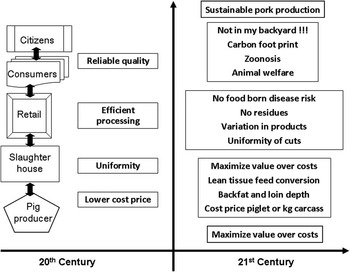
The pork chain includes all chain links involved in pork production, from genetics suppliers and pig producers to the slaughter houses and retail outlets that bring the final products to the pork consumers. Until recently (indicated as 20th century in Figure 1), the pig producers strived for lower cost of production, the slaughter houses demanded more uniformity, the retail outlets need more efficient processing, whereas the consumers value reliable quality. However, in the 21st century, the different chain links each maximise value over costs, while together aiming at sustainable pork production (Figure 1). For example, nowadays, the producers need to maximise value over costs for: (1) better lean tissue feed conversion to minimise cost per kilogram of carcass and (2) maintain optimum levels of backfat and loin depth to maximise payment from the slaughter houses. The slaughter houses and retail outlets need more uniformity in the carcass cuts, need at the same time differentiation in products and need as well no risk of food borne diseases or residues. And, moreover, the pork consumers and citizens in general expect no zoonosis, a low carbon footprint, proper animal welfare and pig farms possibly far away from cities and villages. It will be very hard for pork producers to ignore these expectations of the chain links and, consequently, pig breeders cannot continue breeding pigs in the same way as during the past century. There is a need for new breeding goals that not only reduce costs but also come forward to, for example, better animal welfare, reduced use of antibiotics, reduction of the carbon footprint and adequate organic production next to conventional pork production. All this can be summarised as sustainable pork production.
Pork chain from 20th to 21st century: on the x-axis the change over time of the traits of interest and on the y-axis the traits of interest for the different chain links.

In fact, sustainability is a value-laden concept and its definitions depend very much upon the values and priorities of the person, or group of people. The main values in sustainable farm animal breeding include environmental protection, animal health and disease, animal welfare, animal integrity, biodiversity, consumer safety, food quality, competitiveness and human welfare (Gamborg and Sandøe, Reference Gamborg and Sandøe2005). In some cases, there seems to be a disconnect between selection for efficiency of production and animal welfare, for example, litter size and piglet survival (e.g. Rauw et al., Reference Rauw, Kanis, Noordhuizen-Stassen and Grommers1998) but there are also opportunities to pursue ethical breeding goals without compromising production efficiency (Sandøe et al., Reference Sandøe, Nielsen, Christensen and Sørensen1999).
During the next decades, pig breeding organisations need rapid genetic progress that will maximise value over costs but also improve health and welfare of the pigs and produce pig carcasses with added value for the pork chain. The progress needs to be balanced for sustainable pork production.
New phenotypes
New phenotypes are necessary to target and attain new breeding goals according to the requirement of pork value chain partners and the expectations of consumers and citizens. Considering the current interests of farmers, citizens, governments and food industry and based on available literature there is a need for new ‘phenotypes’: (a) vitality, (b) uniformity, (c) robustness, (d) welfare and health and (e) phenotypes to reduce carbon footprint, while keeping up the production efficiency.
(a) Vitality from birth to slaughter
In view of the increasing global competition, the producers have to continuously strive to decrease the cost of production, and improving vitality is one of the pathways. The intent is to have an undisturbed pig production from birth to slaughter house. Improvement in vitality of the pig production can be acquired through reduction in losses during the different phases of development: from ovulation, embryonic and foetal development, birth, weaning and finishing to slaughter. These should result in better survival of piglet during the perinatal period, less death born piglets, no dead or sick pigs in suckling, nursery and finishing, less sows culled after first parity and lower sickness and mortality in the older sows.
Early survival
Ovulation rate and number of foetuses had positive genetic correlations with number of stillborn pigs per litter in the selection experiment of Johnson et al. (Reference Johnson, Nielsen and Casey1999) on litter size. However, increased ovulation rates after superovulation resulted in decreased within-litter variation for foetal and placental weight and at increased ovulation rates, the number of live foetuses remained similar, but placental development was impaired and the growth of the foetus was retarded compared with reduced ovulation rate, with effects likely lasting into adult life (Van der Waaij et al., Reference Van der Waaij, Hazeleger, Soede, Laurenssen and Kemp2010).
Overall prenatal development (noted as birth weight) and specific prenatal developmental and maturational processes in late gestation are clearly predisposing factors for perinatal losses. Birth weight and variation in birth weight remain important risk factors for perinatal mortality. Genetic selection against piglet mortality will not necessarily increase birth weight but will affect body composition and proportional organ development (Van der Lende et al., Reference Van der Lende, Knol and Leenhouwers2001). Many maturational processes that occur in late gestation in preparation for extrauterine life, for example, specific biochemical changes in the gastrointestinal tract are influenced by glucocorticosteroids and are therefore dependent on maturation of the pituitary–adrenal system. Consequently, a reduction in losses between ovulation and birth will also improve survival of pigs between birth and slaughter house.
Piglet survival
Nearly 20% of the piglets die between late gestation and weaning: about 7% die during farrowing and some 13% are lost during lactation (Knol and Bergsma, Reference Knol and Bergsma2004). Perinatal piglet survival is quite important as approximately 80% of the pig mortality occurs during birth and within the first 3 days after birth (Svendsen, Reference Svendsen1992). Piglet survival consists of a maternal genetic component due to genetic make up of the dam and a direct genetic component due to the genotype of the piglet. The maternal component affects piglet survival through uterus quality and mothering ability, whereas the direct genetic component affects survival through the intrinsic vitality of the pig. Selection on the direct genetic component is useful especially for survival of smaller piglets (Leenhouwers et al., Reference Leenhouwers, de Almeida, Knol and van der Lende2001) and requires individual identifications and phenotypic records on piglets. The maternal component is especially related to the ability of sows in transmitting nutrients to the piglets before weaning. The lactation efficiency can be measured as energy efficiency of sows during lactation and is calculated as a ratio of output to input. The input is based on energy intake in the feed, energy mobilisation and energy used for maintenance. The output is based on energy used in deposition of body fat and protein, and energy used for maintenance of live and dead piglets. However, heritability of lactation efficiency is low (0.12) and inclusion of lactation efficiency in the breeding goal is expected to have limited effect on piglet survival and vitality (Bergsma et al., Reference Bergsma, Kanis, Knol and Bijma2008a).
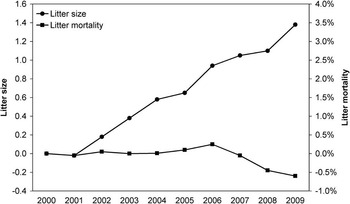
There is often a concern that increasing litter size would lead to an increase in piglet mortality. However, genetic trends over the past 10 years by TOPIGS have already shown the possibilities of increasing litter size at birth and reducing mortality of piglets at the same time (Figure 2).
Genetic trend for litter size and litter mortality in the TOPIGS breeding programme.

Less human interference
Taking care of the less vital piglets can be labour intensive. Consequently, genetically improved vitality will contribute to a reduction of the amount and cost of labour. Analysis of the trends over the past 15 years in the Netherlands (Landelijk Biggenprijzenschema 1997 to 2009) suggest that substantial gains have been made in reducing the time spent per piglet: from 42 min/weaned pig in 1997 to 20 min in 2009. Genetically better vitality from birth to slaughter will therefore contribute to a further reduction in human assistance or labour per pig.
Vitality and longevity
Vitality can be defined as the ability of a piglet to survive, based on its survival at birth and survival till weaning. When defined and recorded in this way, the vitality also has a positive influence on sow longevity. Sprangers et al. (Reference Sprangers, Knol and Heuven2010) considered sow longevity as survival of a sow at its farm till second parity and estimated a correlation of 0.93 ± 0.04 between estimated breeding values (EBVs) of 660 sows and their vitality. This correlation was probably an overestimate because of small number of observations. Further, the repeatability estimates of the EBVs were used in adjusting the correlations following the method of Calo et al. (Reference Calo, McDowell, Van Vleck and Miller1973). This method of weighing typically leads to higher correlations than the Pearson coefficients of correlations between EBVs. Nevertheless, vital piglets can be expected to be fatter (Knol, Reference Knol2001) as a sow and should come in oestrus easily after the first parity and should have better longevity, even when defined as age at last farrowing (Stalder et al., Reference Stalder, Saxton, Conatser and Serenius2005). Vital gilts can also be expected to have less feet and leg problems at least during their first parity and therefore also have lower chances of being culled. Therefore, it is reasonable to expect that selection for vitality in gilts should also improve their longevity as sows.
(b) Uniformity at different levels of production
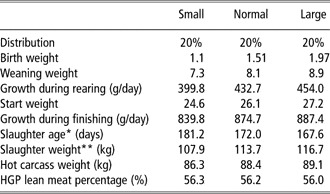
There is an increasing demand for more uniformity in pork cuts from the slaughter houses, retail and consumers. In fact, uniformity is desirable at all levels of pig production. The uniformity in litter size at birth is useful for more efficient management. Uniformity in birth weight is useful to decrease mortality especially because of smaller piglets (Knol et al., Reference Knol, Mathur and Foxcroft2010). This is especially important as the litter sizes increase. Table 1 shows the effect of variation in birth weight for the daily gain later in life of the pigs. Pigs that weight about 400 g less than average at birth, weigh about 5800 g less at slaughter. However, if they are heavier by about 500 g at birth the weight difference at slaughter is about 3000 g. Reducing the number of extremely low weight and extremely high weight piglets for uniformity should therefore be beneficial. Uniformity can also be addressed through genetic selection against variance in a trait, for example, standard deviation of birth weight in a litter. However, reduction of pigs with extremely low or high birth weight can also help a great deal in improving uniformity.
The effect of birth weight on daily gain and lean meat percentage

HGP = Hennessy Grading Probe.
Small = low birth weight, large = high birth weight.
*For 115 kg slaughter weight.
**At 170 days slaughter age.
Uniformity and protein efficiency
Protein deposition (Pd) is the main driving force in animal gain, as every gram of protein accretion is accompanied by, roughly, three times that amount in water. Protein is deposited, roughly again, 50/50 in muscles and in organs. Pd can be described by the widely used linear plateau model (Whittemore and Fawcett, Reference Whittemore and Fawcett1976). This model assumes a linear increase of Pd with feed intake at each given weight after maintenance has been met. This increase is realised until a level of feed intake fully occupies cell function for muscle accretion. After that feed intake level more feed will not result in more Pd, but all access energy in protein will be used for lipid accretion. If this theory is correct, optimal feed quality and quantity can be deduced and formulated to satisfy the average pig. Individual deviations in slope, plateau and optimum feeding level are very large. These differences result in different optimal feeding regimes, which are not given in a normal finishing barn and, therefore, result in inefficiencies in protein and energy metabolism, some animals do not receive enough energy or protein, others too much. Differences in Pd lead to differences in development. Some animals will mature earlier in terms of gut development and will therefore be able to change from starter feed to grower at a younger age than later maturing animals. Given uniform feeding to all pigs in a finishing barn, the variation in the Pd capacity of the finishers leads to lack of uniformity. If the ingested protein is more than the Pd capacity then the surplus of protein is catabolised to urea and the remaining energy is stored as fat. In contrast, if the ingested protein is less than the Pd then protein accretion gains are lower. Therefore, increase in uniformity of Pd would lead to more uniformity in growth and more efficient utilisation of dietary protein.
Uniformity in slaughter weight at shipment and carcass length would help increase slaughter plant efficiency. Finally, uniformity in size and weights of pork chops and uniformity in meat colour, marbling and drip loss is useful for retail shelves and consumers. Uniformity at all these levels means avoiding extremes in low or high in birth weights, slaughter weights and pork quality resulting into products that are good on an average and are uniform. Uniformity can be addressed either through genetic selection or crossbreeding or both.
(c) Robustness
In addition to vitality and uniformity in pig production, there is a need for more robust pigs. Robustness is often defined as the ability of pigs to adapt to different stressors without becoming stressed. The aim is to produce strong and healthy pigs that continue to perform well in presence of various stressors. These stressors can be disease challenges, extremely hot or cold temperatures, low-quality feed or challenges due to changes in housing or management, for example, by transition from individual to group housing.
It is commonly accepted that selection for high productivity drives the physiological demands and could have unfavourable consequences for metabolic, reproduction, health and welfare (Prunier et al., Reference Prunier, Heinonen and Quesnel2010). As a consequence, it can be more difficult to implement breeding programmes that optimise productivity across a variety of environments without compromises in health and welfare of pigs. The differences in environments often lead to systematic differences in phenotypes due to phenotypic plasticity. Models of phenotypic plasticity may therefore help in selection for robust animals or to optimise breeding programmes for multiple environments. Phenotypic plasticity is often quantified by reaction norms. If the different genotypes have different reaction norms, the phenomenon is then described as genotype–environment interaction. Several models for phenotypic plasticity have been reviewed by De Jong and Bijma (Reference De Jong and Bijma2002). These include character state model, reaction norm model and infinite-dimensional model. The character state model considers phenotypic expression of the same trait in different environments as different traits (Falconer, Reference Falconer1952). This model and the phenotypes in different environments can be used to select specific genotypes or lines for specific environments (Mathur, Reference Mathur2003). Another possible approach is to use reaction norm models in selection to reduce the environmental sensitivity of the genotypes to different environments (Knap, Reference Knap2005; Hermesch et al., Reference Hermesch, Huisman, Luxford and Graser2006; Knap and Su, Reference Knap and Su2008). Development of reliable reaction norm models requires accurate description of phenotypes and changes in environmental constraints, sufficient variation in environmental conditions and good representation of sire progeny groups across a number of the environments. Once those conditions are met, then it is possible to obtain accurate heritability for the reaction norm intercept and slope even in relatively small data sets (Hermesch et al., Reference Hermesch, Huisman, Luxford and Graser2006; Hermesch and Luxford, Reference Hermesch and Luxford2010). However, estimating the slope of the reaction norm could also prove to be too complicated and therefore can be classified as a ‘hard-to-measure’ trait phenotype (Knap and Su, Reference Knap and Su2008).
High/low temperatures
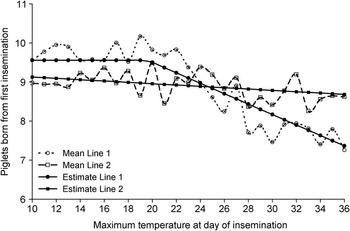
As pig breeding is becoming more and more a global business, robustness to heat in tropical environments or cold in some of the temperate regions is necessary and is a clear example of robustness. Also seasonal infertility is an example of lack of robustness (Auvigne et al., Reference Auvigne, Leneveu, Jehannin, Peltoniemi and Sallé2010). It has been shown that there are genetic differences between sow lines with respect to heat tolerance at the time of insemination (Bloemhof et al., Reference Bloemhof, Van der Waaij, Merks and Knol2008). As an example (Figure 3), one sow line showed a reduction in farrowing rate and litter size as the temperatures on the day of insemination rose above 20°C, whereas there was hardly any effect on the other line.
Genetic differences in heat tolerance (Bloemhof et al., Reference Bloemhof, Van der Waaij, Merks and Knol2008).

The differences between lines can be used either to select lines for specific environments or lines with generalised heat tolerance. More generally, if the genetic correlation between the performance in two environments is lower than 0.4 to 0.6, then separate lines become necessary (Mulder and Bijma, Reference Mulder and Bijma2006), which involves additional costs. In most environments, it is desirable to have lines that are robust and are able to perform well in spite of changes in temperature or climate.
Efficiency and sustainability of pork production heavily depends on feed cost and availability of cost effective feed ingredients. Feed composition and quality varies enormously across the globe. Increase in corn prices creates new challenges, whereas use of by-products from bio-fuel production offers new opportunities. Kyriazakis (Reference Kyriazakis2011) concluded that some opportunities exist for improving the components of the gross efficiency of nutrient and energy utilisation through breeding in poultry and pigs. These opportunities mainly are in the potential to improve the digestive efficiency of pigs and to reduce the maintenance requirements for resources. There is no evidence of measurable genetic variation in the partitioning of scarce nutrient resources between the various productive functions, including between lean and fat growth, among pig genotypes. Currently, it is not known how genetic variation in pigs affects the partitioning of scarce nutrients when animals are exposed to pathogens, and how this in turn will affect the efficiency of nutrient utilisation. It is suggested that some effort should be directed towards this issue.
Disease resistance
Opportunities for selection for higher disease resistance or tolerance have been revealed in several studies. These are the two different host defence strategies. The term resistance refers to the ability of the host to limit parasite burden, whereas tolerance refers to the ability of the host to limit the damage caused by parasite burden. Tolerant pigs may carry a large parasite burden and transmit the parasites to other pigs; however, the parasitic burden does not adversely affect their performance. The decision whether to improve resistance, tolerance, both or neither should be based on the dynamics of the parasite or pathogen within the host and between the hosts as well as on evaluation of the impact of the infection on the performance of the whole population. Methods and models for this analysis are described by Detilleux (Reference Detilleux2011). Studies by Doeschl-Wilson et al. (Reference Doeschl-Wilson, Kyriazakis, Vincent, Rothschild, Thacker and Galina-Pantoja2009), Ait-Ali et al. (Reference Ait-Ali, Wilson, Westcott, Clapperton, Waterfall, Mellencamp, Drew, Bishop and Archibald2007), Vincent et al. (Reference Vincent, Thacker, Halbur, Rothschild and Thacker2006), Opriessnig et al. (Reference Opriessnig, McKeown, Zhou, Meng and Halbur2006) and Halbur et al. (Reference Halbur, Rothschild and Thacker1998) suggest differences in host genetic response with respect to porcine reproductive and respiratory syndrome and postweaning multisystemic wasting syndrome in view of breeding for improved resistance.
However, a majority of disease resistance studies are based on challenge experiments, which are expensive and difficult to do on large number of pigs. Therefore, the main issue is identification of phenotypes that can be easily measured for effective genetic selection.
(d) Welfare and health
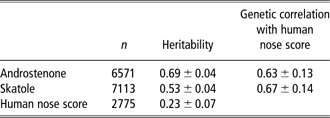
In daily newspapers and other media, there are several calls for better animal welfare and health in the society not only for pigs but for several livestock species. This trend is expected to continue until the society is completely satisfied and fully trusts the production practices. A ban on castration is expected in most European countries. However, if the castration is stopped, there is a risk of boar taint from some entire males such that pork from any entire male can be considered as very risky for pork processors. An important question is what phenotype should be used for genetic selection against boar taint, especially while there is no gold standard for measuring boar taint. Consumers perceive boar taint a penetrating ‘animal’, ‘urine’, ‘faecal’ or ‘sweat’ like unpleasant odour, which becomes especially intense while pork is cooked. Many of the processors use human nose score, a score related to degree of unpleasant odour from carcasses on a high-speed slaughter line. About 500 carcasses can be scored per hour using this method. In contrast, several scientific studies have confirmed that boar taint is mainly caused by two underlying compounds, androstenone and skatole. The levels of these compounds are more precise and objective phenotypes. Further, as these boar taint compounds have relatively high heritabilities, there are opportunities to reduce or eliminate boar taint through genetic selection using them with simultaneous improvement or no change in pork quality (Merks et al., Reference Merks, Hanenberg, Bloemhof and Knol2009; Knol et al., Reference Knol, Bloemhof, Heerens and Tacken2010). However, measurement of androstenone and skatole requires chemical analysis, or use of genetic markers is expensive and time consuming compared with human nose scores on a slaughter line. Human nose scores can be recorded on a large number of samples with a rather simple lab set up at a fraction of the cost of analysis for the measurement of androstenone and skatole. The heritability of human nose scores is lower but there is a good genetic correlation with boar taint compounds (Table 2).
Genetic parameters for different phenotypic measurements of boar taint

Source: Knol et al. Reference Knol, Bloemhof, Heerens and Tacken(2010).
Breeding for welfare traits has been a complex issue. Many consumers consider outdoor production as more favourable for pig welfare allowing for more behavioural freedom, more humane, environmentally friendly and sustainable (Edwards, Reference Edwards2005). However, outdoor pigs also face welfare problems such as greater pathogen load and thermal stress (Edwards and Casabianca, Reference Edwards and Casabianca1997). A simulation study using retrospective index methods (Gourdine et al., Reference Gourdine, de Greef and Rydhmer2010) suggests that inclusion of breeding goal with emphasis on mothering ability and sow longevity could improve welfare but it would decrease the progress in growth rate and leanness of pigs raised for slaughter. The implementation of a welfare-breeding programme for outdoor production requires other prerequisites than only the genetic gain, for example, higher price for products labelled as ‘animal friendly’.
Group housing and non-tail docking necessitate insight in behavioural mechanisms. There is a considerable genetic variation in effects of social behaviour on gain and feed intake (Bergsma et al., Reference Bergsma, Kanis, Verstegen and Knol2008b). However, further investigations are required to evaluate the correlations of these traits with the phenotypes related to behaviour, such as tail biting or male sexual behaviour.
Aggressive behaviour of pigs due to mixing with other pigs can be measured through change in skin lesion scores from before mixing until 24 h after mixing (Turner et al., Reference Turner, Farnworth, White, Brotherstone, Mendl, Knap, Penny and Lawrence2006 and Reference Turner, Roehe, D'Eath, Ison, Farish, Jack, Lundeheim, Rydhmer and Lawrence2009). Genetic selection to reduce aggressive behaviour is expected to improve animal welfare. At the same time, it also helps in reducing the adverse effects on meat quality that could result in economic losses to processors and producers (D'Eath et al., Reference D'Eath, Turner, Kurt, Evans, Thölking, Looft, Wimmers, Murani, Klont, Foury, Ison, Lawrence and Mormède2010).
Animals and humans constitute overlapping reservoirs of resistance, and consequently use of antimicrobials in animals can impact on public health. For example, the occurrence of vancomycin-resistant enterococci in food animals is associated with the use of avoparcin, an antibiotic used as a feed additive for the growth promotion of animals. Vancomycin-resistant enterococci and vancomycin resistance determinants can therefore spread from animals to humans. Wegener (Reference Wegener2003) showed that although the levels of resistance in animals and food, and consequently in humans, has been markedly reduced after the termination of use of avoparcin, the effects on animal health and productivity have been very minor.
A recent inventory of the use of antibiotics on Dutch pig breeding farms (van Leengoed et al., Reference van Leengoed, Postma, van Geijlswijk, Feitsma, Meijer, van Groenland and Mevius2010) showed a variety of attitudes concerning the antibiotic use on nucleus herds despite that these farms made use of the same breeds. The average number of days an animal at these farms was exposed to antibiotics varied between 0.6 and 57 days. Positively notable was the lower use of antibiotics at farms with a higher health status. Also remarkable was the difference between oral and parenteral administration of antibiotics of farms. The percentage of oral administered antibiotics was lower at farms with a higher health status. A comparison of the use of antibiotics from year to year showed consistency for all farms. These results suggest that it is possible to reduce antibiotic use in pig farms. Proper recording for health traits and genetic selection can be of further help.
(e) Phenotypes to reduce carbon footprint
Environmental concerns are often expressed relating to swine production. These include contaminations from animal wastes and inorganic fertilizers, nitrates, phosphorus, trace elements, microbes, antibiotics and veterinary drugs (White, Reference White2010). Attempts can be made to mitigate them using special feeding programme and improving digestibility of nutrients. Capper et al. (Reference Capper, Cady and Bauman2009) showed that the carbon footprint per billion kilograms of milk produced in 2007 was 37% of equivalent milk production in 1944 that can be partly attributed to genetic improvement of milk production. Globally, agricultural livestock account directly for about 9% of total anthropogenic green house gas (GHG) emissions (Gill et al., Reference Gill, Smith and Wilkinson2010). Pig production systems are considered relatively efficient (Kyriazakis, Reference Kyriazakis2011). GHG emissions per kilogram of pork was estimated to be 0.30 carbon dioxide equivalents (CO2e) compared with 1.50, 1.40 and 0.40 CO2e for meat from sheep, cattle and poultry (Gill et al., Reference Gill, Smith and Wilkinson2010). Therefore, carbon footprint from pig production is much lower than ruminant production. However, the large volume of production increases the potential to contribute to environmental burdens. As an example, 1 tonne poultry meat and 1 tonne of eggs are estimated to emit GHG with total aggregated global warming potentials of 4.6 and 5.5 tonnes CO2 over a 100-year horizon, per tonne. Therefore, improvements in efficiency of feed and energy utilisation should contribute to reduction in the carbon footprint. Genetic differences in the digestive efficiency of different breeds of pigs have been reported in several studies. Therefore, there are some opportunities for genetic selection for improved digestive efficiency and reduction in maintenance requirements.
New technologies
New technologies are also becoming available to set and support new breeding goals. Modern pig breeding is actually evolving as a technology-based industry, making use of advancements in housing, feeding and management of pigs, genomics and improvement of statistical models.
Genomics
The completion of the pig genome sequencing and availability of the Porcine Illumina SNP60 BeadChip (Ramos et al., Reference Ramos, Crooijmans, Affara, Amaral, Archibald, Beever, Bendixen, Churcher, Clark and Dehais2009) has opened doors for new opportunities. Genome-wide association studies using the 60K SNP chip can be especially useful for traits that are difficult and expensive to measure. In addition, it has opened up possibilities for selection for traits of animal welfare and societal significance. An example is selection against boar taint compounds to stop castration. A Genome-wide association study using the 60K chip has revealed a cluster of candidate genes associated with androstenone levels (Duijvesteijn et al., Reference Duijvesteijn, Knol, Merks, Crooijmans, Groenen, Bovenhuis and Harlizius2010). This provides further opportunities for selection against boar taint in addition to quantitative selection.
New developments in data recording and automatic transfer of data from the weighing scale to the central database has made it possible to record new birth phenotypes (Knol et al., Reference Knol, Mathur and Foxcroft2010). An example is recording of individual birth weights on hundreds of thousands of piglets and direct transfer of data to central database to help selection for vitality and uniformity in addition to production efficiency.
New and improved statistical models are now developed for taking into account new phenotypes in multi-trait best linear unbiased prediction evaluations. In addition, new models and evaluation methods are being developed to account for social interactions in group housing (Bijma et al., Reference Bijma, Muir and Van Arendonk2007). Combined with technological advancements in management allowing for group housing of large number of pigs, these will be useful for selection on associative or social effects to improve animal welfare.
More developments are taking place in analysis of molecular data and genomic selection (Meuwissen et al., Reference Meuwissen, Hayes and Goddard2001). Along with these developments, there is an increasing need for good sound observations and phenotypes preferably corrected for external factors as herd, year, season, etc. Theoretical studies have shown that much larger training data sets including several thousands of individuals with genotypes and phenotypes are needed than indicated by the initial simulation results (Goddard, Reference Goddard2009; Meuwissen, Reference Meuwissen2009), creating mixture models combining existing quantitative approaches with the use of molecular data.
However, technology is just a tool to support new phenotypes and breeding goals. Technology is for pig breeding not a goal on itself.
Conclusions
The generalised breeding goal for pigs was quality pork against the lowest cost price. This has changed into sustainable pork production, which maximises value over costs.
Clearly, there is a need for not only a higher production efficiency but also more quality to meet the expectations of the value chain partners, pork consumers and citizens. This will require new phenotypes and new breeding goals related to vitality from birth to slaughter, uniformity from birth weight to pork chops and robustness. The breeding goals will not only be driven by economic considerations but also by societal trends and expectations. Special consideration needs to be given to the upcoming ban on castration of male piglets, improving general disease resistance, reducing use of antibiotics and reducing carbon footprint. There are several developments in the technology to support the new breeding goals and recording of the related phenotypes. However, it has to be very clear that technology is just a tool not the breeding goal.
Until recently, the breeding goals mainly focused on litter size at birth and at weaning, daily gain from birth to slaughter, meat percentage and feed conversion. The breeding goals for the future will include vitality from birth to slaughter without human interference, uniformity from birth to pork, reduced use of antibiotics and improved food safety. Simplicity and straightforwardness of the breeding goal has to be weighed against completeness and complexity.