Introduction
Discrimination against people with severe mental illness is a global problem (Thornicroft et al. Reference Thornicroft, Brohan, Rose, Sartorius and Leese2009; Kapungwe et al. Reference Kapungwe, Cooper, Mwanza, Mwape, Sikwese, Kakuma, Lund and Flisher2010; Aromaa et al. Reference Aromaa, Tolvanen, Tuulari and Wahlbeck2011b ; Rose et al. Reference Rose, Willis, Brohan, Sartorius, Villares, Wahlbeck and Thornicroft2011; Evans-Lacko et al. Reference Evans-Lacko, Brohan, Mojtabai and Thornicroft2012a ; Świtaj et al. Reference Świtaj, Wciórka, Grygiel, Anczewska, Schaeffer, Tyczyński and Wiśniewski2012). Sources of discrimination include friends and family (Thornicroft, Reference Thornicroft2006; Henderson et al. Reference Henderson, Corker, Lewis-Holmes, Hamilton, Flach, Rose, Williams, Pinfold and Thornicroft2012), the general public (Thornicroft, Reference Thornicroft2006), mental health professionals (Wahl & Aroesty-Cohen, Reference Wahl and Aroesty-Cohen2010), emergency department clinicians (van Nieuwenhuizen et al. Reference Van Nieuwenhuizen, Henderson, Kassam, Graham, Murray, Howard and Thornicroft2012), and public and private institutions (Corrigan et al. Reference Corrigan, Markowitz and Watson2004). However, people with severe mental illness appear to have more social tolerance towards others with similar diagnoses, though self-stigma is common (Aromaa et al. Reference Aromaa, Tolvanen, Tuulari and Wahlbeck2011a ).
Discrimination can be defined as the behavioural component of stigma (Link & Phelan, Reference Link and Phelan2001), which also includes ignorance (a problem of knowledge) and prejudice (a problem of attitude) (Goffman, Reference Goffman1970; Thornicroft, Reference Thornicroft2006). People with severe mental illness who experience discrimination in their close environment are more likely to anticipate it (Thornicroft et al. Reference Thornicroft, Brohan, Rose, Sartorius and Leese2009); this leads to avoidance of seeking work and relationships, hampering recovery (Link et al. Reference Link, Struening, Neese-Todd, Asmussen and Phelan2001).
Supporting the recovery of people with severe mental illness is a priority for mental health services (Slade, Reference Slade2009). This includes ‘social recovery’, which requires the development of social environments that are both accepting and enabling (Beresford, Reference Beresford2002). Anti-stigma campaigns such as Time to Change (Henderson & Thornicroft, Reference Henderson and Thornicroft2009) support this by seeking to change public attitudes towards mental illness. Social contact interventions are included in these programmes as a means of reducing discrimination (Evans-Lacko et al. Reference Evans-Lacko, London, Japhet, Rüsch, Flach, Corker, Henderson and Thornicroft2012b ). However, social engagement itself plays an important role in recovery from severe mental illness because it helps to build social capital (Webber, Reference Webber and Tew2005; Tew et al. Reference Tew, Ramon, Slade, Bird, Melton and Le Boutillier2012).
Social capital is increasingly being recognized as important for health and well-being (Kawachi et al. Reference Kawachi, Subramanian and Kim2007). It is a multi-dimensional concept encompassing diverse aspects such as trust (Coleman, Reference Coleman1988), social norms and reciprocity (Putnam, Reference Putnam2000), features of social structures and networks (Burt, Reference Burt1992; Lin, Reference Lin2001), and the resources embedded within them (Bourdieu, Reference Bourdieu, Halsey, Lauder, Brown and Stuart Wells1997). Although epidemiological studies have largely drawn upon Putnam's (Reference Putnam2000) conception of social capital (De Silva et al. Reference De Silva, Mckenzie, Harpham and Huttly2005), social network approaches more clearly align the concept with recovery discourses (Webber, Reference Webber and Tew2005).
Defined as the resources that are embedded within social networks, social capital can lead to greater occupational prestige, income and political influence when mobilized (Lin, Reference Lin2001; Lin & Erickson, Reference Lin and Erickson2008). Health gains can be accrued by investing in relationships, which may promote positive health behaviours (Zambon et al. Reference Zambon, Morgan, Vereecken, Colombini, Boyce, Mazur, Lemma and Cavallo2010), provide employment opportunities (Flap, Reference Flap1999), and reinforce an individual's identification with a group and help to maintain subjective social status (Song, Reference Song2011).
Social capital is negatively correlated with depression (Webber & Huxley, Reference Webber and Huxley2007; Song, Reference Song2011; Webber et al. Reference Webber, Huxley and Harris2011) and severe mental illnesses such as schizophrenia or bi-polar disorder (Dutt & Webber, Reference Dutt and Webber2010). Longitudinally, it is associated with changes in quality of life in depression (Webber et al. Reference Webber, Huxley and Harris2011). However, an association between discrimination and reduced access to network resources has not yet been empirically demonstrated.
There is a strong theoretical rationale for an association of discrimination and social capital in people with severe mental illness. Bourdieu (Reference Bourdieu, Halsey, Lauder, Brown and Stuart Wells1997), a key contributor to the development of the concept of social capital, argued that social capital accrued within durable networks of people with strong relationships and shared interests. Social network researchers identified the ‘homophily principle’ as being important to this process whereby people associate with others similar to themselves (Lin, Reference Lin2001). People within networks predominantly composed of those with a high socio-economic status have improved life chances, such as occupational attainment (Lin et al. Reference Lin, Ensel and Vaughn1981), but they exclude those who are different from themselves as they are perceived as not being able to contribute to the group's social capital (Lin & Ao, Reference Lin, Ao, Lin and Erickson2008). People with severe mental illness are commonly characterized as transgressing social norms and distinguished from other members of society (Thornicroft, Reference Thornicroft2006). It follows that discrimination due to mental health stigma may restrict the access of people with severe mental illness to resourceful social networks and the social capital held within them. Therefore, it is important to explore the extent to which discrimination is associated with social capital in people with severe mental illness to empirically verify this assumption.
It is possible, though, that low access to social capital may increase perceptions of discrimination. People who do not have full access to resourceful networks within their community may attribute this to discrimination. Studies of perceived discrimination among ethnic minority groups in the US exemplify this possibility (Goto et al. Reference Goto, Gee and Takeuchi2002; Estrada et al. Reference Estrada, Tsai and Chandler2008; Pérez et al. Reference Pérez, Fortuna and Alegría2008). Although perceptions of discrimination are different from actual experiences of discrimination, careful measurement of both social capital and discrimination is required to fully understand the direction of any cross-sectional association.
This paper aims to test the following hypotheses:
-
(1) that experienced and anticipated discrimination are associated with access to reduced social capital, while controlling for confounding variables;
-
(2) that experienced discrimination from specific social ties such as family, friends, neighbourhoods and mental health professionals are associated with reduced access to social capital from these social ties; and
-
(3) that experienced discrimination in different life domains (such as employment, social life and family) is associated with reduced access to corresponding domains of social capital.
Method
Viewpoint (Hamilton et al. Reference Hamilton, Pinfold, Rose, Henderson, Lewis Holmes, Flach and Thornicroft2011; Corker et al. Reference Corker, Hamilton, Henderson, Weeks, Pinfold, Rose, Williams, Flach, Gill, Lewis-Holmes and Thornicroft2013) is an annual survey of mental health service users in England, which aims to evaluate outcomes of the Time to Change programme (Henderson & Thornicroft, Reference Henderson and Thornicroft2009, Reference Henderson and Thornicroft2013), the largest ever programme to reduce discrimination against people with mental health problems in England. Phase 1 of this programme aimed to achieve a 5% reduction in discrimination over 4 years through a national social marketing campaign launched in 2009, and national and local interventions which engaged individuals, communities and professional groups to improve the attitudes and behaviour of the general public towards people with mental health problems. To evaluate the effect of Phase 2 (2011–2015) on social capital in addition to discrimination, a measure of social capital was added to the survey in 2011 to provide a baseline.
Data were collected via a cross-sectional telephone survey with separate samples of users of specialist National Health Service (NHS) mental health services each year. Participants were aged between 18 and 65 years, had used NHS mental health services in the previous 6 months, but were not hospital in-patients or those with a diagnosis of dementia. Participants were selected from five NHS mental health trusts, which were chosen on the basis of the level of socio-economic deprivation in their catchment area, determined from census data. Full details about the methodology of the Viewpoint surveys are available elsewhere (Henderson et al. Reference Henderson, Corker, Lewis-Holmes, Hamilton, Flach, Rose, Williams, Pinfold and Thornicroft2012).
This paper uses data from the 2011 Viewpoint survey. 9120 invitation packs were posted to eligible participants, of whom 1016 undertook telephone interviews, representing a response rate of 11.1%. Although low, this response rate was an improvement on the three previous surveys which achieved response rates not higher than 8% (Henderson et al. Reference Henderson, Corker, Lewis-Holmes, Hamilton, Flach, Rose, Williams, Pinfold and Thornicroft2012).
The 22-item version of the Discrimination and Stigma Scale (DISC-12) (Thornicroft et al. Reference Thornicroft, Brohan, Rose, Sartorius and Leese2009; Brohan et al. in press) was used to measure participants' reports of experienced and anticipated discrimination. This interviewer-administered scale contains 22 items related to negative experiences of mental health-related discrimination over the prior 12 months and four items related to anticipated discrimination. A ‘not applicable’ option is available for items about situations that were not relevant to the participant in the previous 12 months. Additional questions on positive discrimination were asked in the interview, but were not analysed for this paper. The DISC-12 has robust psychometric properties in this population (Thornicroft et al. Reference Thornicroft, Brohan, Rose, Sartorius and Leese2009; Brohan et al. in press).
The Resource Generator-UK (RG-UK) (Webber & Huxley, Reference Webber and Huxley2007) was used to measure participants' access to social capital. In the tradition of social network measures such as the Name Generator (McCallister & Fischer, Reference Mccallister and Fischer1978) and Position Generator (Lin & Dumin, Reference Lin and Dumin1986), this instrument measures participants' access to social resources within their own social network. The RG-UK was derived from a version developed in The Netherlands (van der Gaag & Snijders, Reference Van Der Gaag and Snijders2005) and its items have been made culturally relevant and validated for use in the UK general population. It has good reliability and validity (Webber & Huxley, Reference Webber and Huxley2007), and has been used in samples of people with mental health problems (e.g., Murray et al. Reference Murray, Easter and Bellringer2007; Webber & Huxley, Reference Webber and Huxley2007; Dutt & Webber, Reference Dutt and Webber2010; Webber et al. Reference Webber, Huxley and Harris2011) and produced valid findings.
The RG-UK asks participants whether or not they could obtain access to 27 skills and resources within their social network within 1 week if they needed it. If they respond ‘yes’ to an item, they are asked to indicate the nature of the social tie – i.e., close family, wider family, friends, colleague, acquaintance, mental health professional – through which they could access each skill or resource. The instrument has four sub-scales each representing a concrete domain of social capital to which an individual may have access: domestic resources, personal skills, expert advice and problem-solving resources. Participants were additionally asked if they personally possessed 14 of the items as it would be unlikely for them to ask anyone for these items if they personally possessed them. This formed a separate human capital sub-scale, which was entered as a potential confounding variable in multivariate analysis (Webber & Huxley, Reference Webber and Huxley2007). Socio-demographic and clinical characteristics were also obtained from the sample.
RG-UK total and sub-scale scores were calculated by scoring items accessible within a participant's network as 1 and those not as 0, and then summing to calculate scale totals. Experienced discrimination DISC scores were calculated by scoring any reported instance of negative discrimination as 1 and situations in which no discrimination was reported as 0. The overall score was calculated as the sum of reported discrimination items divided by the number of items answered, multiplied by 100 to give a percentage of items in which discrimination was reported. Items were excluded where the participant had not been in the situation asked about in the previous 12 months, and therefore could not have experienced discrimination, e.g., in relation to starting a family. The four anticipated discrimination items were analysed individually as binary variables (0 = no, 1 = yes).
We used t tests to compare mean RG-UK scores in the Viewpoint sample with a UK general population sample (Webber & Huxley, Reference Webber and Huxley2007) and a sample of people with severe mental illness (Murray et al. Reference Murray, Easter and Bellringer2007). Univariate analysis using Pearson correlations, t tests, one-way analysis of variance and Spearman's rank correlations explored the relationship between anticipated and experienced discrimination, socio-demographic and clinical variables, and the RG-UK. To test hypothesis one, we entered variables with a significant association with RG-UK total scores (p < 0.05) in blocks into a linear regression model to explore the independent relationship between discrimination and access to social capital (adjusted for human capital). Hypotheses two and three were tested using t tests. All analyses were conducted using SPSS v.15.
The study received ethical approval from Riverside NHS Ethics Committee (ref. 07/H0706/72).
Results
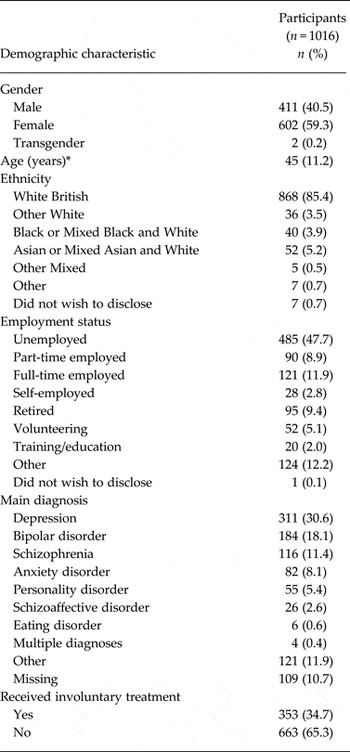
The demographic characteristics of the Viewpoint sample are shown in Table 1. In comparison with national data (Her Majesty's Government, 2012), women (59.3% v. 51.8%) and people of white ethnicity (85.4% v. 80.0%) were oversampled in our population. Otherwise, it was representative of people using secondary mental health services in England.
Demographic characteristics of participants

*Mean (s.d.).
88.2% (n = 896) of our sample reported experiencing discrimination in at least one life domain, with 58.0% (n = 589) reporting it in at least four life domains. Our sample had access to a mean of 13.9 (s.d. = 6.0) out of 27 social capital resources, which was fewer than a comparison general population sample (mean = 17.2, s.d. = 5.9) (Webber & Huxley, Reference Webber and Huxley2007), but more than a similar sample of people receiving specialist mental health care in London (mean = 10.8, s.d. = 5.8) (Murray et al. Reference Murray, Easter and Bellringer2007).
The RG-UK was inversely correlated with experienced discrimination on the DISC (r = −0.219, p < 0.001), a pattern, which was repeated for all of the sub-scales (domestic resources r = −0.206, p < 0.001; expert advice r = −0.182, p < 0.001; personal skills r = −0.164, p < 0.001; problem-solving resources r = −0.154, p < 0.001). However, the human capital sub-scale was not correlated with DISC (r = 0.029, p = 0.353). The shared variance of RG-UK and DISC was low (4.8%) indicating that the two instruments measured distinct constructs.
Access to social capital resources as measured by the RG-UK was also lower for those who chose not to apply for a job (13.3 v. 14.5, t = −2.9, df = 899, p = 004); start adult education (12.9 v. 14.5, t = −3.7, df = 899, p < 0.001); or enter into a new relationship (13.1 v. 14.8, t = −4.4, df = 899, p < 0.001) because of anticipated discrimination than those who did not anticipate any discrimination in these life domains. However, people who concealed their diagnosis from others due to anticipated discrimination (14.0 v. 13.8, t = 0.3, df = 899, p = 0.74) had access to the same quantity of social capital as those who did not.
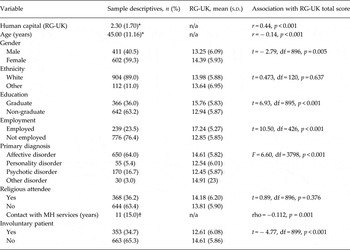
To test the hypothesized independent association of discrimination and access to social capital, we first explored the univariate associations of potential confounding variables with the RG-UK. The RG-UK social capital scale was positively correlated with the RG-UK human capital scale, but inversely correlated with increasing age and length of time in contact with mental health services (Table 2). In addition, women, university graduates, employed people, people with a primary diagnosis of an affective disorder and those with no prior history of being involuntary detained in hospital had increased access to social capital.
Univariate correlates of access to social capital

*Mean (s.d.).
†Median (IQR).
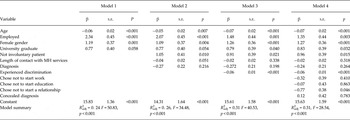
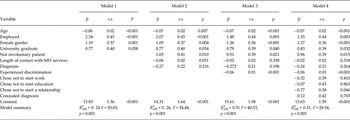
The human capital scale accounted for 18.9% of the variance of RG-UK social capital scale and, as it was a related concept, we adjusted for this in the multivariate linear regression analysis (Table 3). We sequentially entered the other covariates of the RG-UK social capital scale in the following blocks: socio-demographic variables (model 1); clinical variables (model 2); DISC score for experienced discrimination (model 3); DISC anticipated discrimination items (model 4). The entry of experienced discrimination (model 3) into the model created a modest increase in R adj 2 from 0.26 to 0.31. The only anticipated discrimination item to remain significant in the model was ‘choosing not to start a new relationship’, though this made a negligible contribution to the variation explained. The only clinical variable correlated with increased social capital in the final model was not having been an involuntary patient. All the socio-demographic variables remained significant. However, the overall variance explained by all the variables in the multivariate model was somewhat low (31%).
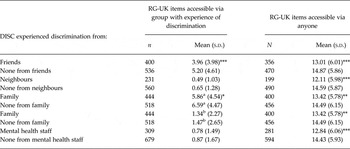
Next, we tested the hypothesis that experience of discrimination from particular social groups was correlated with lower access to social capital from that group. Table 4 shows that the experience of discrimination from any individual social group was associated with reduced access to social capital overall. However, experience of discrimination from friends and immediate family was associated with lower access to social capital from these groups, but this was not found for wider family, neighbours or mental health staff. The mean number of RG-UK items accessible from immediate family and friends were 6.11 (s.d. = 4.56) and 4.57 (s.d. = 4.35), respectively, in contrast to the next highest which was a mean of only 1.41 (s.d. = 2.51) RG-UK items from wider family. It appears that discrimination from social groups had a larger effect on access to social capital when a larger proportion of RG-UK items was accessible via that group.
Tie-specific discrimination and access to social capital

Difference in means (assessed using t test): *p < 0.05; **p < 0.01; ***p < 0.001.
aMean RG-UK items accessible via immediate family.
bMean RG-UK items accessible via wider family.
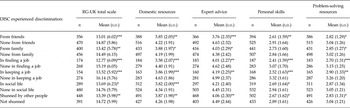
Finally, we tested the hypothesis that domain-specific discrimination had differential effects on specific RG-UK domains. Experiencing discrimination from friends or family; in finding or keeping a job; in one's social life or being shunned by other people were thought to be associated with reduced access to social capital, given the importance of friends and family to access to social capital for our sample; a substantial literature on the effect of employment on social capital (Moerbeek & Flap, Reference Moerbeek, Flap, Lin and Erickson2008); and the resourcefulness of weak ties (Granovetter, Reference Granovetter1973). Each of the six DISC items representing these areas of experienced discrimination was associated with access to less social capital on the main RG-UK scale and on at least two sub-scales (Table 5). Experiencing discrimination from friends or in finding or keeping a job had an effect on access to social capital across all RG-UK sub-scales. However, experiencing discrimination in broader social life primarily had an effect on the domestic resources sub-scale of the RG-UK.
Domain-specific discrimination and access to social capital

Difference in means (assessed using t test): *p < 0.05; **p < 0.01; ***p < 0.001.
Discussion
This is the first study to show a correlation between experienced discrimination and reduced access to social capital in people with severe mental illness. Experienced discrimination made a modest contribution to the explained variance of social capital. Age, employment status and gender are known correlates of access to social capital among people with mental illness (Webber & Huxley, Reference Webber and Huxley2007; Dutt & Webber, Reference Dutt and Webber2010; Webber, Reference Webber, Sekar, Rajaram, Shekhar and Mubarak2010; Webber et al. Reference Webber, Huxley and Harris2011) and these also made a modest contribution to the variance explained. Therefore, if interventions were designed to increase access to social capital, they need to consider both reducing discrimination and supporting people to obtain employment where possible. However, it is important to note that our final model explained about one-third of the variance in social capital suggesting that other unmeasured variables need to be considered in future studies.
This study additionally found that people with experience of a previous involuntary admission to hospital under the Mental Health Act 1983 had reduced access to social capital, while controlling for the potential confounding effect of diagnosis and length of time known to mental health services. A history of involuntary admission is likely to be a proxy of severity of mental disorder, suggesting that provision of continuous and assertive community-based care to this group, including using interventions such as joint crisis plans (Henderson et al. Reference Henderson, Flood, Leese, Thornicroft, Sutherby and Szmukler2004), may be required in order to help them maintain their social networks and enhance their recovery.
Our finding that the anticipated discrimination item ‘chose not to start a relationship’ had an independent relationship with access to social capital in the regression model suggests that people with severe mental illness reduced their social contact when they experienced discrimination, which reduced their access to social capital. Although this item made a negligible contribution to the variance explained, and reverse causality cannot be ruled out, this may provide tentative support for the findings of previous studies (e.g., Link et al. Reference Link, Struening, Neese-Todd, Asmussen and Phelan2001; Moriarty et al. Reference Moriarty, Jolley, Callanan and Garety2012).
People who experienced discrimination from friends or family had reduced access to social capital from these social groups, which was the most common source of social capital for people in this sample and the UK general population (Webber & Huxley, Reference Webber and Huxley2007). Psycho-education with those closest to people with severe mental illness may help to reduce the discrimination experienced by people with severe mental illness and prevent a loss in their access to social capital.
A response rate of only 11% limits the generalizability of these findings. The sample was limited to people who had been in touch with mental health services within the previous 6 months. It is therefore possible that a significant number of those invited to take part were acutely unwell at the time which reduced the response rate. It is also possible that people who did not experience any discrimination chose not to participate as they may have thought that the survey was not relevant to them. Further, the possibility of reverse causality cannot be ruled out. People with access to less social capital possibly recounted more experiences of discrimination as they attempted to understand why their social networks were restricted or provided them with access to fewer resources. Longitudinal studies are required to establish the direction of causality and to examine the impact of changes in experienced or anticipated discrimination on access to social capital. They are also required to determine how resources within people's networks can help to build resilience, which reduces the harmful effect of discrimination on mental health.
This study provides tentative evidence of an association between experienced discrimination and social capital, which appears important for health and wellbeing (Kawachi et al. Reference Kawachi, Subramanian and Kim2007). Mental health services could help to reduce discrimination by supporting clinicians to practice in anti-discriminatory ways and to work closely with individuals' friends and families to minimize their discriminatory behaviour towards them. Often this behaviour is unintentional, such as lowering of expectations, avoiding social situations and increased paternalism that can impact negatively on an individual's recovery. In addition, supporting people with severe mental illness to increase their access to social capital may empower them in the face of experienced or anticipated discrimination.
Acknowledgements
The authors thank the participating NHS Trusts, the Viewpoint interviewers, and the Time to Change management team.
Financial Support
This work was supported by the Big Lottery Fund; Comic Relief; and SHiFT (Shifting Attitudes to Mental Illness), UK Government Department of Health. Dr Henderson, Ms Corker, Ms Hamilton, Dr Rose and Dr Pinfold were supported by a grant to TTC from the Big Lottery Fund and Comic Relief and a grant from SHiFT. Dr Henderson and Dr Thornicroft are funded by a National Institute for Health Research (NIHR) applied programme grant RP-PG-0606-1053 awarded to the South London and Maudsley NHS Foundation Trust. Dr Rose and Dr Thornicroft are also supported by the NIHR Specialist Mental Health Biomedical Research Centre, Institute of Psychiatry, King's College London, and the South London and Maudsley NHS Foundation Trust. Dr Henderson is also funded by a grant from the Guy's and St Thomas' Charity and a grant from the Maudsley Charity. The views expressed are those of the authors and not necessarily those of the NHS, NIHR or the UK Government Department of Health.
Conflict of Interest
Professor Thornicroft has received research grants from Lundbeck UK. The other authors report no competing interests.