Cerebral arteriovenous malformations are rare anomalies that in the neonate present as congestive heart failure and severe pulmonary hypertension.Reference Pellegrino, Milanesi and Saia 1 , Reference Hendson, Emery and Phillipos 2 It has been associated with significant mortality of ~50% despite aggressive medical therapy,Reference Chevret, Durand and Alvarez 3 – Reference Holden, Fyler and Shilito 5 although introduction of endovascular embolisation has allowed for earlier intervention, and thus improved survival;Reference Lasjaunias, Rodesch and Terbrugge 6 , Reference Garcia-Monaco, De Victor and Mann 7 however, associated procedural risks are reduced when intervention can be postponed to 4–5 months of age.Reference Geibprasert, Krings and Armstrong 8 Timing of intervention is based on neurological and cardiac prognosis, with deteriorating heart failure being the primary cardiac indication for urgent intervention. If severe heart failure progresses to end-organ failure despite medical management, intervention may be contraindicated.Reference Geibprasert, Krings and Armstrong 8 Thus, the challenge centres around identifying those at the highest risk of end-organ dysfunction before its occurrence.
Previous studies have shown poor correlation between cardiac output and clinical outcome, with significant overlap between survivors and non-survivors.Reference Chevret, Durand and Alvarez 3 Flow reversal in the aortic arch as evidence of “steal” into the lower-resistance arteriovenous malformation has been identified as a poor prognostic indicator,Reference Chevret, Durand and Alvarez 3 although it is present in most neonatal cases. Retrograde flow extending into systole was reported as a more specific adverse prognostic indicator, but has not been quantified.Reference Frawley, Dargaville and Mitchell 9 In our experience, patients with less flow reversal in the aortic arch have better clinical outcomes and less likelihood of developing severe heart failure. Our aim was to measure the ratio of antegrade to retrograde flow in the aortic arch at presentation as an objective marker of “steal” and assess its utility as a prognostic indicator of clinical outcome.
Materials and methods
With Institutional Review Board approval, the echocardiography database was searched for cerebral arteriovenous malformations and included all neonatal transthoracic echocardiograms performed at Children’s Medical Center, Dallas, between 1 January, 2009 and 15 July, 2014.
Patients’ charts were reviewed for data including demographics, confirmation of diagnosis, intervention, and clinical outcome. Eligibility and timing for intervention were based on the performing physician’s decision regarding technical feasibility and predicted neurological outcome. Severe heart failure was defined as use of ionotropic support, pulmonary vasodilators, and/or mechanical ventilation. Primary outcome was early (<1 month) and late mortality.
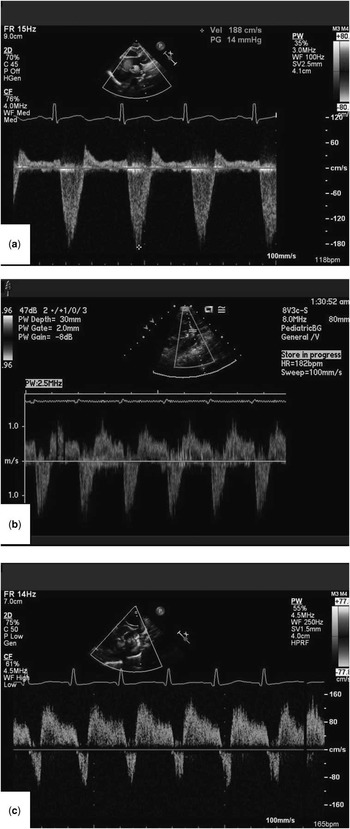
Echocardiograms were performed upon presentation and throughout the hospital stay. Studies were performed and optimised using Sequoia C512 ultrasound equipment (Siemens Medical Solutions USA, Inc., Mountain View, CA, United States of America) or iE33 (Philips Medical Systems, Bothell, WA, United States of America) with multi-frequency, linear-array transducers (range 2.5–10 MHz). Images were reviewed on syngo dynamics workstations (Siemens Medical Solutions, Ann Arbor, MI, United States of America) with prospective measurements obtained one of the authors, (PT) without knowledge of patient outcome or clinical presentation. Measured parameters included the following: right ventricular systolic pressure estimate based on tricuspid regurgitation jet, qualitative right ventricular systolic function, left ventricular size, and systolic function. We quantified the ratio of antegrade to retrograde flow by pulse wave Doppler interrogation at the aortic isthmus based on velocity time integrals (Fig 1), as an assessment of haemodynamic severity of the arteriovenous malformations based on degree of diastolic run-off. The antegrade-to-retrograde ratio was categorised as either <1.5 or ⩾1.5.
Doppler interrogation at the aortic isthmus demonstrating antegrade:retrograde VTI ratio⩾1.5 ( a ) and <1 ( b , c ). VTI=Velocity Time Integral.

Results
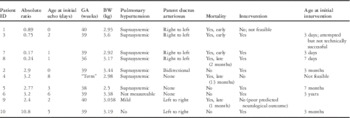
In total, 10 neonates had cerebral arteriovenous malformations and all had adequate echocardiographic images for retrospective measurements (Table 1). Among them, six (60%) were female. All were born at ⩾36 weeks of gestation. Initial echocardiograms were performed at 0–8 days of life (median 2 days). Indication for echocardiograms in all cases was respiratory insufficiency.
Demographics and clinical outcomes for neonates with cerebral arteriovenous malformations.

BW=birth weight in kilograms; GA=gestational age in weeks
First four rows demonstrate patients with ratio <1.5
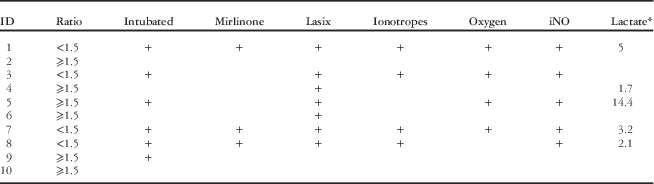
In total, four neonates had a ratio <1.5. All had severe heart failure (Table 2), and mortality was 100% (positive predictive value=100%), three early and one late. Two (50%) had successful interventions with post-procedural resolution of heart failure both clinically and by echocardiogram, and one (patient 7) suffered significant neurological injury and support was eventually withdrawn. The second (patient 8) developed grade III interventricular haemorrhage with poor neurological prognosis, was discharged on palliative care, and died at 2 months of age (late mortality). The other two patients (patients 1 and 3) were not candidates for intervention and had early mortality due to haemodynamic collapse.
Clinical indicators of congestive heart failure in severity compared with the ratio in our cohort.

* Maximum value during hospital stay, if obtained. iNO=inhaled nitric oxide
In total, six neonates had a ratio of ⩾1.5. There were no early deaths. Among them, two (33%) were not candidates for intervention and suffered late deaths (patients 4 and 9). Both patients with late mortality were haemodynamically stable during hospitalisation on oral heart failure medications. Patient 4 was discharged on palliative care and died at 13 months of age. Patient 9 had co-existing syndromic anomalies including a tracheo-oesophageal fistula (late diagnosis). Secondary to co-morbidities, the neonate suffered cardiorespiratory arrest and hypoxic ischaemic brain injury; mortality was not related to the arteriovenous malformation. Overall survival (negative predictive value) in this subgroup was 67%, with one death (17%) attributable to the arteriovenous malformation. In total, four patients underwent late intervention (age 3 months–3 years), and all are alive at the most recent outpatient follow-up (5 months–5.5 years) with no evidence of heart failure.
With regards to previously reported echocardiographic markers of heart failure, seven (70%) had suprasystemic pulmonary pressures; mortality was 71%. Biventricular systolic function was normal in all.
Among all, three patients underwent early intervention with coil embolisation, and two were successful with regard to clinical resolution of heart failure. Both had significant neurological injury. Procedural morbidity was 67%, with no immediate mortality. Technical success as defined by heart failure resolution by echocardiographic and clinical criteria was 67%.
Discussion
Severity of heart failure in neonatal cerebral arteriovenous malformations varies widely depending on the degree of diastolic “steal” into the low-resistance cerebral system. Flow reversal in the aortic arch results in decreased systemic cardiac output and increased systemic venous return through the superior caval vein into the pulmonary bed, which exacerbates pulmonary hypertension. This increases volume and pressure afterload to the right ventricle secondary to persistence of high fetal pulmonary vascular resistance. When severe pulmonary hypertension exists with right-to-left shunting across a patent ductus arteriosus, left heart preload may decrease. Left ventricular filling may also be compromised by a dilated right ventricle via ventricular interdependence mechanisms. The flattened interventricular septal position may further underestimate left ventricular dimension measurements in standard echocardiographic views. Thus, these patients are particularly challenging to diagnose with heart failure, given the lack of customary left heart dilation on echocardiogram.
In our experience, these high-risk neonates had an overall mortality of 60%, similar to previous reports.Reference Chevret, Durand and Alvarez 3 – Reference Holden, Fyler and Shilito 5 Patients with higher degree of steal (ratio <1.5) have an even higher mortality (100% in our cohort). Although heart failure may be present in these neonates, its severity may become clinically apparent only when significant end-organ compromise is present, which may be too late for intervention; in most institutions, heart failure with multi-organ failure is the only single contraindication to intervention.Reference Geibprasert, Krings and Armstrong 8 Intuitively, procedural risks are higher when haemodynamic instability is present. This is evident in our cohort where intervention, even when technically successful, resulted in significant morbidity as seen in 67% of our high-risk patients. We propose that our described index is a marker of worse prognosis. Its use in predicting heart failure severity before its manifestation might allow for a “window” of opportunity for intervention. Thus, a decision about the appropriateness of intervention can be made before multi-organ failure develops, and patients can undergo intervention in a more stable condition.
We believe our index offers several advantages. First, it is a strong prognostic indicator of early mortality (75%) and correlates with development of severe heart failure. Second, it is technically easy to obtain and measure and can be interpreted even by those without much prior experience in arteriovenous malformations. Finally, it is valid when obtained at initial presentation before clinical deterioration, allowing for prompt identification of those at highest risk for early mortality. The poor outcome in those with severe heart failure despite early intervention may be reflective of irreversible neurological perfusion abnormalities and warrants the question – should intervention be offered in this high-risk subset? Further, larger studies are warranted to answer this question.
Our study was limited by its retrospective nature and the small number of patients, which is an inherent characteristic of a study on rare congenital malformations.
Conclusions
Antegrade-to-retrograde ratio of arch flow <1.5 in neonates with heart failure secondary to cerebral arteriovenous malformations appears to promptly, accurately, and objectively identify those at the highest risk for developing significant haemodynamic instability and early mortality. We believe that this objective tool is a reliable and easily obtainable marker of severe heart failure in neonates and can assist with urgency of intervention. In addition, we speculate that this tool may be useful for post-procedural evaluation of success in reducing right heart preload.
Acknowledgements
None.
Financial Support
This research received no specific grant from any funding agency, commercial, or not-for-profit sectors.
Conflicts of Interest
None.