INTRODUCTION
Epibiosis is a facultative and interspecific association where one organism lives on the surface (epibiont) of another organism (basibiont) (Wahl, Reference Wahl1989; Wahl et al., Reference Wahl, Hay and Enderlein1997). A number of suctorian ciliates are epibionts on benthic marine and interstitial invertebrates like harpacticoid copepods, nematodes, halacarid mites etc. (Precht, Reference Precht1935; Jankowski, Reference Jankowski1981, Reference Jankowski and Alimov2007; Dovgal, Reference Dovgal1996, Reference Dovgal2002; Dovgal et al., Reference Dovgal, Chatterjee and Ingole2008a, Reference Dovgal, Chatterjee, Ingole and Nanajkarb, Reference Dovgal, Chatterjee and Ingole2009a, Reference Dovgal, Chatterjee, Subba Rao, Chan and De Trochb; Fernandez-Leborans & Tato-Porto, Reference Fernandez-Leborans and Tato-Porto2000; Ingole et al., Reference Ingole, Singh, Sautya, Dovgal and T. Chatterjee2010; Fernandez-Leborans et al., Reference Fernandez-Leborans, Chatterjee and Grego2012; Chatterjee et al., Reference Chatterjee, Fernandez-Leborans and Chan2012, Reference Chatterjee, Fernandez-Leborans, Ramteke and Ingole2013a, Reference Chatterjee, Fernandez-Leborans and Sennab). This paper reports Praethecacineta halacari and Thecacineta calix collected from Pulau Bedukang, Brunei Darussalam. These ciliates are reported here for the first time from Brunei coastal waters.
MATERIALS AND METHODS
Specimen collection and preparation
A ciliate infested halacarid mite and harpacticoid copepods were collected among epiphytal algae from pneumatophores of mangroves during low tide at the island, Pulau Bedukang, Brunei Darussalam. The infested mite and copepod specimens were preserved in 95% ethanol. To identify the protozoan epibionts, they were isolated and treated using the silver carbonate technique described by Fernandez-Leborans & Castro de Zaldumbide (Reference Fernandez-Leborans and Castro de Zaldumbide1986), and then stained with methyl green and neutral red. The sizes of the epibionts were determined using an ocular micrometer. Light microscope images and morphometry of the ciliate species were obtained using Image Analysis (KS300 Zeiss). Permanent slides of the infested mite and copepod will be deposited in the Museum fur Naturkunde (Invalidentstrasse. 43, Berlin).
Area description
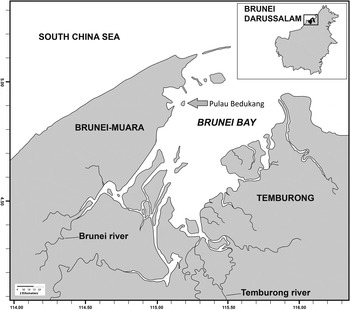
Pulau Bedukang is a mangrove-forested island located in the Inner Brunei Bay, covering an area of around 40 hecatres, near Muara (Figure 1). The forest constitutes species of common mangrove genera, including Rhizophora, Bruguiera, Sonnertia and Avicennia, and supports a species-rich invertebrate benthic community, comprising gastropods, crustaceans and various other invertebrates. The seawater within the bay and near the island is highly turbid and highly variable in salinity (17–26 ppt), and air and water temperatures vary respectively between 25–35°C and 28–32°C (Marshall et al., Reference Marshall, Santos, Leung and Chak2008). The mangrove pneumatophores from this locality support a rich diversity of small invertebrates.
Map of the sampling site.

RESULTS AND DISCUSSION
SYSTEMATICS
Class SUCTOREA Claparède & Lachmann, 1859
Subclass EXOGENIA Collin, 1912
Order METACINETIDA Jankowski, 1978
Family PRAETHECACINETIDAE Dovgal, Reference Dovgal1996
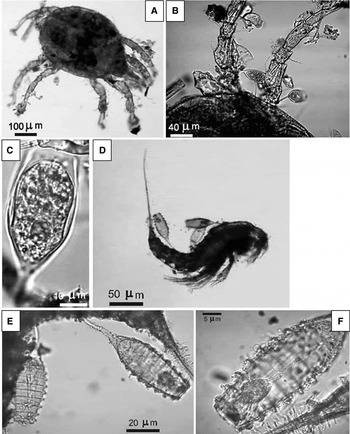
Praethecacineta halacari (Schulz, Reference Schulz1933) (Figure 2A–C)
Praethecacineta halacari collected from Brunei: (A) Praethecacineta halacari attached on halacarid mite collected from Brunei; (B) several epibionts, Praethecacineta halacari on the legs of Copidognathus; (C) magnified view of Praethecacineta halacari; Fig. 2D–F. Thecacineta calix collected from Brunei: (D) Thecacineta calix attached to the halacaticoid copepod collected from Brunei; (E & F) magnified view of Thecacineta calix.

MATERIAL EXAMINED
Four ciliates on legs of a halacarid mite, Copidognathus sp., Brunei Darussalam, Brunei Bay, Pulau Bedukang (115o04′E 4o59′N), June 2013; Collectors: T. Chatterjee & D.J. Marshall.
BRIEF DESCRIPTION
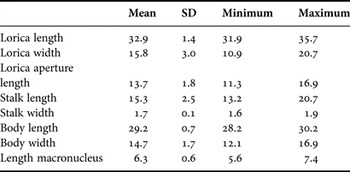
Marine suctorians with stylotheca. Cell body weakly laterally flattened, entirely filling the lorica and attached to its posterior margin. Apical part of the body narrowed. Tentacles placed at upper cell surface. Macronucleus spherical posteriorly located; single contractile vacuole. Stylotheca smooth, without ribbing. Body dimensions of Praethecacineta halacari collected from Brunei are given in Table 1.
Biometric parameters of Praethecacineta halacari (measures in μm). SD, standard deviation.

DISTRIBUTION
Praethecacineta halacari is an epibiont on various halacarid mites reported from Bulgaria, Ukraine (Black Sea); Norway, Kiel Bay of North Sea, Caspian Sea, Western Australia, Atlantic coast of Brazil, west coast of India, Taiwan, Tanzania and Canada (Schulz, Reference Schulz1933; Detcheva, Reference Detcheva1992; Boshko & Dovgal, Reference Boshko and Dovgal2004; Gelmboldt & Dovgal, Reference Gelmboldt and Dovgal2005; Dovgal et al., Reference Dovgal, Chatterjee and Ingole2008a, Reference Dovgal, Chatterjee, Subba Rao, Chan and De Troch2009b), and Brunei Darussalam (present study). The present record indicates an important extension of distribution to the Brunei coastal area.
Class SUCTOREA Claparede & Lachmann, 1859
Subclass VERMIGENIA Jankowski, 1978
Order SPELAEOPHRYIDA Jankowski, 1978
Family THECACINETIDAE Matthes, Reference Matthes1956
Thecacineta calix (Schroder, Reference Schröder1907) (Figure 2D–F)
MATERIAL EXAMINED
Four epibiont ciliates on a harpacticoid copepod from Brunei Darussalam, Brunei Bay, Pulau Bedukang (115o04′E 4o59′N), June 2013; Collectors: T. Chatterjee & D.J. Marshall.
BRIEF DESCRIPTION
Marine loricate, suctorian. Cell body entirely fills the lorica and attached to their bottom. Lorica totally ribbed transversely. Apical part of body protrudes beyond lorica aperture. Up to 30 clavate tentacles with length about 90 µm arise from upper body surface. Macronucleus large, oviform located at the bottom of the cell body. Large contractile vacuole placed in basal body part usually near macronucleus.
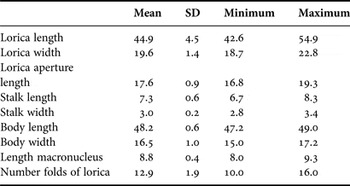
Table 2 shows morphometric measurements of the collected Thecacineta calix specimens in the present study.
Biometric parameters of Thecacineta calix (measures in μm) collected from Brunei. SD, standard deviation.

DISTRIBUTION
Thecacineta calix was earlier reported as an epibiont on nematodes, crustacean copepods, halacarid mites from the Atlantic, Pacific, Antarctic and Indian Oceans (Schröder, 1907; Schulz, Reference Schulz1931; Steiner, Reference Steiner1931; Allgen, Reference Allgen1949, Reference Allgen1952, Reference Allgen1955; Matthes, Reference Matthes1956; Gelmboldt & Dovgal, Reference Gelmboldt and Dovgal2005; Susetiono, Reference Susetiono2006; Jankowski, Reference Jankowski and Alimov2007; Dovgal et al., Reference Dovgal, Chatterjee and Ingole2008a; Ingole et al., Reference Ingole, Singh, Sautya, Dovgal and T. Chatterjee2010; Chatterjee et al., Reference Chatterjee, Fernandez-Leborans and Chan2012). From the north-west Pacific Ocean it was reported on halacarid mites from Hokkaido, Japan and Taiwan (Dovgal et al., Reference Dovgal, Chatterjee and Ingole2008a; Chatterjee et al., Reference Chatterjee, Fernandez-Leborans and Chan2012). This species has been reported from a freshwater system in Thailand (Charubhun & Charubhun, Reference Charubhun and Charubhun2000); however, this record needs confirmation because T. calix is otherwise only known from marine environments (Chatterjee et al., Reference Chatterjee, Fernandez-Leborans and Chan2012). The present report of T. calix represents the first record of this ciliate from Brunei coastal waters.
ACKNOWLEDGEMENT
This study forms part of an investigation of the biodiversity of the Brunei Estuarine system funded by grant from the University Brunei Darussalam (UBD/GSR/S&T/16).