On August 21, 2017, a solar eclipse was observed across North America and a total eclipse was observed in 14 states. The point of greatest eclipse, where the axis of the moon’s shadow passes closest to the center of the earth, was located 20 km northwest of Hopkinsville, Kentucky, and 21 eclipse-related events drew an estimated 116 500 visitors to the area. 1 Mass gatherings present unique public health challenges Reference Polkinghorne, Massey and Durrheim2-5 and may require enhancements to existing surveillance systems. 5 In preparation for the eclipse, the Kentucky Department for Public Health (KDPH) collaborated with local and regional epidemiologists, emergency medical services (EMS), area hospitals, the Kentucky Health Information Exchange (KHIE), and informatics staff at the Tennessee and Illinois state health departments to implement surveillance for anticipated events of public health importance during this period.
In the United States, approximately 60% of nonfederal emergency department (ED) visits are submitted to the National Syndromic Surveillance Program’s cloud-based BioSense platform, which hosts the Electronic Surveillance System for the Early Notification of Community-based Epidemics (ESSENCE). Reference Richards, Iademarco and Atkinson6,Reference Gould, Walker and Yoon7 In the context of Hurricane Irene in 2011 and the Special Olympics World Games in 2015, ED visits were flagged with the event name in syndromic surveillance systems, providing near real-time quantitative data to improve situational awareness for public health authorities. Reference McHugh, Tsai and Bradford8,Reference Kajita, Luarca and Wu9 KDPH collaborated with KHIE and area hospitals to flag ED visits of individuals who participated eclipse events in ESSENCE and monitored this system as part of a larger surveillance plan during the eclipse. We describe the development and performance of our eclipse surveillance system and lessons learned for the future of mass gathering surveillance.
METHODS
Three weeks before the eclipse, KDPH staff gave a presentation to invite representatives of the Hopkinsville, Kentucky, area EDs to implement enhanced syndromic surveillance by including the term eclipse in the chief complaint field for any patients who had attended an eclipse-related event from August 17–22. All 6 hospitals in the region expressed interest; 1 hospital had an information technology-related issue that prevented it from sending data to ESSENCE and thus was unable to participate. To validate their ability to flag eclipse event-related visits, ED clinical staff sent a screenshot of where they would be entering the word eclipse in their electronic health record (EHR) to KDPH informatics staff. KDPH staff then requested that the ED staff send a practice message with the word eclipse in it to verify successful submission to the ESSENCE platform. Staff from 1 hospital chose to modify their EHR to include a required question about eclipse event attendance, which was sent to ESSENCE as part of the triage note. Staff from another hospital were unable to validate their ability to send a flagged message but did flag records during the surveillance period. KDPH sent participating hospitals instruction sheets for flagging records that included the hospital’s screenshot, if desired. KDPH and KHIE held a conference call with participating hospital staff 1 week prior to the eclipse to answer any remaining questions about flagging records.
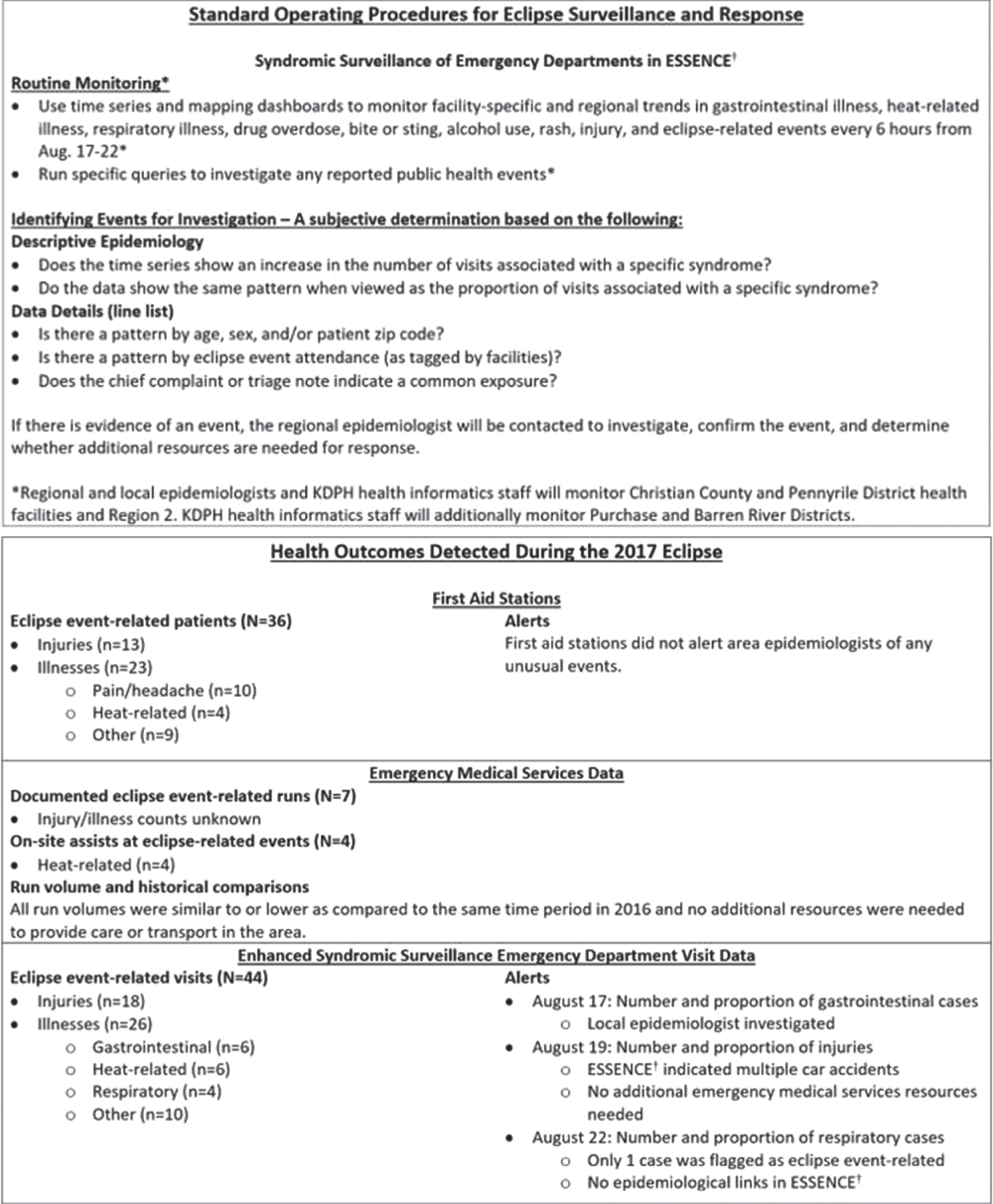
Gastrointestinal illness, heat-related illness, respiratory illness, drug overdose, bite or sting, and the eclipse flag were monitored at the 5 enhanced syndromic surveillance hospitals and at 5 other hospitals located in the regions to the east and west of Hopkinsville. For each hospital and the region, KDPH staff created a dashboard with side-by-side 90-day time series graphs of the counts and category percentages for each outcome and a time series of ED visit volume. KDPH staff trained area epidemiologists to interpret the dashboards a month prior to the eclipse and held an in-person tutorial session with them the day before the start of the surveillance period to ensure that KDPH syndromic surveillance standard operating procedures (SOP; Figure 1) were understood. From August 17–22, area epidemiologists monitored the enhanced syndromic surveillance dashboards every 6 hours; KDPH staff monitored the dashboards more frequently and monitored additional conditions, including alcohol use, rash, and injury at all hospitals using count and percentage time series. We used the regression/EWMA 1.2 algorithm to define warning and alert thresholds. Reference Burkom, Elbert and Magruder10 Per the KDPH SOP (see Figure 1), any warnings or alerts observed during the surveillance period were to be analyzed descriptively, and the area epidemiologist was to be notified of any suspected events in the specific jurisdiction for further investigation. The Illinois, Tennessee, and Kentucky departments of health shared access to their respective eclipse event-related surveillance dashboards during this time to facilitate detection of and response to multistate public health emergencies. Illinois and Tennessee included an eclipse query in their respective dashboards but did not flag event-related ED visits.
Kentucky Department for Public Health (KDPH) Standard Operating Procedures for Syndromic Surveillance and Outcomes During the 2017 Eclipse.

In addition to syndromic surveillance, KDPH staff monitored response data from 14 EMS services, which were entered as summary text reports to a web-based portal at least every 8 hours from August 19–21 by counties in the path of totality. The Kentucky Board of Emergency Medical Services compared daily ambulance run volumes to the same time period during 2016 to determine whether additional resources were needed to provide care and transport in the area. KDPH and area epidemiologists also conducted surveillance at the 26 first-aid stations located at eclipse-related events in the area from August 17–21. The first-aid station staff were instructed to send de-identified surveillance forms via text to the KDPH surveillance liaison immediately after patients presented for care.
RESULTS
Enhanced Syndromic Surveillance in ESSENCE
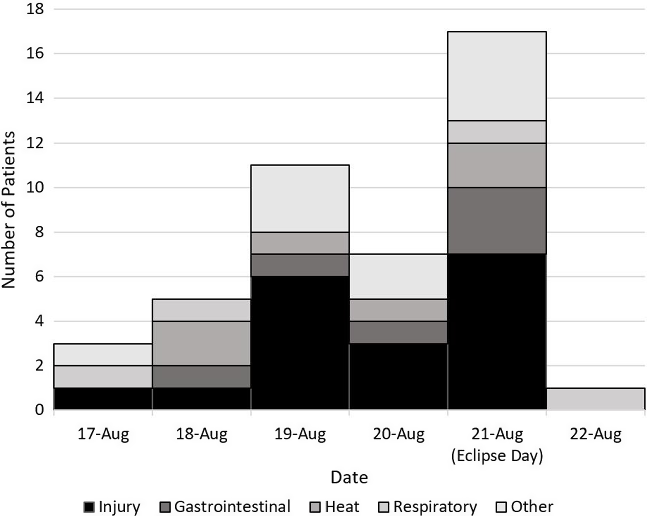
Forty-four visits of patients who participated in eclipse-related events were flagged during the enhanced syndromic surveillance period from August 17–22, including 18 injuries and 26 illnesses (Figure 2). Reported illnesses included 6 cases of gastrointestinal illness, 6 of heat-related illness (eg, weakness, loss of consciousness, rapid heart rate), 4 of respiratory illness, and 10 of other conditions (eg, high blood pressure, chest pain, difficulty breathing). An alert for the number and percentage of gastrointestinal illness cases occurred on August 17, but the local epidemiologist investigated and did not find common places of exposure or contributing factors among cases. An alert for the number and percentage of injuries occurred on August 19. Free text fields in ESSENCE indicated that this was due to several motor vehicle accidents; this increase did not require additional EMS resources. An alert for the number and percentage of cases of respiratory illness occurred on August 22. Only one of these cases, however, was flagged as having attended an eclipse-related event, and no clear epidemiologic links between cases were identified. Nineteen ED visits were identified as eclipse event-related in Illinois and 8 in Tennessee; no major changes in syndrome-specific trends were observed in either state.
Distribution of Conditions Flagged by Emergency Departments Associated With Solar Eclipse Event Attendance in Western Kentucky, 2017.

EMS and First-Aid Station Surveillance
Patient volume did not exceed capacity for any local EMS service, and run volumes were similar to or less than the previous year. Seven patients were documented as receiving EMS transport to a hospital for event-related issues, and 4 were assisted on-site for heat-related illness. Some EMS services did not enumerate patients seen or association of runs with an eclipse-related event. A total of 36 patients sought care at first-aid stations, with 4 of 26 stations reporting. Thirteen sought care for injuries, 10 for pain or headache, 4 for heat-related illness, and 9 for other conditions.
DISCUSSION
The enhanced syndromic surveillance system that KDPH implemented in Kentucky improved public health situational awareness during the mass gatherings associated with the 2017 solar eclipse. A key strength of this system was the proactive flagging of ED patient visits, which allowed public health staff to quantify cause-specific morbidity potentially related to eclipse event attendance and facilitated investigation of potential event-related outbreaks in near real-time. Public health staff observed a larger number of event-specific flags than previously reported for Hurricane Irene or the Special Olympics World Games, despite a shorter surveillance period and smaller population under surveillance Reference McHugh, Tsai and Bradford8,Reference Kajita, Luarca and Wu9 ; the high level of participation of area hospitals and strong collaboration with our state health information exchange likely contributed to the relatively high number of events flagged. An additional strength of the KDPH surveillance system was the inclusion of patient encounter data from providers of different levels of care, which offered more detailed information regarding the type and severity of health issues experienced during the surveillance period. This system had the limitation of not providing the number of patients seeking care due to a lack of identifiable information and an inability to link to EHRs; however, syndromic surveillance data nevertheless provided reassurance that no large event-related increases in injury or illness occurred.
Although the implementation of this surveillance system was generally successful, we identified several areas of improvement for the future planning of mass gathering surveillance in Kentucky. First, although KDPH worked closely with the state health information exchange and clinical ED staff, we did not initially include hospital IT staff and EHR vendors in implementing enhanced syndromic surveillance, although they facilitated the validation of visit flagging. Second, the implementation of syndromic surveillance can be time-consuming, particularly in the validation of visit flagging, thus sufficient time must be allotted for to this step (2 weeks in this experience). Third, we recognized that the schedule for monitoring data sources needed to be changed to correspond with the scheduled situational reports and spot checks, and that standard outcomes were needed to monitor cause-specific morbidity and trends across data sources. Future mass gathering events could benefit from greater advanced planning and standardization of outcomes to facilitate multi-jurisdictional mass gathering surveillance.
Financial Support
This study was supported in part by an appointment to the Health Systems Integration Program administered by the Council of State and Territorial Epidemiologists (CSTE) and funded by CDC Cooperative Agreement 3U38-OT000143-01S4. It was also supported in part by a contract between KDPH and CSTE through CDC Cooperative Agreement Number 5 1U38 OT000143-04 awarded to CSTE.
Conflict of Interest Statement
The authors have no conflicts of interest to declare.
Acknowledgments
We are grateful to the Pennyrile District hospitals and our colleagues at the Pennyrile Health Department (Faith Boldt), KHIE (Lori Adams, Polly Mullins-Bentley, and Rhonda Scott), the Kentucky Board of Emergency Medical Services (Chuck O’Neal and Michael Poynter), the Kentucky Injury Prevention and Research Center (Peter Rock), and KDPH (Rachael Helm, Jim House, Tina Massengill, and Mike Schardein) for their help in implementing enhanced syndromic surveillance. We also thank the Tennessee Department of Health (Caleb Wiedeman) and the Illinois Department of Public Health (Stacey Hoferka) for their collaboration in sharing their state data dashboards during this event.
Disclaimer
The findings and conclusions in this report are those of the authors and do not necessarily represent the official position of the Centers for Disease Control and Prevention.