The Great Crisis of 2008 was the largest economic and financial shock to strike the global economy since 1929. In the United States alone, approximately 450 commercial banks with $2 trillion of deposits have either failed or needed rescue operations since 2008. One of the two largest US commercial banks, Wachovia, failed and was acquired by Wells Fargo. Three of the five largest American investment banks disappeared as independent institutions (Bear Stearns, Lehman Brothers, Merrill Lynch), while two others (Goldman Sachs, Morgan Stanley) converted their legal status to bank holding corporations to gain access to Federal Reserve funding. In its wake, the American economy suffered its largest postwar contraction—3.5 percent of GDP in constant dollar terms in 2009—and poorest labor market performance since the late 1970s.
The Great Crisis promises to have lasting political and policy consequences. The crisis has sharpened the class dimensions of partisan conflict. The combination of poor macroeconomic performance and the large allocation of public money to rescue and rebuild the financial system fueled the Occupy Wall Street movement and pushed the politics of inequality to the fore. The unprecedented federal budget deficit generated by collapsing revenues and sharply rising expenditures provided traction for the Tea Party movement and its focus on smaller government and balanced budgets. This struggle between Tea Party adherents intent on reigning in “fiscal excess” and Democrats determined to use the power of the federal government to revive economic activity produced deadlock in efforts to raise the debt ceiling during the summer of 2011 that unsettled bond markets and led one ratings agency to downgrade US government debt.
We argue that the core consequences and causes of this crisis emerged from the dynamic processes of a complex adaptive international financial system. The consequences of the crisis are unambiguously systemic. More than twenty European countries suffered banking crises triggered in part by the American crisis. The world economy as a whole contracted for the first time since the end of World War II and world trade fell sharply in 2009. As the crisis spread outward from the US to the rest of the world, governments struggled with financial sector weakness, sagging economies and mounting debt. Debt reduction efforts sparked public protests, particularly in the eurozone's southern periphery. Incumbent governments throughout the developed world—among them the US, UK, Iceland, Ireland, Japan, France, Greece, Spain, and Italy—were removed. Belgium went without a government for 541 days, a modern record. Extremist parties gained popularity in many countries. Iceland became the first West European country to graduate from an IMF program in 30 years. In a significant departure from previous law and practice, EU members pledged hundreds of billions of euros—in addition to support from the European Central Bank—to indebted members. Indeed, many observers have argued that the crisis underscores the dangers of globally-integrated capital markets wherein a crisis anywhere can spread quickly through the system with globally devastating consequences.
Many observers also expect the crisis to bring about deeper changes in global economic organization. The crisis generated substantial discussion about an accelerated transition of power away from the US—whose neo-liberal model was supposedly discredited by the crisis—to the BRICs—Brazil, Russia, India, and China—who offer alternatives to the American model of global capitalism. Multilateral efforts to manage the crisis shifted from the insular G-7 to the more inclusive G-20. Simultaneously, governments altered the distribution of voting shares in the International Monetary Fund (IMF) to grant the BRICs a somewhat greater voice. Whether the crisis has these consequences, of course, depends upon its impact on existing structures of international financial power. Much post-crisis commentary has asserted that the crisis will alter this structure by accelerating the pace of American decline.
Many of the causes of this Great Crisis also were systemic: they resided in the structure of financial relationships among actors rather than in the characteristics of these actors themselves. The accumulation of mortgage debt that fueled the American real estate bubble was a consequence of the financial relationships established between actors in high-saving societies of East Asia and the Middle East and actors in the US. The crisis spread globally through the structure of financial relationships created by these cross-border investments. The countries most vulnerable to contagion were those most strongly connected to the American real estate market or to the American financial firms that had invested in that market. The crisis had second-generation effects as it spread to countries in which national financial systems were not themselves directly exposed to mortgage-backed securities, but were tightly connected to countries whose financial institutions were. In emphasizing such systemic characteristics we do not contend that actor attributes (such as financial regulation and risk management practices) were unimportant. Instead, we suggest that such characteristics gained importance, in part, because of how actors were connected to each other.
Understanding how the structure and dynamics of the international financial system produced and distributed the Great Crisis as well as the impact of the crisis on the structure of financial power arguably is the comparative advantage of international political economy (IPE). Yet over the last twenty-five years IPE research has retreated from modeling the systemic characteristics of international financial and economic interdependence. IPE scholarship has developed along three paths in the last three decades. Along one, IPE focuses on determinants of domestic economic policy choice.Footnote 1 How do actors and institutions interact to produce policy outcomes? Why are some states more open to the global economy than others? Why do some governments float their currencies while others fix? The international system enters these analyses as a factor that impinges directly and indirectly on government policy choice. Global capital markets may constrain fiscal policy. Global shocks may trigger government policy responses. This line of research attributes the Great Crisis and the pattern of contagion to country-level characteristics such as domestic financial regulation. In the wake of the crisis, it asks scholars to pay more attention to domestic banking regulation.Footnote 2
Scholarship along the second path focuses on global governance:,“the collective effort to identify, understand, and address worldwide problems that are beyond the capacity of individual States.”Footnote 3 In the context of the international financial system, global governance research focuses on the extent to which international financial interdependence generates regulatory challenges that states cannot address individually. It explores how actors respond to these challenges by making and implementing global rules. Traditionally, researchers have explained outcomes as a function of bargaining between states. During the last few years, research has focused on an apparent shift of regulatory authority from states to private actors.Footnote 4 In both cases, however, the relevant characteristics of the actors engaged in bargaining are derived from actor-level attributes. Interests are derived from domestic politics and firm-level processes. Bargaining power is defined in terms of country-level characteristics, especially GDP.
Finally, along the third path, British-school scholarship emphasizes how interaction between actors within the global political economy shapes the historical development of the global system.Footnote 5 The approach assumes that politics is more than what politicians do, and thus pays substantial attention to market actors and processes.Footnote 6 This work focuses in particular on how deregulation and financial innovation has produced more volatile markets seen to be crisis-prone. This school is thus quite sensitive to the behavior of financial institutions that produced the Great Crisis.Footnote 7 Yet this approach is also actor-centered; it focuses on how specific financial instruments (such as derivatives), financial institutions (hedge funds), and regulatory arrangements (private versus public) affect aspects of financial system performance.Footnote 8
All three perspectives offer extremely useful insights into the politics of global finance. But they also exhibit a common trait: each rests on an implicit conception of the international financial system. All three perspectives recognize that actors and institutions are embedded in a system constituted by cross-border financial relationships. Market volatility and domestic banking regulation have global consequences because national financial systems are connected to each other. Global banking rules are political responses to financial globalization. Yet, none of the three perspectives renders this system explicit.Footnote 9 None offer a clear theoretical statement or empirical representation of the central characteristics of the global financial system. None offer explicit statements about how the structure of financial interdependence shapes the performance of the international financial system. Instead, all three perspectives seem to assume that the financial linkages between countries are conceptually straightforward and reasonably well understood. As a result, they treat the system as a very important but generally unmodeled background condition.Footnote 10
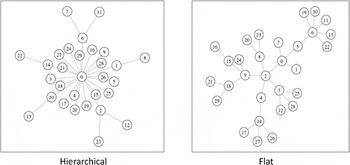
We problematize this conception of the international financial system. We draw on network science to render explicit the relational structure of international finance and articulate three core theoretical arguments.Footnote 11 First, the relational structure of international financial interdependence can vary substantially, from flat networks in which all countries are connected in much the same way, to hierarchical networks that exhibit a sharp center-periphery distinction. Second, network structure shapes financial contagion. In a flat network, a crisis anywhere in the system can spread everywhere. Hence, in these networks the risk of global contagion rises in line with the density of connectedness. By contrast, hierarchical networks are resilient to peripheral crises, but very fragile in the face of crises in the center. In these systems, the risk of contagion falls as the system integrates around the center. Third, hierarchical systems emerge from positive feedback dynamics that make them self-reinforcing, sometimes even in the face of a major disturbance at the center.
Our network approach suggests novel answers to central questions about the contemporary global financial system. We find that the system is a strongly hierarchical network centered firmly on US capital markets. As a result, the massive crisis of 2008 does not imply that the global system is generally vulnerable to crises anywhere. Instead, the hierarchical structure is likely to be far more resilient to financial crises in European and emerging market countries than is typically recognized. In addition, positive feedback in financial markets and the absence of a fit alternative to American centrality will interact to keep the US at the center of the global financial system for the foreseeable future. Thus, the network perspective suggests that the global financial system is far more stable in the face of most disturbances and US hegemony is far more persistent than standard IPE actor-centered models suggest.
A Network Model of the International Financial System
The international financial system is a system: a set of actors connected by economic and political relationships. The relevant actors include private and public entities in the international arena as well as in domestic systems. A partial list of these actors includes private financial institutions of every variety, central banks, domestic regulatory agencies, heads of state, international organizations such as the Basel Committee on Banking Supervision, the Group of 20, the International Monetary Fund, as well as international non-governmental organizations such as the International Organization of Securities Commissions (IOSCO). The ties between these actors extend across national borders and levels of analysis. Indeed, a defining characteristic of financial interdependence is the inability to separate the system into independent national units or distinct levels of analysis. Horizontal ties connect states as they negotiate and implement regulatory structures. Other horizontal ties connect financial institutions in distinct national jurisdictions and connect private actors engaged in governance. Vertical relationships tie domestic policymakers to domestic private financial actors, and link large money-center banks to small community banks. The system also contains “diagonal” relationships, ties between public entities located in one jurisdiction and private entities located in another. Foreign banks, for instance, were among the largest borrowers from the emergency lending programs that the US Federal Reserve established in 2008 to manage the crisis.Footnote 12 The international financial system is a set of economic and political relationships among private and public actors operating in domestic and international fora.
We focus our attention on the set of financial relationships between actors. That is, we focus on the system of international financial interdependence. Our theoretical orientation to this system is informed by the logic of complex adaptive systems.Footnote 13 A complex adaptive system (CAS) is one in which multiple agents interact without guidance provided by a central controller and produce a structured and persistent collective outcome. It is a system in which agents adapt their behavior in response to external stimuli, and in which these adaptations reproduce or alter the structure that their collective behavior produces. A flock of birds, for instance, is an ordered arrangement that maintains coherence as it moves through the sky. The flock's structure changes as individual birds adapt to their neighbors who in turn adapt to their neighbors. Individual behavior aggregates into a persistent though not permanent structure. Moreover, individual behavior is shaped by one's location within the aggregate structure, and individual behavior in turn contributes to the structure.
The global financial system exhibits the characteristics of a complex adaptive system. Financial transactions are undertaken by many private and public entities without the benefit of a global capital allocator. These individual transactions are often highly responsive to the transactions of other agents.Footnote 14 This collective behavior produces a structure, a global network of creditor-debtor relationships. This structure is persistent but not static. Consider, for instance, the surge of lending to Latin America during the 1970s, the surge of investor enthusiasm for East Asian countries during the 1990s, and the surge of lending to the United States during the 2000s. Each investment surge produced a particular network structure that linked global creditors and local borrowers. And the relationships created during each surge were in turn embedded in a more persistent network of global financial relationships.
System Structure as Network Topology
We can model this global financial system as a network constituted by cross-border creditor-debtor relationships. These relationships can be direct or indirect. In a direct relationship, the Chinese government might purchase and hold US government bonds. In an indirect relationship, a link between creditor and debtor is intermediated by a commercial bank or other third party. Some of these relationships will be more liquid than others. Large and deep secondary markets enable the Chinese government to sell its US Treasury bonds quickly and at low cost. Bank debt obligations are less liquid because it is more difficult to develop secondary markets for what are often idiosyncratic obligations. The securitization of mortgages reflected a desire to increase liquidity via transformation of individual mortgages into standardized assets that could be traded at low cost in secondary markets. Yet no matter how complex the instruments might be, the underlying relational structure is simple: finance involves two parties entering an enduring contract. Finance is fundamentally relational.
The international financial system is thus a network of creditor-debtor relationships. A network is a set of actors (nodes in network terminology) and relationships (ties connecting nodes). In the financial system, the actors include financial institutions, non-financial corporations, individuals, and sovereign entities. Ties are the financial contracts that actors establish between themselves. These relationships are directed ties; one actor can be related to another as a debtor and simultaneously as a creditor. Hence, many actors will have two sets of relationships—relationships with parties to whom they have loaned funds, and relationships with parties from whom they have borrowed funds. All of the relationships between all of the actors together constitute the global financial network.
The global financial network exhibits structure, a persistent set of cross-border creditor-debtor relationships. Such persistent relationships are particularly evident when we aggregate the credit that residents of one country provide to residents of another (i.e., asset stocks). Creditors do not fundamentally change the weight of each country in their lending portfolio every day, or even every year. Instead, asset allocation across foreign markets is broadly stable; small changes occur at the margin, but rarely do creditors liquidate a substantial portion of assets based in one country and move them to another. The global financial system thus organizes itself into a stable relational structure of dyadic creditor-debtor relationships.
The relational structures into which the system organizes can assume different topologies. Network topology is the network-wide pattern of relationships among the actors. Two networks composed of the same number of nodes joined by the same number of ties can exhibit different topologies. We focus on two topologies that parallel conceptions of system structure present in international relations scholarship: hierarchical (or hegemonic) networks and flat (or multipolar) networks. In a hierarchical network, one country serves as an international financial center to which most other national financial systems are connected. Most other countries are connected directly to only a few other countries, and most of their connections to other countries run through the center country (Figure 1). During the late nineteenth century, for instance, the United Kingdom hosted assets from across the globe, while most peripheral countries had direct financial relationships with a limited number of other peripheral countries.
Network topologies

In contrast, in a flat network every country has direct financial relationships with many other countries. Such systems lack the sharp delineation between center and periphery characteristic of a hierarchical system. The set of countries with which each country has financial relationships might vary substantially in a loosely-integrated flat international financial system. One might imagine that individual European countries would be strongly connected to other European countries but have few ties to countries in Latin America or Asia. Asian countries might be in turn strongly connected to other countries in Asia and have few connections to Latin America and Europe. But as international financial integration deepens in these flat systems, the regional organization of financial relationships would cede to a global financial system in which most countries are connected to most other countries in the system to a relatively equal extent.
Flat and hierarchical network topologies obviously parallel common understandings of multipolar and hegemonic systems. We can further develop this parallel by redefining common international relations conceptions of power in a network context. Network theory suggests that power as influence is a function of network centrality: central actors have greater influence than others.Footnote 15 In hierarchical structures, one country stands at the center of the system, and other states are on the periphery. Hence influence is unevenly distributed between a central hegemon and everyone else. In flat structures, no country is substantially more central than another. Hence influence is more evenly balanced between countries. Thus hierarchical and flat network topologies generate the same distributions of influence that existing IR structure-based models emphasize.
Although the structural configurations derived from network topologies map onto familiar IR conceptions of structure, the two differ sharply. Network models derive state capabilities and influence from the network structure. In contrast, traditional IR models derive system structure from state power defined in terms of national capabilities.Footnote 16 Although the relational and capabilities conceptions are not entirely independent of one another (larger entities may be more likely to be more central, and vice versa), conceptualizing structure in relational terms allows us to theorize about the dynamics of system and structural change. To what extent and through what causal mechanisms does network topology change in response to changes in the distribution of national capabilities? We return to these issues below.
Network Structure and Contagion
Network structure might be important for understanding the international financial system because whether banking crises that originate in one country generate banking crises in other countries might depend upon the system's topology. Banking crises spread from one country to another through the structure of international financial relationships. Widespread bank insolvencies in one country prevent resident banks from repaying their foreign creditors. These defaults weaken the balance sheets of the foreign creditors, who are in turn indebted to other banks. Bank weakness in the second country makes it difficult for banks to service their debt, which can weaken balance sheets in a third country. Contagion is thus a systemic process through which bank weakness that originates in one country spreads to n countries through existing creditor-debtor relationships. Contagion thus depends upon how, as well as how strongly, countries are connected.
Consider first the international transmission of a banking crisis in a flat system. The global impact of a banking crisis in the modal country in a flat network is a function of the number of foreign systems to which it is connected and the strength of these connections. As financial interdependence increases, that is, as the modal country becomes more strongly connected to more countries, the probability that a banking crisis in any country will be transmitted to many other countries rises. Moreover, each second-generation crisis sparked by the initial crisis may spark its own contagious consequences. In a densely connected flat system, therefore, the probability that a local banking crisis sparks a global crisis rises in line with the depth of financial interdependence (or, in network terms, in line with the system's average in-degree).Footnote 17
Crises spread quite differently in hierarchical systems. Hierarchical networks are highly resilient to disturbances in the periphery but are quite vulnerable to disturbances in the center.Footnote 18 Consider the impact that two thunderstorms of equal strength—one in Atlanta, Georgia, and one in Wilmington, North Carolina—have on national air traffic. Because Atlanta is a central node in the national air traffic network, a thunderstorm in Atlanta that disrupts local operations affects air traffic nationwide. Because Wilmington is a peripheral node in this network, the same magnitude storm with identical local consequences has a negligible effect on national air traffic. The impact of an identical local disturbance (a thunderstorm) on network performance (national air traffic) depends upon whether it occurs in the center (Atlanta) or in the periphery (Wilmington). This property of hierarchical networks is typically referred to as “robust-but-fragile”: the system is robust to peripheral disturbances but fragile in the face of disturbances in the center.
In a hierarchical international financial system, therefore, whether a banking crisis spreads to other countries depends upon where the crisis originates. Because peripheral countries are connected to only a few other countries, and the few ties they do have are weak, a banking crisis in a peripheral country affects the balance sheets of banks in a very limited number of other countries. Moreover, although peripheral countries attract assets from the center, these holdings for any individual peripheral country are a small fraction of the center's total bank capital. Consequently, an isolated banking crisis in the periphery is highly unlikely to impose losses on the center sufficient to precipitate a systemic banking crisis in the center. Hierarchical systems are thus likely to be highly resilient to peripheral banking crises.
In contrast, a banking crisis in a global financial center spreads throughout the system. Because global financial centers are strongly connected to many countries, crises here reduce the value of the assets for many peripheral countries. Because the center attracts such a large share of peripheral assets, the center crisis imposes losses on the periphery that dramatically weaken bank balance sheets throughout the periphery. The concentration of assets in the center that characterizes a hierarchical system thus renders the global financial system quite vulnerable to crises in the center. Hierarchical systems thus have dual global consequences. They stabilize the system against most of the shocks that occur. On occasion, they generate banking crises in the center that destabilize the system.
The global impact of a local crisis depends upon tie strength and tie structure. In a flat network, the likelihood of contagion rises in line with average tie strength. In a hierarchical network, the strength of the ties between the center and periphery is important, but similar financial events have different consequences depending upon where they occur. A banking crisis in the periphery will have predominantly local consequences. A banking crisis in the center is likely to be globally disruptive.
Growth of the Global Financial Network
Moving beyond comparative statics requires us to articulate how the global financial system self-organizes and, once organized, how it changes. The evolution of network topology has only recently received attention from network scholars. We draw on one approach, called “fitness with preferential attachment” (FPA), that allows us to emphasize how the interaction between unit characteristics and systemic dynamics shapes the growth and transformation of system structure.Footnote 19 The FPA model holds that network growth is a function of node “fitness” and the degree distribution of the network. Node fitness is an intrinsic characteristic of the node that shapes its attractiveness. For example, two web pages might be published simultaneously, but one becomes much more popular because it offers intrinsically better content. The network's ex ante degree distribution shapes a node's ability to attract ties regardless of its fitness. The logic of preferential attachment (PA) asserts that the probability that a node attracts a new tie at time t + 1 is a positive function of its degree at time t.Footnote 20 Hence, differences in node fitness provide an initial advantage (“the better get rich”), and preferential attachment reinforces this advantage via positive feedback (“the rich get richer”). As the network develops over time, a hierarchical structure forms and is reinforced.
According to FPA, the growth and evolution of the global financial network results from the interaction between country-level characteristics and positive feedback. Fitness concerns those characteristics of national financial systems that shape their attractiveness to portfolio investment. The relevant factors likely include institutional, regulatory, reputational, and ideational attributes. Institutional dimensions might include infrastructure for entering and clearing transactions, and a central bank system able to provide effective lender-of-last-resort functions.Footnote 21 The regulatory dimensions would include the administrative rules governing financial sector behavior.Footnote 22 Reputational considerations would include perceptions of country risk, including the macroeconomic environment, and the government's willingness to protect the financial sector in times of stress.Footnote 23 Ideational factors would include the adoption of prevailing norms, especially (in recent periods) a general orientation towards market liberalism.Footnote 24 Thus, national financial systems with strong institutions, effective regulatory arrangements, investor-friendly reputations, and that conform to prevailing norms will be fitter than systems lacking on any of these dimensions. Fitter systems will attract more portfolio investment.
Inequities in degree generated by differences in country fitness are reinforced by preferential attachment. Positive feedback appears to be a central mechanism in financial markets and may reflect the impact of network externalities.Footnote 25 In financial markets, positive feedback is related to market characteristics. The attractiveness of a national financial system is in part a function of its liquidity, which is a function of participation, i.e., node degree. Secondary markets for financial instruments are attractive when one can liquidate one position and acquire another. In order to move quickly from one position to another, one needs to find agents that will offer the desired trades at a reasonable price. The likelihood of finding willing trading partners rises in line with the number of participants in the market. The more agents that are active in any national financial system, therefore, the more appealing the market becomes to other agents. A national financial system will thus attract new business because it already attracts a lot of business. Hence, “fitter” financial systems attract more assets initially, and the resulting market liquidity attracts additional assets.
FPA thus suggests that the global financial system is likely to evolve toward hierarchy. Once a hierarchical structure emerges, structural change might be characterized by “slip-stick” dynamics. In such systems, change is a nonlinear response to tension generated by countervailing forces at work within the system.Footnote 26 Two tectonic plates, for instance, are held in place by friction even as processes in the earth's core work to push them past each other. Pressure pushing each plate forward eventually overwhelms the friction that holds the plates stable and the plates lurch past each other triggering an earthquake. The process repeats. In such systems, therefore, a linear input generates a non-linear output.
In the context of the global financial system, tension arises from state efforts to transform themselves into fit alternatives to an existing financial center and the positive feedback that sustains the existing hierarchical structure. States intent on attracting financial business to their shores will invest in the institutional and reputational factors necessary to transform their financial system into a fit alternative to the existing financial center. As other national financial systems emerge as fit alternatives to the center, the fitness advantage that the existing center once enjoyed eventually disappears. Yet network externalities continue to pull portfolio investment to the center country, thereby maintaining the hierarchical structure. The system evolves gradually toward a condition in which an existing hierarchical structure no longer corresponds to the underlying distribution of fitness. Once this gap widens beyond some threshold, the system shifts abruptly to align network topology with the new fitness distribution.Footnote 27 Whether this abrupt shift produces a flat network or new hierarchical network centered on a different country depends upon the distribution of fitness.
We might expect to observe two distinct kinds of major crisis in hierarchical financial systems. First, we might observe systemic (or system-changing) crises generated by the tension built up as fit alternatives emerge within an existing hierarchical system. Here, the crisis is a manifestation of the system's shift from its existing topology to a new one. Such a crisis would likely involve substantial widespread sell-offs of center country assets as investors reallocate their portfolios to match the new fitness distribution. In these events, the abrupt global reallocation of foreign investment away from the old center toward the new fit alternatives causes the crisis. Second, we might observe global crises caused by the mismanagement of the assets that foreign investors have placed in the center country. Such global crises would have large contagious consequences as falling asset values in the center weaken balance sheets throughout the world. These global crises may spark structural change if the underlying distribution of fitness is misaligned with hierarchy, but these global crises are neither symptomatic of pressure for, nor the primary cause of, structural change.
Overall, therefore, this reconceptualization of the international financial system highlights why it might be important to be explicit about system structure and dynamics. Recasting international financial interdependence as a self-organizing network indicates that the system may exhibit non-trivial topologies, that network structure may have non-obvious implications for system performance, and that system change may be characterized by complex non-linear dynamics. Of course, at this stage these are theoretical insights rather than empirical facts. We thus turn our attention now to evaluating whether this network approach provides a plausible characterization of the contemporary international financial system.
Empirics of the International Financial System
We offer some initial evidence on three central observable implications of the network model. First, the contemporary international financial system should be hierarchical. Second, contagion within this hierarchical structure should have robust-but-fragile properties—peripheral crises should have primarily local consequences, while crises that strike the center should have global consequences. Third, global crises are insufficient to alter the system structure; there must be also a large gap between the underlying distribution of fitness and the existing hierarchical structure. Our objective is to begin a conversation about the empirical usefulness of a network orientation to the international financial system rather than to draw definitive conclusions.
The Network Structure of the International Financial System
The international financial system is hierarchical. This hierarchical structure is evident in networks constructed from two data sources.Footnote 28 We constructed one network from Bank for International Settlements (BIS) consolidated banking statistics.Footnote 29 Because BIS data include only interbank deposits for twenty-four countries, we constructed a second network using data on total cross-border portfolio assets, holdings of equity securities, and long- and short-term debt securities, made available by the International Monetary Fund's Coordinated Portfolio Investment Survey (CPIS). These data cover all foreign portfolio assets for 68 countries in 2009. Networks constructed from both indicated the hierarchical structure of the contemporary global financial system.
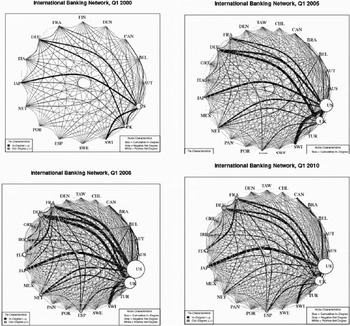
We look first at the network constructed from BIS data.Footnote 30Figure 2 depicts this network in the first quarter of 2000, 2005, 2008, and 2010.Footnote 31 Countries are arranged alphabetically counter-clockwise. Ties are weighted and directed. If country i holds bank assets in country j, a black line connects the two nodes. In this way, the out-degree of i is the in-degree of j. If j holds bank assets in i, a gray line marks that tie, and the out-degree of j is the in-degree of i.Footnote 32 Tie thickness represents the size of the bank holdings that one country has in another. Node size is the sum of the country's total in-degree, or the sum of the banks assets held by all foreigners in that national financial system. A white node indicates that total in-degree is greater than total out-degree for that country, meaning that they are net recipients of bank assets. A gray node indicates that the opposite holds.
International banking network
Source: Bank for International Settlements Consolidated banking statistics Table 9B.

The four panels reveal the strengthening of the interdependence in international banking relationships over time, as represented by the thickening of ties and increased node size. The figures also highlight the extent to which the increase in cross-national bank holdings has been highly skewed toward the US and UK. Thus, as the system became progressively more connected over the course of the decade, the US (and to a lesser extent the UK) became increasingly more central to the system. These network visualizations thus nicely illustrate the development of the global financial fragilities out of which the Great Crisis emerged in 2008. Between 2000 and 2008, global banking assets became increasingly concentrated in the United States. As a result, when the crisis struck the US, most of the major participants in the global financial system were directly exposed.
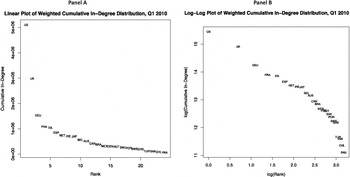
The hierarchical structure of the contemporary banking network is clearly evident in plots of the network's degree distribution. Figure 3a plots weighted in-degree—the number of ties and the average weight of each—for each country against each country's rank in the system. Even in this small sample of large economies, large inequalities in the distribution of bank-centered finance are clearly evident: the US—and to a lesser extent, the UK —is strongly connected to more countries than any other country in the sample, and the degree distribution decays exponentially. Figure 3b plots the same data in log-log scale and shows a similarly hierarchical distribution: the global banking network is skewed and has fat tails.Footnote 33 The network clearly is hierarchical.
Weighted in-degree distribution, international banking network Q1 2010
Source: Bank for International Settlements Consolidated banking statistics Table 9B.

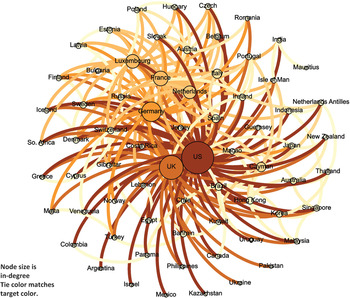
International financial network, portfolio assets. Figure generated with Gephi. (See Bastian, Mathieu, Sebastien Heymann, and Mathieu Jacomy. 2009. Gephi: An Open Source Software for Exploring and Manipulating Networks. International AAAI Conference on Weblogs and Social Media.)

The network constructed from the IMF CPIS data exhibits the same structure (Figure 4). As a contrast to the weighted ties analysis presented above, we transformed this data in two ways. First, we constructed portfolio shares for each country so that each tie is the percent of country i's total overseas portfolio assets that it has placed in country j. Second, we created a directed link from country i to country j for any portfolio share greater than 7.5 percent.Footnote 34 For example, Argentina places more than 80 percent of its overseas portfolio assets in the United States. Argentina is thus linked to the United States. Argentina places less than 1 percent of its overseas portfolio assets in Australia. Argentina is thus not linked to Australia.
The network graph illustrates the center-periphery structure of international financial relationships. The US and the UK are major global financial hubs. Germany and Luxembourg are important European hubs but are less central to the global financial system. We note also the absence of regional organization in East Asia similar to the structure apparent in Europe. The remaining national financial systems are connected to one or more of the financial centers and only rarely to other peripheral countries. Like the banking network, therefore, data on total portfolio assets highlight the hierarchical center-periphery structure of contemporary global financial interdependence.
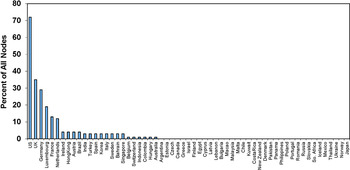
The skewed degree distribution is also evident in a plot of normalized in-degree (Figure 5). The median and modal in-degree in the sample is zero; half of the national economies in the sample are not important hosts of overseas assets for even a single foreign economy. Some national economies, however, are important hosts of overseas investments for many national economies. The most important center, the US, hosts the overseas portfolio assets of 72 percent of the countries in the sample. The UK hosts overseas assets for 35 percent of these countries. Thus, when we look at a broader category of cross-border financial assets and reduce the importance of country size as a determinant of in-degree, we again observe a hierarchical network structure with a sharp differentiation between global financial centers and the periphery.

The contemporary global financial system is thus hierarchical. The United States occupies the center of the financial system, and the UK serves as a second hub. As the global financial center, the US is strongly connected to most other countries in the system. Other countries, even large industrialized countries, are much less strongly connected. Most countries are strongly connected to the United States and only weakly connected to other peripheral countries.
Local Crises and Global Financial Stability
Network science suggests that in a hierarchical network, the global impact of a local banking crisis depends upon where the crisis originates.Footnote 35 Peripheral banking crises are unlikely to trigger global contagion, while banking crises that originate in the center are likely to do so. Consider the global consequences of the three largest crises that have occurred since 1980: the Latin American debt crisis, the Asian Crisis, and the sub-prime crisis. Each crisis originated in a different network location. The Latin American crisis occurred in the periphery: countries were strongly connected to the United States, but weakly to each other. The Asian crisis struck in the semi-periphery: these countries were strongly connected to the US and Japan and attracted investment from other peripheral countries. Finally, the subprime crisis originated in the center. As we shall see, the global consequences of each crisis varied as a function of the relative centrality of the region in which it originated. Only in the subprime crisis does one see banking failures in one country causing bank failures in multiple other countries.
Consider first the Latin American debt crisis. The Latin American debt crisis struck in mid-1982 when sixteen Latin American governments who collectively owed almost $40 billion to the eight largest American banks defaulted.Footnote 36 Technically, this crisis falls outside the scope of the network model we developed above. This crisis did not originate as a banking crisis in Latin American countries that spread to the US. Instead, Latin American governments borrowed heavily from American banks and subsequently encountered negative shocks. As a consequence they could no longer service their commercial bank debt. And this set of defaults imposed a sharp blow on US banks.
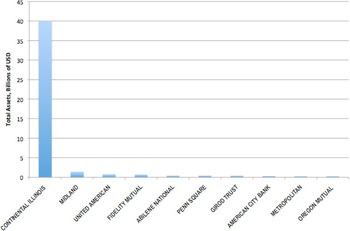
Nevertheless, consider the impact of these simultaneous Latin American defaults on the US banking system. An authoritative FDIC study summarizes this impact: “No large U.S. banks failed [during the 1980s] because of delinquent or nonperforming LDC loans.”Footnote 37Figure 6 illustrates the assets held by the ten largest commercial banks that received FDIC assistance between 1982 and 1986. Continental Illinois, with assets of almost $40 billion, was the only systemically important bank to fail in this period. Its failure resulted from exposure to Penn Square Bank, whose failure was due to over-investment in the Texas oil boom. And what is true about these two failures is true more generally about US bank failures in the 1980s. Over-exposure to the domestic oil sector undermined far more banks than the simultaneous default of sixteen Latin American governments.
Ten largest commercial bank failures, 1982–1985
Source: FDIC.

The Latin American debt crisis certainly was costly for the American banking industry. But, the network model suggests that a crisis that originates in the periphery is unlikely to spark a global banking crisis because the center country absorbs these costs without collapsing itself. In the Latin American debt crisis, sixteen Latin American sovereigns defaulted simultaneously on debt that equaled 147 percent of the capital of the eight largest US banks.Footnote 38 And in the face of this massive shock from the periphery, the US banking system sagged, but it did not shatter. Yes, American banks with heavy exposure to Latin American sovereign borrowers were weakened. Yes, regulators became deeply concerned about potential insolvency of many of the largest American banks. Yes, these large American commercial banks had to recapitalize. But the Latin American defaults did not trigger a systemic crisis in the United States. And in the absence of a systemic crisis in the US, Latin American defaults did not trigger a broader global banking crisis.
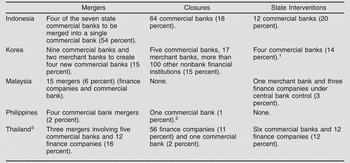
Now consider the global impact of the 1997 Asian crisis. The Asian crisis remains the largest postwar peripheral banking crisis, and the countries involved are among the most connected of all peripheral countries. There is no question about the local severity of the Asian crisis. The magnitude of banking weakness in the Asian crisis countries is evident in the restructuring that followed (refer to Table 1). Governments closed, merged, and intervened directly in a major proportion of the banks and non-bank financial institutions.Footnote 39 The Indonesian government merged half of the state-owned commercial banks and closed another 18 percent of private commercial banks. In South Korea, 15 percent of the commercial banks were closed, and an additional 15 percent of the commercial and merchant banks were merged. Closures, mergers, and acquisitions in Thailand were of a similar magnitude. In all, restructuring cost between 15 and 50 percent of GDP.Footnote 40
Post-crisis consolidation of banking sectors in Asian crisis countries

Source: IMF.
Note: Figures in parentheses refer to percentage of total banking system assets held by the corresponding group of institutions.
1 Banks with over 90 percent government ownership. The government owns varying amounts of shares in seven other commercial banks.
2 Closures of a number of rural banks and small thrifts are not included. Such closures are routine operations in the Philippines.
3 In Thailand, most of the intervened institutions were later merged. Thus, columns one and three include the same institutions.
Yet in spite of its local severity, there is little evidence that Asian bank failures generated banking crises outside the region. The crisis had no discernible impact on the American banking system. According to the Federal Deposit Insurance Corporation, four US banks closed between November 1997 and December 1998. The largest was Best Bank of Boulder, Colorado. Its losses totaled $218 million, far too small to generate a systemic crisis in the US.Footnote 41 Four bank failures in a year is not atypical; six banks failed in 1996. Indeed, Japan is the only industrialized country that experienced a major bank insolvency within the six months following the crisis.Footnote 42 Yet only two institutions failed, and it is unclear whether either failure reflected Japanese bank exposure to the Asian crisis, ongoing weakness specific to Japanese financial difficulties that began several years earlier, or to a combination of these events. Moreover, Japanese difficulties did not spread beyond that country. Thus one sees little evidence that the Asian financial crisis caused major bank failures outside the region.
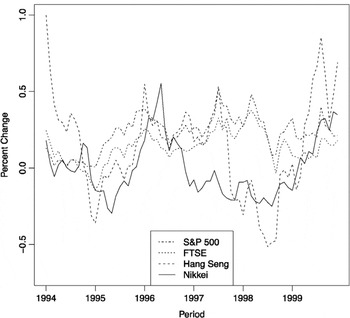
The regional rather than global impact of the crisis is also evident in equity market indices. Figure 7 plots the twelve-month change of the US S&P 500, the UK FTSE, and the Hong Kong Hang Seng, from January 1996 through the end of 1999. Notice that the Hang Seng collapses as the crisis strikes Thailand in the middle of 1997 and substantial losses continue through the middle of 1998. In contrast, the S&P 500 and the FTSE both lose a bit of ground as the Asian crisis breaks, but they both maintain a positive 12-month return and both stabilize relatively quickly. While a major emerging Asian equity market was strongly and negatively affected by the regional crisis, equity markets in the US and UK were largely unaffected. This suggests that while the Asian crisis had a large regional significance, its global impact was limited.
The Asian crisis and equity markets
Source: Global Financial Data.

Our conclusion about the limited global impact of the Asian crisis is consistent with findings reported by financial economists.Footnote 43 One of the more recent studies, for example, evaluates the global consequences of the major peripheral crises of the 1990s (Mexico 1994, Asia 1997, Russia 1998, and Brazil 1999).Footnote 44 The study examines whether these crises altered the probability that banks outside the crisis country would fail. The sample included 334 banks in 28 countries, constituting 80 percent of global bank equity. The research found a small increase in the probability of failure for foreign banks with direct exposure to the crisis country. The largest increase (3.2 percent) came in the 1997 Asian crisis. Thus, even the largest peripheral banking crises have limited impact on bank solvency outside the country involved.
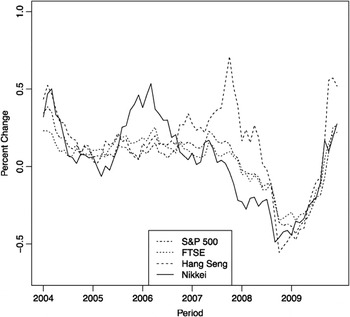
Finally, consider the subprime crisis. The collapse of American financial institutions in the fall of 2008 had a major direct impact on European banking systems. A glimpse back at Figure 4 recalls the extent to which global financial risk came to be increasingly concentrated on developments in the United States over the course of the Naughts. When the crisis broke in the US, the costs were widely distributed across the world. Real estate lenders in Germany, Belgium, Ireland, Italy, and the Netherlands all required government bailouts as they struggled to cope with the impact of their exposure to collapsing values of American real estate. Governments in Ireland and Iceland nationalized the largest banks and turned to the IMF for financial assistance—the first time West European countries have drawn from the IMF since the late 1970s. In all, twenty-three European countries experienced a significant banking crisis following the onset of the American crisis.Footnote 45 Moreover, current sovereign debt problems in Greece, Spain, Portugal, and Italy are lingering consequences of the crisis at the center. The subprime crisis had clear negative consequences for global equity markets too (refer to Figure 8). The collapse of the S&P 500 and the FTSE pulled down the Hang Seng and Nikkei in spite of the fact that neither China nor Japan experienced a property bubble nor were they highly exposed to American subprime assets.
The subprime crisis and equity markets
Source: Global Financial Data.

Thus a crisis in the center generates banking crises in many countries while even the largest peripheral crises failed to generate widespread banking crises in other parts of the system. We realize that some may disagree with our interpretation of the global impact of the Asian and Latin American crises. But these two peripheral crises constitute hard cases for the network model. If ever a peripheral crisis was likely to cause a global banking crisis, then such contagion should be evident in the largest peripheral crises. Moreover, these two episodes constitute a small subset of all peripheral banking crises. Excluding the Asian crisis countries, 116 banking crises occurred between 1975 and 2007.Footnote 46 This includes crises in OECD countries (e.g., Norway 1989, Sweden 1991, Mexico 1994, Turkey 2000, and Argentina 2001) and crises in central and east European and sub-Saharan African countries. None of these crises escalated into a global banking crisis. So the overwhelming majority of peripheral banking crises have not had global contagious consequences. Overall, very little evidence exists to support the claim that peripheral banking crises threaten bank solvency globally.
In short, in a hierarchical financial system the impact of a banking crisis on global financial stability depends upon where the crisis originates. A banking crisis that originates in the center is likely to escalate into a global banking crisis. A banking crisis that originates in a peripheral node—even in a strongly-connected peripheral node—is unlikely to do so. The hierarchical structure of global financial relationships, therefore, may stabilize the system in the face of peripheral crises but make the system vulnerable to crises in the center.
The Great Crisis and the Structure of the International Financial System
Post-crisis commentary has predicted the dissipation of American financial hegemony.Footnote 47 In network terms, the Great Crisis is expected to precipitate a change in the topology of the international financial system. Though few have argued that a new hierarchical topology is likely to emerge anytime soon, most suggest that the system will flatten. Some scholars assert that the BRICs will play a more important role, with China emerging as the first among equals of this group. Others have argued that American centrality will be replaced by a US–EU condominium.Footnote 48 In short, the hierarchical system is likely to be displaced by a flat one.
The network model suggests that the Great Crisis may, but need not, be a harbinger of systemic change. It is quite clear that the Great Crisis was a global rather than a systemic crisis; that is, the crisis reflected mismanagement by the center rather than portfolio adjustments undertaken of a misalignment between the hierarchical structure and the underlying distribution of fit alternatives. Indeed, it is difficult to find anything that enjoys broader consensus than the conclusion reached by the Financial Crisis Inquiry Commission: “the captains of finance and the public stewards of our financial system … failed to question, understand, and manage evolving risks … More than 30 years of deregulation and reliance on self-regulation by financial institutions … had stripped away key safeguards, which could have helped avoid catastrophe.”Footnote 49
The global rather than systemic character of the crisis is also evident in financial market behavior. A systemic crisis should be characterized by (and is defined as) massive net sales of center-country assets. In the fall of 2008, however, the US experienced net capital inflows. As Eric Helleiner points out, “foreign funding of the United States—both public and private—continued during the crisis, even as the United States lowered interest rates dramatically. Indeed, the dollar even strengthened as the crisis became more severe after mid-2008.”Footnote 50 Hence, market participants shifted out of one dollar-denominated asset and into another, a clear indication that even in the middle of the crisis, financial institutions were concerned with a specific asset class (mortgage backed securities) rather than with the United States more broadly. The Great Crisis was a global crisis; it was not a systemic crisis.
Of course, a global crisis can spark structural change. But in order for a global crisis to have this consequence, there must be a gap between the existing hierarchical structure and the underlying distribution of fitness. At present, it is difficult to see evidence of such a gap. The EU does not provide a fit alternative to the US as a world financial center. The EU remains deeply embroiled in and apparently incapable of resolving multiple sovereign debt crises that threatens banking systems across the continent. The inability to address this series of crises has made it difficult to develop a reputation for financial and macroeconomic stability. Key governments have refused to support the institutional developments necessary to transform the EU into a viable center. The Germans in particular have refused to move forward with a euro bond, a necessary step toward generating deep and liquid secondary markets to rival US markets.Footnote 51 The Germans have refused to give the ECB full lender-of-last-resort capacity, and regulatory authority is fragmented across the Union. Ideationally, Europe seems to have adopted norms of austerity that lead to economic and financial contraction rather than growth. As a result, the EU lacks the reputational, institutional, regulatory, and ideational structures required to offer fit alternative to American centrality.
Things are little better in Asia. Japan remains burdened by financial weaknesses that emerged in the late 1980s. The government remains reluctant to embrace a truly international role for the yen, in part because they are reluctant to give up the ability to manage the exchange rate for trade-related purposes. The Asian Tigers have responded to their crises in the 1990s, at least in part, by insulating themselves from global financial markets rather than trying to embed themselves further in them. Moreover, financial markets in these countries are neither deep enough nor sufficiently liquid to occupy a central position. For its part, China looks as though it is beginning to construct the necessary financial infrastructure, but at present it lacks a fully convertible currency and has little presence in global banking.Footnote 52 Moreover, China appears to be suffering from financial weakness of its own. Thus, in the current system no country or region offers an alternative to the US that is fit to serve as the global center.
In the absence of fit alternatives, financial markets have retained the US at the center in spite of financial sector weaknesses and rising public debt. Network centrality measures from the post-crisis era clearly indicate that the US remains at the center of the system. The continued centrality of the US is evident in the banking network in first quarter of 2010 (refer to Figure 2). Other evidence lies in the ability of the dollar to hold its position as a reserve currency since 2010, while the euro has lost ground. Finally, American centrality is evident in the extent to which the US government borrowing costs have benefited from the EU's struggles. The United States government has borrowed at historically low interest rates even as its total debt has increased to a share of GDP unprecedented in a time of peace.Footnote 53 Indeed, borrowing costs for the United States fell during the summer of 2011 even as a political deadlock threatened sovereign default and generated a credit risk downgrade by one of the major global credit ratings agencies.
The network approach is thus more conservative in its expectations about structural change than most post-crisis scholarship. The Great Crisis resulted from the mismanagement of assets by financial institutions at the center, rather than reflecting a large gap between the underlying distribution of fitness and the existing hierarchical structure. As a result, even though the crisis was globally destabilizing, it failed to trigger structural change because the system held no fit alternatives to American centrality, even given the obvious weaknesses in the American financial system. Indeed, the crisis contributed directly to the weakening of the one alternative that most pre-crisis observers considered the most compelling alternative to the US: the emerging euro area.
Conclusion
The global severity of the Great Crisis reflected the structure of the global financial system. The crisis found roots in the ability of the United States to borrow heavily from the rest of the world to finance a real estate boom of historic proportions. The American ability to borrow so heavily was, in turn, a function of its central position within the global financial network. Once the American bubble popped, the resulting financial weakness was distributed globally because so many financial institutions in so many countries either held securities whose value fell sharply as US real estate prices collapsed or were tightly connected to financial institutions that did. The Great Crisis, therefore, was very much a systemic crisis—generated by and distributed through the global network of creditor-debtor relationships.
Although all researchers recognize its importance, prevailing IPE perspectives rarely offer explicit models of the international financial system. In network terminology, existing perspectives assume that the international financial network is flat. In a flat network, the system is only as strong as its weakest link; a banking crisis anywhere can spark contagion that threatens the system as a whole. Hence the key to global financial stability lies in strong and effective financial regulation in all countries that participate in the system. And to the extent that states can compete for financial business using regulation, then effective domestic regulation must be supported by global regulatory arrangements. The implicit assumption that the financial system is flat is accompanied by the belief, typically advanced much more explicitly, that the global distribution of power is flattening as well. The Great Crisis has weakened American material and ideational power. Consequently, a system dominated by American hegemony is giving way to one in which the EU and large emerging-market countries hold much greater influence.
We have problematized this treatment. Drawing on recent developments in network science, we have made explicit the relational structure of international financial interdependence. A first important consequence of adopting this approach is the recognition that we should characterize international financial interdependence along two dimensions: tie strength and tie structure (or degree distribution). A deeply integrated international financial system may be a flat network in which all countries are connected in roughly the same degree, or it may be a hierarchical network with a clear center and periphery. We offered empirical evidence to suggest that the contemporary financial interdependence is better characterized as a hierarchical network than as a flat network. The international financial system exhibits a strongly hierarchical structure in which the US stands at the center of the system and almost all other countries reside in the periphery.
Being explicit about the network topology of the international financial system is important because network structure conditions system performance. In particular, the impact that a local banking crisis has on global financial stability may depend upon whether the network is flat or hierarchical. In a densely connected flat system, a crisis in any country can spread through the entire system and thereby generate a global crisis. In a hierarchical system, crises in peripheral countries are unlikely to spread far, while crises in the center are likely to destabilize the entire system. Being explicit about the network topology of the international financial system also helps us theorize about system change. As network scientists recognized that many real-world networks are hierarchical, they began to search for the mechanisms that “grew” hierarchical structures. We have drawn on this research to suggest that hierarchy in the international financial network may emerge from the interaction between country characteristics (fitness) and positive feedback in financial markets (preferential attachment). Exploring the deepening of financial interdependence through this lens may provide initial steps toward a more fully developed approach to system dynamics. We can begin to explore how local changes in fitness and system-wide positive feedback interact to create, reinforce, and alter the system over time. This network approach suggests that realist-inspired approaches may over-predict system change (by neglecting positive feedback) and weigh market size too heavily as the central characteristic of country fitness.
The network model also has implications for how we view real-world developments moving forward. Three seem most relevant. First, the perspective encourages a differentiated view of financial crises. It suggests that the vast majority of financial crises do not pose system-wide threats. Local financial instabilities in Greece, Spain, Portugal, and Ireland, for instance, pose unquestionably large and unprecedented challenges to EU policymakers. Chinese policymakers appear to face emerging financial challenges as their real estate bubble deflates. And it is likely that other emerging markets will experience debt-induced banking and financial crises in the near future. In a hierarchical financial system, however, crises in these peripheral nodes pose little threat to global financial stability. This suggests that societies can derive benefits from global financial interdependence without necessarily accepting elevated instability.
Second, the network perspective alters how we conceptualize the regulatory challenges generated by international financial interdependence. The discussion about American financial regulation in the wake of the crisis routinely differentiates between classes of financial institutions based on their systemic importance; “systemically important financial institutions,” it is argued, must face more stringent regulations than small banks. Our network model suggests that this paradigm has applications to global financial regulation as well. Some countries are “too big to fail” while others can fail with few systemic consequences. Hence, rather than a single one size fits all global regulatory regime that is common practice now (the Basel Accords), an approach that crafts more stringent rules for systemically important countries than for less central peripheral countries might be more easily negotiated and every bit as effective in delivering a stable global system.
Finally, the US is more firmly ensconced at the center of the global financial system than commonly appreciated. The absence of fit alternatives at present, given the EU's struggles and China's lack of financial development, and extant positive feedback effects interact to keep the US at the center of the global financial system for the foreseeable future. This implies that the United States will and arguably should play a dominant role in shaping global regulations moving forward. After all, given the systemic importance of central countries, the surest path to system stability lies in financial stability in the United States. And while EU and emerging-market countries have a clear and compelling interest in US regulatory arrangements—because they suffer costs when these arrangements fail—the US is much more likely to adopt regulations that Congress designs than rules generated by international committee. While this might be lamentable from a global legitimacy point of view, the situation might actually be relatively efficient from a financial stability perspective.
This network model is only a first step toward an IPE that focuses on the structure within which actors are embedded as well as on the actors themselves. We believe that such an approach is important because the international system is a complex system, characterized by processes and outcomes that cannot be inferred from knowledge of attributes of the actors alone. We believe that network science holds potential for studying this system because it pushes us beyond conventional categories, but allows us to redefine rather than abandon conventional categories. We believe that network science holds potential because it encourages us to theorize in terms of actor characteristics and relationships, rather than to focus on one and to neglect the other.