INTRODUCTION
Nematode fitness is essentially the number of successfully breeding offspring that become established in all hosts, a simple parameter in definition but a difficult variable to record. A good correlate of nematode fitness is the lifetime production of transmission stages, the fertilized eggs. Two major processes shape the rate of egg production in nematodes: the parasite density-dependent constraints, like competition between worms for resources, and the host-mediated effects, particularly the immune response which can reduce worm development and survival, and number of eggs (Tompkins and Hudson, Reference Tompkins and Hudson1999; Viney, Reference Viney2002). The relative importance of host and parasite processes consistently varies during the course of an infection and alters both egg production and parasite development in a non-constant way. For example, experimental infections of Scottish Blackface sheep with the gastrointestinal nematode Teladorsagia circumcincta found an association between the reduction in nematode length and number of eggs in utero and the increase in immunoglobulin A activity and eosinophilia, but this effect was apparent only in lambs that were at least 3 months of age (Stear and Bishop, Reference Stear and Bishop1999; Strain et al. Reference Strain, Bishop, Henderson, Kerr, McKellar, Mitchell and Stear2002; Henderson and Stear, Reference Henderson and Stear2006). In ring-necked pheasants, the length and number of eggs in utero of the intestinal nematode Heterakis gallinarum increased when worm intensity was below a threshold value (~100 worms), above this threshold a negative density-dependent relationship was observed (Tompkins and Hudson, Reference Tompkins and Hudson1999). Similarly, the host-mediated regulation of the length, fecundity and survival of the rat nematode Strongyloides ratti occurred only in the late stage of the infection, when the parasite numbers reached a threshold level and triggered an immune response (Bleay et al. Reference Bleay, Ilkes, Paterson and Viney2007). In general, host-mediated immunity appears to have a major role in many host-parasite responses and has led to some workers to propose that this is also important in mediating parasite density-dependent regulation on establishment, survivorship and fecundity (Paterson and Viney, Reference Paterson and Viney2002). Indeed, acquired immunity can control nematode numbers, their gastrointestinal position, adult body length and fecundity directly, by targeting the parasitic nematodes or causing them stress, as well as indirectly through the control of nematode density-dependent processes (Moqbel and McLaren, Reference Moqbel and McLaren1980; Paterson and Viney, Reference Paterson and Viney2002; Wilkes et al. Reference Wilkes, Bleay, Paterson and Viney2007).
Over and above the host-parasite interaction, gastrointestinal nematode infections usually exhibit strong seasonal patterns that can amplify the host and parasite regulatory responses at particular times of the year. For example, parasites of Svalbard reindeer are exposed to a strong seasonal climatic regime that modulates their infection dynamics (Irvine et al. Reference Irvine, Stien, Halvorsen, Langvatn and Albon2000). Density-dependent regulation significantly contributed to the variation in length of Ostertagia gruehneri but only in specific months of the year (Irvine et al. Reference Irvine, Stien, Dallas, Halvorsen, Langvatn and Albon2001). A seasonal pattern was also observed in the relationship between female length and number of eggs in utero, which suggests a seasonal demographic effect on nematode transmission (Irvine et al. Reference Irvine, Stien, Dallas, Halvorsen, Langvatn and Albon2001; Stien et al. Reference Stien, Irvine, Langvatn, Albon and Halvorsen2002). In general, both nematode length and number of eggs appear to respond to host characteristics and parasite density dependence in a very similar way and generate a strong positive relationship between egg production and nematode body length (Michael and Bundy, Reference Michael and Bundy1989; Gulland, Reference Gulland1992; Stear et al. Reference Stear, Bishop, Doligalska, Duncan, Holmes, Irvine, McCririe, McKellar, Sinski and Murray1995; Tompkins and Hudson, Reference Tompkins and Hudson1999; Richards and Lewis, Reference Richards and Lewis2001). However, some exceptions have been reported. Strongyloides ratti promotes the concentration of antibodies and cytokines IL-4 in their rat host, but changes in the immune status, from immunized to immuno-suppressed hosts, resulted in an increase in nematode fecundity and only a partial gain in body length (Viney et al. Reference Viney, Steer and Wilkes2006; Wilkes et al. Reference Wilkes, Bleay, Paterson and Viney2007).
The relative influence of the host and parasite effects on the development and fecundity of a nematode is important if we want to understand transmission and parasite-host dynamics. To examine these interactions in an age-structured population, and also to understand the seasonal aspect of the system, we used the gastrointestinal nematode Trichostrongylus retortaeformis in a free-living rabbit population sampled throughout the year. We explored whether the direct influence of host-mediated effects alone, such as sex and age (age is also used here as an indirect measure of immunity), were sufficient to explain changes in parasite length and egg number, or if the role of parasite intensity was more relevant. If the host-mediated response, specifically acquired immunity, has a major influence on nematode length and fecundity our prediction is that both length and number of eggs will decrease as the hosts become more heavily exposed to the infection. Alternatively, if density-dependent parasite processes drive nematode length and number of eggs in utero, we predict that these two variables will decrease with an increase in nematode abundance, irrespective to the time and duration of exposure. Finally, if seasonality is relevant we expect to observe monthly changes in the relative effect of the host and the parasite.
MATERIALS AND METHODS
The system
The gastrointestinal nematode T. retortaeformis infects the small intestine of its natural host, the European rabbit (Orytologus cuniculus), and infection occurs through ingestion of free-living 3rd stage infective larvae. The pre-patent period is between 11 and 12 days and patency lasts up to 2–3 months, based on a laboratory single infection of rabbits with 5000–10 000 3rd stage larvae (Haupt, Reference Haupt1975). Recent studies on the epidemiology of T. retortaeformis in the rabbit population used in this study and sampled between 1977 and 2002, have found that intensities rise with host age to a peak in juveniles before decreasing in older individuals, a pattern consistent between cohorts of rabbits born in different months (Cattadori et al. Reference Cattadori, Boag, Bjørnstad, Cornell and Hudson2005). Further analyses and modelling of this system suggested that seasonal changes in the immune response accounted for these profiles and may have played a major role in affecting the dynamics of T. retortaeformis infection (Cattadori et al. Reference Cattadori, Boag, Bjørnstad, Cornell and Hudson2005; Cornell et al. Reference Cornell, Bjørnstad, Cattadori, Boag and Hudson2008). However, seasonal changes in female breeding conditions as well as offspring quality also contributed to the pattern observed (Cornell et al. Reference Cornell, Bjørnstad, Cattadori, Boag and Hudson2008). Laboratory infections of rabbits with this nematode found alteration of the mucosa morphology with signs of inflammation and concentration of mononuclear inflammatory cells, especially plasma cells (Barker and Ford, Reference Barker and Ford1975; Audebert et al. Reference Audebert, Vuong and Durette-Desset2003), which supports the epidemiological results of a host immune-mediated mechanism.
Nematode collection and parasitology
Adult stages of T. retortaeformis were recovered from a population of European rabbits shot monthly from 2004 to 2007 in Perthshire, Scotland (Latitude 5°29′40″N, Longitude 3°9′55″W), as part of a regular pest control procedure applied according to UK regulations. For each rabbit sampled, a careful inspection of the small intestine was performed: T. retortaeformis specimens were identified, the total number recorded and a subsample of at least 10 adult nematodes taken and stored in 0·4% formalin. Host characteristics (sex, breeding status, age and biometry) were also recorded following procedures as described by Cattadori et al. (Reference Cattadori, Boag, Bjørnstad, Cornell and Hudson2005, Reference Cattadori, Boag and Hudson2008). For this study, we selected subsamples of nematodes collected from rabbits shot in alternate months from January to November. Each specimen was examined using a digital camera (Infinity 1, Lumenera Corporation, Canada) connected to an Olmpus SZ-CTV microscope. Nematodes were sexed and length, from head to tail, was measured using the Poly-line option from the measure menu of the Image Analysis software Infinity v4.5.0 (Lumenera Corporation, Canada). The number of eggs in the uterus was counted, with careful attention not to confuse body fat or undigested food within the nematode for eggs. Eggs of T. retortaeformis are aligned along the uterus and could be easily counted without physically disrupting the females' body. In this paper the number of eggs in utero is defined as the total number of eggs counted in the uterus of a female nematode, irrespective of their level of development.
Statistical analysis
Initially, we examined the seasonal relationship between nematode length, or number of eggs in utero, and host age in each cohort of rabbits born in alternative months, which included January, March, May, July, September and November, and averaged over 4 years from 2004 to 2007. Details on the reconstruction of the rabbit age and the cohort they belong to (named by the month of birth) were reported by Cattadori et al. (Reference Cattadori, Boag, Bjørnstad, Cornell and Hudson2005, Reference Cattadori, Boag and Hudson2008). To describe and visually compare the nematode length-host age relationship, a weighted 4th order smooth spline curve was fitted to each rabbit cohort (Cattadori et al. Reference Cattadori, Boag, Bjørnstad, Cornell and Hudson2005). Spline curves can describe a wide variety of shapes, irrespective of the data distribution (Hastie and Tibshirani, Reference Hastie and Tibshirani1990). The curves well described our data and the fitting precision was strongly improved by weighting the curves with the number of samples. Since we used nematode specimens from rabbits sampled in alternative months, the temporal distance between consecutive host age-mean nematode length points corresponds to a 1-step age increment over a 2-month temporal interval. This procedure was repeated for the relationship between mean eggs in utero and host age. We also examined the relationship between nematode intensity (calculated across all individuals, including uninfected rabbits) and host age. In this case the time between consecutive intensity-age points represents a 1-step age increment over a 1-month interval, which is based on the nematode intensity regularly recorded from rabbits sampled every month.
Linear mixed-effect models with restricted maximum likelihood (LME-REML) were used to identify the factors that mainly influenced body length or viable number of eggs in utero. Nematode length, or number of eggs, as a response variable, was examined in relation to host age, sex, breeding status, month of sampling, nematode intensity and their interaction. To take into account the replicated effect of measuring nematodes from the same rabbit host, the rabbit ID number was used as a random effect and nested into month of sampling, host sex and host age, where month of sampling represents the highest level of nesting. The best minimum adequate models are presented and discussed.
RESULTS
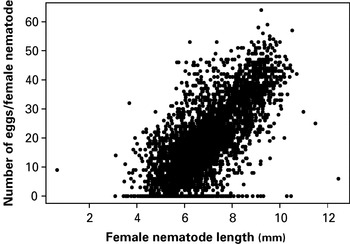
T. retortaeformis adult females were significantly longer than adult males (mean±s.e.: 6·934±0·0214 mm N=3888 and 5·791±0·0235 mm N=2110 for females and males respectively, Wilcoxon rank sum test with continuity correction for non-normally distributed errors W=6101912, P<0·001). The mean number of T. retortaeformis eggs in utero was 19·66±0·202 N=3890, and a strong linear relationship was observed between female length and the total number of eggs (GLM with negative binomial errors: y=0·003x+0·484, N=3882, R2=58%, P<001, Fig. 1), suggesting that fecundity linearly increases with body length.
Relationship between length of Trichostrongylus retortaeformis adult females and number of eggs in utero from rabbits sampled in alternate months from January to November between 2004 and 2007.

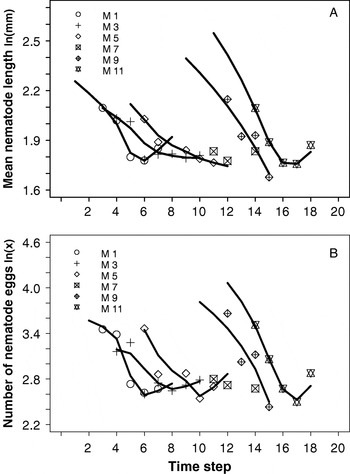
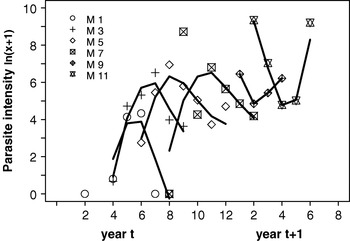
Initially, the relationship between nematode length (males and females combined), or number of eggs in utero, and host age was visually examined in cohorts of rabbits born in alternate months, from January to November and averaged over 4 years of data. Mean nematode length exponentially decreased with host age in all the profiles (Fig. 2A). This analysis was repeated using the number of eggs in utero and similar curves were observed. The number of eggs decreased with rabbit female age, reached the lowest numbers in early adults and tended to increase in the oldest hosts (Fig. 2B). To explore if parasite intensity was consistent with these profiles, the relationship between host age and parasite intensity was examined in the alternate months that matched with the body length and egg data for the period 2004–2007. The shape of the monthly curves showed a very different relationship: in every cohort of rabbits, mean nematode intensity increased with host age, peaked in juvenile hosts and decreased in older individuals (Fig. 3).
Relationship between host age and (A) adult Trichostrongylus retortaeformis length (males and females combined), and (B) number of eggs in utero, in cohorts of rabbits born monthly from January (M1) to November (M11). The temporal distance between consecutive nematode-host age points corresponds to a 1-step host age increment over a 2-month interval; a weighted spline curve is fitted to the data averaged over 4 years.

Relationship between host age and mean Trichostrongylus retortaeformis intensity in a cohort of rabbits born monthly. Only alternate months are presented, from January (M1) to November (M11). The temporal distance between consecutive nematode-host age points corresponds to a 1-month interval; a weighted spline curve is fitted to the data averaged over 4 years.

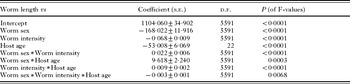
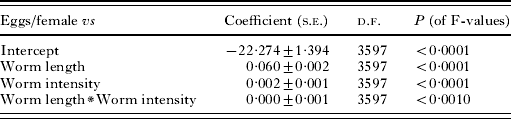
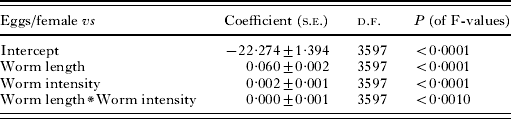
To quantify the relative contribution of host characteristics and nematode intensity to these seasonal host-nematode profiles, linear mixed-effect models (LME-REML) were applied where nematode length or number of eggs, as response variables, were examined in relation to nematode intensity, host age, sex, breeding condition and month of sampling. The best fitting model suggested that T. reto-rtaeformis length (males and females combined) was strongly affected by nematode sex, host age and their interaction (Table 1). Body length decreased with host age, nematode intensity and from female to male worms. However, when worm sex is taken into account, T. retortaeformis length tended to increase in the oldest, less-parasitized rabbits and from female to male nematodes (Table 1). The remaining interactions, while significant, had a relatively low contribution. The analysis was repeated using only female body length as a response variable and similar results were observed: female body length decreased with host age and secondly with nematode intensity (LME-REML, coefficient±s.e. and d.f. −44·122±5·976 and 22 and −0·043±0·005 and 3603, respectively, for both P<0·0001); the interaction between intensity and age was significant but had a weak positive role (coefficient±s.e. and d.f. 0·006±0·001 and 3603, P<0·0001). We also examined which variables affected the number of eggs in utero and female body length (males excluded) was the only strong variable that was significantly and positively associated with the number of eggs (Table 2).
Linear mixed-effect model between Trichostrongylus retortaeformis length (males and females combined) and parasite and host factors

Linear mixed-effect model between number of eggs in utero and parasite and host factors. Only female nematode length is used
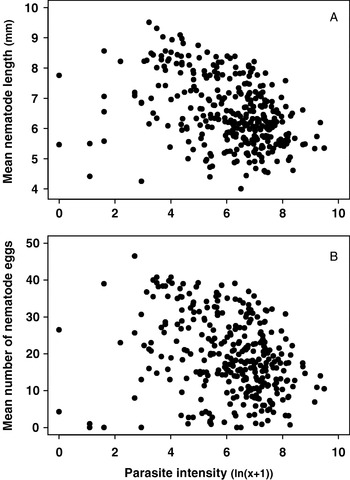
We looked in more detail at the association between nematode infection and worm measures, and a negative relationship was found between nematode length (males and females combined) and parasite intensity (GLM with Poisson errors: y=−0·00003x+6·522 N=5991 R2=52%, P<0·001, Fig. 4A). However, a large variation in body length was observed at low T. retortaeformis intensities, which corresponds to the average infection rate of young and old rabbits (compare Fig. 4A with Fig. 3 and also the interaction term ‘Worm intensity∗Host age’ in Table 1). We also found that the number of eggs in utero decreased with parasite intensity but, again, with large variability among the data (GLM with negative binomial errors: y=−0·00009x+3·083, N=3879, R2=51%, P<0·001, Fig. 4B).
Relationship between Trichostrongylus retortaeformis intensity and (A) adult nematode length (males and females combined) and (B) number of eggs in utero.

DISCUSSION
We explored the relative effect of host characteristics and parasite intensity on body length and the number of eggs in utero in adult T. retortaeformis collected seasonally from a wild population of rabbits. While the number of eggs was determined primarily by female body length, nematode length (males and females combined) was strongly influenced both by nematode sex and host age, which represents a proxy for the duration of nematode exposure and the development of acquired immunity (Woolhouse, Reference Woolhouse1992; Cattadori et al. Reference Cattadori, Boag, Bjørnstad, Cornell and Hudson2005; Cornell et al. Reference Cornell, Bjørnstad, Cattadori, Boag and Hudson2008). These results were further supported by using the female nematode subsample and by finding a strong negative relationship between female nematode length and host age. The nematode measures recorded from our natural rabbit population are in agreement with previous studies on laboratory infections of T. retortaeformis in rabbits (Audebert et al. 2000), and emphasize how changes in the length of male and female nematodes occur within hosts of different ages and sexes, and among hosts sampled in different seasons.
We found that nematode length (males and females combined) and the number of eggs in utero fell exponentially with host age. This pattern was consistent among cohorts of rabbits born monthly and was also associated with convex profiles of parasite intensity with rabbit age. These observations support the hypothesis of a host-mediated effect on nematode length and intensities.
Epidemiological analyses of the seasonal changes in the age-intensity relationship from this system and controlled laboratory infections of rabbits suggested that T. retortaeformis stimulates an acquired immune response in its common host (Michel, Reference Michel1952; Barker and Ford, Reference Barker and Ford1975; Audebert et al. Reference Audebert, Vuong and Durette-Desset2003; Cattadori et al. Reference Cattadori, Boag, Bjørnstad, Cornell and Hudson2005, Reference Cattadori, Albert and Boag2007; Cornell et al. Reference Cornell, Bjørnstad, Cattadori, Boag and Hudson2008). It is possible that immunity influences the growth rate of worms and hence the length of adult T. retortaeformis and, indirectly, the number of eggs in utero. As rabbits mature their acquired immune response is more effective against parasitic infections. This may decrease nematode intensity and also slow the development of T. retortaeformis and reduce its ability to produce eggs. Interestingly, there was a tendency for the egg number and body length to increase in much older hosts. One possible explanation is that while acquired immunity reduced the number and length of worms, as well as their productivity, the fall in intensity released any density-dependent pressure on worm measures and thus nematodes could grow larger and more fecund. Indeed, the results showed a negative relationship between T. retortaeformis intensity and nematode length, or number of eggs in utero, particularly at medium-high intensities. These associations support the hypothesis that parasite density dependence imposes strong constraints at high nematode numbers and therefore, may contribute to the pattern observed only at high parasite intensities. In older rabbits, where parasite intensity is low, nematodes may have been released from such effects and started to grow in length and produce more eggs.
All these arguments are based on the assumption that both host-mediated effects and nematode density-dependent processes directly influence T. retortaeformis characteristics. However, it is also possible that acquired immunity modulates nematode density dependence, especially if the host is able to mount a strong immune response and, thus, control both directly and indirectly T. retortaeformis growth and fecundity. Strong support for this hypothesis is the evidence of a convex relationship between host age and parasite intensity (this work and Cattadori et al. Reference Cattadori, Boag, Bjørnstad, Cornell and Hudson2005) as well as a negative relationship between nematode intensity and nematode measures (body length and number of eggs). We did not find any direct effect of the host on number of eggs in utero but we did find a significant and strong linear relationship between length of adult female nematodes and number of eggs suggesting that, while the rabbits' mechanisms seem to target mainly worm body length, there is a strong knock-on effect that can reduce the number of eggs. The relative contribution of host effects and nematode intensity changed throughout the course of T. retortaeformis infection but the general pattern was consistent among cohorts of rabbits born in different seasons.
Our results suggest that host-mediated effects contributed to the pattern observed. A likely mediator is the host immune system, which operated directly affecting nematode body length and indirectly modulating parasite density-dependent processes, mostly at high nematode intensities. However, other mechanisms may have been involved in such a trend. For example, the oldest and biggest nematodes may have simply died and been shed into the environment during the course of the infection, leaving the hosts with a population of smaller younger worms. Alternatively, T. retortaeformis may have aged with their host, shrinking and reducing their fertility as they got older, irrespective of the environmental conditions they were exposed to. The tendency to find bigger nematodes in the very old rabbits may be the recruitment of a new generation of worms that can grow fast under low density constrains. While these hypotheses are interesting, we currently have insufficient data to disentangle these alternatives.
C.C. performed this work during her 3-month Ph.D. rotation with IMC. This study and B.B. were funded by the HSFP (RGP0020/2007). I.M.C. was supported by a Royal Society University fellowship.