Introduction
This research examines the practice of designing spatial configurations on the basis of metaphoric relations that designers attribute to the design elements. We approach the task of formalizing this practice by studying it in the context of traditional Japanese rock garden (JRG) design and the way in which metaphors may guide the design process of rock compositions.
Metaphors are powerful cognitive devices (Lakoff and Johnson, Reference Lakoff and Johnson2003) often used by designers to encode systems of deep relations into a concise verbal description (Casakin, Reference Casakin2006) that enables the development of a conceptual understanding of the design activity (Hey et al., Reference Hey, Linsey, Agogino and Wood2008). Surprisingly, some of the most celebrated JRGs (such as Ryōan-ji, Kyoto; recognized by UNESCO as a world heritage site in 1994) were designed using metaphor-based practices more than half a millennium ago. Given their frugal nature, which focuses on a spatial design using a well-defined collection of elements, JRGs serve as a solid ground for studying this practice in a systematic manner.
In traditional JRGs, using metaphoric descriptions such as “Buddhist triad” (Fig. 1; Mansfield and Richie, Reference Mansfield and Richie2009) to describe a rock composition is a common practice. These short titles enabled JRG designers to establish a unique design language, cleverly tying spatial relations with linguistics expressions, offered to the designer as intuitive design catalysts. Using these expressions as the basis for designing a rock composition demands designers to (1) interpret the metaphor in terms of spatial relations, (2) select the rocks for the composition, and (3) position them in the garden space.
(Left) Rock configuration referred to as a “Buddhist Triad”, Daitoku-Ji, Kyoto (Mansfield and Richie, Reference Mansfield and Richie2009), also see Figure 9; (right) a Buddhist Triad sculpture (“Amida Raigo Triad”), 1100~ AD (Source: Kyoto National Museum)

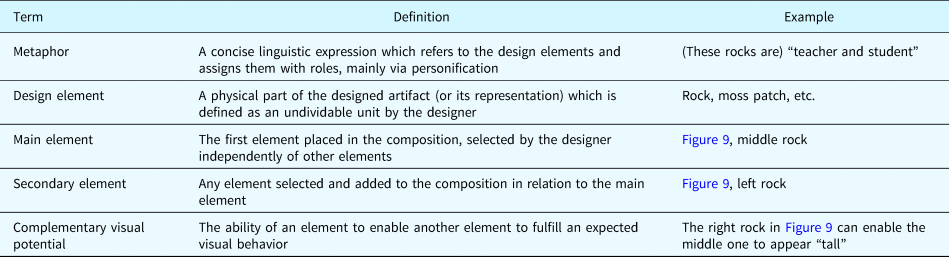
JRG compositions are created using “ready-made” elements, that is, the rocks must be used as they are found in nature (Takei and Keane, Reference Takei and Keane2001). Consequently, the resulting design largely depends on the inherent properties of each rock and its relations to those of the other rocks in the composition. We may say that each rock has a potential to enable certain visual behaviors when combined with other rocks in the garden space (for example, a tall rock can make a neighboring rock appear shorter). To describe this potential, emerging from the possible visual interaction between different rocks, we propose the term “complementary visual potential”, which can be seen as the ability to enable another rock to fulfill its metaphoric role in the composition (further discussed in “Key concepts”). Utilizing the concept of complementary visual potential, a framework for metaphor-based design is proposed and implemented, in an attempt to auto-generate alternative designs for an existing rock composition in a famous rock garden in Kyoto, Japan. The alternative designs are presented, and conclusions are drawn regarding the ability of the framework to support a metaphor-based conceptual design process. Important definitions and abbreviations are provided in Tables 1–3.
Key terms used in ”Key concepts”

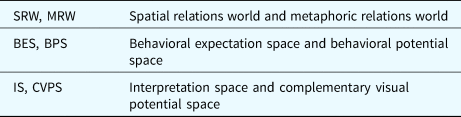
Abbreviations used in ”The proposed framework”

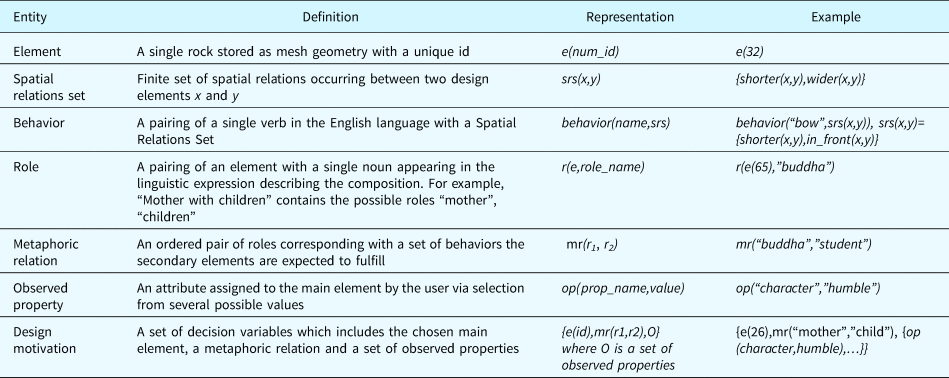
Entities of the implemented system and their formal representation

Aims and scope
This research clarifies how simple metaphoric relations between design elements can be interpreted to allow designers to form different spatial configurations at the conceptual design stage by studying this practice in the context of JRGs.
As an initial effort to establish a clear foundation for formalizing this practice, this study focuses solely on simple compositions consisting of three elements and on the translation of possible metaphoric relations into spatial configurations in such settings. In this, we exclude the following from consideration: (1) other JRG elements, that is, pebbles, moss, etc., and (2) the esthetic dimension of the composition. While other elements, as well as esthetic considerations, play a significant role in our experience of JRGs, both can be seen as a higher-level aspect of the design, which may be attended to in further studies. This is consistent with the traditional guidelines for JRG design given by Takei and Keane (Reference Takei and Keane2001) and also mentioned by Van-Tonder and Lyons (Reference Van Tonder and Lyons2005), in which the positioning of rocks plays a critical role in the design, and serves as a guiding factor for the selection and positioning of other design elements.
Objectives
Two main objectives were set to: (1) identify the main principles which underlie the metaphor-based design process well established in traditional JRG design and organize them into a coherent design framework and (2) test the framework by implementing it in a three-dimensional (3D) environment via generating alternative designs for an existing three-rock composition.
Significance
This study contributes to the understanding of spatial configuration design as an interaction between the spatial properties of the design elements and their metaphoric roles in the composition. We present the potential target groups which may benefit from this research in a (suggested) rising order of relevance:
1) Theorists of design and design cognition who are interested in the mutual dependency between design elements in visual design in a systematic manner.
2) Knowledge engineers in the field of design science, as a basis for a knowledge representation framework which formalizes this dependency.
3) Designers of any discipline incorporating a visual dimension who would like to better understand the practice of utilizing metaphors in design.
4) Software developers of intelligent CAD systems and/or design agents targeted at supporting the translation of metaphoric relations into spatial configurations.
For each target group, we also provide possible utilizations of the framework. For theorists of design and design cognition, the framework can be used as the basis for conducting empirical studies of the relation between metaphoric interpretation and spatial configuration and for identifying common practices in the assignment of roles which project relations and expectations onto the design elements. For knowledge engineers in the field of design science, we see the potential to extend the framework to address additional aspects of the interaction between design elements (for example, functional, esthetic, etc.). Other designers engaged in the visual dimension may benefit from the framework through examining their designs from the perspective of element roles and their related expectations which are mutually projected. Finally, software developers of intelligent CAD systems could integrate the framework into CAD environments with logical inference systems for enabling spatial reasoning based on logical predicates.
Key concepts
Here, we provide the necessary background for understanding the proposed framework and define key terms and concepts. These are summarized at the end of this section in Table 1.
Metaphoric relationships between rocks in JRGs
As evident in the classical manuals for JRG design “Sakuteiki” and “Illustrations for designing mountain, water and hillside field landscapes” (both written by unknown authors), metaphors are extensively used as a basis for the design of rock compositions. This is employed in the design process by assigning names to preferred configurations (see Fig. 1) or even short titles containing a concise narrative such as “a tiger carrying its cubs across a river” (Yamada, Reference Yamada2009). These metaphors are not merely verbal descriptions imposed on the design as an afterthought but rather sophisticated design tools which tie form, position, and meaning (Slawson, Reference Slawson1991; Nakagawara, Reference Nakagawara2004). In this paper, we focus on metaphors expressed by concise verbal descriptions which assign roles for each design element mainly by personification. Accordingly, in the context of JRGs, such metaphors assign roles to rock elements and thus imply that spatial relations are expected to be maintained with neighboring rocks as discussed below.
Main and secondary elements
Our approach to formalizing the design process of rock compositions depends on one of the fundamental instructions given in the “Sakuteiki” (generally considered as the top classical manual for JRG design) regarding how one should go about positioning the rocks in the garden: “Choose a particularly splendid stone and set it as the Main stone … following the request of the first stone, set others accordingly” (this is given as the second instruction in the “Setting Stones” section, following the preparatory instruction of carrying rocks to the garden site, etc.; Takei and Keane, Reference Takei and Keane2001). We interpret this instruction as guiding the designer to select a first rock (hereafter referred to as a main rock), examine its prominent features, and add rocks to the composition (referred to as secondary rocks) in relation to the features observed. This distinction between main and secondary rocks can be generalized to a broader context as a distinction between main and secondary design elements; main elements are selected by the designer (independently of other elements) as an anchor for the composition, while secondary elements are added in relation to the main ones, in attempt to fulfill certain metaphoric relations.
Roles, behaviors, and spatial relations
The metaphoric relations mentioned above are the product of the roles implied by the metaphor, which is chosen by the designer as a basis for creating the configuration. For example, if we wish to design a composition based on the metaphor “mother protecting children”, we may map the role “mother” onto the main design element and the role “children” onto the secondary ones. The relationship the designer associates with these roles will correspond with behaviors that the main element demands secondary elements to fulfill, hereafter referred to as expected behaviors (Gero, Reference Gero1990).
When creating a composition, we define our design goal as to enable the main element to fulfill its metaphoric role in the composition, which occurs when the secondary elements fulfill their expected behaviors. This requires determining which elements are proper candidates to fulfill the expected behaviors imposed on them by the main element, by evaluating their complementary visual potential, as explained in “The concept of complementary visual potential”.
In the context of JRGs, the main rock may be assigned with different roles, each imposing certain expected behaviors onto its secondary rocks in the composition. Typical linguistic (semantic) metaphors underlying the spatial relationship of rock arrangements are “Buddhist triad”, “teacher-student”, and "mother-children”. While at first glance, these may seem rather different, their similarity is readily revealed when considered through the lens of East-Asian thought: the 5 Relationships of Confucianism set basic guidelines for human relations based on the concept of superior–inferior. This is complemented by the yin-yang theory, which emphasizes the fundamental dependencies existing between seemingly opposing or contrasting elements in the world. For example, a teacher is referred to as superior only in relation to a group of students, who are his/her inferiors – as nicely put by Alan Watts: “I can't play the teacher unless you play the student” (Reference Watts2017). Analogously, rock arrangements which correspond with the above linguistic expressions consist of one superior figure (main; imposing expected behaviors) and at least one inferior figure (secondary) and are therefore often expressed visually and interpreted conceptually as interchangeable, if not identical.
Concept of complementary visual potential
The concept of complementary potential finds its roots in the concept of Affordance (Gibson, Reference Gibson2015) and its view as an “ability” as proposed by Kannengiesser and Gero (Reference Kannengiesser and Gero2012) or an “action possibility” (McGrenere and Ho, Reference McGrenere and Ho2000). Accordingly, we precede its definition with a brief discussion of affordances. An affordance can be seen as a visual cue for possible interactions with an object (Soegaard, Reference Soegaard2002) owing either to its inherent or perceived properties. While there are different approaches regarding the nature of affordances, it is generally agreed that the existence of an affordance depends on the spatial relations between the two sides – the agent and the object. For instance, if an object is to afford “grasping”, its physical dimensions and shape need to match the hand of the grasping agent.
In the domain of visual design, each element in a composition has various properties which may enable different visual impressions for the viewer, when combined with other elements in the composition. For example, one object may enable another to appear very large, if the former is significantly smaller than the latter. Therefore, from the standpoint of viewing affordance as an ability depending on spatial relations, we may say that elements in a composition also “afford” certain behaviors to each other. Maier and Fadel (Reference Maier and Fadel2009) have proposed the notion of “artifact-artifact affordance” which is relevant for our discussion; however, since our study focuses on the visual aspect of the interaction between the design elements, we use the term “complementary visual potential” to describe this ability, in order to avoid confusion with the concept of affordance, which stresses the aspect of function.
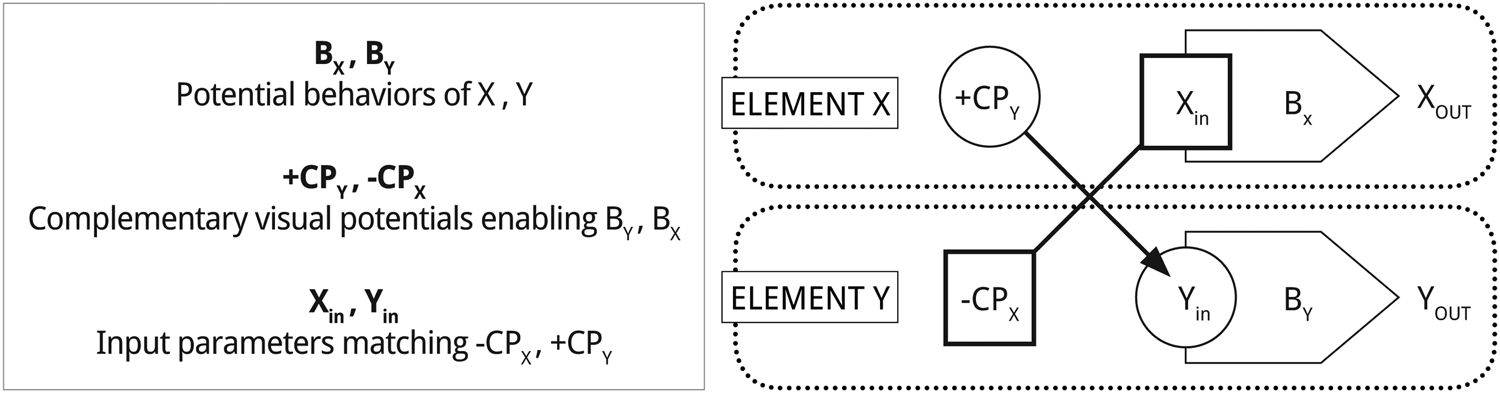
Kannengiesser and Gero (Reference Kannengiesser and Gero2012) proposed a model which conceptualizes the relation between affordances and behaviors via a construct with input parameters matching the affordance. This model is used here to represent the concept of complementary visual potential, which can be seen as a coupled structure tying two objects and their potential behaviors (Fig. 2). We define complementary visual potential as the ability of an object to enable another object to fulfill an expected behavior in the composition.
Complementary visual potential represented using the model proposed by Kannengiesser and Gero (Reference Kannengiesser and Gero2012).

In Figure 3, we provide a simple example using two objects to explain how complementary visual potentials contribute to formalizing the mutual dependency that characterizes the relation between design elements. Behaviors here can be thought of as adjectives or verbs corresponding with sets of spatial relations (for example: “wide” can correspond with certain measurements). The two objects x,y are of different sizes; if we wished y to fulfill the behavior “tall”, y would need to maintain certain spatial relations with the other elements in the composition, which correspond with this behavior. Therefore, adding an object which fulfills these spatial relations, would enable y to fulfill the desired behavior. Being shorter, x can complement the behavior “tall” for y, and thus owns the required complementary visual potential for our goal. Notice that this is a two-way relationship, and y also owns a complementary visual potential in relation to x, that is, to enable it to fulfill an opposite behavior which may be called “short”. Although this example focuses on a single spatial relation, complementary visual potentials may also result from multiple spatial relations. With respect to JRG design, complementary visual potentials can serve as criteria for filtering and selecting candidate secondary rocks out of a large collection in accordance with the design goal.
Example of complementary visual potentials emerging from a height difference.

The proposed framework
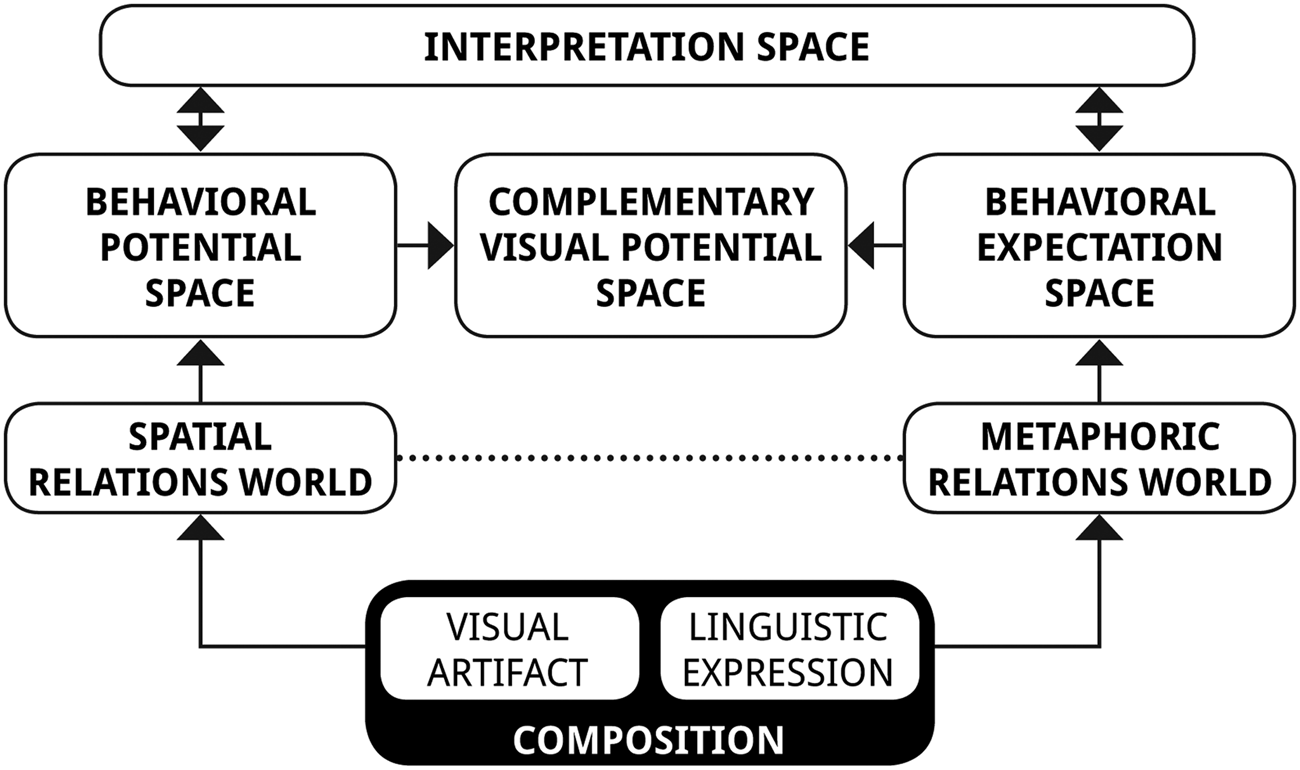
Every spatial configuration has two distinct (yet related) aspects: its physical forms (i.e., the design elements) and its verbal description (i.e., the linguistic phrase from which we can derive the metaphoric relations to serve as a basis for the design). The following framework aims to create a relation between the Spatial Relations World (SRW) emerging from the forms and their spatial configuration and the metaphoric relations world (MRW) emerging from the description. This is done by defining two corresponding spaces: behavioral potential space (BPS) and behavioral expectation space (BES). This construct was inspired by the “Dual Deep-Structure” proposed by Fujii and Aoki (Reference Fujii and Aoki2003) for establishing a relation between shapes and their linguistic descriptions. Yet, here two mediating spaces are added – Interpretation Space (IS) and Complementary Visual Potential Space (CVPS). Abbreviations and definitions are summarized at the end of this section in Table 2; the complete framework is shown below (Fig. 4).
The proposed framework.

SRW and MRW
SRW is concerned with low-level spatial relations that may be identified in the artifact through measurement and comparison, as well as with higher-level relations that may be derived from them via deduction. Given two objects x and y, these relations are represented as simple propositions in the form relation(x,y). For example, the fact that x is taller than y is represented in SRW as taller(x,y). MRW, on the other hand, is concerned with the roles of the design elements which are implied by the linguistic expression. These are represented in the form roles(main_role, secondary_role). For example, given the expression “master teaches student”, a possible formalization of the roles may be roles(master, student).
Referring to Figure 1, possible expressions of the composition in SRW are shorter(secondary,main), wider(main,secondary). Possible expressions of the composition in MRW are role(teacher,students), role(father,children). Given a rock composition, by examining it through the lens of SRW, we can identify spatial relations between the rocks, which result from their configuration in space, as well as from their inherent properties. By examining it through the lens of MRW, we can identify certain roles implied by the metaphoric relations in the verbal description. From these emerge BPS and BES, accordingly.
BES and BPS
Behaviors are entities represented by verbs in the English language. Each behavior receives its spatial meaning from the correspondences specified in the IS (see IS, CVPS). A behavior is said to be well defined if and only if there exists a spatial relation in IS which corresponds with it. An object y is said to fulfill a behavior b in relation to an object x, if and only if b is well defined and y fulfills the spatial relation that corresponds with it in IS, in relation to x. The fact that y fulfills the behavior b in relation to x is expressed in the form behavior(x,y).
BES emerges from MRW and consists of sets of behaviors which one object expects another to fulfill, called expectation sets. Each behavior in the expectation set is referred to as an expected behavior. Let B represent a BES and let B* represent the finite set of all well-defined behaviors. Then B={E 1,..,Et}, where each E j is an expectation set in the form E j={b1,…,bm: bi∈B*}. The set {bow(x,y), listen(x,y)} may serve as an example for an expectation set containing two expected behaviors of an element x from an element y.
BPS emerges from SRW and consists of sets of behaviors that can be fulfilled in practice by an object x. Let B′ represent a BPS; B′ (⊆B*) represents the set of all behaviors that x can fulfill in relation to y and is therefore given by the power set of B, so that B′=P(B). Each item in B′ consists of a combination of potential behaviors referred to as a potential set. Since B′ contains all of the possible combinations of behaviors that x may fulfill in relation to y, it provides us useful information regarding whether x can meet the behaviors in a given expectation set of y. This will determine x's ability to enable y to fulfill its role in the composition.
IS and CVPS
IS enables us to give spatial expression to our behaviors by assigning each with a corresponding spatial relation. Let I={i 1,….,in} represent an IS; Every i j∈I denotes an interpretation for a single behavior so that I=(b,R), where b is a behavior of the form behavior(x,y) and R is a set of spatial relations that may occur between the two elements, each in the form relation(x,y); in other words, each i j represents a single correspondence between a behavior and its spatial expression. For example, the behavior of “bowing” may correspond with being physically shorter and can therefore be expressed as i=(bow(x,y),{shorter(x,y)}). This ties the behavior of an object with the spatial relations it fulfills with another in the composition.
CVPS results from the intersection of BES and BPS and enables an evaluation of the ability of one object to fulfill the expectations of another. Let C represent a CVPS; C is given by C=B∩B′. Since B is populated with expectation sets of x, and B′ is populated with potential sets of y which may fulfill them, C consists only of the expectation sets which can be fulfilled in practice by y in relation to x. When an expectation set of x is fulfilled by y, we say that x fulfills its role in the composition and that y owns the complementary visual potential for that role. Thus, when C≠Ø, we can say that there exists at least one potential set of y which fulfills an expectation set of x, and y can enable x to fulfill its role in the composition.
Results
Experimental implementation
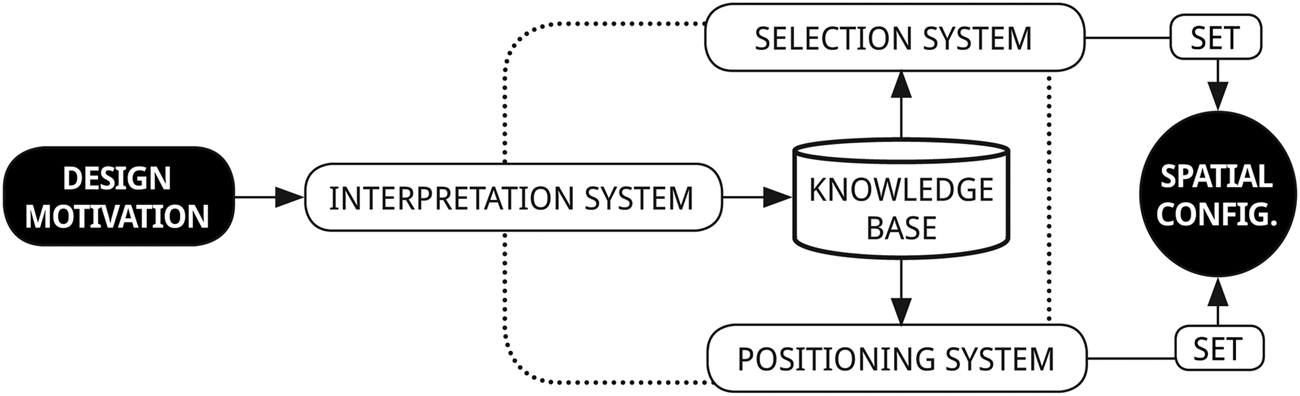
The proposed framework was implemented by constructing three sub-systems assigned with the following tasks: interpretation, selection, and positioning (Fig. 5). This is in accordance with the three main actions of composition design in JRGs: interpreting a metaphor in terms of spatial relations, selecting rocks suitable for the current design task, and positioning them to convey the metaphoric relationship. The systems were integrated with a 3D CAD environment (Rhinoceros 3D) and used to generate spatial configurations of simple rock compositions based on metaphoric relations as described hereafter. Important definitions are given at the end of this section in Table 3.
Spatial configuration design as a product of three integrated sub-systems.

System behavior
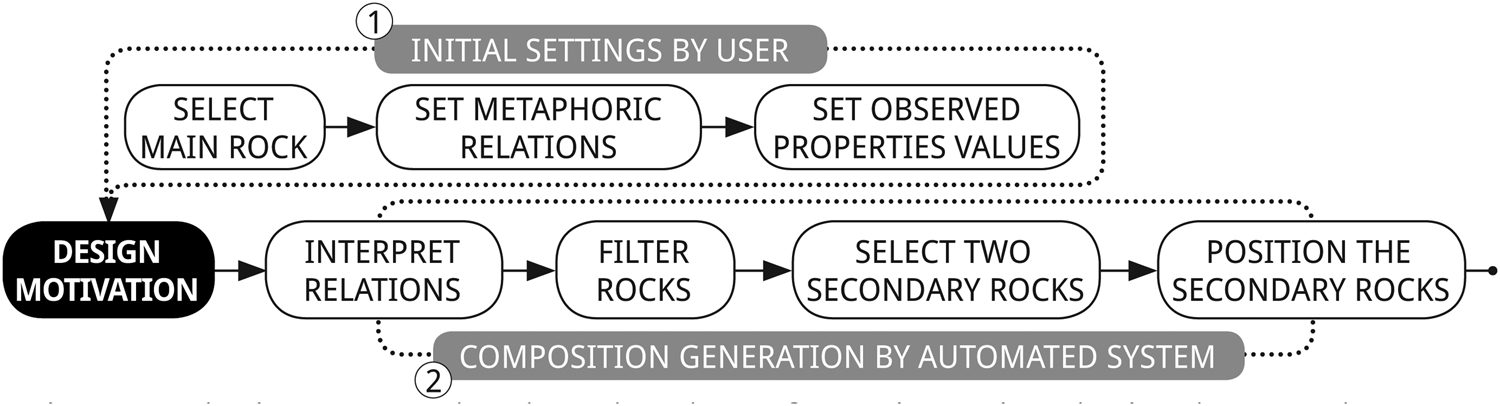
During initialization, the system utilizes three elements as catalysts for the design of a rock composition: a main rock, a metaphoric relation, and a set of observed properties (see Table 3). These serve as decision variables and are collectively referred to as the design motivation.
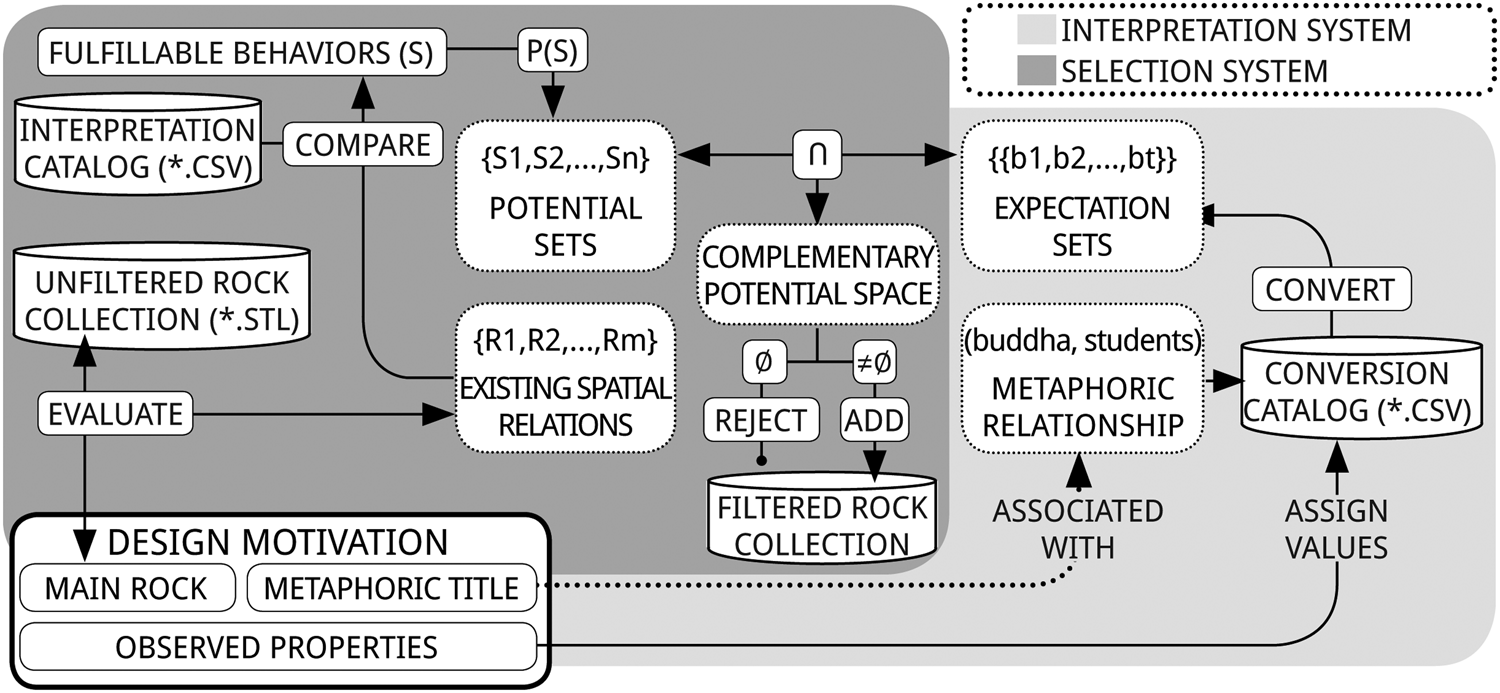
In order to generate a rock composition using the system, the user is required to set the design motivation by selecting a main rock and assigning values to its observed properties. The system will then (1) pass the design motivation to the interpretation system to convert it into expected behaviors, which can be seen as a “pre-processing” phase (Kannengiesser and Gero, Reference Kannengiesser and Gero2012); (2) pass these into the selection system for choosing two suitable candidates for the secondary rocks; (3) pass the chosen candidates to the positioning system to set them in place, also in accordance with the demanded spatial relations. The complete process described above is summarized in Figure 6.
Producing a metaphor-based rock configuration using the implemented system.

Sub-systems and their roles
As mentioned in “Experimental implementation”, the complete spatial configuration generation system consists of three sub-systems: interpretation system, selection system, and positioning system (Fig. 5). The general behavior and tasks handled by each sub-system are described below.
The interpretation system's main task is to convert the metaphoric relationship into expected behaviors. These behaviors will enable the selection system to evaluate the complementary visual potentials and serve as the criteria for filtering the secondary rocks, and the selection of those that enable the main rock to fulfill its role.
The selection system receives the expected behaviors from the interpretation system and attempts to select appropriate secondary rocks, that is, one which will enable the main rock to fulfill its role in the composition by (1) filtering the rock collection from secondary rocks which cannot fulfill the expected behaviors and (2) randomly selecting two rocks from the filtered rock collection and passing them to the positioning system.
Figure 7 outlines the general structure of the system's core; this consists of the interpretation and selection systems (presented above) and the resources involved in the process of interpreting the design motivation and selecting adequate secondary rocks, which are then passed to the positioning system.
Outline the system's core, that is, the interpretation and selection systems.

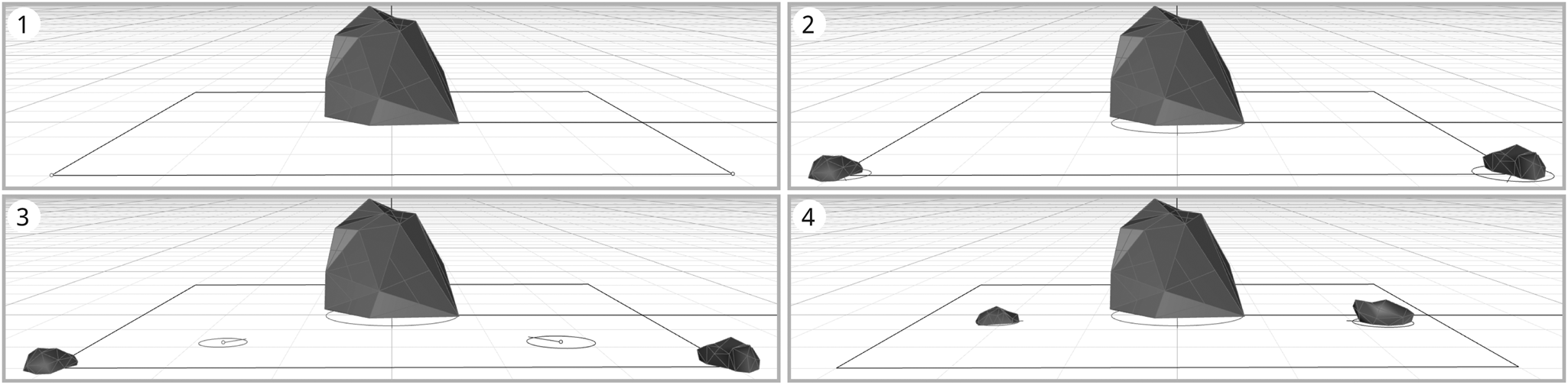
The positioning system aims to position the selected secondary rocks around the main rock in accordance with the metaphoric relationship and its corresponding expected behaviors. Setting the position for the secondary rocks involves three parameters: proximity, relative position (in front, behind, etc.), and orientation, all in relation to the main rock. The system reads the spatial demands corresponding with the expected behaviors and positions the secondary rocks in three phases: (1) initialization: the secondary rocks are arbitrarily placed around the main rock in a pre-defined boundary, serving as the environment for the generation of the composition; (2) gathering: the secondary rocks attempt to approach the main rock to fulfill the demanded spatial relations concerning with proximity; (3) orienting: the secondary rocks will circulate around the main rock and around their pivot axes in order to fulfill the demanded spatial relations. Figure 8 shows a simple positioning process of two secondary rocks around a main rock.
Auto-positioning the secondary rocks around the main rock.

Generating alternative designs for an existing rock composition
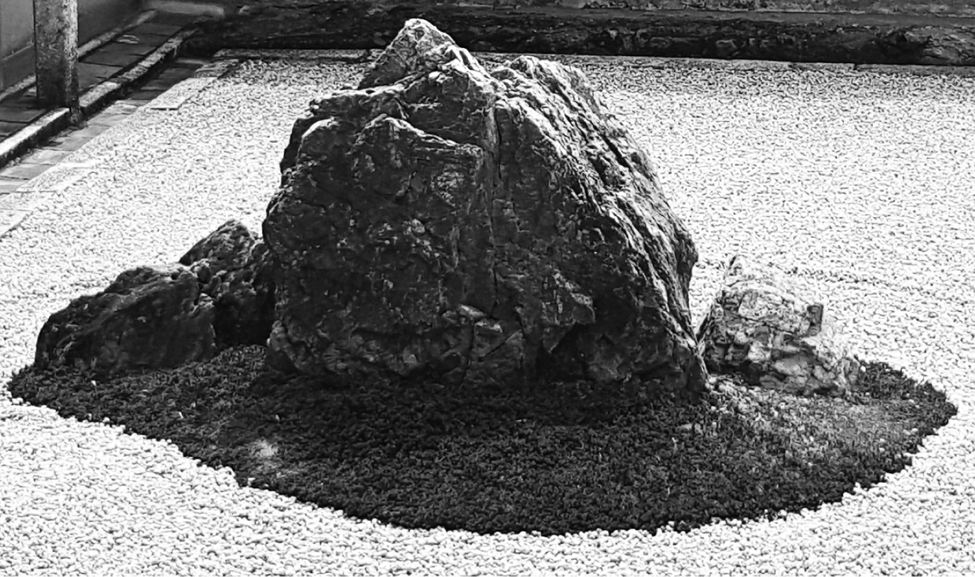
The implemented system was tested by attempting to generate alternative designs for an existing rock composition found in the garden of Ryōan-ji (Figs. 9, 10). The original main rock was maintained (Fig. 9, middle rock) while the secondary rocks were replaced and repositioned by reinterpreting the metaphoric relation in different manners, as explained hereafter.
A Buddhist Triad rock composition at the famous garden of Ryōan-ji, Kyoto.

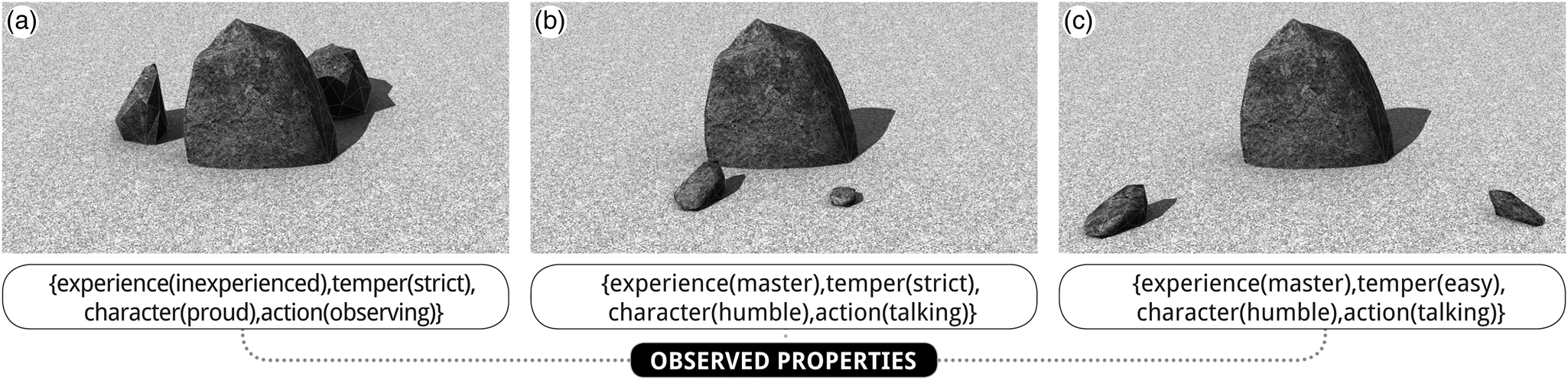
Alternatives to the configuration in Figure 9 generated by changing the observed properties for the main rock.

The main rock in the composition was modeled in 3D after the original according to the photographic documentation taken from multiple angles. The rock collection used for the generation consisted of 48 small rocks, digitally scanned using a desktop 3D scanner, each used in 4 different scales, resulting in a total of (48 × 4=)196 rocks.
According to the metaphoric relation in the original composition, the main rock was assigned with the role of “teacher” and the secondary rocks with the role of “students”. Alternative designs for the original composition were produced by assigning different values to the observed properties of the teacher rock, which determined the selection and positioning of the student rocks. Each set of values represents a different interpretation of the metaphoric relation, as explained below. Figure 10 shows the different sets of the observed properties assigned each time to the teacher rock and the resulting rock configurations.
Interpreting the results
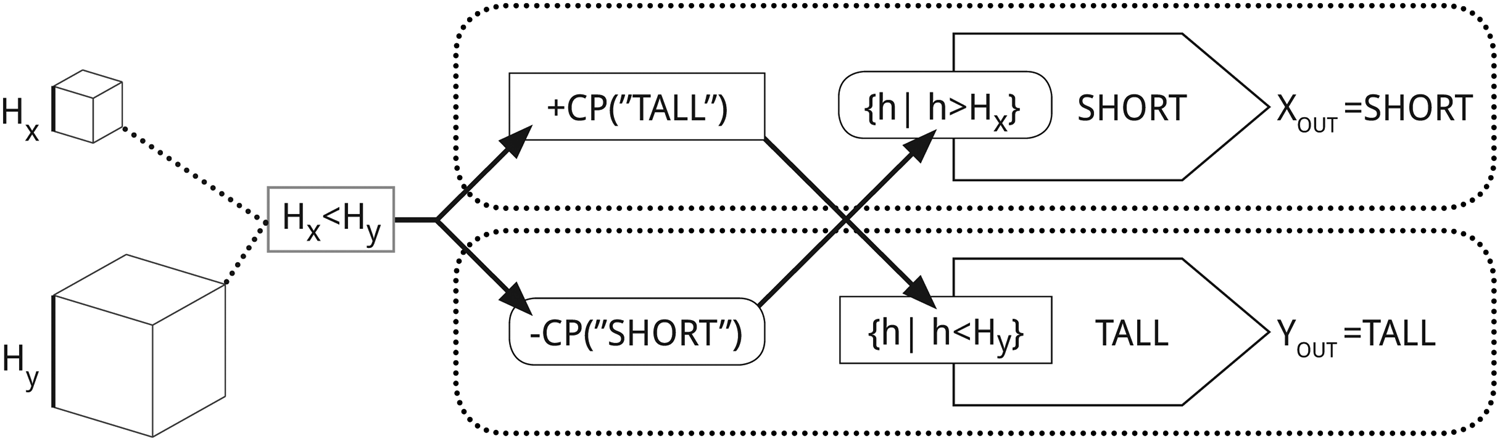
The generated compositions aim to demonstrate the possibility of tying a metaphoric relation with a spatial expression using our framework. In order to clarify how the metaphoric relation is expressed spatially in the compositions, we firstly explain the relationship between the observed properties assigned to the main rock and the resulting configuration. As an example, we will focus on the property of “experience”. In all three compositions, the main rock is assigned with the role of “teacher”, while the secondary rocks are assigned with the role of “students”. As a teacher, the main rock may be further described as either a “master” or “inexperienced”. Since a master is more likely to expect deep respect from his students (compared with an inexperienced teacher), asserting the teacher as having the observed property op(experience,master) will demand the secondary rocks to fulfill the expected behavior of “bowing”, so that the students can express their respect to the teacher. The behavior of “bowing” is spatially interpreted as being relatively short (a common interpretation in JRG; see Fig. 1), and as we see in Figure 10b, the student rocks were selected so as to fulfill this criterion. This expected behavior can be briefly stated as behavior(bow,{shorter(x,y)}), although additional spatial demands may be further integrated according to the user's considerations. In contrast, the assertion that the teacher is “inexperienced, that is, having the property of op(experience,inexperienced), results in a lack of expectation for “deep respect”. This is expressed in the selection of vertically oriented rocks which “stand” (i.e., do not bow) as seen in Figure 10a. For clarification purposes, an example for the above correspondence between an observed property and its spatial expression (determined by an expected behavior) is diagramed below in Figure 11.
From an observed property to an expected behavior.

Discussion
Evaluation
The implementation of the proposed framework focuses on the fundamental entities and considerations involved in translating a metaphoric relation into a simple spatial configuration and is based on our understanding of this practice in JRGs. This enables us to examine the framework's ability to serve as a basis for embodying a given metaphoric relation within a spatial configuration via:
1) elaborating the relation as a set of related qualities which may be assigned to the main element, that is, our observed properties.
2) assigning each observed property with a corresponding expected behavior that the main element may demand the secondary ones to fulfill.
3) tying these behaviors to spatial relations that the secondary elements are consequently required to fulfill.
In this manner, the complete construct of observed properties, expected behaviors, and spatial relations can be seen as an elaboration of the metaphoric expression, which may be used as design knowledge for constructing, as well as interpreting, spatial configurations.
The entities in our implementation are representations of our translation for JRG design principles; the observed properties entity is an exception to this rule and therefore requires further elucidation. As explained in “Key concepts”, the basic instruction of JRG design guides the designer to select a rock, “listen to its request”, and act in accordance with it. From a phenomenological perspective, we may view this stage as implicitly guiding designers to form their initial intentional stance for creating the composition by extracting certain properties suggested by the rock. This can be seen as an interaction between the designer and the main rock in the form of a mental activity. Fujii et al. (Reference Fujii, Nakashima and Suwa2013) proposed the FNS model for describing the formation of the intentional stance of the designer as a result of interaction with the external world. This model uses the terms “current noema” to refer to the designer's experience of the current situation. The current noema is said to form through a process of analysis, which occurs through three sub-processes of observation, evaluation, and narration. The last phase of forming the intentional stance thus results with a narrative which includes the understanding of the current situation. To represent this understanding acquired from observing the rock, we defined the entity of “observed properties”, which are properties that may be assigned with different values by the designer. These properties are neither quantitative nor objective evaluations of the main element but rather conceptual descriptions which the designer associates with it after a careful observation. The observed properties thus serve as an instrument to represent the current noema (resulting from observing the main element) as a set of properties which can be given a spatial expression.
Generalizability of the framework
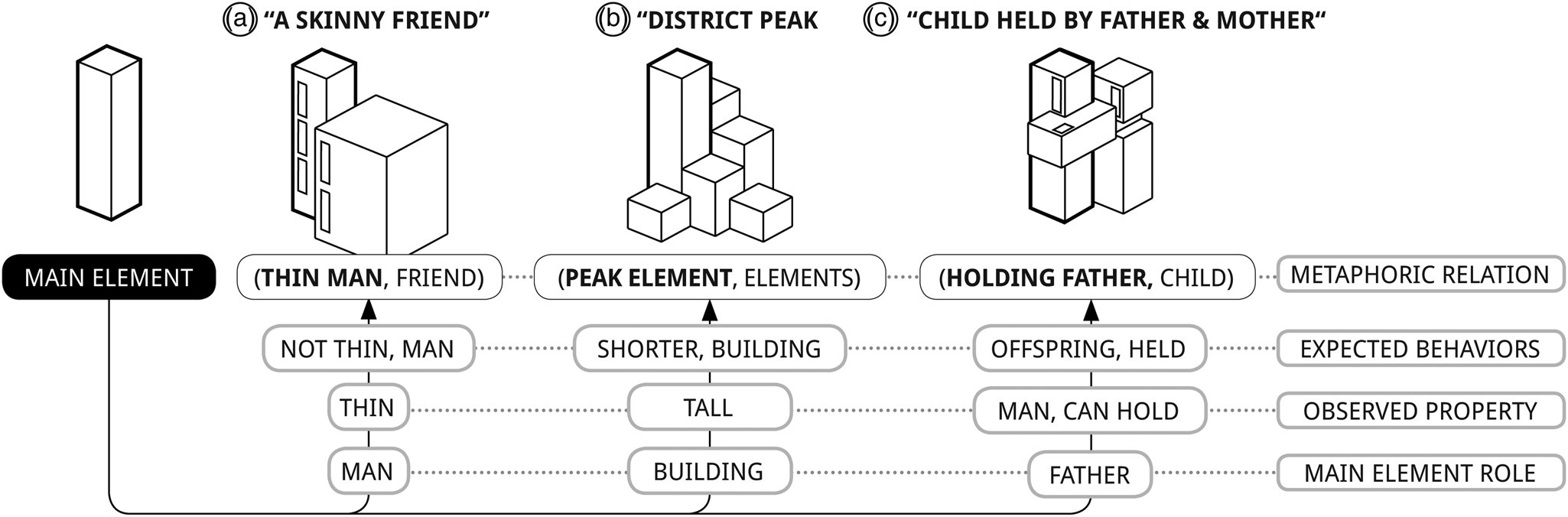
While the framework was introduced through the lens of JRG design, it is fundamentally independent of a specific design discipline and may be utilized in other areas of design which involve spatial configuration, for tying metaphoric expressions with spatial relations. The framework is targeted for use at the conceptual design stage. In order to utilize it in a computational system, regardless of the specific design context, it is required to conduct a preliminary three-phase process of (1) identification and formalization of the domain's design elements, (2) specification of the common spatial relations that may occur between these, and (3) translation of these into behaviors coupled with spatial relations. These may serve as an initial knowledge base for implementing intelligent agents in CAD systems, which can support metaphor-based design processes. In Figure 12, we present a simple example for creating several spatial configurations based on a single element, a metaphoric relation, and a related expected behavior imposed on the secondary elements as a result. For example, in Figure 12b, we have translated the observed property of being perceived as tall to refer to the element as the “peak of the district”, which results in an expectation of the surrounding object to fulfill certain behaviors (being shorter than the main element, having a vertical appearance in order to resemble typical tall buildings, etc.).
A main element used for creating various spatial configurations according to different metaphoric relations.

Future work
The framework presented in this paper attempts to formalize the basic dependency between visual design elements, by tying the metaphoric role of one with the spatial properties of others (in relation to it). In order to utilize the framework, it is necessary to couple spatial relations with behaviors of elements (as explained in “Generalizability of the framework”). These are currently specified in IS (see IS, CVPS) via manual input of such pairings. While feasible in simple conceptual design tasks, demanding users to specify each interpretation in IS a priori may prove inadequate for projects of greater complexity. This is due to the time-costly nature of this process, as well as to the improbability of sufficiently covering the (potentially) vast spaces of possible behaviors and interpretations. This issue may be approached by enabling users to share their IS, potentially leading to a development of public interpretation repositories which are context-based.
Yet, before proceeding in this direction, a preparatory step should be taken to adapt the framework to a standardized knowledge representation system. This will serve as a strong basis for both phrasing and sharing interpretations among designers, as well as facilitating the use of logical inference engines for reasoning purposes. The chosen representation system would preferably (1) enable to phrase metaphoric interpretations formally in an intuitive manner and (2) support comparison between various interpretations created by different users. A possible candidate is the Ontological Logs (“Ologs”) framework by Spivak and Kent (Reference Spivak and Kent2012), yet this requires further inquiry.
Additionally, it is important for future versions of the framework to address nonhierarchical relations between elements, which often occur in design. This may be done by reformulating it as to enable each element to have expectations from others regardless of its position in a hierarchical structure.
Finally, we would like to emphasize that, while the above measures are important for further development of the framework, another key aspect should be attended to – modeling the process of metaphoric interpretation in design activity as a response of the designer to the current situation. As explained in “Metaphoric relationships between rocks in JRGs”, metaphors do not merely serve as verbal labels attached to the design but rather as conceptual tools which are inherent to the designer's thinking process. Therefore, it is highly important to elucidate when and how and do these arise during the design process as an integral part of the design activity. This demands an inquiry of this practice through the lens of situatedness in design (Gero and Fujii, Reference Gero and Fujii2000; Gero and Kannengiesser, Reference Gero and Kannengiesser2004), which may be done by empirically studying it in human design activities. This will enable us to utilize this framework for developing highly intelligent design agents that are capable of actively proposing adequate metaphorical interpretations in-context.
Conclusion
This research examines the metaphor-based conceptual design methodology used for spatial configuration design in JRGs as a vehicle for understanding its fundamental constituents. On the basis of these, a framework for metaphor-based design is proposed and implemented in the context of JRGs and used to generate simple rock configurations based on metaphoric relations. The proposed framework enables an embedding of spatial configurations with meaning by forming a semiotic system of spatial relations coupled to linguistic expressions.
From the perspectives of design-theory and knowledge representation, the proposed framework provides a systematic approach to understanding the visual interaction between objects in a spatial composition by imposing a hierarchical structure of main and secondary elements, attributing metaphoric roles to main elements and translating them to spatial relations demanded from the secondary elements.
From the perspective of computational design, we view this research as a first step towards integrating a metaphor-based conceptual design methodology into CAD environments, both in JRGs and in other field of design; this will enable designers to externalize their conceptual understanding of metaphoric relations between elements by elaborating them in the form of verbal expressions and spatial relations in a structured manner, which is useful for the construction of computational tools supporting this practice.
Yuval Kahlon is currently a doctoral student at the Tokyo Institute of Technology, Japan. He was born in Kfar-Saba, Israel. He studied a Bachelors degree in Building and Environment Design at the Shenkar College of Engineering and Design, Israel and a Masters degree in Engineering Sciences and Design at the Tokyo Institute of Technology, Japan. He was awarded both by Shenkar College of Engineering Design and Tokyo Institute of Technology for Excellence. He conducts research for integrating insights from linguistics, cognition, and visual perception for developing intelligent computational design systems.
Haruyuki Fujii is a Professor of Architecture and Design Science, Tokyo Institute of Technology, PhD, Architect. He was born in Tokyo, Japan. He studied Architectural Design and Engineering at Waseda University, Japan, and Philosophy focusing on computational linguistics at Carnegie Mellon University, USA. He studied Design Computing and Cognition at the University of Sydney, Australia. He has been constructing a methodology for design science that bridges the subjectivity in designing, such as subjective insight, illogical thinking, individual localization, and the objectivity in natural science, such as objective grounding, logical thinking, and universal explanation.