Resilience is an unexpected, positive adjustment in the midst of severe risk or adversity (Hauser & Allen, Reference Hauser and Allen2006; Luthar, Reference Luthar2003). Resilience is not a constant state of mind or trait; rather, it is a behaviour and pattern that represents psychological competence (Luthar, Reference Luthar2003) and can be as simple as doing ‘okay’ (Masten & Coatsworth, Reference Masten and Coatsworth1998). Although resilience is common (Bonnano, Reference Bonanno2008; Masten, Reference Masten2001), single paths to resilience are rare (Bonanno, Reference Bonanno2008; Rutter, Reference Rutter1999). Resilience can be learned over time (White, Driver, & Warren, Reference White, Driver and Warren2008) and can be exhibited in areas of spirituality, social wellbeing, and personal development (Costanzo, Ryff, & Singer, Reference Costanzo, Ryff and Singer2009; deRoon-Cassini, Mancini, Rusch, & Bonanno, Reference deRoon-Cassini, Mancini, Rusch and Bonanno2010).
Although resilience is a common human trait, understanding what makes a resilient person, or resilient response to life difficulties, can be more challenging. Characteristics such as hardiness, self-enhancement, repressive coping, positive emotion, and laughter are key features of resilient individuals (Bonanno, Reference Bonanno2008). Reflectiveness, self-complexity, persistence, ambition, self-esteem, and relationship recruiting are also key elements found in resilient individuals (Hauser & Allen, Reference Hauser and Allen2006). In addition, self-realisation is a primary component in optimal psychological functioning (Waterman, Reference Waterman1993). Reducing resilience to one characteristic is problematic because resilience includes interacting characteristics that exist prior, during, and after trauma (Rutter, Reference Rutter1999) and can include both demographic factors (Bonanno, Galea, Bucciarelli, & Vlahov, Reference Bonanno, Galea, Bucciarelli and Vlahov2007) and personality dispositions (Diener, Suh, Lucas, & Smith, Reference Diener, Suh, Lucas and Smith1999).
Understanding resilience is crucial because resilience promotes healthy responses following trauma, negative affect, hardship, or loss (Hauser & Allen, Reference Hauser and Allen2006; Roosa, Reference Roosa2000; Stone, Reference Stone1992). When resilience is strengthened, individuals learn from their experiences, gaining more than they perceived they lost from the traumatic experience (Stone, Reference Stone1992), and exhibit stronger levels of perseverance and greater coping skills than before (Hoge, Austin, & Pollack, Reference Hoge, Austin and Pollack2007). In addition, individuals possessing a resilient disposition have a greater sense of purpose, increased relational satisfaction, and a strengthened self-realisation than those without (Ryff, Reference Ryff1989).
Social Support and Resilience
Researchers have also linked social support and resilience (Eisman, Stoddard, Heinze, Caldwell, & Zimmerman, Reference Eisman, Stoddard, Heinze, Caldwell and Zimmerman2015; Masten & Coatsworth, Reference Masten and Coatsworth1998; Perrier, Boucher, Etchegary, Sadava, & Molnar, Reference Perrier, Boucher, Etchegary, Sadava and Molnar2010; Werner-Wilson, Zimmerman, & Whalen, Reference Werner-Wilson, Zimmerman and Whalen2000). Isolation not only predicts impairments of mental health following negative life events (Littleton, Horsley, John, & Nelson, Reference Littleton, Horsley, John and Nelson2007; Murphy, Reference Murphy2009; Nietlisbach & Maercker, Reference Nietlisbach and Maercker2009) but also vulnerability to future trauma (Fosha, Reference Fosha and Kerman2010). In fact, loneliness may be one of the aetiological factors linking social support (or social strain) and psychological wellbeing (Chen & Feeley, Reference Chen and Feeley2014) due to the contention that cognition is shaped by the need for belongingness and relationship (Baumeister & Leary, Reference Baumeister and Leary1995). This social-cognitive model maintains that cognitions and relationships are inextricably linked because the fear of social disconnection is a powerful predictor of wellbeing, particularly related to recovery from negative life events (La Bash & Papa, Reference La Bash and Papa2014).
The source of social support may determine the impact it has on individuals’ coping abilities. Although family and friend social support may make different contributions to the psychological health of individuals (Bowles & Hattie, Reference Bowles and Hattie2015; Li, Ji, & Chen, Reference Li, Ji and Chen2014; Nguyen, Chatters, Taylor, & Mouzon, Reference Nguyen, Chatters, Taylor and Mouzon2016), researchers have largely ignored the differential contributions of family and friend support (Li et al., Reference Li, Ji and Chen2014). Moreover, existing research findings are mixed. For example, some studies suggest that parent-child relationships are crucial for both typical and extreme challenges (Masten & Coatsworth, Reference Masten and Coatsworth1998; Wadsworth & Santiago, Reference Wadsworth and Santiago2008) and that as a result, parent-child relationships are the most important for social support of adolescents (Bowles, Reference Bowles2016; Bowles & Hattie, Reference Bowles and Hattie2015). In contrast, other studies suggest that for older adults, support from a spouse or partner and friends is vital (Chen & Feeley, Reference Chen and Feeley2014; Zhang, Yu, Zhou, & Zhang, Reference Zhang, Yu, Zhou and Zhang2017). Moreover, relational convoys, which are defined as a dynamic network of social relationships composed primarily of family and friends (Antonucci, Reference Antonucci, Birren and Schaie2001), vary in their impact on wellbeing depending on the age of the individual. Young or middle-age individuals report that the nature of their family relationships are most salient whereas older adults state that the number of individuals in their family networks and the proportions of family in their convoy are factors in the improvement of psychological wellbeing if family negativity was decreasing (Fuller-Iglesias, Webster, & Antonucci, Reference Fuller-Iglesias, Webster and Antonucci2015). Further studies suggest that positive affect is enhanced by friend (but not family) support (Li et al., Reference Li, Ji and Chen2014), particularly during adolescence when support from family has been found to decrease and social support from friends increases (Bowles & Hattie, Reference Bowles and Hattie2015). Regardless, the connection between the source and content of social support and wellbeing is a complex one (Bowles & Hattie, Reference Bowles and Hattie2015; McGrath, Brennan, Dolan, & Barnett, Reference McGrath, Brennan, Dolan and Barnett2014) and is one that is rarely examined experimentally. Therefore, the purpose of the current project was to investigate the link between social support of friends and family and psychological wellbeing in both correlational (Study 1) and experimental (Study 2) studies to emphasise both the natural link between the concepts in the real world, as well as to examine the cause-and-effect link between preconceptions of social support and buffer against the consequences of negative feedback. Because the participants in both studies were undergraduate students mostly living away from their families, we expected that friend support would account for a greater proportion of the variance in resilience (defined here as psychological wellbeing and affectivity) following negative life events than would family support.
STUDY 1
Method
Participants
Participants were invited via Facebook and email to participate in an online study. Eighty-seven participants (71 females and 16 males) ranged in age from 19 to 69 (M = 36.87, SD = 14.80). Of the 87 participants, 77.5% were White, non-Hispanic; 11.2% were Black or African American; 4.5% were American Indian or Alaska Native; 3.4% were Hispanic or Latino/a; 2.2% were Asian; and 1.1% indicated ‘other’ race/ethnicity.
Materials
Wellbeing
The Scales of Psychological Wellbeing (SPWB; Ryff, Reference Ryff1989) consists of six sections designed to quantify levels of autonomy (e.g., ‘Sometimes I change the way I act or think to be more like those around me’), environmental mastery (e.g., ‘In general, I feel I am in charge of the situation in which I live’), personal growth (e.g., ‘I am not interested in activities that will expand my horizons’), positive relations with others (e.g., ‘Most people see me as loving and affectionate’), purpose in life (e.g., ‘I have a sense of direction and purpose in life’), and self-acceptance (e.g., ‘In general, I feel confident and positive about myself’). Participants responded using a 6-point Likert scale ranging from 1 (strongly disagree) to 6 (strongly agree). Reliability for all subscales were as follows: autonomy (α = .15), environmental mastery (α = .35), personal growth (α = .12), positive relations with others (α = .53), purpose in life (α = .29), and self-acceptance (α = .11).
Social support
To obtain the levels of social support, participants completed the Perceived Social Support Family Scale (PSS-Fa; Procidano & Heller, Reference Procidano and Heller1983), along with the Perceived Social Support Friend Scale (PSS-Fr; Procidano & Heller, Reference Procidano and Heller1983). Both measures utilise a ‘yes/no/don't know’ response format to indicate the degree to which an individual's family fulfilled perceived needs for support (e.g., ‘My family gives me the moral support I need’). Reliability was high for both the PSS-Fa (α = .88) and the PSS-Fr (α = .90).
Life event impact
The Impact of Event Scale — Revised (IES-R; Weiss & Marmar, Reference Weiss, Marmar, Wilson and Keane1997) assesses self-identified negative life events and their impacts on individuals. The IES-R is a 22-item questionnaire that measures three core areas: intrusion (e.g., ‘I had trouble falling asleep’), avoidance (e.g., ‘I tried not to think about it’), and hyperarousal (e.g., ‘I had waves of strong feelings about it’). The survey directs individuals to read from a list of common difficulties found in people who have experienced stressful events and asks respondents to indicate how distressing the event has been. Participants respond using a 5-point Likert scale ranging from 0 (not at all) to 4 (extremely). For the purposes of this study, the instructions were modified to include a life stressor that occurred at any time for the individual rather than being confined to the last seven days, and participants were asked to identify the stressor they referenced. Reliability for the IES-R in the current study was very high (α = .94).
Demographics and trauma history questionnaire
Participants also completed the demographic and background questionnaires, including questions about age, gender, race, and education, and traumatic history (e.g., ‘Have you experienced a personal trauma?’).
Procedure
Participants received invitations via Facebook and email to complete an online study. Individuals who volunteered provided electronic informed consent and then completed the SPWB, PSS-Fa, PSS-Fr, IES-R, demographic questionnaire, and questions related to (but not used) in the current study. The order of the questionnaires was counterbalanced to alleviate contamination effects.
Results
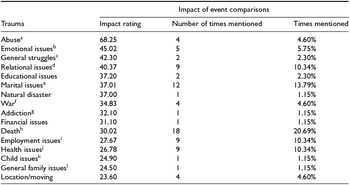
Table 1 displays the frequencies of categories of events self-reported by the participants.
Number and Percentage of Impactful Life Event by Category

Note: aAbuse categories included rape and physical and emotional abuse. bEmotional issues included feelings of loneliness, rejection, future and past. cGeneral issues included overall life issues that were not specified. dRelationship issues included unspecified dating issues, unspecified friend issues, and friend betrayal. eMarital issues were issues related directly to a marriage and included unspecified marital issues, infidelity, personal experience with divorce, and parental divorce. fWar included military deployment and involvement in specific wars (e.g., Vietnam). gThe addiction specified was alcoholism. hDeath included spousal death, death of a child, death of a grandparent, witnessing death, death of a parent, death of a family member, death of a pet, and family member suicide. iEmployment issues included job loss and unspecified work-related issues. jHealth issues included cancer, family member health issues, personal health issues, and child health issues. kChild issues were not specified. lGeneral family issues were unspecified overall life issues.
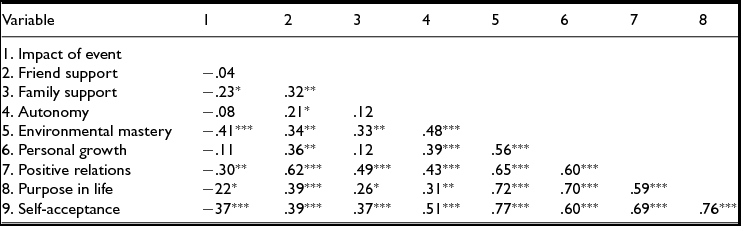
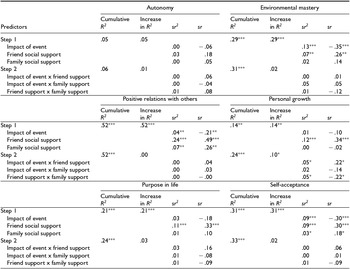
Table 2 displays the correlations between perceived social support by friends, perceived social support by family, impact of event, and psychological wellbeing. Hierarchical regressions were used to examine the relationship between impact of event, perceived friend and family support, and the six subscales of psychological wellbeing (see Table 3). The main effect predictors for impact of the event, friend social support, and family social support were entered on step 1. Each possible two-way was entered at step 2. All variables were centred for the purpose of interpreting interactions (Aiken & West, Reference Aiken and West1991). The model did not significantly predict autonomy.
Correlations Between Perceived Social Support by a Friend, Perceived Social Support by Family, Impact of Event Scale, and Scales of Psychological Wellbeing

Note: N = 89.
p < .05. **p < .01. ***p < .001.
Study 1 (Correlational): Hierarchical Regressions of Wellbeing Onto Measures of Impact of Event and Perceived social support

Note: *p < .05. **p < .01. ***p < .001.
The model was significant (R 2 = .29; p < .001), however, for environmental mastery. That is, impact of event and perceived social support accounted for 29% of the overall variance in environmental mastery. Specifically, impact of event predicted environmental mastery, β = −.36, t(82) = −3.85, p < .001, such that the greater the impact of the event, the lower the reported environmental mastery. Perceived friend social support predicted environmental mastery, β = .28, t(82) = 2.88, p = .005, such that the greater the perceived friend social support, the greater the reported environmental mastery.
The model was also significant (R 2 = .52; p < .001) for positive relations with others. That is, the impact of event and perceived social support accounted for 52% of the overall variance in positive relations with others. Specifically, the impact of the event predicted positive relations with others, β = −.21, t(82) = −2.73, p = .008, such that the greater the impact of the event, the lower the reported positive relations with others. Perceived friend social support predicted positive relations with others, β = .52, t(82) = 6.54, p < .001, such that the greater the perceived friend social support, the higher the reported positive relations with others. Perceived family social support predicted positive relations, β = .28, t(82) = 3.45, p = .001, such that the greater the perceived family social support, the higher the reported positive relations with others.
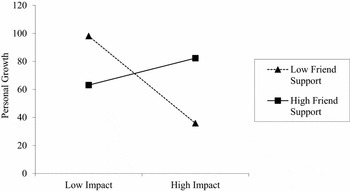
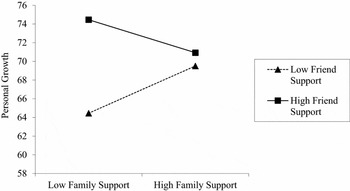
The model was also significant (R 2 = .14; p = .005) for personal growth. That is, the impact of the event and perceived social support accounted for 14% of the overall variance in personal growth. Specifically, perceived friend social support predicted personal growth, β = .36, t(82) = 3.41, p = .001, such that the greater the perceived friend social support the greater the reported personal growth. Furthermore, inclusion of interaction terms significantly added to the model (R 2 = .24; p = .001). That is, the impact of the event, perceived social support, and the interactions between impact of the event and social support accounted for 24% of the overall variance in personal growth. Specifically, there was an interaction between impact of event and perceived friend social support, β = .25, t(82) = 2.31, p = .02 (see Figure 1). The unstandardised coefficient for the simple slope of impact of the event was 0.01 at −1 SD, t(88) = 1.87, ns, and 0.13 at +1 SD, t(88) = 0.07, ns. The unstandardised coefficient for the simple slope of friend social support was 0.02 at −1 SD, t(88) = 1.87, ns, and −0.32 at +1 SD, t(88) = −2.10, p = .04. That is, for highly traumatising events, the absence of social support from friends predicts low levels of personal growth. In addition, there was an interaction between perceived friend social support and perceived family social support, β = −.23, t(82) = −2.28, p = .03 (see Figure 2). The unstandardised coefficient for the simple slope of family social support was −0.09 at −1 SD, t(88) = −2.05, p = .04, and 1.88 at +1 SD, t(88) = 3.07, p = .003. The unstandardised coefficient for friend social support was −0.08 at −1 SD, t(88) = −2.05, p = .04, and 1.38 at +1 SD, t(88) = 1.98, ns. That is, friend support predicted personal growth only when family support was low (but not when family support was high).
Adjusted predicted values for personal growth in Study 1, illustrating the interaction between impact of event and friend social support at one standard deviation above and below the means.

Adjusted predicted values for personal growth in Study 1, illustrating the interaction between family social support and friend social support at one standard deviation above and below the means.

The model was also significant (R 2 = .21; p < .001) for purpose in life. That is, impact of event and perceived social support accounted for 21% of the variance in purpose in life. Specifically, perceived friend social support predicted purpose in life, β = .35, t(82) = 3.43, p = .001, such that the greater the perceived friend social support, the greater the reported purpose in life.
The model was also significant (R 2 = .31; p < .001) for self-acceptance. That is, the impact of event and perceived social support accounted for 31% of the variance in self-acceptance. Specifically, the impact of the event predicted self-acceptance, β = −.31, t(82) = −3.35, p = .001, such that the greater the impact of the event, the lower the reported self-acceptance. Perceived friend social support predicted self-acceptance, β = .32, t(82) = 3.37, p = .001, such that the greater the perceived friend social support, the greater the reported self-acceptance. Perceived family social support predicted self-acceptance, β = .19, t(82) = 1.98, p = .05, such that the greater the perceived family social support, the greater the reported self-acceptance.
A simple linear regression was also used to examine the relationship between impact of the event and perceived social support. The impact of the event did not significantly predict perceived friend social support. However, the model was significant (R 2 = .31; p < .000) for perceived family social support. That is, the impact of the event accounted for 31% of the overall variance in perceived family social support. Specifically, the impact of the event predicted perceived family social support, β = −.23, t(87) = −2.25, p = .03, such that as the impact of the event increased, the perceived family social support decreased.
STUDY 2
Method
Participants
Traditional undergraduate students enrolled at a small private Midwestern Christian university volunteered in exchange for extra credit. A total of 64 participants (42 females and 22 males) ranged in age from 18 to 37 (M = 20.55, SD = 3.12). Of the 64, 82.8% were White, non-Hispanic; 7.8% were Hispanic or Latino/a; 3.1% were Black or African American; 3.1% were American Indian or Alaska Native; and 3.1% were reported ‘other’ race/ethnicity.
Materials
Social support
Individuals completed the Perceived Social Support Family Scale (PSS-Fa; Procidano & Heller, Reference Procidano and Heller1983), and the Perceived Social Support Friend Scale (PSS-Fr; Procidano & Heller, Reference Procidano and Heller1983). Reliability for the PSS-Fa and the PSS-Fr were both high α = .85 and .90, respectively.
Mood
The Positive and Negative Affect Schedule (PANAS; Watson, Clark, & Tellegen, Reference Watson, Clark and Tellegen1988) is rated on a 5-point scale ranging from 1 (very slightly or not at all) to 5 (extremely) for both positive (e.g., interested, alert, determined) and negative (e.g., irritable, distressed, nervous) mood. Reliability for this study was moderate (α = .70).
Rejection
Participants completed a 25-question aptitude test that included questions such as ‘What is acquiesce the opposite of?’ and ‘Complete the order of the 0.1, 0.3, 0.5, 0.7, and 0.9.’ Participants were randomly assigned to one of three feedback conditions: positive (in which participants learned they scored in the upper 10% of the national average on the aptitude test), negative (in which participants learned they scored in the bottom 10% of the national average), or control (in which participants learned their scores were average). Participants then completed a manipulation check by indicating their score on a separate page for the experimenter.
Demographic questionnaire
Participants also completed demographic and background questions about age, gender, race, and education.
Procedure
Participants completed a one-on-one session with the experimenter is a small computer laboratory on campus. After obtaining documented informed consent and completing a questionnaire related to but not used in the current study, participants completed the fake aptitude test. Following the test completion, participants received instructions to stop, see the test moderator, and then return to their computers to complete measures regarding the nature and quality of their social support (the PSS-Fa and PSS-Fr; counterbalanced between participants to control for contamination effects) while the experimenter scored the aptitude tests. Following the questionnaires, participants again received instructions to see the test moderator who gave feedback orally and written in one of the three conditions to which the participants were randomly assigned (positive, negative, or control) and completed the manipulation check. Finally, participants ended the session by completing the PANAS and demographic questions.
Results
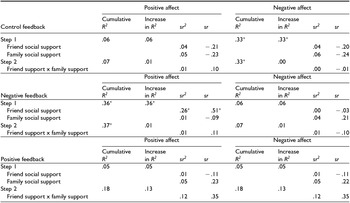
Hierarchical regressions were used to examine the relationship between perceived friend and family support and positive and negative affect for each experimental condition (see Table 4). The main effect predictors for friend social support and family social support were entered at step 1. The two-way interaction between friend and family social support was entered at step 2. All variables were centred for the purpose of interpreting interactions (Aiken & West, Reference Aiken and West1991).
Study 2 (Experimental): Hierarchical Regressions of Affect Onto Measures of Perceived Social Support by Feedback Condition

Note: *p < .05. **p < .01. ***p < .001.
It was expected perceived social support would predict positive affect and negative affect for the negative feedback group (but not for the positive feedback or control feedback groups). In fact, among the negative feedback group, the model was significant for positive affect (R 2 = .35; p = .02). That is, perceived social support accounted for 35% of the overall variance in positive affect for participants receiving negative feedback. Specifically, perceived friend social support predicted positive affect, β = −.66, t(18) = 2.79, p = .01, such that the greater the perceived friend social support, the greater the positive affect following negative feedback. No other effects were found.
Discussion
We hypothesised that social support and the impact of difficult life events would predict wellbeing, and thus resilience, due to wellbeing and resilience being highly correlated concepts (de Paula Couto, Pinheiro, Koller, & Novo, Reference de Paula Couto, Pinheiro, Koller and Novo2011; Gayton & Lovell, Reference Gayton and Lovell2012; Griffith & West, Reference Griffith and West2013; Hauser & Allen, Reference Hauser and Allen2006; He, Cao, Feng, Guan, & Peng, Reference He, Cao, Feng, Guan and Peng2013; Luthar, Reference Luthar2003; Mak, Ng, & Wong, Reference Mak, Ng and Wong2011; Masten & Coatsworth, Reference Masten and Coatsworth1998; Zhang et al., Reference Zhang, Yu, Zhou and Zhang2017). As hypothesised, the impact of a difficult life event and perceived social support predicted individuals’ environmental mastery, positive relations with others, personal growth, purpose in life, and self-acceptance. Specifically, as impact of difficult life events increased, environmental mastery, positive relations with others, personal growth, and self-acceptance decreased. It is worth noting that ‘difficult life events’ may vary between individuals. In Study 1, the most impactful events were abuses (i.e., rape), whereas the results of Study 2 showed that doing poorly on an aptitude test can also decrease individuals’ wellbeing.
In addition, we were interested in examining specific sources of social support (i.e., social support of friends and family) and their predictive ability on wellbeing and resilience in the face of difficult life events. The current study clarified the contributions social support given by friends and social support given by family had on psychological wellbeing. Although social support by friends predicted five of the six domains of psychological wellbeing (environmental mastery, positive relations with others, personal growth, purpose in life, and self-acceptance), social support by family predicted only two (positive relations with others and self-acceptance). However, friend support impacted personal growth the most when family support was low. Interestingly, as the impact of difficult life events increased, perceived family social support decreased; however, there was no link between impact of the event and perceived friend social support.
These findings were noteworthy given that it was unexpected that friend support would appear to have a broader impact on wellbeing than family support. These results suggest that family support — although often more consistent throughout a lifetime — has a fluid or dynamic quality to it that could decrease perceived or actual empathy (Antonucci, Reference Antonucci, Birren and Schaie2001; Fuller-Iglesias et al., Reference Fuller-Iglesias, Webster and Antonucci2015). This dynamic fluctuation in perceived or actual empathy likely contributes to loneliness, which has been found to be a key factor in wellbeing in the face of difficult life events (Chen & Feeley, Reference Chen and Feeley2014).
Previous research has indicated that individuals, particularly during difficult life events, actively recruit relationships and build relational convoys (Antonucci, Reference Antonucci, Birren and Schaie2001; Hauser & Allen, Reference Hauser and Allen2006). Our findings suggest that for individuals facing difficult life events, the stability offered by relationships (i.e., family relationships) is important, particularly as individuals age (Antonucci, Birditt, & Akiyama, Reference Antonucci, Birditt, Akiyama, Bengston, Silverstein, Putney and Gans2009; Fuller-Iglesias et al., Reference Fuller-Iglesias, Webster and Antonucci2015; Zhang et al., Reference Zhang, Yu, Zhou and Zhang2017); however, the nature of the support is critical throughout the lifespan. The nature, or quality, of the relationship appears particularly salient given the impact that difficult life events have on the social self (Budden, Reference Budden2009; DeCou, Cole, Lynch, Wong, & Matthews, Reference DeCou, Cole, Lynch, Wong and Matthews2017). That is, external relationships (i.e., friends) become critical in combating negative cognitions and potential disconnection that often result after experiencing difficult life events — particularly those that are interpersonal in nature — due to their ability to add to the quality of relational convoys and social networks that fill gaps in the experience of empathy (Antonucci, Reference Antonucci, Birren and Schaie2001; Antonucci et al., Reference Antonucci, Lansford, Akiyama, Smith, Baltes, Takahashi and Dartigues2002; Antonucci et al., Reference Antonucci, Birditt, Akiyama, Bengston, Silverstein, Putney and Gans2009; Budden, Reference Budden2009; Chen & Feeley, Reference Chen and Feeley2014; DeCou et al., Reference DeCou, Cole, Lynch, Wong and Matthews2017; Hauser & Allen, Reference Hauser and Allen2006; Leigh & Baumeister, Reference Leith and Baumeister1998; Resick & Schnicke, Reference Resick and Schnicke1992; Ehlers & Clark, Reference Ehlers and Clark2000; Tangney & Dearing, Reference Tangney and Dearing2002; Tangney, Mashek, & Stuewig, Reference Tangney, Mashek and Stuewig2007).
These findings are particularly interesting given their contrast with previous research on attachment. Attachment has long been considered a strong predictor of resilience and wellbeing due to the formative nature that attachment has on identity development (Bowlby, Reference Bowlby, Parkes and Stevenson-Hinde1982; Masten & Coatsworth, Reference Masten and Coatsworth1998; Wadsworth & Santiago, Reference Wadsworth and Santiago2008); however, this research highlights that attachment to family is only part of an individual's network of resilience due to these primary attachment's varying nature related to the experience of empathy. Therefore, our research findings suggest that individuals need a wide array of relationships (i.e., friend support) when facing difficult life events across the lifespan due to the inevitable lapses in empathy, particularly in the face of difficult life events. This is an important finding because it highlights that relationship recruiting, or the building of relational convoys, matters (Antonucci, Reference Antonucci, Birren and Schaie2001; Hauser & Allen, Reference Hauser and Allen2006), not just related to the numbers of individuals recruited to be a part of the relational system, but more importantly, related to the qualitatively different experiences (Fuller-Iglesias et al., Reference Hauser and Allen2015) provided that allow for connection, self-acceptance, growth, and environmental mastery in the face of difficult life events.
Strengths, Limitations, and Future Directions
To address external validity, a general population study solicited through social media was included. That is, Study 1 consisted of a general population sample and had an average age of 36.44 years (SD = 15.24), allowing for a broader representation of individuals who have experienced a significant difficult life event. However, the large variation in age reduced the internal validity of the study by increasing the ‘noise’ in the data. In addition, self-selection was a factor in Study 1. Individuals were invited to participate in the survey via online mediums (i.e., Facebook and email) with the explicit information that the study was focused on the relational factors that predicted resiliency following difficult life events. Therefore, it is possible that individuals participated in the survey based on either self-selecting out due to lack of meeting the criteria, or self-selecting in to the study based on previous exposure to difficult life events. This self-selection detracts from the rigour of the selection process and thus made the second study necessary in order to account for divergent results.
Most importantly, Study 2 examined the contribution of friend and family social support when it was needed (or not). The findings of this experimental manipulation allow for the exciting conclusion that being faced with negative feedback (i.e., a type of negative life event) causes individuals’ perceptions of friend (but not family) support to activate aspects of positive mood. However, the controlled nature of an experimental study is limited in generalisability. That is, a clinical sample would allow for a more detailed look at resilience through the lens of more impactful trauma than just the achievement rejection done in the experiment. In addition, our findings may be impacted by the age of the individual. In Study 1, our range of mean age for participants was 36.87 whereas in Study 2, the mean age for participants was 20.55. It is possible that with a broader sample of developmental ages that family impact on wellbeing would increase. Participants in our study fell largely into the age ranges of young and middle age, which may suggest that these individuals are more concerned with the nature of the support received and building relational convoys related to numbers. That is, perhaps social support at these developmental ages are still very fluid, and thus family convoys have not had enough time to impact wellbeing for younger adults, particularly in the face of difficult life events. The impact of culture on the results should also not be discounted. This study was conducted with a Western, primarily White sample that has traditionally valued independent functioning, particularly in relation to the nuclear family, as compared to collectivist cultures that tend to value ongoing connection and group wellbeing (Schwartz, Reference Schwartz2015). It is possible that with a broader demographic sample that results would vary. Thus, future studies should expand these ideas to examine the extent of the manipulation's generalisability, as well as to probe for potential generational or cultural limitations. Most importantly, future studies should investigate the content of the social support to deconstruct the most meaningful and helpful aspects of the social support of both friends and family.