Introduction
Depression is a common and serious health issue among very old people (i.e. ≥80 years) (Stek et al., Reference Stek, Gussekloo, Beekman, van Tilburg and Westendorp2004; Bergdahl et al., Reference Bergdahl2005). The disease causes emotional suffering and reduced quality of life, and has been reported to be a risk factor for dementia (Byers and Yaffe, Reference Byers and Yaffe2011), cardiovascular diseases (Ariyo et al., Reference Ariyo2000), disability (Lenze et al., Reference Lenze2001), and death (Ariyo et al., Reference Ariyo2000). In attempts to reduce depression and its negative outcomes, antidepressant drugs are the most widely used therapy among people aged ≥65 years, with higher frequencies of use among women, people with dementia, and those living in nursing homes (Giron et al., Reference Giron, Forsell, Bernsten, Thorslund, Winblad and Fastbom2001; Midlöv et al., Reference Midlöv, Andersson, Östgren and Mölstad2014). However, evidence supporting the benefit of antidepressants over placebo in older people is currently insufficient (Wilkinson and Izmeth, Reference Wilkinson and Izmeth2012), especially among those with cognitive impairment (Streim et al., Reference Streim2000; Banerjee et al., Reference Banerjee2011). In addition, the risk of harm may be increased when treating older people with antidepressants, as adverse drug reactions become more common with age, especially among women, people with multimorbidities, and those with dementia (Cadieux, Reference Cadieux1999; Field et al., Reference Field2001; Hajjar et al., Reference Hajjar2003; Anderson, Reference Anderson2005). Thus, the risk that harmful effects of antidepressants outweigh their beneficial effects is increased in this population (Andrews et al., Reference Andrews, Thomson, Amstadter and Neale2012).
Previous studies have found both reduced and increased mortality risk with antidepressant use. A randomized controlled trial demonstrated that antidepressants reduced the risk of mortality in people with post-stroke depression (Jorge et al., Reference Jorge, Robinson, Arndt and Starkstein2003). In addition, an observational study showed that mortality rates after myocardial infarction were lower in patients who used antidepressants (Taylor et al., Reference Taylor2005). In contrast, a large cohort study showed that all antidepressant drug classes (tricyclic antidepressants [TCAs], selective serotonin reuptake inhibitors [SSRIs], and other) were associated with higher risks of falls, fractures, upper gastrointestinal bleeding, attempted suicide, and all-cause mortality, after adjusting for confounders and depression severity, in depressed community-dwelling older people (Coupland et al., Reference Coupland, Dhiman, Morriss, Arthur, Barton and Hippisley-Cox2011). In addition, SSRIs and other antidepressants were associated with increased risks of stroke and epilepsy (Coupland et al., Reference Coupland, Dhiman, Morriss, Arthur, Barton and Hippisley-Cox2011). Two other studies have found independent associations between antidepressants and death among community-dwelling men (Ryan et al., Reference Ryan2008; Almeida et al., Reference Almeida, Alfonso, Hankey and Flicker2010). Especially the risk of cardiovascular death was elevated among antidepressant users in one of the studies (Almeida et al., Reference Almeida, Alfonso, Hankey and Flicker2010). The other study found the risk to be particularly elevated among antidepressant users with more severe depression (Ryan et al., Reference Ryan2008). The association between antidepressants and mortality has not been evaluated in representative samples of very old people, among whom dementia, multimorbidity, and disability are common.
The aim of the present study was thus to evaluate the risk of death associated with antidepressant use in a population-based cohort of very old people. A secondary aim was to determine whether depressive symptom level, sex, dementia, heart failure, or stroke moderated this association. The hypothesis was that the increased risk of adverse drug reactions associated with very old age, dementia, and multimorbidity would contribute to an increased risk of death with antidepressant use.
Method
Setting and participants
This study employed data from the population-based Umeå 85+/GErontological Regional DAtabase (GERDA) study, which has been described in detail elsewhere (von Heideken Wågert et al., Reference von Heideken Wågert2006). The objectives of the Umeå 85+/GERDA study were to increase knowledge of health, quality of life, and living conditions of very old people, and to provide data for use in the planning and support of their eldercare. In selected municipalities of Västerbotten County, Sweden, and Ostrobothnia, Finland, half of residents aged 85 years and all residents aged 90 and ≥ 95 years were invited to participate in 2000, 2002, 2005, 2007, 2010, and 2012. The municipalities involved were Umeå (2000; 2005; 2010), Storuman, Sorsele, Malå, Vilhelmina, and Dorotea (2002, 2007, 2012) in Sweden, and Vasa/Vaasa and Korsholm/Mustasaari (2005) in Finland. Invitations were sent to potential study participants by mail. A preliminary informed consent was obtained over the telephone a couple of days later, and confirmed at a subsequent home visit. In cases of severe cognitive or hearing impairment, contact was established via a next of kin or a caregiver. A next of kin was also asked to provide informed consent in cases of cognitive impairment. When appropriate, i.e. in cases of cognitive impairment, a close relative and/or caregiver was contacted after a home visit to confirm and complement objective information, such as dependency in activities of daily living (ADL). The Umeå 85+/GERDA study was approved by the Regional Ethics Review Board in Umeå (registration nos. 99–326, 05–063M, 09–178M and 2015/296–31) and the Ethics Committee of Vaasa Central Hospital (registration no. 05–87).
Assessments
Trained assessors (nurses, physical therapists, physicians, and medical students) visited and interviewed consenting participants in their homes. Structured interviews included sociodemographic questions and the application of rating scales, assessments, and various tests. The Mini-Mental State Examination (MMSE) was used to measure cognitive function (range 0–30; mild cognitive impairment, 18–23; severe impairment, <18) (Folstein et al., Reference Folstein, Folstein and McHugh1975; Tombaugh and McIntyre, Reference Tombaugh and McIntyre1992). Dependency in ADL was assessed using the 10-item Barthel ADL Index (range 0–20) (Collin et al., Reference Collin, Wade, Davies and Horne1988). Measured height and weight were used to calculate body mass index (kg/m2). The 15-item Geriatric Depression Scale (GDS) was used to screen for depression (yes/no questions, range 0–15; normal, 0–4; mild depression, 5–9; moderate to severe depression, 10–15) (Sheikh and Yesavage, Reference Sheikh and Yesavage1986; Alden et al., Reference Alden, Austin and Sturgeon1989). The GDS has been shown to detect clinical depression with high sensitivity and specificity in people aged ≥85 years (de Craen et al., Reference de Craen, Heeren and Gussekloo2003) and in people living in residential care facilities (Smalbrugge et al., Reference Smalbrugge, Jongenelis, Pot, Beekman and Eefsting2008). In addition, it has been validated and judged useful in older people with severe cognitive impairment (Smalbrugge et al., Reference Smalbrugge, Jongenelis, Pot, Beekman and Eefsting2008; Conradsson et al., Reference Conradsson, Rosendahl, Littbrand, Gustafson, Olofsson and Lövheim2013). Participants answering nine or fewer GDS questions were not included in the present study.
Information about diagnoses, medical conditions, and prescribed drugs was collected from the participants and their medical records. An experienced specialist in geriatric medicine reviewed the information on diagnoses, prescribed drugs, and assessment results to verify diagnoses. Dementia was diagnosed or verified according to the criteria of the Diagnostic and Statistical Manual of Mental Disorders, Fourth Edition, Text Revision (American Psychiatric Association, 2000), based on all available information, including medical records, MMSE scores, Organic Brain Syndrome scale scores, and information about visual and hearing impairment.
Data on mortality were collected from death certificates, population registers, and medical records. Each participant's date of death up to five years after the date of study inclusion, or the last date of data collection (1 September 2014) was used as the termination date for analyses.
Statistical analyses
Covariates were considered possible confounders when they were associated significantly (p < 0.05) with both death and antidepressant use in independent-samples t-tests or χ 2 tests. Total GDS scores were imputed when 10–14 of the 15 GDS questions were answered, using the fraction of the answered score extrapolated to 15 questions and rounded up to an integer (Shrive et al., Reference Shrive, Stuart, Quan and Ghali2006). Of the 139 participants with imputed GDS scores, the majority (n = 94) had only one missing answer. The care facility resident and MMSE score covariates were not included in the final model due to high degrees of correlation (r > 0.5) with Barthel ADL Index scores and dementia, respectively.
Cox proportional hazard regression models were used to estimate HRs for death among antidepressant users compared with non-users. HRs were calculated in three models: model 1 was adjusted for age and sex; model 2 was adjusted for age, sex, and GDS score; and model 3 was adjusted for age, sex, GDS score, and possible confounders (living alone, dementia, neuroleptics, heart failure, Barthel ADL index). The three models were applied to the total sample and to those with GDS scores ≥ 5 and < 5, respectively. In addition, sensitivity analyses of participants without imputed GDS scores were performed in model 3, giving essentially the same results as in the total sample (data not shown).
Interaction effects between antidepressant use and sex, dementia, heart failure, and stroke, respectively, were analyzed in model 3. In case of significant interactions, HRs for death were investigated further in subgroups of antidepressant users. Schoenfeld residuals were used to test the proportional hazard assumption. As model 3 indicated that age was time dependent in the total sample and in men, an age × follow-up time interaction term was included in these analyses and in interaction analyses based on model 3. IBM SPSS Statistics version 21.0 (IBM Corporation, Armonk, NY, USA) was used for statistical analyses. All statistical tests were two tailed and p < 0.05 was considered to indicate statistical significance.
Results
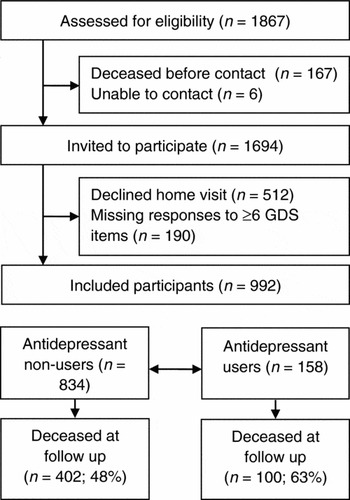
The flow of study participation is presented in Figure 1. Of 1,694 persons invited to participate, 992 (59%) participants were included in the present study (Figure 1). Those who declined home visits (n = 512) or failed to answer ≥10 GDS items (n = 190) were more likely than participants included in the analyses to be older (90.1 vs. 89.1 years, p < 0.001) and female (76% vs. 65%, p < 0.001).
Flowchart of the study.

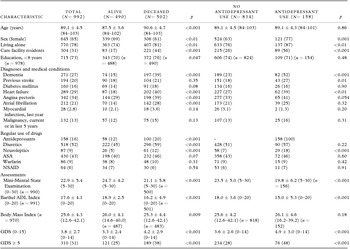
Table 1 shows the baseline characteristics of the total sample and according to survival status and antidepressant use. The mean age of the participants was 89 years. Dementia was diagnosed in 271 (27%) participants, 194 (20%) had a history of stroke, and 289 (29%) had heart failure (Table 1). A total of 158 (16%) participants used antidepressants, most commonly citalopram (91 users), mirtazapine (20 users), and sertraline (11 users). SSRIs were used by 121 participants, TCAs by 16, and other antidepressants by 35 (14 participants used two antidepressant drug classes). The mean GDS score (± standard deviation) was 3.8 ± 2.7 (range, 0–14), and 310 (31%) participants had GDS scores ≥ 5, of which 76 (25%) were being treated with antidepressants. Among participants living in care facilities, 29% used antidepressants and the mean GDS score ± SD was 4.5 ± 2.9 (range, 0–13). The corresponding numbers in the community were 10% and 3.5 ± 2.5 (range, 0–14). During the follow-up period (mean 3.3 years), death rates were 51% (502/992) in the total sample and 63% (100/158) among antidepressant users. Mortality and antidepressant use were associated with living alone, neuroleptic use, dementia, heart failure, lower MMSE scores, lower Barthel ADL Index scores, and higher GDS scores. Among women, mortality rate was lower and antidepressant use higher than in men (Table 1).
Baseline characteristics of the study cohort

Note: ASA = acetylsalicylic acid; NSAID = nonsteroidal anti-inflammatory drug; ADL = activities of daily living; GDS = Geriatric Depression Scale –15-item version. Data are presented as mean ± standard deviation (range) or n (%). For all assessment scales except GDS, higher scores indicate higher function. Differences between living and deceased participants and between antidepressant users and non-users were analyzed using the χ 2 test or independent-samples t-test, as appropriate.
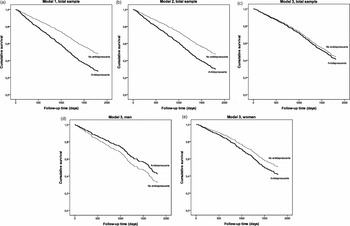
In the initial age- and sex-adjusted model (model 1), antidepressant use was associated with a 76% increased risk of death (HR = 1.76, 95% CI, 1.41–2.19). In model 2, additionally adjusted for continuous GDS score, antidepressant use remained associated with an increased risk for death (HR = 1.62, 95% CI, 1.29–2.03). In model 3, additionally adjusted for factors associated with both mortality status and antidepressant use (Table 1), this association was no longer significant (Table 2; Figure 2). In particular, adjustment for dementia, heart failure, and ADL dependency attenuated the associations found in models 1 and 2 (data not shown).
Hazard ratios for death among antidepressant users compared with non-users

Note: HR = hazard ratio; CI = confidence interval; GDS = Geriatric Depression Scale – 15-item version. Analyses were performed using Cox proportional hazard regression models. Model 1 was adjusted for age and sex; model 2 was adjusted for age, sex, and continuous GDS score; and model 3 was adjusted for age, sex, continuous GDS score, living alone, dementia, neuroleptics, heart failure, and Barthel ADL index. In the total sample and among men, model 3 was also adjusted for age × follow-up time.
Survival curves based on Cox proportional hazard regression models of antidepressant users versus non-users in the total sample (a–c) and in subgroups of men (d) and women (e). Model 1 (a): adjusted for age and sex; Model 2 (b): adjusted for age, sex, and continuous GDS score; Model 3 (c–e): adjusted for age, sex, continuous GDS score, living alone, dementia, neuroleptics, heart failure, and Barthel ADL index.

In subgroups of participants with high and low GDS scores, antidepressant use was associated with an increased risk of death in model 1 (HR = 1.48, 95% CI, 1.05–2.07 and HR = 1.85, 95% CI, 1.37–2.50, respectively) and model 2 (HR = 1.42, 95% CI, 1.01–1.99 and HR = 1.84, 95% CI, 1.36–2.48, respectively). In model 3, these associations were no longer significant (Table 2).
Interaction analyses of model 3 revealed a significant interaction between sex and antidepressant use (HR: 1.76; 95% CI, 1.05–2.94). The HRs for death among antidepressant users in model 3 were 0.76 (95% CI, 0.47–1.24) among men and 1.28 (95% CI, 0.97–1.70) among women (Table 2; Figure 2). Interaction effects in model 3 were not significant for dementia (HR: 0.69; 95% CI, 0.44–1.09), heart failure (HR: 0.79; 95% CI, 0.50–1.24), or previous stroke (HR: 0.80; 95% CI, 0.45–1.41).
Discussion
In this population-based study of very old people, treatment with antidepressants at baseline was found to be a risk factor for death, independent of depressive symptoms, but dependent on dementia, heart failure, and ADL dependence. The pattern was similar in the total sample and in those with high and low levels of depressive symptoms. A significant sex-based interaction was found among antidepressant users, and subgroup analyses revealed a tendency toward an increased risk of death among female users and a decreased risk among male users; however, these associations were not significant.
Although the present study included a large sample of people prone to adverse drug reactions, i.e. those with high mean age, multimorbidity, and dementia, antidepressant use was not associated with an increased risk of death in the fully adjusted model. These results stand in contrast to those of other large cohort studies conducted in younger and healthier populations (Ryan et al., Reference Ryan2008; Almeida et al., Reference Almeida, Alfonso, Hankey and Flicker2010; Coupland et al., Reference Coupland, Dhiman, Morriss, Arthur, Barton and Hippisley-Cox2011). In the present study, the association between antidepressant use and mortality was dependent on confounders, as it was significant in unadjusted analyses. Of these confounders, dementia, heart failure, and ADL dependency were the main factors explaining the association. These conditions are more common among very old people than among younger old people and seem to be associated with both a higher prescription rate of antidepressants and a higher rate of mortality. The divergent results compared with previous studies may also be explained by differences in the timing of prescribed medication data collection. In the present study, data on prescribed medications, including antidepressant treatment, were collected during home visits, rather than at the time of treatment initiation. This approach created a time gap, such that some individuals who received antidepressants may have died or discontinued treatment due to serious side effects before inclusion in the present study. Thus, individuals included in the present study with antidepressant use at baseline may be less prone to adverse reactions to these drugs. Coupland et al. (Reference Coupland, Dhiman, Morriss, Arthur, Barton and Hippisley-Cox2011) observed the highest risks of such reactions within 28 days after antidepressant initiation and 28 days after discontinuation. In addition, the risk of death diminished over time and was lower among antidepressant users 85 days after treatment initiation than among those who never received an antidepressant (Coupland et al., Reference Coupland, Dhiman, Morriss, Arthur, Barton and Hippisley-Cox2011). However, the authors used a crude measure of depression severity, and recognized the need for more sensitive adjustment for this variable (Coupland et al., Reference Coupland, Dhiman, Morriss, Arthur, Barton and Hippisley-Cox2011). The present study did use a more sensitive adjustment for depression severity. However, the death rate due to antidepressant use could not be explained by the severity of depression according to GDS scores. In addition, no tendency toward an increased death rate was observed among antidepressant users with GDS scores ≥ 5 compared with those with GDS scores < 5.
Among antidepressant users, no difference in the risk of death according to dementia, heart failure, or previous stroke was found in the present study. However, mortality risk due to antidepressant use differed between men and women, with a tendency toward increased risk among women. In a previous study, men were instead found to have a higher risk than women (Ryan et al., Reference Ryan2008). Differences in age, adjustments, and population characteristics may explain the divergent results. A factor that may have contributed to the sex difference in the present study is the increased risk among women of QTc prolongation and torsade de pointes, an adverse drug reaction that may be found among antidepressant users (van Noord et al., Reference van Noord, Eijgelsheim and Stricker2010; Castro et al., Reference Castro2013). However, no increased risk of death associated with baseline antidepressant treatment at the time of study inclusion was found among participants with heart failure in the present study, suggesting that adverse drug reactions affecting the heart may be limited after the initial phase of antidepressant usage. Furthermore, the stronger association observed between mortality and antidepressant use among women in comparison with men may be confounded by preclinical dementia, which has been associated with depressive disorders, mortality (Wallin et al., Reference Wallin, Boström, Kivipelto and Gustafson2013), and female sex (Fratiglioni et al., Reference Fratiglioni, Viitanen, von Strauss, Tontodonati, Herlitz and Winblad1997) in the very old. Unfortunately, preclinical dementia was not defined in participants in the present study.
The present study has some limitations that should be considered. As it was observational, no causal inference from the associations can be made. The limited number of antidepressant users and the uneven distribution of antidepressant drug classes prevented the analysis of mortality risk in subgroups of SSRI, TCA, other antidepressants, and among those using two antidepressant drug classes. However, all three classes have previously been associated with an increased risk of death (Coupland et al., Reference Coupland, Dhiman, Morriss, Arthur, Barton and Hippisley-Cox2011). As we investigated the risk of death due to baseline antidepressant use, data on time since treatment initiation or discontinuation were not available. Although baseline treatment does not seem to increase the risk of death among very old people, the initial and discontinuation phases of treatment may require further examination. Strengths of the study include the large population-based sample. In addition, home visitation enabled extensive collection of objective measures of ADL dependency, diseases, and other factors that may affect survival independent of antidepressant therapy. In the present study, antidepressant use was more common among participants with dementia, heart failure, and ADL dependency. These participants have shorter expected survival times, and failure to adjust properly for these factors may inflate estimates of the risks of antidepressant use.
Conclusion
The association between baseline treatment with antidepressants and mortality was in the present study dependent on confounding factors, and in particular, dementia, heart failure, and ADL dependency. A sex difference in mortality risk was found, suggesting that antidepressants affect the risk of death differently in men and women. This difference and the potential risk of initial treatment require further investigation in future large cohort studies of very old people with proper control for confounding factors, such as preclinical dementia.
Conflict of interest
None.
Description of authors’ roles
All authors contributed to the study design and formulation of research questions. GB, CH, JB, MC, and YG participated in the data collection. GB drafted the manuscript and performed data analyses. All authors assisted with data interpretation and critically revised the manuscript for intellectual content. GB, CH, JB, MC, PN, YG, and HL approved the final version of the manuscript. Unfortunately, PA passed away before the paper was completed and thus, he was not able to approve the final version.
Acknowledgments
This study was supported by the Swedish Research Council (K2014-99X-22610-01-6), the Swedish Research Council for Health, Working Life and Welfare [2013-1512], the Swedish Dementia Association, and the County Council of Västerbotten. Funding was also received from the European Union and the Regional Development Fund: the Interreg IIIA Mitt-Scandia and the Bothnia-Atlantica Program.