INTRODUCTION
Halicarcinus planatus (Fabricius, 1775) is a small brachyuran crab of the family Hymenosomatidae, which is only present in the extreme south of America. Its geographical distribution is closely associated with the Antarctic Circumpolar Current; it is found on Chilean coasts from Bahía Taltal (35°S) to the Cabo de Hornos, New Zealand and sub-Antartic Islands in the Pacific Ocean; along Fuegian coasts in Patagonia until 38°S in the Atlantic Ocean; and in the Prince Edward, Crozet and Kerguelen Islands in the Indian Ocean (Boschi et al., Reference Boschi, Scelzo and Goldstein1969; Melrose, Reference Melrose1975).
Halicarcinus planatus is a coastal species common in rocky, lower intertidal and sublittoral bottoms, and it occurs down to depths of about 10–15 m in Golfo San Jorge (Vinuesa, Reference Vinuesa2005). Populations are more abundant in sheltered areas such as bays and inlets and can also be found on exposed coasts, but in places protected from the high wave energies and where water is retained. In Golfo San Jorge and other areas, crabs often shelter under rocks in the lower intertidal and in sublittoral beds of Mytilidae or in the holdfasts of Macrocystis pyrifera (L.) Agardh, 1820 (Zaixso & Pastor, Reference Zaixso and Pastor1977; López Gappa et al., Reference López Gappa, Romanello and Hernández1982).
Information on different aspects of the biology of H. planatus has been provided by populations from the Kerguelen Islands (Richer de Forges, Reference Richer de Forges1977) and Puerto Deseado (Vinuesa & Ferrari, Reference Vinuesa and Ferrari2008a, Reference Vinuesa and Ferrarib). However, data on settlement and recruitment of this species are scarce. Richer de Forges (Reference Richer de Forges1977) reported the periods of recruitment and aggregation of juveniles. Vinuesa & Ferrari (Reference Vinuesa and Ferrari2008a), who described temporal changes in the structure of the H. planatus population in Puerto Deseado, suggested that recruitment occurs in the subtidal environment.
Benthic species with planktonic larvae experience high mortality during settlement and recruitment, thus these stages appear as critical in their life-cycle. In this context, the regulatory mechanisms play a major role in conditioning population dynamics (Beck, Reference Beck1995; Caley et al., Reference Caley, Carr, Hixon, Hughes, Jones and Menge1996). Settlement and recruitment are complex processes influenced by factors intrinsic to the population and by numerous environmental variables (Rodríguez et al., Reference Rodríguez, Ojeda and Inestrosa1993). In particular, the type of substrate and accessibility to refuge are of great importance for coastal crabs.
The objective of the present work was to study some aspects of the settlement and recruitment of H. planatus. The temporal patterns of these processes, the type of microhabitat and post-settlement movement of juveniles were investigated. In addition, the seasonal variations in the presence of the planktonic stages were evaluated.
MATERIALS AND METHODS
Study area
The study was performed in the central area of Golfo San Jorge, Argentina, in two nearby rocky shores, one located in Caleta del Fondo, a province of Santa Cruz (46°03′03″S and 67°36′13″W) and the other in front of Comodoro Rivadavia City (45°51′13″S and 67°28′35″W). These localities show similar characteristics in terms of orientation and exposure to waves, and depth.
The area is influenced by cold-temperate waters of the Patagonian Current which flow along the Patagonian coasts from the Estrecho de Magellanes northwards (Brandhorst & Castello, Reference Brandhorst and Castello1971). A branch of this current entering in north–north-west direction predominates in the studied area.
Sampling
Four plankton samples, two from each of the above-mentioned localities, were taken monthly between September 2006 and August 2007. Samples were collected with a conical net of 70-cm mouth diameter and 185-μm mesh opening. Oblique tows were conducted from near the bottom (7 m) to the surface. The volume of water filtered was estimated considering the distance of the haul and the mouth diameter of the plankton net. The samples were preserved in 4% formalin–seawater until further analysis in the laboratory. The temperature and salinity of surface water were recorded during each sampling period.
Three types of collectors were offered as settlement substrates:
(1) fibre concrete panels of 10 × 20 cm and 1 cm of thickness, provided with synthetic lawn of 10 × 10 cm and 1 cm of height on the surface. Panels had two holes in the ends to allow placement;
(2) fibre concrete panels of 10 × 20 cm and 1 cm of thickness, with a smooth surface of 10 × 10 cm without synthetic lawn. Panels had two holes in the ends to allow placement; and
(3) 5 l plastic boxes (20 × 25 × 10 cm) with an upper aperture of about 10 × 10 cm closed with a plastic net of 10 mm in diameter, pierced with many 10-mm holes, filled with approximately 1 kg of fishing nets, and ballasted with concrete.
The collectors were placed in the sea for 20 days to eliminate the initial effects of chemical compounds of the materials that became collectors. Later they were mounted on 1 × 2 m iron frames attached to the rocky bottom. Six smooth-surface panels, six panels with synthetic lawn and four collecting boxes were installed every month between July 2006 and June 2007. All were removed two months after immersion. The installation and recovery of the collectors were performed by a diver, who placed the collectors in sealed bags in situ. The panels were frozen at –14°C until analysis, and the boxes inspected within the following 20 hours.
Laboratory analysis
Halicarcinus planatus larvae were sorted from the rest of the zooplankton and the zoeal stages were identified according to Boschi et al. (Reference Boschi, Scelzo and Goldstein1969). The larvae were determined and counted under stereo zoom microscope. When needed, to avoid misidentifications, the observations were also made at higher magnifications with a compound microscope.
The collectors were washed and sieved with a mesh size of 0.5 mm to remove sediment. Taxonomic identification of the accompanying fauna and algae was made to the lowest possible taxonomic level. The crabs were sorted from the rest of the organisms, sexed and their carapace width (CW) was measured to the nearest 0.01 mm. Males are recognized by the narrowing of the last three abdominal segments. Females were first classified based on the morphology of the abdomen into the following five categories: immature (IMM2, IMM3 and IMM4); adolescent (ADO); and adult or mature (MAT), according to a previous work (Vinuesa & Ferrari, Reference Vinuesa and Ferrari2008a). Then, they were grouped into four stages as follows: (a) settlers were IMM1 individuals, who included both small males and females since sex cannot be determined at this stage; (b) recruits were small males and IMM2 and IMM3 females; (c) late juveniles included IMM4 and ADO females; and (d) adults were ovigerous and post-ovigerous females.
Statistical analyses
The comparison of the total number of H. planatus individuals among collector types was performed by factorial analysis of variance. Data were checked for homocedasticity and normality using the Cochran C test and the Lilliefors test, respectively (Sokal & Rohlf, Reference Sokal and Rohlf1995). Significant differences in the distribution of postlarval stages were tested with permutational analysis of variance (PERMANOVA), using the Bray–Curtis dissimilarity index and presence–absence data transformation (Anderson, Reference Anderson2001, Reference Anderson2005). PERMANOVA is a univariate or multivariate analysis of variance using permutations procedures to obtain P values. It is suitable for any multifactorial ANOVA design allowing for all pairwise multiple comparisons by permutation. Similarity percentage analysis (SIMPER) was performed to quantify the contribution of each category to the different collector types. Bray–Curtis dissimilarity index and presence–absence data transformation were used for this test (Clarke & Warwick, Reference Clarke and Warwick2001).
RESULTS
The temperatures and salinities were similar in both sites. The minimum temperature, recorded in August, was 7.6°C and the maximum temperature, recorded in January, was 17.3°C. Salinity ranged between 33.1 and 34.2‰.
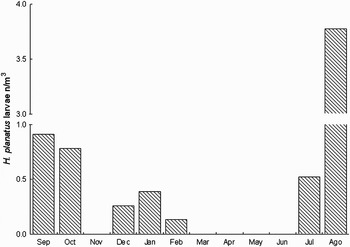
The H. planatus zoeae were collected between September and February 2006 and in July and August 2007, and were not found between March and June (Figure 1). No larvae were collected in November, probably due to the rough sea conditions during the sampling. The temporal distribution of larvae was similar between localities. Zoeae I were present throughout the months mentioned above, while zoeae II were only found in December and February.
Abundance of larvae of Halicarcinus planatus between September 2006 and August 2007. Values from both localities are pooled.

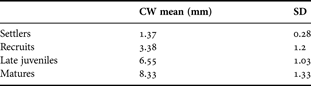
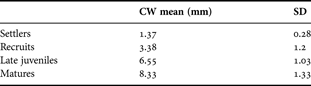
A total of 412 crabs and several exuviae were removed from all the collectors recovered (N = 192), with an overall sex-ratio of 1:25 (male:female). For recruits, the male:female ratio was 1:7. Adult males were not registered. The settlers (IMM1) represented 24.8% of total crabs (N = 105), with sizes ranging between 0.8 and 2.1 mm CW. The recruits included males between 1.8 and 3.0 mm CW and females between 1.8 and 3.5 mm CW (N = 139). Late juveniles (N = 103) and adults (N = 60) were only represented by females (Table 1). Exuviae of IMM I were recorded also, in synthetic lawn panels.
Mean and standard deviation (SD) of the carapace width (CW) at each developmental stage of Halicarcinus planatus.
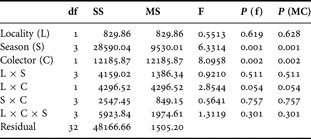
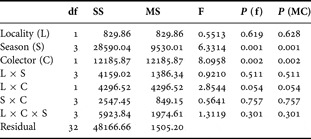
In the smooth-surface panels, the number of individuals (N = 5) was much lower than in the rest of the collectors, and then were excluded from further analysis. There were significant differences in the distribution of the developmental stages among collector types and seasons but not between localities. No interactions were found among the analysed factors (PERMANOVA; Table 2).
Permutational analysis of variance based on the Bray–Curtis dissimilarity index. df, degrees of freedom; SS, sum of squares; MS, mean square; F, F ratio; P (f), probability values associated with F values; P (MC), probability values obtained using Monte Carlo permutations.
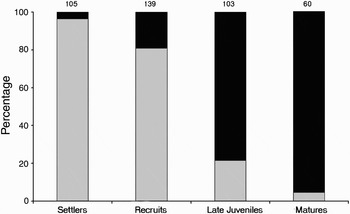
Settlers had a higher contribution to dissimilarities among collectors compared to the other developmental stages (SIMPER analysis; Table 3). This stage was almost exclusively found on the panels covered with synthetic lawn, and recruits were also more abundant on this collector type. Late juveniles and adults predominated in the boxes (Figure 2). Ten exuviae of settlers were recovered from the collector panels. The accompanying fauna and flora also differed between panels and boxes. The panels were colonized by diverse organisms such as more than ten algal species, colonial benthic diatoms, foraminifers, nematodes, polychaetes, harpacticoid copepods, amphipods, isopods, cumaceans and other juvenile decapods. The boxes contained mainly polychaete worms, small fissurellids and octopuses, juvenile sea urchins, ophiuroids and starfish, isopods, caridean shrimps and fish.
Abundance (as percentage) of each stage of Halicarcinus planatus by type of collector. Grey and black bars represent the collecting panels and boxes, respectively. Individuals from both localities are grouped.

Similarity percentage analysis based on the Bray–Curtis dissimilarity index and transformed absence–presence data. The percentages of presence in the collectors are shown. All values are expressed as percentage of presence.

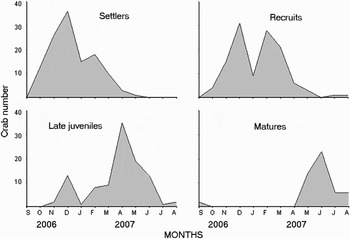
The settlers were found throughout spring and summer, showing an abundance peak in December; the recruits were more abundant during December 2006 and February 2007; and the abundance peak of late juveniles was observed in April 2006. Mature females occurred from May throughout the winter months (Figure 3). The decrease in the number of crabs observed in January may have been due to severe storms some days before the collectors were recovered.
Abundance (number of crabs per month) of the developmental stages of Halicarcinus planatus. Crabs from both localities are grouped.

DISCUSSION
Settlement and recruitment are important events to understand the dynamics and structure of a population (Beck, Reference Beck1995; Caley et al., Reference Caley, Carr, Hixon, Hughes, Jones and Menge1996). These are complex processes determined by the interaction between physical (e.g. light, water flow and substrate surface), chemical (e.g. secondary metabolites) and biological factors (e.g. larval behaviour, predation or juvenile dispersion) (Rodríguez et al., Reference Rodríguez, Ojeda and Inestrosa1993).
The larval supply, its distribution and behaviour are important pre-settlement factors (Rodríguez et al., Reference Rodríguez, Ojeda and Inestrosa1993; Moksnes & Wennhage, 2001). Larvae of H. planatus occur during eight months of the year. No larvae were captured in November. This is due to weather conditions during sampling. The absence of zoeae in the latter month is unexpected since it is when the local adult population undergoes larval hatching (Vinuesa, unpublished results). Zoeae I were the most abundant stage throughout the study period, indicating a continuous supply of larvae to the water column. The rare presence of zoeae II and the absence of zoea III may result from underestimation by an increase in positive geotaxis during larval ontogeny. Similar results were obtained with late zoeae in H. planatus from the Kerguelen Islands (Richer de Forges, Reference Richer de Forges1977). The absence of later stages due to larval dispersal seems unlikely; according to Lucas (Reference Lucas1980) a limited dispersal is a common strategy among the Hymenosomatidae.
Post-settlement factors have an important role in survival and distribution of juvenile crabs. These factors include: shelter, food supply, predation and cannibalism. The habitat availability is important in settlement and recruitment. Many works on the role of shelter and substrate in these processes conclude that species select complex habitats to minimize mortality (e.g. Botero & Atema Reference Botero and Atema1982; Marx & Herrnkind, Reference Marx and Herrnkind1985; Herrnkind & Butler, Reference Herrnkind and Butler1986; Beck, Reference Beck1995; Moksnes, Reference Moksnes2002). Mytilid and oyster beds, seagrass and shellhash beds, kelp forests, and other structurally complex microhabitat provide refuge for early crab stages from predation (Palacios et al., Reference Palacios, Armstrong, Armstrong, Williams and Melteff1985; Fernández et al., Reference Fernández, Iribarne and Armstrong1993; Forward et al., Reference Forward, De Vries, Ritschoff, Frankel, Bischof, Fisher and Welch1996; Stevens & Kittaka, Reference Stevens and Kittaka1998).
Richer de Forges (Reference Richer de Forges1977) reported the aggregation of H. planatus juveniles < 4 mm CW in holdfasts of M. pyrifera, highlighting their nursery role. In Puerto Deseado (~48° SL), the smallest juveniles (between 1.1 and 1.3 mm CL) were also exclusively found in the holdfasts of this kelp (Vinuesa & Ferrari, Reference Vinuesa and Ferrari2008a). In this work, settlers and recruits were more abundant on collectors with synthetic lawn. The smooth-surface collectors with unprotected, exposed areas were unfavourable for crab settlement. The early postlarval stages of H. planatus showed preference for complex structural collectors.
According to Rodríguez et al. (Reference Rodríguez, Ojeda and Inestrosa1993) the selection of microhabitats by benthic marine organisms at settlement may be related to food availability. In the spiny lobster Panulirus argus (Latreille, 1804), the abundance of food resources is an important factor for habitat selection in juveniles (Herrnkind & Butler, Reference Herrnkind and Butler1986). Halicarcinus planatus is a generalist crab; polychaete annelids, copepods, algae and diatoms were found in its diet (Arnaud, Reference Arnaud1974; Richer de Forges, Reference Richer de Forges1977). The high number of algae and animals found on the panels suggests that settlers and recruits used them not only as shelters but also as food source.
Crustaceans have discontinuous growth and therefore the shelter is particularly important during moulting and post-moult stages. Moreover, decapods are able to delay moulting in the absence of an appropiate shelter (Hopkins, Reference Hopkins1992). The occurrence of two successive developmental stages and the presence of exuviae on the panels provide evidence that the settlers remain for some time in the settlement microhabitat, where they undergo moulting.
Predation is responsible for high mortality during the post-settlement of numerous decapod species (Herrnkind & Butler, Reference Herrnkind and Butler1986; Eggleston & Armstrong, Reference Eggleston and Armstrong1995; Moksnes, Reference Moksnes2002). Moreover, predation contributes to the dispersal of early juvenile stages of some species, e.g. P. argus (Herrnkind & Butler, Reference Herrnkind and Butler1986), and the blue king crab Paralithodes platypus Brandt, 1850 (Stevens & Swiney, Reference Stevens and Swiney2005). The low number of settlers and recruits in the boxes could be related to the presence of predators. In fact, some predators like the starfish Anasterias minuta Perrier, 1875 (Gil & Zaixso, Reference Gil and Zaixso2007), notothenid fish (Hureau, Reference Hureau1970), and potential predators like the shrimp Betaeus truncatus Dana, 1852 and the octopus Enteroctopus megalocyathus (Gould, 1852) were found in the boxes.
In some species, the presence of adult conspecific specimens or parental odour is likely to act as a stimulus for settlement (Jensen Reference Jensen1991; Rodríguez et al., Reference Rodríguez, Ojeda and Inestrosa1993; Gebauer et al., Reference Gebauer, Paschke and Anger2003), but would induce intercohort cannibalism. Intraspecific predation is important in regulating recruitment and has been thoroughly studied in the blue crab Callinectes sapidus Rathbun, 1896 (Moksnes et al., Reference Moksnes, Lipcius, Pihl and van Montfrans1997), the ‘Dungeness crab’ Cancer magister Dana 1852 (Fernández et al., Reference Fernández, Iribarne and Armstrong1993), the estuarine crabs Chasmagnatus (= Neohelice) granulata Dana 1851 and Cyrtograpsus angulatus Dana 1851 (Luppi et al., Reference Luppi, Spivak and Anger2001) and Paralithodes camtschaticus (Tilesius, 1815) (Stevens & Swiney, Reference Stevens and Swiney2005), among others. The presence of larger conspecific individuals in the boxes may also account for the small number of early stages found in them. Halicarcinus planatus was observed to feed on recently moulted or smaller conspecific individuals under laboratory conditions (Vinuesa, unpublished results). The presence of larger conspecific individuals in the boxes may also account for the small number of early stages found in them.
Post-settlement movements may result from ontogenetic shifts in diet, behaviour and shelter requirements (Herrnkind & Butler, Reference Herrnkind and Butler1986). This behaviour has been described for several decapods, e.g. P. argus (Herrnkind & Butler, Reference Herrnkind and Butler1986), C. sapidus (Moksness et al., Reference Moksness, Pihl and van Montfrans1998), Carcinus maenas L. (Moksnes, Reference Moksnes2002), C. granulata and C. angulatus (Luppi et al., Reference Luppi, Spivak, Anger and Valero2002) and P. platypus (Tapella et al., Reference Tapella, Romero, Stevens and Buck2009). The spatial separation among different developmental stages of H. planatus may imply a microhabitat shift during recruitment, which seems to be particularly pronounced in males. The panels may become less safe as individuals increase in size, compelling juveniles to occupy more protected habitats. The H. planatus population from the Golfo San Jorge showed a strongly female-biased sex-ratio, which could be explained by the movement of males to more cryptic habitats at early stages. In the Deseado estuary, all crabs collected between low intertidal and upper subtidal rocky shore (Vinuesa & Ferrari, Reference Vinuesa and Ferrari2008a) and holdfasts of Macrocystis pyrifera (López Gappa et al., Reference López Gappa, Romanello and Hernández1982) were exclusively females.
The recruitment may be mainly limited by settlement when there is a good correlation between larval settlers, recruits and the subsequent stages (Connell, Reference Connell1985; Doherty & Williams, Reference Doherty and Williams1988; Palma et al., Reference Palma, Wahle and Steneck1998) or regulated, if the population density is affected by post-settlement processes (Eggleston & Armstrong, Reference Eggleston and Armstrong1995; Moksnes et al., 1998; Luppi et al., Reference Luppi, Spivak, Anger and Valero2002; Sainte-Marie & Lafrance, Reference Sainte-Marie and Lafrance2002). Temporal distribution of larvae, settlers and recruits of H. planatus showed a clear correlation. Prolonged periods of occurrence with peaks of abundance were observed for these stages. Post-settlement factors (shelter, food, predation and cannibalism), may have important roles in microhabitat selection and distribution of juveniles of H. planatus. On this basis, the species in Golfo San Jorge would follow a mixed pattern of recruitment, during which individuals undertake movements leading to differences in the spatial distribution of the developmental stages and sexes.
ACKNOWLEDGEMENTS
Thanks are due to the diver Mr Héctor Durbas for the installation and recovery of the collectors. We appreciate the helpful comments of two anonymous referees on the manuscript. This work was supported by the Project PNUD ARG 02/018: ‘Coastal Contamination Prevention and Marine Biodiversity Management’ Proyecto Marino Patagónico, Donación GEF/BIRF (Subproject AB-67).