Introduction
Antimicrobial peptides (AMPs): ubiquitous natural antibiotics
Small biological molecules (<10 kDa) with direct antimicrobial activity, including enzymatically synthesized compounds and ribosomal-synthesized AMPs, provide effective microbial defense for all organisms from bacteria to mammals (Beutler, Reference Beutler2004; Hancock and Sahl, Reference Hancock and Sahl2006). The discovery and development of conventional antibiotics, which are primarily based on bacteria- or fungi-generated antimicrobial compounds, have led to dramatic improvements in the ability to treat infectious diseases and significant increases in food animal production. Unquestionably, antibiotics represent one of the major scientific and medical advances of the 20th century (Gordon et al., Reference Gordon, Romanowski and McDermott2005; McPhee and Hancock, Reference McPhee and Hancock2005). Although antibiotic therapy is still the first choice to combat microbial infections in humans and animals, the prevalence of bacterial resistance to conventional antibiotics is a growing public health concern. This has driven the search for new antimicrobials that are broadly effective and less likely to induce antimicrobial resistance.
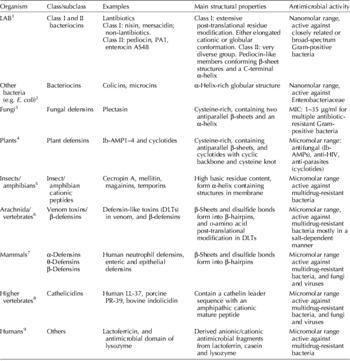
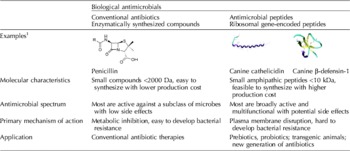
Natural gene-encoded AMPs are a diverse group of innate immune molecules present in all organisms. Mature AMPs generally contain 12–100 amino acid residues, possess a net positive charge and an amphipathic structure that facilitates interaction with negatively charged microbial membranes or other cellular targets (Yeaman and Yount, Reference Yeaman and Yount2007; Linde et al., Reference Linde, Ross, Davis, Dib, Blecha and Melgarejo2008; Sang and Blecha, Reference Sang and Blecha2008). A list of the general properties of AMPs, including primary structural properties and antimicrobial activities, is presented in Table 1. Compared with conventional antibiotics, which are generally active against bacteria or fungi, AMPs often exert activity against a broad spectrum of micro-organisms including bacteria, fungi, parasites, enveloped viruses and even some cancer cells. In addition, unlike conventional antibiotics, which generally target a metabolic enzyme and may selectively induce resistance in micro-organisms, AMPs kill microbes mainly by membrane-targeting pore-forming mechanisms (Table 2), a mechanism that is inherently more difficult for microbes to circumvent by developing resistance (Boman, Reference Boman2003; Hancock and Sahl, Reference Hancock and Sahl2006). AMPs have been isolated from most life forms and include bacteriocins, fungal peptide antibiotics, plant thionins and defensins, insect defensins and cecropins, amphibian magainins and temporins, as well as defensins and cathelicidins from higher vertebrates (McPhee and Hancock, Reference McPhee and Hancock2005; Yeaman and Yount, Reference Yeaman and Yount2007). This review will summarize and discuss the antibiotic properties of AMPs with the aim of highlighting their potential as alternatives to conventional antibiotics.
Examples and general properties of AMPs

1 Willey et al., Reference Willey and van der Donk2007; Field et al., Reference Field, Connor, Cotter, Hill and Ross2008.
2 Duquesne et al., Reference Duquesne, Destoumieux-Garzón, Peduzzi and Rebuffat2007; Nes et al., Reference Nes, Diep and Holo2007.
4 Colgrave et al., Reference Colgrave, Kotze, Huang, O'Grady, Simonsen and Craik2008; Ireland et al., Reference Ireland, Wang, Wilson, Gustafson and Craik2008; Marcos et al., Reference Marcos, Muñoz, Pérez-Payá, Misra and López-García2008.
5 Bechinger, Reference Bechinger1997; Giacometti et al., Reference Giacometti, Cirioni, Kamysz, D'Amato, Silvestri, Del Prete, Łukasiak and Scalise2003.
6 Yeaman and Yount, Reference Yeaman and Yount2007; Warren et al., Reference Warren, Hillier, Marshall Graves, Birney, Ponting, Grützner, Belov, Miller, Clarke, Chinwalla, Yang, Heger, Locke, Miethke, Waters, Veyrunes, Fulton, Fulton, Graves, Wallis, Puente, Lopez-Otin, Ordonez, Eichler, Cheng, Cheng, Deakin, Alsop, Thompson, Kirby, Papenfuss, Wakefield, Olender, Lancet, Huttley, Smit Arian, Pask, Temple-Smith, Batzer, Walker, Konkel, Harris, Whittington, Wong, Gemmell, Buschiazzo, Vargas Jentzsch, Merkel, Schmitz, Zemann, Churakov, Kriess, Brosius, Murchison, Sachidanandam, Hannon, Tsend-Ayush, Mcmillan and Attenborough2008.
7 Selsted and Ouellette, Reference Selsted and Ouellette2005; Lehrer, Reference Lehrer2007.
8 Zanetti, Reference Zanetti2005.
9 Brogden, Reference Brogden2005.
Characteristics and applications of biological antimicrobials

1 Structure information for penicillin is from the public domain (http://www.hopkins-abxguide.org/). Structures of canine β-defensin-1 and cathelicidin were adapted from our previous work (Sang et al., Reference Sang, Ortega, Blecha, Prakash and Melgarejo2005; Sang et al., Reference Sang, Ortega, Rune, Xiau, Zhang, Soulages, Lushington, Fang, Williams, Blecha and Melgarejo2007).
Bacteriocins: bacterial AMPs
Bacteriocins are bacterially produced, small, heat-stable peptides that bacteria use to compete against other bacteria of the same species (narrow spectrum) or against bacteria of other genera (broad spectrum) (Cotter et al., Reference Cotter, Hill and Ross2005). One or several bacteriocins have been identified or are believed to exist in every species of bacteria and archaea (Cotter et al., Reference Cotter, Hill and Ross2005; Willey and van der Donk, Reference Willey and van der Donk2007). A current bacteriocin database (Hammami et al., Reference Hammami, Zouhir, Ben Hamida and Fliss2007; http://www.cck.rnu.tn/pfba/bactibase/main.php) lists 145 entries including 39 lanthionine-containing bacteriocins (Class I), 40 non-lanthionine-containing bacteriocins (Class II) and other unclassified entries, likely bacteriolysins (Cotter et al., Reference Cotter, Hill and Ross2005; Willey and van der Donk, Reference Willey and van der Donk2007). Class I bacteriocins are small peptides (18–39 residues) and are commonly called lantibiotics because of the lanthionine or β-methyllanthionine residues that they contain. These unusual residues are formed during post-translational modification and enzymatically crosslink a dehydrated serine/threonine to a neighboring cysteine, resulting in intramolecular covalent bridges (Cotter et al., Reference Cotter, Hill and Ross2005; Willey and van der Donk, Reference Willey and van der Donk2007). In contrast, Class II bacteriocins constitute a very diverse group and are not subject to this extensive post-translational modification. Class III bacteriolysins are large, heat-labile proteins that catalyze the hydrolysis of bacterial cell walls resulting in autolysis of targeted bacteria. The majority of Class I and Class II bacteriocins are active in the nanomolar range against Gram-positive bacteria in closely related species or in a broad-spectrum manner for many species.
The most promising bacteriocins in development as antibiotics are those produced by lactic acid bacteria (LAB) with the core genera including Lactobacillus, Lactococcus, Leuconostoc, Pediococcus and Streptococcus. Because of the long history of using LAB in the processing of fermented foods, the antimicrobial and safety information for LAB in food preservation is widely accepted. In addition, LAB are used extensively as probiotics in food processing and preservation (De Vuyst and Leroy, Reference De Vuyst and Leroy2007; Sit and Vederas, Reference Sit and Vederas2008), and LAB-derived bacteriocins will likely enter the working pharmacopeia as oral or gastrointestinal antibiotics (Rossi et al., Reference Rossi, Rangasamy, Zhang, Qiu and Wu2008). Examples of LAB-derived bacteriocins include nisin, mersacidin, lacticin 481 and lacticin 3147. Among these, nisin has been approved for commercial use in some food processing applications and as an anti-infective for bovine mastitis (Cotter et al., Reference Cotter, Hill and Ross2005; Dufour et al., Reference Dufour, Hindré, Haras and Le Pennec2007), and mersacidin has been evaluated in preclinical tests to treat Gram-positive infections (Hancock and Sahl, Reference Hancock and Sahl2006). Lacticin 3147, a two-peptide lantibiotic, has shown promise in preventing mastitis infections (Crispie et al., Reference Crispie, Twomey, Flynn, Hill, Ross and Meaney2005) and as a food preservative (Gardiner et al., Reference Gardiner, Rea, O'Riordan, O'Connor, Morgan, Lawlor, Lynch, Cronin, Ross and Hill2007). Importantly, several bacteriocins, including lacticin 3147, mersacidin and leucocin A, display potent activity against antibiotic-resistant bacterial strains such as vancomycin-resistant enterococci (VRE) and methicillin-resistant Staphylococcus aureus (MRSA) (Kruszewska et al., Reference Kruszewska, Sahl, Bierbaum, Pag, Hynes and Ljungh2004; Sit and Vederas, Reference Sit and Vederas2008). In addition to food-introduced LAB, gastrointestinal commensal LAB (enterococci and streptococci) and microflora of the family Enterobacteriaceae produce a large panel of bacteriocins, such as enterocins, salivaricins, colicins and microcins. These bacteriocins have significant potential for probiotic or antibiotic use after suitable biotechnological modifications are developed (Duquesne et al., Reference Duquesne, Destoumieux-Garzón, Peduzzi and Rebuffat2007; Nes et al., Reference Nes, Diep and Holo2007).
Fungal AMPs
The most widely used and historic antibiotic to date, penicillin, is from the fungus Penicillium chrysogenum, previously named Penicillium notatum. In addition, many peptide antimicrobials are produced by fungi. For example, soil-fungi peptide antibiotics named peptaibols (small peptides usually containing α-aminoisobutyric acid and a C-terminal alcohol) have potent antibacterial and antifungal properties (Duclohier, Reference Duclohier2007). The antimicrobial properties of peptaibols derive from their amphipathic, helical structure that facilitates lytic pore formation in membranes. Although peptaibols are peptide antibiotics they are not gene-encoded, ribosomal-produced AMPs; instead they use a multi-enzyme, non-ribosomal peptide sythetase complex (peptaibol synthetase) for their biosynthesis (Leitgeb et al., Reference Leitgeb, Szekeres, Manczinger, Vágvölgyi and Kredics2007). Hundreds of peptaibol sequences are compiled in the Peptaibol Database (http://www.cryst.bbk.ac.uk/peptaibol/home.shtml).
Fungal genomes also encode abundant cysteine-rich AMPs consisting of α-helix and β-sheet structures, collectively called defensin-like peptides (Zhu, Reference Zhu2008). Plectasin is the first identified fungal defensin and is active against antibiotic-resistant strains of Streptococcus pneumoniae with efficacy in treating peritonitis and pneumonia in mice (Mygind et al., Reference Mygind, Fischer, Schnorr, Hansen, Sönksen, Ludvigsen, Raventós, Buskov, Christensen, De Maria, Taboureau, Yaver, Elvig-Jørgensen, Sørensen, Christensen, Kjaerulff, Frimodt-Moller, Lehrer, Zasloff and Kristensen2005) (Table 1). Bioinformatics analysis of fungal genomes reveals six families of fungal defensin-like peptides, among which three families are ancestral to defensin molecules from plants, insects and invertebrates (Zhu, Reference Zhu2008). Indeed, evolutionarily, cysteine-rich defensin-like peptides have been suggested to be the most diverse group of AMPs existing in all cellular organisms (Yeaman and Yount, Reference Yeaman and Yount2007; Zhu, Reference Zhu2008).
Plant AMPs
It has been estimated that there are about 300 genes encoding defensins in plants (Silverstein et al., Reference Silverstein, Graham, Paape and VandenBosch2005; Thevissen et al., Reference Thevissen, Kristensen, Thomma, Cammue and François2007). Although direct antimicrobial activity of most plant defensins against animal pathogens has not been reported, four cysteine-rich plant AMPs and their synthetic analogues are potent against bacterial and fungal infections. These AMPs were isolated from seeds of Impatiens balsamina, an herb with a long history of use among Asian people to treat infectious diseases (Thevissen et al., Reference Thevissen, Kristensen, Thomma, Cammue and François2007; Marcos et al., Reference Marcos, Muñoz, Pérez-Payá, Misra and López-García2008). Another fascinating subgroup of plant AMPs are cyclotides characterized by a cyclic backbone and knotted disulfide bonds resulting from cyclization. Plant cyclotides were recently shown to be highly active against HIV-infected cells (Ireland et al., Reference Ireland, Wang, Wilson, Gustafson and Craik2008) and to significantly suppress the development of gastrointestinal nematode parasites in livestock (Barbeta et al., Reference Barbeta, Marshall, Gillon, Craik and Anderson2008; Colgrave et al., Reference Colgrave, Kotze, Huang, O'Grady, Simonsen and Craik2008).
Animal AMPs
Most animals possess defensins or defensin-like peptides. Indeed defensin-like peptides are present in venom toxins from arthropod and reptile species such as scorpions and snakes (Whittington et al., Reference Whittington, Papenfuss, Bansal, Torres, Wong, Deakin, Graves, Alsop, Schatzkamer, Kremitzki, Ponting, Temple-Smith, Warren, Kuchel and Belov2008), and genome analysis of the platypus suggests that defensin-like peptides are an evolutionary signature (Warren et al., Reference Warren, Hillier, Marshall Graves, Birney, Ponting, Grützner, Belov, Miller, Clarke, Chinwalla, Yang, Heger, Locke, Miethke, Waters, Veyrunes, Fulton, Fulton, Graves, Wallis, Puente, Lopez-Otin, Ordonez, Eichler, Cheng, Cheng, Deakin, Alsop, Thompson, Kirby, Papenfuss, Wakefield, Olender, Lancet, Huttley, Smit Arian, Pask, Temple-Smith, Batzer, Walker, Konkel, Harris, Whittington, Wong, Gemmell, Buschiazzo, Vargas Jentzsch, Merkel, Schmitz, Zemann, Churakov, Kriess, Brosius, Murchison, Sachidanandam, Hannon, Tsend-Ayush, Mcmillan and Attenborough2008; Whittington et al., Reference Whittington, Papenfuss, Bansal, Torres, Wong, Deakin, Graves, Alsop, Schatzkamer, Kremitzki, Ponting, Temple-Smith, Warren, Kuchel and Belov2008). Mammals possess the most diverse groups of defensins. Three subgroups of mammalian defensins, α-, β- and θ-defensins, have been classified based on the differential connections of their three disulfide bridges (Ganz, Reference Ganz2003; Selsted and Ouellette, Reference Selsted and Ouellette2005). Defensins have evolved in mammals with α- and θ-defensins only appearing in species later than glires and some primate clades (Selsted and Ouellette, Reference Selsted and Ouellette2005; Lehrer, Reference Lehrer2007; Lynn and Bradley, Reference Lynn and Bradley2007; Sang and Blecha, Reference Sang and Blecha2008).
In addition to cysteine-rich AMPs, there are other prominent subgroups of AMPs in animals characterized on the basis of primary or secondary peptide structure (Brogden, Reference Brogden2005). One subgroup is characterized by an abundant number of cationic peptides containing basic and/or hydrophobic residues at a high ratio and many of them conform into α-helical structures in membrane-mimetic environments. Examples of these subgroups include mammalian cathelicidins, amphibian magainins and maximins, and insect cecropins. Some members of this subgroup, such as cathelicidins, are rich in certain residues such as proline (e.g. porcine PR-39), phenylalanine (e.g. porcine prophenins) and tryptophan (e.g. bovine indolicidin), which may contribute to their ‘multi-hitting’ model of antimicrobial responses (McPhee and Hancock, Reference McPhee and Hancock2005; Hancock and Sahl, Reference Hancock and Sahl2006; Hale and Hancock, Reference Hale and Hancock2007) (Fig. 1). The second subgroup of AMPs includes antimicrobial fragments derived from large proteins such as lactoferricin from lactoferrin and the antimicrobial domain of lysozyme (Brogden, Reference Brogden2005) (Table 1). Potent activity against a broad spectrum of micro-organisms including bacteria, fungi, enveloped viruses and tumor cells has been observed in members of these animal AMPs (Brogden, Reference Brogden2005) plus multiple roles with respect to immunoregulation and cell signaling (Hancock and Sahl, Reference Hancock and Sahl2006; Zaiou, Reference Zaiou2007). These examples illustrate the diversity of AMPs and suggest that they may be a rich source for future antibiotic design and drug development. Indeed, multiple AMPs or analogues are in development for antimicrobial and immunoregulatory therapies (Gordon et al., Reference Gordon, Romanowski and McDermott2005; McPhee and Hancock, Reference McPhee and Hancock2005; Hancock and Sahl, Reference Hancock and Sahl2006).
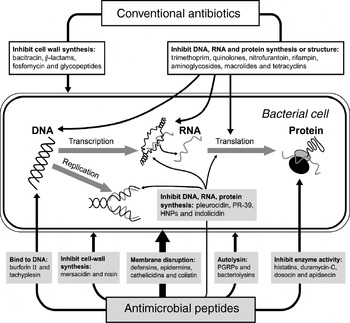
Mechanisms of action of conventional antibiotics and AMPs. Bactericidal mechanisms of AMPs are illustrated with an emphasis on the propensity to membrane disruption. AMP-related aspects were adapted with permission from Macmillan Publishers: Nature Reviews: Microbiology (Brogden, Reference Brogden2005) and Nature Biotechnology (Hancock and Sahl, Reference Hancock and Sahl2006). Conventional antibiotic information was adapted from a public domain (http://www.hopkins-abxguide.org/).

AMPs as natural antibiotics: antimicrobial activity, mechanism of action and current status in development
Similar to traditional antibiotics, most AMPs are highly active against bacteria and fungi. However, many AMPs, including plant cyclotides, and animal defensins and cathelicidins, also possess antiviral or anti-parasite activity (Table 1). Generally, bacteriocins are extremely active against related Gram-positive bacteria or Enterobacteriaceae with minimal inhibitory concentration (MIC) in the nanomolar range. Several bacteria that produce bacteriocins are food-borne pathogens, such as Listeria monocytogenesis and antibiotic-resistant strains of Salmonella spp., Campylobacter spp., Escherichia coli and Enterococcus spp. (Kang and Lee, Reference Kang and Lee2005; Nes et al., Reference Nes, Diep and Holo2007; Sit and Vederas, Reference Sit and Vederas2008; Svetoch et al., Reference Svetoch, Eruslanov, Perelygin, Mitsevich, Mitsevich, Borzenkov, Levchuk, Svetoch, Kovalev, Stepanshin, Siragusa, Seal and Stern2008). Therefore, bacteriocins, especially lantibiotics, have promise as antibiotics to meet the requirements of food preservation and in preventing infections from food-borne pathogens (Nes et al., Reference Nes, Diep and Holo2007; Sit and Vederas, Reference Sit and Vederas2008). The primary bactericidal mechanism of bacteriocins is through membrane pore formation as shown for most lantibiotics. However, some bacteriocins also attack other cellular targets such as mersacidin interaction with lipid II to prevent cell-wall synthesis, microcin J25 inhibition of bacterial RNA synthesis and duramycin-C inhibition of bacterial phospholipase A2. Other bacteriocins like nisin use more than one mechanism (membrane pore formation and disruption of cell-wall synthesis) to kill targeted bacteria. The antimicrobial capacity of two-peptide bacteriocins such as Class I lacticin 3147 and Class II lactacin-F requires the combined activity of both partners to dissipate membrane potential, to induce ion leakage and/or to interfere with cellular ATP production (Fig. 1) (Cotter et al., Reference Cotter, Hill and Ross2005; Willey et al., Reference Willey and van der Donk2007).
Membrane-targeting mechanisms are the most conserved killing mechanisms of AMPs identified from plants, insects and vertebrate animals (Table 1 and Fig. 1). Through their net-positive surface charge and/or amphipathic structure, AMPs undergo a pore-formation process of membrane attachment, insertion and permeabilization (Brogden, Reference Brogden2005). In a recently proposed two-state model based on studies of representative cysteine-rich AMPs, it is posited that AMPs initially assemble parallel to the plane of the membrane and cause membrane thinning in proportion to the peptide/lipid ratio of the membrane. As the peptides continue assembling on the membrane surface and exceed the peptide/lipid ratio threshold, the interaction enters a second state, where alignment of the peptide assemblages becomes perpendicular to the plane of the membrane and form transmembrane pores (Huang, Reference Huang2006; Jang et al., Reference Jang, Ma, Woolf and Nussinov2006). Using solid-state NMR techniques, Mani et al. (Reference Mani, Cady, Tang, Waring, Lehrer and Hong2006) accurately measured the properties of the lytic pores induced by porcine protegrin (a cysteine-rich cathelicidin) on a lipid bilayer that mimics the bacterial membrane. Although AMPs with diverse structural properties may undergo different kinetic processes, this model shows that cysteine-rich AMPs like defensins and protegrins insert a pore in the lipid bilayer through a β-barrel mechanism. In addition, due to the distinct lipid composition (mainly cholesterol content) and relative neutral charge of eukaryotic membranes compared with bacterial membranes, the effective concentration of AMPs to induce changes in eukaryotic membranes is higher than the lytic dose on bacteria (Huang, Reference Huang2006; Jang et al., Reference Jang, Ma, Woolf and Nussinov2006; Mani et al., Reference Mani, Cady, Tang, Waring, Lehrer and Hong2006). The different kinetics of AMP interaction with eukaryotic and bacterial membranes partially explain why host AMPs discriminate between host cells and bacteria. In addition, many higher vertebrates have evolved other mechanisms to target their AMPs to pathogens while limiting damage to themselves, including (i) storage of potent AMPs in special cells or cell compartments such as neutrophils and neutrophil granules (Selsted and Ouellette, Reference Selsted and Ouellette2005; Lehrer, Reference Lehrer2007), (ii) controlled synthesis of mature AMPs only in functional organs such as synthesis of killing toxins in venom glands of arthropods, reptiles and the platypus (Warren et al., Reference Warren, Hillier, Marshall Graves, Birney, Ponting, Grützner, Belov, Miller, Clarke, Chinwalla, Yang, Heger, Locke, Miethke, Waters, Veyrunes, Fulton, Fulton, Graves, Wallis, Puente, Lopez-Otin, Ordonez, Eichler, Cheng, Cheng, Deakin, Alsop, Thompson, Kirby, Papenfuss, Wakefield, Olender, Lancet, Huttley, Smit Arian, Pask, Temple-Smith, Batzer, Walker, Konkel, Harris, Whittington, Wong, Gemmell, Buschiazzo, Vargas Jentzsch, Merkel, Schmitz, Zemann, Churakov, Kriess, Brosius, Murchison, Sachidanandam, Hannon, Tsend-Ayush, Mcmillan and Attenborough2008), (iii) differential processing of AMP's mature peptides to balance antimicrobial activity such as multiple mature forms of human LL-37 in sweat on the skin surface (Murakami et al., Reference Murakami, Lopez-Garcia, Braff, Dorschner and Gallo2004), and (iv) interference with AMP activity by other coexisting molecules such as serum proteins and mucins (Brogden, Reference Brogden2005). Similarly, bacteria also have protective mechanisms to limit harm from self-produced bacteriocins. For example, the genes for lantibiotic biosynthesis, regulation and self-immunity are found in clusters allowing for coordinated expression (Rossi et al., Reference Rossi, Rangasamy, Zhang, Qiu and Wu2008). Furthermore, in the case of lantibiotics, immunity is provided by specific immune proteins and/or by sensing proteins to regulate bacteriocin synthesis or transport. For example, a single immune protein PepI protects Staphylococcus epidermidis from its bacteriocin Pep5 by masking the target molecule of Pep5 on the membrane. NisI, which is an outer membrane lipoprotein of Lactococcus lactis, arrests nisins to limit local concentrations from reaching the membrane of nisin-producers; however, NisI cannot protect L. lactis from closely related lantibiotics produced by Bacillus subtilis, indicating that self-immunity to a bacteriocin is very specific (Willey et al., Reference Willey and van der Donk2007; Draper et al., Reference Draper, Ross, Hill and Cotter2008).
The overall antimicrobial effect of an AMP in vivo, which is manifested by suppression/elimination of infection by a pathogen, can result from both its direct antimicrobial activity and indirect immune regulatory functions. In this context, most AMPs in higher vertebrates, such as mammalian defensins and cathelicidins, have been shown to be multifunctional and because of this property are often referred to as host defense peptides (Hancock and Sahl, Reference Hancock and Sahl2006; Zaiou, Reference Zaiou2007). A partial list of these immunoregulatory functions exerted by mammalian antimicrobial host defense peptides includes chemoattractant activity for immune cells, inhibition of oxidative burst of phagocytes, promotion of angiogenesis and wound healing, regulation of development and function of male reproductive cells, and induction of autoimmunity (Hancock and Sahl, Reference Hancock and Sahl2006; Zaiou, Reference Zaiou2007). Although these multifunctional properties may increase the drug development potential of AMPs, some may also cause limitations in the development of antibiotics. Other challenges to AMP-based drug development include cytotoxicity and the higher cost of peptide synthesis (Hancock and Sahl, Reference Hancock and Sahl2006; Scott et al., Reference Scott, Dullaghan, Mookherjee, Glavas, Waldbrook, Thompson, Wang, Lee, Doria, Hamill, Yu, Li, Donini, Guarna, Finlay, North and Hancock2007). Finally, although microbial resistance is usually considered less likely for AMPs than conventional antibiotics, some mechanisms of resistance to AMPs have been identified (Gunn, Reference Gunn2008; Kraus and Peschel, Reference Kraus and Peschel2008); this should be considered in developing and using AMP-based drugs.
Several recent publications have discussed and reviewed AMP-based drug development (Andrès and Dimarcq, Reference Andrès and Dimarcq2005; Gordon et al., Reference Gordon, Romanowski and McDermott2005; McPhee and Hancock, Reference McPhee and Hancock2005; Hancock and Sahl, Reference Hancock and Sahl2006). Most AMP-based antibiotic studies are in the discovery or preclinical stages with some proceeding to clinical trials. Nisin, a LAB lantibiotic, is one of few examples of AMP-based antibiotic therapies that have been commercialized. Other AMP-based drugs that have progressed to clinical trials, such as those derived from insect cecropin B and bovine indolicidin (Hancock and Sahl, Reference Hancock and Sahl2006; Scott et al., Reference Scott, Dullaghan, Mookherjee, Glavas, Waldbrook, Thompson, Wang, Lee, Doria, Hamill, Yu, Li, Donini, Guarna, Finlay, North and Hancock2007), have been developed to treat wounds or skin-related infections in humans, applications that may also be used in veterinary medicine. Some drugs in testing are derivatives of AMPs that have been modified to improve their antimicrobial activity. These modifications include introducing non-natural residues like d-amino acids, addition of C-terminal amidation and catalysis of cyclic formation, which are believed to improve stability and activity against targeted micro-organisms as shown in natural bacteriocins, plant cyclotides and primate θ-defensins (Lehrer, Reference Lehrer2007; Bansal et al., Reference Bansal, Torres, Crossett, Wong, Koh, Geraghty, Vandenberg and Kuchel2008; Ireland et al., Reference Ireland, Wang, Wilson, Gustafson and Craik2008). Therefore, optimized design of synthetic peptides based on knowledge from natural AMP studies (the concept of ‘designer AMPs’) may provide a feasible way to increase novel drug development (Scott et al., Reference Scott, Dullaghan, Mookherjee, Glavas, Waldbrook, Thompson, Wang, Lee, Doria, Hamill, Yu, Li, Donini, Guarna, Finlay, North and Hancock2007; Jenssen et al., Reference Jenssen, Fjell, Cherkasov and Hancock2008).
Generation of transgenic animals and plants by xenobiotic expression of an AMP from other species is another approach to improve disease resistance and growth performance in food animals. Transgenic animals are also potent bioreactors to produce AMP-containing prebiotics or to purify natural AMPs. For example, transgenic cows (Hyvönen et al., Reference Hyvönen, Suojala, Orro, Haaranen, Simola, Røntved and Pyörälä2006), rabbits (Han et al., Reference Han, Li, Zhang, Yu, Xiao, Wu, Jiang, Zhao, Zhao and Li2008) and goats (Zhang et al., Reference Zhang, Li, Cai, Xu, Chen, Wu, Yu, Yu, Liu, Zhang, Chen and Cheng2008) expressing human lactoferrin in milk were produced to enhance health effects for dairy consumers and to provide large-scale production of human lactoferrin. Although transgenic cows with xenobiotic expression of human lactoferrin did not exhibit enhanced protection against an E. coli intramammary infection (Hyvönen et al., Reference Hyvönen, Suojala, Orro, Haaranen, Simola, Røntved and Pyörälä2006), transgenic mice expressing porcine lactoferrin in milk promoted offspring growth (Wu et al., Reference Wu, Chen, Yen, Kuo, Yang, Wang, Weng, Chen and Cheng2007) and resistance to foot-and-mouth disease (Chen et al., Reference Chen, Wang, Chang, Yen, Cheng, Wu, Hung, Kuo and Chen2008). Broiler diets containing rice that was genetically altered to express human lactoferrin or lysozyme protected chick intestinal tracts similar to subtherapeutic antibiotics and improved small intestinal architecture (Humphrey et al., Reference Humphrey, Huang and Klasing2002). Moreover, transgenic mice with ectopic expression of human intestinal defensin-5 (HD-5) (Salzman et al., Reference Salzman, Ghosh, Huttner, Paterson and Bevins2003), porcine cathelicidin PR-39 (Lee et al., Reference Lee, Ohtake, Zaiou, Murakami, Rudisill, Lin and Gallo2005) and protegrin-1 (Cheung et al., Reference Cheung, Turner, Song, Wu, Cai, MacInnes and Li2008) had significantly enhanced protection against enteric salmonellosis, bacterial skin infection and Actinobacillus suis infection, respectively. In contrast, transgenic mice overexpressing mouse AMPs, such as β-defensin-6 (Yamaguchi et al., Reference Yamaguchi, Nagase, Tomita, Nakamura, Fukuhara, Amano, Yamamoto, Ide, Suzuki, Teramoto, Asano, Kangawa, Nakagata, Ouchi and Kurihara2007) or mouse cathelicidin (Lee et al., Reference Lee, Ohtake, Zaiou, Murakami, Rudisill, Lin and Gallo2005), exhibited no increased resistance.
Concluding remarks
AMPs, a group of innate immune effectors with special antimicrobial mechanisms that have endured the selective pressure of years of evolution, provide an attractive platform from which to develop novel antibiotics (Beutler, Reference Beutler2004). The recent realization that AMPs are an essential component of microbe–host mutualism underscores the important immunoregulatory role of AMPs in addition to their well-known direct antimicrobial activity. Thus, these peptides will continue to be investigated for novel therapeutic strategies based on their multifunctional properties as antimicrobials and host defense peptides (Hancock and Sahl, Reference Hancock and Sahl2006; Hoskin and Ramamoorthy, Reference Hoskin and Ramamoorthy2008; Steinstraesser et al., Reference Steinstraesser, Koehler, Jacobsen, Daigeler, Goertz, Langer, Kesting, Steinau, Eriksson and Hirsch2008).
Acknowledgments
We thank former graduate and postdoctoral students, technicians and collaborators who made this work possible and Danielle Goodband for her excellent technical support. This work was supported in part by USDA NRI Competitive Grant 2006-35204-17337.