


Pero el apretón es grande. El control del gasto es brutal y el crédito está seco aquí adentro también.Footnote 1
José López Portillo, 30 July 1982The decade that preceded the debt crisis of 1982 witnessed a sharp expansion of international banking and an increase in overseas lending and borrowing activities of commercial banks. After the oil shock of 1973, as large amounts of petrodollars streamed into the international banking system, private financial institutions increasingly engaged in the Euromarkets and the recycling of wholesale market liquidity via syndicated or direct loans to developing countries.Footnote 2 Mexican banks were no exception:Footnote 3 cross-border claims and obligations went from representing about 0.7 per cent of total assets and liabilities of the banking sector in 1975 to 20 per cent in 1982.Footnote 4 Involvement with foreign funding and international lending created a series of new vulnerabilities for the domestic banking system, in particular related to foreign exchange and world financial fluctuations.
Until now, scholars have paid little attention to the internationalisation of Mexican and Latin American banks during the lead-up to the 1982 debt crisis.Footnote 5 This is unfortunate because, as the debt and banking crises in Europe have recently illustrated, the condition of domestic banks is typically affected by the activities they undertake in the international capital markets.Footnote 6 It is all the more surprising given that banking crises broke out in Argentina in 1980, Chile and Uruguay in 1981, Colombia and Ecuador in 1982, Peru in 1983 and, some time later, Bolivia in 1986.Footnote 7 Other countries, such as Brazil and Venezuela, although not affected by systemic banking meltdowns, still experienced banking failures in the 1980s. Mexico, unlike most of its neighbours, did not suffer from a banking crisis or bankruptcy, but this does not mean that the situation of the sector was positive. On the contrary, previous research has shown that leading domestic banks accumulated serious mismatches on their books while running their international activities.Footnote 8
This article is concerned with the health of the Mexican banking system in connection with the international expansion of leading domestic banks between 1972 and 1982. Why did foreign exposure increase? What was the consequence in terms of the risk of the banking sector? To address the first question, I draw on the minutes (‘Actas’) of the Governing Board of Banco de México, the central bank, as well as those of the Executive Committee of Banamex, one of the two largest private commercial banks and a pioneer institution in Mexican international finance. For the second question, I rely on data from banks’ balance sheets, as published in the monthly bulletins of the Comisión Nacional Bancaria y de Seguros (National Banking and Securities Commission, CNBS), and the annual reports and historical financial statistics of Banco de México.
Scholarly views on Mexican banks prior to the 1982 debt crisis have usually examined performance at the industry level, and give the sense of a system operating under normal returns and low risks with limited penetration in the national economy.Footnote 9 I argue, in contrast, that the Mexican banking sector showed clear signs of a deterioration in its risk and financial position well before the onset of the crisis. Between 1977 and the early 1980s, commercial banks became twice as leveraged and much more reliant on debt instead of equity to finance the expansion of their assets. At the bank level, financial statement analysis shows that the banks that engaged in international lending and foreign funding were the most severely affected by these problems, displaying worse capitalisation levels, a weaker liquidity position and a more unstable funding base than those that operated at only a national level.
This decade of Mexican economic history saw dramatic growth of public expenditure and fiscal deficit accompanied by aggressive recourse to external indebtedness, which has usually been related to underlying political and populist purposes.Footnote 10 This article adds the role of domestic financial institutions to the story and argues that the large-scale foreign indebtedness by private and mixed commercial banks was at the heart of increasing risk in the banking system. Within a context of poor domestic funding and rising competition from foreign bank lending, internationalisation provided Mexican banks with the possibility to secure their financing needs and protect market share. Yet, it helped the Mexican government and the central bank to accommodate the increasing financial and foreign exchange needs of their developmentalist strategy and fixed exchange rate regime.
The article begins by presenting the historical context of the Mexican banking industry in the years that preceded the debt crisis of 1982. The second and third sections analyse the driving factors as well as the political economy of the international expansion of Mexican banks. The fourth section looks at the risks underlying the Mexican banking sector, while the fifth section offers a bank level analysis to assess whether foreign finance was a source of additional risk for the system. The sixth section explores the association between banks’ risk levels and domestic deposit-taking capacities. It concludes with some implications for Mexico, especially in regard to banking history and the historiography on the debt crisis of 1982.
Historical Background
From the post-war years up to 1982, the Mexican banking sector experienced a continuous enlargement of its intermediating activities. After the collapse and destruction of the financial system during the Mexican Revolution at the beginning of the twentieth century and its subsequent reorganisation and reconstruction during the 1920s,Footnote 11 Mexico's banking system enjoyed an unprecedented level of growth during the following decades. In terms of the number of institutions established and the volume of transactions and lending activities they carried out the domestic banking sector underwent a powerful expansion from the 1930s on.Footnote 12
The foundation for the Mexican banking system was established in the two decades that followed the Revolution. One of the most important measures was the creation in 1925 of a central bank, Banco de México, which would become the institution at the centre of the financial system. The Comisión Nacional Bancaria, later renamed the CNBS, was created the previous year as the supervisory agency for the banking sector. In terms of the legal framework, new legislation and amendments were passed during the 1920s and 1930s, and the legal rules for Mexican banking were further elaborated with the adoption of the banking law of 1941. This law established a system of specialised banking that defined the banking industry until 1975, when the legislation went through its first substantial modification.Footnote 13
During the post-war era, the Mexican banking sector grew and gradually consolidated.Footnote 14 The banking law of 1941 divided Mexican banks into three main types of financial intermediaries: mortgage banks, financieras (similar to industrial banks), and deposits and savings banks, otherwise known as commercial banks.Footnote 15 Each of these had a specific set of operational boundaries, their own balance sheet, and was a separate legal entity. Despite strict regulatory constraints in terms of their funding instruments, reserve requirements and lending activities, commercial banks managed to expand the scale of their operations beyond the activities the law defined for them. As Gustavo del Angel explains, they were able to ‘bypass these restrictions by taking over other intermediaries and using them as their legal mandates to channel funds with greater flexibility’.Footnote 16 By the 1960s, commercial banks and their associated firms had formed financial conglomerates or holdings – legally recognised with the banking law amendment of December 1970 – which became, in general, the financial units of larger business or economic groups.Footnote 17
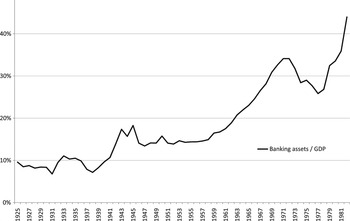
The consolidation of the banking sector was accompanied by a strengthening of its position in the economic development of the country. This evolution and enlargement of banking activities took place during a period when the Mexican economy was experiencing a remarkable expansion, with growth rates that often exceeded those observed in the banking sector. Particularly between the late 1950s and early 1970s, the banking sector deeply penetrated the national economy: total assets of private financial intermediaries went from US$1.5 billion or 15 per cent of GDP in 1958 to US$15.3 billion or 34.1 per cent in 1972 (see Figure 1).Footnote 18 This rapid pace of expansion came along with an increased concentration of the industry and consolidation among the country's leading banks.Footnote 19
Evolution of the Mexican Banking Sector, 1925–82

Two private banks stood out from the rest. One was Banco Nacional de México, known as Banamex. Founded in 1884 as the result of a merger between Banco Mercantil Mexicano and Banco Nacional Mexicano, Banamex was one of the oldest banks in the country and a leading player in the domestic commercial banking market. The other leading player was Banco de Comercio, known as Bancomer. Created during the early 1930s in Mexico City, Bancomer quickly expanded its activities to the national level, becoming a major actor in the banking industry and the main competitor of Banamex. Whereas originally established as commercial banks, these two institutions progressively acquired, created, or grouped with other financial firms, such as financieras, mortgage banks, brokerage houses, leasing agencies and insurance companies, and covered a vast network of financial services, becoming the two biggest banking groups in the country.
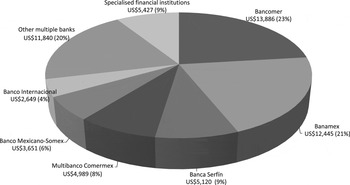
The concentration of the industry, and the positions of Banamex, Bancomer and other leading banks, were further strengthened by the reorganisation of the Mexican banking system during the mid-1970s. With the passage and enactment of the Multiple Bank Law in 1975–6, banking groups were legally permitted to consolidate their different financial institutions into one single banking entity, called a multiple bank. The reform transformed the previous arrangement, which had included a great number of specialised financial companies, and created a universal banking system composed of a small number of larger banks. By the beginning of the 1980s, multiple banks represented as much as US$54.6 billion or 91 per cent of the assets of the banking sector, and Banamex and Bancomer alone accounted for almost a half of this, both of them having similar shares (see Figure 2).
Composition of the Mexican Banking Market in the Early 1980s (Total Assets in December 1980 in US$ million)

Mexico's third largest private bank was Banca Serfín, which controlled nearly one-tenth of the country's total banking market. Serfín was created in July 1977, after the huge conglomerate Valores Industriales SA (VISA group) acquired Financiera Aceptaciones, Mexico's largest industrial bank, and merged it with Banco de Londres y México and three regional banks. Multibanco Comermex was the fourth largest bank, followed by Banco Mexicano-Somex and Banco Internacional, both of which were majority-owned by the Mexican state. The remainder was made up of multiple banks, as well as a number of deposits and saving banks, financieras and mortgage banks which had not evolved into multiple banks and kept their previous legal standing.Footnote 20 Together they accounted for over a quarter of the Mexican banking system's total assets (see Figure 2).
A special remark should be made with respect to foreign banks and their participation in the Mexican domestic banking market. In contrast to Porfirian times, the financial system reconstructed in the aftermath of the Revolution was almost entirely national. Indeed, with the General Law of Credit Institutions of June 1932, the operations of foreign banks in Mexico were legally forbidden. Citibank was the main exception with full branch facilities and commercial banking activities in the country. The other foreign banks were only allowed to open representative offices that, although not permitted to collect savings from the public, could associate with national banks and leverage this network of correspondent banks to conduct business. The presence and activities of foreign banks nevertheless remained relatively discreet until the late 1960s and 1970, when they began to open offices and engage in lending activities in Mexico.Footnote 21
Incursion into Foreign Finance, 1972–6
A salient feature in the historical evolution of the Mexican banking industry during the post-World War II period is the major disruption it suffered during the 1970s. As is evident in Figure 1, after decades of stability, expansion and increasing penetration in the national economy, the rise of the commercial banking sector came to a halt around 1972. Following the historic peak of 34.1 per cent that year, the banking system's total assets relative to GDP progressively diminished until 1977, when they reached 25.8 per cent, the lowest value of the decade. This trend, which Mexican scholars have named the ‘financial disintermediation process’,Footnote 22 would be reversed in coming years and, by the early 1980s, commercial banks had regained their losses.
The underlying factor behind the contraction of banks’ total assets was the slowdown in fundraising. While commercial banks’ domestic funding increased by 10.2 and 18.1 per cent annually in real terms during the 1956–60 and 1964–70 periods, the average annual growth rate between 1971 and 1978 was a much more modest 1.7 per cent.Footnote 23 By 1971–2, about 93 per cent of the banks’ funding base consisted of local deposits and savings from the private and public sector, 4 per cent were transactions between domestic financial institutions and the remaining 3 per cent was made up by other domestic liabilities.Footnote 24 This funding structure and weak performance in terms of domestic funding, in the context where the Mexican economy was expanding at an annual rate of 5.6 per cent, implied a relative decline in the financial resources available to banks.Footnote 25
The minutes of the Executive Committee of Banamex are witness to the serious difficulties the banking sector experienced in terms of domestic financial resources. During their weekly Wednesday meeting, Banamex's General Director Agustín Legorreta referred to the scarcity of cash resources and the slow growth that deposit accounts showed during 1971 and 1972. These difficulties went beyond the case of Banamex, since, as he stressed, ‘the situation was not exclusive to [their] bank, but general to all the credit institutions of the country, particularly affecting small institutions, which have been failing to meet their legal deposits’.Footnote 26 Banks’ funding problems were also a matter of concern for the national financial authorities who, looking for a solution, introduced a reform to the banking law in December 1973 which authorised Banco de México to ‘equip the Mexican banking system with more and more flexible fundraising instruments’.Footnote 27
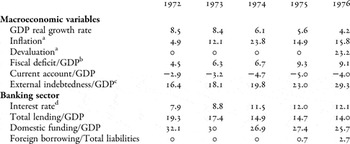
The causes of the banks’ domestic fundraising problems were mostly related to inflation and the interest rate policy followed by the central bank. For many years, until the late 1960s, inflation in Mexico was low, but it started to rise in the early 1970s, with rates oscillating between 4 and 6 per cent, and became a real problem beginning in 1973, when prices rose by 21.4 per cent over the course of the year. Inflation was a problem for banks because of the difficulties in adjusting upwards the interest rates on deposits and savings instruments. The last year with positive real interest rates was 1972, and from 1973 onwards nominal rates were persistently below inflation rates (see Table 1). In Mexico, as in many other Latin American countries, this was a period of heavy financial regulation, or financial repression, and interest rates were not market-determined, but were instead established by the monetary authority. In this respect, as Edward Buffie and Allen Sanginés-Krause observed, ‘whereas real deposit rates were maintained at positive levels throughout [the era of stabilising development],Footnote 28 after 1972 this policy was allowed to lapse’.Footnote 29
Macroeconomic and Banking Indicators, Mexico 1972–6 (%)

a Annual rate.
b Public sector borrowing requirement (includes public financial sector) from Negrete Cárdenas, ‘Mexican Debt Crises’.
c Total external debt from World Bank's World Development Indicators.
d Average annual interest rate of bank's domestic fundraising instruments from historical financial statistics of Banco de México.
Source: Banco de México and INEGI.
The resulting funding difficulties gnawed away at the lending capacities of the banks. Bank lending was further affected by the decision made by the financial authorities to increase reserve requirements, which rose from an average of about 31.3 per cent in 1970 to 51.1 per cent in 1976.Footnote 30 As a result of these events, between 1972 and 1976, the bank loan portfolio declined from 19.3 to 14.0 per cent of GDP (see Table 1).Footnote 31 This contraction of domestic bank lending was ill-timed, as the economy and demand for credit continued to grow in Mexico, stimulated by an aggressive expansion of public spending and large fiscal deficits. 1972 was, indeed, the beginning of a decade in Mexican economic history underpinned by populist macroeconomic programmes and expansionary fiscal policy.Footnote 32 For Mexican bankers, as Legorreta pointed out, the lack of funding was exacerbated by rising demand for credit from both the private and, especially, the public sector, which ‘was exerting strong pressures on the credit institutions to obtain funding’.Footnote 33
In a context of rising demand for credit and insufficient domestic supply, the financing that Mexican banks were not able to provide was supplied by foreign banks. Although the country had been borrowing in the international capital markets for some time prior to the early 1970s, the boom in international lending to Mexico, and to Latin America generally, began in earnest with the oil shock of 1973 and the rise of the petrodollar recycling process.Footnote 34 Indeed, Mexico's external debt started to accelerate around that time: while between 1970 and 1972 the Mexican public sector raised US$2 billion in the world capital markets, it borrowed that same amount in 1973 alone and a total of US$14.5 billion during the following three years.Footnote 35 In other words, in each successive year between 1973 and 1976, the Mexican public sector took on five times more foreign loans than during the entire 1970–3 period. The overwhelming majority of this financing came from international banks operating in the Euromarkets.
In the eyes of leading domestic banks, the increasing role of foreign bank lending to Mexico was a major threat. As Gustavo del Angel has documented, there had been worries and complaints by the Mexican banking association about foreign competition since the late 1960s, and Mexican bankers had lobbied for government protection.Footnote 36 But the bankers’ position became eventually that, as Legorreta explained to Committee members, if they were not involved in the international capital markets ‘they would be condemned to be a mere supplement to foreign banks’, which were ready to provide the funding the country was demanding to finance its economic development at very attractive interest rates.Footnote 37 It is within this context of poor domestic funding, rising demand for credit and increasing foreign competition that Mexican banks turned to the Euromarkets.
The example of Banamex illustrates the pattern of Mexican banks’ international expansion. During early 1972, the Executive Committee started to discuss alternatives for entering the international capital markets and, eventually, decided the best way to do it was to associate with large foreign banks and create a London-based multinational bank. The International Mexican Bank Ltd (Intermex) was finally opened on 1 April 1974, with Banamex as the main shareholder with 38 per cent of the bank's initial capital.Footnote 38 Around that same time, Bancomer and Banco de Londres y México (which later became Banca Serfín) also founded Consortium banks: Libra Bank and Euro-Latinamerican Bank (Eulabank), respectively. These banks, particularly Intermex, would take a predominant role in international lending to Mexico in the upcoming years.Footnote 39
The internationalisation of Mexican banks would not have taken place in the absence of the consent and support of the federal government and the country's financial regulators. In 1974, an important change to the banking law was passed that permitted Mexican banks to access international capital markets.Footnote 40 The amendment explicitly empowered domestic banks to participate in the capital stock of foreign financial institutions and to open agencies and branches upon receiving authorisation from the Secretary of Finance. Up until that point, domestic bank participation in international finance was not contemplated in national banking law. This reform aligned with other measures taken by the Mexican authorities that tended to soften controls on banks and liberate the financial sector.Footnote 41
For Mexican policymakers, the involvement of domestic banks in foreign finance was desirable for at least two reasons. First, this was a period of state-led development and, as previously noted, the government had been putting pressure on the banks to provide financing that they were not able to afford with domestic financial resources.Footnote 42 Second, given the fixed exchange rate and growing inflation, the Mexican economy was also suffering from capital flight and a deterioration in the balance of payments (see Table 1). Letting banks access international money markets promised, therefore, to be useful both to finance the government and provide foreign exchange to bridge the peso gap.Footnote 43
From Domestic to Foreign Funding, 1977–82
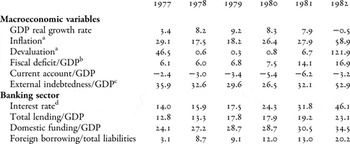
1977 marked a turning point in the evolution of the Mexican banking system during the 1970s. After half a decade of contracting activities and shrinking presence in the national economy, the banking industry started to recover. Total assets, which represented 25.8 per cent of Mexican GDP in 1977, grew to 32.4 per cent in 1979 and 35.9 per cent by 1981 (see Figure 1). In terms of lending, the loan portfolio of domestic banks rose from 12.8 to 19.2 per cent of GDP between 1977 and 1981 (see Table 2). By the beginning of 1982, the domestic banking sector had not only regained the ground it had lost during the years of financial disintermediation, but its weight in the national economy was even greater than the historic high reached in 1972.
Macroeconomic and Banking Indicators, Mexico 1977–82 (%)

a Annual rate.
b Public sector borrowing requirement (includes public financial sector) from Negrete Cárdenas, ‘Mexican Debt Crises’.
c Total external debt from World Bank's World Development Indicators.
d Average annual interest rate of bank's domestic fundraising instruments from historical financial statistics of Banco de Mexico's.
Source: Banco de México and INEGI.
The revival of the domestic banking sector was possible because banks reversed the declining trend and increased their funding base. In December 1976, Gustavo Romero Kolbeck was named Governor of Banco de México, and, from the beginning of his mandate, he stressed the need to strengthen the financial capacity of the domestic banking system.Footnote 44 To do so, Banco de México created and restructured saving instruments, with an emphasis on encouraging long-term funding in national currency. Nominal interest rates were revised upwards, and in 1977, ‘for the first time since 1972, the interest rate of longer-term deposits became positive in real terms’.Footnote 45 Interest rates were periodically revised, especially beginning in late 1979, and adapted to inflation levels (see Table 2). As a result, by the end of 1977, domestic funding of the banking sector had increased by 18.6 per cent in real terms, and continued to expand at a rate of 8.8 per cent per year between 1978 and 1982.
At that time, expanding the lending capacities of the banks was important both because it was believed to be necessary to support economic growth and also because it helped companies with liquidity problems. With the devaluation of 1976, a number of firms that were indebted in dollars abroad experienced payment difficulties and relied on financing from domestic banks to cover their financial needs. Romero Kolbeck explained to Banco de México board members that the mechanism ‘observed in the business sector consisted of obtaining credits in national currency and using those amounts to pay liabilities in foreign currency’.Footnote 46 During the last four months of 1976, Banco de México had already been supporting the banking system to assist companies with cash flow problems, and, in January 1977, it made up to 1.7 billion pesos (U$S 770 million) available to the banks to maintain their credit capacity.Footnote 47
A step forward in improving bank lending capacity was the reform of the reserve requirement regime. On 1 April 1977, a unified reserve requirement system replaced the complex existing structure of multiple requirements with one single reserve ratio for all liabilities in national currency. The process of homogenisation of reserve requirements came along with a general reduction in their level. Up until March 1977, the average reserve requirement ratio had been around 50 per cent; that April it was unified and reduced to 39.5 per cent and later, in August of the same year, reduced further to 37.5 per cent. With these measures, the financial authorities aimed to both simplify a system that had become very complex and to release considerable amounts of resources to banks for lending.Footnote 48
Though domestic funding was important, the recovery of the banking sector after 1977 was also based on increasing use of foreign finance by Mexican banks. In 1975, obligations of the commercial banking system with foreign creditors represented US$176.9 million or 0.7 per cent of the sector's total liabilities (see Table 1). Although clearly limited in scale, reliance on external borrowing as a source of funding escalated considerably thereafter. While in 1977, foreign obligations accounted for US$ 630 million or 3.1 per cent of the funds raised by the banking sector, they progressively increased up to 1982, when they reached US$8.53 million or 20.2 per cent of the sector's total liabilities (see Table 2). This consisted of wholesale interbank funding that leading Mexican banks accessed through their expanding network of foreign agencies and branches in the main international financial centres.Footnote 49
Referring back to the case of Banamex, after the first incursion into the Euromarkets as a shareholder of Intermex, the bank eventually decided to engage in foreign finance on its own. In April 1974, Banamex's director brought to the attention of the Executive Committee a proposal to open a branch in Los Angeles, California, as part of the development of the international operations of the bank.Footnote 50 The project consisted of replacing the existing representative office with a branch, and the reasoning given was that this upgrade made it ‘eligible for loans from American banks that could be invested in the United States, Mexico or in another country’.Footnote 51 In 1975, soon after the Los Angeles branch was opened, the representative office of the bank in New York was also converted to branch status, and in 1978 a new branch facility was created in London. Like Banamex, other leading Mexican banks developed a similar network of foreign agencies and branches, including Bancomer and Banca Serfín and, to a lesser extent, Multibanco Comermex, Banca Somex and Banco International.
Initially allowed by the amendment of the banking law in 1974, the participation of Mexican banks in foreign financial markets was further favoured by the Multiple Bank Law of 1975–6. Since the law implied the consolidation of assets of many financial institutions into a larger one, multiple banks were in much better shape to place themselves in the international capital markets as bigger players with an impressive overall volume of business.Footnote 52 Size and name were determinant factors in the ability of banks to raise fund in the international money markets.Footnote 53
Financing was a fundamental underlying component of the economic development of the country between 1977 and 1982. These were the years of the oil boom in Mexico, and macroeconomic policy was characterised by vigorous expansion of aggregate demand, boosted by government spending.Footnote 54 Increasing demand for financing came not only from the public sector, whose deficits were reaching extremely high levels (see Table 2), but also from the private sector, which had considerably expanded external borrowing towards the end of the decade.Footnote 55 For Mexican banks, domestic sources proved insufficient to satisfy loan needs, since, as Legorreta explained for Banamex, ‘[the bank] could not serve nor meet the needs of their big clients if [they] could not count on resources coming from abroad’.Footnote 56
The Underlying Weaknesses of the Banking Industry
Recourse to foreign borrowing to overcome domestic financing limitations created new vulnerabilities for the Mexican banking system. As previously mentioned, external fundraising instruments were made up of credit lines or interbank placement from foreign banks operating in the Euromarkets or the US international money market and were mainly conducted through overseas banking offices. Maturities were usually very short, between overnight and six months, and consisted of dollar denominated instruments, arranged at variable interest rates. Increasing reliance on foreign interbank funding exposed the domestic banking system not only to currency risk but also to funding strains that could develop in the international financial markets.
The involvement of Mexican banks with international finance through London-based consortium banks did not create such vulnerabilities. Although these banks relied heavily on international wholesale liquidity for funding, they were separate institutions with their own capital base and legally independent from shareholder banks.Footnote 57 Unlike foreign agencies and branches, their borrowing and lending activities were not consolidated into the balance sheets of parent banks. Thus, for the Mexican banking system, the international operations of its consortium banks were not a major source of vulnerability. In contrast, the direct involvement of domestic banks in international banking through their headquarters in Mexico or their agencies and branches overseas was of growing concern.
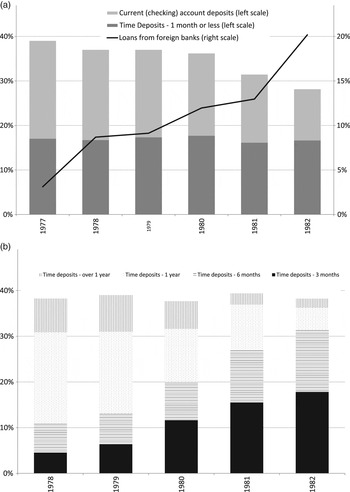
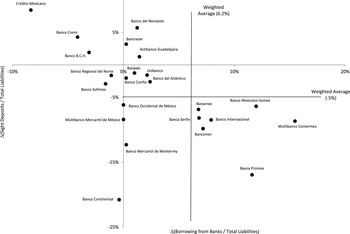
Adding to these vulnerabilities, the Mexican banking system experienced a deterioration in the domestic funding base between 1977 and 1982. First, the share of liquid saving instruments was reduced as a source of funding owing to a persistent contraction of current (checking) account deposits. While in 1977, sight deposits (liquid deposits, i.e. current accounts + savings accounts) represented about 22 per cent of the funds of the sector, by early 1982 their weight had fallen to just under 10 per cent. As is evident in Figure 3(a), there was a change in the funding structure of the banking system, with domestic liquidity being substituted by international liquidity: declining sight deposits, which were the least expensive non-equity source of funding for commercial banks, were replaced by larger interbank foreign borrowing that was most costly and entailed higher risks.
Funding Structure of the Mexican Banking System, 1977–82 (% of Total Liabilities) (a) Liquid Funding Instruments (b) Long-term Deposits

Second, although stable in terms of the volume of liabilities, the internal composition of long-term funding also underwent a significant transformation (see Figure 3(b)). While longer-term time deposits (one year and over) accounted for 70 per cent of total illiquid liabilities in 1978, they represented 26 per cent by end-1981, and around 18 per cent in 1982. In contrast, shorter-term (three-month) deposits were the most dynamic, and increased their share from 12 to 47 per cent over the period. The concentration of three-month term deposits appears to be the result of a yield structure in which nominal interest rates of saving instruments at different maturities were similar, and even converged, throughout the period.Footnote 58 For the banking system, this shortening of the maturity structure of term deposits implied a weakened and less stable funding base.
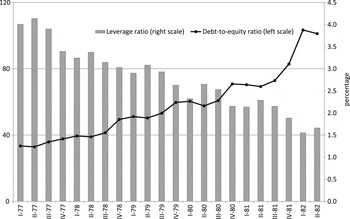
Apart from changes in funding, the build-up of risks in the banking system was also associated with a general deterioration of the balance sheet structure. Figure 4 displays changes in the leverage ratio and the debt-to-equity ratio for the Mexican domestic banking system between 1977 and 1982: they both show increasing levels of risks. The debt-to-equity ratio went from 33.4 to 1 in early 1977 to 82.8 to 1 by the end of 1981, which demonstrates the extent to which the banking sector relied on debt rather than equity to finance its expansion.Footnote 59 The fact that the banking sector became increasingly leveraged during this period indicates that reserve levels did not proportionally improve either. Moreover, because of the growing share of dollar liabilities with the foreign sector, ratios values became much worse after the devaluation of the peso in February 1982.
Risk Indicators for the Mexican Banking System, 1977–82

Although these figures give a clear sense of the deteriorating trend, they say less about how dangerous the values were. The case of Intermex, which operated in London under the regulation of Bank of England, provides an interesting benchmark. At the end of 1974, the year of its creation, Intermex had a capital base of £2.5 million and liabilities that represented ten times its capital. By 1976, its liabilities had increased up to 19 times the level of paid-in capital, which pushed shareholder banks to increase its capital to £5 million, diminishing the debt-to-equity ratio to 14.Footnote 60 In 1977, Intermex's liabilities had climbed to around £130 billion, ‘giving a debt to equity ratio of 26 to 1, which was outside the policy of the Bank of England, which consider[ed] a ratio of 20 to 1 between debts and capital manageable’.Footnote 61 With these figures in the background, the numbers for the Mexican banking system look quite worrisome: debt to equity was already 50 per cent higher than the level the Bank of England considered prudent by early 1977.
Inspection at the Bank Level
This section analyses whether higher risk in the Mexican banking sector was a homogeneous phenomenon. Did this risk affect some banks or groups of banks differently from others? To investigate banks’ risk position, I use quarterly bank-level information from the monthly bulletins of the CNBS and analyse a number of financial ratios reconstructed from the balance sheets of the banks.Footnote 62 The period I cover begins in June 1979, six months after the first bulletin was published, up to June 1982, before the announcement of the Mexican government's temporary debt moratorium and the later nationalisation of the banking system.Footnote 63 The analysis includes 23 multiple commercial banks, for which there is complete and consistent information for the entire period.
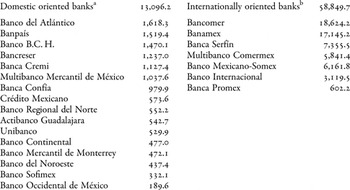
As of early 1982, the 23 banks considered here accounted for US$71.9 billion or 95.8 per cent of the assets of multiple banks, and as much as 90 per cent of the total commercial banking system. Table 3 classifies the banks as international or domestic, depending on whether they were substantially involved in foreign finance. The group of banks most actively engaged in international banking activities include Mexico's largest institutions: Bancomer, Banamex, Serfín, Comermex, Somex and Banco Internacional (Banca Promex was part of the banking group Mexicano-Somex). In contrast, the group of domestic-oriented banks is made up of a larger number of smaller institutions that operated only in the national market. At an industry level, the segment of internationally oriented banks represented about three-quarters of the commercial banking system, and domestic-oriented institutions accounted for the remaining quarter.
Total Assets of 23 Mexican Multiple Banks, January 1982 (US$ million)

a Banks operating only at a national level.
b Banks operating at both national and international level.
Source: CNBS, Boletín de indicadores financieros de banca múltiple privada y mixta de Enero de 1982.
Distinguishing between these two groups of banks allows me to evaluate the role of international activities in the deteriorating health of the Mexican banking system. On one hand, access to foreign liquidity, which was a source of potential vulnerability, was available to international banks, but not to those that operated at a national level. On the other hand, as previous research has shown, Mexico's six largest banks incurred serious maturity, interest rate and currency mismatches on the balance sheet of their foreign agencies and branches while developing their international banking activities.Footnote 64 Had international financial intermediation been a significant source of additional vulnerability, one would expect the international bank group to exhibit higher risk levels than domestic-oriented banks.
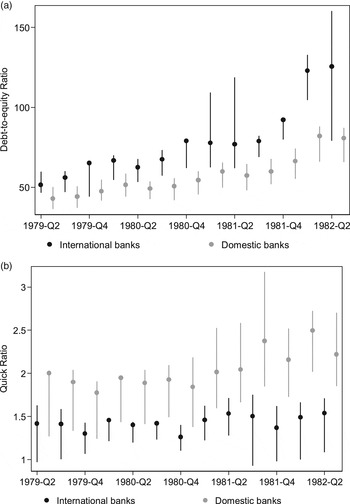
Since there is no information available on financial terms or the composition of the loan portfolio and funding instruments, I assess bank risk level through a comparative analysis of their balance sheet ratios. Figure 5 plots the weighted average (with the total liabilities of each bank as weights) of the debt-to-equity ratio and the quick ratio by banking group, as well as the 50 per cent central distribution: they both show considerably higher risk levels for internationally oriented banks. As is evident in Figure 5 (a), international banks were much more aggressive than the domestic-oriented banks in financing their growth with debt instead of shareholders’ equity, becoming significantly more leveraged toward 1982. Access to foreign finance gave these banks the possibility of finding new sources of funding to further expand their activities. As for Figure 5 (b), the lower values of the quick ratio for the group of international banks indicate a more limited ability to meet their short-term obligations with liquid assets, and thus a worse short-term liquidity position.
Risk Levels of International vs. Domestic-oriented Banks, Mexico 1979–82 (a) Debt-to-equity Ratio (b) Quick Ratio

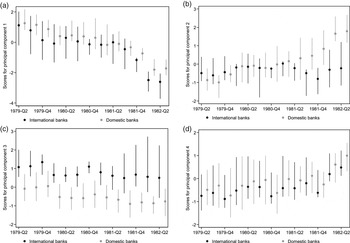
Greater risk levels for internationally oriented banks are further confirmed when considering a larger number of balance sheet ratios. The appendix develops a Principal Component Analysis (PCA) based on ten financial ratios (see Table A1) that are used in finance to conduct financial statements and banking analysis, and have been identified in the literature as important indicators of bank risk management.Footnote 65 PCA proves to be a useful methodology here because it allows for the extraction of the most relevant information from the series of financial ratios, while identifying the sources of bank vulnerabilities and risk factors behind their balance sheet structures. The analysis shows that on average, international banks displayed slightly worse capitalisation levels than domestic-oriented banks, and suffered from a more pronounced deterioration in capital ratios toward the end of the period (see Figure A1 (a)). Significant differences also exist when comparing the asset liquidity position: while domestic-oriented banks’ ability to meet their financial obligations with liquid assets improved from 1981 onwards, a deterioration and subsequent modest recovery are observed for international banks (see Figure A1 (b)).
Discrepancies are also observed with respect to funding structures. The maturity composition indicator of the banks’ funding base shows a relatively larger concentration in short-term instruments for the international bank group. Greater reliance on liquid fundraising instruments is explained not by a broadening sight deposit base, but rather by increasing interbank borrowing. Between 1978 and 1982, sight deposits actually decreased their share as a source of funding for international banks and, as previously posited and clearly shown in Figure 6, international wholesale liquidity appears to have provided these banks with the resources they were losing in their current (checking) accounts. In contrast, domestic-oriented banks that were also suffering from significant declines in sight deposits, such as Banco Occidental de México, Multibanco Mercantil de México, Banco Mercantil de Monterrey and Banco Continental, did not increase interbank borrowing. Instead, their balance sheets exhibit offsetting increases on time deposit accounts, which indicates a change in the composition of retail deposits that did not necessarily imply a less stable and riskier funding base, as in the case of international banks.
Change in the Share of Deposits and Bank Borrowings to Total Liabilities, 23 Mexican Multiple Banks, 1978–81

As for the condition of the banks in terms of the quality of their assets, no clear distinction can be made between the two groups. If anything, the indicator of bank asset quality shows a slightly better performance for international banks, with the two groups displaying worsening levels during the last two quarters of the period (Figure A1 (d)).Footnote 66 Similar results are obtained when evaluating the ratios of troubled assets to total assets and return on total assets separately, as well as when comparing the banks in terms of their values. Thus, it seems that no differences existed in the quality of the assets of international and domestic-oriented banks. This finding suggests that the risks associated with their asset portfolio were similar. It appears that the devaluation of 1982 is the factor behind the deterioration of banks’ asset quality, and that it affected all banks – not just those involved in international lending.
An Econometric Interlude
The declining share of sight deposits as source of funding mentioned above seems to have been, indeed, a point of concern for banks. At the Mexican bankers’ annual convention in Acapulco in June 1980, the bankers underscored the hard time banks were having in capturing and absorbing new deposits. They argued that this problem was due to the inflationary process affecting the country, the direct competition for savings that came from government papers such as the certificados de tesorería (treasury certificates, CETEs) and, to a lesser extent, the stock exchange. For their part, the reply from officials to the delegates’ complaints pointed to trouble in the banking sector, since, as Romero Kolbeck observed, Banco de México ‘[was] bailing out banks that [had] over-committed themselves in the extension of credit to customers’.Footnote 67 It is thus worth investigating the potential link between the performance of sight deposit accounts and bank health.Footnote 68
Although a complete model is not developed here, the single-equation regressions in this section may clarify whether the difficulties in obtaining new deposits were related to the higher risks observed on banks’ balance sheets. The basic idea is to relate changes in sight deposits to risk indicators and test whether bank risk level is associated with differential changes in the accounts. The dependent variable is the quarterly percentage change of sight deposits from the domestic non-banking sector. The independent variables are the first four principal components in the prior quarter, namely capital adequacy, liquidity position, maturity structure of the funding base, and asset quality. As already noted and developed in much more detail in the appendix, these components can be interpreted as indicators of bank risk level and financial fragility.
A number of reasons favour the use of the first four principal components instead of the original financial ratios as explanatory variables. First of all, the principal components provide much clearer and more robust risk indicators than the financial ratios they were derived from. Second, many of the original ratios are very similar measures: it is not clear which of these should be included in the regression and which should be left out.Footnote 69 Finally, because financial ratios vary between zero and one, high multicollinearity is detected when running regressions on the original variables. In short, not only do the principal components show the risk more clearly, but they also provide uncorrelated predictors that incorporate most of the information contained in the original ratios.Footnote 70
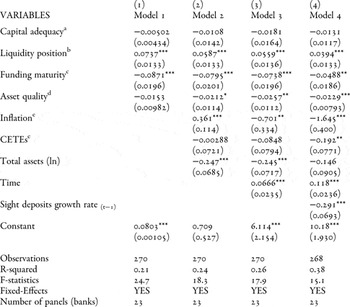
Table 4 reports the fixed effect panel data regressions for the 23 Mexican multiple banks (those listed in Table 3) between 1979 and 1982. Overall, the results show consistent evidence of a negative association between the risk level of the banks and the performance of sight deposit accounts. The coefficients indicate that a worsening in the liquidity position of the bank (decrease in second principal component, PC2), a shortening in the maturity structure of the funding base (increase in PC3) and a deterioration in the quality of the asset portfolio (increase in PC4) have negative impacts on the growth rate of sight deposits across the four different specifications. Unlike them, the coefficient on the PC1 is negative, although not statistically significant in any of the models: at best, no link is found between bank capitalisation levels and deposit growth.
Regression Analysis: Domestic Funding Capacity and Risk Level for the 23 Mexican Multiple Banks

Cluster-robust standard errors in parentheses.
*** p < 0.01, ** p < 0.05, * p < 0.1.
a PC1: Higher values indicate better capitalisation levels.
b PC2: Higher values indicate a better liquidity position.
c PC3: Higher values indicate a shorter-term funding structure.
d PC4: Higher values indicate worse asset quality levels.
e Inflation and CETEs are calculated as the natural logarithm of the Consumer Price Index and of the ratio of CETEs yield to the average of banks’ domestic cost of borrowing respectively.
The regressions of Columns 2 to 4 also assess the effect of other variables that potentially influence banks’ deposit performance. The coefficient of the variable CETEs, calculated as the ratio between the interest rate of government papers and bank deposits, shows a negative impact on the relative yield of alternative saving instruments on bank domestic funding performance. The effect of inflation on sight deposits is more unclear than might be expected, and has a significantly negative impact in the models that include time-control and lag variables.Footnote 71 Finally, the size of the bank, measured by total assets, appears to be negatively associated with the growth rates of liquid deposits. Overall, these regression results are consistent with the previous discussion of international banks as being in a weaker financial position and the most adversely affected by domestic funding difficulties.
Though these results confirm the association between deposit-taking and bank risk levels, the interpretation is more ambiguous that it might first appear. It could be that many of the explanatory variables, and in particular risk indicators, depend on the evolution and performance of bank deposits. As shown in the previous sections, recourse to foreign finance, which was at the root of increasing risk levels in the Mexican banking sector, was accompanied by a contraction in sight deposits. It thus seems likely that a negative feedback mechanism might have been in place: banks borrowed abroad to make up the shortfall in domestic liquidity, which, in turn, raised worries among customers about the health of the banks, further affecting deposit funding.Footnote 72 However, because the concern here is whether banking risk can be viewed as a symptom of domestic funding difficulties rather than determining the causality relationship, endogeneity is not a major issue.Footnote 73
Conclusions
This article has examined the role of internationalisation on the situation of the Mexican banking system in the lead-up to the debt crisis of 1982, a subject that has previously eluded serious scholarly attention. While the national historiography has tended to see the Mexican banking sector as low risk and yielding normal profits, this study shows that the sector's financial position progressively deteriorated as involvement with international finance increased. The foreign borrowing and lending activities undertaken by leading Mexican financial institutions were at the root of new vulnerabilities and greater risks for the banking system.
The fragility of the Mexican banking sector in the wake of the debt crisis is a revealing finding. As a growing amount of literature shows, and the current European debt crisis has further confirmed, sovereign debt problems have been historically associated with weak domestic banking sectors.Footnote 74 This article shows that Mexico in 1982 was no exception: the devaluation of the peso along with debt payment difficulties in the private and public sector were major negative shocks for Mexican banks, especially for those that had foreign liabilities and considerable amounts of Mexican dollar debt on their books. Further research, however, is required to determine the banks’ exposure to the default, as well as to address the causality links between the problems of the banking sector and the currency and debt crises of 1982.
Such weakness of the banking system raises the question of the political economy of bank nationalisation. As a major event in Mexican economic history, the expropriation of commercial banks decreed by President López Portillo on 1 September 1982 is still a matter of debate and controversy. Traditionally seen as an ideological and opportunistic political decision, prominent Mexican banking scholars, such as Carlos Marichal and Gustavo del Angel, have nevertheless suggested that the nationalisation might have rescued a system on the brink of collapse.Footnote 75 Although well beyond the scope of this article, the foregoing findings give compelling support to that suggestion. They also call for further investigation into the possibility of moral hazard and the role of financial regulation on banks’ risk-taking behaviour.
A final issue this study raises relates to the performance of sight deposit accounts with commercial banks during the years that preceded the crisis. Although problems in capturing and absorbing new deposits appear to have been related to the risk level of the bank, further inquiry is still required to explain the nature of this relationship as well as the causality link. Was the contraction of liquid deposits due to concerns on the part of customers about the health of the bank, or did banks deliberately reduce the share of domestic funding? Where was all this money going? These are very important concerns in a context in which the government accused the banks of foreign exchange speculation and of responsibility for the wave of capital flight affecting the country.Footnote 76
Appendix
This appendix examines the differences in risk levels between international and domestic banks though Principal Component Analysis (PCA). By reducing the dimensionality of the dataset, the main factors driving the variability of the data can be identified. PCA is used here to extract the most relevant information from a series of financial ratios and identify the risk factors underlying the balance sheets of banking institutions. In what follows, I explore the correlation (factor loadings) between principal components and the original financial ratios. This allows me to interpret their meaning and look for patterns or distinctive features among banks, in comparison with bank component scores.
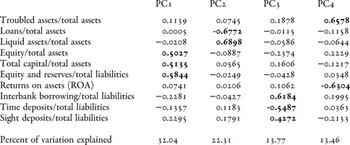
One single application of the principal component method is performed on the entire set of panel data, which includes ten financial ratio series on each of the 23 multiple banks (those listed in Table 3) for the 13 quarters from June 1979 to June 1982. Four components are found to have eigenvalues larger than one and, therefore, will be retained to perform subsequent analysis. They account for 81.5 per cent of the variation in the data set, of which 32 percentage points correspond to the first principal component, 22.3 to the second, and the remaining 27 are equally distributed among the last two components. The variation explained by each component, as well as the factor loadings, are reported in Table A1.
Principal Components, Financial Ratios and Factor Loadings for 23 Mexican Multiple Banks, 1978–81

As observed in Table A1, three of the ten original financial ratios, those referring to the bank's capitalisation levels, are the most strongly correlated with the first principal component: equity to total assets, total capital to total assets, and equity and reserves to total liabilities.Footnote 77 The higher the value of the ratio, the more the component increases. This suggests that it can be viewed as a measurement of the capital adequacy of the banks, with lower values indicating worse capitalisation levels. Component scores show that no bank or group of banks follows a clear pattern or has consistently higher or lower values than the others.Footnote 78 Instead, what can be observed is a general deterioration in commercial banks’ capital adequacy throughout the years. Figure A1 plots the weighted average of component scores (dots) and the 50 per cent central distribution (lines) for the international and domestic bank groups. There is a clear downward trend in the scores of the first principal component for both groups of banks (see Figure A1 (a)), with international banks displaying a slightly lower average and suffering from a more pronounced decline by the end of the period.
Principal Component Scores of International vs. Domestic-oriented Banks, Mexico 1979–82 (a) Capital Adequacy (b) Liquidity Position (c) Funding Maturity Structure (d) Asset Quality

The greatest differences between the international and domestic banks groups can be observed in the following two components. Factor loadings for the second principal component show a strong association with the variable loans to total assets (negative) and liquid assets to total assets (positive). Higher values in this component are, therefore, associated with a bank being better able to meet its obligations with most liquid assets and/or with lower exposure to relatively illiquid assets (loans). This suggests that the component can be considered a measure of banks’ assets liquidity. Figure A1 (b) shows no clear differences in banks’ asset liquidity until mid-1981, with the two groups of banks diverging from that point on. While there was a clear improvement in the component scores of domestic banks, values for international banks decreased until the end of 1981 and stagnated thereafter. These lower scores for international banks in comparison to domestic banks indicate a relatively weaker situation in terms of their liquidity position.
The third component displays high loadings in the following ratios: time deposits to total liabilities, sight deposits to total liabilities, and borrowing from banks to total liabilities, all of which are indicators of the banks’ funding structure. Correlation is negative with the former and positive with the latter two, meaning that banks with higher values of this component tend to have relatively lower ratios of time deposits and, conversely, higher shares of sight deposits and bank borrowings. This contrast between short-term and long-term instruments could suggest that the component provides a measure of the maturity composition of the financing of banks, with high scores indicating a funding base that is more reliant on short-term funding. Figure A1 (c) illustrates international banks as a distinctive group in terms of funding structure, with higher average component scores during the entire period. This result should not be surprising since, as previously discussed, during these years international banks had increased their reliance on short-term interbank borrowing in the international capital markets as recourse against domestic fundraising difficulties.
Finally, the fourth principal component contrasts the variable return on assets (ROA) with the ratio of troubled assets to total assets. Since the correlation is negative with the former and positive with the latter, it appears that this component represents characteristics that account for the quality of the bank assets. Banks with higher scores in the component could be associated with lower relative levels of returns and higher shares of troubled assets, and thus poor asset quality. Component scores show no evidence of significant differences between the two groups of banks. It is worth noting that component scores rise for both groups of banks toward the end of the period, indicating a general deterioration in bank asset quality as the crisis approached (see Figure A1 (d)).