INTRODUCTION
The diversity of the eastern Australian heterobranch sea slug (formerly opisthobranch) fauna reduces dramatically with increasing latitude, such that the species count reduces from approximately 1000 on the northern Great Barrier Reef (GBR) to less than 50% of that number on the central coast of New South Wales (NSW) (Rudman & Willan, Reference Rudman, Willan, Beesley, Ross and Wells1998). Changes in southern distribution limits of low-latitude heterobranchs may indicate the effects of climate change, especially in south-eastern Australia, a documented climate change hot-spot (Hobday & Lough, Reference Hobday and Lough2011).
In eastern Australia, southern range extensions have already been recorded for sea anemones and their commensal shrimps (Scott et al., Reference Scott, Harasti, Davis and Smith2014), scleractinian (hard) corals (Baird et al., Reference Baird, Sommer and Madin2012) and fishes (Perry et al., Reference Perry, Low, Ellis and Reynolds2005; Figueira & Booth, Reference Figueira and Booth2010). Indeed, for many invertebrate species, shifts in range are an identified and predicted response to climate-driven change in oceanic systems (Przeslawski et al., Reference Przeslawski, Ahyong, Byrne, Woerheide and Hutchings2008; Beger et al., Reference Beger, Sommer, Harrison, Smith and Pandolfi2014). Although molluscs living on intertidal rocky shores often exhibit considerable variability in distribution (Underwood & Chapman, Reference Underwood and Chapman1996; Smith, Reference Smith2005), Pitt et al. (Reference Pitt, Poloczanska and Hobday2010) noted an average southward shift in species range of 116 km over a 50-year period on Tasmanian shores, with barnacles and gastropods showing the greatest extension of range.
The northern NSW coast is frequently bathed by the southward flow of the East Australian Current (EAC), particularly in summer (Malcolm et al., Reference Malcolm, Davies, Jordan and Smith2011), which delivers warm water from the Coral Sea and, with it, a supply of tropical larvae (Booth et al., Reference Booth, Figueira, Gregson, Brown and Beretta2007; Malcolm et al., Reference Malcolm, Jordan and Smith2010a). As a result, a number of species have been documented to occur at their southern limit of distribution in this region (Smith, Reference Smith2003, Reference Smith2011), although, to date, distribution patterns have not been assessed for sea slugs. Increasing water temperatures driven by climate change may bring tropical larvae into southern, cooler waters where the presence of such novel species may cause changes in ecological processes (Beger et al., Reference Beger, Sommer, Harrison, Smith and Pandolfi2014), including the alteration of predatory and competitive interactions (Underwood & Chapman, Reference Underwood, Chapman, Connell and Gillanders2007). For this reason, it is important, wherever possible, to document these changes as they occur.
Aside from the development of a comprehensive list for the far-northern NSW coast (Riek, Reference Riek2013a), the sea slug fauna of the northern NSW coast has received little consistent attention. Studies that concentrate on discrete sections of coast have been carried out sporadically, such as the work of Allan (Reference Allan1947), Rudman (Reference Rudman2009a, Reference Rudman1988 & Reference Rudman1998) and Buchanan (Reference Buchanan1989): however, sustained, broad-scale studies have not been undertaken. Consequently, it is likely that there are more species along the NSW coast than are currently recognised and, without continued survey efforts, any shift in species composition and distribution, whether significant or minor, would, therefore, remain unknown.
The Solitary Islands Marine Park (SIMP), north of Coffs Harbour, protects an area of faunal merging where tropical and temperate marine biomes overlap (Smith & Simpson, Reference Smith and Simpson1991). The park includes five rocky islands, numerous beaches, headlands and estuaries, and covers a broad range of marine habitats. The heterogeneity of habitat and the subtropical latitude mean that the SIMP encompasses the southernmost coastal limit for a range of tropical species (Harriott et al., Reference Harriott, Banks, Mau, Richardson and Roberts1999; Wilson & Harrison, Reference Wilson and Harrison2003; Smith, Reference Smith2011) and, conversely, the northern limit for many temperate species (Smith & Simpson, Reference Smith and Simpson1991; Malcolm et al., Reference Malcolm, Smith and Jordan2010b). Between January 2014 and March 2015, whilst undertaking a series of monthly surveys of the heterobranch sea slug fauna on intertidal rocky reefs, we recorded four species that were clearly beyond their previously reported range and these range extensions are reported here.
In this paper, we follow the current concept that sea slugs comprise a group of taxonomically unrelated heterobranch gastropods (Schrödl et al., Reference Schrödl, Jörger, Klussmann-Kolb and Wilson2011; Wägele et al., Reference Wägele, Klussmann-Kolb, Verbeek and Schrödl2014), so we refrain from calling them opisthobranchs.
MATERIALS AND METHODS
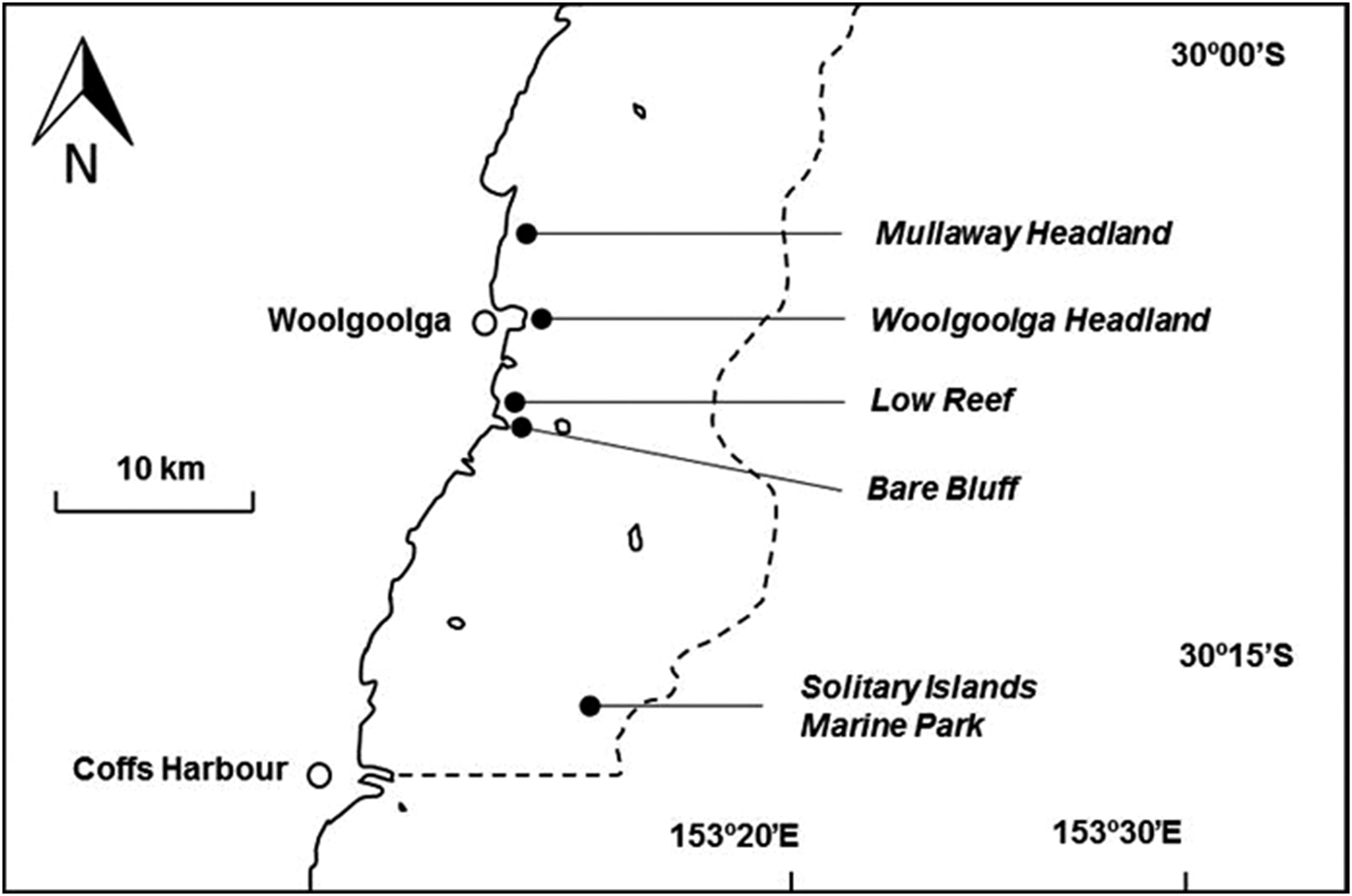
Several rocky headlands were surveyed in the southern section of the SIMP (Figure 1). The south-east point of Bare Bluff (30°9′24″S 153°12′24″E) has a broad wave-cut rock platform with large tide pools that are exposed to southerly seas and prevailing winds, however, at low tide an exposed reef crest provides a degree of protection from wave action. Low Reef (30°8′45″S 153°12′11″E) contains an extensive shallow lagoon with large expanses of brown algae and scattered boulders. The north-eastern tip of Woolgoolga Headland (30°6′32″S 153°12′41″E) is well protected from prevailing, wind, seas and southerly swell and supports a large, deep intertidal pool as well as several extensive shallow pools. Mullaway Headland (30°4′33″S 153°12′15″E) supports a well-developed, sheltered, intertidal boulder-field on the north-western platform and has a moderate cover of shallow pools.
Map of the southern section of the Solitary Islands Marine Park showing the four survey sites. The dotted line represents the marine park boundary.

Timed visual surveys of the heterobranch sea slug fauna were conducted on low tides ≤0.45 m during fine weather conditions when the sea-swell was <1.5 m. All intertidal habitats were searched with particular attention given to the undersurfaces of boulders, rock faces, crevices and overhangs, where likely heterobranch food sources are often located (Benkendorff & Davis, Reference Benkendorff and Davis2002). Each sea slug encountered in each survey was photographed in the field (Olympus TG-3 compact camera in an Olympus PT-056 housing) to provide a permanent record and to aid in subsequent identification. Collecting was limited to species for which the identification was uncertain and was conducted under a permit issued by NSW Department of Primary Industries (SIMP 2014/001).
RESULTS AND DISCUSSION
SYSTEMATICS
Order CEPHALASPIDEA Fischer, 1883
Family DIAPHANIDAE Odhner, 1914 (1857)
Genus Colpodaspis M. Sars, 1870
Colpodaspis thompsoni Brown, Reference Brown1979
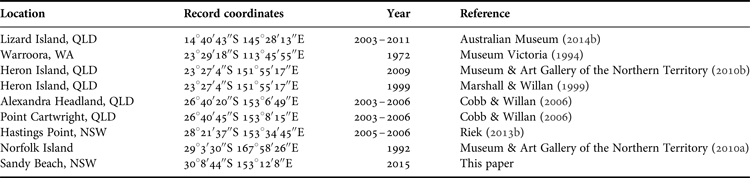
This distinctive diaphanid (Figure 2A) has a tropical Indo-Pacific distribution and has been recorded from Queensland (QLD) waters ranging from Martin Reef in the northern Great Barrier Reef, south, to Mooloolaba (Marshall & Willan, Reference Marshall and Willan1999) (Table 1). The biology and ecology of Colpodaspis thompsoni remain unknown (Rudman, Reference Rudman2002a), however, a specimen found under a boulder at 0.7 m at Low Reef on 13 March 2015 extends the species’ range by 400 km south into the subtropical waters of the SIMP.
(A) Colpodaspis thompsoni, 3 mm, Low Reef, 13 March 2014; (B) Elysia pusilla, 10 mm, Low Reef, 19 November 2014; (C) Phidiana bourailli, 15 mm, Low Reef, NSW, 8 January 2015; (D) Herviella claror, 12 mm, Low Reef, NSW, 10 February 2015.
Summary of Colpodaspis thompsoni records in Australian waters.
Order SACOGLOSSA Ihering, 1876
Family PLAKOBRANCHIDAE J.E. Gray, 1840
Genus Elysia Risso, 1818
Elysia pusilla (Bergh, Reference Bergh1871)
Synonyms: Elysia dubia Eliot, 1904, Elysia halimedae Macnae, 1954, Elysia latipes Er. & Ev. Marcus, 1960, Elysia macnaei Ev. Marcus, 1982.
Elysia pusilla has a tropical Indo-Pacific distribution (Marshall & Willan, Reference Marshall and Willan1999; Rudman, Reference Rudman2002b; Gosliner et al., Reference Gosliner, Behrens and Valdés2008) (Table 2), is an obligate browser of the calcareous green algae Halimeda (Rudman, Reference Rudman2002b; Cobb & Willan, Reference Cobb and Willan2006) and is extremely cryptic when on its host alga. This sacoglossan undergoes ontogenetic change, modifying its morphology (shape and colour) to camouflage with the particular segment of Halimeda on which it is grazing (Rudman, Reference Rudman2002b). Only one other NSW record exists – from Hastings Point (Riek, Reference Riek2013b). An observation at Low Reef at a depth of 0.5 m on 19 November 2014 (Figure 2B) extends this range a further 89 km south.
Summary of Elysia pusilla records in Australian waters.
Order NUDIBRANCHIA Cuvier, 1817
Family FACELINIDAE Bergh, 1889
Genus Phididana Gray, 1850
Phidiana bourailli (Risbec, Reference Risbec1928)
Synonyms: Aeolidia bourailli Risbec, Reference Risbec1928, Facelina bourailli (Risbec, Reference Risbec1928).
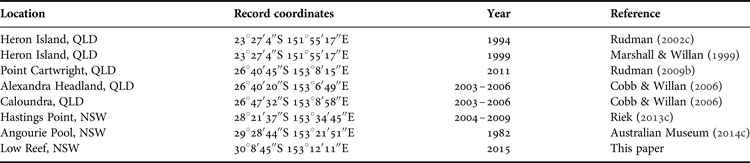
This small aeolid nudibranch feeds on hydroids in shallow water (1–10 m) and is often found under rocks (Gosliner et al., Reference Gosliner, Behrens and Valdés2008). It was first described by Risbec (Reference Risbec1928) as Aeolidia bourailli from specimens collected in New Caledonia; however, this species was later redescribed by Rudman (Reference Rudman1980) using specimens collected from Tanzania. With an Indo-Pacific distribution (Rudman, Reference Rudman2002c), this species has previously been recorded on the eastern Australian coast between the latitudes 23°27′S and 29°28′S (Table 3). The southernmost record at Angourie Pool, NSW, was noted in 1982 with no further observations recorded at, or south of, this location in the intervening 33 years. Our observation at Low Reef at a depth of 1 m on 8 January 2015 (Figure 2C) extends this range southward by a further 77 km.
Summary of Phidiana bourailli records in Australian waters.
Genus Herviella baba, 1949
Herviella claror Burn, Reference Burn1963.
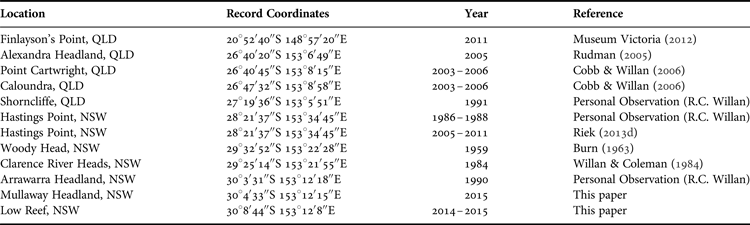
This nudibranch is endemic to temperate Australia and restricted to southern QLD and northern NSW (Willan & Coleman, Reference Willan and Coleman1984; Rudman, Reference Rudman2005; Gosliner et al., Reference Gosliner, Behrens and Valdés2008). Burn (Reference Burn1963) described this species using specimens collected from Woody Head in 1959, with a southernmost NSW record from the Clarence River Heads (Willan & Coleman, Reference Willan and Coleman1984) (Table 4). The second author (R.C. Willan) observed this species at Shorncliffe, QLD in 1991, at Hastings Point, NSW, in 1986, 1987 and 1988, at Brooms Head in 1990, and at Arrawarra Headland in 1990. In addition, our recent observations at Low Reef, one at 0.5 m depth on 24 December 2014, another at 1.0 m on 10 February 2015 (Figure 2D) and a third at Mullaway Headland found under a boulder at low tide on 4 February 2015 extend the southern distribution limit for this species beyond the previously reported limit at the Clarence River Heads by 80 km.
Summary of Herviella claror records in Australian waters.
Our observations of range extensions for these four sea slug species support the findings of Pitt et al. (Reference Pitt, Poloczanska and Hobday2010) who similarly noted a southward shift in rocky shore mollusc species in temperate Australia. Heterobranch sea slug larvae may disperse in one of two ways: via the plankton as pelagic veliger or by direct development, hatching at the post-veliger benthic stage (Thompson, Reference Thompson1976). Tropical pelagic larvae may have travelled great distances (Kempf, Reference Kempf1981; Pawlik, Reference Pawlik1992) on the EAC to reach the northern NSW coast, only settling after making contact with a suitable food source (Cobb & Willan, Reference Cobb and Willan2006).
It should be reiterated that the interval between the present and the last formal, comprehensive sea slug survey spans 25 years. Thus, it is possible that our current observations of species beyond their recorded range may simply be the product of intermittent survey efforts. Indeed, the diminutive size, cryptic habits and morphology of some of these species may mean that they were merely overlooked in previous studies (although this is unlikely, given the involvement of the second author (R.C. Willan) in the previous studies). At the very least, observations such as these are critical to document ranges of species as a baseline against which to assess future change. In this case, however, it is highly likely that the documented range extensions reflect real, poleward movement of species as has been reported in eastern Australia for an increasing number of species from other taxa (Perry et al., Reference Perry, Low, Ellis and Reynolds2005; Figueira & Booth, Reference Figueira and Booth2010; Baird et al., Reference Baird, Sommer and Madin2012; Scott et al., Reference Scott, Harasti, Davis and Smith2014).
ACKNOWLEDGEMENTS
The authors extend their gratitude to Bernard Picton, Curator of Marine Invertebrates at Ulster Museum, Belfast, for his assistance and Denis Riek for detailed information regarding the numerous species he observed on the Tweed-Byron coast. This research was conducted as part of an undergraduate research project by the first author (M. Nimbs) and received no specific grant from any funding agency, commercial or not-for-profit sectors.