

INTRODUCTION
Amongst planktonic foraminifera, Globigerinoides ruber (d'Orbigny, Reference d'Orbigny1839) is one of the most widely studied species in the field of palaeoceanography (e.g. Zarič et al., Reference Zarič, Donner, Fischer, Mulitza and Wefer2005; Sadekov et al., Reference Sadekov, Eggins, De Deckker, Ninnemann, Kuhnt and Bassinot2009). This species was described for the first time by Alcide Dessalines d'Orbigny in 1839 as Globigerina rubra from recent sediment samples collected in Cuba (d'Orbigny, Reference d'Orbigny1839). Cushman (Reference Cushman1927) classified the species under the genus Globigerinoides owing to the existence of a supplementary aperture in final adult chamber as compared to the species pertaining to the genus Globigerina. The distribution of this planktonic foraminifer spans from warm tropical to temperate waters and is restricted to the upper 100 m of the water column due to the presence of its algal symbionts (e.g. Knight & Mantoura, Reference Knight and Mantoura1985; Hemleben et al., Reference Hemleben, Spindler and Anderson1989).
Within the morphospecies G. ruber, two variants (chromotypes) can be identified: G. ruber ‘white’ with a pale, colourless test and G. ruber ‘pink’ with a pink coloured test, respectively. These chromotypes of G. ruber show differences in their ecological requirements and seasonal abundance (e.g. Tolderlund & Bé, Reference Tolderlund and Bé1971). During the Pleistocene, both the chromotypes occupied a worldwide warm-water habitat (e.g. Prell & Hays, Reference Prell and Hays1976). Later, about 0.12 million years ago, the pink chromotype disappeared from the Indo-Pacific region but continued to exist up to today in the modern Atlantic Ocean and adjacent seas (e.g. Aurahs et al., Reference Aurahs, Yvonne, Darling and Kucera2011) while the white chromotype is still cosmopolitan (e.g. Thompson et al., Reference Thompson, Bé, Duplessy and Shackleton1979; Richey et al., Reference Richey, Poore, Flower and Hollander2012).
During some investigations on the benthic foraminiferal assemblages from the surface sediments from the marine turtle (Olive Ridley) mass congregation site in Rushikulya (Orissa) along the east coast of India (north-west Bay of Bengal, Indian Ocean) in 2009, some specimens of both the pink and white chromotype G. ruber were collected (Bhattacharjee et al., Reference Bhattacharjee, Choudhury, Sivakumar, Sharma, John, Behera, Behera and Bhadury2013a). The present study, documents for the first time the appearance of the pink chromotype of G. ruber in the Bay of Bengal (northern Indian Ocean).
MATERIALS AND METHODS
Study area
The Bay of Bengal is the largest bay in the world, situated in the northern part of the Indian Ocean. The climate is dominated by a monsoon regime (e.g. Cullen, Reference Cullen1981) along the Bay of Bengal and comparable to other oceanic environments, resulting in a rich biodiversity including different eco-regions (e.g. coral reefs, mangroves and estuaries). Recently, climate induced changes were recorded along the northern sector of the bay and in other parts of India and Bangladesh (e.g. Agrawala et al., Reference Agrawala, Ota, Ahamed, Smith and van Alst2003; Mitra et al., Reference Mitra, Gangopadhyay, Dube, Schmidt and Banerjee2009). Some studies documented that such changes could alter biodiversity over a geographical region (e.g. Richardson et al., Reference Richardson, Bakun, Hays and Gibbons2009; Côté & Green, Reference Côté and Green2012).
The study site was located along the coastal belt of Rushikulya facing the north-western Bay of Bengal, Indian Ocean. This region is also famous worldwide for being a marine turtle (Olive Ridley; Lepidochelys olivacea) congregation site (Pandav & Choudhury, Reference Pandav, Choudhury, Choudhury and Shanker2006). Samples were collected in early winter (December 2009), at the beginning of the congregation season of the Olive Ridley turtles.
Sample collection
Sediment samples were collected using a Van Veen grab (0.1 m2) from 12 sampling stations in Rushikulya located between 19°26′N and 85°09′E and 19°17′N and 84°57′E (Figure 1) with water depths ranging between 3.0 and 7.3 m (Table 1). The surface sediments were sub-sampled for the first 3 cm following the methods proposed by Herb (Reference Herb1968) using a core sampler (10 cc), and were then stored in 4% buffered formaldehyde to prevent dissolution. Principal environmental parameters such as surface water salinity and temperature were measured using a hand held refractometer (Brix) and an ordinary hand held Celsius thermometer at the time of sampling.
Map of the study area with the location of the sampling stations.

Depth and distance from the shoreline of the sampling stations.

Micropalaeontological analysis
In the laboratory, sediment samples of 10 cc from each station were mounted over ordinary glass slides in glycerol (98% purified) as media (refractive index, 1.47 at 20°C) for counting of planktonic foraminifers in sediments (retained in 63 µm sieve).
All specimens of Globigerinoides ruber from each sample were recognized following the protocol of Banner & Blow (Reference Banner and Blow1960), picked under a dissection microscope (Magnus), mounted on microfossil slides and photographed.
RESULTS
Foraminiferal assemblage
At the time of sediment collection, mean salinity and surface water temperature were 31 psu and 28°C, respectively.
The foraminiferal assemblage of the surface sediment in the studied area was dominated by benthic foraminifers. The planktonic foraminiferal assemblage was dominated by Globigerinoides ruber with some specimens of Globorotalia inflata and Neogloboquadrina dutertrei. The specimens of Globigerinoides ruber (both pink and white chromotypes) were intact.
Total planktonic foraminiferal abundance in Rushikulya ranged between 0 and 54 specimens/10 cc (Table 2). Highest abundances of planktonic foraminifers were documented in Station 8 with 54 specimens/10 cc, while no specimens were recorded from Stations 5, 9, 11 and 12. The abundances of planktonic foraminifers from each station are detailed in Table 2.
Planktonic foraminifera abundance expressed as number of specimens per 10 cm3 of sediment (#specimens/10cc). ‘−’, indicates absence.

Globigerinoides ruber in Rushikulya
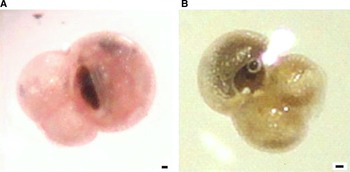
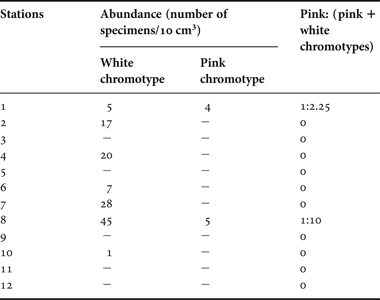
Globigerinoides ruber numerically dominated the planktonic foraminifera assemblage of the surface sediments in Rushikulya. The present study reports the occurrence of the pink chromotype of G. ruber in the study area (Plate 1). Abundance of the pink chromotype ranged between 0 and 5 specimens/10 cc, while for the white chromotype, the abundance ranged between 0 and 45 specimens/10 cc. The pink chromotype was documented only in two stations (1 and 8) while the white chromotype in seven of the sampled stations (1, 2, 4, 6, 7, 8 and 10) (Table 3).
(A) Globigerinoides ruber pink chromotype; (B) G. ruber white/pale chromotype collected from Rushikulya. Scale bar, 50 µm.

Abundances (in percentages) of Globigerinoides ruber chromotypes (pink and white) in the sampling stations. ‘−’, indicates absence.

DISCUSSION
While investigating the benthic foraminiferal assemblage patterns that characterize the surface sediments in Rushikulya, modern specimens of Globigerinoides ruber (pink chromotype) were documented for the first time from this region (Bhattacharjee et al., Reference Bhattacharjee, Choudhury, Sivakumar, Sharma, John, Behera, Behera and Bhadury2013a). The aim of this study is to discuss the recent reappearance of G. ruber pink in this part of the Bay of Bengal.
Although the pink chromotypes of G. ruber have not been documented in recent sediments from the Indian Ocean they were documented in deep-sea cores from this region at 120,000 yr BP (e.g. Thompson et al., Reference Thompson, Bé, Duplessy and Shackleton1979). The pink chromotype, however, occurs in the modern Atlantic Ocean and its adjacent seas (e.g. Bé & Hamlin, Reference Bé and Hamlin1967; Richey et al., Reference Richey, Poore, Flower and Hollander2012). Disappearance of the pink chromotype from the Indian Ocean was attributed to a rapid climatic shift that occurred 0.12 million years ago (Thompson et al., Reference Thompson, Bé, Duplessy and Shackleton1979).
Studies on the modern distribution of G. ruber in the northern Indian Ocean (e.g. Bay of Bengal and Arabian Sea) are extremely rare, but some of them provide valuable information. Peeters et al. (Reference Peeters, Brummer and Ganssen2002) collected living specimens of G. ruber from the surface waters of the north-west Arabian Sea and suggested that the habitat of this species is shallower during upwelling than during non-upwelling periods. However, this study did not distinguish between the two chromotypes of G. ruber. Chowdhury et al. (Reference Chowdhury, Haque Md., Nasreen and Hasan Md.2003) studied the distribution pattern of planktonic foraminifera from sediments of the northern Bay of Bengal and documented the dominance of G. ruber (white) and Neogloboquadrina dutertrei. In a recent study, Saraswat (Reference Saraswat2010) reported the occurrence of G. ruber with pale yellow tests from the Bay of Bengal, comparing them to the ones collected in the Arabian Sea, which showed an opaque and white shell. Kumar et al. (Reference Kumar, Ganesh, Karudu and Rao2012) identified three species of planktonic foraminifers (including G. ruber from the surface sediments of the River Gosthani estuary, south-east coast of India) and suggested that those were brought in to the River Gosthani estuary by seawater flowing from the Bay of Bengal; but also this study did not distinguish between the two morphotypes of G. ruber.
Re-appearance of the pink chromotype of G. ruber in this region could not be accidental, and we think that it was due to a number of environmental changes occurring in the north-west Bay of Bengal. This part of the Indian Ocean suffers from the effects of climate change, as already reported in recent literatures (e.g. Mitra et al., Reference Mitra, Gangopadhyay, Dube, Schmidt and Banerjee2009; Bhattacharjee et al., Reference Bhattacharjee, Samanta, Danda, Bhadury, Sundaresan, Sreekesh, Ramanathan, Sonnenschein and Boojih2013b). Observations over three decades revealed a progressive increase of pH in water column in the northern part of the Bay (Mitra et al., Reference Mitra, Gangopadhyay, Dube, Schmidt and Banerjee2009) and an overall rise of the sea surface water temperature in the northern Indian Ocean (e.g. Thompson et al., Reference Thompson, Kennedy, Wallace and Jones2008).
Molecular phylogenetic analyses have revealed that the two chromotypes of G. ruber are genotypically divergent (Darling et al., Reference Darling, Wade, Kroon, Brown and Bijma1999; Aurahs et al., Reference Aurahs, Grimm, Hemleben, Hemleben and Kucera2009). While the pink chromotype from the north-east Atlantic Ocean belonged to the same genotype (Aurahs et al., Reference Aurahs, Grimm, Hemleben, Hemleben and Kucera2009), the white chromotype was considered to be paraphyletic (e.g. Darling et al., Reference Darling, Wade, Kroon, Brown and Bijma1999; Aurahs et al., Reference Aurahs, Yvonne, Darling and Kucera2011). Furthermore, the chromotypes of G. ruber have different ecological preferences and different seasonal distribution (e.g. Tolderlund & Bé, Reference Tolderlund and Bé1971; Haarmann et al., Reference Haarmann, Hathorne, Mohtadi, Groeneveld, Kolling and Bickert2011). The pink chromotype inhabits the sea surface mixed layer (usually the upper 25 m of the water column but may migrate down to 100 m depths during summer season) as it prefers warmer water (>24°C) for calcification (e.g. Tedesco et al., Reference Tedesco, Thunell, Astor and Müller-Karger2007; Richey et al., Reference Richey, Poore, Flower and Hollander2012). A recent sediment trap study in the Bay of Bengal during winter on the global distributions and seasonal abundances of some planktonic foraminifera documented high relative abundance of the G. ruber white chromotype (Fraile et al., Reference Fraile, Schulz, Mulitza and Kucera2008). This chromotype is thought to be susceptible to small-scale variation in sea-surface temperature (e.g. Steinke et al., Reference Steinke, Chiu, Yu, Shen, Lowemark, Mii and Chen2005); it prefers temperature ranging from 18–27°C (Kucera et al., Reference Kucera, Weinelt, Kiefer, Pflaumann, Hayes, Weinelt, Chen, Mix, Barrows, Cortijo, Duprat, Juggins and Waelbroeck2005). Mean surface water temperature in Rushikulya during our study was 28°C, which was slightly higher than the preferred temperature ranges reported earlier in literature.
The recent re-appearance of the pink chromotype of G. ruber from this part of the Bay of Bengal could be also related to new food resources (or its algal symbiont), as it is generally presumed that food is an important controlling factor influencing the distribution of planktonic foraminifera across favourable temperature regimes (e.g. Ortiz et al., Reference Ortiz, Mix and Collier1995; Schiebel et al., Reference Schiebel, Hiller and Hemleben1995).
The surface sediment from the study area was dominated by benthic foraminifera (living and dead). The number of planktonic foraminifera in the surface sediments is comparable to that reported in many other parts of the world including shallow and coastal areas (e.g. Boltovskoy & Wright, Reference Boltovskoy and Wright1976; Hayward, Reference Hayward1979). On the other hand, the dominance of G. ruber across the study area is in agreement with the fact that this species generally dominates in the oligotrophic coastal waters (e.g. Schiebel et al., Reference Schiebel, Zeltner, Treppke, Waniek, Bollman, Rixen and Hemleben2004), as we have also observed very low abundance of photosynthetic eukaryotes (e.g. diatoms) in the water column. Most of the tests of Globorotalia inflata and Neogloboquadina dutertrei from the study area were broken probably indicating the importance of depositional systems and may be useful in future for deciphering the type of sediment transportation in the study area.
In conclusion, in this study we documented the re-appearance of the pink chromotype of G. ruber in the Bay of Bengal probably due to increasing water temperature and new food resources in the area.
ACKNOWLEDGEMENTS
We thank two anonymous referees for their helpful suggestions. This study was supported by grants awarded to Punyasloke Bhadury from IISERK.