INTRODUCTION
Americans hear often that the United States is a land where differences are valued and respected. Indeed, liberal democracy is premised on the idea that individuals will tolerate groups that hold ideas and beliefs that other citizens do not like. Those ideals are lofty and abstract, but in practice, American political culture has been a complex tapestry that has included a variety of racial, nativist, and religious tensions (Smith Reference Smith1993). Political tolerance within the social sciences generally concerns whether or not to extend basic civil rights and liberties to out-groups, especially groups that are disliked or do not share wider societal values and norms. However, social acceptance extends beyond political tolerance to include other social practices such as appropriate speech about each particular out-group. Inclusive speech avoids the overt expression of inter-group biases and prejudices that would mark out-groups as lesser or devalued parts of the polity, but social norms about appropriate speech toward out-groups have varied over time and across groups. Reactions to negative speech about out-groups depend, in part, on the presence or absence of social norms about how the group should be treated and the context in which the individual encounters the group (Petersen et al. Reference Petersen, Slothuus, Stubager and Togeby2011).
The 2012 presidential election provided a useful context to examine biases toward religious out-groups and reactions to the public expression of those biases. In particular, Mitt Romney's Mormon faith sparked reflection on just how accepting the public would be of a religion considered by many to be outside of the mainstream.Footnote 1 The 2012 election thus represented an opportunity to understand norms of public speech about religious out-groups when such issues were especially salient: a member of a religious faith that had previously experienced considerable religious bias was a major party nominee.
Presidential candidates have faced questions about their religion before. Alfred Smith in 1928 and John F. Kennedy in 1960 faced doubts about their Catholicism (Converse Reference Converse, Converse, Miller, Stokes and Campbell1966; Dulce and Richter Reference Dulce and Richter1962; Moore Reference Moore1956). In 2000, Joe Lieberman, notable as a practicing Jew, was path breaking in his pursuit of the vice-presidency (Kane, Craig, and Wald Reference Kane, Craig and Wald2004). Throughout his presidency, Barack Obama has been plagued by false rumors that he is Muslim (Campbell, Green, and Monson Reference Campbell, Green and Monson2009; Hollander Reference Hollander2010; Nyhan and Reifler Reference Nyhan and Reifler2016). While other work has studied reactions to Mitt Romney's religion in the context of his 2008 and 2012 campaigns (Campbell, Green, and Monson Reference Campbell, Green and Monson2012; Reference Campbell, Green and Monson2014), our work uses the 2012 election contest to examine when individuals apply norms about religion and not just the candidate and to compare how those norms are applied to a variety of religious groups.
Aside from the 2012 election context and the religious affiliations of candidates, previous work in the area of religious tolerance and bias more broadly suggests that Americans have biases toward a variety of religious groups. Anti-Semitism has a long history in American culture and politics (Dinnerstein Reference Dinnerstein1994; Glock and Stark Reference Glock and Stark1966) as do anti-Catholic sentiments (Greeley Reference Greeley1967; Reference Greeley1977; Jenkins Reference Jenkins2003). In recent years, social scientists have focused attention on Evangelical Protestants (Greeley and Hout Reference Greeley and Hout2006), or on Evangelical subgroups such as Christian Fundamentalists (Bolce and De Maio Reference Bolce and De Maio1999; Reference Bolce and De Maio2008), and have explored attitudes about American Muslims (Kalkan, Layman, and Uslaner Reference Kalkan, Layman and Uslaner2009). This work on attitudes about various religious groups and religious bias has in common a focus on intergroup relations and a concern for how religious majorities, or religious in-groups, interact with religious minorities or religious out-groups.
We review previous work on inter-group bias, social norms, and religion, then report the results of a survey experiment conducted in the midst of the 2012 presidential election. The experiment allows us to compare reactions to disparaging comments made about five different religious groups, including Mormons, Muslims, Evangelicals, Catholics, and Jews. We find evidence that no single norm of acceptable public discourse about religious groups exists: holding constant the content of the negative speech, respondents react differently to disparaging comments made in public about these different groups, and partisans of different stripes express strikingly distinctive patterns of concern. Democrats express the greatest unease — and the greatest willingness to sanction those who make the disapproving comments — with statements about Jews and Muslims. Republicans also express concern about negative statements about Jews, but react much differently to Muslims, reporting little concern and even less willingness to sanction those who express negative views about Muslims. In general, in the midst of an election in which the Latter-day Saint (LDS) religion was unusually salient, reactions to negative statements about Mormons appear to be largely similar to responses to disparaging statements directed toward Evangelicals and Catholics. In the contemporary political environment, it is Muslims, not Mormons, who most readily experience the effects of group-based religious bias, but this bias comes primarily from Republicans. Put simply, we find little evidence among Republicans of a social norm of inclusive speech toward Muslims. We conclude with a discussion of the implications of these results for our understanding of social norms, intergroup bias, and religion.
SOCIAL NORMS AND RELIGIOUS PLURALISM
Ever since Stouffer (Reference Stouffer1955) found that religious individuals felt differently about allowing communists to teach, social scientists have sought to unpack the relationship between religion and tolerance. This critical exercise involved settling such questions as the definition of religion, the content of religious beliefs, and the significance of practice (see Djupe Reference Djupe2015). Furthermore, the relationship between religion and tolerance also needed to come to grips with such questions as how congregations might affect tolerance or how religious leaders could shape mass opinions (e.g., Robinson Reference Robinson2010). All of this work draws its value from the normative significance of the compatibility between religious and democratic values. However, doubt still persists about the extent to which some religions are compatible with liberal democracy.
For social scientists, political tolerance has a specific meaning that has to do with civil rights and liberties for out-groups, such as allowing or banning an individual from teaching, speaking, or some other public activity. While our focus here is related to tolerance, we look at the broad question from a different angle. We want to see how expansively individuals extend an equality norm to various religious groups. Specifically, we want to know how Americans react to disparaging public comments about those groups. Where tolerance normally means allowing a disliked or “least liked” group to engage in certain activity, we go beyond this standard by examining the social norms regarding acceptable speech about religious out-groups. A fully inclusive polity extends beyond offering a legal guarantee of speech from disliked groups to ensuring that the public square is equally welcoming to all. Social norms against explicit expressions of religious bias or overtly disparaging comments toward religious out-groups as a group help to ensure that the arguments of all religious peoples can be heard on their merits.
Generally, social norms are societal expectations that are enforced without relying on formal judicial processes (Posner Reference Posner1997). Norms are self-regulating social rules that prescribe societal sanctions through informal means. Socialization may result in enforcement internal to the norm violator, causing feelings of guilt (Posner and Rasmusen Reference Posner and Rasmusen1999). Social norms seem to affect behavior most strongly when they are externally enforced through public surveillance (Horne Reference Horne2009; Rind and Benjamin Reference Rind and Benjamin1994; Whatley et al. Reference Whatley, Webster, Smith and Rhodes1999) and prosecution, such as in the extreme case of social ostracism (Elster Reference Elster2007) or public shaming (Scheff Reference Scheff2000). Horne refers to the enforcement of norms as “sanctions.”
As previous research indicates, social norms not only dictate acceptable conduct, they also define acceptable attitudes. They encompass the beliefs and values shared by members of a society (Elster Reference Elster2007). Many of the behavioral norms stem from attitudinal norms. We expect people to vote because we believe democracy is the best form of governance and its legitimacy requires it.Footnote 2 Mendelberg defines a norm as “an informal standard of social behavior accepted by most members of the culture that guides and constrains behavior” (Mendelberg Reference Mendelberg2001, 17). An essential element of norms is this social element where a particular behavior or the expression of an attitude that cuts against social norms leads to disapproval from others.
There is a critical distinction between the existence and awareness of a norm and its level of internalization among the public. Despite the presence of a collective norm, the level of commitment to the norm varies from person to person. By measuring norm perceptions at the individual level we can estimate the penetration of a norm into society, or its internalization. The willingness of individuals to sanction a violation of the norm provides an estimate of its strength. In the presence of an acknowledged societal norm, public pressure to comply under surveillance can be powerful (Gerber, Green, and Larimer Reference Gerber, Green and Larimer2008; Horne Reference Horne2009).
Horne (Reference Horne2009) shows how different standards for different groups can be explained even more elaborately by a consequentialist framework for understanding norms. In a consequentialist framework, individuals assess the benefits and costs in order to determine whether or not to enforce a norm by sanctioning those who violate it. It is not always easy for an individual to enforce a norm because it often means confronting individuals about the acceptability of the behavior. The consequentialist literature suggests that the more significant the behavior, the more likely individuals will be to enforce the norms. For example, a norm against smoking would be likely to elicit enforcement action from an individual because of the immediate harm created by second-hand smoke. The benefit of preventing these harmful effects outweighs the uncomfortable social costs of telling somebody to stop smoking. When behavior does not immediately produce obvious harm, people are less likely to want to pay the social costs of correcting that behavior.
Furthermore, Horne (Reference Horne2009, 135) argues that differences in norm enforcement depend on the strength of “meta-norms” or “a specific type of norm that regulates sanctioning.” Individuals not only receive direct benefits by stepping in and enforcing a norm at the moment of the enforcement, they can also receive personal benefits from their community. For example, the person who stops somebody from smoking or cutting in line realizes immediate and direct personal benefits. However, if a meta-norm about the acceptability of sanctioning exists, the person also can receive accolades, encouragement, and support from the group. When those kinds of benefits are present, an individual may engage in costly sanctioning behavior even if the direct benefits are negligible because they “consider the likely reactions of others” (Horne Reference Horne2009, 64).
Our focus in this article centers on the extent to which individuals will accept or reject disapproving remarks about a particular religion. Specifically, we seek to understand reactions to public speech that overtly expresses religious bias, including a willingness to sanction such speech.Footnote 3 When confronted with expressions of religious bias in public settings, individuals must decide how to react to it. They accept religiously biased speech either by explicitly endorsing it or by passively allowing it — that is, refusing to express disapproval or otherwise sanction the speaker. Whether the approval is active or passive, accepting negative speech about religious out-groups supports norms of religious differentiation and bias, reinforcing the boundary between in-groups and out-groups. When individuals sanction the speaker, however, they reject religious bias and express support for a norm of inclusive speech. Empirically, we define a “norm of equality and inclusion” in this article as a widely accepted constraint against expressing negative views about a religion. Endorsing a norm of equality and inclusive speech does not mean that an individual possesses no bias; instead, it simply means that he or she is expressing a belief about the appropriateness of certain forms of group-centered talk and an unwillingness to use public speech to explicitly place the religious tradition outside of the public square.
A norm against overt bias toward religious minorities, or what we call the norm of religious equality and inclusion, has received comparatively less attention than norms for other characteristics (e.g., race, gender). Much of the work on religious bias has used the context of a political campaign. Berinsky and Mendelberg (Reference Berinsky and Mendelberg2005) explore the effects of religious stereotypes about Jews on judgments about Jewish candidates. Kane, Craig, and Wald (Reference Kane, Craig and Wald2004) used a list experiment to measure bias against a Jewish candidate on the heels of Joe Lieberman's vice presidential candidacy.
Mitt Romney's presidential candidacy provided a surge in research about voting for a Mormon candidate that is instructive in terms of how to understand religious bias and social norms about religion (Benson, Merolla, and Geer Reference Benson, Merolla and Geer2011; Campbell, Green, and Monson Reference Campbell, Green and Monson2012; Reference Campbell, Green and Monson2014; McDermott Reference McDermott2009; Penning Reference Penning2009). Well before Romney, however, both in political matters and in popular work, Mormons were so disliked that they were redefined in non-religious and negative terms. They were accused of “deliberately subverting American values” and referred to as an undesirable ethnic out-group complete with undesirable physical traits (Givens Reference Givens1997, 48). Similarly, other historical research traces the origins of anti-Mormon rhetoric and finds that non-Mormons generally were “disinclined to regard Mormonism as just another church” (Fluhman Reference Fluhman2012, 77). Thus, historically, by redefining Mormons as a strange religion or even an undesirable ethnic group, it was easier to deny Mormons the equality afforded by the American norm of religious pluralism embodied in the First Amendment to the Constitution. As Campbell, Green, and Monson (Reference Campbell, Green and Monson2014, 264) put it, “It is one thing for American to tolerate and accept religions that minimize their differences with the broader culture, and it is quite another to tolerate, accept, and even embrace starkly different faiths.”
Particularly interesting given the 2012 presidential race is more recent social science work investigating the equality norm applied to the Mormon tradition. One study from the 2008 election focuses on negative stereotypes and indicates that Americans see Mormons as “distant” from their beliefs. Mormons are viewed as the least likely to hold issue positions similar to the respondent's and least likely to be perceived as trustworthy, and these perceptions affect citizens' willingness to vote for a Mormon candidate (McDermott Reference McDermott2009). Similarly, survey experiments show that simply adding Mormon to a biography of Mitt Romney in 2008 dramatically reduced the likelihood of voter support and further showed that limited social contact with Mormons leads to perceptions of Mormons as a social out-group and is connected with a resistance to counter information (Campbell, Green, and Monson Reference Campbell, Green and Monson2012; Reference Campbell, Green and Monson2014). List experiments also find significant bias against Mormon candidates for president (Benson, Merolla, and Geer Reference Benson, Merolla and Geer2011; Monson and Riding Reference Monson and Riding2008).
As a comparison group, the Baptist tradition does not appear to face similar obstacles as the Mormon faith. In the context of the 2008 campaign, invoking Hilary Clinton's United Methodist faith had no measurable effect, but statements invoking Mike Huckabee's Southern Baptist faith had a small negative effect. Both of these strongly contrast to the much larger negative effect of Mitt Romney's Mormonism (Campbell, Green, and Monson Reference Campbell, Green and Monson2012; Reference Campbell, Green and Monson2014). For purposes of our research, we include discussion and data on the Evangelical tradition. While the Baptist denomination may have proven non-controversial, the broader Evangelical tradition may be more divisive because of the way in which it has “fused” a political identity with a religious one (Patrikios Reference Patrikios2013).
What is true for Mormons is also true of other minority faiths, like Muslims or Jews that are religiously and/or culturally distinctive. The pattern of findings among Mormons can thus be generalized to other religious minority groups. Whether spoken of in terms of ethnicity, out-group, or sub-culture, a common thread in the literature about religious minority groups is that their distinctiveness, both religious and cultural, produces boundaries between the religious minority and the larger American culture that prevent full acceptance.
The struggle for social acceptance amid social distinctiveness for Mormons is similar to a trajectory traveled by American Catholics, Jews, Muslims, and others. Non-Christian status qualifies as a distinctive enough boundary for Muslims and Jews. For example, a large part of the deep patterns of American anti-Semitism stemmed from religious boundaries created by fundamentalist Christian beliefs (Glock and Stark Reference Glock and Stark1966). Yet even shared Christian beliefs can lead to suspicion and intolerance (Robinson Reference Robinson2010). For example, one result of tension between Catholics and Protestants is that American Catholics developed a system of schools, hospitals, and other organizations that parallel counterparts in the larger society (Greeley Reference Greeley1967). Over time, however, the acceptance of both Catholics and Jews has been signaled by their success in the political arena, suggesting that both groups have achieved some degree of social inclusion.
Norms seldom enjoy universal acceptance. Because the acceptance of a norm varies by social factors, including attitudes about the groups, we expect some groups to have the norms more readily extended to them than others. For example, social identity theory argues that an “individual strives to achieve a satisfactory concept or image of himself… namely the individual is a member of numerous social groups and that his membership contributes, positively or negatively, to the image that he has of himself” (Tajfel Reference Tajfel1974, 68–69). When merged with norm theory, it means that norms of acceptance and inclusion (in other words, norms against making disparaging or demeaning comments) may be more generously applied to some religious traditions than others (Horne Reference Horne2009, 78). Because we believe some groups are more likely to be seen as accepted parts of the larger political society than others, we expect that a norm against certain kinds of negative discourse will not apply equally to all groups. For example, we expect that negative discourse about religious groups will be more acceptable when applied to religious groups with a history of being treated as outsiders.
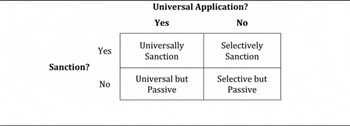
Furthermore, Horne's relational theory of norms, which points our attention to benefits that accrue to the enforcement of norms beyond what the individual directly receives, suggests that different groups will vary in the extent to which they both apply and enforce the norm. This theoretical insight expands the number of predictions about the impact of norms (see Table 1). An individual can believe that norms apply to all groups and choose to sanction for violation of those norms (Universally Sanction). A person could apply those norms only to one or a few groups and want to sanction for violation (Selectively Sanction). Third, a person could hold that the norms apply to all groups and choose never to sanction (Universal but Passive). Finally, a person could apply the norm to only one or a few groups and not want to sanction in the event of a violation (Selective but Passive).
Application and sanction of norms

These several possibilities lead us to examine differences across subgroups for both the holding of a norm and the willingness to sanction for violations of the norm. We find differences both in the extensiveness of the norm and in the willingness to sanction or enforce the norm.
DATA AND EXPERIMENTAL METHODS
Data for this experiment were collected as part of the 2012 Cooperative Congressional Election Study (CCES). The CCES is a collaborative research effort that in 2012 involved 48 different research teams, with each team developing a survey questionnaire for a national sample of approximately 1,000 respondents. In addition, all respondents answered Common Content Questions, which consisted of a series of questions included with all team modules. Most teams purchased one module of 1,000 respondents, but some teams purchased more than one module or paid for additional cases. Thus, the Common Content sample includes 54,535 cases (Ansolabehere Reference Ansolabehere2013, 7).
The survey was administered in two waves, a pre-election wave conducted in October of 2012 and a post-election wave fielded immediately following the November election. Surveys were administered over the Internet by YouGov, and respondents were selected for the survey using YouGov's matched random sample methodology.Footnote 4 The AAPOR Response Rate 4 is 0.443 for the Common Content and 0.437 for the team panels (Ansolabehere Reference Ansolabehere2013, 11).Footnote 5
We fielded two modules in 2012, and our experiment was included on both. On one module, the experiment was administered prior to the election, and on the other module, the experiment occurred after the election. Results are identical regardless of when the experiment was administered, so to increase statistical power, we combine both modules in the analysis that follows.Footnote 6 A total of 1,837 respondents completed the experiment.Footnote 7
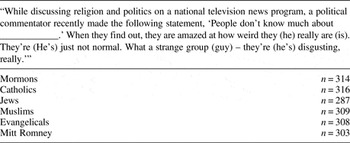
The experiment consisted of a vignette followed by one open-ended and several closed-ended questions. The vignette described an example of a public expression of religious bias: a political commentator making disparaging comments about a religious group. The quotation used in the vignette was drawn from examples of real commentators making disparaging comments about Mormons in public settings — primarily from a statement Bill Maher made as part of a discussion of Mitt Romney and Mormonism on Maher's television show, “Real Time.”Footnote 8 The Maher statement emphasized how strange and different Mormons seemed to him, thus explicitly highlighting the line between the in-group and out-group. To further strengthen the treatment, we added another quote drawn from an online response to a Salt Lake Tribune article about the LDS Church. This aspect of the treatment further emphasized Mormons as an out-group by labeling them as “disgusting.”Footnote 9 The vignette did not attribute the quotation to Bill Maher, but rather to an anonymous “political commentator.” The full vignette can be found in Table 2.
Experimental vignette and treatments

Participants in the experiment were randomly assigned to one of 6 experimental conditions, with the only difference between the conditions being the group described in the quotation.Footnote 10 The groups included 5 religious denominations — Mormons, Catholics, Jews, Muslims, and Evangelicals — and for purposes of comparison, Mitt Romney (a political candidate who is a member of the LDS Church). The number of respondents in each condition can be found in Table 2. The experiment thus utilizes a between-subjects design, and each participant was exposed to only one of the six experimental conditions. This approach is patterned after what Gibson calls a “fixed group” approach to measuring tolerance but applies it to measuring the existence of social norms about disparaging speech toward religious groups (Gibson Reference Gibson2013).Footnote 11
After reading the vignette, respondents were first asked to reflect on their general reactions to the quotation by imagining “that the news program has a web page that allows for anonymous comments. If you were to post a comment about the statement above, what would you say?” Following this open-ended reflection, respondents were asked how much they agreed or disagreed with each of the following statements (presented in random order):
-
• People should be reprimanded for making statements like this.
-
• I feel uncomfortable when I read comments like this.
-
• No one should be ridiculed like this.
-
• Comments like this should be allowed, even if they make some people uncomfortable.
-
• There is some truth to the political commentator's statement.
Finally, respondents were asked how much they agreed or disagreed that the person who made the comment was “prejudiced,” “educated,” “civil,” “someone with a sense of humor,” and “someone I would like as a friend.”
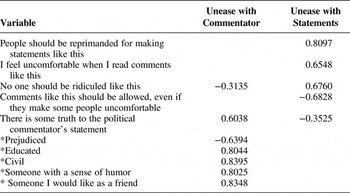
The Likert scale items measure reactions to both the content of the statement itself as well as the unease with the commentator. We used an exploratory factor analysis to test the existence of these two dimensions and found evidence of two distinct factors. Table 3 presents the factor loadings after Varimax rotation for the first two dimensions found using principal components analysis. Agreement with labeling the commentator as “prejudiced,” “educated,” “civil,” “someone with a sense of humor,” and “someone I would like as a friend,” all loaded strongly together on a single factor with an eigenvalue of 4.51 and all of the factor loadings but two above 0.80. The Cronbach's alpha for an index of these six items is 0.87. The items gauging reaction to the statement itself, including two items that explicitly mention possible sanction, all loaded on a single factor with an eigenvalue of 1.47 with factor loadings all above 0.65. An index of all four items has a Cronbach's alpha of 0.72. Given these results, we use these two indices as the main dependent variables of interest in our initial analyses.
Principal components factor analysis of respondent unease

* To what extent do you agree or disagree that the political commentator who made the statement about {GROUP} you read earlier is…
RESULTS
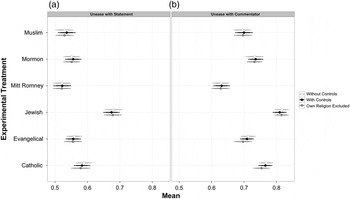
Figure 1 presents the initial basic results for the experimental conditions for both unease with the commentator and unease with the statement. The indices have been normalized between zero and one, with high scores indicating greater unease. Thus, respondents with higher scores reject negative discourse about the religious group, while those with lower scores show greater acceptance of the negative sentiments contained in the experimental treatments. Put differently, higher scores are evidence of a norm of equality and religious inclusion, while lower scores are evidence in favor of a norm of religious differentiation. The figure presents the results without any controls as well as the results that control for gender, age, education, race, party identification, income, religiosity, and religious affiliation. Results with and without controls are virtually identical. In addition, the figure also shows that excluding respondents who were randomly assigned to their own religious tradition never makes a statistically significant difference in the pattern of findings.Footnote 12 Dots indicate the estimated level of unease, and spikes represent 95% confidence intervals. Bolded spikes denote 83% confidence intervals, which we include as a rough visual approximation of whether two estimates would be statistically distinct from each other at the 95% confidence level in a two-tailed difference-of-means test (Bolsen and Thornton Reference Bolsen and Thornton2014; Goldstein and Healy Reference Goldstein and Healy1995; Payton, Greenstone, and Schenker Reference Payton, Greenstone and Schenker2003).
Overall unease with offensive statements and commentator. Note: Spikes with each point estimate indicate 95% confidence intervals, and bolded spikes represent 83% confidence intervals. Supporting information for these figures found in online Appendix Table A1.

In our search for the existence of social norms of equality and inclusion for minority religious groups, disparaging statements against Jews consistently produced the strongest result. Unease with the other groups varied between 0.5 and 0.6 on our zero-to-one scale, but for Jews the unease was at 0.68 — about 9 percentage points higher than the average for Catholics and approximately 15 percentage points higher than the average for Mitt Romney or for Muslims. The differences between statements about Jews and statements about other groups were all significant at p < 0.01.Footnote 13 Unease with statements about Catholics was also significantly higher than all groups other than Evangelicals.Footnote 14 As the country's first Mormon to receive a party's nomination, we included Mitt Romney on our list in the context of the 2012 election to test whether members of a religious group fared differently from the group as a whole. Unease with disparaging statements about Romney was slightly (though not always significantly) lower than unease with statements about the religious groups. It appears that individuals (and specifically, a political candidate in a competitive election contest) are seen as fair game relative to the group to which they belong.
The pattern in Figure 1 is essentially unchanged when the dependent variable is unease with the commentator, though the lower levels of unease when the statement was directed toward Romney were even more pronounced. Unease with the commentator was generally greater than unease with the statements, suggesting that Americans’ sensitivity to disparaging speech about religious groups is heightened when they focus on their feelings about the person making the statement in a visible public forum.
Still, it might be the case that our measures of social norms were simply a function of the respondent's affect toward each group. The panel design of the CCES allows a nice test of this possibility. A common way to measure attitudes toward religious groups is a standard thermometer rating for each group (Putnam and Campbell Reference Putnam and Campbell2010), and we included thermometer ratings for each of the groups of interest on one of our pre-election CCES modules and then included the experiment on the post-election module. Importantly, when we conducted the analysis in Figure 1 on the half sample with the thermometer ratings and included those ratings as controls, the results were virtually unchanged, suggesting our index measures something beyond mere affect toward the group.Footnote 15 Instead, we are tapping into a social norm for how each group ought to be treated.
Next, we examined differences in the experimental results by various subgroups. As Horne (Reference Horne2009) suggests, the existence of social norms can vary across subgroups in distinctive ways. In the context of the 2012 election, the subgroup of greatest interest was political party.Footnote 16 But clearly 2012 was not the first time a minority religious group had played a prominent role in American politics. A long history of partisan differences rooted in ethno-religious allegiances to political parties suggests we should find differences in social norms about acceptance of each group (Jensen Reference Jensen1971; Kleppner Reference Kleppner1979; Reference Kleppner1987; Swierenga Reference Swierenga1971). In modern times, especially with a Mormon presidential nominee in 2012, Mormons are politically distinctive and quite conservative (Campbell, Green, and Monson Reference Campbell, Green and Monson2014), suggesting that Democrats might be more lenient toward prejudicial statements about Mormons, while Republicans might have more unease with those same statements. One might expect something similar with Catholics. In recent elections, the conservatism of practicing Catholics has led to more support for Republican candidates (Green Reference Green2007). Thus, in spite of a more traditional allegiance with the Democratic New Deal Coalition, practicing Catholics today might face less bias within Republican ranks. Likewise, as long-time supporters of Democratic candidates, Jews could face less prejudice from Democrats.
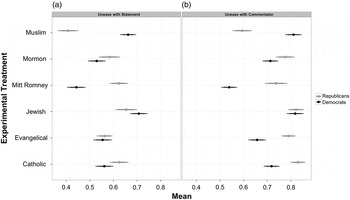
Figure 2 presents the differences in our experiment between Republicans and Democrats.Footnote 17 Panel A shows the partisan differences in unease with the derogatory statements. Notably, the differences between the two parties were statistically significant for Catholics and Muslims and nearly significant for Mormons and Jews. The only group for which partisan differences were not statistically meaningful was Evangelicals.Footnote 18 Panel B presents the differences for unease with the commentator. Here the partisan differences were statistically significant for all groups except Jews, where both parties expressed significant unease.Footnote 19 One striking result is that for both statements and commentator, the differences between Republicans and Democrats in attitudes about disparaging comments toward Muslims was massive — a 25 percentage point difference in unease with the statement and a 22 percentage point difference in unease with the commentator. While Republicans expressed comparatively little concern with negative statements about Muslims, Democrats became uncomfortable. Large differences also emerged between partisans in unease over statements about Mitt Romney, but because he was the Republican nominee for president in 2012, less unease among Democrats with negative information about the Republican nominee is expected and offers some helpful face validity to the concepts we were attempting to measure. Overall, Democrats expressed greater concern with negative statements about Jews and Muslims and comparatively less concern when those statements were directed toward Evangelicals, Catholics, or Mormons. Republicans voiced some concern about disparaging statements about Jews, Catholics, and Evangelicals, and perhaps Mormons, but they worried much less when negative comments were directed toward Muslims.
Unease with offensive statements and commentator by party identification. Note: Spikes with each point estimate indicate 95% confidence intervals, and bolded spikes represent 83% confidence intervals. Supporting information for these figures found in Models 1, 3, 5, and 7 in online Appendix Table A2.

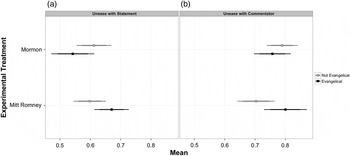
Religiosity and religious affiliation could also be important factors in predicting unease with the offensive statements. For example, because of the historical tension between Mormons and Evangelicals (c.f., Campbell, Green, and Monson Reference Campbell, Green and Monson2014), and with the presence of Mitt Romney on the ballot in 2012, we had substantial interest in reactions of Evangelicals to statements about both Romney and Mormonism. Consistent with the previous work that finds antipathy surfacing within the Republican nomination process (Campbell, Green, and Monson Reference Campbell, Green and Monson2012), the only differences between Republican Evangelicals and non-Evangelicals that came close to statistical significance occurred when Mormons (p = 0.13) or Mitt Romney (p = 0.09) were the targets of offensive statements (Figure 3; other comparisons seen online Appendix Figure A4). Interestingly, Evangelicals were much more uneasy when confronted with negative statements about Romney than with comments about Mormons as a group (p-value of the difference < 0.01).Footnote 20 One interpretation of these results is that once Mitt Romney became the Republican nominee in 2012, the fact of his Mormonism was a less weighty consideration than his position as party standard-bearer. Thus, Romney's run for president did not eliminate Evangelicals’ concerns about Mormonism generally, but it did make them more sensitive to attacks against Romney specifically.
Unease with offensive statements and commentator by Evangelical denomination (Republicans only). Note: Spikes with each point estimate indicate 95% confidence intervals, and bolded spikes represent 83% confidence intervals. Supporting information for these figures found in online Appendix Table A4.

Republicans’ responses to negative statements about religious groups were not merely a function of their religiosity. When we conducted the same analysis using a measure of religiosity that included measures of the importance of religion in daily life together with questions about church attendance and prayer, we found few differences between the most and least religious respondents (online Appendix Table A5 and Figure A5).Footnote 21 When comparing the predicted values among those in the highest quartile of religiosity with predictions for those in the lowest quartile, the only significant difference that emerged was for Mitt Romney (p = 0.02), with religious Republicans expressing greater concern about negative statements about Romney than their non-religious fellow partisans. But this difference did not persist when we asked about unease with the commentator. In general, the patterns within the Republican party seem to have little relationship to the respondents’ level of religiosity.
To this point, we have focused on two measures of unease with disparaging remarks about religious groups, but Horne's (Reference Horne2009) work on norms draws special attention to the importance of the willingness of individuals to sanction norm violators. Our index of unease with the statement includes two questions that tap directly into this willingness to sanction. We asked respondents whether “people should be reprimanded for making statements like this” and whether “statements like this should be allowed, even if they make some people uncomfortable.” The other elements of the unease index we have been using to this point tap into a general sense of discomfort (“I feel uncomfortable when I read comments like this” and “No one should be ridiculed like this”). We thus disaggregated the unease with statements index and focused on its two elements: willingness to sanction and expressions of discomfort.Footnote 22 As expected given that they scale together, the two measures are significantly correlated with each other (r = 0.49, p < 0.01), but the correlation is not perfect. That is, some respondents felt uncomfortable but were not willing to sanction, while others took the next step and wanted to sanction those who make negative comments about religious groups in public.Footnote 23
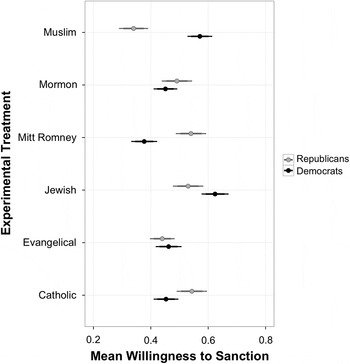
Figure 4 highlights the partisan differences in respondents’ willingness to sanction in each of the experimental conditions.Footnote 24 We find strong evidence that norms of sanctioning differ across parties with respect to Catholics, Jews, Mitt Romney, and especially Muslims. Democrats were most willing to sanction negative comments about Jews and Muslims, less willing to sanction comments about Catholics, Evangelicals, and Mormons, and (not surprisingly) least willing to sanction disparaging comments about their party's opponent in the election, Mitt Romney. Republicans again exhibited a very different pattern. They were most willing to sanction comments about Catholics, Jews, and Mitt Romney, but least willing to take action when the negative comments were directed toward Muslims.Footnote 25
Willingness to sanction by partisanship. Note: Spikes with each point estimate indicate 95% confidence intervals, and bolded spikes represent 83% confidence intervals. Supporting information for these figures found in Models 3 and 5 in online Appendix Table A6.

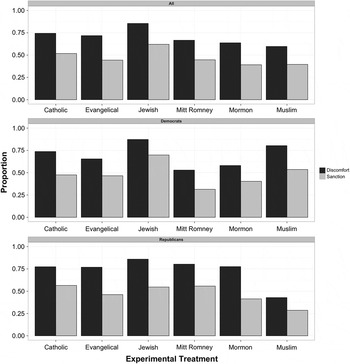
A different way of exploring these data can be seen in Figure 5, which shows the proportion of respondents scoring above the midpoint on the discomfort and sanctioning scales. Again, the patterns for Democrats and Republicans differed substantially. High percentages of Democrats felt discomfort with negative comments about Jews and Muslims, and many Democrats were willing to sanction those who talk in disparaging ways about those groups. Fewer Democrats reported discomfort about Mormons and Mitt Romney, and fewer still were willing to sanction when the negative comments focused on groups that are typically seen as more conservative — Mormons, Catholics, and Evangelicals. Many Republicans also felt discomfort and were willing to sanction negative comments about Jews, and they reported increased concern with negative comments about Mormons, Catholics, Evangelicals, and Mitt Romney, even if they were not always willing to sanction such comments. What stands out most for Republicans, however, is their exceptionally low levels of discomfort with and unwillingness to sanction negative comments about Muslims. Republicans were simply far more willing than Democrats to accept disparaging remarks about Muslims.
Proportion expressing discomfort and willingness to sanction.

Notably, independents (not shown in the figure) looked far more like Republicans than Democrats in this respect. About 45% of independents assigned to the Muslims condition scored above the scale median on the discomfort scale (compared to 82% of Democrats and 41% of Republicans), and only about 19% of independents (compared to 47% of Democrats and 21% of Republicans) scored high on the sanctioning scale.Footnote 26 To the extent that norms against public disparagement of religious groups exist, Democrats were willing to extend those norms to Muslims, while Republicans and independents were far more reticent to do so.
So far, we have focused on respondents’ self-reported attitudes and their “willingness” to sanction negative comments about religious groups. But the key measure is behavioral – did the respondents actually sanction by pushing back against the negative statement in some way? To assess this possibility, we examined the open-ended responses to the experimental vignettes. Prior to any of the closed-ended responses we have analyzed so far, respondents were asked to “[i]magine that the news program has a web page that allows for anonymous comments. If you were to post a comment about the statement above, what would you say?” Because the respondents were told that their open-ended responses would be online and anonymous, they represent a low bar for sanctioning behavior. That is, respondents faced no personal, face-to-face social pressure to either agree or disagree with the vignette statement. Nonetheless, the act of writing a response that condemns the commentator would reveal the presence of a meta-norm. The individual does something more than simply receive individual gratification by affirming beliefs in the norm but takes a stand that can be viewed by others.
To analyze the open-ended responses, two coders independently assessed each respondent comment and were asked to indicate whether the respondent's comment agreed with the vignette statement, disagreed with it, or included no indication of agreement or disagreement (a category that included respondents who did not offer any comment at all). We counted any statement of disagreement as a form of sanctioning behavior. Out of more than 1800 open-ended statements, the two coders agreed in their assessments of sanctioning approximately 85% of the time, and when we analyzed their independent coding separately, the basic pattern of results remained very similar. After the first round of coding, the two coders met to discuss the responses on which they disagreed. They resolved the remaining disagreements during this meeting and produced a final, single coding assessment.
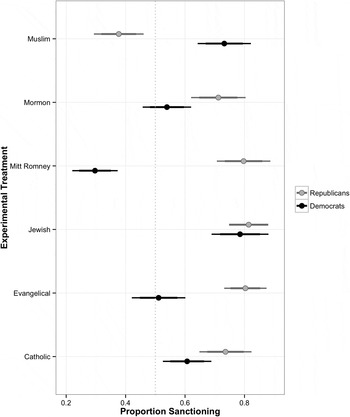
The results can be seen in Figure 6, which presents the proportion of respondents making any sanctioning comment, disaggregated by respondent partisanship. These behavioral measures reinforce the attitudinal results. Among Democrats, we see evidence of meta-norms of sanctioning negative statements about Jews (over 78% offered a sanctioning comment), Muslims (73%), and, to a lesser extent, Catholics (60%). No strong norm exists with respect to Evangelicals (51% sanctioned) and Mormons (54%), two groups who tend to be pillars of support for the Republican Party, and we find no evidence of a norm of sanctioning the Republican nominee Mitt Romney (less than 30% engaged in sanctioning behavior). Republicans, on the other hand, sanctioned disparaging statements about every religious group but one: Muslims. Whereas more than 70% of Republicans sanctioned statements about all other religious groups (the lowest percentage was for Mormons), only 38% of Republicans sanctioned commentators making statements about Muslims. Republicans thus appear to have a metanorm protecting religious groups, except when it comes to Muslims.
Proportion sanctioning (open-ended responses). Note: Spikes with each point estimate indicate Bonferroni-corrected 95% confidence intervals, and bolded spikes represent 83% confidence intervals. Supporting information for these figures found in Models 1 and 3 in online Appendix Table A7.

Similarly, when we compared sanctioning behavior among the religious and the non-religious (not shown in a figure), we found that the most dramatic differences occurred with respect to Muslims and Evangelicals. More than 60% of non-religious respondents sanctioned negative comments about Muslims, while only 48% of more religious respondents did so (p-value of the difference = 0.04).Footnote 27 Indeed, Muslims were the only group for which less than half of religious respondents engaged in sanctioning behavior. Conversely, a little more than half of religious respondents sanctioned disparaging speech about Evangelicals (56%), compared to over 68% of their more religious counterparts (p-value of the difference = 0.03). We found no consistent differences between the religious and the non-religious with respect to the other groups.
CONCLUSION
The United States Constitution carves out a special place for religion in the 1st amendment and in Article VI. The founding generation, especially James Madison, expressed high levels of support for toleration of religious differences. Indeed, 84% of Americans agree that religious diversity has been good for America (Putnam and Campbell Reference Putnam and Campbell2010, 520) and 89% of Americans agree that members of other faiths can go to heaven (Putnam and Campbell Reference Putnam and Campbell2010, 534). These and many other indicators point toward a broad conceptual agreement on a norm of religious equality in the United States.
But as studies of political tolerance have repeatedly shown (Chong Reference Chong1993; Reference Chong1994; Marcus et al. Reference Marcus, Sullivan, Theiss-Morse and Wood1995; Stouffer Reference Stouffer1955; Sullivan, Piereson, and Marcus Reference Sullivan, Piereson and Marcus1993), acceptance of abstract norms does not mean that those norms are applied equally. This basic insight can be extended to religious groups — and in our case, to social discourse about religious groups — as well. Our findings support the notion that norms of religious equality and inclusion are not universally applied across the several minority religious groups we tested in our experiment. To the extent that the public embraces a norm about religious groups, it does so about the Jewish faith. With respect to other groups, we find large differences in norms of social discourse. Most importantly, the norm varies in its application by different political parties, with much of the variation associated with the partisan leanings of the religious groups. We do not find compelling evidence of some special animus in public discourse about Mormons, compared to other religious groups such as Evangelicals or Catholics, though Mormons do not receive any unique benefit or protection either.
Instead, the group for which we find the greatest partisan differences is Muslims: while Democrats expressed special concern about disparaging remarks directed toward Muslims, Republicans and independents felt little discomfort with such speech. Indeed, as we write these words in 2016, the Republican presidential nominee Donald Trump fears no sanction from large elements of his party for policy proposals and statements that single out Muslims. Even among the most religious respondents, Muslims enjoy few of the norms of protection against disparaging speech extended to other religious groups.
Importantly, we also find that even among those who express discomfort with the statements, there is variation by party in willingness to sanction any violations of the norm. This finding calls out for additional exploration — an unwillingness to sanction could say something about the strength of meta-norms regarding sanctioning behavior, but it could also be a function of other, competing norms, such as a strong commitment to free speech that respects the rights of even those who express very different beliefs (Wilcox and Kim Reference Wilcox, Kim and Djupe2015). Still, we find that in the anonymous setting of online comments, large percentages of respondents did articulate some form of sanctioning behavior by saying something negative about the disparaging comments in our vignette experiment. This raises an additional, important caveat: our experiment focused on discourse that occurs in public settings, such as on television, and for its measure of sanctioning behavior on the often acerbic world of online commentary. More work remains to understand patterns of both discomfort and sanctioning in more private settings, such as dinners or cocktail parties.
While additional research is needed, we believe that these initial findings have implications for the ways in which we understand norms specifically and American politics generally. Norms of acceptable social discourse about religion do not extend to all groups equally, and what counts as acceptable public speech appears to vary by political party. Furthermore, some individuals do not seem to want to sanction even when they feel discomfort about some forms of public discourse. The dynamics of the groups in which people find themselves provide more or less benefits above and beyond the direct benefit to be accrued when sanctioning. The results point towards a deeper understanding of the group dynamics of American politics. Not only do individuals receive the benefits of some norms depending on the groups to which they belong, the nature of group membership shapes the benefits that will be extended to individuals who choose to sanction when violations of the norm occur. American politics is not just about the groups that comprise society, but it is about how committed those groups are to a particular form of social discourse and whether that commitment leads them to enforce the norms upon which democracy rests.
Supplementary materials and methods
To view supplementary material for this article, please visit http://dx.doi.org/10.1017/S1755048316000456.