Introduction
It has long been accepted that the low public awareness of radiotherapy as a modern, radical treatment option 1 and possible career choice presents a significant challenge to recruitment into radiotherapy courses in higher education institutions (HEIs). Consequently, in 2011, ‘The Age of Radiotherapy’ campaign was launched to raise awareness of radiotherapy, and initiatives now continue to be undertaken to promote the profession. An added challenge to the radiotherapy profession is retention of both students and qualified radiographers. Despite figures for attrition in radiotherapy courses from 2009 to 2012 ranging between 33 and 37%, 2 the Society and College of Radiographers (SCoR) refer to a dearth of information regarding why students leave health courses. There is some indication that practice placement plays a significant role, but with reasons given being largely anecdotal. 3 This report identified six risk factors that may have contributed to attrition, including first year experience and expectations. 3 A subsequent 2013 studyReference Colyer 4 aimed to improve student retention in pre-registration therapeutic radiography by increasing student satisfaction. This resulted in three key recommendations relating to the role of a clinical visit during the application process:
1. ‘The opportunity for a clinical visit must be made available by centres before any offer of a place on a pre-registration therapeutic radiography programme’;
2. ‘Prospective students must have undertaken a clinical visit and submitted a report to be considered during the selection and recruitment processes, and before the offer of a place [by HEIs]’);
3. ‘Guidance and a template for a clinical visit report to be used during the selection process should be developed [by SCoR]’.Reference Colyer 4
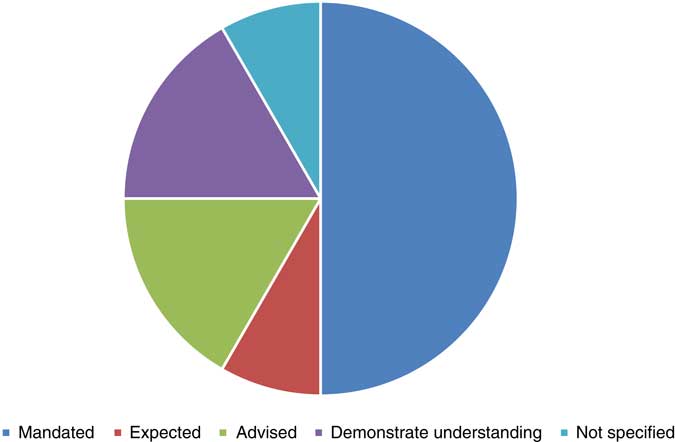
As seen in Figure 1, nine of the 12 UK universities currently offering undergraduate radiotherapy courses for 2018 mandate or recommend on their websites that a clinical visit be undertaken by potential students before either application or interview. The hypothesis underpinning these requirements was that better-informed applicants would be less likely to leave courses because of unexpected practice placement experience.
Current publicised UK clinical visit requirements.

Applications to radiotherapy courses slowed dramatically following the removal of bursary funding for the training of allied health professionals in 2017, plummeting by 23% compared to the previous year. 5 Despite the 2013 recommendations and the ongoing perception of academic and clinical staff that a clinical visit is necessary for the appropriate recruitment and retention of student radiographers, the possibility that this presents as an unnecessary barrier to applications has been mooted. There are, indeed, significant logistical challenges presented to both applicants and clinical departments. With the increasing prevalence of online information with sites such as YouTube allowing access to videos of both patient and staff experiences in radiotherapy and demonstrations of the equipment used, it could be argued that these visits are now unnecessary. Evidence supporting or refuting the requirement for clinical department experience during application is needed to identify if this is still the most relevant way to ensure a student enters the profession with appropriate expectations.
The aim of the study, therefore, was to explore the perceptions of both first-year radiotherapy undergraduates and clinical educators concerning the benefit of a clinical visit.
Method
A focus group interview method was used to gather in-depth qualitative data concerning the clinical department visit experiences of applicants and clinical educators. The focus group setting allowed participants to share experiences and generate common themes.Reference Wright, Schneider-Kolsky, Jolly and Baird 6
Participants
This study was conducted at The University of Liverpool in the United Kingdom. All 30 first-year B.Sc. radiotherapy students were sent an email invitation to participate in a focus group. Clinical educators and staff involved in the organisation and facilitation of clinical visits from the three major regional partner departments were also invited to form an additional focus group.
Data collection
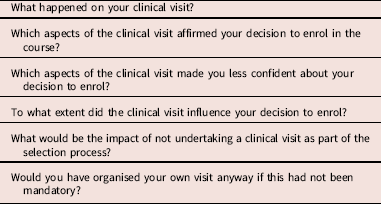
The focus groups adopted a semi-structured design in order to facilitate discussion while maintaining reasonable consistency across the different groups. Participants were asked questions as seen in Table 1 and additional questions were used to follow-up on responses and gather a more complete response. Focus groups were planned to last around 1 hour and were facilitated by an experienced independent research assistant who was unknown to participants. Each interview started with a short discussion about the aims of the session and the importance of confidentiality of responses.Reference Wright, Schneider-Kolsky, Jolly and Baird 6 The sessions were recorded digitally and the resulting audio data was transcribed verbatim into a written document. All responses were anonymous and the audio file was deleted following confirmation of the transcription accuracy. The focus groups were held on three dates from September to November 2017.
Focus group questions

Data analysis
The data were subjected to qualitative content analysis with responses being assigned to themes and subthemes.Reference Graneheim and Lundman 7 , 8 Two researchers independently coded the responses by allocating them to one of an evolving list of domains. Consensus between the researchers was reached on the coding before the domains were analysed to identify similarities and differences in meaning and content and generate subthemes and themes.
Ethical considerations
Ethical approval for the study was granted by The University of Liverpool Health and Life Sciences Committee on Research Ethics. Participants were provided with written information about the study and written consent was obtained before participation. All participants were advised that participation was voluntary and that their responses would be anonymised.
Results
There were eight participants in the student focus groups and three in the clinical educator group.
Student focus groups
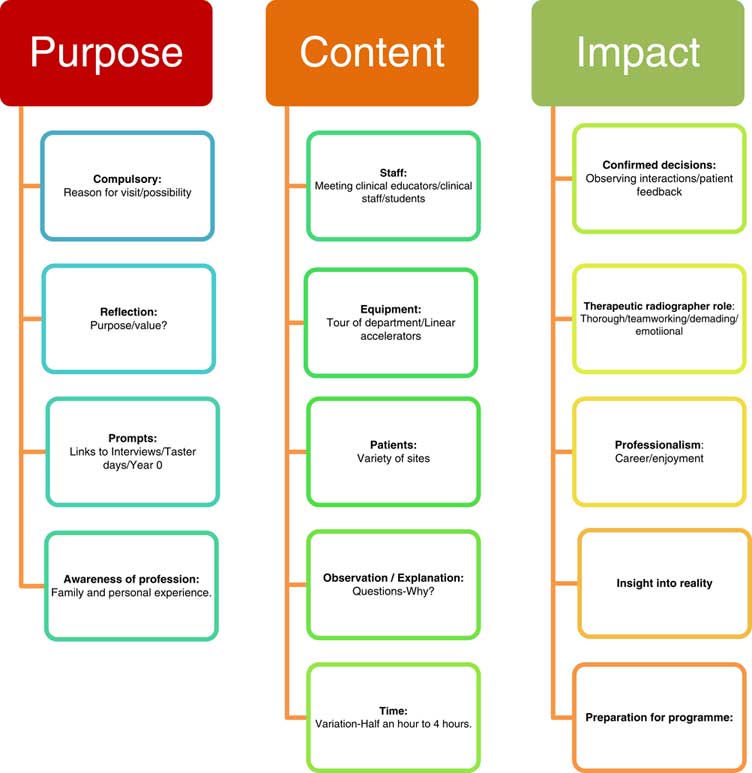
Analysis of the ‘student’ focus group data resulted in three main themes and corresponding subthemes, as shown in Figure 2. The first theme concerns the perceived purpose of the clinical visit, the second on the content of the visit itself and the third theme on the outcomes and impact arising from the visit.
Emergent themes from student focus groups.

Student theme 1: purpose
More than one student described their first exposure to radiotherapy on a personal level.
My grandmother had cancer a few years ago, and that is what introduced it to me. Then I started researching it, and found I really liked it.—Student 1
Interestingly, however, when the students were asked if they would have organised a visit if it had not been mandatory, all students agreed that they would not have done so. Further exploration revealed that not all students realised that they were allowed to visit. There was general agreement on the whole that the clinical visit should be compulsory.
I think that if it wasn’t mandatory that people probably would not do it. Because I probably wouldn’t have done it if I were told I didn’t have to do it, but I think I am probably really glad that I did it because I think it really helped.—Student 2
There was also some discussion and comments made by students about the actual process of organising the visits.
[…]because for mine I was going through like a careers person because it was under like work experience, but I ended up like getting my clinical trial by going to the open day and there was like place where you could like sign up for clinical placement because most hospitals know that you have to go through it to find out. So like my college advisor was not useful in that way […].—Student 3
Student theme 2: content
With regard to the content of the visits, the students described large variations in both visit duration (2–4 hours) and visit content. There was also variation in opportunities for prospective students to talk to current students, the equipment that was observed, the range of patient treatment observed and the level of explanations given. For some, time was spent in a classroom setting rather than actually observing treatment delivery. Irrespective of the amount of time in a treatment bunker, some students commented on the effectiveness of that time spent:
Um I felt like I knew what I was seeing, but I didn’t know why things were being done the way they were. I feel like they could improve that at least a little bit if at least one person, perhaps a student or a professional, was aware that I’ve only known about the profession for about two months and I didn’t know what I was doing there.—Student 4
It was disappointing to hear that some students were not allowed to see how patients are treated:
[…]but on my first one [visit], I wasn’t allow to see any treatments or stuff like that because I was under 18.—Student 1
Student theme 3: impact
The student comments showed that for many this experience clearly helped them to make the decision to pursue radiotherapy as a career by giving them an insight into the profession.
I liked seeing the radiotherapists work as a team, that like also swayed my decision also. It was not just, like what immediate effects this had, it was being part of a team that swayed my decision.—Student 5
For some students, however, the visit served to affirm a decision that they had already made:
[…]and so I went to xxxxx to do my clinical visit and I found it really useful, really it kind of enticed me more to really do the course even though I was already quite keen on it. After spending half a day with the people, I really just thought, ‘wow, what an amazing thing to do.’—Student 4
When asked if the visit had deterred any students from enrolling into the programme, all students stated that it had not.
Clinical educator focus groups
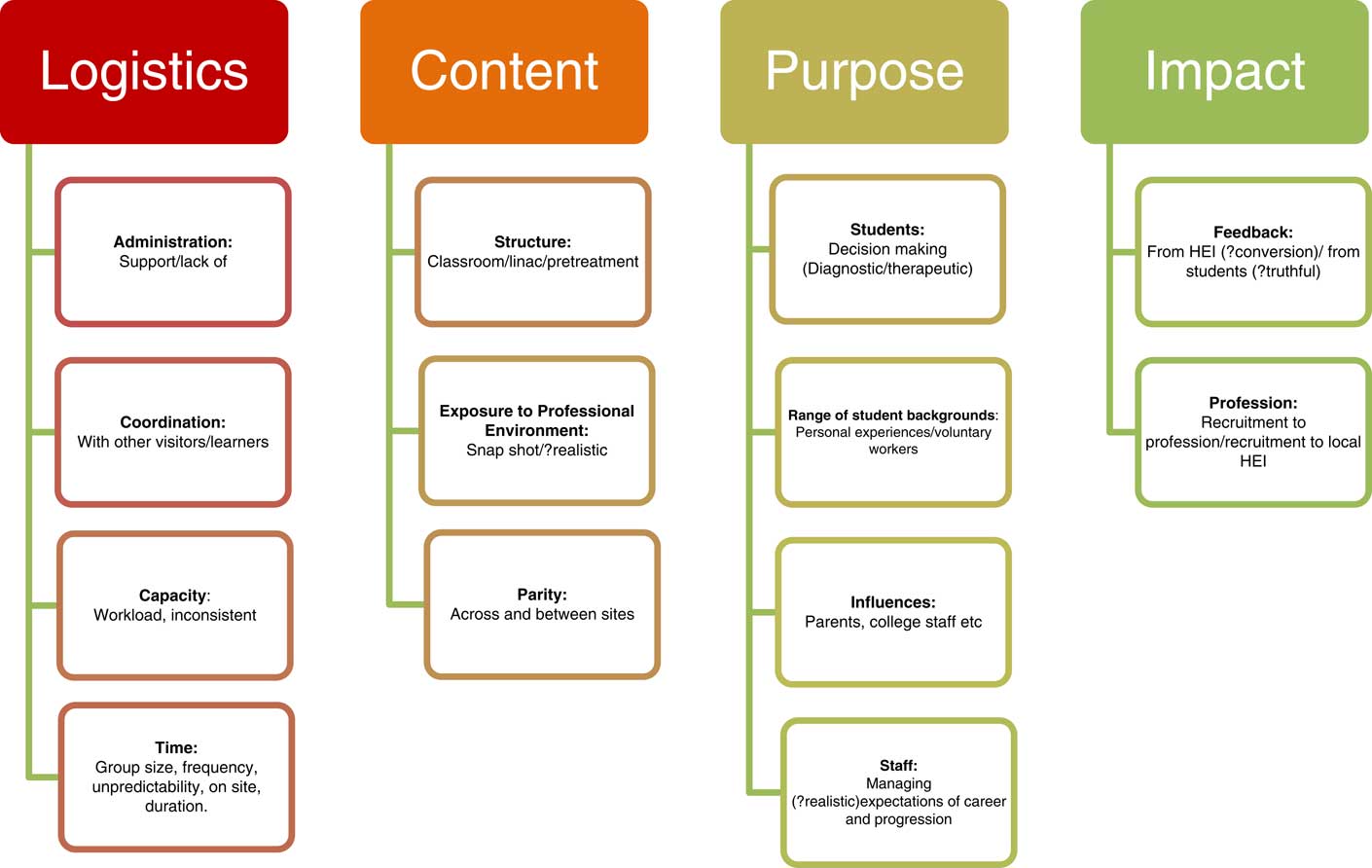
Figure 3 illustrates the four main emergent themes derived from the clinical educator focus groups along with the corresponding subthemes. These corresponded well to those expressed by the students, with the addition of a theme concerning the logistical impact of the visit.
Emergent themes from the clinical educator focus groups.

Educator theme 1: logistics
The clinical educator focus group provided plenty of feedback relating to the logistical issues with many comments highlighting the challenge of the administration, coordination and organisation of the clinical visits alongside the routine work of supporting all learners in the clinical environment. It appears that the different clinical sites adopted a different approach to organising visits with one site being lucky enough to have administrator support with this. There was general agreement that planning and preparing for these visits took a considerable amount of clinical educator time.
So they would email, I’d look in the diary and I’d book them in for the day and they’d come in ones and twos. Which from a time point of view is horrible.—Educator 1
[…]it is very time consuming, there is a lot of admin and quite a lot of work goes into it preparing for the clinical visits.—Educator 2
A common factor influencing the planning of visits was the capacity with regard to the number and range of other visitors and learners in the departments at different times.
You’ve got elective students, you’ve got nurses, there are just so many visitors and people who want to see radiotherapy.—Educator 2
Educator theme 2: content
The transcript showed considerable dialogue concerning the actual content, structure and consequent quality of the visit as each clinical site again appears to have taken a different approach leading to a lack of parity of opportunity:
[…]and we go through a lot of kind of theory, we talk about situations that they may have to observe, and then next, we show them the DVD video that we show to our patients.—Educator 2
There was recognition of the unpredictable nature of the work and the resulting differences in student experience in levels of technical complexity, patient contact time and patient support requirements, for instance:
So it’s a very small snapshot of what it is actually like on the treatment floor to be honest.—Educator 2
There was some concern that the prospective students needed to be exposed to the realities of radiotherapy practice and whether or not these visits achieved this aim, particularly with the inconsistency of the experience gained:
[…]they need to come in and see what the actual job involves. That for the first 5 years, 10 years, they are going to have to run in and out of the linac every day, they are going to have to treat 30–40 patients every day, that it is stressful, they have to have an idea of what it is[…].—Educator 1
Educator theme 3: purpose
The primary motivation from the educator perspective was to help students to make the right career choice before investing in a place on the programme. They anticipated that this would resonate with the advice given by other major influencers on the student group.
[…]and whether or not the University of Liverpool see it as a requirement or not, a student coming into the University of Liverpool is still going to be advised by their high school counsellor, by their college, by their parents, and by every other advisor that they have got to actually go and visit.—Educator 1
There was acknowledgement, however, that the students themselves are often from different backgrounds and so have disparate prior knowledge and expectations.
We have students at the moment who have volunteered with us for years, so [know] more than some of those who have come straight from school.—Educator 2
The clinical educator motivation for the clinical visits had an additional element in that they described the need to promote and maintain the profession as a whole.
What we are selling is the profession because we do need to make sure that there will be somebody to treat all of us in the future, otherwise no one will go into the profession.—Educator 3
Educator theme 4: impact
There was undeniable uncertainty about the actual impact of these visits despite the time and effort involved in facilitating them by the educators. The educators felt there was little if any feedback from the HEI(s) as to how many of the prospective students were later offered and/or accepted a place on the programme.
[…]but what we then don’t know is if they go on to apply, and if they go on to apply, to which university, […].—Educator 1
Discussion
Future directions
There seemed to be differing expectations of the purpose of the clinical visits with some overlap between clinical visit and academic ‘taster day’ and open days. The original purpose of the visit was to provide insight into the career and day-to-day working practices in order to ensure that first-year students had clear expectations. The rationale behind this was to reduce attrition. From the clinical educators’ perspective, the visit also served to publicise the profession rather than the course and it was clear that this had led to some classroom-based activities being included within the visit.
From an academic perspective, the clinical visit should provide insight into the clinical environment including time on a linear accelerator and experience with patients. It was clear that students found the actual clinical time to be of value and particularly relished meeting students on clinical placement who provided additional insight. The ability to observe patient treatments alongside a practicing student was highlighted as particularly beneficial as the students were able to explain what was happening and why. They also acknowledged that videos and online resources did not provide a realistic picture, with the observation of teamwork in practice being highly regarded by both students and educators. It was not always clear to students what the purpose of the visit was and some thought that the feedback from clinical staff formed part of the interview and suggested replacing interviews with this. Others were using the experience to determine which future placement site they would prefer.
The experience of the clinical work environment should provide applicants with a clear idea of what the career involves instead of reliance on time-intensive classroom-based activities. Classroom experiences are generally provided at academic events and clinical visit applicants tend to have some understanding of the profession. A clear distinction should therefore be made between clinical ‘open days’ where the profession should be marketed and ‘clinical visits’ to provide clinical insight. Further work should generate collaborative guidance to reduce classroom-based aspects of clinical experience and coordinate better with academic classroom-based activities. Work should also be performed to reduce the demonstrated variability in experience seen here even between small numbers of clinical sites. A coordinated approach to agreeing national guidance for structure and content of these visits would be of value.
The time and resource constraints were considerable with many centres providing visits to applicants from around the country. It was clear that administrative support for coordination was a great help to clinical educators, but facilitation of clinical visits is still a challenge within the wider remit of clinical educator workload. Booked group sessions can be more efficient but it can be difficult to provide clinical experience for large groups compared to single visitors. Educators felt that there should be a limit on numbers of ‘learners on linacs’. The activities reported by the clinical educators suggested that the combination of active teaching, classroom-based sessions and clinical time were overly intensive and were adding unnecessary time–resource pressure. It is possible that expectation of these sessions is unrealistic and that a standardised and less resource-intensive alternative can achieve the required outcomes.
Potential impact of cessation
It is challenging to predict the impact of removing the clinical visit requirement in the United Kingdom. Anecdotal evidence from overseas suggests that this is an unnecessary barrier to course admission. It is acknowledged that some potential applicants do not follow-up on requests to undertake clinical visits and it is possible that this presents a barrier. Potentially, however, this could be seen as an effective deterrent to exclude applicants who lack the necessary enthusiasm and motivation to succeed, a perception reflected by the student group. If the visit has been effective, then in theory attrition levels should be low. Clinical experience may not be the main reason for attrition; however, additional reliable data concerning reasons for leaving would help to provide further insight into this hypothesis. Students who reported personal benefit to undertaking the visit suggested that they were unlikely to have organised a visit without it being mandated. The primary reasons for this being lack of guidance, awareness and effort.
Limitations
One of the limitations of this project was the paucity of data from clinical visitors who subsequently decided to abort their application for a radiotherapy course. Although this data would have provided a useful insight to the value of the clinical visit on career decisions, this was impossible to collect retrospectively. An additional limitation was the reliance on data from only three centres; a wider national study would increase the validity of the findings.
Conclusion
This study has indicated that the clinical visit is perceived to have value to applicants and can help confirm their decision to study radiotherapy. Additional data concerning the role of the clinical visit in deterring potential applicants is needed to provide a complete picture. Across the studied clinical sites, it is clear that there is variation in expectation for these visits and they frequently demand a high level of coordination and staffing resources. Nationally agreed guidelines for clinical visit structure and content could potentially reduce clinical educator workload and lead to more efficient and effective visits. This would also be an ideal opportunity to develop the previously mooted national clinical visit form, which would further diminish barriers from an applicant perspective. The current challenges facing radiotherapy recruitment mean that this potentially vital aspect of the admissions process urgently needs to be streamlined and monitored in more depth.
Acknowledgements
The authors would like to acknowledge the invaluable assistance of Brook Byrd with the focus group facilitation and transcription.