


Introduction
Weed control is a primary concern for vegetable growers, and for organic growers in particular it ranks among their highest priorities, according to the Organic Farming Research FoundationReference Walz1. Yellow nutsedge (Cyperus esculentus) and purple nutsedge (C. rotundus) are prevalent and prolific weeds in Florida. These weeds are difficult to control even in conventional vegetable production because of underground perennating organs or tubers. The pointed apices of rhizomes that sprout from tubers very effectively penetrate opaque polyethylene film mulch. The tubers provide the needed source of energy for the weed to sprout, and then the sharp tips of the leaves penetrate the polyethylene filmReference Majek and Neary2.
Black polyethylene film (or white with a black underside) mulch is used extensively in vegetable production. Benefits include weed growth inhibition, increases in soil temperature leading to faster crop development and earlier harvests, reduction in the rate of fumigant loss as a result of the water layer that is formed beneath the mulch, and fruit protection from rain-splash and soil organismsReference Maynard and Hochmuch3. However, the use of polyethylene mulch has several limitations and disadvantages. Removal of polyethylene film from the field is costly and its disposal has become an environmental concern where landfill space is scarceReference Shogren4. In 1995, annual polyethylene mulch use in US agriculture was reported to be approximately 110 million kg with an estimated removal and disposal cost of US$125–175 ha−1.Reference Anderson, Garisto, Bourrut, Schonbeck, Jaye, Wurzberger and DeGregorio5 In 2004, the use rate had increased to 130 million kg per year with disposal costs of about $250 ha−1.Reference Shogren and Hochmuth6
Polyethylene mulch acts as a water-impermeable layer over up to 75% of a planted field, causing water and agrochemical runoff into nearby water systems and thereby increases environmental impacts on nearby watercourses and lakesReference Raloff7. A study that compared the off-site translocation of soil and agrochemicals between tomato plots under polyethylene mulch and a residue mulch of hairy vetch (Vicia villosa) indicated significantly greater quantities of pesticide runoff with the polyethylene mulchReference Rice, McConnell, Heighton, Sadeghi, Isensee, Teasdale, Abdul-Baki, Harman-Fetcho and Hapeman8.
Also, opaque polyethylene film does not effectively suppress nutsedge unless a soil fumigant has been applied. Methyl bromide in mixtures with chloropicrin has been widely used to control weeds and soil-borne diseases in conventional plasticulture vegetable production. However, as stipulated by the Montreal Protocol, the production and import of methyl bromide was banned on 1 January, 2005, in developed countries9. The loss of methyl bromide is likely to result in yellow and purple nutsedge becoming increasingly important weed problems in conventional vegetable productionReference Rosskopf, Chellemi, Charudattan and Chandramohan10.
Transparent polyethylene film mulches are less prone to penetration by yellow and purple nutsedge than opaque polyethylene film because leaf expansion occurs under the clear film when rhizome tips detect light as they emerge from the soilReference Chase, Sinclair, Shilling, Gilreath and Locascio11. Rhizome elongation ceases and elongating nutsedge leaves become trapped beneath the clear film. This photomorphogenic response has also been demonstrated with infrared-transmitting film and silver film, which transmit low levels of light and are thus considered translucentReference Patterson12. Translucent mulches resulted in a 70–88% reduction in purple nutsedge penetration compared to opaque mulches.
Effective and environmentally sound alternatives to polyethylene mulch are needed. One option is paper mulch. Paper mulch can be applied using standard polyethylene film application equipment with minimal adjustmentsReference Shogren and Hochmuth6. The difficulty has been in developing a paper product that can remain intact throughout the growing seasonReference Shogren4. Paper loses much of its strength when wet and degrades too quickly where it is embedded in the soil to be effective for season-long weed control. Degradation of paper mulches before the end of the cropping season commonly occurs, resulting in limited adoption among growersReference Schonbeck and Evanylo13. Paper is also prone to removal by wind. However, brown kraft paper coated with vegetable oil-based resins (linseed or soybean oil with a cobalt octoate catalyst solution) is more durable than noncoated paperReference Shogren4. Paper coated with vegetable oil resin maintained its integrity for a single crop of watermelon and resulted in yields that were statistically similar to those obtained with polyethylene mulchReference Shogren and Hochmuth6. Coating paper with a biodegradable polymer on both sides or on the underside also considerably decreased the rate of degradationReference Brault, Stewart and Jenni14,Reference Weber15. However, at low yellow nutsedge population, no difference in nutsedge plant density was observed with paper and polyethylene mulchReference Brault, Stewart and Jenni14, but yellow nutsedge was more effectively suppressed by paper mulches than by polyethylene mulch with a relatively high nutsedge populationReference Shogren and Hochmuth6. Because of the short duration of persistence and because it cannot be used as a fumigation tarp, paper mulch may be adopted for commercial use primarily by organic growers.
Other potential alternative mulches for weed management are biodegradable materials that are applied as slurries: foam mulch, hydraulic mulches and hydramulch. Foam mulch consists of: recycled cotton and cellulose fibers, gums and starches, surfactants and saponins, pigments, fertilizers and buffersReference Masiunas, Wahle, Barmore and Morgan16. This material maintained its integrity throughout the growing season and provided broadleaf and grass weed control similar to that of black polyethylene mulch.
Hydraulic mulch slurry, derived mainly from wood by-products, is sprayed onto the soil surface as a biodegradable ground cover to prevent erosion and establish vegetation. Liburd et al.Reference Liburd, Casagrande and Alm17 tested hydraulic mulch materials and reported that humidity and regular rainfall resulted in softened mulches that could be easily penetrated by weeds. The authors concluded that hydraulic mulch could potentially control weeds provided that an effective adhesive was added to ensure that the material maintains a rigid structure during moist conditions.
Hydramulch (Novovita Inc., Raleigh, NC), the subject of the current study, is a variation of hydraulic mulch that is composed of cotton waste and newsprint, with gypsum as a filler (for improving texture) and bound by proprietary adhesive. Hydramulch slurry dries within 12 h of application, forming a gray shell with a texture similar to the old-style egg cartons made from paper by-products. Potential benefits of appropriate use of hydramulch may be as a durable, biodegradable mulch that can remain intact and effective throughout the growing season and the successful control of nutsedge with applicability for sustainable conventional production systems. Discussions between the manufacturer and the National Organic Standards Board about the suitability of hydramulch for use in organically certified acreage are ongoing. The components of the mulch are considered individually acceptable; however, the process of mulch production is in review for consideration as a nonsynthetic substance.
The objectives of this study were to determine the suitability of hydramulch for weed control and to compare the effect of three formulations of hydramulch on soil temperature, soil moisture and weed growth with polyethylene film mulch and bare ground.
Materials and Methods
Hydramulch was tested in Florida during the spring of 2003 at two locations: an organic farm in Gainesville (north-central Florida) and a conventional farm in Loxahatchee (southeast Florida). These two sites differed in nutsedge pressure, soil type, temperature, humidity and rainfall. Treatments consisted of three hydramulch formulations (HM1, HM2 and HM3), polyethylene film mulch and a bare soil (no mulch) control. Hydramulch formulations differed in the quantity of shredded newsprint and gypsum used: HM1—55% newsprint, 32% gypsum and 13% cotton by-products; HM2—45% newsprint, 43% gypsum and 12% cotton by-products; HM3—39% newsprint, 49% gypsum and 12% cotton by-products. All formulations contained the same percentage of the manufacturer's proprietary adhesive (Novovita Inc.). Hydramulch slurry was applied using a 750 gallon Turbo Turf Hydro Seeder (Turbo Technologies, Inc., Beaver Falls, PA) powered by a 27 horse power gas engine. A 1.25 inch inside-diameter wound-fiber-reinforced PVC hose with a smooth bore was used to deliver the slurry at a rate of 1 m3 per 50 linear bed meters at Loxahatchee and 2 m3 per 50 linear bed meters at Gainesville.
Loxahatchee
Hydramulch slurry was applied on 17 February in Loxahatchee and dried to give a 2 mm-thick mulch. The experimental design was a randomized complete block with four replications. Ten raised beds were positioned north–south. Each plot was 6.1 m in length and 1 m wide with 1 m alleys separating plots along beds. Beds were irrigated with two drip tapes (Queen Gil International, Israel) per bed, 30 cm apart, and positioned approximately 2 cm below the soil surface. The flow rate was 4 l h−1 per linear meter bed length, with drip emitters located 10 cm apart. Irrigation occurred daily at 6:00 am and 6:00 pm for 45 min unless it rained. The white-on-black polyethylene film mulch (Sunoco, Philadelphia, PA) was 0.032 mm thick. The soil type was classified as Riviera Sand (loamy, siliceous, hyperthermic Arenic Glossaqualfs), a poorly drained soil with 1–2% organic matter, and reaching a depth of 50–100 cm above a loamy subsoil. The field capacity of Riviera Sand is 4–6% in the top 15 cm, and 3–5% to a depth of approximately 70 cm.Reference Gilbert, Rice and Lentini18,Reference Carlisle, Collins, Sodek, Hammond and Harris19
Gainesville
In Gainesville, hydramulch slurry was applied on 21 March at double the volume, resulting in a mulch approximately 4 mm thick (added thickness intended to improve durability). Treatments were applied to 3 m-long beds oriented north–south, with four replications in a randomized complete block design. Irrigation was provided via one drip tape (T-Tape) per bed buried 2 cm below the soil surface. Irrigation was used to supplement rainfall. The soil type was a Millhopper sand with 1–2% organic matter and a field capacity of 6–12% in the top 20 cm, and 5–6% for the subsoilReference Carlisle, Collins, Sodek, Hammond and Harris19. Black 0.025 mm-thick polyethylene film mulch (Helena Chemical, Collierville, TN) was used in Gainesville.
Data collection
Volumetric soil moisture was measured at 2-week intervals on 2 March, 15 March, 30 March, 13 April and 26 April in Loxahatchee; and 28 March, 12 April, 23 April, 7 May and 20 May in Gainesville. A portable time domain reflectometry (TDR) probe (Hydrosense model, Decagon Devices, Pullman, WA) was used to take four readings at 20-cm depth in the central section of each plot that excluded a 61 cm border at each end. Soil temperatures at 10-cm depth were measured in two replications at 30 min intervals with CR10 dataloggers (Campbell Scientific, Logan, UT) equipped with copper-constantan thermocouples. Soil temperatures were measured from 1 March to 31 May at Loxahatchee and from 5 April to 15 June at Gainesville. Daily maximum, minimum and mean temperatures were calculated.
Weed density and biomass in each plot were assessed using a randomly placed quadrat with dimensions of 76.2 cm×76.2 cm. Weeds were counted and categorized as broadleaf, grasses and nutsedge on 2 March, 15 March, 30 March, 14 April and 27 April in Loxahatchee and on 29 March, 15 April and 3 May in Gainesville. Fresh above-ground weed biomass was determined in Loxahatchee on 30 May and in Gainesville on 12 June. The weed biomass was dried at 75°C to a constant weight and weighed again to obtain dry biomass. All weed species were combined at the Loxahatchee site (due to a low nutsedge population), while nutsedge, grasses and broadleaf weeds were weighed separately at the Gainesville site in order to quantify the impact of the substantial purple nutsedge population.
Data were analyzed by location. Analysis of variance (ANOVA) was performed using the general linear model approach of SAS®Reference Littell, Freund and Spector20 and the level of significance used was 5%. Contrasts were used to test preplanned comparisons of treatment means.
Results and Discussion
Soil temperature
Loxahatchee
Maximum and mean soil temperatures beneath white-on-black polyethylene mulch were consistently 1–3°C warmer than beneath hydramulch (Table 1). From 1 March to 19 April, maximum soil temperature was 1.4°C warmer than with the hydramulch treatments and mean soil temperatures were 1.0°C warmer. Between 26 April and 31 May, the difference in temperature had increased to 3.3 and 1.5°C, respectively. The trend with nonmulched soil was somewhat different. From 1 March to 19 April, maximum and mean temperatures of nonmulched soil were 1.0 and 0.6°C higher than soil temperatures under hydramulch; however, between 26 April and 31 May, maximum and mean temperatures of nonmulched soil were cooler than with hydramulch treatments by 1.6 and 0.6°C, respectively. Minimum soil temperatures were consistently warmer under polyethylene than under hydramulch.
Comparative effect of mulch type on daily soil temperatures (maximum, minimum and mean) in Loxahatchee and Gainesville recorded at 30-min intervals at a depth of 10 cm.
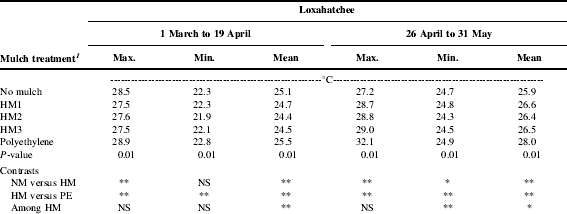
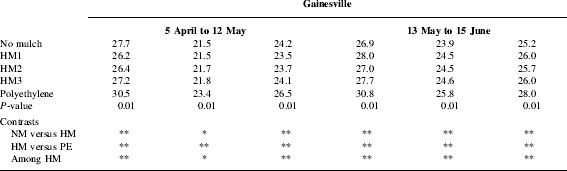
1 NM, HM, and PE are no mulch, hydramulch and polyethylene mulch, respectively. White on black polyethylene was used at Loxahatchee and black polyethylene at Gainesville. Contrasts are designated NS when nonsignificant.
* and ** indicate significance at 0.05 and 0.01 levels, respectively.
Gainesville
From early April to mid-June, maximum, minimum and mean soil temperatures were warmer with black polyethylene mulch than with the hydramulch treatments by 1–4°C (Table 1). Nonmulched soil was warmer than soil under hydramulch by approximately 1°C for maximum and mean temperatures. Differences in maximum and mean soil temperatures were recorded among the hydramulch treatments. During April and the first half of May, soil temperature increased as the proportion of newsprint and gypsum in the hydramulch formulations increased and declined, respectively. However, this same pattern did not hold true from 13 May to 15 June.
Colored polyethylene mulches can be used to modify soil temperature to improve crop growth and yield. The optimum soil root zone temperature for tomato has been shown to be approximately 26°CReference Diaz-Perez and Batal21. Mulches that result in soil temperatures closest to the optimum gave the best plant growth and yields. Black polyethylene film mulch results in higher soil temperatures than nonmulched soilReference Ashworth and Harrison22–Reference Ham, Kluitenberg and Lamont25. In north Florida where black polyethylene mulch is used in spring to promote soil warming, the cooler temperatures under hydramulch may be a limitation. Soil temperatures with white-on-black polyethylene mulch tend to be lower than with black mulchReference Ham, Kluitenberg and Lamont25,Reference Hanna, Millhollon, Herrick and Fletcher26. Therefore, white-on-black mulch is typically used instead of black mulch in spring in south Florida and in fall in north Florida to obtain cooler soil temperatures. Hydramulch could prove beneficial at moderating soil temperatures during the hot weather in Florida. This moderating effect may be similar to that reported with organic mulches, which exhibit smaller diurnal fluctuations in temperature than polyethylene mulchReference Schonbeck and Evanylo13,Reference Ashworth and Harrison22 and is thought to be due to insulating actionReference Schonbeck and Evanylo13.
Soil moisture
In Loxahatchee, moisture levels of 7–10% for most readings were near field capacity range for this slow draining soil (Riviera sand). Soil moisture levels at the bed edge were similar for all treatments (Table 2). In the center of the beds, soil moisture with polyethylene was 1–2% greater than soil moisture with the hydramulch treatments on the third and fourth sampling dates (30 March and 13 April). The soil moisture levels on sampling date 5 (26 April) greatly exceeded field capacity because of heavy rains. As a result, soil moisture under hydramulch was greater than with the polyethylene mulch at the centers of the beds. This may be explained by the relatively high permeability of the hydramulch. In Gainesville, the soil moisture in hydramulch beds was consistently 1–4% lower than in polyethylene-mulched beds during periods without rainfall. The rains that occurred during the final week of March and around 20 May resulted in higher moisture with hydramulch relative to polyethylene. Overall, it can be concluded that no practical differences exist among hydramulches as statistical difference in soil moisture among hydramulch treatments occurred on only one measurement date at each location.
Effect of mulch type on soil moisture (%) measured at 2-week intervals at 10 cm depth on bed edges and centers.
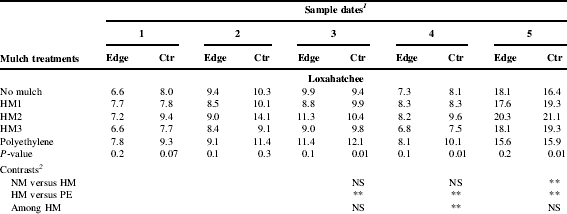
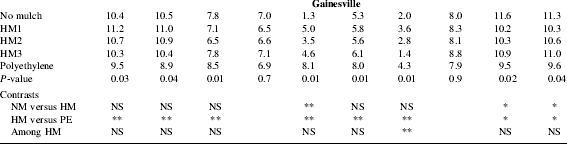
1 Sample dates 1, 2, 3, 4 and 5 correspond to 2 March, 15 March, 30 March, 13 April and 26 April in Loxahatchee; and 28 March, 12 April, 23 April, 7 May and 20 May in Gainesville.
2 NM, HM and PE are no mulch, hydramulch and polyethylene mulch, respectively. Contrasts are designated NS when nonsignificant.
* and ** indicate significance at 0.05 and 0.01 levels, respectively. Contrasts were not used when ANOVA indicated no significant difference among treatment means.
Drip irrigation was used to promote weed germination and growth and to assess the effects of soil moisture on hydramulch integrity under soil moisture conditions that could be expected if a crop were present. The use of irrigation masked possible differences in soil moisture content that can occur between nonmulched and mulched soils. However, previous work has demonstrated the effectiveness of natural mulches in conserving soil moisture. In an experiment in which no irrigation was used, by 4 weeks after treatment, shredded newspaper, chopped newspaper and synthetic mulches all had higher soil moisture than the nonmulched controlReference Monks, Monks, Basden, Selders, Poland and Rayburn27. With nonbonded or loose materials such as shredded newspaper, the depth of the mulching material can be criticalReference Monks, Monks, Basden, Selders, Poland and Rayburn27 and may explain why effects on soil moisture are not always consistentReference Ashworth and Harrison22,Reference Johnson, Hough-Goldstein and Vangessel28. Higher soil moisture content with natural mulches has been attributed to increased infiltration of rainfall, whereas polyethylene mulch can limit the contribution of rainfall and overhead irrigationReference Schonbeck and Evanylo13. The permeability of hydramulch to rainfall and overhead irrigation would allow faster watering of beds with less water than polyethylene mulches and would be useful where drip irrigation is unavailable.
Weed biomass
The comparative effect of the mulches on weed biomass was evaluated 11.5 and 12 weeks after mulch application at Loxahatchee and Gainesville, respectively. No difference in biomass was apparent among the hydramulch treatments at either location (Table 3). At Loxahatchee, weed biomass with hydramulch was less than with the nonmulched control but greater than with polyethylene. Fresh and dry weed biomass were more than two times greater in the nonmulched control than the hydramulch treatments, and 12-fold more fresh weed biomass and 16-fold more dry biomass occurred in the hydramulch treatments than with the polyethylene treatment. In Gainesville, fresh and dry biomass of nutsedge and grasses with hydramulch and polyethylene were statistically similar. Broadleaf weeds, which grew to over 1 m high in the nonmulched control beds, resulted in greater fresh biomass in the nonmulched control than those broadleaf weeds that grew through cracks in hydramulch beds. No broadleaf weeds and grasses occurred within the polyethylene mulch treatment.
Effect of mulch type on weed biomass 80 and 83 days after mulch application in Loxahatchee and Gainesville.
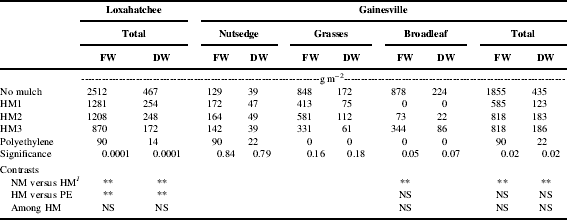
1 NM, HM and PE are no mulch, hydramulch and polyethylene mulch, respectively. Contrasts are designated NS when nonsignificant.
* and ** indicate significance at 0.05 and 0.01 levels, respectively. Contrasts were not used when ANOVA indicated no significant difference among treatment means.
Weed counts
Loxahatchee
Weed density was assessed 13, 26, 41, 56 and 69 days after mulch application. Nutsedge populations were low at this location and density was similar in all treatments (Table 4). In contrast, more grasses and broadleaf weeds were present with the nonmulched control than with hydramulch treatments throughout the field trial. Through day 41, differences in density of broadleaf weeds and grasses between hydramulch and polyethylene, and among hydramulch treatments were not significant. However, by day 56, broadleaf weeds emerged through cracks in the hydramulch, resulting in higher population densities compared to polyethylene. Nutsedge pressure was minimal, with no difference in nutsedge populations between polyethylene and hydramulch.
Effect of mulch types on weed population densities (plants m−2) of broadleaf weeds (B), grasses (G), and nutsedge (N) in Loxahatchee and Gainesville.
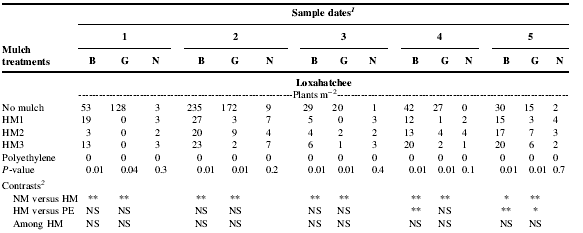
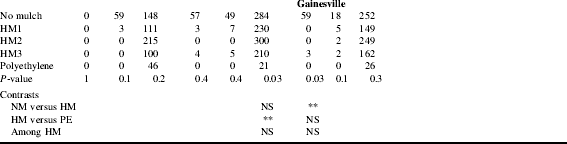
1 Sample dates 1, 2, 3, 4 and 5 at Loxahatchee correspond to weed counts performed 13, 26, 41, 56 and 69 days, and sample dates 1, 2 and 3 in Gainesville were done 8, 26 and 44 days, after mulch application.
2 NM, HM and PE are no mulch, hydramulch and polyethylene mulch, respectively. Contrasts are designated NS when nonsignificant.
* and ** indicate significance at 0.05 and 0.01 levels, respectively. Contrasts were not used when ANOVA indicated no significant difference among treatment means.
Gainesville
Weed densities were assessed on day 8, 26 and 44 after mulch application. Purple nutsedge was the predominant weed in all treatments (Table 4), with more nutsedge in the hydramulch treatments (up to 11 times more) compared with polyethylene by day 26. The density of nutsedge leveled off after the first month, which was likely due to the added mulch effect from a thick blanket of non-penetrating nutsedge leaves trapped beneath the hydramulch, and forcing the hydramulch upwards 4–8 cm in some places. By day 44, nutsedge that had penetrated the hydramulch was 6–9 cm in height and dense enough to shield approximately 50% of the hydramulch from sunlight. Broadleaf weeds in the nonmulched control increased over time so that by day 44, broadleaf weed density in the nonmulched control was significantly higher than in the hydramulch treatments.
These results show that broadleaf and grass weed densities with the hydramulch treatments were generally lower than the bare ground control and the suppression of broadleaf and grass weeds by hydramulch and polyethylene mulch was similar. However, hydramulch was readily penetrated by purple nutsedge, especially at the Gainesville site where high nutsedge populations existed. Nutsedge is less able to penetrate polyethylene mulches that transmit light than opaque polyethylene filmsReference Chase, Sinclair, Shilling, Gilreath and Locascio11,Reference Patterson12. Dense populations of nutsedge were observed growing under the hydramulch and lifting it several centimeters off the bed surface. Leaf expansion and growth under the hydramulch appeared to occur after widespread nutsedge penetration and growth had lifted the hydramulch. This is consistent with the study by Chase et al.Reference Chase, Sinclair, Shilling, Gilreath and Locascio11, who found that nutsedge penetrated polyethylene mulch more readily where the mulch was applied tightly against the soil, but considerably less penetration occurred with a small space between the soil and the mulch. No single hydramulch treatment proved more effective in suppressing nutsedge (and other weeds) than the other hydramulch treatments at either research site; therefore increased amounts of gypsum and newsprint did not produce a mulch product with improved suppression capacity.
In contrast to the findings of Liburd et al.Reference Liburd, Casagrande and Alm17, who reported that the moist, softened ‘hydromulch’ was easily penetrated by weeds, increased moisture in the hydramulch did not appear to lead to greater weed penetration. The drip emitters regularly moistened the hydramulch up to a 10 cm radius with no observable increase in weed penetration near the emitters—an important finding when considering using hydramulch in wet weather conditions or with overhead sprinklers. The results with foam mulchReference Masiunas, Wahle, Barmore and Morgan16 suggest that a thicker material that maintains its integrity throughout the season is highly effective at suppressing broadleaf weeds.
In conclusion, a paper-like mulch that is applied as a slurry precludes the need for embedding of edges in the soil, which leads to the disintegration of standard kraft paper mulch. Hydramulch is fully biodegradable and so does not have the adverse environmental impacts of polyethylene film. All three formulations of hydramulch tested performed in a similar manner to suppress broadleaf and grass weeds to lower levels than a bare ground control and generally equivalent to polyethylene mulch. Since soil temperatures were 1–4°C cooler than under polyethylene, hydramulch may be more applicable for fall crops. Hydramulch should be used at a minimum thickness of 4 mm to ensure season-long durability and high nutsedge infestations should be avoided or controlled by alternative means. Future research with hydramulch should focus on mulch thickness, adhesion to soil, addition of color to promote warming, and improved method of application.
Acknowledgements
We thank Timothy Cathey of Novovita, Inc., for providing and applying the hydramulch. This research was supported by the Florida Agricultural Experiment Station, and approved for publication as Journal Series No. R-10885.


