Introduction
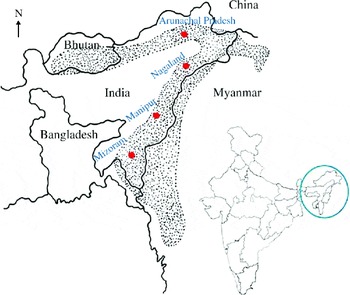
The rare bovine species known as the mithun Bos frontalis is part of a rich biodiversity in the forests of north-east India and in parts of Bhutan, Myanmar, China and Bangladesh (fig. 1). The mithun is generally found at an altitude of 1000–3000 m above mean sea level and is well adapted to this environment (Chaurasia et al., Reference Chaurasia, Mech, Dhali, Vidyarthi, Rajkhowa and Sharma2010). It plays an important role in the socio-economic and cultural life of the tribal population of this region, being used primarily as a beef animal. The mithun is raised under free-range conditions in its natural habitat and, as a result, no systematic methodology is adopted for the field diagnosis of the sub-clinical parasitic infections in the animal. Furthermore, the aetiological agents of the parasitic diseases have not been adequately recorded. No systematic studies on the epidemiology, genetic characterization and diagnosis of the helminths affecting the mithun have been conducted. Sporadic studies done on the prevalence of different parasites could not lead to the formulation of strategic control measures on parasitic diseases of this rare species. Also, identification of the helminths has been based on conventional methods of morphometry, and characterization based on molecular tools like ribosomal DNA, internal transcribed spacers and mitochondrial genes, providing reliable genetic markers for differentiation of the parasite species/strains, has not been done. The present study focuses on the occurrence and identification of amphistomes, liver flukes and cystic echinococcosis prevalent in the mithun, using 28S ribosomal DNA, internal transcribed spacer 2 (ITS-2) and mitochondrial nad1 as molecular markers.
The distribution of the mithun Bos frontalis (shaded area) in the north-east region of India.

Materials and methods
Collection and examination of helminths
Post-mortem examinations were conducted on 90 mithun slaughtered at various tribal rituals and ceremonies in Arunachal Pradesh and Nagaland, where infections with the trematodes Fasciola gigantica, Paramphistomum epiclitum, Calicophoron calicophorum and Explanatum explanatum and cestodes Echinococcus granulosus and E. ortleppi were recorded. The majority of these helminths were fixed in 70% ethanol, washed in distilled water, stained with borax-carmine (SD Fine Chemicals, Mumbai, India), dehydrated in an ethanol series and mounted in DPX (SD Fine Chemicals). In addition, identification to species level was compared by sequencing with molecular markers.
Molecular and phylogenetic analyses
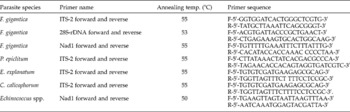
ITS-2, 28S rDNA and mitochondrial nad1 sequences were used as markers for the species identification of Fasciola flukes and for studying the polymorphisms in these sequences. Up to 22 F. gigantica were recovered from the mithun from Itanagar and Doimukh areas of Arunachal Pradesh and were used in the characterization of the parasite. The flukes were washed with normal saline, preserved in 70% ethanol and stored at − 20°C until DNA extraction. Genomic DNA was extracted from the individual worms using a commercial DNA extraction kit (QIAGEN GmbH, Germany) and polymerase chain reaction (PCR) amplification of the ITS-2 region was carried out. Primers were designed on 5.8S and 28S rDNA sequences flanking the ITS-2 region to amplify a fragment of 550 bp (Marcilla et al., Reference Marcilla, Bargues and Mas-Coma2002) (table 1).
Primers used for PCR amplification of marker sequences of F. gigantica, hydatid and three amphistomes of mithun.

Likewise, the partial sequences of 28S rDNA corresponding to the 16–633 bp (618 bp) region and 343 bp of the nad1 gene were PCR amplified using forward and reverse primers (accession nos AJ440785 and LC012910; table 1). The PCR products were sequenced and Basic Local Alignment Search Tool (BLAST), NCBI (National Center for Biotechnology Information, USA) was used to confirm the identity of the sequences. The phylogenetic relationship of the nad1 sequence of the F. gigantica flukes was carried out by neighbour-joining tree in MEGA 6.0 (http://www.megasoftware.net), with GenBank accession numbers given for each F. gigantica haplotype, where available. Bootstrap analysis of 1000 replicates was applied and values given at relevant nodes of the constructed tree.
Genomic DNA of 14 P. epiclitum, 14 C. calicophorum and 17 E. explanatum adult flukes was extracted using a commercial DNA isolation kit (Qiagen). The ITS-2 sequences of P. epiclitum (290 bp), C. calicophorum (480 bp) and E. explanatum (442 bp) were PCR amplified with species-specific primers (table 1). These PCR products were sequenced and analysed using BLAST.
Thirty-seven hydatid cysts were recovered over a period of 1 year from the slaughtered mithun in Arunachal Pradesh. The DNA was extracted from the germinal membrane of ten hydatid cysts using a commercial DNA isolation kit (QIAGEN) and a partial sequence of 377 bp of the nad1 gene was PCR amplified from these cysts. The PCR amplicons were purified, sequenced and analysed using BLAST. The phylogenetic analysis was done to compare these sequences with known strains/species of Echinococcus circulating globally. The phylogenetic tree was constructed using a neighbour-joining tree in MEGA 6.0, with GenBank accession numbers and the genotype given for each Echinococcus isolate when available. Bootstrap analysis of 1000 replicates was applied and values given at relevant nodes of the constructed tree.
Results and discussion
Of 90 mithun examined, the prevalences of infection ranged from 16.6% for cystic echinococcosis, with all cysts sterile; to 7.8% for F. gigantica; 8.8% for P. epiclitum; 4.4% for E. explanatum and 2.2% for C. calicophorum. Intensities of infection with F. gigantica ranged from 10 to 300 flukes, where some of the livers showed signs of traumatic hepatitis and fibrosis. Intensities of infection with amphistomes ranged from 34 to 107 flukes per animal.
Twenty-two Fasciola flukes (mithun isolate) were PCR amplified for the ITS-2 region and the sequence results confirmed the species as F. gigantica. The sequence differed from F. hepatica ITS-2 at six nucleotide positions: 207, 231, 270, 276, 327 and 334, with one distinguishing deletion of a T nucleotide occurring at position 327. The substitution of T → C at positions 207 and 231, C → T at 270 and 276, and G → A at position 334 clearly differentiated the species as F. gigantica. None of the specimens sequenced for ITS-2 matched with F. hepatica. However, some of the ITS-2 sequences from these flukes showed several nucleotide variations differing from the typical six nucleotide substitutions used for distinguishing between F. gigantica and F. hepatica. A partial sequence of 618 bp of 28S rDNA was also generated from these adult flukes, which showed a 100% match with 28S rDNA of F. gigantica. Each sequence revealed a consistent single nucleotide polymorphism (SNP) at position 284, with a transition of G → A in all the specimens sequenced.
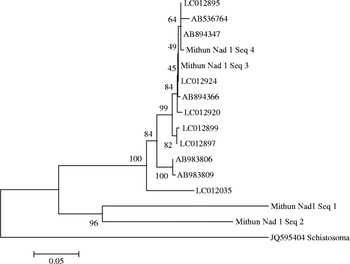
A partial sequence of 343 bp of the nad1 gene of 12 F. gigantica flukes was generated. Of these 12 flukes sequenced, 10 showed a nucleotide sequence identical to the haplotypes ND1-E1 and ND1-E3 previously reported from Fasciola flukes in north-east India (Hayashi et al., Reference Hayashi, Ichikawa-Seki, Mohanta, Singh, Hiromu and Itagaki2015) and neighbouring countries (Peng et al., Reference Peng, Ichinomiya, Ohtori, Ichikawa, Shibahara and Itagaki2009; Ichikawa et al., Reference Ichikawa, Iwata and Itagaki2010, Reference Ichikawa, Bawn, Maw, Htun, Thein, Gyi, Sunn, Katakura and Itagaki2011; Mohanta et al., Reference Mohanta, Ichikawa-Seki, Shoriki, Katakura and Itagaki2014). However, the nad1 nucleotide sequence of the remaining two flukes showed many substitutions differing from the others. The relationship of these flukes is depicted in the phylogenetic tree, where the two flukes are placed distantly from other published haplotypes of the parasite (fig. 2). The frequency of other Fasciola nad1 haplotypes from the mithun could not be determined due to the small number of specimens being sequenced.
The phylogenetic tree of the partial DNA sequences of nad1 from F. gigantica in mithun and F. gigantica nad1 sequences submitted to GenBank. The neighbour-joining tree was constructed using a p-distance model with bootstrap analysis of 1000 replicates.

ITS-2 regions of three trematode species, E. explanatum (442 bp), P. epiclitum (290 bp) and C. calicophorum (480 bp), were amplified by PCR (fig. 3). The sequence analysis of ITS-2 regions of 17 E. explanatum and 14 P. epiclitum, respectively, showed no nucleotide changes in the sequences compared to the isolates reported from domestic ruminants in north-east India (accession numbers JX678258, JX678260 and JX678261). Likewise, sequence analysis of the ITS-2 region of 14 C. calicophorum showed 100% identity with isolates from domestic ruminants from north-east India (accession no. GU133057). These data indicated that ITS-2 is a suitable marker for identification of the above amphistome species and also confirm that amphistomes isolated from the host mithun were identical to the isolates of these parasites infecting cattle and buffaloes.
PCR amplification of ITS-2 regions of the trematode species (a) Explanatum explanatum (442 bp); (b) Paramphistomum epiclitum (290 bp); and (c) Calicophoron calicophorum (480 bp). Lanes: M, 100-bp DNA marker; 2–4, ITS-2 sequences of each species; 1, negative controls.

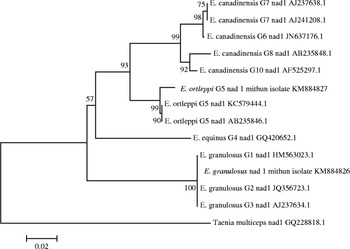
All the 37 hydatid cysts recovered from the mithun were sterile and DNA isolated from the germinal membrane of ten cysts was PCR amplified for the nad1 gene fragment. BLAST alignment of the 377-bp partial sequence of the nad1 gene showed 100% identity with E. granulosus in 8 out of 10 Echinococcus isolates. The other two isolates showed 99% identity with E. ortleppi. The phylogenetic relationship of these ten Echinococcus isolates showed that eight (80%) Echinococcus isolates from the mithun clustered with E. granulosus (genotypes G1–3) with strong bootstrap (1000) replicates. However, the other two isolates (20%) clustered with E. ortleppi (genotype 5) (fig. 4). Nad1 gene sequences of E. granulosus and E. ortleppi (mithun isolates) were submitted to GenBank with accession numbers KM884826 and KM884827.
The phylogenetic tree of the partial DNA sequences of nad1 from Echinococcus species in mithun and nad1 sequences of Echinococcus species submitted to GenBank. The neighbour-joining tree was constructed using a p-distance model with bootstrap analysis of 1000 replicates.

Parasitic gastroenteritis is one of the major causes of pathogenic conditions in the mithun directly or indirectly associated with their morbidity and mortality. Helminths are the causative agents of immature amphistomosis, calfhood mortality and production losses in these animals (Chakraborty et al., Reference Chakraborty2001; Rajkhowa et al., Reference Rajkhowa, Bujarbaruah, Rajkhowa and Thong2003). Fasciolosis caused by F. gigantica has been reported previously in the mithun (Chamuah, Reference Chamuah2005) but studies on the molecular characterization of the fluke were not carried out earlier. The ITS-2, 28S rDNA and nad1 sequences have been shown as the specific markers for differentiating F. gigantica from F. hepatica (Marcilla et al., Reference Marcilla, Bargues and Mas-Coma2002; Huang et al., Reference Huang, He, Wang and Zhu2004; Itagaki et al., Reference Itagaki, Kikawa, Terasaki, Shibahara and Fukuda2005; Ichikawa et al., Reference Ichikawa, Bawn, Maw, Htun, Thein, Gyi, Sunn, Katakura and Itagaki2011; Raina et al., Reference Raina, Jacob, Sankar, Bhattacharya, Bandyopadyay, Varghese, Chamuah and Lalrinkima2015). Using these markers in the present study, the liver fluke prevalent in the mithun was confirmed as F. gigantica. The partial sequence of nad1 of ten F. gigantica flukes was identical to the haplotypes ND1-E1 and ND1-E3 previously reported from Fasciola flukes in north-east India (Hayashi et al., Reference Hayashi, Ichikawa-Seki, Mohanta, Singh, Hiromu and Itagaki2015). However, the other two flukes differed from known haplotypes. The frequency of other haplotypes prevalent in the mithun could not be determined in the present study due to the small number of specimens sequenced. Identification of the Fasciola species prevalent in different hosts in this country, using molecular tools, has gained relevance because of the prevalence of F. hepatica reported in sheep in the north-western Himalayan region (Sharma et al., Reference Sharma, Dhar and Raina1989) and F. gigantica in cattle and buffaloes in the north-eastern region of the country (Prasad et al., Reference Prasad, Tandon, Biswal, Goswami and Chatterjee2009, Reference Prasad, Goswami, Tandon and Chatterjee2011; Hayashi et al., Reference Hayashi, Ichikawa-Seki, Mohanta, Singh, Hiromu and Itagaki2015). The geographical co-existence, and even the presence of hybrid forms that have both nuclear and mitochondrial sequences of these two species, have been described in several countries (Huang et al., Reference Huang, He, Wang and Zhu2004; Itagaki et al., Reference Itagaki, Kikawa, Terasaki, Shibahara and Fukuda2005; Peng et al., Reference Peng, Ichinomiya, Ohtori, Ichikawa, Shibahara and Itagaki2009) but not in India. Therefore, molecular characterization of the Fasciola species prevalent in the different hosts in this country is required.
Hydatidosis has been reported previously in the mithun, affecting a large animal population (Chamuah, Reference Chamuah2005). In the present study about 16.6% of mithun were found to be infected. The nad1 sequence of ten isolates confirmed that both E. ortleppi and E. granulosus are prevalent in the mithun but that E. granulosus is the predominant species. The same results have been reported previously, with E. granulosus being the predominant species infecting domestic ruminants in the plains of India (Bhattacharya et al., Reference Bhattacharya, Bera, Bera, Maity and Das2007; Pednekar et al., Reference Pednekar, Gatne, Thompson and Traub2009; Sharma et al., Reference Sharma, Fomda, Mazta, Sehgal, Singh and Malla2013). Nevertheless, the present study also indicated that E. ortleppi should be considered equally as an infectious form of Echinococcus in the mithun. This result provides evidence for the circulation of E. ortleppi in this host for the first time. Therefore, E. ortleppi should be considered during epidemiological surveys for this important parasitic infection in domestic ruminants and mithun. As more sequencing data become available, our understanding of the epidemiology and transmission pattern of Echinococcus strains/species between the mithun, domestic ruminants, humans and canids in this region will be enhanced. There is the possibility of maintaining a sylvatic cycle, with wild carnivores such as the fox, jackal and wolf acting as reservoirs of infection in this region.
Acknowledgements
The authors are thankful to the Directors of the Indian Veterinary Research Institute, Izatnagar and the National Research Centre on Mithun, Nagaland for providing facilities for completion of this study.
Financial support
The authors are also thankful to the Department of Biotechnology, Government of India, New Delhi, for providing research funds under the DBT-Twinning Programme for the north-east.
Conflict of interest
None.