INTRODUCTION
Due to increasingly intense and unpredictable changes in the industrial environment and competition in the workplace, stirring and enhancing the individual creativity is valuable for companies because individual creativity significantly contributes to competitive advantage of firms (Amabile, Reference Amabile1998; Shalley, Zhou, & Oldham, Reference Shalley, Zhou and Oldham2004). In terms of role expectations and organizational goals, goal setting is considered as a significant way to instigate creative activity, which could influence motivation of employees via self-regulatory mechanism (Kanfer & Ackerman, Reference Kanfer and Ackerman1989). Research shows that goal orientation can effectively influence the motivation of team members (Locke & Latham, Reference Locke and Latham1990). Shalley (Reference Shalley1991, Reference Shalley1995) found in a series of research that creativity could be significantly improved by goal setting. Taing, Smith, Singla, Johnson, and Chang (Reference Taing, Smith, Singla, Johnson and Chang2013) report that goal setting is associated with goal orientation. In addition, they also mention that goal setting mediates the relationship between learning goal orientation and individual’s performance outcome. According to self-regulation theory, individual goal orientation has a strong influence on individual creativity because it inspires people to seek or avoid the opportunity to become creative (De Stobbeleir, Ashford, & Buyens, Reference DeShon, Kozlowski, Schmidt, Milner and Wiechmann2011).
Based on the assumption that creativity is a multilevel phenomenon, recent studies indicate that the cross-level relationship between the idiosyncrasy of team and individual creativity could stimulate, and furtherly affect individual creativity through various team characteristics or attributes (Shin, Kim, Lee, & Bian, Reference Shin, Kim, Lee and Bian2012; Gong, Kim, Lee, & Zhu, Reference Gong, Kim, Lee and Zhu2013). Thus, it is important to understand the cross-level effects of team-level goal orientation on employees’ creativity. In addition, group contexts could also affect individual creativity. For instance, Shalley and Gilson (Reference Shalley and Gilson2004) indicate that work context like team goal orientation may limit or enhance the relationship between individual goal orientation and creativity. The moderating effect of an independent variable should be taken into consideration when its effects on dependent variable are sometimes strong or weak in other circumstances, sometimes positive or negative in other circumstances. Therefore, aiming at exploring contextual influence of team goal orientation, our study will examine the moderating effects of team goal orientation on the relationship between individual goal orientation and individual creativity.
Appling motivated information processing theory (De Dreu & Carnevale, Reference De Dreu and Carnevale2003), we are also interested to find mediating effects of team information exchange and individual information elaboration on the relationship between goal orientation and individual creativity. The motivated information processing theory suggests that: (a) the level, direction, and methods of information processing are dependent on motivation; (b) self-motivation of team members could affect their information searching, encoding, storing, extracting, and sharing abilities; (c) employees’ expectation shapes the way they deal with information and increases intrinsic motivation of employees to develop innovative and useful ideas which will induce creativity. In addition, Hinsz et al. (1997) found isomorphism in the information processing on the team and individual-level. Like the individuals, team members also need to search, encode, store, and extract information when they perform cognitive tasks. Former theories of creativity emphasize that the individual and contextual factors (e.g., ability, personality, inner motive, job characteristic) influence individual or group creativity (Woodman, Sawyer, & Griffin, Reference Woodman, Sawyer and Griffin1993; Amabile, Reference Amabile1998). In addition, motivated information processing theory holds that both epistemic motive and social motive influence individual or group creativity (De Dreu, Nijstad, Bechtoldt, & Baas, Reference De Dreu, Nijstad, Bechtoldt and Baas2011).
We view individual and team goal orientation as epistemic motivation factors. Motivation to learn increases learning desire of employees stimulating them to elaborate work information, such kind of activity can enhance individual creativity (Grant & Berry, Reference Grant and Berry2011). Therefore, this study proposes that both team information exchange and individual information elaboration are key activities linking team goal orientation, individual goal orientation, and individual creativity. Johnson, Hollenbeck, Humphrey, Ilgen, Jundt, and Meyer (Reference Johnson, Hollenbeck, Humphrey, Ilgen, Jundt and Meyer2006) consider information exchange and sharing happening on team level as a kind of knowledge (Johnson et al., Reference Johnson, Hollenbeck, Humphrey, Ilgen, Jundt and Meyer2006). Van Knippenberg, De Dreu, and Homan (Reference VandeWalle2004) define information elaboration as individual-level information processing in which employees search for information and perspectives from coworkers, process this information and consider its implications. To the best of our knowledge, only few scholars have hitherto focused on the relationship between information elaboration and innovation/creativity (Homan, Van Knippenberg, Van Kleef, & De Dreu, Reference Homan, Van Knippenberg, Van Kleef and De Dreu2007; Resick, Murase, Randall, & DeChurch, Reference Resick, Murase, Randall and DeChurch2014). Our study combines information elaboration with individual creativity and introduces a new way toward exploring individual creativity. Therefore, focusing on the mediating role of individual information elaboration is one distinct feature of our research. In a multilevel research, Gong et al. (Reference Gong, Kim, Lee and Zhu2013) explored the relationship among team goal orientation, team information exchange, and individual creativity. However, they did not explore individual-level goal orientation. Because individual behavior is influenced by factors from both team and individual level, we believe that inclusion of individual-level factors in our study will significantly contribute to the literature. Besides, Gong et al. collected sample from South Korea which is a developed country, we collected sample from mainland China which is a developing country. We believe that different industrial structure, and cultural background of our country might affect the results of the research. In addition, relationships between (a) goal orientation on the team level and team information exchange, (b) goal orientation on the individual level and individual information elaboration are not obvious at first glance. This study also enriches literature on the above relationships because to the best of our knowledge there is no comprehensive research conducted yet to explore these two couples of variables.
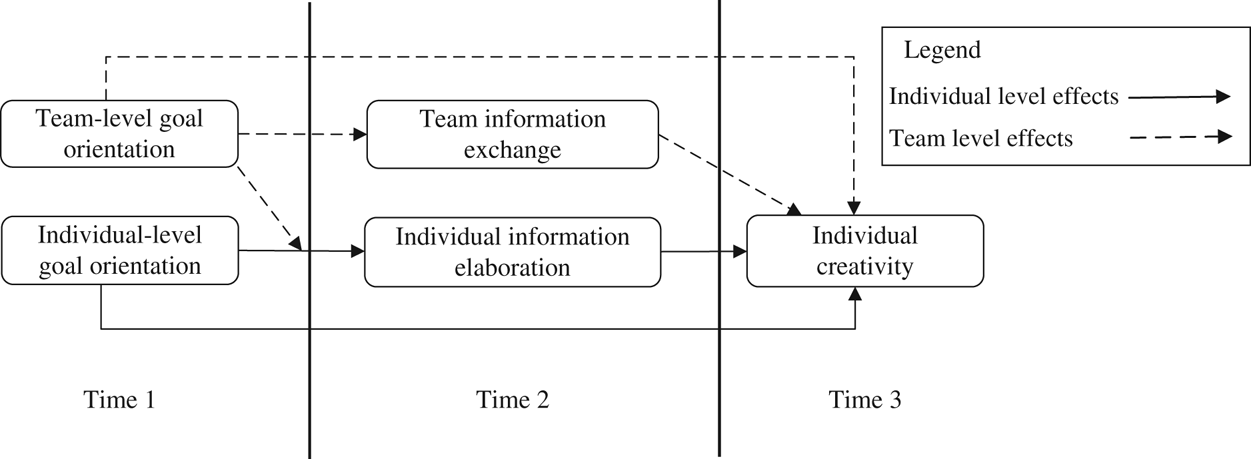
By integrating the goal orientation theory and motivated information processing theory, this study develops the following conceptual model and anticipates that (a) team goal orientation could improve individual creativity by promoting team information exchange; (b) individual goal orientation could affect individual creativity via information elaboration; (c) team goal orientation might enhance or weaken the relationship between individual goal orientation and individual information elaboration, furtherly affect individual creativity (Figure 1).
Research framework

THEORETICAL UNDERPINNINGS AND HYPOTHESES
Goal orientation
Goal orientation refers to the goals pursued by individuals or situational goal preferences during their task engagement (Dweck & Leggett, Reference Dweck and Leggett1988; Payne, Youngcourt, & Beaubien, Reference Payne, Youngcourt and Beaubien2007). It can be viewed as the response tendencies toward success of the individual (Spinath & Stiensmeier-Pelster, Reference Spinath and Stiensmeier-Pelster2003). Relevant literature suggests that the value of goal orientation lies in regulating employees’ attention and efforts to develop innovative solutions to problems faced at work (VandeWalle, Reference Van Knippenberg, De Dreu and Homan1997). Thus, goal orientation is a motivational orientation that encourages individuals to address challenging problems in the work-related processes based on intrinsic task motivation or extrinsic factors such as receiving rewards or avoiding criticism.
The significance of goal orientation at individual level draws scholars to test it on the team level. Team goal orientation is a kind of shared perceptions team members perceive to achieve team goals (Bunderson & Sutcliffe, Reference Bunderson and Sutcliffe2003). Similarly, team goal orientation is triggered by shared perception from team members striving to achieve common goals (DeShon, Kozlowski, Schmidt, Milner, & Wiechmann, Reference De Stobbeleir, Ashford and Buyens2004). Therefore, shared perception is the base of the concept of team goal orientation. When team members find information that is important and useful to guide and coordinate their behaviors from environmental clues, such as team leader achievement model, managerial strategy and method choice, their interaction would develop a psychological climate. Psychological climate refers to achievement focused team goal orientation based on shared perceptions of team members (Mehta, Feild, Armenakis, & Mehta, Reference Mehta, Feild, Armenakis and Mehta2009).
Although originally conceived as two-dimensional construct (learning and performance goal orientation), research indicates that goal orientation has three distinct dimensions, that is, learning, performance-approach, and performance-avoidance (Elliott & Harackiewicz, Reference Elliot and Church1996; VandeWalle, Reference Van Knippenberg, De Dreu and Homan1997). Individuals with high learning goal orientation emphasize developing their skills, knowledge, and competence. On the contrary, individuals with high performance-approach goal orientation focus on tasks with a desire to prove their ability to others. They exhibit high level of aspiration and cognition as well as affective task immersion (Wegner, Reference Wegner1994; Elliott & Harackiewicz, Reference Elliot and Church1996), resulting in adaptive and beneficial response patterns. However, people with high performance-avoidance goal orientation are also task-focused but are primarily concerned with avoiding failures. This distracts them from task engagement, resulting in a passive, risk-aversive approach to task completion and maladaptive response patterns (Elliot & Church, Reference Elliott and Harackiewicz1997).
Few studies focus on the issues of goal orientation at individual level and how it influences individual creativity (Lu, Lin, & Leung, Reference Lu, Lin and Leung2012), but studies explored the cross-level relationship between the team goal orientation and individual creativity are rare. Recent studies indicate that team goal orientation (classified as an organization level characteristic) has a motivational impact on members within the teams (Mehta et al., Reference Mehta, Feild, Armenakis and Mehta2009).
Individual creativity
Creativity is commonly considered as a dependent variable in many empirical studies which typically focuses on the creation of new and useful ideas concerning products, services, processes, and procedures (Shalley, Reference Shalley1991; Amabile, Reference Amabile1998; Ford, Reference Ford1996; Oldham & Cummings, Reference Oldham and Cummings1996; Zhou, Reference Zhou1998). Individual creativity is mainly affected at individual, job, team, and organization level (Shalley, Gilson, & Blum, Reference Shalley, Gilson and Blum2000). On the individual level, the depth and breadth of knowledge has been linked to creativity. In contrast to personality traits and creativity-related skills, domain-specific knowledge reflects an individual’s level of education, training, experience, and knowledge within a specific context (Gardner, Reference Gardner1993). It is well known that information is an important source of knowledge. On the job level, goals influence and motivate individuals via self-regulatory mechanisms (Kanfer & Ackerman, Reference Kanfer and Ackerman1989) and goal setting is an extremely effective technique to regulate motivation (Locke & Latham, Reference Locke and Latham1990). Therefore, assigning creativity-related goals could effectively enhance creative performance of employees (Shalley, Reference Shalley1991, Reference Shalley1995). Similarly, individuals who are assigned with a creative task would perform more creatively than those assigned with a regular task (Carson & Carson, Reference Carson and Carson1993). On the team or work group level, creativity can, but does not always, occur in isolation. Creativity is one outcome of an interactive process between coworkers and team members (Mumford & Gustafson, Reference Mumford and Gustafson1988; Agrell & Gustafson, Reference Agrell and Gustafson1994). Additionally, communication of ideas and information along with contact with diverse workforce could lead to higher levels of creativity (Woodman, Sawyer, & Griffin, Reference Woodman, Sawyer and Griffin1993; Amabile, Reference Amabile1998). On the organizational level, values, beliefs, history, and traditions of the organizations could affect employees’ propensity to become creative (Isaksen, Lauer, Ekvall, & Britz, Reference Isaksen, Lauer, Ekvall and Britz2001). If team leaders emphasize on creativity and encourage their team members to be creative, a key contextual problem they need to resolve is to foster a kind of atmosphere where risk taking is encouraged and uncertainty is not avoided. For this, fostering a culture, where employees feel psychologically safe by providing blame-free and punishment-free environment or consequences of breaking the status quo, is a prime responsibility of an employer (Edmondson, Reference Edmondson1996).
Information elaboration theory
Elaboration theory, advanced by Charles Reigeluth, targets the cognitive domain and focuses on sequencing and organizing information to maximize learning. This learning design theory proposes a process to increase memorization abilities, to retain and transfer information in an easy way which leads to increased motivation. Information elaboration, introduced into organizational domain, is a key process through which team members could manipulate and utilize the diverse corporate information resources based on the exchange, conversation and integration of views, and knowledge or mindsets relevant to tasks. Previous studies revealed that information elaboration by highly creative members could improve the organizational performance in the complex and dynamic tasks environment (Stasser & Titus, Reference Stasser and Titus1985; Homan et al., Reference Homan, Van Knippenberg, Van Kleef and De Dreu2007; Homan, Hollenbeck, Humphrey, Van Knippenberg, Ilgen & Van Kleef, Reference Homan, Hollenbeck, Humphrey, Van Knippenberg, Ilgen and Van Kleef2008). Information elaboration positively relates to creativity, but researchers focused on it as a team process and how this process influences team-level creativity (Hoever, Van Knippenberg, Van Ginkel, & Barkema, Reference Hoever, Van Knippenberg, Van Ginkel and Barkema2012). Given that creative ideas are generated by individuals and team creativity stems from individual creativity (West & Anderson, Reference West and Anderson1996), the effect of information elaboration on individual-level creativity should draw more attention. Theory of creative cognition indicates that creativity occurs when individuals gather and use job-related information to produce creative outcomes (Amabile, Reference Amabile1988). Thus, we expect that task-related information elaboration from coworkers would enhance individual creativity at work because it provides employees with cognitive resources.
Team information exchange
In order to explain how team goal orientation affects individual creativity, this paper adopts information exchange theory. Information exchange involves sharing of data, task-related thinking, and work-related knowledge among team members (Johnson et al., Reference Johnson, Hollenbeck, Humphrey, Ilgen, Jundt and Meyer2006). It is also a key team process which links the properties of teams to their performance outcomes. Linking team property like creativity with information exchange will influence the performance of teams (Williams & O’Reilly, Reference Williams and O’Reilly1998; Van Knippenberg, De Dreu, & Homan, Reference VandeWalle2004; Mesmer-Magnus & DeChurch, Reference Mesmer-Magnus and DeChurch2009). Information exchange is significantly related to knowledge exchange and their integration can promote creativity (Smith, Collins, & Clark, Reference Smith, Collins and Clark2005). Creativity needs input from different sources especially from research and design teams. Their jobs are to resolve difficult problems and develop new products and services which need consistent and high information exchange. Therefore, exchange and sharing of explicit and implicit knowledge by team members is necessary to improve creative outputs of teams (Hülsheger, Anderson, & Salgado, Reference Hülsheger, Anderson and Salgado2009). Hence, this paper predicts that team goal orientation will promote or inhibit information exchange because the goal of sharing information will affect collective creative behavior of team members (Chen & Kanfer, Reference Chen and Kanfer2006).
Team goal orientation and individual creativity
Goal orientation refers to the determination and goal preference of employees in achievement context (Payne, Youngcourt, & Beaubien, Reference Payne, Youngcourt and Beaubien2007). Relevant literature reflects that the value of goal orientation lays on moderating relationship between work focus, diligence of employees and their creative problem-solving skills (VandeWalle, Reference Van Knippenberg, De Dreu and Homan1997), which significantly demonstrates the relationship between goal orientation and creativity (Janssen & Van Yperen, Reference Janssen and Van Yperen2004). Therefore, goal orientation can be viewed as an incentive orientation. It does not matter that goal orientation is based on intrinsic task motivation or extrinsic factors, such as receiving rewards or avoiding critics. Goal orientation can motivate staff to actively solve challenging problems regarding their tasks.
We define team goal orientation as a kind of common pursuit toward specific goals achievement on the team level. According to team climate perspective, team-level goal orientation can also be viewed as a kind of team-level atmosphere aiming to pursue specific achievements (Dragoni & Kuenzi, Reference Dragoni and Kuenzi2012). Goal orientation at team level poses galvanizing and motivational effects on staff working atmosphere, induces staff to focus on specific goal-oriented behavior which ultimately influences individual creativity. Goal orientation is a three-dimensional construct, that is, learning goal, performance-approach goal, and performance-avoidance goal (Hirst, Van Knippenberg, Chen, & Sacramento, Reference Hirst, Van Knippenberg, Chen and Sacramento2011). This classification is widely adopted by researchers explored goal orientation at team level (Mehta et al., Reference Mehta, Feild, Armenakis and Mehta2009; Dragoni & Kuenzi, Reference Dragoni and Kuenzi2012; Gong et al., Reference Gong, Kim, Lee and Zhu2013).
Team-level learning goal orientation implies that individual staff would actively develop their ability and focus on work by learning new things to achieve team outcomes. In order to become learning goal-oriented, team members should focus on acquiring new knowledge and technology, seek diverse information and feedback, and have a good knowledge of diversified new contexts. The performance-approach goal at team level is reflected when (a) employees show high performance-approach orientation, (b) the atmosphere they feel is competitive and focus on objective of transcending others, and they are likely to be viewed as active competitors of others to receive favorable evaluations and rewards. On the contrary, few team members may have high performance-avoidance orientation. They will be more sensitive to the decision of avoiding which is an adverse ability as compared to performance-approach oriented individuals. Such members commonly keep their focus on image management to cope with blames and avoid errors (Edmondson, Reference Edmondson1996; Hofmann & Stetzer, Reference Hofmann and Stetzer1998).
Individual creativity holds that employees produce novel, useful, and creative ideas in their work in terms of products, procedures, and processes (Woodman, Sawyer, & Griffin, Reference Woodman, Sawyer and Griffin1993; Amabile, Reference Amabile1998). Creativity in the work commonly emerges when employees face problems and challenges, which is why this leads to a continuous and purposeful employee behavior (Shalley, Reference Shalley1991). Therefore, the goal orientation differences between team members are discrepancies on incentives, whether team members accept challenges, which influences staff creative outcomes (Hirst, Van Knippenberg, & Zhou, Reference Hirst, Van Knippenberg and Zhou2009). However, individual creativity normally emerges in the team context (Taggar, Reference Taggar2002), and some special contexts might affect individual behavior up to certain extents (Taggar, Reference Taggar2002). Combing the above arguments with goal orientation theory, this study reasonably believes that goal orientation has similar effects on employees’ devotion to adjust behavior (such as learning) and promotes individual creativity. Therefore, we propose the following hypotheses:
Hypothesis 1a: Team-level learning goal orientation positively influences individual creativity.
Hypothesis 1b: Team-level performance-approach goal orientation positively influences individual creativity.
Hypothesis 1c: Team-level performance-avoidance goal orientation negatively influences individual creativity.
Mediating role of team information exchange
Knowledge is the backbone of creativity (Amabile, Reference Amabile1988). Review of literature indicates that information exchange among team members is an important way to create and acquire knowledge (Bunderson & Sutcliffe, Reference Bunderson and Sutcliffe2003; Johnson et al., Reference Johnson, Hollenbeck, Humphrey, Ilgen, Jundt and Meyer2006). Generally, people superficially rely on information processing with familiar associations. However, when encountering argument-based evaluations, they focus on systematic and effortful information elaboration. According to motivated information processing theory (De Dreu, Weingart, & Kwon, Reference De Dreu, Weingart and Kwon2000; De Dreu, Reference De Dreu2007), whether group members focus on systematic information processes accompanied with in-depth information processes depends on the epistemic motivation of group members, which stems from individual differences such as cognitive needs (Kruglanski & Webster, Reference Kruglanski and Webster1996) or contextual clues (Bechtoldt, De Dreu, Nijstad, & Choi, Reference Bechtoldt, De Dreu, Nijstad and Choi2010). Therefore, we predict that goal orientation at team level is a motive clue, and this kind of anticipation could promote employees to commit systematic information processing such as information exchange activities.
Team managers could encourage employees to comprehensively understand team-based tasks by focusing on learning goal orientation. In that case, they become eager to exchange and share work-related information. This helps them to distinguish novel and useful ways to solve problems and complete tasks. Performance-approach orientation at team level, aiming at receiving favorable evaluation and rewards, leads corporate employees to understand their task objectives, and make cooperative links with others (Chen & Kanfer, Reference Chen and Kanfer2006). This kind of achievement interdependence among team members is positively related to effective communication, which further enhance chances of work-related information exchange (Weingart, Reference Weingart1992), and promote information exchange activities to get new and useful information (De Dreu, Reference De Dreu2007; De Dreu, Nijstad, & van Knippenberg, Reference De Dreu, Nijstad and van Knippenberg2008). On the other hand, team members high in performance-avoidance goal orientation might reduce their motivation to exchange knowledge because they only anticipate to acquire specific work achievements (Lun, Sinclair, Whitchurch, & Glenn, Reference Lun, Sinclair, Whitchurch and Glenn2007).
Goal orientation on different dimensions would stimulate learning strategy or cognitive process, no matter the extent of which would influence work performance, such as creativity (Payne, Youngcourt, & Beaubien, Reference Payne, Youngcourt and Beaubien2007). Because creativity includes introducing novel and useful concepts (Amabile, Hill, Hennessey, & Tighe, Reference Amabile, Hill, Hennessey and Tighe1994), creative employees must focus on high degree of novelty, uniqueness, originality, and usefulness. In terms of creativity in the work, team-level goal orientation (e.g., learning goal or performance-approach goal) may lead employees to focus on creating novel artifacts while lacking usefulness. Studies demonstrate that methods of focusing on usefulness can be cultivated by promoting information sharing among colleagues, which in turn directs team members to identify relevant information necessary to decide how to develop novel ideas by utilizing useful methods (Simonton, Reference Simonton2003; Litchfield, Reference Litchfield2008). Based on above arguments, we predict that information exchange activity can partially mediate the relationship between team-level goal orientation and individual creativity. Hence, we propose the following hypotheses:
Hypothesis 2a: Team-level information exchange mediates the relationship between team learning goal orientation and individual creativity.
Hypothesis 2b: Team-level information exchange mediates the relationship between team performance-approach goal orientation and individual creativity.
Hypothesis 2c: Team-level information exchange mediates the relationship between team performance-avoidance goal orientation and individual creativity.
Mediating role of individual information elaboration
Our research on the relationship between individual-level goal orientation and individual creativity focuses on learning goal orientation only, because it concerns about developing one’s competencies (Dweck & Leggett, Reference Dweck and Leggett1988). However, literature shows that effects of other individual goal orientations on employee creativity are ambiguous (Hirst, Van Knippenberg, & Zhou, Reference Hirst, Van Knippenberg and Zhou2009; Gong et al., Reference Gong, Kim, Lee and Zhu2013). Redmond, Mumford, and Teach (Reference Redmond, Mumford and Teach1993) consider learning orientation as an important determinant of individual creativity. Individual learning goal orientation promotes the combination of knowledge and skills, equips employees with intensive inner motivation, and poses a positive effect on individual creativity (Gong, Huang, & Farh, Reference Gong, Huang and Farh2009; Hirst, Van Knippenberg, & Zhou, Reference Hirst, Van Knippenberg and Zhou2009; Hirst et al., Reference Hirst, Van Knippenberg, Chen and Sacramento2011). Information elaboration can be viewed as a team process and it can affect creativity at team level (Hoever et al., Reference Hoever, Van Knippenberg, Van Ginkel and Barkema2012). Because team creativity stems from individual creativity (West & Anderson, Reference West and Anderson1996), this study predicts that individuals’ information elaboration activities could promote their work creativity because this kind of information can provide employees with cognitive resources. Kozlowski, Gully, Brown, Salas, Smith, and Nason (Reference Kozlowski, Gully, Brown, Salas, Smith and Nason2001) cite that people with high learning goal orientation always seek to acquire new knowledge and skills. Acquiring knowledge can be seen as intrinsic motive to become learning oriented and compels human resource to adopt deep information processing strategy (such as information elaboration), which leads to individual creativity (Amabile, Reference Amabile1998). Based on motivated information processing theory, individuals with high learning goal orientation will be more susceptible to intrinsic motives such as acquiring knowledge. Such knowledge accumulated from information elaboration will lead to creativity (De Dreu, Weingart, & Kwon, Reference De Dreu, Weingart and Kwon2000). Thus, we propose the following hypothesis:
Hypothesis 3: Individual-level information elaboration mediates the relationship between individual-level learning goal orientation and individual creativity.
Moderating role of team-level goal orientation
Individual creativity comes from different work unit contexts (Taggar, Reference Taggar2002), which indicates that work unit context may enhance or limit the relationship between learning orientation and creativity among individuals (Hirst, Van Knippenberg, & Zhou, Reference Hirst, Van Knippenberg and Zhou2009). The person-in-situation perspective proposes that influence of individual differences may have fixed effects (Tett & Burnett, Reference Tett and Burnett2003; Chen & Kanfer, Reference Chen and Kanfer2006), indicating that the relationship between the differences of individual goal orientation and task outcomes is contingent, and may be moderated by different situational or individual factors. Therefore, we expect that team-level goal orientation could moderate the tendency of employee-level learning orientation in deep information processing tendency, and furtherly influence the effect of learning goal orientation on individual creativity.
The trait activation theory (Chen & Kanfer, Reference Chen and Kanfer2006) states that community context would trigger a specific behavior with individual intent within employees, such as employee-level learning orientation. Especially, when the context is critical to this intent, team-level learning goal orientation become an extremely critical contextual factor which will motivate learning-orientated employees to devote themselves to learn more, so this factor could motivate and promote individual-level learning of employees. Therefore, we anticipate that individuals with learning orientation will elaborate work information from colleagues, and this potential will be released when the team-level learning orientation is high.
Interdependence among community will have a positive preferential effect on task achievements via collaboration, which will promote the realization of team performance goal (Weldon, Jehn, & Pradhan, Reference Weldon, Jehn and Pradhan1991). Positive collaboration could improve and promote effective communication among team members (Weingart, Reference Weingart1992), providing chances to elaborate work information. Team-level performance-approach goal orientation focusing on acquiring favorite external evaluations is a kind of exploring motive which stimulate members to penetrate into deep knowledge processing, understanding, and mastering (De Dreu, Nijstad, & van Knippenberg, Reference De Dreu, Nijstad and van Knippenberg2008). Therefore, we predict that individuals high in learning orientation will devote themselves to work-related information elaboration activities when they have a high level of team-level performance-approach goal.
Team-level performance-avoidance goal orientation will reduce the opportunity to explore and learn, which could construct a type of context in which the linkage between psychological safety and learning would reduce because of focus on avoidance of negative evaluations (Gong, Cheung, Wang, & Huang, Reference Gong, Cheung, Wang and Huang2012) and encouragement for reducing systematic information processing as much as possible. In such context, learning-orientated employees may show less interest in learning and exert no efforts to process information systematically, in order to deal with the challenges at work. Based on the arguments above, we propose the following hypotheses:
Hypothesis 4a: When the team learning goal is high, the relationship between individual learning goal orientation and work information elaboration is stronger.
Hypothesis 4b: Only when the team performance-approach goal is high, individual learning goal orientation has a positive impact on the work information elaboration.
Hypothesis 4c: Only when the team performance-avoidance goal is low, individual learning goal orientation has a positive impact on the work information elaboration.
METHODOLOGY
Sample and procedure
Begun in November 2015, data were collected by administering standard questionnaires to 562 individuals serving 81 teams in 16 companies (manufacturing, service, IT, and finance industry) operating in the Chinese cities of Jilin, Tianjin, and Shanghai. Following research ethics and with the permission of these companies, all team members were invited to participate in this study. Before conducting the formal survey for data collection, a focus group interview was conducted with 10 individuals to confirm the face validity of the questionnaire items.
In order to get individual and team-level data and avoid common method problems, the questionnaires were distributed to team members and supervisors separately, while, gathering questionnaires from employees and supervisors at the same time. Employees answered questions about team-level goal orientation, individual-level goal orientation, team information exchange, and individual information exchange based on their own feelings. Meanwhile, supervisors answered questions about individual creativity by scoring their own team members. These measures ensured the objectiveness and reliability of the responses of questionnaires.
In order to avoid common method bias in the cross-sectional design and data collection, this study adopted a time-lagged, multisource design, that is the survey was administered at three time points within 4 months. At Time 1, employees answered questions about team-level goal orientation and individual-level goal orientation. Meanwhile, employees and their supervisors answered questions on demographic and control variables. Two month later (Time 2), employees answered questions on team information exchange and individual information exchange. Finally, 4 months later (Time 3), supervisors evaluated individual creativity of employees.
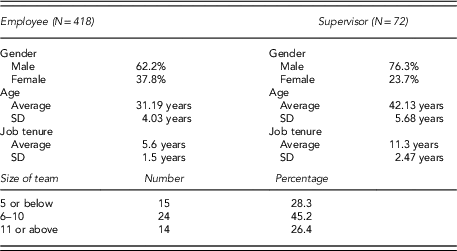
In total, 534 paired responses (response rate 95%) were received back for analysis. After eliminating questionnaires with omission, and errors, we finally had 490 paired questionnaires from 72 teams. The basic information about samples and their group distribution is provided in Table 1.
Basic information of samples (N=490)

Measures
All measures were translated into Chinese by using the translation and back-translation procedure as described by Brislin (1980). All translators were blind to the study’s hypotheses. First, two bilingual translators independently translated the survey from English to Chinese. There was 90% agreement between the translators regarding word choice and expression. A third translator individually translated the survey back to English. The results showed that only eight words or phrases in the Chinese version did not match those in the English version, and then were corrected. In this study, dependent variable (individual creativity), independent variables (team-level goal orientation, individual-level goal orientation), mediators (team information exchange, individual information elaboration), and moderator (team-level goal orientation) were measured by 7-point Likert response format.
Team-level goal orientation
To measure team-level goal orientation, 13-item measure used by Gong et al. (Reference Gong, Kim, Lee and Zhu2013) was adopted. The Cronbach’s α for team-level learning goal orientation, performance-approach orientation, and performance-avoidance orientation was 0.91, 0.87, and 0.86, respectively.
Individual-level goal orientation
Individual-level learning goal orientation was tapped by 5-item scale, performance-approach orientation 4-item scale, and performance-avoidance 4-item scale, developed by VandeWalle (Reference Van Knippenberg, De Dreu and Homan1997). The Cronbach’s α for individual-level learning goal orientation, performance-approach orientation, and performance-avoidance orientation was 0.90, 0.89, and 0.86, respectively.
Team information exchange
This study adopted 2-item team information exchange scale used by Gong et al. (Reference Gong, Kim, Lee and Zhu2013). The Cronbach’s α for this measure was 0.90.
Individual information elaboration
This construct was measured with 4-item scale developed by Hoever et al. (Reference Hoever, Van Knippenberg, Van Ginkel and Barkema2012). Its Cronbach’s α was 0.81.
Individual creativity
This construct was measured by 8-items developed by Cohen-Meitar, Carmeli, and Waldman (2009). The Cronbach’s α for the scale was 0.97. In these items, the extent of eight creative behaviors was characterized by unit supervisors.
Control variables
Based on previous research (e.g., Gong et al., Reference Gong, Kim, Lee and Zhu2013), this study controlled size of team on the team level, because the size of team affects internal communication in teams (Bantel & Jackson, Reference Bantel and Jackson1989), and furtherly influences creativity. At individual level, employee’s age, gender, education level, job tenure, and academic experience can affect creativity as demonstrated by previous research (Tierney & Farmer, Reference Tierney and Farmer2002; Shin & Zhou, Reference Shin and Zhou2003).
DATA ANALYSES AND RESULTS
Descriptive statistics
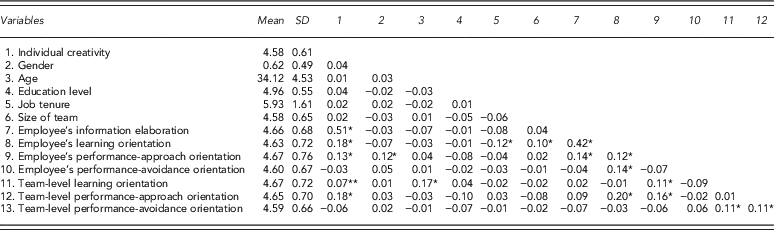
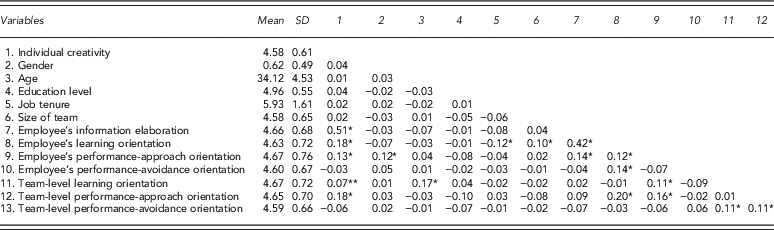
The correlation matrix and descriptive statistics for all individual and team-level variables were calculated by using SPSS 19.0, and are listed in Table 2.
Correlation matrix and descriptive statistics of variables
Note. *p<.05; **p<.01.
As indicated in Table 2, the team-level goal orientation (learning goal orientation, performance-approach goal orientation, performance-avoidance goal orientation), team information exchange and individual-level goal orientation (learning goal orientation, performance-approach goal orientation, performance-avoidance goal orientation), employee’s information elaboration, and individual creativity are significantly correlated. All correlation values for independent variables are <0.70, which indicates that there is no multicollinearity found among these variables. Hence, regression analysis could be conducted furtherly.
Validity
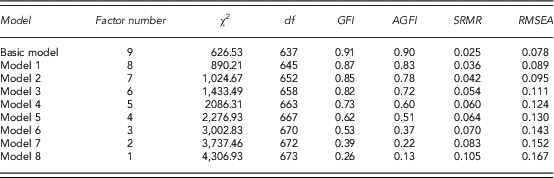
This study verified the construct validity through factor analysis conducted by using AMOS 17.0 package. The results showed that the factor loaded value for each item was >0.70 except one with 0.69 (detailed results available upon request), which demonstrates that the questionnaire has a high validity. Meanwhile, by using LIRSEL 8.8 software, we verified discriminant validity of nine variables via confirmatory factor analysis. As shown in Table 3, only 9-factor model met the above testing standard because in other models, the value of root mean-square error of approximation for each item was >0.08, the value of comparative fit index and Tucker-Lewis index was <0.90. Therefore, this study found that fitting indexes of variables supported the 9-factor model.
The results of measurement model compared
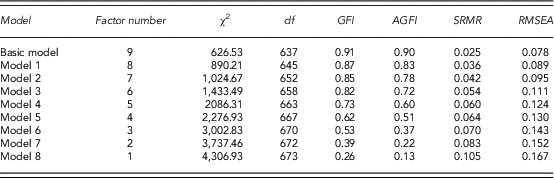
AGFI = adjusted goodness-of-fit index; GFI = goodness-of-fit index; RMSEA = root mean-square error of approximation; SRMR = standardised root mean square residual.
As far as convergent validity in concerned, team-level goal orientation (learning goal orientation, performance-approach goal orientation, performance-avoidance goal orientation), and team information exchange were evaluated by employees and mean of data. Therefore, evaluations from individual level should be converted into team level to examine their validity. The mean and median of team-level learning goal orientation, performance-approach goal orientation, performance-avoidance goal orientation, and team information exchange were ≥0.70 which is the lowest standard. The value of team-level learning goal orientation for ICC(1) and ICC(2) was 0.18 and 0.58, respectively; team-level performance-approach goal orientation 0.19 and 0.61, respectively; team-level performance-avoidance goal orientation 0.21 and 0.60, respectively; team information exchange 0.14 and 0.48, respectively. All value of variables for ICC(1) and ICC(2) were >0.12 and >0.47, respectively. Obviously, the comments from team members on team-level goal orientation, team information exchange can be clustered into team-level.
RESULTS
In this study, SPSS 19.0 and HLM 7 were used to examine above-mentioned hypotheses. First of all, this study conducted a descriptive analysis and a Pearson correlation analysis to examine the correlations between all constructs. Second, this study analyzed the cross-level effects of team-level goal orientation on individual creativity. In this section, mediating effect of team information exchange was examined between team-level goal orientation and individual creativity where the team-level goal orientation was explored in detail which contains learning goal orientation, performance-approach goal orientation, and performance-avoidance goal orientation. Then a mediating effect of individual information elaboration was examined between individual-level goal orientation and individual creativity where the individual-level goal orientation was divided into learning goal orientation, performance-approach goal orientation, and performance-avoidance goal orientation. The mediation was tested by using Baron and Kenny’s (1986) causal steps approach, which has three assumptions of its own: (1) the independent variable significantly predicts the dependent variable, (2) the independent variable significantly predicts the mediator, and (3) the mediator significantly predicts the dependent variable, controlling for the independent variable. Finally, a moderating effect of team-level goal orientation was examined between individual-level goal orientation and individual creativity.
Examination of mediating role of team information exchange
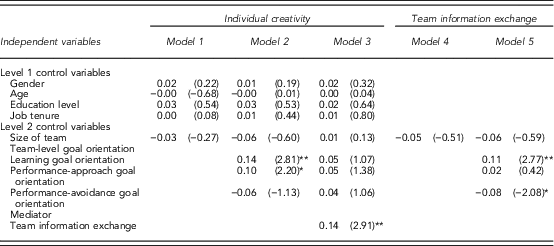
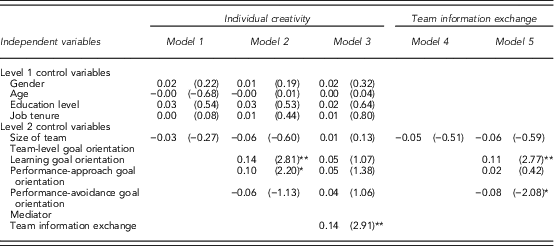
Table 4 shows five submodels produced as the result of testing direct effects of team-level goal orientation on individual creativity and any indirect effect offered by team-level information exchange. It can be seen that team-level learning goal orientation significantly predicted individual creativity (γ=0.14, p<.01). Therefore, Hypothesis 1a was supported. Team-level performance-approach goal orientation also significantly predicted individual creativity (γ=0.10, p<.05), supporting Hypothesis 1b. The results verified that the differences of team members on goal orientation mainly lie on the motive differences of whether team members are willing (learning or performance-approach) to receive challenging tasks, which will influence employee’s creative outcomes (Hirst, Van Knippenberg, & Zhou, Reference Hirst, Van Knippenberg and Zhou2009). However, there was no significant relationship found between team-level performance-avoidance goal orientation and individual creativity (γ=−0.06, ns), therefore, Hypothesis 1c was not supported. This is a new research perspective important to be further explored in future, which is different from the results of research conducted by Gong et al. (Reference Gong, Kim, Lee and Zhu2013).
The mediating effect of team information exchange
Note. *p<.05; **p<.01.
In terms of the mediating effect, when team information exchange exists, the relationship between team learning goal orientation and individual creativity was not significant (γ =0.05, ns), the relationship between team learning goal orientation and team-level information exchange was significant (γ=0.11, p<.01), the relationship between team-level information exchange and individual creativity was significant (γ=0.14, p<.01), and the direct effect of team learning goal orientation on individual creativity was also significant (Hypothesis 1a, γ=0.14, p<.01). Hence, team-level information exchange fully mediated the relationship between team learning goal orientation and individual creativity, which supports Hypothesis 2a. Results reflect that team information exchange and knowledge are intimately related, while the integration and sharing of knowledge pose a great influence on creativity. Consequently, team information exchange will play an active role during individual creative procedure. Whether team members focus on systematic and deep information processing depends on their epistemic motivation (Bechtoldt et al., Reference Bechtoldt, De Dreu, Nijstad and Choi2010). This stems from individual differences because when employees are motivated by team-level learning goal, their excitement to learn will make them more focused on elaborating information relevant to their jobs through which they can distinguish novel and useful techniques to accomplish tasks and to solve problems.
There is no significant relationship found between team-level performance-approach goal orientation and team information exchange (γ=0.02, ns). Hence, the mediation effect of team information exchange does not exist between team-level performance-approach goal orientation and individual creativity, therefore, Hypothesis 2b was not supported. However, we observed that the significant relationship between team performance-approach orientation and individual creativity (Hypothesis 1b) becomes insignificant when the mediator (team information exchange) was added to the model. Perhaps, individual ideas and innovation suffer some constraints, and then compromise comes when team members are driven by realizing team-level performance after information exchange.
Although team-level performance-avoidance goal orientation negatively predicted individual creativity via team information exchange, but its effect on individual creativity was not significant (Hypothesis 2c, γ=−0.08, ns), therefore, Hypothesis 2c was not supported. This verifies the results of Lun et al. (Reference Lun, Sinclair, Whitchurch and Glenn2007). They found that employees with avoidance goal would reduce their motive of acquiring knowledge, because employees just want a surface-level common task achievement.
The obtained results reflect that team information exchange offers a partial mediating role in the relationship between team learning orientation, team performance-approach orientation, and individual creativity. This demonstrates that relational mechanism at team level is more complicated than that at individual level. We hope that this study advances more deep research on the relationship between team-level goal orientation and individual creativity in order to receive more academic research support.
Examining mediating effect of individual information elaboration
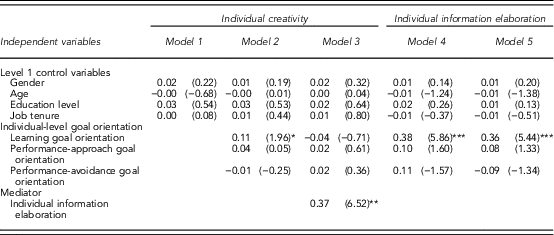
As shown in Table 5, five submodels existed when we examined the mediating effect of individual information elaboration. Controlling gender, age, education level, and job tenure, the results of this study revealed that individual-level learning goal orientation significantly predicted individual creativity (γ=0.11, p<.05). When the individual information elaboration was added to our model, the relationship between individual learning goal orientation and individual creativity became insignificant (γ=−0.04, ns), and the relationship between individual learning goal orientation and individual information elaboration was significant (γ=0.38, p<.001), the relationship between individual information elaboration and individual creativity was significant (γ=0.37, p<.01), the direct effect of the individual learning goal orientation on the individual creativity was also significant (γ=0.11, p<.05). Hence, individual information elaboration fully mediated the relationship between individual learning goal orientation and individual creativity, which supported Hypothesis 3. We considered learning goal orientation as epistemic motive which is a contextual factor. This factor can promote employees to actively learn, share, elaborate knowledge and information, etc., which can furtherly improve individual creativity. This result extends the application of motivated information processing theory in creativity domain (De Dreu et al., Reference De Dreu, Nijstad, Bechtoldt and Baas2011).
The mediating effect of individual information elaboration
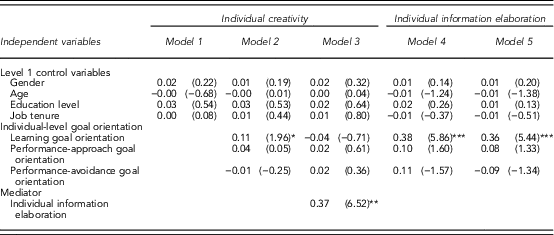
Note. *p<.05; **p<.01; ***p<.001.
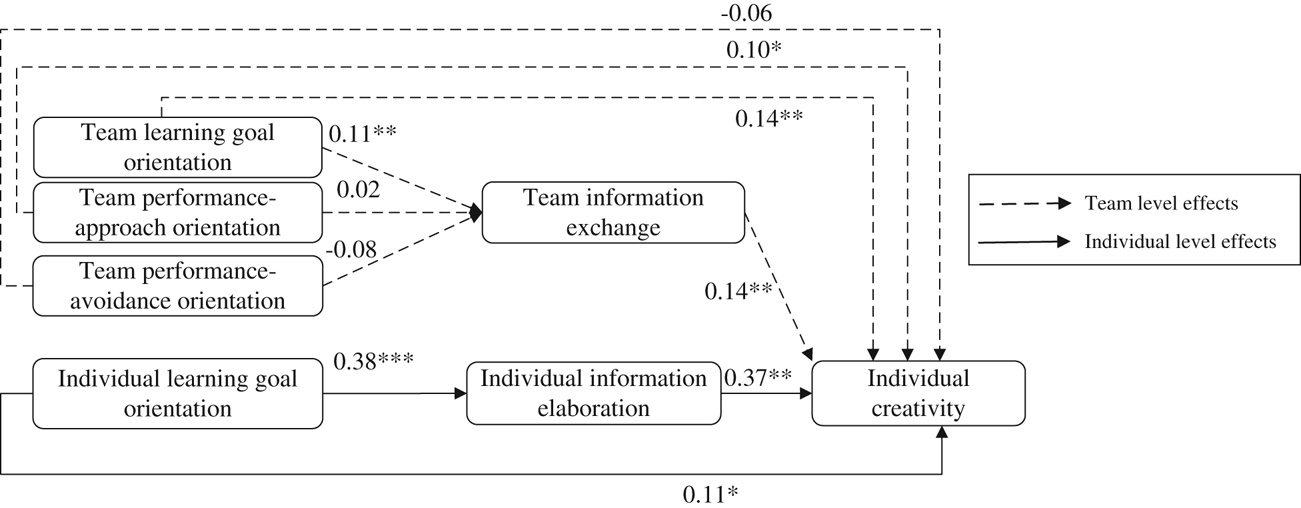
Besides examining the results, we depicted a path model of constructs shown in Figure 2 to present a comprehensive relationship among variables.
The results of path model

Examining moderating effect of team-level goal orientation
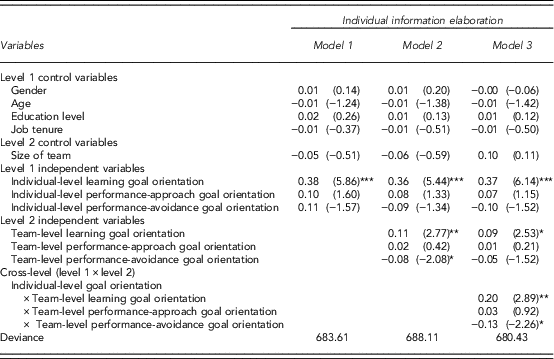
Table 6 lists the results of data analysis to explore moderating effects of team-level goal orientation. The relationship between intercept and team-level goal orientation (learning goal orientation, performance-approach goal orientation, performance-avoidance goal orientation) was significantly predicted at level p<.01. Therefore, the moderating effects of team-level goal orientation on the relationship between independent variables and dependent variable were verified.
Results of cross-level analysis
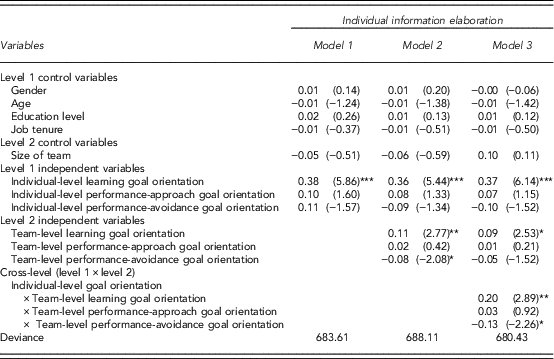
Note. *p<.05; **p<.01; ***p<.001 (two tails).
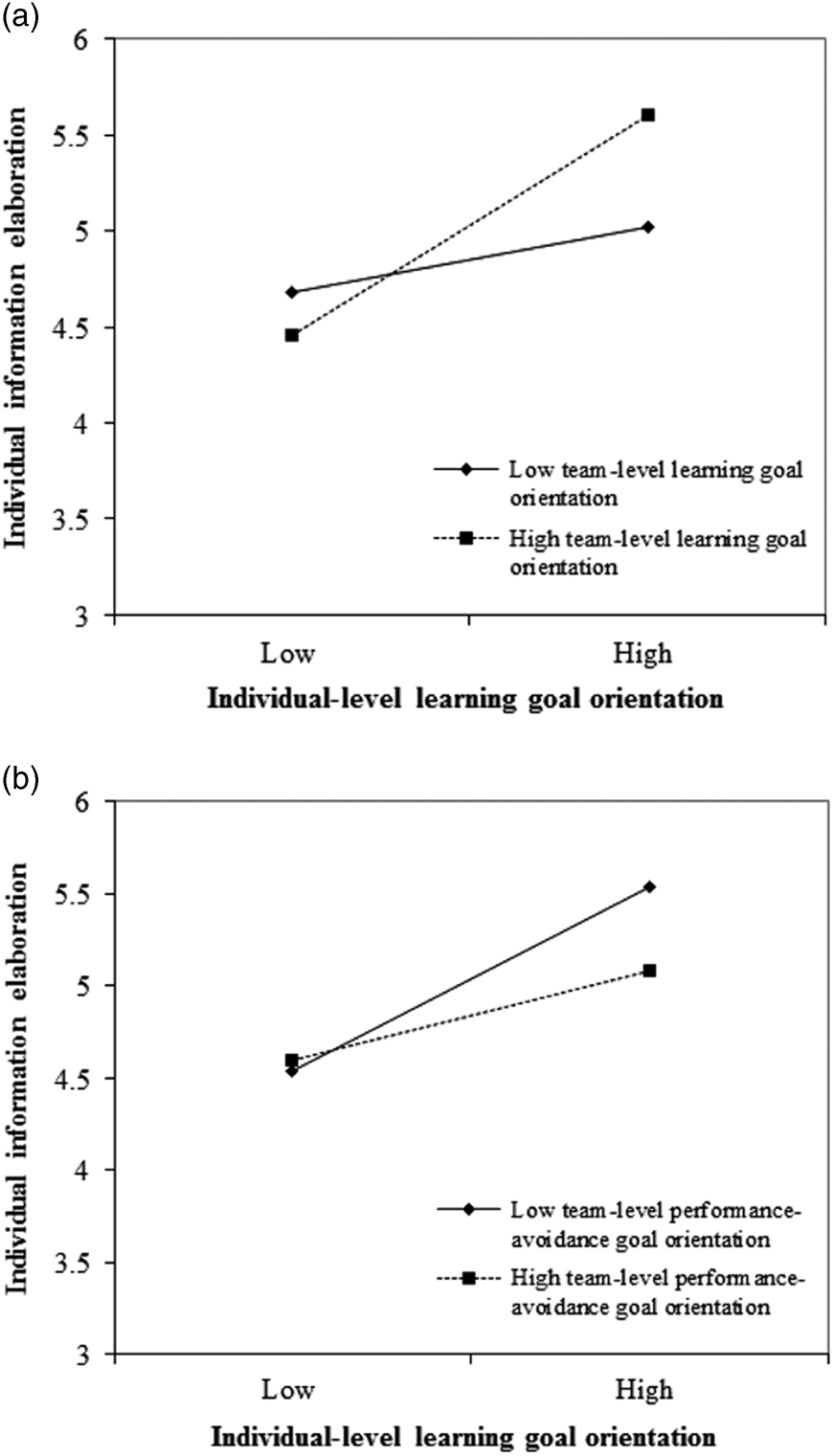
There were three submodels produced during the process of examining moderating effects. First, control variables at levels 1 and 2 were added in the models, then individual-level, team-level, and cross-level independent variables were added. The obtained results showed that learning goal orientation and performance-avoidance goal orientation significantly predicted individual information elaboration, however, the relationship between performance-approach goal orientation and individual information elaboration was not significant. In addition, team-level learning goal orientation positively predicted individual information elaboration, whereas, performance-approach goal orientation did not predict individual information elaboration. It is evident that performance-avoidance goal orientation significantly and negatively predicted individual information elaboration. Finally, when the interaction terms were introduced, interaction term between individual-level goal orientation and team-level learning goal orientation positively predicted individual information elaboration (γ=0.20, t=2.89, p<.01), which partially supports Hypothesis 4a; interaction term between individual-level goal orientation and team-level performance-approach orientation was insignificant, hence, Hypothesis 4b was not supported (γ=0.03, t=0.92, ns); interaction term between individual-level goal orientation and team-level performance-avoidance orientation negatively predicted individual information elaboration (γ=−0.13, t=−2.26, p<.05), which partially supports Hypothesis 4c.
Therefore, the results of this study show that teams’ members tend to elaborate more work-related information when teams are more learning goal-orientated. Conversely, members do not tend to elaborate information when their team has higher performance-avoidance goal orientation. This conclusion demonstrates the person-in-situation perspective (Tett & Burnett, Reference Tett and Burnett2003), which states that the relationship between people’s differences on goal orientation and their results are contingent and moderated by different factors. Theory advanced by Gong et al. (Reference Gong, Cheung, Wang and Huang2012) states that the constructed context will reduce the link between psychological safety and learning because of the focus of avoiding negative evaluations, then team might encourage members to input less systematic information elaboration.
In order to understand the moderating effects in detail, we conducted a two-way simple slope test based on the procedures suggested by Cohen, Cohen, West, and Aiken (Reference Cohen, Cohen, West and Aiken2013) and Preacher et al (2006). First, the moderators (team-level learning goal orientation, and team-level performance-avoidance goal orientation) were divided into two groups: high group consisting of means plus standard deviation, low groups consisting of means minus standard deviation. The results are depicted in Figures 3a and 3b. The path analytic procedure to test moderation showed that the simple slope of the relationship between individual-level learning goal orientation and individual information elaboration was positive and significant (β =0.57, t=1.978, p<.05) when team-level learning goal orientation was high. It is also positive and significant but reduced (β=0.37, t=11.70, p<.001) when the moderator was low. Thus, these results fully support Hypothesis 4a. In addition, the simple slope of same relationship was positive and significant (β=0.38, t=12.01, p<.001) when team performance-avoidance orientation was low, and significant but reduced (β=0.25, t=0.77, p<.05) when the moderator was high. These results therefore partially support Hypothesis 4c.
The effect of individual-level learning goal orientation on individual information elaboration at low and high levels of team-level learning goal orientation (a) the effect of individual-level learning goal orientation on individual information elaboration at low and high levels of team-level performance avoidance goal orientation (b)

Discussion
This study explores the relationship between goal orientation and creativity in depth. By dividing goal orientation into team and individual level, which contains three dimensions, and two different information processing techniques, this paper constructed a complete mechanism to analyze the relationship between goal orientation and creativity. We found that team learning goal orientation and individual learning goal orientation influence individual creativity through different information activities on their own levels. Moreover, team learning goal orientation has a positive and team performance-avoidance goal orientation has a negative effect on individual creativity through team information exchange, and individual learning goal orientation poses a positive effect on individual creativity through individual information elaboration. Finally, teams’ members tend to elaborate more work-related information when teams are more learning goal orientated. Conversely, members do not tend to elaborate information when their teams are high in performance-avoidance goal orientation.
Academic implications
This study extends research of Gong et al. (Reference Gong, Kim, Lee and Zhu2013) by examining the mediating role of team-level information exchange and the relationship between team goal orientation and employee’s creativity. The results of this study show that relationships among team learning goal orientation, team information exchange, and individual creativity are significant, while the relationship between team performance-avoidance goal orientation and individual creativity is not significant. These results are in line with Gong et al. (Reference Gong, Kim, Lee and Zhu2013). However, the relationship between team performance-approach goal orientation and individual creativity was not significant in the research of Gong et al. Such relationship in our research is significant. This difference might stem from samples from different countries, which provides a new perspective for research on the influence of organization level and other levels on team performance-approach goal orientation.
Second, our study could promote the development of individual creativity theory. Formerly, individual creativity theory focused on creators’ personalities, characteristics, abilities, thinking, etc. Nowadays, creation from single person is gradually replaced with team-level creation prospective. Especially, team is the unit of conducting task in modern firms, that is, the tasks are tackled by teams rather than single persons. Therefore, former research on individual creativity is far from the practical requirements of creativity. Such social and practical needs promote scholars to extend research on individual creativity from individual level to team and organization level, and focus on which factors will affect individual creativity and how do they affect each other? We believe that our research on (1) the influence of both team-level and individual-level goal orientation on individual creativity, (2) the indirect effect of information elaboration, (3) moderating effect of team goal orientation on individual goal orientation and individual information elaboration, will advance individual creativity theory.
Finally, our study also extends the application of information elaboration on individual creativity. Information elaboration is a kind of complicated communication process beyond information sharing, and it has been studied as a team-level variable which might affect individual creativity. We argue that research on information elaboration is not confined within the team-level prospective. Its mediation, for instance, on the relationship between individual goal orientation and individual creativity extends this theory to individual level.
Managerial implications
This study highlights the significance of goal orientation for individual creativity, and suggests organizational managers to build a high level team learning goal orientation culture in order to stir individual creativity. Additionally, in order to reinforce team learning goal, managers or team leaders could eliminate or avoid the occurrence of team performance-avoidance goal, avoid inhibiting the individual motive to explore learning and hinder the individual creative performance. Through effective leading, setting subgoals and ways of recognition (Hirst, Van Knippenberg, & Zhou, Reference Hirst, Van Knippenberg and Zhou2009), managers could help individuals to develop team learning goal and provide a learning role model to avoid the formation of group avoidance orientation in the team and reduce the negative effects of this orientation. On the other hand, our study found that external contexts also play an important role for the relationship between individual learning orientation and work-related information elaboration. That is, when team learning goal orientation is high and performance-avoidance goal is low, employees will have a good sense of security and willingness to deal with information in a systematic way, which will promote individual creativity.
The effects of team information exchange and individual information elaboration should be fully explored on the team and individual level. It should be noted that the high level of team learning goal orientation does not always benefit individual creativity. This indicates that managers should guide individuals about the key team activities, such as information filtration and elaboration from peers. This paper suggests that if managers want to promote individual creativity, they must create working conditions supporting information exchange and elaboration at first. In that case, managers can provide institutionalized platforms or channels so that individuals can put themselves into others’ shoes or help them how to resolve the exigent problems.
Circumstances where performance-approach goal orientation is competitive should be built on the team level. Our study demonstrated that the relationship between team performance-approach goal orientation and individual creativity is significant. This result is contrary to the research conducted by Gong et al. and might be more suitable for organizational management in Chinese context. Given that individual goal orientation is different and in the subsequent interactions, even in situations like clash among team members, managers should advocate coordination and cooperation, inspire a benign competition among employees, and work for a positive assessment of teams.
Limitation and future directions
Like other studies this study also has few limitations. First, the data were collected by using self-reported questionnaire which may increase the chances of common method variance. In order to eliminate this problem, the present study adopted two methods. The first one was time-lagged design. That is, we collected all data about the independent variables at first, the mediators 1 month later, and the dependent variables 2 months later. Second, for present study we collected data from multiinformation resources. That is, managers provided the data about dependent variables, and individuals provided the answers about mediators and independent variables. Based on the two methods above, this study effectively minimized the potential influence of the common method variance.
Second, due to the small number of samples at team level, the statistical validity on the cross-level and multilevel effects is limited. The limited sample was also used to test the comparison of the multilevel structural equation modeling model by Grizzle, Zablah, Brown, Mowen, and Lee (Reference Grizzle, Zablah, Brown, Mowen and Lee2009). For future studies on the goal orientation at the unit-level or group-level, the sample size at team level and the average number of the interviewees in the teams should be increased in order to improve the statistical validity.
To test the influence of team goal orientation on employee’s creativity, further research is required because extant research indicates that goal orientation might not stimulate employees to devote more information elaboration relevant to jobs when there is a high performance goal orientation at team level. A plausible explanation is that a work unit performance goal orientation might promote employees to focus on external evaluation, such as performance. Compared with learning, knowledge and skills relevant to creativity, these evaluations will not be beneficial to employee’s creativity (Gong et al., Reference Gong, Kim, Lee and Zhu2013). Another aspect is that employees within teams with performance orientation are less encouraged by learning from environment because learning is not the sole way to demonstrate self-ability and receive beneficial evaluations. However, the mediating effect observed by Gong et al. (Reference Gong, Kim, Lee and Zhu2013) plays an important role to increase employees’ creativity. Therefore, future studies should take different mediators into consideration to reach some results similar to what Gong et al. (Reference Gong, Kim, Lee and Zhu2013) observed under the team performance orientation.
This study also enlightened human context interaction perspective (Amabile, Reference Amabile1998; Shalley, Zhou, & Oldham, Reference Shalley, Zhou and Oldham2004) and extended the comprehension on the interaction between individual differences and context. This kind of interaction plays a key role in creativity processes and links individual learning orientation and team goal orientation. The paper mainly presents that team goal orientation might stimulate or constrain individual learning and affect creativity. Team learning goal orientation induces the tendency of individual creativity, but team performance-avoidance would constrain individual learning behavior, which is in line with trait activation theory (Tett & Burnett, Reference Tett and Burnett2003). Therefore, future research should explore other individual differences, such as regulatory focus view (Friedman & Förster, Reference Friedman and Förster2001). This might help us better understand how a team goal orientation context affects individual creativity.
ACKNOWLEDGEMENTS
Authors appreciate and thank Dr. Bevan Catley (Associate Editor, JMO) and four anonymous reviewers for their helpful comments and guidance to improve this manuscript.