Introduction
The prevalence of overweight and obesity among children and adults appears to be rapidly rising in both industrialized and developing countries, assuming an epidemic proportion (Hill & Peters, Reference Hill and Peters1998; Wang, Reference Wang2002; Stein & Colditz, Reference Stein and Colditz2004). The increase in obesity has led to a parallel increase in obesity-associated chronic diseases, such as type 2 diabetes and cardiovascular diseases (Sinha et al., Reference Sinha, Fisch, Teague, Tamborlane, Banyas and Allen2002; Rocchini, Reference Rocchini2002). It has been suggested that this ‘new epidemic of the third millennium’ is linked to a modest imbalance between caloric intake and energy expenditure, although an underlying genetic susceptibility is also a factor in 40–70% of inter-individual body mass index (BMI) variations (Friedman, Reference Friedman2003). The obesity epidemic is also characterized by strong variability among different populations, partly as a consequence of different methodological approaches to its measurement (Neovius et al., Reference Neovius, Linné, Barkeling and Rössner2004). For the Italian island of Sardinia, no directly measured data have been available on the prevalence and incidence of obesity in adult populations. Recently, the result of a large epidemiological survey performed by direct measurement of anthropometric parameters on Sardinian school children attending compulsory school education has been reported (Velluzzi et al., Reference Velluzzi, Lai, Secci, Mastinu, Pilleri and Cabula2007).
The present paper reports the prevalence and thirty-year trend (1969 and 1998) of overweight and obesity in the male Sardinian population, as part of a larger national study (Project of National Relevant Interest) that aimed to investigate the changes of the bio-demographic characteristics of Sardinian recruits in the century from 1880 to 1980. The present research only analysed data for the military conscripts of 1969 (born in 1951) and 1998 (born in 1980). The use of military registers allowed the analysis of the entire male population from Sardinia, providing a complete documentation of overweight and obesity trends during these 30 years. The availability of samples from different parts of the island also allowed the evaluation of the impact of environmental and lifestyle factors on the expression of these anthropometric variations. Since the anthropological, genetic and socioeconomic characteristics of Sardinians differ from those of other European and Mediterranean populations (Vona, Reference Vona1997), and consistent variation of socioeconomic conditions has occurred in the last decades, the results of this study will be of interest in providing specific trends of overweight and obesity in the Sardinian population.
Methods
Data collection
Data were collected during 2003–2004 from military registers in the Archive of the Military District of Cagliari for the years 1969 and 1998. These archives include data from the whole of Sardinia. The choice of these years allowed having data from the whole male population of two generations. It was not possible to analyse data before 1969 because of the lack of information (for example body weight). The Italian Ministry of Defence gave authorization for the research.
The data were taken from forms compiled during medical examination; stature and weight were measured by military doctors during the same medical examination. All conscripts were 18 years old at the time of the examination. A total of 14,220 forms for the 1969 conscripts were analysed; 288 of these were eliminated because the conscripts did not live in Sardinia, and another 3356 were eliminated due to incomplete weight or stature data. The resulting 1969 sample consisted of 10,576 valid forms. A total of 8125 forms were analysed for 1998 conscripts; 1197 were eliminated because the conscripts were not born in Sardinia or because of incomplete data. The resulting 1998 sample thus consisted of 6928 forms.
Body mass index was determined from total stature and weight, and overweight and obesity were estimated according to the WHO criteria (1995): overweight was defined as BMI between 25 and 29.9 kg/m2, and obesity was defined as BMI≥30 kg/m2 (Ferro-Luzzi et al., Reference Ferro-Luzzi, Sette, Franklin and James1992; Shetty & James, Reference Shetty and James1994).
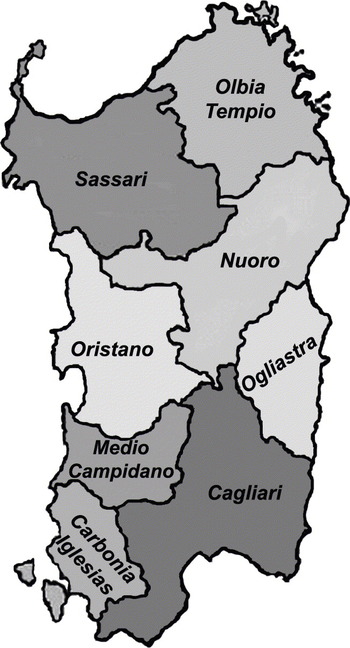
The Sardinian samples were analysed as a whole, and subdivided into the eight provinces defined by the May 2005 administrative subdivision (Fig. 1). The samples were further divided into four zones by altitude: plain, internal hill, coastal hill and mountain and by the rural/urban economies of resident areas. Both subdivisions were made according to classification by the National Institute of Statistics (ISTAT, 1986).
Territorial divisions of Sardinia.

Statistical analyses
Means and standard deviations of stature, weight and BMI were calculated. Differences between means were tested by one-way and two-way analysis of variance (ANOVA) and the Student-Newman-Keuls test for parametric data, and by Kruskal-Wallis and Mann-Whitney tests for ordinal data. Correlations between profession and number of years attended school were analysed by Pearson's R for BMI and Spearman's R for obesity and overweight. All statistical analyses were performed with SPSS software (version 8.0 for Windows). Statistical significance was considered when p<0.05.
Results
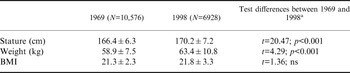
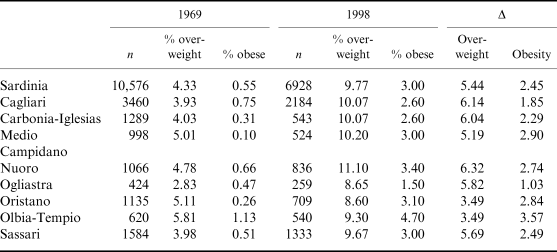
Mean values of stature, weight and BMI are shown in Table 1. Data from the eight provinces were analysed separately and the results are reported in Table 2. Table 2 also shows the overall prevalence of overweight and obesity in Sardinia among the conscripts of 1969 and 1998. Both overweight and obesity frequencies significantly increased (Wilcoxon test: t=0, Z=31.7, p=0.00) during this period. The prevalence of overweight varies from a minimum value of 4.3% (CI: 4.0 to 4.7%) to a maximum value of 9.8% (CI: 9.1 to 10.5%), and obesity from 0.5% (CI: 0.4 to 0.7%) to 3.0% (CI: 2.6 to 3.4%).
Average values and standard deviations of stature, weight and BMI in Sardinian recruits in 1969 and 1998

a Differences between 1969 and 1998 were tested with Student's t test.
Prevalence of obesity and overweight in the Sardinian provinces in the two surveys
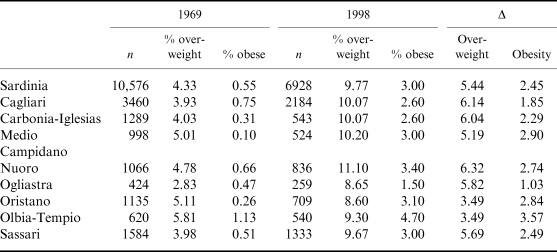
The provinces with the highest prevalence of overweight were Olbia-Tempio (northern Sardinia) in 1969 and Nuoro (central Sardinia) in 1998. Olbia-Tempio also showed the greatest prevalence of obesity in both 1969 and 1998. The lowest incidences of overweight were observed in Ogliastra in 1969 and Ogliastra and Oristano in 1998, while the lowest incidences of obesity were observed in Medio Campidano in 1969 and Ogliastra in 1998. The province of Ogliastra, the most mountainous and least populated on Sardinia, thus seems to have been less influenced by environmental and behavioural factors promoting weight increase. Calculation of the delta interval between the incidences observed in the two periods shows that all geographic areas experienced a substantial increase in mean weights, and that in Medio Campidano and Olbia-Tempio provinces, obesity was 30 and 14 times more frequent in 1998 than in 1969, respectively. Olbia-Tempio turned out to be the district with the highest increase of obesity and Ogliastra the district with the lowest increase.
The distribution of absolute BMI values among the Sardinian provinces was evaluated by ANOVA and by Student-Newman-Kuels tests: despite a statistically significant heterogeneity in both surveys (p<0.001 and p=0.018, respectively), a clear decrease of internal variability was observed from 1969 to 1998 (F=10.21 and F=2.43, respectively). Nuoro province contributed most to variability; anthropological and genetic measures have defined it as the most conservative and differentiated area of Sardinia (Capello et al., Reference Capello, Rendine, Griffo, Mameli, Succa and Vona1996). Non-parametric Kruskal-Wallis tests were then used to examine the distribution of overweight and obesity prevalence among the Sardinian provinces in the two surveys. A statistically significant difference was observed only for 1969, probably due to absolute BMI distribution (χ2=18.28, p=0.032).
Prevalence and trend of overweight and obesity by altitude
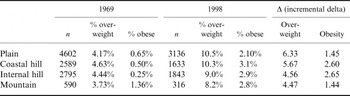
As shown in Table 3, a consistent incremental trend for both overweight and obesity was observed in Sardinia when the data were divided according to zones of altitude. In 1969 overweight was more frequent in hilly zones and obesity was more frequent in mountainous zones (Kruskal-Wallis tests χ 2=35, 42; p<0.05). In 1998 the prevalence of overweight did not show significant variation by altitude zones, but obesity was more prevalent in hilly zones (χ2=3.06, p>0.05). The incremental delta values of overweight and obesity were positive and consistent in all altitude zones.
Prevalence and trend of obesity and overweight in the Sardinian altimetry areas

Prevalence and trend of overweight and obesity by urban and rural areas
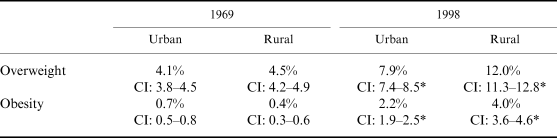
The distributions of overweight and obesity in rural and urban areas are show in Table 4. The 1969 distributions are significantly homogenous, while in 1998 overweight and obesity were more concentrated in rural areas. A marked increase in the incidences of both overweight and obesity is clear for both urban and rural areas, with increases in rural areas of a greater magnitude (two- and three-fold increases of overweight in urban and rural areas, respectively; three- and ten-fold increases of obesity in urban and rural areas, respectively). The 1969 rural and urban distributions of overweight and obesity showed a similar prevalence of overweight, while in 1998 rural areas showed a prevalence of both overweight and obesity strongly higher than in urban areas.
Incidence of obesity and overweight in Sardinian urban and rural areas.
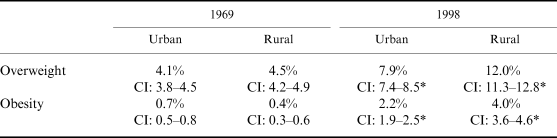
CI, 95% confidential intervals.
* p<0.05.
The two-way analysis of variance was applied to test the combined effect of urbanization and/or province and year of survey on BMI in 1969 and 1998. The analysis gave a highly significant result (F=24.9 and F=59.7 for province and urbanization respectively), with a p-value of <0.00001, demonstrating that the two factors interact in influencing BMI.
Social and cultural characteristics
Subjects were separated into several social and cultural groups (kind of work and educational level). While no relationship was found between the kind of work (standardized by ISTAT classification) and prevalence of oversize (data not shown), a significant relationship was observed both in 1969 (negative) and 1998 (positive) between BMI and education level (R=−0.065, p<0.001 and R=0.036, p=0.004 respectively). The ANOVA Kruskal-Wallis test, used to assess the differences between normal, overweighed and obese subjects in number of education years, showed a significant difference only in 1998 (χ2=8.2, df=3, p=0.04).
Discussion
Sardinia is the second largest island in the Mediterranean Sea, with a population of over 1,650,000 (ISTAT, 2006). This population has a distinctly different genetic and anthropological background to other Italian populations (Wang, Reference Wang2001). Ninety-four per cent of Sardinian territory is rural and the economy is largely based on farming and sheep breeding, with recently developed contributions from the tourism industry (ISTAT, 2006). Obesity is thought to be related to genetic, anthropological and socioeconomic factors capable of influencing prevalence across populations (WHO, 2004).
The increase in overweight and obesity in Sardinian males reported here is comparable to the global trend of increases in both children and adults, and may be attributed to a decrease in the energy expenditure of individuals in association with an increase in high-fat, high-carbohydrate foods (Stein & Colditz., Reference Stein and Colditz2004). Ogden et al. (Reference Ogden, Flegal, Carroll and Johnson2002) data from a 1999–2000 survey in the United States demonstrated a three-fold increase in oversize prevalence among adolescent boys, from 4.5% to 15.5%, during the same decades considered in our study. Among the European countries an inverse trend has been observed in Russia, as a consequence of economic recession, while a general trend of increase has been observed in other regions. Studies reporting the trend of oversize by using conscript data are relatively scarce. Padez (Reference Padez2006) recently analysed changes of anthropometric parameters in 977,639 Portuguese conscripts born between 1966 and 1981, observing an increased prevalence of overweight and obesity from 10.5% and 0.9% to 21.3% and 4.2%, respectively. These values are consistently higher than those observed in Sardinia, although the relative increases are similar: two-fold for overweight and five-fold for obesity in Portuguese and two-fold and six-fold in Sardinia. Four cross-sectional surveys of 112,822 Polish conscripts were performed from 1965 to 2001, and Kozieł et al. (Reference Kozieł, Szklarska, Bielicki and Malina2006) observed a gradually increasing trend of overweight and obesity from 5.12% to 11.85% and from 0.21% to 2.46%, respectively; the relative overweight increase (two-fold) was similar to the Sardinian and Portuguese data, but markedly higher for obesity (ten-fold). In 180,176 Austrian conscripts, analysed in four cross-sectional study cohorts during the observation period 1985–2000, Rami et al. (Reference Rami, Schober, Kirchengast, Waldhör and Sefranek2004) found prevalence of overweight and obesity that increased from 10.9% to 15.5% and from 1.8% to 4.9%, respectively; the relative increases were more modest compared with those of other studies, consisting of a five-fold increase in overweight and a greater than two-fold increase in obesity. Rasmussen et al. (Reference Rasmussen, Johansson and Hansen1999) studied oversize trends in all Swedish males born in 1953, 1958, 1963 and 1968, and between 1973 and 1977. Anthropometric data were available for 448,732 (89%) of a total of 503,689 subjects. Unadjusted trend analyses showed a more than two-fold increase in the prevalence of overweight among 18-year-old males over the period, from 6.9% in 1971 to 16.3% in 1995. Over the same years, the prevalence of obesity nearly quadrupled, from 0.9% to 3.2%.
This study's results regarding the distribution of oversize among the Sardinian provinces contain an inherent limitation, as the aggregation of provinces is solely administrative and does not always correlate well with anthropological or socioeconomic factors. It was observed that adjacent provinces (e.g. Sassari-Olbia/Tempio and Cagliari–Carbonia/Iglesias) showed distinctly different oversize prevalence. For this reason, the data were also examined using territorial characteristics. Several studies of the relation of genetic markers (Siniscalco et al., Reference Siniscalco, Bernini, Filippi, Latte, Meera Khan, Piomelli and Rattazzi1966; Vona & Porcella, Reference Vona and Porcella1984; Succa et al., Reference Succa, Mameli and Vona1990) and blood relationship (Moroni et al., Reference Moroni, Anelli, Anghinetti, Lucchetti, Rossi and Siri1972; Sanna et al., Reference Sanna, Iovine and Floris2004) to zones of altitude among the Sardinian population give more consistent results. Our results of the relationship between oversize and altitude zones are in agreement with those observed in a previous survey of Sardinian children (Velluzzi et al., Reference Velluzzi, Lai, Secci, Mastinu, Pilleri and Cabula2007), which showed decreased risks of overweight (30% decrease) and obesity (50% decrease) for children living in mountainous zones in comparison with those living in hilly or lowland zones. Among Sardinian conscripts, the lowest prevalence of overweight is also in mountainous zones, but lower percentages of obesity were found in all other areas in 1969 and in lowland zones in 1998. A similar trend was observed in adult populations of Latin American countries by Filozof et al. (Reference Filozof, Gonzalez, Sereday, Mazza and Braguinsky2001), who found a lower prevalence of both overweight and obesity in mountainous zones than in hilly areas. These altitude-related stratifications of oversize prevalence could be attributed to income or cultural behaviour, as well as a greater physical energetic expenditure in mountainous areas. Typically isolated genetic histories and the intermittent availability of food could also have contributed to the selection of more thrifty genotypes in populations resident in mountainous zones (Levin, Reference Levin2006).
The results show a consistent relationship between oversize prevalence and rural or urban home regions among the Sardinian conscripts. While both overweight and obesity showed similarly low prevalence in rural and urban areas in 1969, both overweight and obesity showed greater prevalence in rural areas in 1998. These results are in agreement with overweight data observed in Swedish (Rasmussen et al., Reference Rasmussen, Johansson and Hansen1999) conscripts. Rasmussen et al. (Reference Rasmussen, Johansson and Hansen1999) observed that young Swedish men living in rural and sparsely populated areas were more overweight and obese than those living in urban areas. In contrast, Portuguese conscripts showed greater risk of obesity in urban than in rural areas (Padez, Reference Padez2006). The gradient of increasing overweight from urban to rural areas has not been reported in other studies conducted on populations categorized by age and socioeconomic income: surveys performed in Thailand (Sakamoto et al., Reference Sakamoto, Wansorn, Tontisirin and Marui2001) and in Russia and China (Wang, Reference Wang2001) reported markedly higher prevalence of oversize preschool children in urban areas than in rural areas (22% to 7%, respectively). Similar results were obtained for an adult population in Greece (Panagiotakos et al., Reference Panagiotakos, Pitsavos, Chrysohoou, Risvas, Kontogianni, Zampelas and Stefanadis2004). It is likely that differences in income and cultural background, as well as aesthetic, lifestyle and age-related factors, may exert an influence on the tendency towards weight reduction in urban areas of the West more than in Eastern regions (Knai et al., Reference Knai, Suhrcke and Lobstein2007).
The variability of BMI distribution in Sardinia probably decreased from 1969 to 1998 as a consequence of a reduction in secular isolation. This change increased genetic admixture, resulted in the loss of many rural alimentary traditions, and increased average real incomes and the mechanization of agriculture. Two internal migrations have occurred in Sardinia that may be relevant to the results of this study: the first occurred in 1951, with population movement from interior villages to coastal areas, and the second occurred in 1971, with movement in the opposite direction, toward more densely populated areas (Pinnelli, Reference Pinnelli1982). This was confirmed by the two-way ANOVA, which demonstrated a combined effect on BMI of year of survey and province and urbanization.
Most studies in developed countries have found that educational level and/or socioeconomic class were inversely related to the prevalence of obesity (Sobal & Stunkard, Reference Sobal and Stunkard1989; Gutierrez-Fisac et al., Reference Gutiérrez-Fisac, López, Banegas, Graciani and Rodrìguez-Artalejo2004; Panagiotakos et al., Reference Panagiotakos, Pitsavos, Chrysohoou, Risvas, Kontogianni, Zampelas and Stefanadis2004). This trend was partially confirmed in our study, as we observed a significant inverse relationship between the distribution of BMI and education level, although only in 1969. A similar trend was also observed in Swedish conscripts (Rasmussen et al., Reference Rasmussen, Johansson and Hansen1999), while Bar Dayan et al. (Reference Bar Dayan, Elishkevits, Grotto, Goldstein, Goldberg and Shvarts2005) found a greater prevalence of obesity in female Israeli conscripts (but not in males) with lower educational levels. It was not possible to compare our data with those of Kozieł et al. (Reference Kozieł, Szklarska, Bielicki and Malina2006), as their classification structure prohibits direct comparison of educational levels.
Surveys regarding the prevalence of oversize among other Italian conscripts, registered according to IOTF criteria, are not, to the authors' knowledge, available. Celi et al. (Reference Celi, Bini, De Giorgi, Molinari, Faraoni and Di Stefano2005) reported on a survey performed from 1993 to 2001 on 44,231 subjects (22,829 males and 21,402 females) aged 3–17.5 years living in three provinces of central Italy. The overall prevalence of overweight was 20.9% in boys and 18.9% in girls, and that of obesity was 6.7% in boys and 6.5% in girls. This study showed a peak of overweight in boys aged 10 years (27.7%) and girls aged 11 years (23.5%). Detailed comparison of the data on 17.5-year-old boys with our 1998 results highlighted a substantially higher prevalence of both overweight (15.0%) and obesity (4.3%) in young students from continental Italy compared with our population.
A more direct comparison with other Italian conscripts from 1880 to 1980 was made by using a database from ‘National Project PRIN 2004: Evolution of the biodemographic characteristics of Sardinian recruits in a century: from 1880 to 1980’. The regions of central and southern Italy registered the highest increase of overweight and obesity (particularly Calabria), but the increase in obesity shows a narrower range of variability than that of overweight. It is noteworthy to mention that Sardinia showed the lowest prevalence of overweight in 1969 and in 1998, and it was second-lowest after Veneto in prevalence of obesity in 1998. Since genetic predisposition is relevant to overweight and obesity (Comuzzie & Allison, Reference Comuzzie and Allison1998; Friedman, Reference Friedman2003; WHO, 2004), these results could be attributed to the presence of peculiar genotypes in Sardinia. On the other hand, the observation that obesity has increased strongly in the last 30 years, even in Sardinia, could mean that it simply developed much slowly because of the cultural and geographical isolation that characterizes the island. Moreover, for the same reason, over-nutrition or fast food alimentary behaviour could have arrived later in Sardinia than in other Italian and Western European populations.
The percentages of overweight and obese individuals in Sardinia have markedly increased during the last 30 years, but their low incidence compared with other Italian populations could be explained by the genetic peculiarity of the island or the isolation that delayed the development of this ‘epidemic’. The change in the internal distribution of obesity clearly reflects socioeconomic changes.
Acknowledgments
The present research was supported by grants from National Project PRIN (MIUR, 2004). The authors would like to thank Write Science Right for English revision and Dr L. Minerba for statistical suggestions.