Introduction
Patients with advanced otosclerosis present a dilemma in terms of management. Many patients will present with hearing thresholds eligible for cochlear implantation, and cochlear implantation will effectively treat the sensorineural component of their deafness.Reference Ruckenstein, Rafter, Montes and Bigelow 1 Patients who undergo stapes surgery may subsequently require cochlear implantation in the future if surgery is unsuccessful or there is significant progression of sensorineural hearing loss. Stapes surgery is most often simpler, safer and cheaper than cochlear implant surgery, and successful stapes surgery has the added benefit of preserving acoustic hearing.Reference Calmels, Viana, Wanna, Marx, James and Deguine 2 Cochlear implantation in this patient group is also associated with an increased risk of complications such as partial electrode insertion and facial nerve stimulation.Reference Rotteveel, Proops, Ramsden, Saeed, van Olphen and Mylanus 3
We investigated our patient group undergoing stapes surgery for advanced otosclerosis. Pre- and post-operative audiometric outcomes, and stapes surgery complication rates, were evaluated in this patient group to determine what proportion of patients required, or would benefit from, further surgery.
Materials and methods
All patients who had undergone primary stapes surgery at University Hospitals Birmingham since 2002 were identified retrospectively and their audiology records were reviewed. This date was chosen as the audiology data were electronically available. Cases of advanced otosclerosis, as defined by mean air conduction pure tone audiometry thresholds at 0.5, 1, 2 and 4 kHz of 80 dB or worse, were selected.
Between 2002 and 2015, 252 patients underwent primary stapes surgery. Twenty-eight ears in 25 patients (12 females and 13 males) were deemed to have advanced otosclerosis, and the records of these patients were analysed. Patients’ mean age at surgery was 59 years (standard deviation = 12.0). All patients underwent a stapedotomy type of procedure, with a variety of stapes prostheses used.
We assessed the post-operative hearing outcomes of these patients to determine what proportion of surgical procedures were successful, and what proportion of patients required further surgery including cochlear implantation. Pure tone audiograms were recorded pre- and post-operatively. Mean air and bone conduction thresholds at 0.5, 1, 2 and 4 kHz were calculated, and surgical complications were determined. ‘Successful surgery’ was defined as surgery with no major operative complications, with a hearing improvement sufficient such that further surgery, including stapes revision or cochlear implantation, was not required.
Results
Complication rates
Seven patients (24 per cent) had no significant hearing gain or had hearing loss in the operated ear; two of these underwent successful revision stapes surgery.
Three patients (10 per cent) reported balance disturbance, one (3 per cent) reported altered taste, and one (3 per cent) had a post-operative infection with loss of hearing, and subsequently required a cochlear implant. One of the patients with a balance disturbance (3 per cent) also had tinnitus, hemifacial spasm and a ‘dead ear’. Subsequently, this patient underwent revision surgery in the form of a petrosectomy (see ‘Surgical revision’ section below).
The overall complication rate was 34 per cent. Only 1 of 25 patients reported having significant complications of stapes surgery that did not resolve.
Surgical revision
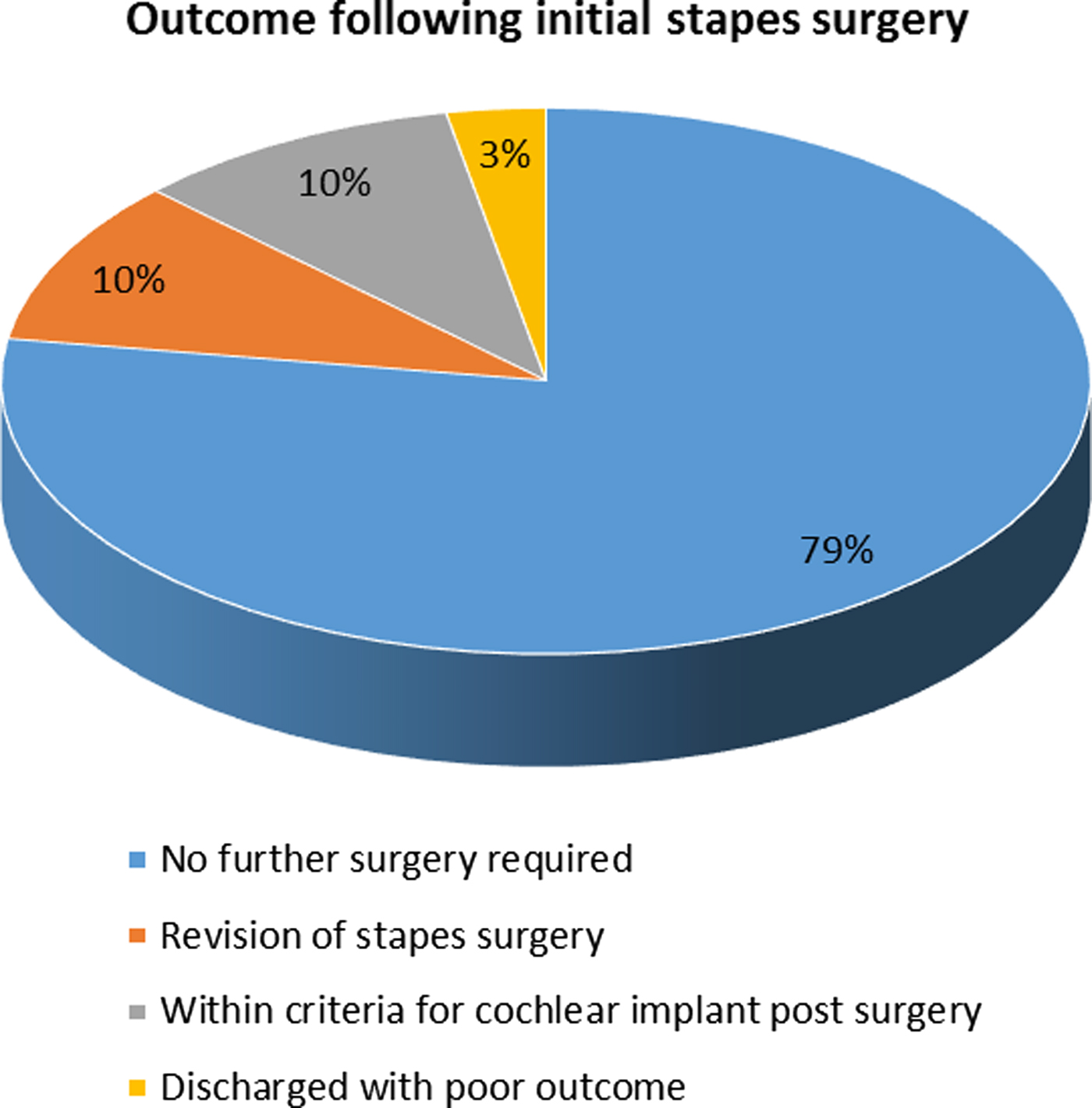
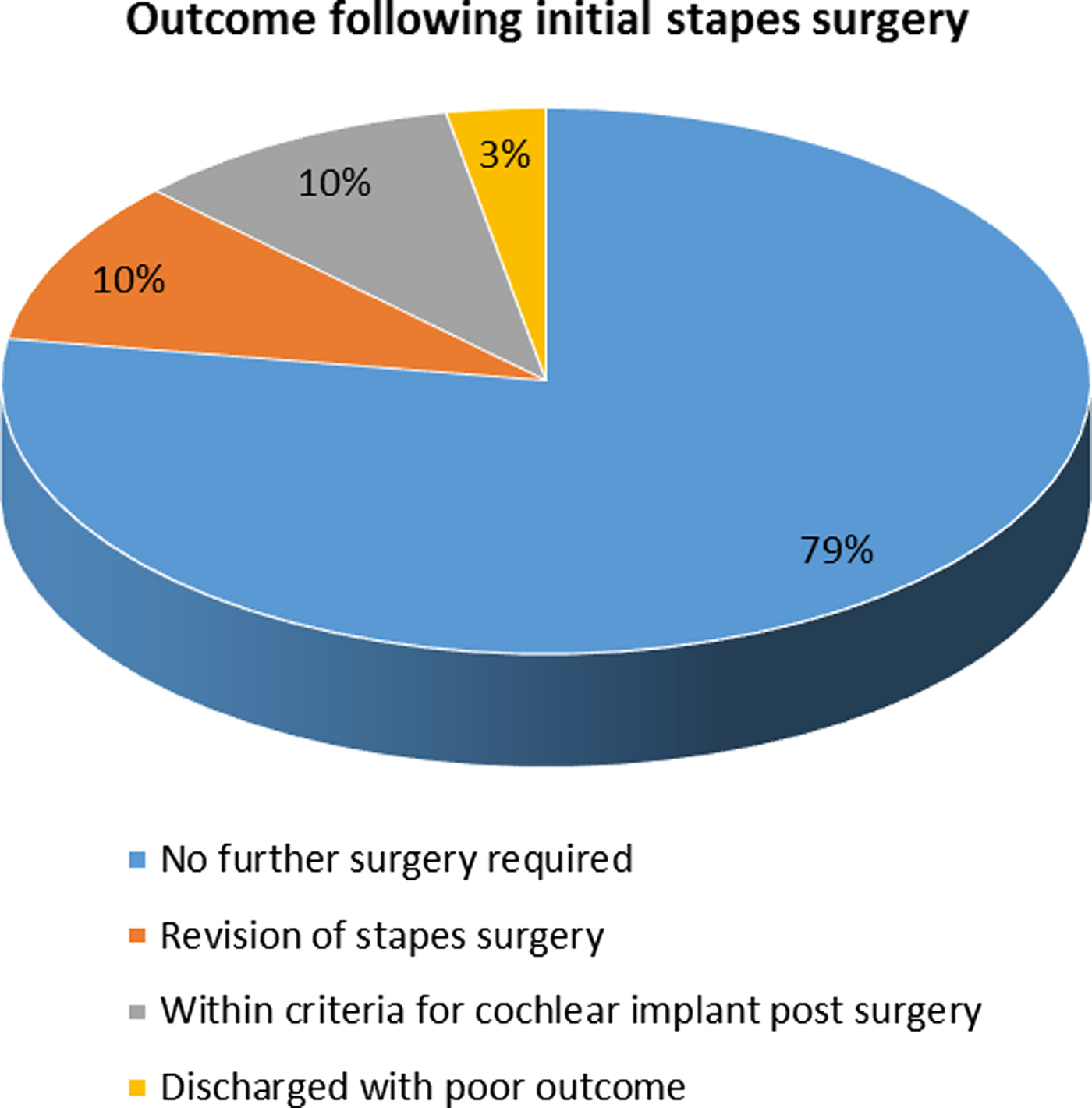
Twenty-two patients (76 per cent) had successful primary surgery, with hearing improvement, and did not undergo further surgery.
Two patients (7 per cent) required revision of stapes surgery; both had a successful outcome, with audiological improvement. Five patients (17 per cent) had hearing loss that satisfied criteria for cochlear implantation after stapes surgery; three of these patients underwent cochlear implantation (Figure 1). One patient (3 per cent) had a poor audiological outcome, with no hearing gain; they did not pursue any further intervention and were discharged following surgery. One patient (3 per cent), who had tinnitus, hemifacial spasm, balance disturbance and a dead ear, was diagnosed with a middle-ear granuloma which had eroded into the inner ear and facial nerve. This was removed via petrosectomy and blind sac closure of the ear. Post-operatively, the facial nerve symptoms resolved and normal facial nerve function was maintained.
Pie chart showing the percentage of patients with a good outcome following stapes surgery, initially or after revision. A minority of patients required cochlear implantation.
Patients who did not show improvement had no standout characteristics in common, although the numbers were small and so meaningful conclusions are difficult.
Audiological outcomes
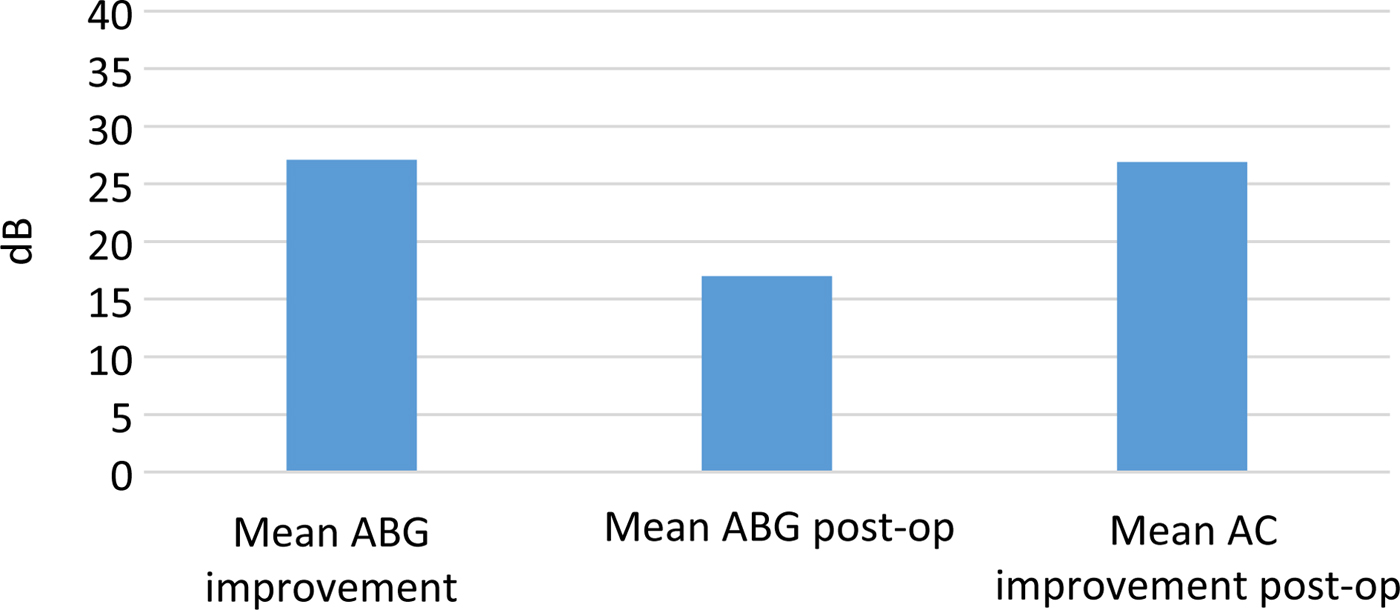
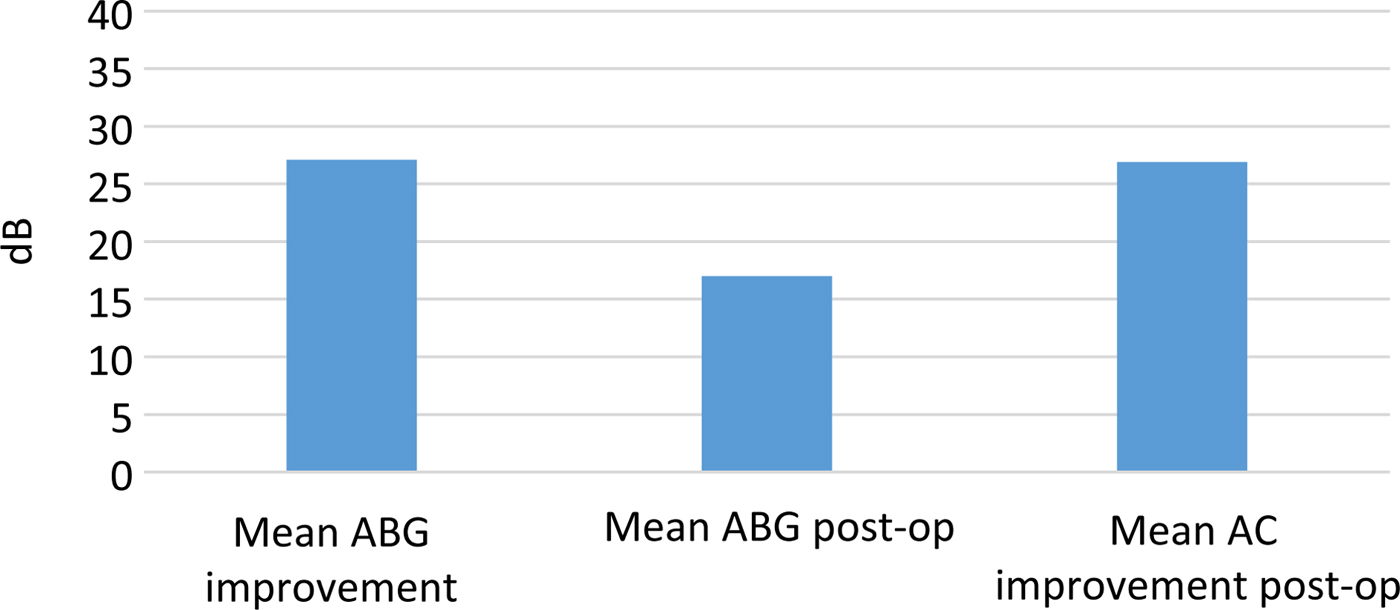
The mean overall improvement in air–bone gap following stapes surgery was 27.1 dB. The mean air–bone gap post-operatively was 17 dB. The mean air conduction improvement was 26.9 dB (Figure 2).
Audiological outcomes of all patients who underwent stapes surgery. ABG = air–bone gap; AC = air conduction
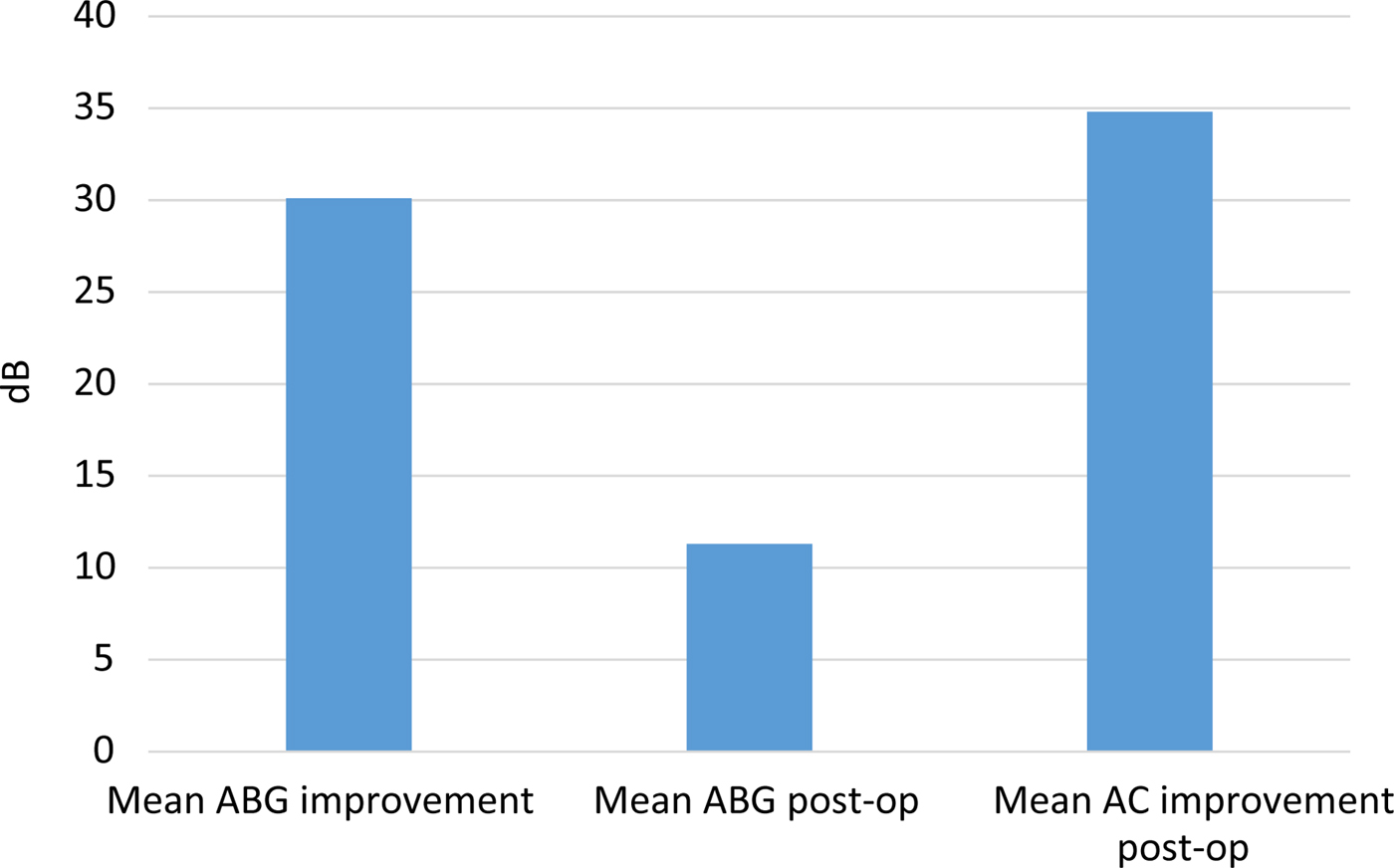
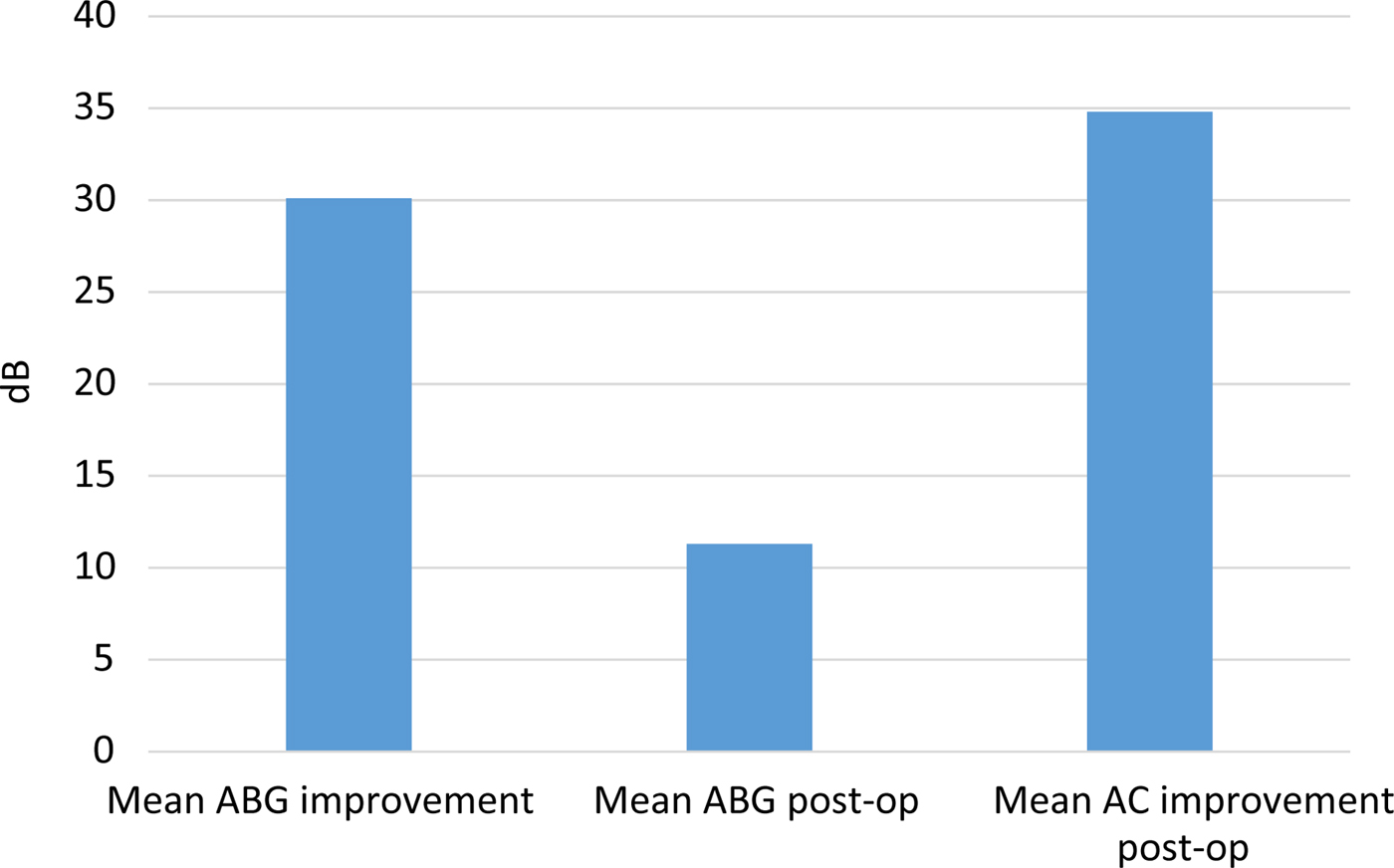
In patients who had successful surgery, the mean air–bone gap improvement was 30.1 dB. The mean air–bone gap post-operatively was 11.3 dB. The mean air conduction improvement was 34.8 dB (Figure 3).
Audiological outcomes of patients who had successful stapes surgery (no complications and no revision surgery). ABG = air–bone gap; AC = air conduction
Discussion
Cochlear implants provide a good audiological outcome in appropriately selected patients. Patients with otosclerosis may gain significant benefit from stapes surgery, a cheaper, less invasive procedure that requires less intensive follow up. In addition, if stapes surgery does not have a successful outcome, a cochlear implant is still an option. Choosing between stapes surgery and cochlear implantation can be a difficult decision for clinicians and patients, with some uncertainty over which will give them the best outcome.Reference Merkus, van Loon, Smit, Smits, de Cock and Hensen 4 Many factors need to be considered when choosing between the treatment options, including severity of disease and hearing loss, patient preference, and the availability of appropriately trained surgeons and audiologists.
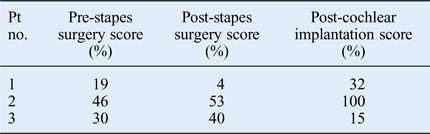
The audiological outcome for the majority of patients who underwent primary stapes surgery at our centre was good. Most patients were further rehabilitated with standard hearing aids. A minority of patients required revision surgery or a cochlear implant. Patients who underwent cochlear implantation after stapes surgery also demonstrated improved audiological performance (Table I).
Speech test results for cochlear implantation patients*

* Speech testing was performed using the Bamford–Kowal–Bench tests. Pt no. = patient number
The success rates of stapes surgery at our centre compare favourably with published success rates, with 60 per cent requiring no further treatment in one study.Reference Kabbara, Gauche, Calmels, Lepage, Escude and Deguine 5 Kabbara et al. had a similarly designed study to ours – a retrospective case review conducted at an academic neurotology tertiary referral centre.Reference Kabbara, Gauche, Calmels, Lepage, Escude and Deguine 5 These authors investigated all patients with advanced otosclerosis treated in the last 20 years. They demonstrated that patients undergoing primary stapedotomy required no further intervention in 60 per cent of cases. They also reported a good outcome from cochlear implantation following primary stapes surgery. The authors supported our conclusion that stapes surgery should be the first-line treatment for patients with advanced otosclerosis.
Other studies have arrived at similar conclusions. Lachance et al. showed that 87 per cent of patients treated at their centre between 2005 and 2010 no longer satisfied criteria for cochlear implantation following primary stapes surgery.Reference Lachance, Bussières and Côté 6 Systematic reviews of the literature also support our conclusion that primary stapedotomy is the best first-line treatment, with cochlear implantation being a subsequent option if the initial outcome is unsatisfactory.Reference van Loon, Merkus, Smit, Smits, Witte and Hensen 7
-
• Some advanced otosclerosis patients will present with hearing thresholds eligible for cochlear implantation
-
• Stapes surgery is often simpler, safer and cheaper than cochlear implantation, and preserves acoustic hearing
-
• Cochlear implantation following stapes surgery is associated with increased complications
-
• Stapes surgery is appropriate for advanced otosclerosis patients, and should be considered prior to cochlear implantation
-
• Patient preference, contralateral hearing and hearing loss duration may influence treatment decision
-
• A small group of patients get little benefit from stapes surgery and will require a cochlear implant
Our study has some limitations. For instance, the sample size is relatively small. This is difficult to avoid given the relative rarity of far advanced otosclerosis. Kabbara et al. reviewed 20 years of cases to find 58 patients.Reference Kabbara, Gauche, Calmels, Lepage, Escude and Deguine 5 The follow-up duration of patients was also quite variable, with the shortest duration being 12 weeks and the longest 3 years. Some late complications of surgery or dissatisfaction with outcome may have been missed. In addition, speech discrimination testing was not performed on all patients in this study. Speech testing is not performed routinely; if these data had been available, it would have provided a more comprehensive assessment of hearing disability pre-operatively and enabled a better assessment of outcome.