Implications
The suitability of modern or old pig genotypes for organic pork production is as widely as contrarily discussed in the organic pig-fattening scene. For a rationally based answer information about potential genotype–environment interactions is necessary. A corresponding trial showed that the modern genotypes selected under conventional conditions are also superior to indigenous breeds under organic conditions in economically important traits.
Introduction
Since the year 2000, there has been a continuously increasing demand for food produced under organic conditions (BÖLW, http://www.boelw.de/dokumente.html). The total turnover in the EU countries in 2006 increased to 13.3 billion €. Germany, with 4.6 billion €, was the leading country within the EU in 2006, holding more than 30% of the total EU market. Germany was followed by Great Britain (2.8 billion €), Italy (1.9 billion €) and France (1.7 billion €). The growth rate in Germany within the last 4 years was above 10% per year. The amount of organic food within the EU is, with 5%, still very low. Within Germany the amount of organic food is only 3%. The market percentage of pig meat from organic production systems in Germany is, with around 1%, lower than for other organic products. One reason for this low amount could be a lacking profile for organic pork. Most of the organic farms use the same breeds as used for conventional systems, hence the consumer can hardly distinguish between pork produced under organic or conventional conditions.
According to EU regulations 1804/1999 (1999) organic production systems should favour indigenous breeds or strains. Producers are often in a conflict situation because the indigenous breeds often show much lower performance, especially for important economic traits like meat percentage or feed conversion ratio in pigs (Loeser and Deerberg, Reference Loeser and Deerberg2004).
The breeding goals for organic pig meat production are very similar to those under conventional production systems, including reproductive performance of sows, daily weight gain, feed conversion ratio and meat percentage in the carcass as major economically important traits. Meat quality requirements are also the focus of both organic and conventional pig production systems. Nevertheless, in discussions about organic production systems it is often argued that special breeding programmes are necessary (Reuter, Reference Reuter2007). The demand for special breeding programmes for organic pig meat production is based on the assumption that when compared with conventionally kept pigs, pigs kept under organic conditions need other biological properties in order to achieve a good performance. Should this be the case, genotype–environment interactions should occur due to changes in the ranking of different pig breeds between the two environments. As a result, breeding programme success, usually achieved under conventional conditions, could not be transferred to organic production environments and a special organic breeding programme would be necessary. Statistically, genotype–environment interactions can be analysed using ANOVA, estimating genetic correlations between traits measured under conventional and under organic conditions (Falconer and Mackay, Reference Falconer and Mackay1996) or using a reaction norm model (De Jong, Reference De Jong1990). For the latter methods, the relationship between animals used under conventional and organic conditions have to be known. Such a structure is available for dairy production systems, therefore these methods have been used in cattle (Calus et al., Reference Calus, Groen and De Jong2002; Fikse et al., Reference Fikse, Rekaya and Weigel2003). In cattle for milk production the genotype–environment interaction is analysed within breed as interaction between breeding values for bulls with daughters in conventional and organic dairy production systems. In pigs the discussion about genotype–environment interaction is seen as an across-breed problem, whether the same breeds can be used for conventional and for organic production systems.
So far, there are no results available from the literature, nor any evidence proving or disproving genotype–environment interactions in pigs kept under conventional or organic conditions. In pigs, the within-breed approach to analyse genotype–environment interaction as correlation between breeding values for boars based on progeny in conventional and organic systems fails so far because very few boars are used in AI under both production systems. Additionally, a second limiting factor for the within-breed approach is missing pedigree information on the widely used crossbred animals in both conventional and organic production system.
Therefore, it was the aim of this study to analyse the occurrence of genotype–environment interactions by testing the performance of genetically different pigs (different breeds) under conventional and organic conditions.
Material and methods
No field data similar in structure to dairy cattle data are available to estimate genetic correlations between traits measured under organic and conventional production systems for pigs. Therefore, a station test with seven different pig breeds kept under conventional and organic feeding and housing systems was performed to estimate possible genotype–environment interactions. Using this test station design, it was not possible to use housing and feeding conditions that can reflect all conditions used in farm production systems neither for conventional nor for organic production systems. Hence, it was decided to use the traditional station test conditions in Germany as conventional standard and organic conditions using the available capacities in the two stations involved in this experiment.
Testing stations and environment
Owing to the temporal and spatially limited capacities, two performance-testing stations (Neu-Ulrichstein and Rohrsen) were used to test the intended number of genotypes and animals with three replications each. The six replications ranged over 2.5 years; the first one started in July 2004 and the last one ended in December 2006. Whereas the three replications in Neu-Ulrichstein were in winter, summer and autumn, the three replications in Rohrsen took place only during summer.
Environment was split into (i) conventional – characterised by housing and feeding conditions of German performance testing station standard as a reflection of modern intensive fattening systems, and (ii) organic – characterised by housing and feeding conditions in accordance to the European Community(EC) Regulation 1804/1999.
Animals
The following genotypes were applied: (i) Angler Sattelschwein (AS; indigenous rare saddleback breed of North Germany), (ii) Schwaebisch–Haellisches (SH) Schwein (indigenous saddleback breed of South Germany), (iii) Piétrain (Pi) × AS (crossbreed of AS with the commercial Pi sire line), (iv) Pi × SH (crossbred of SH with the commercial Pi sire line), (v) Pi × Deutsches Edelschwein (DE; commercial cross with German Large White), (vi) Duroc (Du) × Deutsche Landrasse (DL) (commercial cross of Du with German Landrace) and (vii) Bundeshybridzuchtprogramm (BHZP; final product of a commercial breeding programme). Within all genotypes and both environments, the number of females and castrates was almost balanced except for purebred SH with only 15% females due to the high demand for female breeding stock.
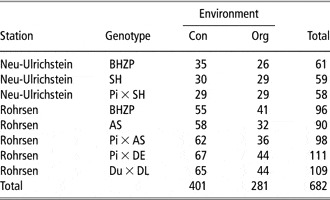
Table 1 gives a survey of the distribution in consideration of station, genotype and environment.
Number of animals (n) grouped by station, genotype and environment

Con = conventional; Org = organic; BHZP = Bundeshybridzuchtprogramm; SH = Schwaebisch–Haellisches; Pi = Piétrain; AS = Angler Sattelschwein; DE = Deutsches Edelschwein; Du = Duroc; DL = Deutsche Landrasse.
The selection of the different genotypes pursued two aims. On the one hand, it ought to represent the huge variety between old, endangered, extensive breeds and modern, intensive hybrid pigs. On the other hand, only pure breeds or single crosses were used, which can be easily generated within an organic production system. Both considerations correspond to the demand of the EC Regulation 1804/1999 to use traditional indigenous or rare breeds and animals of organic origin. The BHZP-genotype was used as an internal standard, and was tested at each station, in each environment and in each replication.
The animals came from different commercial farms throughout Germany. The requirement of organic origin of piglets could not be fulfilled for most of the animals. Pedigree information only existed for BHZP and partially for AS and Pi × AS pigs. All animals were individually identified by electronic ear tags on the occasion of initial weighing and grouping (at about 30 kg live weight) at the performance testing stations.
Thirty-eight pigs, that is 5.6% of the 682 housed pigs did not reach the end of the test, almost balanced for conventional and organic environment. The main causes were respiratory diseases, cardiovascular diseases and leg disorders. Under station test conditions in which piglets are brought together from several farms with unknown hygienic status, the acquisition of loss rates is not representative for field conditions. Additionally, an exact measurement of loss rates requires a higher number of animals as used in this study. Therefore, loss rates will not be further discussed here. In addition to the disease related losses, furthermore nine animals were excluded from the analysis of growth performance and carcass quality, and another four animals (i.e. carcasses) excluded solely from the analysis of carcass quality due to incomplete data records.
Housing and feeding
Conventional housing without straw bedding consisted (i) in Neu-Ulrichstein of the Danish housing system – pens with concrete floor, a minimum of straw in the dung passage and a stocking rate of five animals per pen with an area of 1.2 m2 per animal and (ii) in Rohrsen of pens of two-third of concrete floor and one-third of slats with two animals per pen and an area of 1 m2 per animal. Drinking water was offered by one nipple watering place per pen. Both conventional stables had climate control.
Organic housing in both performance-testing stations consisted of naturally ventilated external climate housing systems with straw bedding, but without an extra outdoor area. In Neu-Ulrichstein and Rohrsen stocking rates were five and four animals per pen, respectively, with an indoor area access per animal of 1.8 and 2.5 m2, respectively. In Neu-Ulrichstein wooden boxes inside the pens offered microclimate zones. Drinking water was offered by one nipple watering place per pen.
Conventional feeding followed the standardised diets of the performance testing stations with 13.3 MJ metabolisable energy (ME) per kg feed and a Lysine: ME ratio of 0.82, used as a one-phase feed. It was pelletised and fed ad libitum in one self-feeder per pen.
Organic diets were formulated in accordance with the EC Regulation 1804/1999 (1999) with 100% organic origin. In Neu-Ulrichstein, the industrially made diet contained 13.1 MJ ME per kg feed and 0.76 g Lysine per MJ ME. Rohrsen disposed over a diet of farm grown feedstuffs (except for 1% oil and 3% minerals) with 12.6 MJ ME per kg feed and 0.73 g Lysine per MJ ME. In both stations, feed was pelletised and fed ad libitum in one self-feeder per pen as a one-phase feed. Additional roughage was not offered due to the impracticability of measuring feed consumption. Consumption of litter straw was scarcely observed.
Self-feeders for conventional and organic diets were filled when required, but at least every third day.
Measurements
Data collection and analyses of growth performance and carcass quality followed the guideline for on-station testing of growth performance, carcass and meat quality of the Board for Performance Testing and Estimation of Breeding Value of the Pig (http://www.zds-bonn.de/section_name_publikation.html) and were similarly conducted in both performance testing stations.
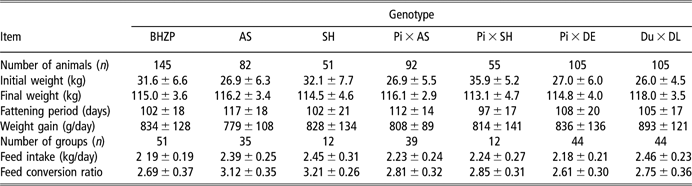
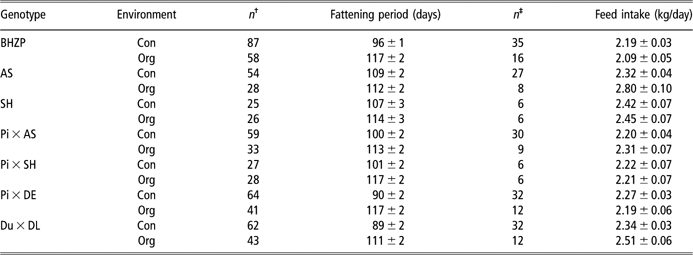
Pigs were individually weighed at the outset and at the end of the trial, on the day of slaughtering, with intermediate weighing every 4 weeks in order to check live weight development. A final live weight of 110 and 115 kg was aimed. Animals were weighed weekly at the end of the fattening period. Daily weight gain of each animal was calculated as the difference between its final and initial live weight, divided by the days of its fattening period. Net filling weight of the self-feeders was equated with feed consumption. Average daily feed intake and feed conversion ratio were calculated as group average. The corresponding growth performance data grouped by genotype can be seen in Table 2.
Growth performance data grouped by genotype (mean ± s.d.)
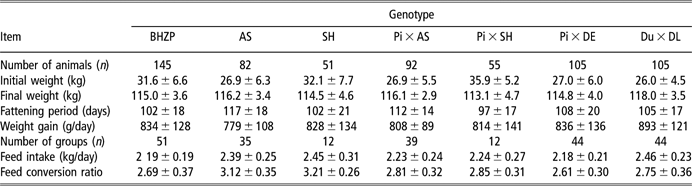
BHZP = Bundeshybridzuchtprogramm; AS = Angler Sattelschwein; SH = Schwaebisch–Haellisches; Pi = Piétrain; DE = Deutsches Edelschwein; Du = Duroc; DL = Deutsche Landrasse.
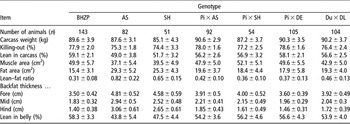
Animals were slaughtered subsequent to a resting period of 1 h in two commercial abattoirs either after electrical (Neu-Ulrichstein) or after CO2 stunning (Rohrsen). In the abattoir, warm carcass weight was recorded in order to calculate killing-out percentage based on the final live weight on station. The day following slaughtering, the right carcass half was used for measuring muscle and fat area and varying fat thickness following the guideline for on-station testing of growth performance, carcass quality and meat quality of the Board for Performance Testing and Estimation of Breeding Value of the Pig (http://www.zds-bonn.de/section_name_publikation.html). Lean to fat ratio is the quotient of fat area and muscle area. Lean meat content is calculated with the ‘Bonner Formula’ (Wiese et al., Reference Wiese, Tholen, Baulain and Höreth2004, see also http://www.zds-bonn.de/neue_bonner_formel.html), which uses fat area and varying fat thickness measurements. Lean meat percentage in the belly is calculated with the ‘Gruber Formula’, which uses muscle area and varying fat thickness measurements. The corresponding carcass quality data grouped by genotype can be seen in Table 3.
Carcass quality data grouped by genotype (mean ± s.d.)

BHZP = Bundeshybridzuchtprogramm; AS = Angler Sattelschwein; SH = Schwaebisch–Haellisches; Pi = Piétrain; DE = Deutsches Edelschwein; Du = Duroc; DL = Deutsche Landrasse.
Statistical analysis
The data were analysed with the analysis of variance (ANOVA) procedure General Linear Model (GLM) of SAS Version 8.1 (SAS, 2000). All traits were normally distributed, and in this study, there is no evidence of unequal variances of traits under conventional and organic production systems (levene test). Because of the design of the experiment with the BHZP breed tested on both stations, and within each replication, and the fact that it was not within the scope of this experiment to estimate station differences, all data were calculated as deviation from the BHZP group within the station and replication. This adjustment eliminates the effect of station and replicate. Hence, finally, genotype, environment and sex were included in the model as fixed effects, as was the interaction between genotype and environment. Other significant interactions are shown in the results. Additionally, as covariate, the initial weight for growth traits and the carcass weight for carcass traits were included in the model. The significance of differences among least square means was calculated using the linear contrast option in SAS GLM. The following GLM was used:

with yijkl = individual observation for traits calculated as deviation from BHZP standard within station and replicate; μ = mean within trait; GTi = fixed effect of genotype (BHZP, AS, SH, Pi × AS, Pi × SH, Pi × DE, Du × DL); EVj = fixed effect of environment (conventional, organic); Sk = fixed effect of sex (castrates, sows); GTi × EVj = fixed interaction between genotype and environment; GTi × Sk = fixed interaction between genotype and sex; eijkl = random residual effect.
Additionally, the initial weight or the carcass weight is included as covariate for growth traits and carcass traits, respectively.
Results and discussion
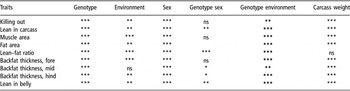
The significance of effects analysed for growth and for carcass traits are summarised in Tables 4 and 5, respectively.
Significance levels of the fixed effects and covariate used in the analyses for growth performance

***P < 0.001; **P < 0.01.
Significance levels of the fixed effects and covariate used in the analyses for carcass quality

ns = not significant.
***P < 0.001; **P < 0.01; *P < 0.05.
The tables show that for all traits the effects of genotype and sex are highly significant and significant to highly significant genotype–environment interactions are detected. The environment also shows expected significant to highly significant effects on all traits except mid-backfat thickness, but it was not the aim of this study to verify these effects. From a statistical point of view, an ANOVA only shows whether an interaction is significant or not, but does not give information about the actual effect in the form of reranking of genotypes. Within an ANOVA with a high number of animals within subclasses, even small differences in ranking of genotypes or small scaling effects can cause significant interactions. In contrast, the method of analysing genotype–environment interactions through estimation of genetic correlations among traits in two different environments can show the significance (also dependent on number of animals) and also give an estimate of the magnitude of the interaction. Significant genotype–environment interactions are also found in recent studies (Nauta et al., Reference Nauta, Veerkamp, Brascamp and Bovenhuis2006; Simianer et al., Reference Simianer, Augsten, Bapst, Franke, Maschka, Reinhardt, Schmidtko and Stricker2007), both using the within-breed correlation approach to detect genotype–environment interactions in dairy cattle. In both studies, genetic correlations between milk traits in conventional and organic dairy production systems above 0.7 are estimated. Only very few estimates in these studies are significantly different (P ⩽ 0.05) from unity, which is a sign of genotype–environment interactions. Nauta et al. (Reference Nauta, Veerkamp, Brascamp and Bovenhuis2006) concluded that only genetic correlations below 0.80 require specific breeding values for organic and for conventional dairy production systems to make an adequate selection of breeding bulls under each system.
For non-ruminants such as pigs, it is necessary for the animals to get the essential amino acids provided through their feed, whereas ruminants such as dairy cows can produce their necessary amino acids through their rumen bacteria from protein resources of minor quality. Therefore, it is expected that ruminants will not react to feed restrictions (one of the major differences between organic and conventional production systems) in the same way as non-ruminants. This can explain the very few significant genotype–environment interactions found for dairy production in contrast to our results for pigs.
Over all breeds, the animals tested under organic housing and feeding conditions show highly significant lower performance than the animals tested under conventional conditions.
Over all breeds under organic conditions, the daily weight gain decreased by 120 g, which leads to a 15-day fattening period to reach final weight, the daily feed intake increased by 80 g and the feed conversion ratio worsened by 0.5 kg feed per kg weight gain. The higher feed intake under organic conditions can be explained by the findings of several studies reviewed by Whittemore et al. (Reference Whittemore, Green and Knap2001) that pigs ‘eat by energy and protein’; hence, under lower-energy content and limiting amino acids (usually Lysine) in the diet pigs will increase their voluntary feed intake. In comparable studies (Millet et al., Reference Millet, Hesta, Seynaeve, Ongenae, De Smet, Debraekeleer and Janssens2004 and Reference Millet, Raes, Van Den Broeck, De Smet and Janssens2005), there is an increase not only in feed intake but also in daily weight gain, and no difference in feed conversion ratio when comparing organic v. conventional feeding and housing. On the other hand, no difference was found in feed intake and in feed efficiency between conventional and organic diets, but a decrease in daily gain when using organic diets without potato protein (Sundrum et al., Reference Sundrum, Buetfering, Henning and Hoppenbrock2000). The same decrease in daily gain of nearly 100 g per day is also reported by Wood et al. (Reference Wood, Nute, Richardson, Whittington, Southwood, Plastow, Mansbridge, Da Costa and Chang2004). As in all the above-mentioned publications different breeds are used, these inconsistent results are a sign of possible genotype–environment interactions for growth traits.
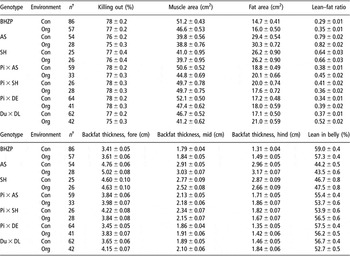
In carcass quality traits, the predominance of the conventional environment is not as obvious as in growth performance traits. Nonetheless, in all breeds, except SH and Pi × SH, the animals tested under organic housing and feeding conditions show inferior carcass quality traits compared with the animals tested under conventional conditions (Table 7). But, significances are not as homogeneous as in growth performance traits (Table 5).
All carcass quality traits (Table 7) show that the organic feeding (and housing) resulted in a higher degree of fatness for all genotypes except SH and Pi × SH. Owing to an increase of the fatness-associated criteria (backfat thickness and fat area) and a decrease of muscle area, resulting lean-to-fat ratio worsened and in consequence decreased lean meat content in the belly as well as in the whole carcass. These findings are consistent with the general tendency of other studies (Sundrum et al., Reference Sundrum, Buetfering, Henning and Hoppenbrock2000; Millet et al., Reference Millet, Hesta, Seynaeve, Ongenae, De Smet, Debraekeleer and Janssens2004; Wood et al., Reference Wood, Nute, Richardson, Whittington, Southwood, Plastow, Mansbridge, Da Costa and Chang2004; Millet et al., Reference Millet, Raes, Van Den Broeck, De Smet and Janssens2005) that organic production systems usually produce lower carcass qualities concerning meat quantity. Concerning a high lean meat yield, the most important fact, beside the use of a suitable genotype, is the proportion between feed energy and limiting amino acids in the diet, with first preference lysine (Moehn et al., Reference Moehn, Gillis, Mougham and De Lange2000). Hence, it is concluded that the main reason for the decreased lean meat in the organically produced carcasses is the poorer lysine: ME ratio of 0.73 and 0.76 of the organic diet, compared with 0.82 in the conventional diet in this study. Therefore, our findings support the fact that a low-dietary protein level increases carcass fatness and decreases carcass leanness (Millet et al., Reference Millet, Ongenae, Hesta, Seynaeve, De Smet and Janssens2006). Table 7 shows that organic conditions resulted in a lower killing-out percentage. This could be an effect of an increased consumption of concentrates (Sundrum et al., Reference Sundrum, Buetfering, Henning and Hoppenbrock2000) and/or roughage (Bellof et al., Reference Bellof, Gaul, Fischer and Lindermeyer1998; Heyer, Reference Heyer2004) and a decreased lean meat content (Schmid, Reference Schmid1987), as shown in Tables 6 (concerning concentrates) and 7 (concerning lean meat content), respectively.
Growth performance data grouped by genotype and environment (LSQM ± s.e.)
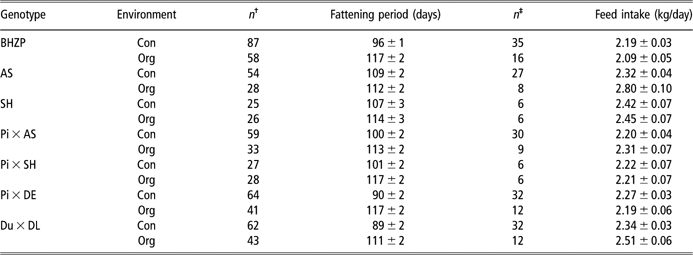
LSQM = least square mean; BHZP = Bundeshybridzuchtprogramm; AS = Angler Sattelschwein; SH = Schwaebisch–Haellisches; Pi = Piétrain; DE = Deutsches Edelschwein; Du = Duroc; DL = Deutsche Landrasse; Con = conventional; Org = organic.
†Number of animals.
‡Number of groups.
The differences in all traits between castrates and sows (data not shown) are in agreement with literature results and will not be further discussed here.
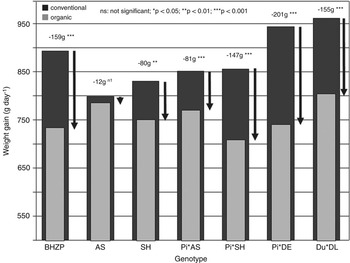
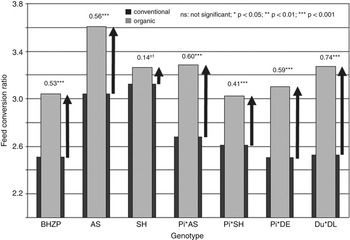
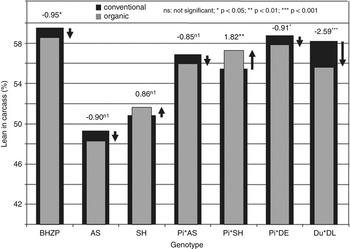
Tables 4 and 5 show that the genotype–environment interactions, the main subject here, are highly significant for all traits shown in this study. To visualise the impact of this interaction, the least square means for the genotype interaction subclasses, including the difference between environments within genotype, are shown graphically for the economically most important criteria, such as daily weight gain (Figure 1), feed conversion ratio (Figure 2) and lean meat content (Figure 3).
Differences of daily weight gain grouped for genotype and environment (least square mean).

Differences of feed conversion ratio grouped for genotype and environment (least square mean).

Differences of lean meat in the carcass grouped for genotype and environment (least square mean).

Figures 1 and 2 show that for daily weight gain and feed conversion ratio, all genotypes show better performance under conventional production systems from an economic point of view. The significant interaction is caused by varying differences between organic and conventional systems within genotype. Concerning growth traits, it could be concluded that the older local breeds (AS for daily gain and SH for feed conversion ratio) did not suffer as much from reduced protein and energy in their diet than the modern highly selected breeds, such as BHZP, Pi × DE and Du × DL. The higher decrease in daily weight gain for modern breeds under organic conditions is also reported in the study of Wood et al. (Reference Wood, Nute, Richardson, Whittington, Southwood, Plastow, Mansbridge, Da Costa and Chang2004), in which the local breeds Berkshire and Tamworth only show a decrease in daily weight gain of 28 to 50 g/day between conventional and low-protein diets compared with 140 to 169 g/day in Du and Large White. The AS animals in this study, reach the same daily gain under both conditions mainly through the much higher feed intake (+480 g/day) under organic conditions compared with conventional fattening. On the other hand, the SH purebred pigs react only with a very small increase in feed intake under organic conditions and the lowest (non-significant) decrease in feed conversion ratio. The rapid decrease in daily weight gain for BHZP, Pi × SH and Pi × DE is caused by the lower feed intake under organic than under conventional conditions and simultaneously the same decrease in feed conversion ratio than most of the breeds. In contrast, the difference of 155 g/day in daily weight gain between environments for Du × DL animals is caused by the highest difference in feed conversion ratio found, but with the second highest increase in feed intake under organic conditions.
Concerning carcass quality (Figure 3), the old breeds (AS and SH) show their low potential in lean meat percentage, which is according to the other findings (Kelly et al., Reference Kelly, Browning, Day, Martins, Pearce, Stopes and Edwards2007). The inferiority is obvious under both systems. Additionally, both breeds show no significant differences between environments. The authors have no explanation for the higher lean meat percentage of purebred SH and Pi × SH crossbred pigs under organic conditions. The lowest number of animals is available from these two genotypes and no knowledge is available about the number of sires or dams these animals came from, which could be the only available explanation for these results. All other genotypes show a decrease in meat percentage close to 1% except the Du × DL animals with 2.6% lower meat percentage under organic conditions. In another study, 0.6% less lean meat was observed under organic conditions (Hansson et al., Reference Hansson, Hamilton, Ekman and Forslund2000). Assuming that in the latter study not all pigs were fed ad libitum to the final weight, the higher decrease in this study under ad libitum feeding till the end was expected. The Du × DL pigs have probably reached their protein growth potential under organic conditions so that the extra 170 g of daily feed intake was converted into fat deposition as the fat area, the fat measurements and also the lean-to-fat ratio under organic conditions show (Table 7).
Carcass quality data grouped by genotype and environment (LSQM ± s.e.)

LSQM = least square mean; BHZP = Bundeshybridzuchtprogramm; AS = Angler Sattelschwein; SH = Schwaebisch–Haellisches; Pi = Piétrain; DE = Deutsches Edelschwein; Du = Duroc; DL = Deutsche Landrasse; Con = conventional; Org = organic.
†Number of animals.
The results clearly show the superior performance in economically important traits like feed conversion and lean meat percentage of modern crosses to the indigenous breeds AS and SH under conventional and organic conditions. Hence, from an economical point of view, the modern breeds should be used under organic production systems as well. The results also show that the crossbreeds with the indigenous breeds on the sow side and the Piétrain as sire line nearly reach the performance of commercial breeds. Such crossbreeds are often used as indigenous breed in a marketing concept for a niche market like the Baeuerliche Erzeugergemeinschaft Schwaebisch Hall.
It can be assumed that under practical, conventional and organic production systems, not all animals, especially not the castrates, are fed ad libitum to the end of the fattening period. Hence, it can be assumed that under restricted feeding regimes, the differences and interactions will probably be smaller than under the feeding conditions shown here.
Conclusions
This study shows statistically significant genotype–environment interactions for all growth and carcass quality traits. Different reactions of indigenous breeds v. modern type breeds to the feeding restrictions under organic production systems, with a less-balanced protein-to-energy ratio in the diet explain most of these interactions. However, the modern type breeds show their performance potential also under organic conditions. Although only the across breed interactions are analysed in this study, it can be concluded that no special breeding programme is necessary for organic pork production. Breeds which realise the best performance in conventional breeding programmes will do so under organic production conditions as well. Hence, breeding success achieved under conventional conditions can be transferred to organic production environments. It is definitely necessary to adjust the overall breeding goals within breeds for organic production systems as it is used in practice for dairy breeds. Under organic production systems, the economic importance of traits probably differs from those under conventional production systems. From an economic point of view, modern crossbreeds should be used for organic production systems, but the choice of the breed is sometimes influenced by the marketing concept, especially for niche markets.
Acknowledgements
This work was funded by BMLEV/BLE under project 03OE323. We thank Gerhard Quanz (Neu-Ulrichstein) and Armin Schoen (Rohrsen) for technical realisation on the performance testing stations.