
Corundum (α-Al2O3) is a material of high technological importance due to its varied applications such as dielectric insulators in complementary metal-oxide semiconductor (CMOS) devices, substrate for growing silicon and gallium nitride, high-temperature structural ceramics, anti-corrosive coatings, and optical devices. This can be attributed to its excellent mechanical strength, high-temperature thermal stability, large band gap (8.8 eV), and high dielectric constant (9.0).[Reference Santos, Longhinotti, Freire, Reimberg and Caetano1, Reference Cahill, Lee and Selinder2] In spite of its widespread usage, most research has focused on its electrical[Reference Guo, Ambrosio and Pasquarello3, Reference Choi, Janotti and Van de Walle4] and chemical[Reference Wu, Lind, Timm, Hjort, Mikkelsen and Wernersson5, Reference Colleoni, Miceli and Pasquarello6] interface properties.
Thermal device design, on the other hand, is of utmost importance as the CMOS transistor gate lengths are scaled below 45 nm.[Reference Pop and Goodson7] InGaAs-based MOS stacks supported on Al2O3 have recently been shown to present better breakdown characteristics due to the high thermal conductivity of Al2O3.[Reference Palumbo, Lombardo and Eizenberg8] Nevertheless, the latest measurements on the thermal conductivity of single-crystal[Reference Cahill, Lee and Selinder2] and amorphous thin films[Reference Stark, Stordeur and Syrowatka9, Reference Lee, Cahill and Allen10] of Al2O3 are almost two decades old and are in contradiction with earlier results.[Reference Slack11] Effect of grain size and impurity phonon scattering on κ in polycrystalline α-Al2O3 has also been studied.[Reference Williams, Graves, Janney, Tiegs and Yarbrough12] There are some recent studies on thermal transport in polycrystalline porous alumina, porous alumina layers, and membranes.[Reference Smith, Fayette, Grandjean, Martin, Telle and Tonnessen13–Reference Kargar, Ramirez, Debnath, Malekpour, Lake and Balandin15] However, there are no computational studies of the thermal conductivities of bulk and thin-film Al2O3, and in this study we fill this gap.
We report the calculated bulk, and the in-plane and cross-plane thin-film lattice thermal conductivities (κ l) of α-Al2O3 with varying cross-sections. κ l calculated using the full iterative solution to the Boltzmann transport equation (BTE) and the relaxation time approximation (RTA) agree well with each other. From now on κ l is simply referred as κ. For the bulk single crystals, we find a value of ~39 W/m K for LDA at 300 K, which is consistent with the experimental values of ~35[Reference Cahill, Lee and Selinder2] and ~39 W/m K,[Reference Slack11] whereas the GGA value ~26 W/m K is considerably smaller. For the thin films, it is found that the reduction in κ already sets in around 40 µm and for a 10 nm film thickness ~79% reduction is observed.
The thermal conductivity tensor, κ αβ, is calculated by carrying out the full BTE computations, i.e., solving the linearized BTE while accounting for all scattering terms as[Reference Carrete, Vermeersch, Katre, van Roekeghem, Wang, Madsen and Mingo16]:
 $$\kappa ^{\alpha \beta} = \sum\limits_\lambda C_\lambda v_\lambda ^\alpha F_\lambda ^\beta, $$
where α and β are the Cartesian coordinates and λ comprises of both the phonon branch index j and wave vector q. C λ is the mode λ contribution to the specific heat, v the group velocity and F is the solution of the linearized BTE written in the form:
 $${\bf F}_\lambda = \tau _\lambda ({\bf v}_\lambda + {\bf \Delta} _\lambda ).$$
In Equation (2), τ λ is the lifetime of mode λ.  $\tau _\lambda {\bf v}_\lambda $ is the RTA phonon mean free path and
 ${\bf \Delta} _\lambda $ accounts for the deviation of the population of a specific phonon mode from the RTA prediction. The detailed expression for
 ${\bf \Delta} _\lambda $ and the full iterative solution to the BTE can be found in Ref. Reference Li, Carrete, Katcho and Mingo17.
Considering the Taylor series of the potential energy up to the third-order term, the total scattering rate τ −1 is calculated as a sum of the contributions from inelastic three-phonon and elastic two-phonon scattering processes as:
 $$\tau ^{ - 1} = \tau _{{\rm 3ph}}^{ - 1} + \tau _{{\rm 2ph}}^{ - 1}. $$
The expressions for the three-phonon scattering rates as well as the isotopic contribution to the two-phonon scattering can be found in Refs. Reference Li, Carrete, Katcho and Mingo17 and Reference Tamura18, respectively. In the present work, only isotope scattering is considered, but in a more general scenario, other contributions to the two-phonon elastic scattering can come from, for example, point defects,[Reference Katre, Carrete, Dongre, Madsen and Mingo19, Reference Dongre, Carrete, Katre, Mingo and Madsen20] nanoparticles,[Reference Kundu, Mingo, Broido and Stewart21] and dislocations.[Reference Wang, Carrete, van Roekeghem, Mingo and Madsen22]
The in-plane ( ${\rm \parallel} $) and cross-plane (⊥) effective thin-film RTA thermal conductivities are calculated according to the methodology developed in Ref. Reference Carrete, Vermeersch, Katre, van Roekeghem, Wang, Madsen and Mingo16, as:
 $$\kappa_{\rm eff}(I) = \sum\limits_{\lambda} S_{\lambda} (I)C_{\lambda} \left\vert {\bf v}_{\lambda} \right\vert {\Lambda}_{\lambda}{\cos}^{2} {\Theta}_{\lambda}.$$
Here I is the film thickness,  $\Lambda (T) = \vert {\bf v} \vert \tau (T)$ the mean free path, and Θ is the angle between the group velocity and the transport axis. The suppression function, S, accounts for the additional phonon scattering induced by the film boundaries. We account for the crystal anisotropy by evaluating the wavevector-resolved S on a mode-by-mode basis, as discussed in Ref. Reference Carrete, Vermeersch, Katre, van Roekeghem, Wang, Madsen and Mingo16. For the in-plane transport, the Cartesian vector
 ${\bf n}$, which denotes the film normal, is perpendicular to the vector
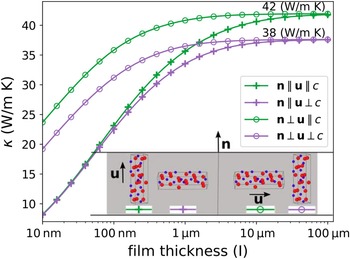
 ${\bf u}$ along which the thermal transport is to be evaluated (see inset Fig. 4), whereas for the cross-plane transport, the two are parallel to each other.
For the in-plane transport, S is defined according to the Fuchs–Sondheimer formalism as[Reference Carrete, Vermeersch, Katre, van Roekeghem, Wang, Madsen and Mingo16]:
 $$S_{\rm \parallel} = \displaystyle{{1 - p\;\hbox{exp}( - 1/K_{\rm \parallel} ) - (1 - p)K_{\rm \parallel} [1 - \hbox{exp}( - 1/K_{\rm \parallel} )]} \over {1 - p\;\hbox{exp}( - 1/K_{\rm \parallel} )}},$$
where  $K_{\rm \parallel} = \hat \Lambda _{\hat z}/I$ is the effective Knudsen number and 0 ≤ p ≤ 1 the specularity, meaning that for p = 0 the film boundaries act as perfectly absorbing black bodies, whereas p = 1 would denote perfectly reflective boundaries. The calculations are carried out in a transformed coordinate system as explained in Ref. Reference Carrete, Vermeersch, Katre, van Roekeghem, Wang, Madsen and Mingo16 and the symbol ^ corresponds to quantities expressed in transformed coordinates. Similarly, for the cross-plane transport where the film boundaries are considered to act as perfectly absorbing black bodies, the suppression function takes the form:
 $$S_ \bot = \displaystyle{1 \over {1 + 2K_ \bot}} $$
and the Knudsen number is simply evaluated without the need for coordinate transforms as, K ⊥ = Λ|cosΘ |/I.
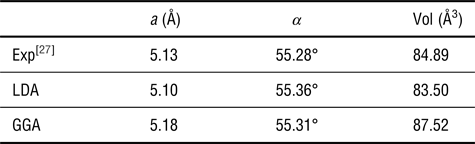
The total energy as well as the force calculations are done using the projector-augmented-wave method[Reference Blöchl23] as implemented in the VASP code,[Reference Kresse and Joubert24] with both the local density approximation (LDA)[Reference Perdew and Zunger25] and the generalized gradient approximation (GGA) to exchange and correlation. For GGA the Perdew–Burke–Ernzerhof exchange and correlation functional[Reference Perdew, Burke and Ernzerhof26] is used. The experimental and calculated equilibrium lattice parameters for α-Al2O3 are shown in Table I.
Lattice parameters for α-Al2O3. The LDA and GGA values are from this work.

The atomic positions and the volume of the unit cell for both LDA and GGA structures are relaxed until the energy and the forces are converged up to 10−8 eV and 10−7eV/Å, respectively. The second- and third-order interatomic force constants (IFCs) are extracted using 4 × 4 × 4 and 3 × 3 × 3 supercells, containing 640 and 270 atoms, respectively, of the rhombohedral primitive cell, using just the Γ-point. For the second-order IFC calculations, we use the Phonopy[Reference Togo and Tanaka28] software package, and for the third-order IFCs, we use our in-house code thirdorder.py.[Reference Li, Carrete, Katcho and Mingo17] The bulk thermal conductivity is calculated using a 18 × 18 × 18 q-point mesh for both LDA and GGA calculations using our in-house code almaBTE.[Reference Carrete, Vermeersch, Katre, van Roekeghem, Wang, Madsen and Mingo16] As α-Al2O3 is polar, a non-analytical correction is added to the dynamical matrix to correctly reproduce the LO–TO splitting (see Fig. 2).[Reference Wang, Wang, Wang, Mei, Shang, Chen and Liu29]
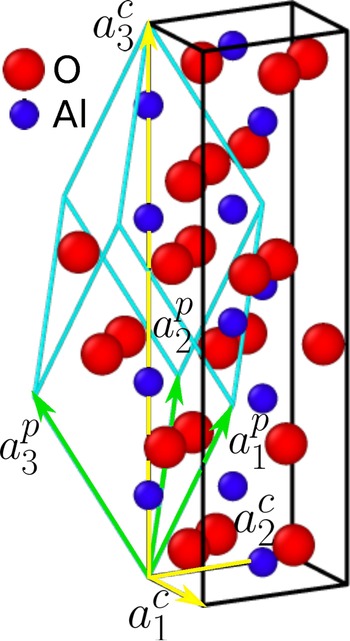
α-Al2O3 belongs to the trigonal crystal system and has space group  $R\bar 3c$ [167]. In the conventional description, its crystal structure is composed of six molecular units (30 atoms) and can be described as a nearly close-packed ABAB stacking of oxygen ions. The aluminium ions occupy two-thirds of the octahedral interstitial sites along the c-axis
 $(a_3^{\rm c} )$ of the hexagonal coordinate system, i.e., the [0001] direction. The primitive unit cell is composed of two molecular units of Al2O3 (ten atoms). The relationship between the two lattices can be seen in Fig. 1. The lattices are oriented in such a fashion that the [0001] direction of the conventional lattice and the [111] direction of the primitive lattice are both parallel to the z direction in the Cartesian coordinate system.
Crystal structure of α-Al2O3 in the conventional (black) and primitive (blue) lattices, with  $a_1^{\rm p}, a_2^{\rm p} $, and
 $a_3^{\rm p} $ being the primitive lattice vectors and
 $a_1^{\rm c}, a_2^{\rm c} $, and
 $a_3^{\rm c} $ being the conventional lattice vectors.

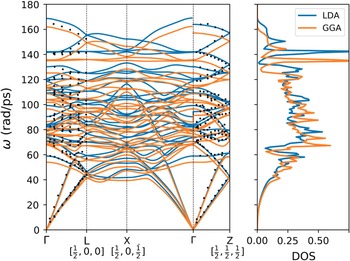
The calculated LDA and GGA phonon band structures and the corresponding density of states of α-Al2O3 are shown in Fig. 2. We get an excellent agreement of the LDA dispersion with the inelastic neutron scattering dispersion, as also obtained earlier by Heid et al.[Reference Heid, Strauch and Bohnen30] The LDA frequencies are significantly higher than the GGA values at the Brillouin zone boundaries. This agrees with the fact that the LDA relaxed structure volume is ~5% smaller than GGA (Table I). It is also seen that the slope of the graphs along the Γ-Z and Γ-X directions which correspond to the group velocities along the  $a_3^{\rm c} $ and the
 $a_1^{\rm c} $ axes, respectively, are only slightly different. This small difference in the group velocities is also reflected in a small anisotropy in the thermal conductivity values along the respective directions, as we will see later.
LDA and GGA phonon bandstructure and density of states (DOS) of α-Al2O3. The black dots are the data from the inelastic neutron scattering experiments from Ref. Reference Schober, Strauch and Dorner31.

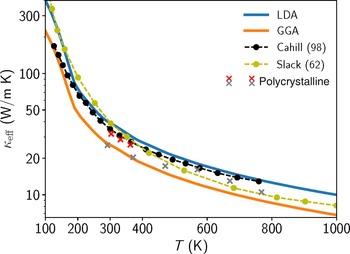
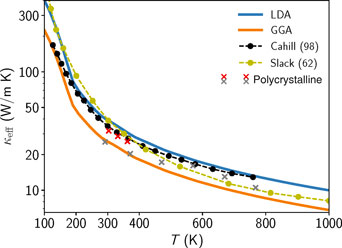
Figure 3 shows the calculated BTE and experimental thermal conductivities of α-Al2O3. Our values are in very good agreement with the single-crystal experimental values in the literature.[Reference Cahill, Lee and Selinder2, Reference Slack11] The relatively more recent single-crystal values by Cahill et al.[Reference Cahill, Lee and Selinder2] are found to be in better agreement to the LDA values than GGA. Whereas, for the earlier results compiled by Slack,[Reference Slack11] a good agreement with LDA is found up till room temperature. For higher temperatures, the Slack data fall off more rapidly than both the LDA and the more recent experimental results. This high-temperature deviation can be seen as a difference in the experimental techniques used for different temperature regimes in the results compiled by Slack.[Reference Slack11] It should also be noted that some of these high-temperature values are even lower than the κ of 90% dense polycrystalline samples measured by Smith et al.,[Reference Smith, Fayette, Grandjean, Martin, Telle and Tonnessen13] which is unrealistic. Williams et al.[Reference Williams, Graves, Janney, Tiegs and Yarbrough12] measured the κ for a sample of 99.3% dense polycrystalline α-Al2O3 with a grain size of 7.2 µm and obtained a value of 31.7 W/m K at 303 K, Fig. 3. However, with our LDA calculations, this reduction is only observed for a grain size of 0.5 µm. The agreement of the experimental thermal conductivity values with the LDA results is also in line with the excellent agreement of the LDA and experimental phonon dispersions (Fig. 2). Earlier calculations by some of us have also shown better agreement of LDA thermal conductivities with the experimental ones as compared with those obtained with GGA.[Reference Katre, Togo, Tanaka and Madsen32]
Effective thermal conductivity (κ eff = Tr(κ αβ)/3) of α-Al2O3 compared with the experimental results. The black and the yellow dots are the single-crystal data from Cahill et al.[Reference Cahill, Lee and Selinder2] and Slack,[Reference Slack11] respectively. The red crosses are for the 99.3% dense polycrystalline samples from Williams et al.,[Reference Williams, Graves, Janney, Tiegs and Yarbrough12] whereas the gray crosses are for 90% dense polycrystalline samples from Smith et al.[Reference Smith, Fayette, Grandjean, Martin, Telle and Tonnessen13]

Throughout the temperature range, the experimental values lie between the LDA and GGA values. As can be seen in Table I, the LDA lattice volume is smaller than the experimental one which is again smaller than that obtained with GGA. This translates to LDA having stronger interatomic interactions and larger second- and third-order IFCs. The influence on κ will thus be a competition between the increased group velocities and third-order scattering rates. In the present case, we do indeed find a lower thermal conductivity with phonon softening (Fig. 2) whereas, in other cases, even a slight increase in κ has been found in connection with phonon softening.[Reference Stern, Wang, Carrete, Mingo and Madsen33]
The room temperature LDA in-plane and cross-plane thermal conductivities of α-Al2O3 for thicknesses varying from 10 nm to 100 µm are shown in Fig. 4. We find that for cross-plane transport along the  $a_3^{\rm c} $ axis (green curve with plus signs) reduction in κ starts already around 20–30 µm film thickness. A 50% reduction is observed at ~80 nm, where as ~80% is observed at 10 nm film thickness. It can be observed that the cross-plane reduction in κ is much higher than the in-plane reduction. This is a direct consequence of the fact that the suppression function (S), by its construction, contributes more to the scattering in the cross-plane direction than the in-plane direction.
Thermal conductivity of α-Al2O3 films calculated at p = 0.2. The green and purple curves correspond to the calculations with transport axis being parallel to, and perpendicular to the c-axis of the conventional cell in Fig. 1, respectively. The open circles correspond to the in-plane transport, whereas the plus signs denote the cross-plane transport as shown by the corresponding  ${\bf u}$ vectors in the inset.

The bulk values for transport along both the  $a_3^{\rm c} $ axis and the basal plane are recovered for ~40 µm film thickness. We observe that the ratio of thermal conductivity along the
 $a_3^{\rm c} $ axis to the one in the basal
 $a_1^{\rm c} - a_2^{\rm c} $ plane is 1.1 which agrees well with the experimental value at 300 K.[Reference Slack11] This slight anisotropy in the κ values is related to the aforementioned small difference in the group velocities along the
 $a_1^{\rm c} $ and
 $a_3^{\rm c} $ axes.
In conclusion, we have reported the first-principles calculations of the bulk, and in-plane and cross-plane lattice thermal conductivities of α-Al2O3 for varying film thicknesses. The LDA values are 1.5–1.8 times higher than GGA values throughout the temperature range. A very good agreement between the LDA values and the recent experimental values by Cahill et al.[Reference Cahill, Lee and Selinder2] was found. We have calculated the thin-film thermal conductivities of crystalline α-Al2O3 for thicknesses varying from 100 µm to 10 nm. A maximum of ~79% reduction was observed in κ for 10 nm film thickness.
Acknowledgments
The authors acknowledge support from the European Union's Horizon 2020 Research and Innovation Programme, Grant No. 645776 (ALMA).