Introduction
Canada fleabane, also known as marestail or horseweed, is a summer or winter annual (Weaver Reference Weaver2001). It is a member of the Asteraceae or Compositae family, is native to North America, and is found throughout most of Canada (Weaver Reference Weaver2001). Canada fleabane can grow in diverse environments, such as roadsides, railways, and fields with reduced or no tillage, but is found most frequently on coarse-textured and well-drained soils (Weaver Reference Weaver2001).
Canada fleabane has a short taproot with a few lateral roots, and has narrow, sparsely haired, dark green leaves with toothed margins that are attached alternately to an erect hairy stem (Weaver Reference Weaver2001). It begins to flower in mid-July, with peak seed production in August (Weaver Reference Weaver2001). Canada fleabane can produce thousands of florets; each of which can produce approximately 40 seeds, resulting in up to 1 million seeds per plant (Tozzi and Van Acker Reference Tozzi and Van Acker2014). The seed remains viable in the soil for 1 to 2 yr (Green et al. Reference Green, Sindel, Charles and Werth2008). Each seed is approximately 1 mm long with an attached pappus that aids in wind dispersal (Main et al. Reference Main, Steckel, Hayes and Mueller2006; Tozzi and Van Acker Reference Tozzi and Van Acker2014). Most of the seeds (99%) fall within 100 m of the mother plant (Steckel et al. Reference Steckel, Main and Mueller2010), but the seeds can enter the planetary boundary layer and move over 500 km (Shields et al. Reference Shields, Dauer, VanGessel and Neumann2006).
Glyphosate-resistant (GR) Canada fleabane was first confirmed in Delaware, USA in 2000 (Main et al. Reference Main, Mueller, Hayes and Wikerson2004). As of 2016, it has been found in 17 additional countries around the world including Brazil, China, Poland, and Greece (Heap Reference Heap2016). Canada fleabane was the second GR weed discovered in Canada in 2010, in Essex County in southwestern Ontario (Byker et al. Reference Byker, Soltani, Robinson, Tardif, Lawton and Sikkema2013). Glyphosate resistance in Canada fleabane has developed through non-target site mechanisms, which are passed on via an incompletely dominant single nuclear gene (Beckie Reference Beckie2011; Christoffers and Varanasi Reference Christoffers and Varanasi2010). The rapid spread of GR Canada fleabane across Ontario is due primarily to windborne seeds, but it is possible that new populations have evolved through mutations in addition to movement from seed dispersal (Byker et al. Reference Byker, Soltani, Robinson, Tardif, Lawton and Sikkema2013; Yuan et al. Reference Yuan, Abercrombie, Cao, Halfhill, Zhou, Peng, Hu, Rao, Heck, Larosa, Sammons, Wang, Ranjan, Johnson, Wadl, Scheffler, Rinehart, Trigiano and Stewart2010). Self-fertilization allows the proportion of GR biotypes to increase rapidly in a population under selection pressure (Weaver Reference Weaver2001).
Cover crops provide many benefits such as reduction of erosion, soil nutrient sequestration, reduction of nutrient leaching, and increasing soil organic matter (Blanco-Canqui et al. Reference Blanco-Canqui, Shaver, Lindquist, Shapiro, Elmore, Francis and Hergert2015; Snapp et al. Reference Snapp, Swinton, Labarta, Mutch, Black, Leep, Nyiraneza and O’Neil2005; Thilakarathna et al. Reference Thilakarathna, Serran, Lauzon, Janovicek and Deen2015). Cover crops can also reduce weed emergence, growth, and seed production (Teasdale et al. Reference Teasdale, Brandsæter, Calegari and Skora Neto2007). Winter annual cover crops produce biomass that can suppress weeds throughout the autumn and the following spring (Teasdale Reference Teasdale1996). Following spring termination, cover crop residue can suppress weeds for part of the growing season (Teasdale Reference Teasdale1996). However, overly dense cover crop residue can interfere with crop establishment (Teasdale Reference Teasdale1996). Cover crops may not completely control all weeds present in a field; therefore, other weed management tactics may be required including the use of POST herbicides (Sarrantonio and Gallandt Reference Sarrantonio and Gallandt2003; Teasdale Reference Teasdale1998).
Cover crops and their residues modify the soil environment, which may result in weed suppression (Moore et al. Reference Moore, Gillespie and Swanton1994). Cover crops reduce light that reaches the soil surface, reduce soil temperature, and modify soil moisture content (Creamer et al. 1996). Furthermore, cover crops take up nutrients, reducing their availability to support weed growth (Teasdale et al. Reference Teasdale, Brandsæter, Calegari and Skora Neto2007). Pioneer weed species tend to be affected more by cover crops than successional weed species (Teasdale Reference Teasdale1998). Annual weeds are easier to control with cover crops, because after initial establishment they have lower energy reserves available (Teasdale et al. Reference Teasdale, Brandsæter, Calegari and Skora Neto2007). Furthermore, weed seed predation is increased when cover crops are present (Moore et al. Reference Moore, Gillespie and Swanton1994). It is important to note that in certain circumstances, cover crops can also encourage weed growth by maintaining soil moisture and releasing nutrients to an established weed seedling or growing weed (Teasdale et al. Reference Teasdale, Brandsæter, Calegari and Skora Neto2007).
Attributes to consider when selecting a cover crop include speed of emergence and establishment, time to canopy closure, and biomass production (Blackshaw et al. Reference Blackshaw, Anderson and Lemerle2007; Sarrantonio and Gallandt Reference Sarrantonio and Gallandt2003). Cover crops that intercept a greater amount of incident radiation are better at reducing weed growth (Kruidhof et al. Reference Kruidhof, Bastiaans and Kropff2008). The longer a cover crop can grow, the greater the weed suppression it will exert (Blackshaw et al. Reference Blackshaw, Anderson and Lemerle2007). It is important that cover crops do not compete with the main cash-generating crop, through either direct competition or residues on the soil.
Corn residues reduce Canada fleabane emergence more than soybean (Glycine max L. Merr.) or cotton (Gossypium hirsutum L.) residues; however, residues from all three crops have been found to reduce Canada fleabane emergence compared to bare soil (Main et al. Reference Main, Steckel, Hayes and Mueller2006). In Indiana, Davis et al. (Reference Davis, Gibson, Bauman, Weller and Johnson2007) reported that an overwintering wheat (Triticum aestivum L.) cover crop reduced Canada fleabane density both 1 mo after termination via a spring preplanting burndown and 1 mo after the spring seeding of the main cash-generating crop to a greater extent than an autumn-applied residual herbicide. However, they did not find a reduction in Canada fleabane density 4 mo after seeding the main cash-generating crop compared to a residual herbicide applied in the autumn. Furthermore, there were no differences in Canada fleabane densities between the winter wheat cover crop and a spring-applied residual herbicide. The following year, the autumn- and spring-applied residual herbicides reduced Canada fleabane densities more than the winter wheat cover crop.
The increased incidence of herbicide-resistant weeds has given rise to a need for alternative control methods to reduce the reliance on herbicides for weed control. Therefore, the objective of this study was to determine if cover crops seeded after winter wheat harvest could suppress the establishment and growth of GR Canada fleabane in corn grown the following growing season in Ontario.
Materials and Methods
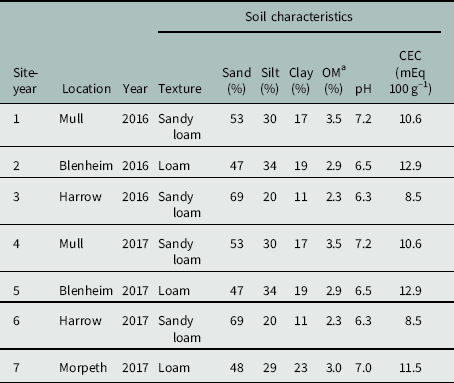
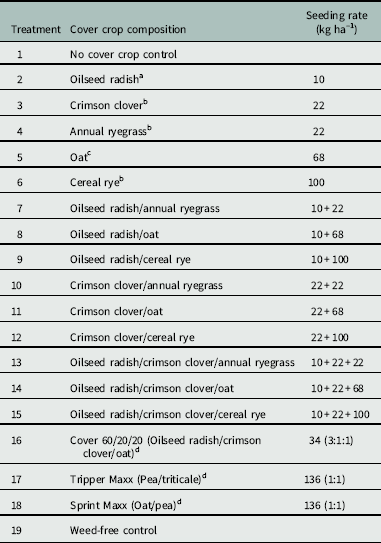
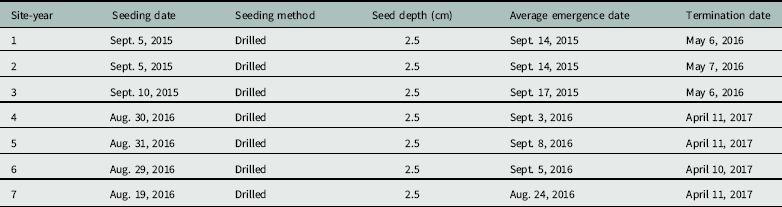
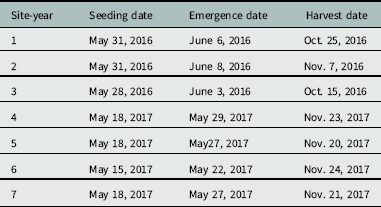
This experiment was conducted over a 3-yr period (2015–2017) at 7 site-years in southwestern Ontario. The studies were initiated when the cover crops were seeded in late summer after winter wheat harvest, and completed after corn harvest the following calendar year. Site-year locations, years, and soil characteristics are presented in Table 1. Each experiment was designed as a randomized complete block design with four replications. The cover crops evaluated were oilseed radish (OSR), crimson clover (CC), annual ryegrass (ARG), oat (Avena sativa L.) (O), and cereal rye (CR) seeded alone and in combination plus three commercial standards: Cover 60/20/20, a blend of OSR, CC, and O; Tripper Maxx, a blend of pea (Pisum sativum L.) and triticale (Triticale hexaploide Lart.); and Sprint Maxx, a blend of O and pea. The cover crop treatments and their seeding rates are presented in Table 2. Cover crop seeding rates were based on the Midwest Cover Crop Field Guide (Midwest Cover Crop Council and Purdue Crop Diagnostic Training and Research Center 2012). Each replicate contained a control treatment where a cover crop was not seeded (no cover crop control), and no cover crop plus GR Canada fleabane-free control (weed-free control) (Table 2). The weed-free control was maintained by applying dicamba/atrazine (1800 g ai ha–1) preplanting to the corn followed by hand hoeing as required. Each plot was 2.25 m wide (three corn rows spaced 0.75 m apart) by 8 m long. Cover crop information including seeding date, seeding method, seeding depth, average emergence date, and termination date are presented in Table 3. Cover crops were seeded, in rows spaced 0.18 m apart, using an International 5100 drill after the wheat stubble had been mowed. The drill was calibrated for each cover crop treatment. Cover crops were terminated the following spring using glyphosate (1800 g ai ha–1) applied before the corn was planted; plots were re-sprayed if the cover crops were not controlled completely. Glyphosate also controlled any emerged weeds with the exception of GR Canada fleabane. Corn seeding date, hybrid, seeding rate, seeding method, seeding depth, emergence date, and harvest date are presented in Table 4. Corn was seeded using a custom-built no-till three-row Kinze planter with Yetter coulters and row cleaners. No starter fertilizer was applied at planting. At the V4 corn stage, urea was applied at 224 kg N ha–1. Herbicides were applied with a CO2-pressurized backpack sprayer calibrated to deliver 200 L ha–1 at a pressure of 276 kPa equipped with a 1.5-m spray boom with four ULD 120-02 (Hypro, New Brighton, MN) nozzles spaced 0.5 m apart resulting in a 2.0-m treatment width.
Location, year, and soil characteristics for the 7 site-years in southwestern Ontario in 2015–16 and 2016–17.

a Abbreviations: OM, organic matter; CEC, cation exchange capacity.
Cover crop treatment information including treatment number, cover crop composition, and seeding rate for the 7 site-years in southwestern Ontario in 2015 and 2016.

a La Crosse Seed (La Crosse, WI).
b Speare Seeds Ltd (Harriston, ON).
c Maynard Feed Specialist (Chatham, ON).
d Growmark Inc. (Kitchener, ON).
Cover crop information including seeding date, seeding method, seed depth, average emergence date, and termination date for the 7 site-years in southwestern Ontario in 2015 and 2016.

Corn information including seeding date, hybrid, seeding rate, seeding method, seed depth, emergence date, and harvest date for the 7 site-years in southwestern Ontario.Footnote a

a The corn hybrid planted at all 7 site-years was DKC53-56 (Dekalb® (Winnipeg, MB); seeds were planted at 83 seeds per 100 ha–1 at a depth of 4 cm.
The percentage cover crop ground cover was assessed visually 2, 4, and 8 wk after cover crop emergence (WAE). Cover crop density and biomass were determined 4 WAE from two 0.25-m2 quadrats, with one placed toward the front and one toward the back of the plot. Cover crop plants were counted by species, cut at the soil surface, placed in paper bags by species, dried at 60 C for 72 h in an oven, and then weighed.
GR Canada fleabane suppression was assessed in corn around mid-May and around the beginning of June, July, August, and September. Visual assessments of GR Canada fleabane suppression were performed on a scale of 0 to 100, with 0 representing no decrease in Canada fleabane compared to the no cover crop control. Around mid-May, GR Canada fleabane had not emerged at site-years 1 and 2, and at the June rating it had not emerged at site-year 2. Therefore, no data were collected at those site-years at those assessment times. GR Canada fleabane density and biomass were determined at the beginning of July by counting the number of GR Canada fleabane in two 0.25-m2 quadrats placed randomly between the corn rows. The GR Canada fleabane was cut at the soil surface, placed in paper bags, dried at 60 C for 72 h in an oven, and then weighed. Grain corn was harvested at maturity by removing the cobs from 2 m of the center rows from each plot and threshing them in a stationary threshing machine. The corn weight and moisture content were recorded for each plot.
Data were analyzed in SAS (Version 9.4, SAS Institute Inc., Cary, NC) using PROC MIXED with the cover crop treatments set as a fixed effect, whereas the random effects were the environments, blocks nested within environment, and the cover crop treatment-by-environment interaction. Error assumptions of the variance analysis were examined using residual plots to ensure the data were random, independent, and homogeneous. The Shapiro-Wilk test for normality was performed using PROC UNIVARIATE in SAS. The w-value was used to determine if the data needed to be transformed. The percentage cover crop ground cover data at 4 WAE and the GR Canada fleabane suppression assessments from May through September were not transformed. Percentage cover crop ground cover data at 2 WAE and cover crop biomass were transformed using square root (x+0.5); cover crop density, GR Canada fleabane density, and the GR Canada fleabane biomass were natural log (x+1) transformed; and percentage cover crop ground cover data at 8 WAE was arcsine transformed prior to analysis. The no cover crop control treatment was excluded from analysis for the ground cover and GR Canada fleabane suppression evaluations, but values were compared to zero independently (using lsmeans output). Tukey’s HSD was used to separate means at α=0.10. Weed suppression with cover crops has proved to be variable in other research; therefore, α=0.10 was used rather than α=0.05 (Moore et al. Reference Moore, Gillespie and Swanton1994). Though a direct comparison with chemical control was not included in this study, the variability in herbicide control trials is smaller than in biological control studies (Moore et al. Reference Moore, Gillespie and Swanton1994). The lsmeans of transformed data were back-transformed for presentation purposes.
Correlations between cover crop ground cover at 4 WAE, cover crop density, and cover crop biomass were compared to GR Canada fleabane suppression around July 1, density and biomass using PROC CORR in SAS. Data were transformed as previously described to satisfy the assumptions of the correlation analysis.
Results and Discussion
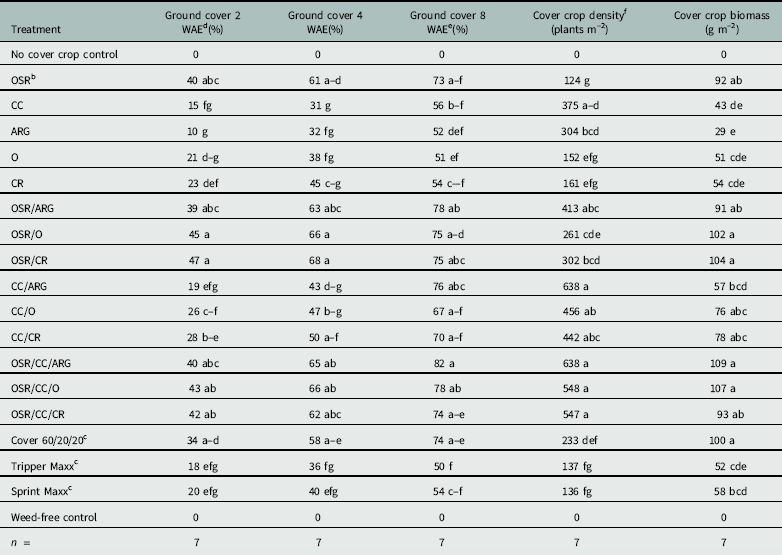
Rapid cover crop establishment and canopy closure after seeding may be important for Canada fleabane suppression. Cover crop ground cover increased throughout the autumn. The cover crops provided 10% to 47%, 31% to 68%, and 50% to 82% ground cover at 2, 4, and 8 WAE, respectively, with all cover crops providing greater ground cover than the controls (Table 5). At all three data assessment timings, OSR/ARG, OSR/O, OSR/CR, OSR/CC/ARG, OSR/CC/O, OSR/CC/CR, and Cover 60/20/20 provided greater ground cover, whereas CC, ARG, O, CC/ARG, Tripper Maxx, and Sprint Maxx provided lesser ground cover. Other treatments provided different levels of ground cover across the different assessment timings.
Cover crop treatments and their means for ground cover 2, 4, and 8 wk after emergence, cover crop density, and biomass 4 wk after emergence for the 7 site-years in southwestern Ontario in 2015 and 2016.Footnote a

a Means within column followed by the same letter are not different according to Tukey’s HSD at α=0.10.
b Abbreviations: ARG, annual ryegrass; CC, crimson clover; CR, cereal rye; O, oat; OSR, oilseed radish; WAE, weeks after emergence of cover crop; n, number of site-years within means of each column.
c Cover 60/20/20 is a commercial blend of oilseed radish, crimson clover, and oat; Tripper Maxx is a commercial blend of pea and triticale; Sprint Maxx is a commercial blend of oat and pea.
d Ground cover 2 WAE and cover crop biomass data were square root transformed prior to analysis; the square root means were back-transformed for presentation purposes.
e Ground cover 8 WAE data were arcsine transformed prior to analysis; the arcsine means were back-transformed for presentation purposes.
f Cover crop density data were log transformed prior to analysis; the log means were back-transformed for presentation purposes.
Cover crop treatments that contain OSR provided greater ground cover at both 2 and 4 WAE than most monocot species and cover crop treatments containing CC. This can be attributed to the more rapid establishment of OSR and its broad leaves, which cover more surface area compared to monocot species and CC. When seeded as a monoculture, OSR provided greater ground cover than the other cover crop species evaluated at 2 WAE; however, by 8 WAE, it was not different from any of the other monocultures. CR provided greater ground cover than ARG, indicating that there were differences among monocot species at 2 WAE but not at the later ratings.
Cover crop plant population densities depended on the seeding rates of each treatment; therefore, any differences in surface cover or Canada fleabane suppression across cover crop species are confounded with differences in seeding rates. Cover crop plant densities across treatments varied from 124 to 638 plants m–2 at 4 WAE (Table 5). CC, OSR/ARG, CC/ARG, CC/O, CC/CR, OSR/CC/ARG, OSR/CC/O, and OSR/CC/CR had the highest densities at 375 to 638 plants m–2. ARG, OSR/O, OSR/CR, and Cover 60/20/20 had intermediate densities of 233 to 304 plants m–2, whereas OSR, O, CR, Tripper Maxx, and Sprint Maxx had the lowest densities at 124 to 161 plants m–2. In the monoculture treatments, CC and ARG had higher densities than OSR, O, and CR. Cover 60/20/20 had about 45% of the density found with OSR/CC/O. The OSR/CC/O mixture had a total seeding rate of 100 kg ha–1, whereas the Cover 60/20/20 treatment, which is composed of the same three species, had a seeding rate of 34 kg ha–1. In the monocultures, the treatments with smaller seeds such as CC and ARG had higher densities than species with larger seeds such as OSR, O, and CR. When comparing the monoculture treatments that contained monocots, ARG had a lower seeding rate than O and CR; however, ARG had a higher density.
At 4 WAE, cover crop biomass varied between 29 and 109 g m–2, depending on the cover crop treatment (Table 5). The cover crop treatments with the highest cover crop biomass at 4 WAE (76 to 109 g m–2) included OSR, OSR/ARG, OSR/O, OSR/CR, CC/O, CC/CR, OSR/CC/ARG, OSR/CC/O, OSR/CC/CR, and Cover 60/20/20. CC/ARG and Sprint Maxx had intermediate levels of biomass of 57 to 58 g m–2. CC, ARG, O, CR, and Tripper Maxx produced the least biomass at 29 to 54 g m–2. Among the monocultures, the OSR treatment produced the highest biomass. Biomass was similar for Cover 60/20/20 and the OSR/CC/O mixture, although their densities were different. Cover 60/20/20 had more biomass than the other commercial mixtures.
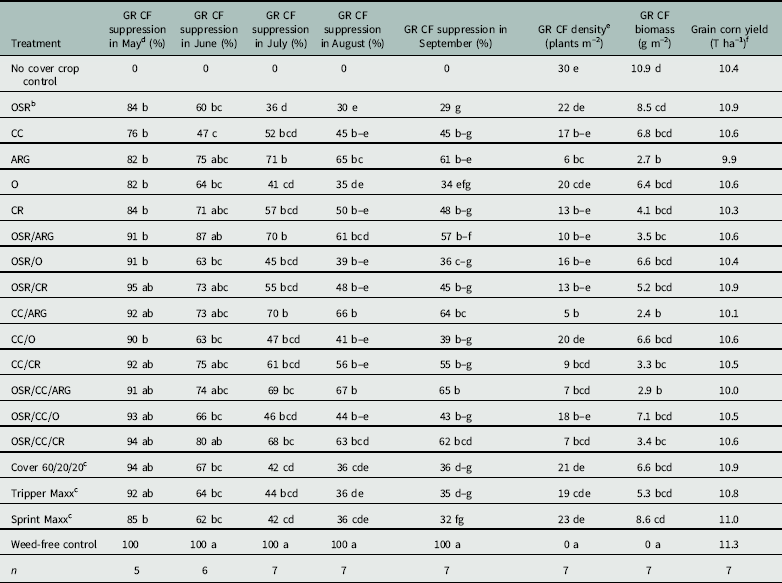
All of the cover crops evaluated suppressed GR Canada fleabane in corn grown the following growing season evaluated around mid-May and June 1, July 1, August 1, and September 1 (Table 6). Most of 17 cover crops evaluated suppressed GR Canada fleabane similarly around mid-May and June 1. GR Canada fleabane suppression was 76% to 95% and 47% to 87% in May and June, respectively. In July, GR Canada fleabane suppression ranged from 36% to 71%. ARG, OSR/ARG, and CC/ARG suppressed GR Canada fleabane 70% or more in July. All other cover crops provided less than 70% suppression of GR Canada fleabane (Table 6).
Cover crop treatments and their means for glyphosate-resistant Canada fleabane (GR CF) suppression in May, June, July, August, and September, for GR CF density and biomass in July, and for grain corn yields for the 7 site-years that went through the full cycle (2015–2016 and 2016–2017) in southwestern Ontario.Footnote a

a Means within column followed by the same letter are not different according to Tukey’s HSD at α=0.10.
b Abbreviations: ARG, annual ryegrass; CC, crimson clover; CR, cereal rye; O, oat; OSR, oilseed radish; n, number of site-years within means of each column.
c Cover 60/20/20 is a commercial blend of oilseed radish, crimson clover, and oat; Tripper Maxx is a commercial blend of pea and triticale; Sprint Maxx is a commercial blend of oat and pea.
d GR CF suppression in May data were arcsine transformed prior to analysis; the arcsine means were back-transformed for presentation purposes.
e GR CF density and biomass data were log transformed prior to analysis; the log means were back-transformed for presentation purposes.
f No differences among treatments, P=0.40.
In corn around August 1, the cover crop treatments suppressed GR Canada fleabane 30% to 67% compared to the no cover crop control (Table 6). ARG, OSR/ARG, CC/ARG, OSR/CC/ARG, and OSR/CC/CR were the best treatments and suppressed GR Canada fleabane 63% to 67%. OSR, CC, O, CR, OSR/O, OSR/CR, CC/O, CC/CR, OSR/CC/O, Cover 60/20/20/ Tripper Maxx, and Sprint Maxx were not as effective and suppressed GR Canada fleabane 30% to 56% (Table 6).
Around September 1, the cover crops evaluated suppressed GR Canada fleabane 29% to 65% (Table 6). ARG, CC/ARG, OSR/CC/ARG, and OSR/CC/CR were the best treatments and suppressed GR Canada fleabane 61% to 65%. OSR, CC, O, CR, OSR/ARG, OSR/O, OSR/CR, CC/O, CC/CR, OSR/CC/O, Cover 60/20/20/ Tripper Maxx, and Sprint Maxx were not as effective and suppressed GR Canada fleabane 29% to 57% (Table 6). In other studies, Lawley et al. (Reference Lawley, Weil and Teasdale2011) reported that OSR suppressed winter annual weeds in the autumn and early spring, but there was no weed suppression throughout the growing season. In this study, although OSR suppressed GR Canada fleabane relative to the no cover crop control, it was not equivalent to the weed-free control, showing incomplete weed suppression.
GR Canada fleabane density ranged from 5 to 30 plants m–2 around July 1 (Table 6). ARG, CC/ARG, CC/CR, OSR/CC/ARG, and OSR/CC/CR were the best treatments and reduced GR Canada fleabane density 70% to 83%. All other cover crop treatments were similar to the no cover crop control. GR Canada fleabane biomass ranged from 2.4 to 10.9 g m–2 (Table 6). ARG, OSR/ARG, CC/ARG, CC/CR, OSR/CC/ARG, and OSR/CC/CR were the best treatments among cover crops evaluated and reduced GR Canada fleabane biomass 68% to 78%. Biomass of all other cover crop treatments was similar to the no cover crop control. Interestingly, all of the treatments that contained O provided density and biomass that were similar to the no cover crop control. Grimmer and Masiunas (Reference Grimmer and Masiunas2004) found that O increased weed density compared to bare ground. However, Campiglia et al. (Reference Campiglia, Mancinelli, Radicetti and Caporali2010) found that O was the best treatment for reducing weeds in the spring, with an average reduction of weed biomass of 93%. Grain corn yield ranged from 9.9 to 11.3 t ha–1. However, grain corn yield was not affected by the cover crops or the GR Canada fleabane (Table 6).
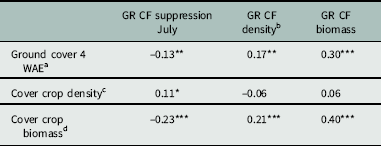
Cover crop ground cover 4 WAE was correlated with GR Canada fleabane density and biomass around July 1 (Table 7). Cover crop density 4 WAE was correlated with GR Canada fleabane suppression biomass around July 1. Cover crop biomass was correlated with GR Canada fleabane density and biomass around July 1. However, none of these correlations were very strong, a result that might be attributed to the variability inherent in weed management studies utilizing biological weed management tactics.
Pearson correlation coefficients for the relationship between cover crop ground cover, density, and biomass 4 wk after cover crop emergence with glyphosate-resistant Canada fleabane (GR CF) suppression, density, and biomass around July 1 from the data for the 7 site-years that went through a full cycle (2015–2016 and 2016–2017) in southwestern Ontario.

a Abbreviation: WAE, weeks after emergence of cover crop.
b GR CF density and biomass data were log transformed prior to analysis.
c Cover crop density data were log transformed prior to analysis.
d Cover crop biomass data were square root transformed prior to analysis.
*, **, and *** denote significance at P<0.05, P<0.01, and P<0.0001, respectively.
In conclusion, on average, the monocultures (with the exception of OSR), Tripper Maxx, and Sprint Maxx had less ground cover than most polycultures. Three of the monocultures (OSR, O, CR) had lower densities than the remaining two (CC and ARG). Tripper Maxx and Sprint Maxx had lower densities than the other polycultures with the exception of Cover 60/20/20. Most of the cover crops had similar biomass. OSR had greater biomass compared to the other monocultures, whereas Cover 60/20/20 had greater biomass than Tripper Maxx and Sprint Maxx. All of the cover crop treatments suppressed GR Canada fleabane in corn from May to September compared to the no cover crop control. Among treatments evaluated, ARG, CC/ARG, OSR/CC/ARG, and OSR/CC/CR were the most consistent treatments for the suppression of GR Canada fleabane in corn. ARG alone or in combination with CC provided the most consistent suppression of GR Canada fleabane. Cover crop treatments evaluated did not influence grain corn yield. Although many of the correlations between cover crop ground cover, cover crop density, and cover crop biomass with GR Canada fleabane suppression, density, and biomass were significant, most were weak, and repeating these experiments may strengthen these correlations.
Acknowledgments
Funding for this project was provided in part by the Grain Farmers of Ontario and the Growing Forward 2 program of the Agricultural Adaptation Council.