



%20--%3e%3c!DOCTYPE%20svg%20PUBLIC%20'-//W3C//DTD%20SVG%201.0//EN'%20'http://www.w3.org/TR/2001/REC-SVG-20010904/DTD/svg10.dtd'%3e%3csvg%20version='1.0'%20id='Layer_1'%20xmlns='http://www.w3.org/2000/svg'%20xmlns:xlink='http://www.w3.org/1999/xlink'%20x='0px'%20y='0px'%20width='64px'%20height='64px'%20viewBox='5.5%20-3.5%2064%2064'%20enable-background='new%205.5%20-3.5%2064%2064'%20xml:space='preserve'%3e%3cg%3e%3ccircle%20fill='%23FFFFFF'%20fill-opacity='0'%20cx='37.785'%20cy='28.501'%20r='28.836'/%3e%3cpath%20fill='%23595959'%20d='M37.441-3.5c8.951,0,16.572,3.125,22.857,9.372c3.008,3.009,5.295,6.448,6.857,10.314%20c1.561,3.867,2.344,7.971,2.344,12.314c0,4.381-0.773,8.486-2.314,12.313c-1.543,3.828-3.82,7.21-6.828,10.143%20c-3.123,3.085-6.666,5.448-10.629,7.086c-3.961,1.638-8.057,2.457-12.285,2.457s-8.276-0.808-12.143-2.429%20c-3.866-1.618-7.333-3.961-10.4-7.027c-3.067-3.066-5.4-6.524-7-10.372S5.5,32.767,5.5,28.5c0-4.229,0.809-8.295,2.428-12.2%20c1.619-3.905,3.972-7.4,7.057-10.486C21.08-0.394,28.565-3.5,37.441-3.5z%20M37.557,2.272c-7.314,0-13.467,2.553-18.458,7.657%20c-2.515,2.553-4.448,5.419-5.8,8.6c-1.354,3.181-2.029,6.505-2.029,9.972c0,3.429,0.675,6.734,2.029,9.913%20c1.353,3.183,3.285,6.021,5.8,8.516c2.514,2.496,5.351,4.399,8.515,5.715c3.161,1.314,6.476,1.971,9.943,1.971%20c3.428,0,6.75-0.665,9.973-1.999c3.219-1.335,6.121-3.257,8.713-5.771c4.99-4.876,7.484-10.99,7.484-18.344%20c0-3.543-0.648-6.895-1.943-10.057c-1.293-3.162-3.18-5.98-5.654-8.458C50.984,4.844,44.795,2.272,37.557,2.272z%20M37.156,23.187%20l-4.287,2.229c-0.458-0.951-1.019-1.619-1.685-2c-0.667-0.38-1.286-0.571-1.858-0.571c-2.856,0-4.286,1.885-4.286,5.657%20c0,1.714,0.362,3.084,1.085,4.113c0.724,1.029,1.791,1.544,3.201,1.544c1.867,0,3.181-0.915,3.944-2.743l3.942,2%20c-0.838,1.563-2,2.791-3.486,3.686c-1.484,0.896-3.123,1.343-4.914,1.343c-2.857,0-5.163-0.875-6.915-2.629%20c-1.752-1.752-2.628-4.19-2.628-7.313c0-3.048,0.886-5.466,2.657-7.257c1.771-1.79,4.009-2.686,6.715-2.686%20C32.604,18.558,35.441,20.101,37.156,23.187z%20M55.613,23.187l-4.229,2.229c-0.457-0.951-1.02-1.619-1.686-2%20c-0.668-0.38-1.307-0.571-1.914-0.571c-2.857,0-4.287,1.885-4.287,5.657c0,1.714,0.363,3.084,1.086,4.113%20c0.723,1.029,1.789,1.544,3.201,1.544c1.865,0,3.18-0.915,3.941-2.743l4,2c-0.875,1.563-2.057,2.791-3.541,3.686%20c-1.486,0.896-3.105,1.343-4.857,1.343c-2.896,0-5.209-0.875-6.941-2.629c-1.736-1.752-2.602-4.19-2.602-7.313%20c0-3.048,0.885-5.466,2.658-7.257c1.77-1.79,4.008-2.686,6.713-2.686C51.117,18.558,53.938,20.101,55.613,23.187z'/%3e%3c/g%3e%3c/svg%3e)
%20--%3e%3c!DOCTYPE%20svg%20PUBLIC%20'-//W3C//DTD%20SVG%201.0//EN'%20'http://www.w3.org/TR/2001/REC-SVG-20010904/DTD/svg10.dtd'%3e%3csvg%20version='1.0'%20id='Layer_1'%20xmlns='http://www.w3.org/2000/svg'%20xmlns:xlink='http://www.w3.org/1999/xlink'%20x='0px'%20y='0px'%20width='64px'%20height='64px'%20viewBox='5.5%20-3.5%2064%2064'%20enable-background='new%205.5%20-3.5%2064%2064'%20xml:space='preserve'%3e%3cg%3e%3ccircle%20fill='%23FFFFFF'%20fill-opacity='0'%20cx='37.637'%20cy='28.806'%20r='28.276'/%3e%3cg%3e%3cpath%20fill='%23595959'%20d='M37.443-3.5c8.988,0,16.57,3.085,22.742,9.257C66.393,11.967,69.5,19.548,69.5,28.5c0,8.991-3.049,16.476-9.145,22.456%20C53.879,57.319,46.242,60.5,37.443,60.5c-8.649,0-16.153-3.144-22.514-9.43C8.644,44.784,5.5,37.262,5.5,28.5%20c0-8.761,3.144-16.342,9.429-22.742C21.101-0.415,28.604-3.5,37.443-3.5z%20M37.557,2.272c-7.276,0-13.428,2.553-18.457,7.657%20c-5.22,5.334-7.829,11.525-7.829,18.572c0,7.086,2.59,13.22,7.77,18.398c5.181,5.182,11.352,7.771,18.514,7.771%20c7.123,0,13.334-2.607,18.629-7.828c5.029-4.838,7.543-10.952,7.543-18.343c0-7.276-2.553-13.465-7.656-18.571%20C50.967,4.824,44.795,2.272,37.557,2.272z%20M46.129,20.557v13.085h-3.656v15.542h-9.944V33.643h-3.656V20.557%20c0-0.572,0.2-1.057,0.599-1.457c0.401-0.399,0.887-0.6,1.457-0.6h13.144c0.533,0,1.01,0.2,1.428,0.6%20C45.918,19.5,46.129,19.986,46.129,20.557z%20M33.042,12.329c0-3.008,1.485-4.514,4.458-4.514s4.457,1.504,4.457,4.514%20c0,2.971-1.486,4.457-4.457,4.457S33.042,15.3,33.042,12.329z'/%3e%3c/g%3e%3c/g%3e%3c/svg%3e)
1. Introduction
The current paradigm for single, massive star evolution posits that classical Wolf-Rayet (WR) stars are the descendants of O stars with initial masses greater than
 $25M_\odot$
and have lifetimes less than 7 Myr (Georgy et al. Reference Georgy2012). This makes them useful tracers of high-mass star formation, both in our Galaxy and in external galaxies. However, in the Galaxy, some WR stars are found outside the Galactic thin disk, at z-heights greater than Hii regions and OB associations and these have been identified as runaways (e.g., Rosslowe & Crowther Reference Rosslowe and Crowther2015). Stars can be dynamically ejected during the formation process of young, star-forming regions (dynamical ejection scenario: DES) or by the disruption of a close binary system when the more massive component explodes as a supernova (binary supernova scenario: BSS). In both scenarios, the runaway star will have a peculiar velocity larger than the typical velocity dispersion of an OB association,
 $V_\mathrm{pec}\gt30$
km s
 $^{-1}$
. In this paper, we identify runaway WC and late-type WN (WNL) stars from their peculiar velocities and/or z-heights calculated from GDR3 astrometric data and reliable line-of-sight velocities from the literature. The trajectories of the runaways are then integrated backwards in time in order to infer their kinematical ages and possible ejection mechanisms, with the aim of testing massive star evolution scenarios such as the relationship between different WR subtypes and their progenitors.
2. Identification of Runaways
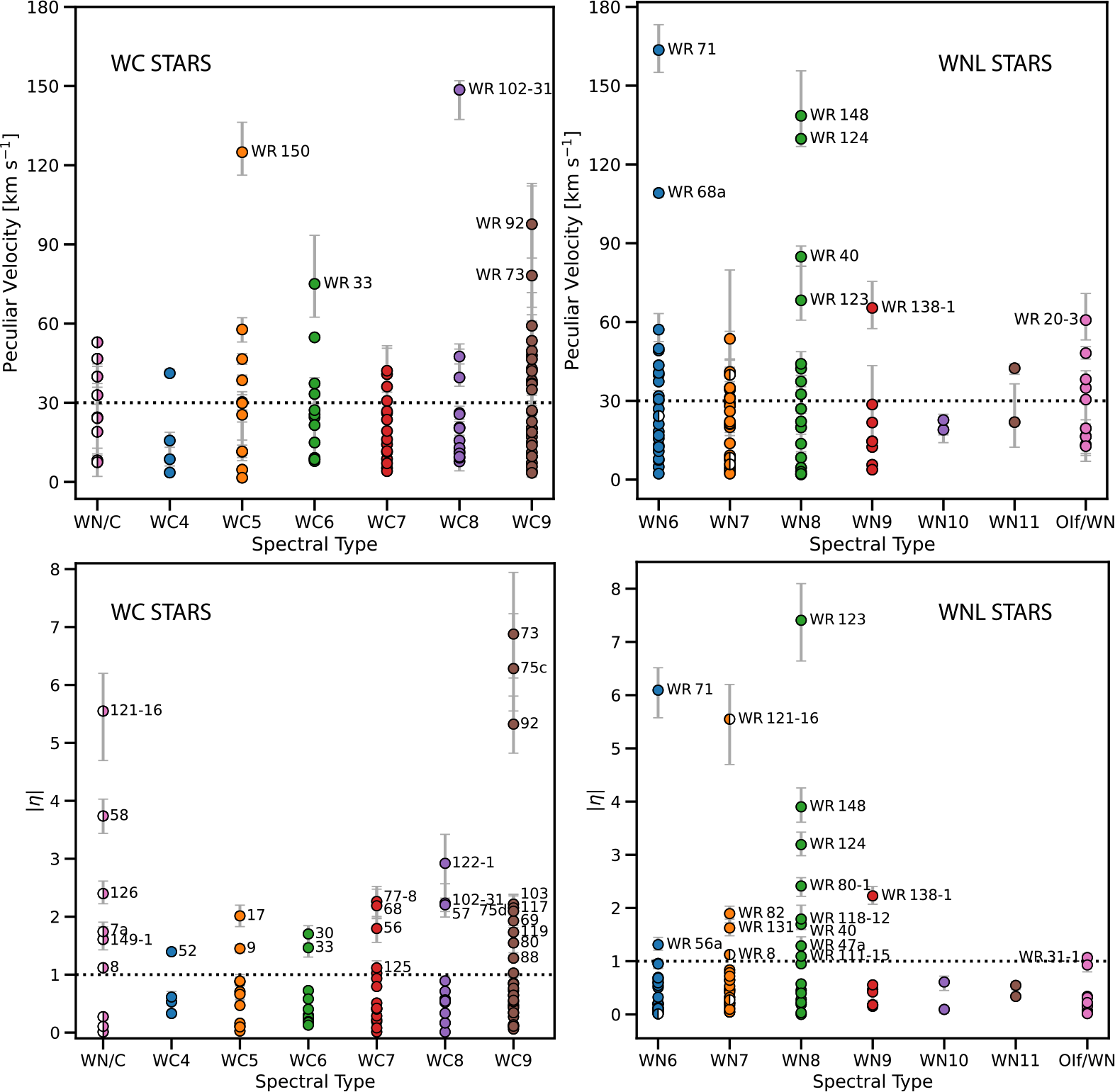
Sources, their spectral types and GDR3 IDs were taken from v1.32 of the Galactic Wolf-Rayet CatalogueFootnote † (Crowther et al. Reference Crowther, Rate and Bestenlehner2023). Around half of the selected objects had acceptable GDR3 astrometric solutions. The final sample consisted of 90 WNL stars and 98 WC stars, including 8 transition objects WN/WC and 10 core H-burning OIf*/WNL stars. Distances, tangential velocities and position angles were estimated simultaneously from the GDR3 positions, parallaxes and proper motions using a Bayesian approach (Arthur Reference Arthur2025). The peculiar velocity of each source was found by subtracting the co-rotation velocity at the appropriate Galactocentric radius. Figure 1 shows the peculiar velocities as a function of WR subtype (upper panels). Stars with
 $V_\mathrm{pec} \gt 30$
km s
 $^{-1}$
are considered runaways. The labelled stars have
 $V_\mathrm{pec} \gt 60$
km s
 $^{-1}$
, a strong indicator that they were dynamically ejected from a young star-forming region during the formation stage.
Top panels: Peculiar velocities as a function of WR subtype. Stars with
 $V_\mathrm{pec} \gt 60$
km s
 $^{-1}$
are labelled and the threshold runaway velocity
 $V_\mathrm{pec} = 30$
km s
 $^{-1}$
is indicated by a dotted line. Bottom panels: Galactic z-distance in units of OB-star scale height
 $|\eta|$
as a function of WR subtype. Stars with
 $|\eta| \gt1$
(labelled) are considered to be runaways. The threshold value
 $|\eta| =1$
is indicated by a dotted line. Half-filled symbols represent transition objects, WN/WC.

The parameter
 $\eta = (z - z_w)/h_z(R)$
, where
 $z-z_w$
is the z-height correction for the Galactic warp and
 $h_z(R)$
is the scale height at Galactocentric radius R, measures the z-distance in units of the OB-star scale height taken from Li et al. (Reference Li, Zhao, Jia, Liao, Yang and Wang2019). Figure 1 shows the
 $\eta$
-values of the samples of WC and WNL stars (lower panels). Stars with
 $|\eta|\gt1$
are considered runaways and are labelled.
Either, or both of the runaway criteria are met by 40 out of 90 WNL stars and 44 out of 98 WC stars, of which 10 are confirmed spectroscopic binary systems. The WN8h subtype has a notably larger proportion of high peculiar velocity stars than other subtypes. 8 of the 17 WN8 stars (4 classical WN8 and 4 WN8h) have
 $|\eta|\gt1$
, suggesting that they could be older (or longer lasting) than other subtypes. Very massive stars (VMS: OIf/WN, WN6h, WN7h) have generally low z-heights, consistent with their likely young ages. The classical WN7 subtype is notably deficient in high-velocity runaways.
3. Tracing the Trajectories of Galactic Runaways
The orbital motion of each runaway star was integrated for 10 Myr backwards from its current position using the GALPY package (Bovy Reference Bovy2015). Most objects follow circular trajectories in a Galactocentric coordinate system, but some stars have substantial radial or vertical motions (Arthur Reference Arthur2025).
For the runaways that are found at large z-distances from the Galactic midplane, kinematic ages can be estimated from the z-velocities based on the assumption that the stars originated in the thin disk. The majority of the trajectories can be traced back to the midplane within the past 6 Myr, consistent with the typical lifetime of a massive star. Many WNL stars have kinematic ages around 6 Myr, consistent with a DES during their early life as their runaway origin. On the other hand, many WC stars intersect the midplane 4–5 Myr ago, suggesting that a different mechanism is responsible, such as the BSS, later in their evolution.
It must be noted that most stars in the sample have only tangential velocity data, from the proper motions, and there is a need for reliable line-of-sight velocity data to establish the correct initial conditions. This situation could be improved by establishing systemic velocities for confirmed binary systems or the expansion centres of ejecta nebulae, where available. Surprisingly, some stars with full 3D velocity data do not intersect the midplane within 10 Myr, hinting that binary evolution may be important for these sources.
4. Summary and Conclusions
-
• At least 22% of WNL and WC stars are found to be runaways under the peculiar velocity and z-height criteria. This is consistent with the observed fraction of O star runaways (Tetzlaff et al. Reference Tetzlaff, Neuhäuser and Hohle2011; Carretero-Castrillo et al. Reference Carretero-Castrillo, Ribó and Paredes2023).
-
• The fraction of binary runaways and fast runaways (
 $V_\mathrm{pec} \gt 60$
km s
$^{-1}$
) compared to slower runaways is consistent with estimates of the DES and BSS fractions from numerical simulations (Dray et al. Reference Dray, Dale, Beer, Napiwotzki and King2005).
-
• The WN8 subtype, particularly the hydrogen-rich class WN8h, has a higher proportion of high-velocity runaways than any other subtype, while the WN7 subtype is noticeably deficient in high-velocity runaways. This suggests that the WN7 and WN8 subtypes do not constitute an evolutionary sequence.


5. Acknowledgments
SJA is grateful for financial support from UNAM DGAPA PAPIIT project IN109823.
 Vpec>60
 −1
 Vpec=30
 −1
 |η|
 |η|>1
 |η|=1

 Open access

