


Introduction
In the wake of natural hazards, characterized by earthquakes, floods, outbreaks, and hurricanes, the imperative for emergency response has never been more evident. During such events, emergency responses by national resources are immediately mobilized to respond to the health needs of the affected community. 1 However, in low-income countries already facing critical shortages of staff, supplies, and infrastructure, the need for medical care often exceeds national capacity.Reference Coventry, Vaska and Holland 2 As a result, emergency medical care is often overwhelmed, leaving affected populations heavily reliant on Emergency Medical Teams (EMTs).Reference El-Khani, Ashrafian and Rasheed 3 Coordinated through the World Health Organization (WHO), EMTs are groups of health professionals, including doctors, nurses, paramedics, support workers, and logisticians, deployed to provide rapid life-saving medical care when local systems are unable to cope.Reference Hamilton, Södergård and Liverani 4 , 5 EMTs operate according to internationally recognized minimum standards outlined in the WHO’s Classification and Minimum Standards for EMTs, which ensure the delivery of quality care. 5 It emphasizes the role of EMTs in delivering timely, coordinated, and quality-assured medical assistance, while also strengthening national health capacities.
Evidence From the Field
Research consistently highlights the critical role of EMTs in delivering immediate care during the acute phase of disasters. For instance, major deployments, such as the Haiti and Nepal earthquakes and Cyclone Idai in Mozambique, demonstrated EMTs’ effectiveness in providing rapid surgical interventions, trauma care, medical supplies, and infectious disease control.Reference Camacho, Karki and Subedi 6 –Reference Sacchetto, Raviolo and Lovesio 8 However, concerns remain regarding the overall effectiveness and functioning of EMTs. For instance, key shortcomings identified during EMT deployments included poor coordination, limited community engagement, and inadequate data management.Reference Hamilton, Södergård and Liverani 4 Similarly, the 2023 Türkiye earthquake exposed ongoing issues related to interoperability and coordination mechanisms between teams and other sectors. 9 These challenges result in short-term interventions that fail to effectively reach target populations, hinder performance assessment, and disrupt care continuity.Reference Djalali, Ingrassia and Della Corte 10 , Reference Schreiber, Gaebel and de Hoop 11
Although no studies have comprehensively assessed EMT approaches for sustaining care post-disaster, recent missions in Samoa, Mozambique, and Papua New Guinea briefly noted EMTs’ contributions to national systems through workforce training, coordination improvements, and the use of data tools like the EMT Minimum Data Set.Reference Casey, Mamea-Maa and Nofoaiga 12 –Reference Maddah, Vadi and Aloğlu 15 Similar support was requested in the aftermath of the Morocco earthquake and Libya floods, where countries called for improved emergency protocols and hospital communication systems.Reference Achbani, Bouchriti and Sine 16 , Reference Alhudiri, Zaghdani and El Meshri 17 Notably, despite the consistent deployment of EMTs in the context of natural hazard-related disasters, little is known about the long-term contributions and sustained impact of EMT interventions on health system recovery and continuity of care.
This limited understanding underscores a critical gap in the literature, one that calls for deeper exploration of the long-term impacts of EMT interventions and their influence on the continuity of care after departure from areas affected by disasters.Reference Hamilton, Södergård and Liverani 4 , Reference Vadi, Wilk and Radecka 18 Addressing this gap is essential, given that post-acute mortality often exceeds deaths during the emergency phase, primarily due to disrupted services and a lack of sustained support.Reference Kishore, Marqués and Mahmud 19 These service disruptions were further exposed during the COVID-19 pandemic, which highlighted deficits in national health systems and prompted EMTs to expand their role to include the training of local health staff, the development of protocols, and enhanced Risk Communication and Community Engagement (RCCE).Reference Maddah, Vadi and Aloğlu 15 , Reference Vadi, Wilk and Radecka 18 It also triggered the update of the WHO EMT initiative to emphasize EMTs’ role in strengthening capacity and fortifying overwhelmed health systems. 5 Although mechanisms for an integrated approach that maintains health care services until a host country’s system is fully restored are still poorly understood,Reference Hertelendy, Salio and Ciottone 20 field experience and disaster responders’ knowledge can help analyze the sustainability of EMT interventions in post-disaster health system recovery.
Key frameworks for ensuring sustainable impact include Monitoring, Evaluation, Accountability, and Learning (MEAL), which provides a structure for assessing performance and guiding improvements.Reference Blanchet, Ramesh and Frison 21 Similarly, RCCE is a critical approach for building trust and ensuring interventions are culturally appropriate and community-led.Reference Gilmore, Ndejjo and Tchetchia 22 , Reference Gonah 23 The role of these frameworks in EMT deployments remains an underexplored area this study seeks to investigate.
This research aims to fill this critical gap by examining the personal experiences of EMT members deployed in the field, in place of long-term monitoring data, and gaining critical insights into the factors that inhibit the long-term efficacy of health care programming. These accounts provide valuable first-hand experiences of various EMT interventions and their impacts. This study builds on existing literature by analyzing these experiences to better understand long-term EMT effectiveness. Furthermore, it offers critical insights for achieving sustainable health care development post-EMT departure, which could lead to more impactful interventions if adopted by the WHO secretariat.
This study was guided by the following research question: From the perspective of deployed members, what factors support or hinder the long-term effectiveness and sustainable impact of EMT interventions in disaster-affected health systems?
Methodology
Study Design
Researchers used a qualitative approach, conducting one-on-one in-depth interviews and using thematic analysis to explore common perceptions of the challenges and recommended strategies for leveraging EMTs’ work to create a positive, lasting impact after natural hazards. The first part of the research focused on defining “long-term effectiveness” in humanitarian health care programming. The OECD Development Assistance Committee defines “effectiveness” as “the extent to which an intervention achieved, or is expected to achieve, its objectives,” providing a framework for evaluating development and humanitarian interventions. 24 Building on this definition, “long-term effectiveness” was interpreted as the perceived ability of EMT interventions to contribute to sustained health services, local capacity, and community resilience after the team’s departure. The interview questions were designed to probe this by asking participants to reflect on continuity of care, knowledge transfer, and system integration. To capture the EMT members’ perceptions, interviews were designed to elicit participants’ personal accounts of whether they believed their medical responses successfully met intended health outcomes and population needs within the practical limitations imposed by natural hazard-related disaster settings.
Participant Selection
This study used a purposive sampling strategy to recruit a diverse group of EMT members. The initial research design also intended to employ snowball sampling, where recruited EMTs would be asked to refer end-users such as local health care professionals and ministry representatives to capture a broader range of perspectives.
However, the snowball sampling strategy proved unfeasible as participating EMTs were unable to provide contact information for end-users, citing the absence of a standardized contact database and the transient nature of field deployments. Consequently, the final sample was composed exclusively of the 9 EMT members who responded to the initial invitation and returned a signed consent form. The eligibility criteria were listed in Table 1. Exclusion was applied to responses to conflict emergencies due to the dynamic nature of health care systems in affected countries, as well as responses predating 2023 to mitigate potential memory recall issues.
Inclusion and exclusion criteria for study participants

Table 1. Long description
The table is divided into two main headers.
Inclusion criteria column includes five points:
- E M T member who deployed between January 2023 and April 2025.
- Deployment was in response to a natural hazard.
- Aged 18 years or older.
- Able to communicate in English.
- Deployed to a country that requested international humanitarian assistance.
Exclusion criteria column includes two points:
- Deployment was in response to a conflict emergency.
- Deployment occurred before 2023.
Approval was obtained from the WHO EMT Secretariat, which provided a list of EMTs who had responded to natural hazards. A research invitation, including a consent form, was sent to the Secretariat for dissemination among the EMT network. All participants who returned the signed consent form were contacted to be scheduled for an interview.
Data Collection
In-depth, semi-structured interviews were conducted remotely via Zoom between February and April 2025. The development of the interview guide was guided by the study’s primary aim of exploring the long-term effectiveness of EMT interventions and was informed by a review of key policy and academic literature. Foundational questions regarding EMT standards, coordination, and known operational challenges were drawn from established frameworks, including the WHO’s “Classification and Minimum Standards for Emergency Medical Teams” 5 and literature on EMT effectiveness.Reference Hamilton, Södergård and Liverani 4 , 9 Questions designed to explore long-term impact, sustainability, and health system strengthening were aligned with the strategic vision outlined in the WHO’s EMT 2030 Strategy. 25 Furthermore, questions related to community-level impact were informed by established principles of RCCE.Reference Gilmore, Ndejjo and Tchetchia 22 , Reference Gonah 23 This multi-faceted approach ensured that the interview questions were aligned with both the study’s analytical aims and the existing evidence base on humanitarian response.
Interviews were conducted by a lead researcher with expertise in humanitarian public health. All sessions were audio-recorded, transcribed verbatim, and anonymized to protect participant confidentiality.
Data Analysis
Thematic analysis was employed to identify recurring themes and patterns within the qualitative data, following the six-phase framework developed by Braun and Clarke.Reference Braun and Clarke 26 A hybrid inductive and deductive approach was adopted. The analysis was deductively guided by pre-existing concepts identified from the literature review, including “coordination,” “capacity building,” and “continuity of care,” which formed an initial coding framework. Simultaneously, an inductive approach was maintained to ensure that new, data-driven themes emerging directly from participants’ narratives were captured.
To enhance methodological rigor and transparency, the analysis was conducted as follows. Initial coding was performed independently by two researchers (Author initials D.M. and Y.Y.) to ensure reliability. The researchers then held peer debriefing sessions to compare their initial codes, discuss interpretations, and resolve discrepancies through consensus. This iterative process led to the refinement of the coding framework and the development of the final overarching themes presented in this paper. Throughout the analysis, the research team engaged in reflexive discussions to acknowledge and mitigate potential biases stemming from their prior field experience in humanitarian settings.
Ethical Considerations
The study was approved by Qatar University Institutional Review Board (QU-IRB 211/2024-EA). Confidentiality was ensured through anonymization, where personal information was dissociated from any research findings.
Results
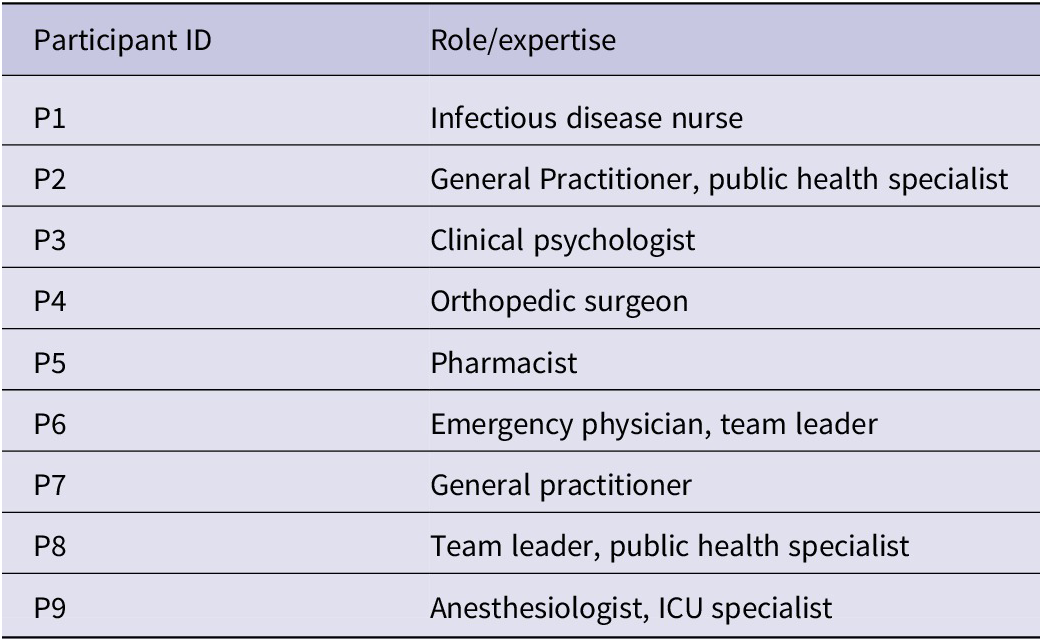
A total of nine interviews were conducted with EMTs from diverse professional and geographic backgrounds. Their experiences spanned different regions and types of natural hazards. Table 2 shows the role/expertise of the participants.
Participants expertise

Table 2. Long description
The table consists of two columns titled Participant I D and Role/expertise. There are nine rows of data:
* P 1: Infectious disease nurse.
* P 2: General Practitioner, public health specialist.
* P 3: Clinical psychologist.
* P 4: Orthopedic surgeon.
* P 5: Pharmacist.
* P 6: Emergency physician, team leader.
* P 7: General practitioner.
* P 8: Team leader, public health specialist.
* P 9: Anesthesiologist, I C U specialist.
The thematic analysis revealed that members’ perspectives on long-term effectiveness are shaped by a central duality: they encountered a consistent set of barriers that constrained impact, yet also identified powerful mechanisms that could promote sustainability. Woven throughout their accounts was a third, overarching theme—the systemic challenge of measuring effectiveness—which complicated both the barriers and the facilitators they described. This thematic map of the members’ perspectives is presented visually in Figure 1.
Thematic map of EMT members’ perspectives on long-term effectiveness.

Figure 1. Long description
At the center of the diagram is a grey box titled E M T Long-Term Effectiveness from Members’ Perspectives. Surrounding this core are three thematic clusters.
1. Top-Left (Pink): Challenges in Measuring Impact and Effectiveness. Bullet points include Lack of M E A L Frameworks, Short Deployment Durations, and Limited Exit Strategies.
2. Top-Right (Orange): Barriers to Sustaining E M T Healthcare Impact. Bullet points include Coordination Issues with National Staff, Lack of Capacity Building with National Staff, Gaps in Skills and Resource Availability, Structural and Logistical Barriers, and Cultural Barriers.
3. Bottom (Red): Supporting Mechanisms that Promote Long-Term Effectiveness. Bullet points include Building National E M T Technical Capacity and Knowledge, and Community Participation and R C C E.
Barriers to Sustaining EMT Health Care Impact
Participants consistently reported that despite their capacity to deliver immediate care, the long-term sustainability of their efforts was constrained by a range of structural, organizational, and contextual barriers.
The most frequently cited challenge was poor coordination with national staff. Participants explained that weak communication and the absence of a unified command structure often led to EMTs functioning in isolation, hindering programmatic integration. One participant noted, The overwhelming nature of the situation … creates some conflict within coordination (P2).
This lack of coordination was closely linked to another major barrier: a failure to implement effective capacity building. Many participants viewed their deployments as too short-term to prioritize training over acute clinical care, a situation often exacerbated by limited funding. As one participant stated, During emergency or deployment, it is very difficult to do trainings … national leadership is not part of the plan (P2). Language barriers further obstructed knowledge exchange, with one interviewee calling it the biggest challenge during deployment (P5).
Participants also identified critical gaps in essential skills, particularly in mental health and psychosocial support. We need to know how to deal with stress management and with people who are traumatized, one participant explained (P3). These gaps, alongside structural and logistical barriers like customs delays, Couldn’t get them in because of the customs … it was a bit painful (P1), hindered the establishment of self-sustaining specialty care systems.
Finally, cultural barriers emerged when interventions lacked adequate community consultation. When services were viewed as externally imposed, participants noted community resistance, which limited the longevity of impact. As every time, whenever there is a new concept, there might be resistance, one participant reflected (P8).
Supporting Mechanisms That Promote Long-Term Effectiveness
Despite these significant barriers, participants also described key strategies and mechanisms that, when implemented, appeared to extend the impact and sustainability of their interventions.
The most powerful of these was intentional capacity building and knowledge transfer. Participants differentiated between simple service delivery and deployments where structured, hands-on teaching was embedded. One interviewee proudly described a successful outcome: We designed a … localized training mechanisms where we trained the professionals how to set up an ICU … by the time we finished our response, they were equipped with ICU (P8). Another confirmed the value of on-the-job training to manage specific health crises like cholera: Staff had no real skills or knowledge … so the other part of our mission was really making sure that we could give some training education to the staff (P1).
This capacity building was most effective when coupled with the second key mechanism: meaningful community participation and RCCE. Participants described RCCE as pivotal for gaining public trust and influencing health behaviors. II think the risk communication and community engagement aspect is a key component, one participant emphasized (P8). However, they also acknowledged the tension created by short deployment durations, which made it difficult to build the deep relationships required for true engagement. As one person reflected, I think part of the issues of community is a feeling that things are either temporary or that there’s no real commitment to ongoing follow up (P3).
Challenges in Measuring Impact and Effectiveness
An overarching challenge that permeated all aspects of EMT deployments was the absence of structured MEAL frameworks. Participants from all backgrounds expressed frustration that without clear metrics or exit strategies, it was nearly impossible to formally assess long-term programmatic success. This was not seen as an oversight, but as a systemic issue. As one participant explained, It’s just not feasible for you as an EMT delegate to be able to do all of those. There are different people in each deployment with no clear MEAL (P3). Another summarized the core problem of organizational practice: I think one of the things that I believe to be quite frustrating and challenging is that impact is not measured. Most organizations will enter an emergency response… without any clear exit plan for longevity and sustainability (P2).
Discussion
The findings of this study indicate that EMTs perceive their interventions as having lasting, sustainable impacts on affected communities following a natural hazard-related disaster. However, consistent with previous research,Reference Hamilton, Södergård and Liverani 4 , 9 participants also identified persistent challenges that can undermine effectiveness, including coordination difficulties, communication barriers, and inconsistent reporting. Key themes that emerged as central to enhancing sustainability included capacity building, community engagement, and planning for post-deployment continuity.
Beyond a descriptive account of barriers and facilitators, a deeper interpretation of the findings reveals critical relationships and tensions between the themes. For instance, participants’ accounts suggest that poor coordination is not merely a logistical hurdle but a direct impediment to effective capacity building and continuity of care. This observation aligns with existing literature that has consistently identified coordination breakdowns as a primary challenge in disaster response.Reference Hamilton, Södergård and Liverani 4 , 9 When communication with national health authorities was weak, EMTs struggled to identify the right personnel for training or align their teaching with local needs, rendering even well-intentioned efforts less effective. This illustrates a direct relationship where failures in one area cascade to undermine success in another.
More fundamentally, the findings highlight a persistent tension between the immediate, life-saving priorities of an acute emergency response and the long-term goal of health system strengthening. This reflects a well-documented challenge in the humanitarian sector, where the urgency of acute crises often overshadows the need for evidence-based, sustainable interventions.Reference Blanchet, Ramesh and Frison 21 , Reference Spiegel, Checchi and Colombo 27 The underlying mechanism for this, suggested by the participants’ experiences, appears to be systemic: the short deployment durations, funding models focused on immediate outputs, and the lack of a formal mandate for long-term development create a context where short-term priorities will almost always supersede long-term goals. This moves the challenge beyond individual EMT performance and points toward a structural issue within the current humanitarian response model, a conclusion supported by recent calls to re-envision disaster response frameworks.Reference Hertelendy, Salio and Ciottone 20 , 25
Following a natural hazard-related disaster, casualties and trauma injuries surge, with an increased need for human resources that are specialized in delivering prompt acute services.Reference Hamilton, Södergård and Liverani 4 Participants consistently described EMTs as filling critical human resource gaps, delivering specialized care, and supporting health service continuity. These observations align with existing literature that recognizes EMTs as vital providers of rapid response care. 5 However, what emerged is the dual role of EMTs, not only in delivering immediate clinical care but also acting as vehicles for capacity building and skill transfer.
The role of EMTs in training and capacity building of national staff is not strongly emphasized in the Classification and Minimum Standards for Emergency Medical Teams book. It is often overlooked by EMT personnel, whose focus tends to be on addressing urgent clinical needs. However, the COVID-19 pandemic underscored the importance of expanding EMT functions beyond immediate response. For example, a study by Vadi reported that EMTs such as UK-Med and PCPM were requested to provide training and capacity-building support to hospital staff during the outbreak.Reference Vadi, Wilk and Radecka 18 In line with our study, although capacity building was not consistently practiced as a core component during deployments, participants recognized it as a critical function. This reflects a broader shift in global humanitarian health discourse from short-term relief efforts toward integrated, sustainable solutions, as highlighted in the updated EMT 2030 strategy. 25 To operationalize this shift, capacity building should be clearly defined, structured, and embedded in EMTs’ terms of reference from the outset of deployment.
Capacity building also targets EMT personnel and patients to promote sustained outcomes. The training of EMTs themselves has received increasing attention, with a newly developed framework designed for use by international teams.Reference Echeverri, Salio and Parker 28 Our study highlights the importance of training the trainers and equipping EMTs to deal with disaster-traumatized communities. Given the psychological strain EMTs often face post-deployment,Reference Hsiao, Chang and Ma 29 there is a growing call to integrate psychological resilience training into EMT professional development.Reference Gerantia 30 Doing so would not only support EMTs’ mental health but also improve their capacity to care for traumatized populations. Nonetheless, patient education, while shown to have immediate benefits, holds an under-recognized potential to influence long-term health-seeking behaviors and improve community-level public health practices.
Sustaining changes in community health practices is primarily achieved through effective RCCE, which the literature recognizes as a vital participatory approach in global health emergencies.Reference Gilmore, Ndejjo and Tchetchia 22 As highlighted by our participants and supported by previous research, RCCE is critical not only for complementing clinical support but also for ensuring that interventions are trusted, culturally appropriate, and successfully influence local health behaviors.Reference Maddah, Vadi and Aloğlu 15 The success of RCCE, however, is deeply intertwined with effective coordination. When EMTs successfully partner with local community leaders and NGOs, they can build trust more rapidly and implement interventions that are better aligned with community needs.Reference Gonah 23 Such coordinated efforts not only improve immediate outcomes but also lay the groundwork for long-term sustainability by enhancing local preparedness and self-sufficiency. Despite this, our findings echo a persistent concern identified in recent disaster reports and systematic reviews: chronic coordination breakdowns, particularly with local ministries and government bodies, continue to hinder the long-term effectiveness of humanitarian responses.Reference Hamilton, Södergård and Liverani 4 , 9
In the absence of precise coordination between EMTs and local authorities, evaluation of interventions is hindered. This issue is compounded by a broader issue: the limited availability of structured data, rigorous analysis, and research on EMT impact, all of which are essential for improving the sustainability of their operations.Reference Oyugi, Kamara and Nuwagira 31 Without clear indicators, documentation systems, or systematic exit strategies, it becomes nearly impossible to measure the long-term impacts. This limitation reflects a broader challenge in the humanitarian sector, where the urgency of emergency response often overshadows the need for rigorous impact assessment and learning.Reference Spiegel, Checchi and Colombo 27 The scarcity of research in these contexts further limits the ability to inform evidence-based improvements.Reference Hamilton, Södergård and Liverani 4 , Reference Blanchet, Ramesh and Frison 21
Notably, the consequences of these unclear coordination and MEAL structures are significant. They directly hinder follow-up mechanisms and continuity of care. As a clear illustration of this, none of the participants retained contact with community or ministry representatives from their deployment sites, highlighting a missed opportunity for mutual feedback and post-departure evaluation. Addressing these systemic gaps aligns with the vision outlined in the EMT 2030 strategy, which calls for the integration of standardized methodologies into national health systems to ensure that coordination mechanisms are not only immediate but are also institutionalized to build resilient, collaborative health systems.Reference Hertelendy, Salio and Ciottone 20
To address these gaps, the operationalization of MEAL and RCCE frameworks within EMT deployments is critical. For MEAL, this could involve implementing simple, standardized data collection tools from day one, such as the WHO’s EMT Minimum Data Set,Reference Kubo, Chimed-Ochir and Cossa 13 to track patient outcomes and service delivery. It would also mean embedding a dedicated MEAL officer in larger teams or training existing team members to conduct rapid post-deployment evaluations and share findings with the host Ministry of Health. This creates a feedback loop for continuous learning and ensures that interventions are evidence-based.Reference Blanchet, Ramesh and Frison 21 For RCCE, operationalization moves beyond simple awareness campaigns. It could involve formally partnering with local community leaders to co-design health messaging,Reference Gilmore, Ndejjo and Tchetchia 22 establishing patient feedback mechanisms in clinics, and training EMT staff in basic cross-cultural communication to ensure services are trusted and accepted. By embedding these frameworks, EMTs can transition from a model focused solely on immediate service delivery to one that intentionally builds local capacity and sustainable health system resilience. 25
Planning for exit and handover was also inconsistently addressed, with some EMTs leaving without clear transition protocols or mechanisms to ensure sustainability. This absence of planning risks undermining even the most effective interventions, especially in contexts where local health systems remain fragile. While some participants saw value in maintaining contact post-deployment, others argued for full autonomy of the local system. This divergence suggests the need for more straightforward guidelines on transition planning and post-departure support models.
Limitations
Firstly, and most significantly, this study’s findings are drawn exclusively from the perspectives of EMT members. As noted in the methodology, the original research design aimed to include local stakeholders. However, due to the practical challenge of obtaining contact information through snowball sampling, this was not feasible. The absence of perspectives from local health care professionals, community members, and national health authorities means this study cannot offer a comprehensive, 360-degree view of EMT effectiveness. This limitation is particularly relevant when considering themes such as continuity of care, integration with local systems, and community-level impact, which can only be fully understood by including the voices of the host community and health system. Secondly, the findings are based on participants’ recalled perceptions rather than institutional data, which limited the ability to measure or verify the actual, long-term effectiveness of the described interventions. Thirdly, as interviews were conducted virtually, the quality of communication may have been affected by technical issues such as unstable internet connections. Finally, conducting interviews exclusively in English may have influenced the accuracy of participants’ comprehension and responses due to varying language proficiency among non-native speakers.
Conclusion
This study addresses a critical gap in the literature by exploring the perspectives of EMT members on the factors that influence the long-term effectiveness of their interventions. Through an analysis of these first-hand accounts, the study provides valuable insights into the perceived barriers, supporting mechanisms, and measurement challenges related to achieving a sustainable impact on health systems following a natural hazard.
Participants reported that the sustainability of their efforts was often constrained by poor coordination, limited knowledge transfer, and the absence of structured monitoring strategies. Conversely, they identified intentional capacity building and robust RCCE as pivotal mechanisms for promoting lasting positive outcomes.
These findings contribute to a growing body of evidence that can inform the evolution of EMT practices. They highlight that while EMTs provide essential acute care, their potential to contribute to long-term health system strengthening remains a complex challenge. By emphasizing the need for structured approaches like MEAL frameworks and embedded RCCE, this study suggests pathways for the WHO EMT Secretariat to support more resilient post-crisis health systems and improve the continuity of care in disaster-affected settings.
Recommendations
Building on the findings of this study, the following recommendations are proposed to strengthen the long-term effectiveness and sustainability of EMT interventions. These are divided into actionable guidance for policy and practice, and priorities for future research.
Recommendations for Policy and Practice
To translate the lessons from this study into improved operational outcomes, EMT-coordinating bodies and deploying organizations should:
Formalize Capacity Building as a Core Deliverable: Embed structured training and knowledge transfer for local staff into the official Terms of Reference for all EMT deployments. This will shift capacity building from an ad-hoc activity to a core, measurable objective.
Mandate the Integration of MEAL and Exit Planning: The WHO EMT Secretariat should require the use of standardized MEAL frameworks. All deployments must include clear, documented exit strategies to measure long-term impact and ensure a smooth handover to local health systems.
Strengthen RCCE as a Core Competency: Invest in dedicated training for EMT members in RCCE. This will enhance their ability to build trust, ensure cultural adaptation of interventions, and foster community ownership of health outcomes.
Recommendations for Future Research
To build a stronger evidence base and address the limitations identified in this study, the research community should prioritize the following:
Employ Longitudinal Research Designs: Future studies should move beyond cross-sectional interviews and adopt longitudinal designs to track the impact of EMT interventions over an extended period. This is essential to differentiate between the perceived effectiveness reported by deployees and the actual, sustained outcomes within the health system.
Incorporate and Triangulate Stakeholder Perspectives: Research must intentionally include the perspectives of local stakeholders, including community members, local health care professionals, and national health authorities. This is critical for validating findings and gaining a comprehensive understanding of an intervention’s true community-level impact.
Evaluate the Implementation of New Frameworks: As organizations begin to adopt MEAL, structured capacity building, and RCCE, research should focus on evaluating the fidelity, effectiveness, and contextual challenges of implementing these frameworks in real-world disaster settings.
Supplementary material
The supplementary material for this article can be found at http://doi.org/10.1017/dmp.2026.10425.
Acknowledgments
We would like to acknowledge the contribution of the WHO EMT Secretariat for granting the researchers access to the EMT network. We want to thank all EMTs for their time and cooperation in providing information for this research study.
Author contribution
All authors contributed to the study conception and design. Material preparation, data collection, and analysis were performed by DM, YY, and GI. The initial draft of the manuscript was prepared by DM, IN, IG, KK, and RV. The final manuscript was substantially revised and rewritten by DM. All authors read and approved the final manuscript.
Funding statement
This research was supported by the Foreign, Commonwealth and Development Office (FCDO). Author DM has received research support from UK-Med. Also, Open Access funding provided by the Qatar National Library.
Competing interests
None.
AI declaration
The authors used artificial intelligence (AI) tools to support language editing and improve the clarity of the manuscript. All content was critically reviewed and verified by the authors, who take full responsibility for the final version of the manuscript.



 Open access

