Most syntactic models agree that syntactic structures share the same basic ingredients across natural languages: the structure of a sentence consists of a hierarchical arrangement of phrases, each phrase being constituted of a nucleus element called “head” (e.g., the verb in the verb phrase), its complement (e.g., the object) and a phrase specifying the head called “specifier” (e.g., the subject). Although the hierarchical structure tends to remain constant across languages, linear order of the head and its complement is variable; for example, there are verb–object languages (VO), like English or French and object–verb languages (OV), like Japanese or Turkish. Of interest, besides this variability across languages, studies in syntax have revealed surprising stability within a given language, as the order of the head–complement order tends to be the same throughout all the constituents of the language (even though disharmonic orders are occasionally permitted; Greenberg, Reference Greenberg and Greenberg1963). For example, in head–complement languages, verbs precede objects (the cat chases the mouse) but also main clauses precede subordinate clauses (I know that the girl crossed the street), nouns precede their complements (the picture of the man), and adpositions are prepositions that precede nouns (of the man). In contrast, in complement–head languages verbs follow objects, main clauses follow subordinate clauses, nouns follow their complements, and adpositions are postpositions that follow nouns.
Within the theoretical framework of parametric syntax (Chomsky, Reference Chomsky1981), an approach in which cross-linguistic variation is expressed by means of a system of binary parameters, this variation in the word order of the languages is captured by the head direction parameter: a head either precedes or follows its complement. In this view, language acquisition is conceived of as a process of parameter setting by which the child, on the basis of the input she receives from her linguistic environment, selects the correct settings of the parameters for her language (e.g., Rizzi, Reference Rizzi2006; Wexler, Reference Wexler1998). Like for other parameters, the child is assumed to learn the word order of her language by setting the head direction parameter.Footnote 1
For such a hypothesis to be plausible, one needs to establish the presence of cues to head-complement order in the linguistic environment. Two types of cues were identified. First, head direction correlates with prosodic properties of the language as prominence always falls on the complement within phonological phrases (Nespor & Vogel, Reference Nespor and Vogel1986). Hence, although prominence falls on the right edge of constituents in head–complement languages, it falls on the left in complement–head languages. Babies as young as 3 months old were found to rely on this cue to discriminate between languages with different head–complement orders (Christophe, Nespor, Guasti, & Van Ooyen, Reference Christophe, Nespor, Guasti and van Ooyen2003). Second, head direction correlates with statistical regularities in the distribution of grammatical morphemes in the sentence. Whereas head–complement languages typically have their function words in initial position in complex phrases, complement–head languages have them in the final position (Gervain, Nespor, Mazuka, Horie, & Mehler, Reference Gervain, Nespor, Mazuka, Horie and Mehler2008). Gervain and colleagues (Reference Gervain, Nespor, Mazuka, Horie and Mehler2008) found that at 8 months infants already show preference for an artificial language with frequent words (i.e., typically function words) situated in the same position as the target language they are exposed to.
These observations were argued to support the view that acquisition of word order relies on a mechanism by which the infant, on the basis of prosodic and statistical cues present in the input, rapidly develops an abstract representation of head direction. It is crucial that, in this view, children develop rulelike knowledge of the basic word order of their language before and independently of any knowledge of the lexicon.
This theoretical framework stands in clear opposition to constructivist, usage-based theories of grammatical development according to which word order is acquired via the lexicon (e.g., Abbot-Smith, Lieven, & Tomasello, Reference Abbot-Smith, Lieven and Tomasello2001; Akhtar, Reference Akhtar1999; Tomasello, Reference Tomasello2000). In this view, word order is learned on a verb by verb basis as the child initially encodes word order as lexicalized, verb-specific knowledge, in the form of “verb islands.” The learning process involves slow, gradual generalization across an important sample of lexically specific examples by way of general inferential mechanisms.
Studies in experimental psycholinguistics suggest that knowledge of the interpretive properties of word order, that is, of the mapping between the position of the words in the sentence and their thematic role, develops quickly. Initial research using the preferential looking paradigm reported that English infants as young as 17 months old interpret the noun phrase following a familiar verb as the patient of the action (Hirsh-Pasek & Golinkoff, Reference Hirsh-Pasek and Golinkoff1996). More compelling evidence in favor of early abstract word order representations comes from studies involving novel verbs for which children cannot rely on lexical knowledge. A number of studies have shown that children as young as 2 years old hypothesize about the meanings of novel verbs on the basis of the frames in which these verbs appear (e.g., Bavin & Growcott, Reference Bavin, Growcott, Perkins and Howard1999; Kidd, Bavin, & Rhodes, Reference Kidd, Bavin, Rhodes, Almgren, Barreña, Ezeizabarrena, Idiazabal and MacWhinney2001; Naigles, Reference Naigles1990, Reference Naigles1996; Naigles & Kako, Reference Naigles and Kako1993). Transitive frames, either with full or pronominal noun phrases (NPs), lead children to prefer causative meanings, whereas intransitive frames, either with single or conjoined NP subjects, lead children to prefer noncausative meanings. More recently, Gertner, Fisher, and Eisengart (Reference Gertner, Fisher and Eisengart2006) tested the comprehension of NP–V–NP sentences involving pseudoverbs in even younger children, aged 21 months. Sentences were illustrated by two competing videos illustrating either the correct subject–VO (SVO) interpretation or the incorrect OVS interpretation. Infants looked longer at the matching than at the mismatching video, again suggesting that they interpret the argument preceding the pseudoverb as the agent, and the argument following it as the patient. Similar results were obtained by Fernandes and colleagues on 28-month-old children in a forced-choice pointing task (Fernandes, Marcus, Di Nubila, & Voloumanos, Reference Fernandes, Marcus, Di Nubila and Vouloumanos2006). These authors also reported that when presented with intransitive NP–V sentences, children preferred the animation illustrating the NP being the agent of the action to the animation illustrating the NP being the patient of the action.
These findings are in line with the parametric approach according to which the child, on the basis of surface cues (prosodic/phonological and distributional) present in the input, and independently of the acquisition of lexical knowledge, rapidly develops an abstract representation of word order. However, the results just reported do not bear directly on the acquisition of the head–complement order.
Moreover, a number of studies of children's early productions conducted within the constructivist approach have been argued to provide counterevidence to the hypothesis that the child has abstract representations of word order properties from early on. The main experimental support comes from observations of children's elicited productions in experiments using the weird word order (WWO) experimental paradigm (e.g., Abbot-Smith et al., Reference Abbot-Smith, Lieven and Tomasello2001; Akhtar, Reference Akhtar1999; Akhtar & Tomasello, Reference Akhtar and Tomasello1997; Matthews, Lieven, Theakston, & Tomasello, Reference Matthews, Lieven, Theakston and Tomasello2005, Reference Matthews, Lieven, Theakston and Tomasello2007). The core argument of these studies is the claim that young children (below age 3 years, 6 months [3;6]), in contrast to older children, tend to reuse the ungrammatical word orders modeled by the experimenter when they do not know the verb. This finding was taken to support the hypothesis that it is not until age 3;6 or even 4 that children develop abstract knowledge of word order, whereas word order is encoded lexically, on a verb by verb basis below that age.
Along these lines, the results obtained by Gertner et al. (Reference Gertner, Fisher and Eisengart2006) were recently challenged by a study by Dittmar Abbot-Smith, Lieven, and Tomasello (Reference Dittmar, Abbot-Smith, Lieven and Tomasello2008). The authors questioned the role of the training phase used by Gertner and colleagues (Reference Gertner, Fisher and Eisengart2006) that involved the same nouns (duck, bunny) as those used in the test, presented in transitive sentences with familiar verbs. Hence, the children may have had the opportunity to learn that the word “duck” used in sentence-initial position indicated the duck causing the action, whereas the same word “duck” used in sentence-final position indicated the duck as the patient of the action. In line with this possibility, Dittmar and colleagues (Reference Dittmar, Abbot-Smith, Lieven and Tomasello2008) replicated Gertner and colleagues’ (Reference Gertner, Fisher and Eisengart2006) findings on English infants with 21-month-old German infants tested with a similar training phase. However, infants who had been tested after a training phase consisting only of familiar verbs, without the nouns used at test, failed to show any preference for the SVO order. This report was taken to support the authors’ hypothesis that the preference found by Gertner and colleagues (Reference Gertner, Fisher and Eisengart2006) was due to lexical knowledge acquired during training, along the lines of the constructivist view, and that “there are no experimental findings in either production tasks or act out comprehension tasks of children using novel verbs productively in any language before about 2.5 years of age” (Dittmar et al., Reference Dittmar, Abbot-Smith, Lieven and Tomasello2008, p. 576).
AIM OF THE PRESENT STUDY
The aim of the present study is to reconcile the apparent contradiction in the empirical findings. A first line of research we followed was to finely reanalyze the studies using the WWO paradigm. In independent work, we pinpointed a number of shortcomings in the methods, results, and argumentation developed (Franck, Millotte, & Lassotta, in press). A second line of research consists in collecting new empirical evidence while taking into account a number of issues in previous work on the acquisition of word order. This is the aim of the present study conducted in yet another language, that is, French. The experiment combines the preferential looking paradigm used in comprehension experiments with the WWO paradigm used in production experiments, adapted here to comprehension.
The experiment addresses three potential problems of previous studies. The first issue was that raised by Dittmar et al. (Reference Dittmar, Abbot-Smith, Lieven and Tomasello2008) about the potential role of a training phase in which infants may learn some relevant syntactic information that would help them parse the test sentences. In our study, test nouns were not included in sentences during the training phase.
The second issue concerns the choice of the mismatch condition. We contrasted infants’ capacity to interpret grammatical, NP–V–NP sequences and ungrammatical, NP–NP–V sequences with pseudoverbs. Critically here, each sequence was paired with two videos: one depicting a causative action (an agent executes an action on a patient) and the other depicting the same action executed non causatively (the agent executes the same action on himself). In the previous preferential looking studies using pseudoverbs (Dittmar et al., Reference Dittmar, Abbot-Smith, Lieven and Tomasello2008; Fernandes et al., Reference Fernandes, Marcus, Di Nubila and Vouloumanos2006; Gertner et al., Reference Gertner, Fisher and Eisengart2006), two causative actions were contrasted with reverted agent and patient corresponding to the SVO and OVS interpretations of the test sentence. The rationale behind our choice is the observation that the overwhelming majority of human languages manifest the SO order (irrespective of the position of the verb), whereas the OS order is extraordinarily rare (about 3%; Tomlin, Reference Tomlin1986), and arguably always a derived order. Hence, infants’ preference for the SVO over the OVS order in previous studies may reflect universal constraints on the form-meaning mapping, rather than tapping into the grammatical property of word order as set by the head direction.
A third issue arising in the studies by Gertner and colleagues and by Dittmar and colleagues is that the pairs of videos used in the experimental contrasts depicted two different actions; hence, the two videos differed not only with respect to who is the agent and who is the patient, the critical issue in word order, but also with respect to the action that is being carried out. In the present experiment, similar to Fernandes et al. (Reference Fernandes, Marcus, Di Nubila and Vouloumanos2006), infants were presented with pairs of videos illustrating the same action with the same characters, but playing different roles. This ensures that the focus is on the characters’ roles, that is, on the processing of word order, and not on the lexical content of the verb.
Infants’ early abstract knowledge that French is VO is expected to manifest itself in terms of a significant preference for the causative scene upon presentation of NP–V–NP sequences. In contrast, if word order is encoded as a lexical property of the verb, no such preference is expected because experimental sentences contain pseudoverbs. Both hypotheses predict a lack of preference in the ungrammatical NP–NP–V condition, although for different reasons. Whereas the hypothesis of abstract knowledge predicts a lack of preference because ungrammatical sentences fail to adequately describe any of the scenes,Footnote 2 the lexical hypothesis predicts a lack of preference due to the fact that infants have no lexical knowledge of the pseudoverbs. In sum, whereas the abstract representation hypothesis predicts distinct performance for the two word orders, similar performance is expected under the lexical hypothesis. By increasing the validity of the procedure, we anticipated that it would be possible to test even younger infants than those previously studied: infants aged between 19 and 20 months were therefore examined. Eye movements were recorded via an infrared eye-tracker (Tobii 1750, http://www.srlabs.it/en/eyetracker-1750.html). Although the eye tracking of young infants has started to develop in the area of lexical development (i.e., Fernald, Zangl, Portillo, & Marchman, Reference Fernald, Zangl, Portillo, Marchman, Sekerina, Fernandez and Clahsen2008), our experiment is, to our knowledge, the first to use high-resolution video-oculographic measures for the study of very early grammatical development.
METHOD
Participants
The participants were 19 infants with a mean age of 19 months (age range = 1;7.8–1;8.5). Seventeen of them had a native French-speaking mother, two had a native French-speaking father, and all of them were attending French-speaking kindergartens in Geneva. Eight of the infants were also exposed to another language (English, Spanish, Portuguese, Italian, Tagalog, Dutch, and Russian). Four additional infants participated in the study but were not included in the results because of bad eye calibration or because of the infant's lack of compliance with the task. Infants’ comprehension vocabulary was measured using the adapted French version of the MacArthur Communicative Development Inventory (Inventaire Français du Développement Communicatif “mots et phrases”; Kern, Reference Kern2003). Infants achieved a mean score of 87 words (range = 8–389).
Materials
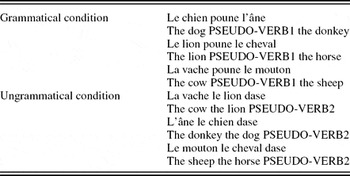
Two variables were manipulated: the grammaticality of the test sentence (grammatical word order vs. ungrammatical word order) and the type of action depicted in the video (causative vs. noncausative). Grammatical sentences had NP–V–NP as word order, whereas ungrammatical sentences had NP–NP–V as word order. Noun phrases consisted of a definite article (le, la) and a highly frequent animal name (dog, cow, horse, sheep, lion, and donkey).
Two bisyllabic pseudoverbs were selected (“daser” and “pouner”) following the phonological and phonotactic constraints of the French language. They were selected so that verbs in the phonological neighbourhood of the two pseudoverbs (following Luce & Pisoni, Reference Luce and Pisoni1998) showed a similar distribution of transitivity. Statistics computed on the French database Lexique (New, Pallier, Ferrand, & Matos, Reference New, Pallier, Ferrand and Matos2001) relative to the number of verbs showed that respectively 80% and 66.7% of the verbs in the phonological neighborhood of “daser” and “pouner” were transitive. Statistics on the number of words balanced with frequency showed a distribution of 88.4% and 87.9% of transitive verbs for “daser” and “pouner,” respectively. Given the slight imbalance in the statistics on the number of words, “pouner” was used in the grammatical, transitive NP–V–NP condition, whereas “daser” was used in the ungrammatical NP–NP–V condition. The six test sentences are listed in Table 1.
Experimental sentences

Each sentence was associated to a synchronized pair of videos depicting the animals (puppets) realizing actions that are not typically lexicalized in French (“daser”: to put a crown on someone's head; “pouner”: to catch someone's head under a net). One video illustrated the action realized causatively with the first NP as agent and the second NP as patient (causative action, e.g., the cow putting a crown on the lion's head), the other video depicted the same action realized reflexively with both NPs as agents (reflexive, noncausative action, e.g., the cow and the horse each putting a crown on their own heads). The six test items were presented in pseudorandom order with the presentation of the causative and noncausative actions counterbalanced across the left and right sides of the screen and across the grammatical and ungrammatical conditions.
Procedure
The experiment took place in a quiet room of the laboratory. The infant sat on her parent's lap at about 60 cm from the computer screen. The testing started with a procedure of eye calibration, which was reinitialized until a predetermined criterion reached a satisfying level of validity. A training session, divided into three phases, preceded the experimental test. The audio stimuli accompanying the videos were created such that at no time they provided the infant with a transitive or intransitive description of the scenes. The first phase familiarized infants with the puppets and to the fact that videos would appear to the left and right sides of the screen. Each animal was presented once, either on the left or on the right window, together with an audio stimulus naming the animal (e.g., Look, do you see? It's the cow!). The second phase familiarized the infant with the simultaneous presentation of two videos on the screen. Two different animals were presented on each screen while the audio asked the infants whether they saw one of them (e.g., Look, do you see the horse? Where's the horse?). The third phase familiarized infants with the novel actions used in the experimental videos. Each action was presented once on the left side of the screen, once on the right side of the screen, and once in its causative form, once in its non causative form. The videos were paired with sentences that did not introduce the pseudoverbs or the animals’ names (e.g., Look, what's happening?).
The experimental session involved the six pairs of experimental videos. Each pair lasted 20 s, during which the action was presented continuously loopwise. The 20-s sequences were spread into five windows. During the first 4-s window, an attentional sentence was presented with the videos (e.g., Look, do you see? What is it?). During the following 16 s, the test sentence was presented three times, so that the offset of the first presentation fell at the end of the 4- to 8-s window, the offset of the second presentation at the end of the 8- to 12-s window, and the offset of the third presentation at the end of the 12- to 16-s window. The last time window involved the videos on their own, without the sentences.
To capture infants’ attention, the Rising Baby from the Teletubbies (a laughing baby's face is seen to rise slowly toward the sky) was presented at seven moments in the experiment. The whole session lasted less than 15 min.
Data analyses
For each of the five windows of analysis, only infants with more than 55% of detected signal and at least two good test sentences over the total of three (within each experimental condition) were taken into account. The number of participants analyzed for each window varied between 12 and 18. Statistical contrasts involved pairwise comparisons on proportions using the nonparametric Wilcoxon matched-pairs test and bivaried paired Student t tests for means’ comparisons. For multiple comparisons, we used the Bonferroni correction. In addition, multilevel modeling was performed on gaze durations for each type of video (causative and noncausative) in each condition (grammatical and ungrammatical). The model used looking times in the 0- to 4-s window as baseline against which the evolution of looking preferences in the following windows was estimated. The baseline allowed us to assess changes in preferential looking due to the introduction of the linguistic materials taking into account potential preexisting preferences due to other, uncontrolled factors.
RESULTS
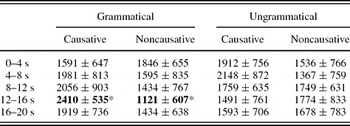
The evolution of looking times to the causative video in the five time windows of interest is illustrated in Figure 1. Mean looking times are reported in Table 2.
The proportion of looking time to the causative action for the grammatical condition (noun phrase–verb–noun phrase sentences) and the ungrammatical condition (noun phrase–noun phrase–verb) in the five windows of analysis.

Mean looking times (ms) toward the causative and noncausative videos in the grammatical and ungrammatical conditions across the five time windows

* p < .05 (in bold).
Preference for the causative over the noncausative action in the grammatical condition emerges in window 8–12 s (mean = 0.58); thus, after the first presentation of the grammatical sentence, peaking at the next time window (12–16 s) after the second presentation of the test sentence (mean = 0.69), and then decreases in the last window (mean = 0.57 at 16–20 s). Analysis of the proportion of looking time to the causative video against chance level showed a significant effect in the grammatical condition in window 12–16 s only, Z (11, 1) = −3.06, p < .01, p corrected = .02. Looking times in the other windows of the grammatical condition as well as in all the windows of the nongrammatical condition were at chance level.
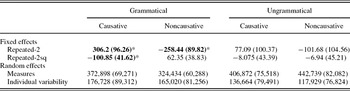
Comparison of gaze fixations in each condition and each time window showed that infants looked longer at the causative video than at the noncausative video only in the grammatical condition, and only in window 12–16 s, t (11, 1) = 4.27, p < .01, p corrected = .01. In window 12–16 s, the proportion of gazes toward the causative video was significantly higher in the grammatical condition (mean = 0.69) than in the ungrammatical condition (mean = 0.45), Z (11, 1) = 2.59, p < 0.01, p corrected = .04. Multilevel modeling was computed using mean gaze durations for each time window with the y axis crossing the x axis at the 4- to 8-s mean point. Coefficients are reported in Table 3.
Mean (SE) coefficients of the multilevel modeling of gaze duration toward the causative and noncausative videos in the grammatical and ungrammatical conditions

* p < .05 (in bold).
Successful models were only found for the grammatical condition with a positive slope in the causative video (coefficient = 306.2, standard error = 96.3) and a negative slope in the noncausative video (coefficient = −258.4, standard error = 89.8). This confirms the significant preference for the causative video in the grammatical condition reported in the previous analyses. The best fit model for the causative video also shows a negative quadratic coefficient (−100.9, standard error = 41.6) confirming the decrease of looking time to the causative video in the last time window (16–20 s).
DISCUSSION AND CONCLUSIONS
High-resolution eye-tracking measures were recorded as 19-month-old infants watched pairs of videos presented simultaneously with audio sentences. When infants heard grammatical SVO sentences, they looked at the video depicting the causative action significantly above chance, showing a significant preference for the causative interpretation of the sentence over the noncausative interpretation, as illustrated in the alternative video. This effect was significant in the 12- to 16-s time window, corresponding to the end of the second presentation of the test sentence. However, it emerged as early as the initial time windows, as attested by the continuously increasing preference shown by infants for the matching screen in the grammatical condition. Although 12–16 s may seem late in comparison to Gertner and colleagues’ (Reference Gertner, Fisher and Eisengart2006) study who reported an effect during the first 2 s of the first test trial, our study critically differed from theirs in that whereas in our design the first sentence arose during the 4- to 8-s window, in Gertner et al.'s (Reference Gertner, Fisher and Eisengart2006) study a practice sentence (of a similar structure to the test sentence) was already presented during a 5-s blank screen before the videos. Hence, the preference they report actually arises during the second presentation of the sentence. When ungrammatical sentences containing two preverbal noun phrases were presented, infants looked at chance level to the two videos.
The preference observed in the grammatical condition cannot be explained by a variety of biases that were uncontrolled in previous studies (Dittmar et al., Reference Dittmar, Abbot-Smith, Lieven and Tomasello2008; Fernandes et al., Reference Fernandes, Marcus, Di Nubila and Vouloumanos2006; Gertner et al., Reference Gertner, Fisher and Eisengart2006). It cannot be accounted for by a universal bias for SO over OS order, because the alternative, mismatching video did not illustrate the OS interpretation as was the case in previous studies. The preference cannot be explained either by some general preference for actions executed causatively because no preference was observed for the causative scene when ungrammatical sentences described it. The application of some “one to one mapping’ principle, according to which infants are biased to assume that verbs in sentences with two NP arguments should be mapped onto actions with two semantic roles (agent and patient; Lidz, Gleitman, & Gleitman, Reference Lidz, Gleitman and Gleitman2001) cannot account for the results either. Indeed, if such a principle was applied independently of word order constraints, a similar preference for the causative scene should have been found in the ungrammatical condition that also contained two NPs. Finally, the preference observed in the grammatical sentence condition is not due to the learning of a mapping between the position in the sentence and the thematic role of a specific noun during the training phase, as argued by Dittmar et al. (Reference Dittmar, Abbot-Smith, Lieven and Tomasello2008) to be the case in Gertner et al. (Reference Gertner, Fisher and Eisengart2006), because no linguistic information, lexical or structural, was provided in the training phase.Footnote 3
The results reported cannot be explained by the constructivist view that children slowly develop knowledge of word order on a verb by verb basis and abstract knowledge only appears around age 3;6 or 4. If this were the case, 19-month-olds should not have demonstrated any preference in their interpretation of grammatical sentences containing pseudoverbs. It is also interesting that vocabulary scores (ranging from 8 to 389 words, as measured by the French version of the MacArthur Communicative Development Inventory) failed to correlate with individual preferences for the matching video (r = −.24, p = .21). Again, such a correlation was predicted if infants’ interpretation of the sentences was depending on their lexical knowledge.
The data therefore provide a clear-cut demonstration that infants at that age not only know that the postverbal NP in NP–V–NP configurations expresses the patient of the action, following the grammatical SVO order of French, but also that the second preverbal NP in NP–NP–V configurations cannot express the patient of the action as would be the case in a grammar with SOV order. Such knowledge, available very early on in French infants, is particularly interesting in consideration of recent experimental evidence for the preferred SOV order in improvised gesture communication in adults of both SOV and SVO languages (Langus & Nespor, Reference Langus and Nespor2010). These findings, in line with independent empirical facts, support the view that whereas SVO presents certain advantages for syntactic computations, simple communication that relies on the direct interaction between the sensory–motor and the conceptual system seems to prefer the SOV order. If indeed SOV is in some sense the default order for cognitive systems underlying simple communication, this further reinforces our conclusion that the performance exhibited by our 19-month-old French infants reflects grammatical knowledge.
Our data are in line with those by Gertner and colleagues, and fail to replicate the finding by Dittmar and colleagues (Reference Dittmar, Abbot-Smith, Lieven and Tomasello2008) that infants’ preferences require a training phase involving transitive sentences with familiar verbs and the same characters as in the test sentences, occupying the same syntactic positions. A closer look at the data reported by Dittmar et al. (Reference Dittmar, Abbot-Smith, Lieven and Tomasello2008), however, shows that the difference between the training and no-training conditions is actually mostly due to one window: the first 4 s of the first trial (corresponding to the second presentation of the test sentence). Critically, the difference between the two conditions in that window fails to attest of any preference for the matching video in the training condition because the proportion of looking times for the matching screen in that condition is 0.49 (against 0.41 in the no-training condition). Mean looking times averaged over the last three presentations of the sentence are actually very similar in the training and no-training conditions: 0.57 and 0.55, respectively. Hence, although the data by Dittmar and colleagues (Reference Dittmar, Abbot-Smith, Lieven and Tomasello2008) do indeed seem to differ from Gertner et al.'s (Reference Gertner, Fisher and Eisengart2006) in English and from ours in French, this difference seems to be more adequately captured by variations in the strength of infants’ looking preferences rather than by an effect of a training phase, as hypothesized by Dittmar et al. (Reference Dittmar, Abbot-Smith, Lieven and Tomasello2008). Weaker representations of word order are indeed expected in German infants, given that word order is much less reliable in German than in English or French. Critically, corpus analyses reported by Dittmar and colleagues (Reference Dittmar, Abbot-Smith, Lieven and Tomasello2008) show that 21% of the transitive sentences German infants are exposed to contain a preverbal object and a postverbal subject, which may well contribute to slowing down the development of an abstract representation of SVO as the canonical word order.
In sum, our data provide the first direct evidence for the hypothesis of early abstract word order representations in 19-month-old French infants: (a) preference for the correct interpretation of word order was found with pseudoverbs without any training on the materials, (b) this preference is anchored in abstract parametric grammatical knowledge and not in some universal predominance of the SO order, and (c) this preference is found in even younger infants, aged 19 months. The finding that infants demonstrate an abstract representation of the head direction of their language very early on, independently of the lexicon, is hard to explain under usage-based theories of language acquisition according to which grammatical constructions are acquired progressively on a lexical basis.Footnote 4 Rather, it finds a natural explanation in the theoretical framework that views acquisition as a process of parameter setting, by which the infant sets the direction of the head prelexically and on the basis of limited input, thanks to the limited range of prewired abstract structural representations that her cognitive architecture allows for.
ACKNOWLEDGMENTS
The work reported here was supported by Grant 100014_126924 of the Fonds National de la Recherche Suisse (to J.F.). We are grateful to the students in the Masters Program in Speech Therapy of the University of Geneva; Laura Schenker and Sandrine Schnyder for their assistance in the materials and testing of the experiment; as well as the infants and their parents who participated in the study. Many thanks to Alain Perruchoud for his technical support; Anne Christophe, Ulrich Frauenfelder, Sven Mattys, Julien Musolino, Rushen Shi, and Ur Shlonsky for the insightful discussions; and two anonymous reviewers for their comments that helped improve the manuscript.