Rheumatic heart disease is not a disease of the past. It remains a disease of the poor, the disadvantaged, and those who lack regular access to both preventative care and advanced cardiac care. With worldwide prevalence at 33.4 million and 319,000 deaths each year, it is a significant contributor to the global burden of cardiac disease – particularly in the sub-Saharan Africa, South Asia, and Oceania.Reference Watkins, Johnson and Colquhoun1 Clinical cases in these regions commonly present with advanced disease, usually beyond the window of being able to benefit from penicillin prophylaxis.Reference Zuhlke, Karthikeyan and Engel2–Reference Zuhlke, Engel and Karthikeyan5 Early detection of rheumatic heart disease is therefore a high priority.Reference Remenyi, Carapetis, Wyber, Taubert and Mayosi6, Reference Carapetis, Zuhlke, Taubert and Narula7 The 2012 World Heart Federation diagnostic criteria for rheumatic heart disease provide a standardised evidence-based approach to echocardiography diagnosis of rheumatic heart disease that includes borderline and definite rheumatic heart disease categories.Reference Remenyi, Wilson and Steer8 Patients with subclinical rheumatic heart disease (disease that is detected prior to any clinical symptoms) are potential candidates for early intervention with monthly penicillin injections.Reference Zuhlke and Karthikeyan9–Reference Nascimento, Nunes and Lopes11 This effort to prevent progression of the disease, however, is not universally accepted.
Multiple screening studies in children using World Heart Federation criteria have revealed a prevalence of rheumatic heart disease of up to 4%, with pathological mitral regurgitation making up the largest proportion of borderline cases.Reference Nascimento, Nunes and Lopes11–Reference Beaton, Aliku and Dewyer24 One of the challenges in the interpretation of screening echocardiograms is the potential overlap between borderline rheumatic heart disease and normal physiologic mitral regurgitation. Publications from the United States and Australia evaluating World Heart Federation criteria in low-risk populations provide support for these criteria not simply identifying normal physiologic mitral regurgitation.Reference Clark, Krishnan and McCarter25, Reference Roberts, Maguire and Brown26 There may, however, be other contributing factors to the presence of echocardiography-detected mitral regurgitation in endemic countries that would lead to an over-diagnosis of borderline rheumatic heart disease. One such consideration is the high prevalence of anaemia in the same geographical regions where rheumatic heart disease is most prevalent. Anaemia affects 27% of the world’s population, and 89% of the burden is in developing countries.Reference Kassebaum27, Reference Kassebaum, Jasrasaria and Naghavi28 The age-standardised prevalence rate (per 100,000) of anaemia in the Sub-Saharan Africa is estimated to be 36,315, compared to 16,773 in high-income North America.Reference Kassebaum27
The cardiovascular response to chronic anaemia includes elevated preload from an increase in blood volume and decreased systemic vascular resistance. This combination leads to a significant increase in cardiac output.Reference Lonsdorfer, Bogui and Otayeck29 As a result, there is increased presence of mitral regurgitation in the setting of a structurally normal mitral valve.Reference Ahmed, Siddiqui and Sadiq30 There have been no studies addressing if anaemia contributes to the findings of rheumatic heart disease on echocardiography, potentially confounding the use of World Heart Federation criteria in anaemic patients. As the World Heart Federation criteria emphasise ruling out other causes of mitral regurgitation before diagnosing rheumatic heart disease, then it may be necessary to rule out anaemia prior to making the aforementioned diagnosis. Given the World Health Organization estimate that one-quarter of school-age children worldwide are affected by anaemia, diagnostic overlap between anaemia and rheumatic heart disease is inevitable. Reference McLean, Cogswell, Egli, Wojdyla and de Benoist31
The primary aim of this study is to determine if the presence of anaemia increases the likelihood of an echocardiography diagnosis of borderline rheumatic heart disease using World Heart Federation criteria in a population of children in the United States without other structural or functional heart disease who are referred for both echocardiography and haemoglobin. The secondary aim is to identify other variables that could potentially contribute to borderline rheumatic heart disease on echocardiography.
Methods
We employed a cross-sectional retrospective study design based on historical data from patients referred for echocardiography and haemoglobin at Children’s National Health System from 1 January, 2013 to 31 December, 2015. All echocardiograms and haemoglobin values were identified by study date and integrated by patient medical record number into a Structured Query Language server database (Philips Healthcare Research, Cambridge, Massachusetts, United States of America). Retrospective studies using the Structured Query Language-based database are approved by the Institutional Review Board at Children’s National Health System. This study received Expedited status from the Institutional Review Board.
A snapshot of the database was imported onto a local server for analysis and data extraction. Date of study, patient demographics, including age, race, and gender as well as study indication and blood pressure were extracted from the echocardiography database, and haemoglobin was extracted from the laboratory database and incorporated into the analytics client.
All subjects between the ages of 5 and 18 years who had haemoglobin performed within 30 days of echocardiography were eligible for inclusion. Subjects with any congenital or acquired functional or structure heart disease were excluded, as were post-procedural patients (e.g. radiofrequency ablation), and those with inflammatory conditions (e.g. Kawasaki Disease). The only exception is that trivial tricuspid or pulmonary insufficiency was not in the exclusion criteria. Hypertension was only used as an indication if systolic or diastolic blood pressure was greater than or equal to the 95th percentile based on age, gender, and height-based norms.32
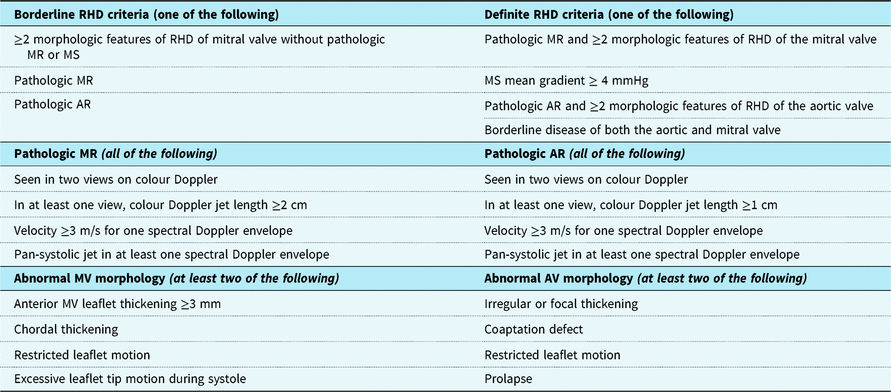
The final study population was categorised as anaemic or non-anaemic, based on age and gender-based normative data, with anaemia as defined by a haemoglobin value less than the 2.5 percentile.Reference Sills, Sills and Hochberg33 Echocardiography images were then reviewed to determine the presence or absence of World Heart Federation criteria for rheumatic heart disease. World Heart Federation criteria, which are based upon morphologic and Doppler findings, are shown in Table 1.Reference Remenyi, Wilson and Steer8 This includes measuring length of mitral regurgitation jet on colour Doppler on parasternal long axis and apical four chamber views. Subjects who had mitral regurgitation jets just under the 2.0 cm cutoff for rheumatic heart disease (1.5–1.9 cm) were classified as mitral regurgitation of unclear significance. A registered paediatric cardiac sonographer performed the initial image review, and the second review was performed by a board-certified paediatric cardiologist. When discrepancies occurred between the first two reviews, a third reviewer, also a board-certified paediatric cardiologist, acted as tiebreaker. All reviewers have extensive experience in the echocardiographic diagnosis of rheumatic heart disease using World Heart Federation criteria.
Overview of World Heart Federation diagnostic criteria of rheumatic heart disease for patients 20 years or younger

AR = aortic regurgitation; AV = aortic valve; MR = mitral regurgitation; MS = mitral stenosis; MV = mitral valve; RHD = rheumatic heart disease.
Modified from Remenyi et al. World Heart Federation Criteria for echocardiographic diagnosis of rheumatic heart disease – an evidence-based guideline Nature Reviews Cardiology 2012.
The study population represents a convenience sample available through our database query. Two-tailed Fisher’s exact tests were used to compare categorical data including presence or absence of borderline rheumatic heart disease and mitral regurgitation of unclear significance between anaemic and non-anaemic patients. Unpaired two-tailed t-test was used to compare continuous, normally distributed variables and two-tailed Mann–Whitney U-test to compare continuous variables that were not normally distributed. p-Values less than 0.05 were considered statistically significant.
Results
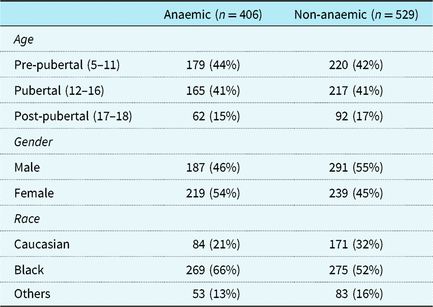
Over 300,000 haemoglobin tests and 60,000 echocardiograms were available for data extraction in the database. Of the 1325 unique subjects who met the inclusion criteria based on age and paired haemoglobin and echocardiograms within 30 days, 290 were excluded based on the presence of underlying cardiac disease. This left 935 subjects in the study population. Of the total study population, 43% (406 of 935) were categorised as anaemic and 57% (529 of 935) were not anaemic. The relative frequencies of gender, age, and race among anaemic and non-anaemic study subjects are displayed in Table 2.
Study population demographics

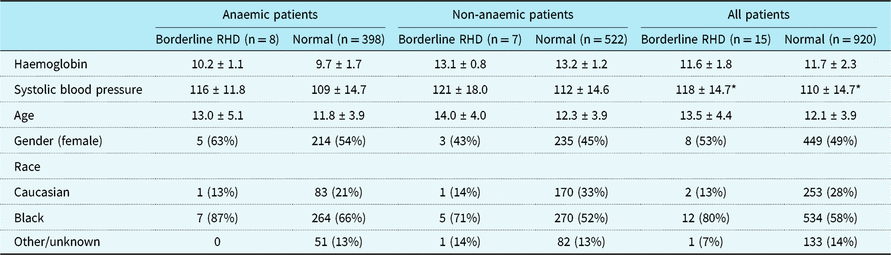
Table 3 shows the comparison of prevalence of borderline rheumatic heart disease and mitral regurgitation of unclear significance between anaemic and non-anaemic subjects. All patients identified to meet borderline rheumatic heart disease criteria did so by the finding of pathologic mitral regurgitation. The prevalence of borderline rheumatic heart disease was not statistically different between anaemic (n = 8, 2.0%, 95% CI 0.6–3.3%) and non-anaemic subjects (n = 7, 1.3%; 95% CI 0.3–2.3%). There was a significantly higher rate of mitral regurgitation of unclear significance in anaemic versus non-anaemic subjects (8.6 versus 3.6%, p = 0.0012). Table 4 shows the breakdown of haemoglobin, blood pressure, and demographic variables by category of anaemia and presence or absence of borderline rheumatic heart disease. There was no difference in age, race, gender, or haemoglobin between subjects with and without borderline rheumatic heart disease. There was a non-significant trend towards higher systolic blood pressure in subjects with borderline rheumatic heart disease (p = 0.064).
Comparison of borderline rheumatic heart disease and mitral regurgitation of unclear significance between anaemic and non-anaemic subjects

MRUS = mitral regurgitation of unclear significance; RHD = rheumatic heart disease.
Haemoglobin, blood pressure, and demographic variables by anaemia and rheumatic heart disease status

RHD = rheumatic heart disease.
All comparisons not significant, except:
* p = 0.064 systolic blood pressure borderline RHD versus normal in entire study cohort.
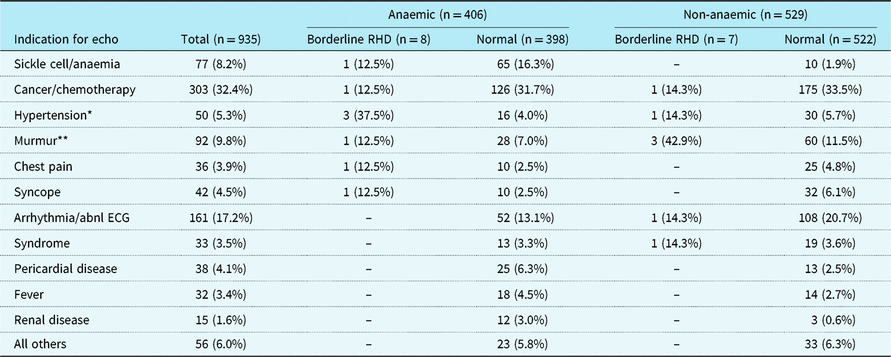
A breakdown of frequency of echocardiographic indication for the total population as well as the anaemic and non-anaemic cohorts is provided in Table 5. The most common indication for echo among our study population was cancer and cancer treatment at 32.4%, followed by arrhythmias/abnormal electrocardiogram at 17.2%, and then murmur at 9.8%. Sickle cell disease and hypertension were the fourth and fifth most common indications for echo, respectively. Among anaemic patients, those with hypertension as the indication for echocardiogram were statistically more likely (37.5 versus 4.0%) to have borderline rheumatic heart disease (p = 0.0042). Among non-anaemic patients, the indication of murmur made finding borderline rheumatic heart disease more likely (42.9 versus 11.5%, p = 0.040).
Frequency of echocardiogram indication for study population

ECG = electrocardiogram; RHD = rheumatic heart disease.
For the purposes of analysis, where more than one indication for echo was given, only the primary reason was included.
* p = 0.0042 for hypertension association with borderline RHD in anaemic patients.
** p = 0.040 for murmur association borderline RHD in non-anaemic patients.
Discussion
The early diagnosis of rheumatic heart disease holds promise for crucial public health intervention to mitigate the impact of this disease.Reference Weinberg, Beaton, Aliku, Lwabi and Sable17 However, the significance of finding borderline rheumatic heart disease by echocardiography screening in endemic regions using the 2012 World Heart Federation criteria remains uncertain.Reference Colquhoun, Kado and Remenyi34–Reference Zuhlke and Mayosi37 Establishing that the World Heart Federation criteria can effectively distinguish between variants of normal and true early rheumatic heart disease is an important component in justifying the possible role echocardiography screening as a public policy tool. Multiple studies have shown that borderline rheumatic heart disease is much less likely to be found in low-risk populations, helping to support the validity of the World Heart Federation criteria.Reference Clark, Krishnan and McCarter25, Reference Roberts, Maguire and Brown26 Our study adds additional important data to support this concept. The main finding of this study is that anaemia does not likely correlate with enough mitral regurgitation to increase the prevalence of borderline rheumatic heart disease on echocardiography.
Anaemia is found in relatively high rates in the same geographic distributions as rheumatic heart disease.Reference Watkins, Johnson and Colquhoun1, Reference Kassebaum27, Reference Kassebaum, Jasrasaria and Naghavi28 Contributors to higher rates of anaemia include nutritional deficiencies, most commonly iron deficiency, and sickle cell disease.Reference Kassebaum, Jasrasaria and Naghavi28 Malaria and other parasitic infections also contribute to higher rates of anaemia in low- and middle-income countries. There is significant overlap in the prevalence and years lived with disability maps when comparing a 2016 paper on global burden of anaemiaReference Kassebaum27 and a 2017 paper on global burden of rheumatic heart disease.Reference Watkins, Johnson and Colquhoun1 Given that anaemia increases cardiac output, there is the potential for mitral regurgitation on echocardiography among the anaemic population.Reference Ahmed, Siddiqui and Sadiq30, Reference Lonsdorfer, Bogui and Otayeck29 This physiologic principle begs the question about the potential impact of anaemia on assessment of degree of mitral regurgitation using World Heart Federation criteria in children undergoing screening echocardiography for rheumatic heart disease in endemic regions.
Our study aims to fill this knowledge gap and shows that the presence of anaemia does not result in echocardiograms that meet the World Heart Federation diagnostic criteria for borderline rheumatic heart disease in this low-risk population. However, as expected based on physiology, anaemia does increase the likelihood that measurable mitral regurgitation is present on otherwise normal echocardiograms in children. This information is very important in validating the use of a 2.0 cm mitral regurgitation colour Doppler jet length cutoff as part of the criteria for pathological mitral regurgitation.Reference Remenyi, Wilson and Steer8 Our data suggest that a lower cutoff would result in higher rate of positive studies in anaemic patients.
The secondary analyses showing increased rates of borderline rheumatic heart disease among non-anaemic patients with murmur and anaemic patients with hypertension as primary indications for echocardiography are not surprising. A recent study from the United Kingdom showed a 26% increase in the likelihood of mitral regurgitation for every 20 mmHg increment increase in systolic blood pressure.Reference Rahimi, Mohseni and Otto38 Furthermore, concurrent anaemia and hypertension may make pathologic mitral regurgitation even more likely. Measurement of blood pressure in a screening setting may not be feasible, and correlating the actual blood pressure during the exact time of echocardiography image acquisition is even more challenging. Nonetheless, blood pressure is a necessary component to accurately interpret an echocardiogram. A future study to further separate out the overlap between borderline rheumatic heart disease and physiologic mitral regurgitation secondary to hypertension would be beneficial.
Rheumatic heart disease is the leading global cause of cardiovascular morbidity and mortality in children and young adults.Reference Watkins, Johnson and Colquhoun1 Inattention to rheumatic heart disease continues to play a key role in the unacceptably slow progress in reducing its global burden.Reference Remenyi, Carapetis, Wyber, Taubert and Mayosi6, Reference Carapetis, Zuhlke, Taubert and Narula7, Reference Carapetis and Zuhlke39 The 2012 World Heart Federation criteria, based on existing evidence and expert consensus, have made a significant contribution to the field of rheumatic heart disease. There have been dozens of publications and tens of thousands of children screened in low- and middle-income countries using these standardised set of echocardiography parameters widely accepted by global rheumatic heart disease experts.Reference Zuhlke, Engel and Lemmer10, Reference Nascimento, Nunes and Lopes11, Reference Beaton, Lu and Aliku15–Reference Sims Sanyahumbi, Sable and Beaton19, Reference Yadeta, Hailu and Haileamlak21–Reference Beaton, Aliku and Dewyer24, Reference Colquhoun, Kado and Remenyi34, Reference Godown and Beaton35, Reference Saxena, Zuhlke and Wilson40–Reference Zuhlke, Engel, Nkepu and Mayosi60 Several of these publications focus on task-shifting and other ways to increase the practicality of echocardiography-based screening in endemic regions. While there are opportunities for improving and refining the two-dimensional and Doppler criteria in the World Heart Federation rheumatic heart disease echocardiography guidelines, the critical importance of these guidelines in the fight against rheumatic heart disease cannot be overstated. Our study adds an additional important piece of information in interpretation of these guidelines.
Several limitations exist in our study. The overall rate of borderline rheumatic heart disease in anaemic and non-anaemic groups was higher than in other studies in low-risk populations.Reference Clark, Krishnan and McCarter25, Reference Roberts, Maguire and Brown26 Only a small fraction of patients undergoing haemoglobin or echocardiography testing had both studies performed within the time period that we were able to extract data from and met our inclusion criteria. Our convenience sample of 935 subjects resulted in only 15 subjects who met World Heart Federation criteria for rheumatic heart disease. It is possible that a larger sample size with more positive studies might have detected a significant difference between anaemic and non-anaemic subjects.
Furthermore, it is likely that the patient population of this study may be sicker than a typical paediatric population, by nature of the fact that patients received both an echocardiogram and a haemoglobin assessment in a short period of time. For example, the rate of anaemia and the proportion of patients with cancer in our study population are both higher than in the general population. This selection bias limits the generalisability of our study to the general population in both endemic and low-risk settings. As this was a retrospective study, it was not possible to mitigate any selection bias that resulted from our study design.
Many screening studies utilise handheld echocardiography with lower cutoffs for mitral regurgitation jet length.Reference Ploutz, Lu and Scheel18, Reference Lu, Sable and Ensing53, Reference Mirabel, Bacquelin and Tafflet54 Our study is based on review of echocardiograms performed on full functional echocardiography machines and cannot be extrapolated to handheld echocardiography. Our study was not powered to assess the impact of hypertension and the intersection of hypertension and anaemia on echocardiographic findings. At best, our data provide support for further study of this finding.
Most significantly, this study was conducted with a low-risk population, whereas the patients most impacted by anaemia, rheumatic heart disease, and the potential intersection of the two reside in endemic (high-risk) settings with different aetiologies for anaemia. The echocardiographic findings must be interpreted differently depending on the setting and patient circumstance. Additionally, most data that inform the diagnosis and management of rheumatic heart disease are from endemic settings. Applying the data to the low-risk population of this study is solely for exploratory thought. This study was to support interpretation of ongoing rheumatic heart disease screening studies; it was not meant to diagnose subjects in the study with rheumatic heart disease. Conversely, the data obtained from this study in a low-risk population may not apply in the high-risk settings where rheumatic heart disease is most prevalent. Ideally, this study would be repeated as part of a prospective study in an endemic region with patient matching that included simultaneous echocardiography and haemoglobin. This limits the applicability of our findings.
In conclusion, the presence of anaemia makes mitral regurgitation more likely, but not to the degree at which it would meet World Heart Federation criteria for the diagnosis of borderline rheumatic heart disease. Our data support investigating this question prospectively in a high-risk region, to more definitively determine the contribution of anaemia to the presence of borderline rheumatic heart disease on screening echocardiography.
Acknowledgement
We would like to acknowledge the support of Philips Healthcare Research for providing the relational database tools for this study.
Financial Support
This research received no specific grant from any funding agency, commercial or not-for-profit sectors.
Conflicts of Interest
None.
Ethical Standards
This paper is in compliance with all ethical standards.
Ethical Approval
All procedures performed in studies involving human participants were in accordance with the ethical standards of the institutional and/or national research committee and with the 1964 Helsinki declaration and its later amendments or comparable ethical standards. Informed consent was waived due to retrospective study design.