INTRODUCTION
The current study examined the composition of lexicons reported on the Language Development Survey (LDS; Rescorla, Reference Rescorla1989) for a sample of sixty-seven children with autism spectrum disorders (ASD). The central question investigated was how similar in composition the lexicons of the ASD children were in comparison to lexicons reported for typically developing young children. This central question relates to the broader issue of whether children with ASD are ‘deviant’ in their lexical development or merely just ‘delayed’.
Lexical development in typically developing children
Lexical development in typically developing children has been widely studied for decades. Early parental diary studies (e.g. Leopold, Reference Leopold1939), integrative analyses of diary studies (Clark, Reference Clark and Moore1973), and ‘group’ diary studies (e.g. Benedict, Reference Benedict1979; Nelson, Reference Nelson1973; Rescorla, Reference Rescorla1980) have shown many similarities across children and languages in lexical acquisition. These similarities include that expressive vocabulary growth starts slowly at about age 1;0 and then accelerates from 1;6 to 2;0; that early vocabularies are composed of words from a variety of word classes, with nouns generally the largest class; and that early words often show overextensions in reference.
Starting in the 1980s, studies using vocabulary checklists such as the MacArthur Communicative Development Inventory (CDI; Fenson, Dale, Reznick, Bates, Thal, & Pethick, Reference Fenson, Dale, Reznick, Bates, Thal and Pethick1994) and the Language Development Survey (Rescorla, Reference Rescorla1989) have revealed many cross-linguistic similarities in lexical acquisition (Dale & Goodman, Reference Dale, Goodman, Tomasello and Slobin2005; Papaeliou & Rescorla, Reference Papaeliou and Rescorla2011). For example, children within each country vary widely in their rate of lexical acquisition, acquisition accelerates from age 1;0 to 2;0, girls tend to have larger reported vocabularies than boys, and there are similarities in vocabulary composition across languages.
In the past few decades, laboratory procedures (i.e. teaching nonsense words for unusual objects or testing lexical comprehension using preferential looking) have also increased our understanding of lexical development. For example, laboratory studies have demonstrated that young children tend to label whole objects rather than parts of objects or actions and to generalize labels on the basis of shape rather than color or texture (Landau, Smith & Jones, Reference Laudau, Smith and Jones1988; Markman, Reference Markman1989).
Lexical development in children with ASD
Vocabulary checklists and lab procedures have also been used to study lexical development in children with ASD. Children with ASD vary widely both in severity of presenting symptoms and in prognosis (Klin & Volkmar, Reference Klin, Volkmar, Goldstein and Reynolds1999), but they are generally characterized by deficits in interpersonal relatedness, problems in communication, and repetitive interests or behaviors. With the inclusion of Asperger's Disorder as a subtype of pervasive developmental disorder in the DSM-IV (American Psychiatric Association, 1994) and the greatly increased diagnosis rates of ASD in the past decade (Fombonne, Reference Fombonne2003), ASD now subsumes more children with milder impairments than in previous decades.
With the expansion of the diagnostic criteria for ASD, language abilities are more diverse (Kjelgaard & Tager-Flusberg, Reference Kjelgaard and Tager-Flusberg2001) and outcomes tend to be better (Howlin, Reference Howlin, Volkmar, Paul, Klin and Cohen2005) than in samples of autistic children diagnosed previously. An estimated 25 percent of children with ASD remain non-verbal (Lord, Risi & Pickles, Reference Lord, Risi, Pickles, Rice and Warren2004; Sigman & McGovern, Reference Sigman and McGovern2005). The presence of language before age five has traditionally been one of the best predictors of better long-term outcome (Mahwood, Howlin & Rutter, Reference Mahwood, Howlin and Rutter2000; Venter, Lord & Schopler, Reference Venter, Lord and Schopler1992). Landa (Reference Landa2007) has noted that vocabulary is often a relative strength for children with ASD, but Tager-Flusberg and Caronna (Reference Tager-Flusberg and Caronna2007) noted that although children with ASD often have good vocabulary scores, they may not have a strong grasp of the meaning of abstract words.
Parent-report studies. Charman, Drew, Baird and Baird (Reference Charman, Drew, Baird and Baird2003) examined language skills in 116 boys and 8 girls with ASD diagnoses (mean age about three years) using the Infant form of the CDI (Fenson et al., Reference Fenson, Dale, Reznick, Bates, Thal and Pethick1994). Some naming/labeling was reported for 29% of the sample (15% for <two years, 19% for age two, 32% for age three, and 52% for age four and older). This represents a significant delay, given that 75% of the CDI normative sample were reported to name/label at age 1;4. No words were reported for forty-seven children, mean vocabulary was 30 words for the 2;0 to 2;11 age bracket, but some children had normal vocabulary scores for their age. Among children using some words, percentages of common nouns, predicates and closed-class terms were comparable to those with similar vocabulary sizes in the normative sample, but no information about specific vocabulary words was provided.
Luyster, Qui, Lopez and Lord (Reference Luyster, Qui, Lopez and Lord2007) used the Infant and Toddler forms of the CDI to describe language skills in sixty-two children with ASD at ages two and three. A parental response of ‘yes’ to the question ‘understands and says’ at least one word indicated that 49% of the children at age two and 71% of the children at age three possessed some expressive language, but no further details were provided about their lexicons.
Smith, Mirenda and Zaidman-Zait (Reference Smith, Mirenda and Zaidman-Zait2007) assessed vocabulary development four times over two years in thirty-five children with autism (age 1;9 to 5;8) who had <60 words on the CDI at intake. All the children manifested significant intellectual disability (mean score of 48·9 on the Mullen Scales of Early Learning (Mullen, Reference Mullen1995) and scores of ⩾30 on the Child Autism Rating Scale (CARS; Schopler, Reichler & Renner, Reference Schopler, Reichler and Renner1988)). Over the 24-month period, fifteen children had a mean increase of only 10 words, eight gained 200 words, seven gained 453 words, and five children gained 638 words. No details about lexical composition were provided.
Luyster, Kadlec, Carter and Tager-Flusberg (Reference Luyster, Kadlec, Carter and Tager-Flusberg2008) assessed receptive and expressive language skills in 164 toddlers with ASD (age 1;6 to 2;9). Expressive vocabulary scores on the CDI were correlated at 0·82 with expressive language test scores on the Mullen (Reference Mullen1995), indicating strong concurrent validity for parental reports of vocabulary in children with ASD. Mean CDI vocabulary score was 86·90, with the SD of 121·42 much larger than the mean, but no details were provided about the distribution of lexicon sizes or lexical composition.
Ellis Weismer, Lord and Eisler (Reference Ellis Weismer, Lord and Eisler2010) analyzed early language abilities in 257 children with ASD assessed from age 2;0 to 3;0 via parent report on the Vineland Adaptive Behavior Scales (Sparrow, Balla & Cicchetti, Reference Sparrow, Balla and Cicchetti1984; Sparrow, Cicchetti & Balla, Reference Sparrow, Cicchetti and Balla2005), as well as by the Mullen (Reference Mullen1995) and the Sequenced Inventory of Communicative Development (SICD; Hendrick, Prather & Towbin, Reference Hendrick, Prather and Tobin1984). Only 3 percent of the children with ASD had normal language, and the 179 children with autism had greater delays than the seventy-eight children with pervasie developmental disorder – not otherwise specified (PDD-NOS). Lexical composition findings were not presented.
Finally, Ellis Weismer, Gernsbacher, Stronach and Karasinski (Reference Ellis Weismer, Gemsbacher, Stronach and Karasinski2011) reported lexical composition and grammatical findings for forty children with ASD (age 1;11–3;1) and forty late talkers (age 1;10–2;6) yoked on CDI expressive vocabulary scores. The mean CDI vocabulary score of the ASD sample was 108 words (SD = 76, range = 17–298 words), indicating relatively good, albeit somewhat delayed, language skills. Groups were also similar in the percentage of children producing word combinations (22 not yet combining words), and in the grammatical complexity of their phrases. However, the late talkers displayed a stronger association between lexicon size and grammatical complexity score than the children with ASD (correlations of 0·76 and 0·44, respectively). The only lexical composition findings reported were that the children with ASD were similar to the late talkers in semantic category distributions.
In summary, parent report studies of lexical development in young children with ASD have indicated high rates of language delay but great variation in vocabulary skills. The two studies that examined lexical composition reported that semantic category distributions were similar to those of typically developing children with comparable vocabulary sizes (Charman et al., Reference Charman, Drew, Baird and Baird2003) and to those of late talkers (Ellis Weismer et al., Reference Ellis Weismer, Gemsbacher, Stronach and Karasinski2011), but no details about the specific words acquired were reported.
Laboratory studies. Laboratory studies of early lexical development in young children with ASD have revealed some similarities relative to performance of typically developing children. For example, Swenson, Kelley, Fein and Naigles (Reference Swenson, Kelly, Fein and Naigles2007), who studied ten two- and three-year-olds with ASD and thirteen children aged 1;9 with typical development, found no group differences in noun bias using an intermodal preferential looking task, with children in both groups tending to interpret a novel word as a noun rather than as a verb.
In contrast to Swenson et al. (Reference Swenson, Kelly, Fein and Naigles2007), Tek, Jaffery, Fein and Naigles (Reference Tek, Jaffery, Fein and Naigles2008) found differences between fourteen children with ASD (aged 2;2 to 3;1) and fifteen typically developing language-matched children (1;6 to 1;11) when intermodal preferential looking was measured during four visits over twelve months. The two groups did not differ in noun bias, consistent with Swenson et al. (Reference Swenson, Kelly, Fein and Naigles2007), but they did differ in their tendency to show a shape bias (i.e. interpreting a novel word as referring to an object's shape rather than its color or texture). Neither group showed a shape bias at Visit 1, but the typically developing group manifested a significant shape bias at the subsequent three visits, whereas the ASD group did not. Even the children with ASD who had >100 count nouns in their vocabularies did not show a significant shape bias, but shape bias was linked to lexical growth in the children with ASD.
In summary, children with ASD were similar to typically developing children in manifesting a noun bias but different in failing to manifest a shape bias. To our knowledge, lab studies have not addressed lexical composition in children with ASD.
Summary of findings on lexical development in children with ASD
A widely discussed issue with respect to non-autistic children who are slow to talk is whether they are ‘deviant’ rather than just ‘delayed’ in language development (Curtiss, Katz & Tallal, Reference Curtiss, Katz and Tallal1992). The literature on lexical development in children with ASD raises the same issue. The ‘delay’ view is supported by the ways lexical development in children with ASD resembles typical lexical development, namely that children with ASD (a) tend to acquire more words in their lexicons as they get older (Charman et al., Reference Charman, Drew, Baird and Baird2003; Smith et al., Reference Smith, Mirenda and Zaidman-Zait2007); (b) vary widely in lexicon size (Charman et al., Reference Charman, Drew, Baird and Baird2003; Ellis Weismer et al., Reference Ellis Weismer, Lord and Eisler2010; Ellis Weismer et al., Reference Ellis Weismer, Gemsbacher, Stronach and Karasinski2011; Luyster et al., Reference Luyster, Qui, Lopez and Lord2007; Luyster et al., Reference Luyster, Kadlec, Carter and Tager-Flusberg2008); (c) show a predominance of nouns and roughly the same percentages of nouns, verbs and closed-class terms as typically developing children with similar vocabulary sizes (Charman et al., Reference Charman, Drew, Baird and Baird2003); (d) exhibit a noun bias in laboratory preferential looking studies (Swenson et al., Reference Swenson, Kelly, Fein and Naigles2007; Tek et al., Reference Tek, Jaffery, Fein and Naigles2008); and (e) manifest high correlations between parent-reported vocabulary scores and directly administered expressive language tests (Ellis Weismer et al., Reference Ellis Weismer, Lord and Eisler2010; Luyster et al., Reference Luyster, Kadlec, Carter and Tager-Flusberg2008). On the other hand, the ‘deviance’ view is supported by the ways in which lexical development in children with ASD differs from typical development, such as (a) a much higher percentage of severe vocabulary delays (Charman et al., Reference Charman, Drew, Baird and Baird2003, Ellis Weismer et al., Reference Ellis Weismer, Gemsbacher, Stronach and Karasinski2011; Luyster et al., Reference Luyster, Qui, Lopez and Lord2007; Luyster et al., Reference Luyster, Kadlec, Carter and Tager-Flusberg2008); (b) much greater variation in rate of vocabulary growth over time (Smith et al., Reference Smith, Mirenda and Zaidman-Zait2007); (c) weaker associations between lexicon size and grammatical complexity than late talkers with the same-size lexicons (Ellis Weismer et al., Reference Ellis Weismer, Gemsbacher, Stronach and Karasinski2011); and (e) failure to show a shape bias on novel word tasks (Tek et al., Reference Tek, Jaffery, Fein and Naigles2008).
To our knowledge, no studies have examined the ‘delay versus deviance’ issue with respect to lexical composition in children with ASD. Because no studies have reported the specific words that are common in the vocabularies of young children with ASD, it is unknown if they acquire the same words as typically developing children or whether their early lexicons are largely composed of idiosyncratic words. Additionally, no studies have compared the lexical composition of children with ASD and of non-ASD children who have comparably small vocabularies, such as younger typically developing children or late talkers.
Although no studies have examined lexical composition in young children with ASD, there is a body of literature on lexical composition in typically developing young children and late talkers. For example Rescorla, Alley and Christine (Reference Rescorla, Alley and Christine2001) examined the consistency of word frequencies in toddlers' lexicons across four Pennsylvania subsamples (N = 422) using parents' report on the 310-word LDS (Rescorla, Reference Rescorla1989). For each subsample, the percentage of children reported to use each word on the LDS was calculated, with high percentage use scores indicating that the word was present in the vocabulary of most children (e.g. mommy for 96% of the full Pennsylvania sample). A Pearson correlation coefficient was then calculated between these percentage use scores for each pair of subsamples, which are denoted as Q correlations because they are calculated across items rather than cases (Stephenson, Reference Stephenson1935; Reference Stephenson1953). A high Q correlation between two samples indicates, for example, that mommy, daddy, ball and byebye are high-frequency words in both samples, whereas trolley is a low-frequency word. Among the four Pennsylvania subsamples, Q correlations were >·90 for percentage word use scores. Additionally, Q correlations of 0·76 to ·84 were found between percentage use scores on the LDS for these four subsamples and percentage use scores for the CDI, based on the 280 words in common on the two instruments (Dale & Fenson, Reference Dale and Fenson1996). LDS words with the highest percentages of use in the Pennsylvania sample included daddy, mommy, baby, apple, cookie, juice, ball, book, dog, cat, eye, nose, shoes, socks, car, hot, bath, no, yes, byebye, hi, please, thank you and allgone.
When Rescorla et al. (Reference Rescorla, Alley and Christine2001) compared percentage use scores for a longitudinal sample of late talkers with the full Pennsylvania sample, the Q correlation for percentage use scores was only moderate (0·54). However, when these late talkers were compared with the children in the Pennsylvania sample who had vocabularies of the same size (<50 words), the Q correlation was 0·86. Furthermore, the highest-frequency words in the late talkers' lexicons were also among the highest-frequency words in the Pennsylvania sample, even though the late talkers were older.
By comparing lexical composition patterns in ASD, typically developing and late talking groups, we can begin to determine if lexical composition in children with ASD is deviant rather than being merely delayed. Our findings will not only add to the existing literature examining delay versus deviance in lexical development in children with ASD, it will also have important theoretical implications for our understanding of the ‘universality’ of early lexicons. Existing literature has shown that English-speaking typically developing children and late talkers tend to acquire the same words (Rescorla et al., Reference Rescorla, Alley and Christine2001). Many of these same words are also acquired by typically developing children and late talkers acquiring Greek (Papaeliou & Rescorla, Reference Papaeliou and Rescorla2011). Whether the same is true for young children with ASD was the central focus of the current study.
Based on the strong similarities in lexical composition that have been reported for typically developing children and for late talkers, one might hypothesize that lexical composition in children with ASD would be rather similar to that reported for non-ASD children with similar-sized lexicons. However, one might also entertain the rival hypothesis, namely that lexical composition might be quite different in children with ASD. One reason for this might be the fact that children with ASD are generally older when they are acquiring vocabulary than typically developing children, which might lead them to be interested in different words. This phenomenon was reported for the late talkers studied by Rescorla et al. (Reference Rescorla, Alley and Christine2001), who had higher frequencies for words like peepee, read, ABC, etc., and fork than younger children with the same-size lexicons. Another reason children with ASD might have atypical lexical composition derives from their tendency to manifest peculiar and idiosyncratic interests and preferences (Klin & Volkmar, Reference Klin, Volkmar, Goldstein and Reynolds1999). Their tendency to focus more on parts of objects than on the object as a whole (e.g. page numbers rather than the pictures in books) and more on the sensory qualities of objects than their functional use (e.g. spinning the wheels of the car rather than pretending with the car itself), as well as their tendency to have unusual preoccupations (e.g. fans), might lead them to acquire an atypical lexicon.
Purpose of the current study
The central purpose of the current study was to examine how similar the specific words reported for a sample of sixty-seven children with ASD (aged 1;6 to 5;11) are to those reported for typically developing young children. Prior to addressing the main purpose of the study, we examined several other aspects of lexical development in the ASD sample, namely the distribution of LDS Total Vocabulary scores, the distribution of LDS Mean Phrase Length scores, and the association between Mean Phrase Length and Total Vocabulary.
METHOD
Participants
Participants' data were culled from de-identified, archival information from an autism research center in a large urban children's hospital in Pennsylvania. The Institutional Review Boards of the hospital and of Bryn Mawr College approved the study. All sixty-seven children in the sample had been assessed at the center and given a clinical diagnosis of ASD by the evaluation team based on all information obtained. Subtypes of ASD (e.g. autism, Asperger's, PDD-NOS) were too inconsistently recorded to be analyzed. Children were selected from the database if their charts were accessible for coding during the data coding period, they were aged between 1;6 and 5;11, and LDS data were in the chart. The sample, which contained 84 percent boys and 16 percent girls, had a mean age of 3;3 (SD = 0·9), with twenty-two children <three years and forty-four aged between 3;0 and 5;11 (age was missing for one child).
Measures
The LDS. The LDS (Rescorla, Reference Rescorla1989) is a 310-word vocabulary checklist arranged into fourteen semantic categories such as animals, foods, actions and modifiers. The LDS takes around ten minutes to complete and assesses expressive language only. A caregiver is asked to identify each word on the list the child uses spontaneously, but is not asked to indicate the frequency of use of the word or its range of reference. A caregiver is also asked if the child has begun combining words into phrases and, if so, to write down five of the child's best sentences. Mean Length of Phrases is scored by averaging the number of words (not morphemes) across the five phrases supplied. The LDS also requests developmental and family information. Caregivers completed the LDS as part of their intake packet prior to their child's evaluation.
Retest reliability of the LDS is 0·99, as is Cronbach's alpha (Rescorla, Reference Rescorla1989). Strong concurrent validity with direct assessments of vocabulary has been reported by Rescorla (Reference Rescorla1989) and Rescorla and Alley (Reference Rescorla and Alley2001). The LDS has also been able to correctly identify delayed and typically developing children with low rates of false positives and negatives (Rescorla & Alley, Reference Rescorla and Alley2001). Although the LDS is half as long as the CDI, Rescorla, Ratner, Juszyk and Juszyk (Reference Rescorla, Ratner, Jusczyk and Jusczyk2005) reported a correlation of 0·95 between total vocabulary score on the two instruments. As reported by Rescorla and Alley (Reference Rescorla and Alley2001), mean LDS vocabulary was 184 words (SD = 86 words) in a sample of 422 children aged 2;0 to 2;4, with 8% having lexicons of <50 words, 12% having lexicons of 50–99 words, 15% having lexicons of 100–149 and 150–200, 25% having lexicons of 200–249 words, and 28% having lexicons of ⩾250 words. Girls had larger reported vocabularies than boys, consistent with previous studies (Fenson et al., Reference Fenson, Dale, Reznick, Bates, Thal and Pethick1994). Rescorla and Achenbach (Reference Rescorla and Achenbach2002), who studied 274 children aged 1;6 to 2;11 in the cross-sectional LDS normative sample, reported that mean LDS Total Vocabulary scores increased with age, with great variability in each age group: 1;6 to 1;11: 104·6 (SD = 83·7); 2;0 to 2;5: 184·2 (SD = 97·9)' and 2;6 to 2;11: 226·5 (SD = 91·8). Also as expected, Mean Phrase Length increased from age 1;6 to 2;11. The correlation between Total Vocabulary score and Mean Phrase Length was 0·71, consistent with Rescorla and Alley (Reference Rescorla and Alley2001).
Childhood Autism Rating Scale. All sixty-seven children in the primary sample were also rated by a member of the evaluation team using the Child Autism Rating Scale (CARS; Schopler, Reichler & Renner, Reference Schopler, Reichler and Renner1988). The CARS contains fifteen items designed to measure autistic behaviors (e.g. socialization, communication, emotional responses and sensory sensitivities). The CARS is completed by a clinician based on his/her own observation of the child as well as the caregiver's report. CARS outcome categories are non-autistic (score 15–30), mild–moderate autism (score 30–36·5), or severe autism (score ≥37). Of the sixty-seven children in this sample, fifteen scored in the non-autistic range, twenty-five scored in the mild–moderate range, and twenty-seven scored in the severe range of autism. All sixty-seven children received a clinic diagnosis of ASD despite the fact that fifteen of them scored in the non-autistic range on the CARS.
Data analyses
Analysis of variance (ANOVA) was used to test effects of age group and CARS status on Total Vocabulary scores and Mean Length of Phrases. Correlations were computed between Total Vocabulary score and Mean Length of Phrases, as well as between both of these measures and CARS scores. ANOVAS were used to compare semantic category and word-class scores for the full ASD and normative samples as well as for children in both samples with 1–49 words. To examine lexical composition further, Q correlations were used to compare percentage use scores for the full ASD sample, the normative sample, the Pennsylvania sample and various subsamples. Finally, qualitative analysis of the words with highest percentage use scores in the ASD sample was conducted.
RESULTS
Vocabulary size
For the sixty-seven children in this ASD sample (age 1;6 to 5;11), mean LDS Total Vocabulary score was 65·3 words (SD = 91·4), well below the mean score of 104·6 (SD = 83·7) for even the youngest age group (1;6 to 1;11) in the Achenbach and Rescorla (Reference Achenbach and Rescorla2000) LDS normative sample. The large SD indicates that Total Vocabulary scores varied widely in this ASD sample, consistent with findings for typically developing children. Mean Total Vocabulary score was 25·8 (SD = 51·7) for the twenty-two children in this ASD sample <three years and 86·5 (SD = 100·8) for the forty-four children ≥three years (age missing for one child), a significant difference (F(1,64) = 7·0, p < ·01, η2 = ·10). The effect size (ES) of 0·10 for age was much smaller than the age ES of 0·25 found for the LDS normative sample (Rescorla & Achenbach, 2001), suggesting that these children with ASD did not demonstrate the same degree of association between age and vocabulary size found in typically developing children.
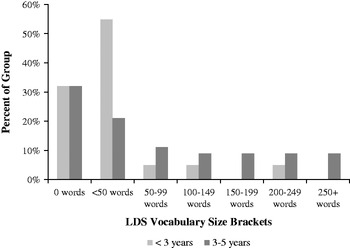
Total Vocabulary scores were classified into seven vocabulary level groups: 0 words (n = 22), 1–49 words (n = 21), 50–99 words (n = 6), 100–149 words (n = 5) 150–199 words (n = 4), 200–249 words (n = 5), and ≥250 words (n = 4). In both the younger and older groups, 32% of the children were reported to have no words, a much higher rate than found in typical samples. As shown in Figure 1, lexicons of 1–49 words were reported for 55% of children under age three (12/22 children) but only 21% of the children aged 3;0 to 5;11 (9/44 children). As expected, the younger group had lower percentages than the older group in the larger vocabulary size brackets.
Distribution of vocabulary size in younger and older children with ASD.

The correlation between CARS score and LDS Total Vocabulary score of −0·36 was medium in size (Cohen, Reference Cohen1988). As expected, children scoring in the non-autistic range on the CARS had the largest vocabularies (124·9, SD = 118·2), children scoring in the severe autism range had the smallest vocabularies (27·3, SD = 51·8), and children scoring in the mild-to-moderate range had a mean vocabulary size between these two extremes (70·5, SD = 89·7; F(2,64) = 6·5, p < ·01). According to Student-Newman-Keuls (S-N-K) post-hoc tests, the two CARS autistic groups had significantly smaller vocabularies than the CARS non-autistic group.
Mean length of phrases
No score for Mean Phrase Length was given to children reported to have no vocabulary words (22 out of 67) or children reported to produce phrases but for whom no examples of phrases were provided (3 out of 67), leaving forty-two children for analysis. Children reported to produce no phrases but who had at least one LDS word were scored 1·0 for Mean Phrase Length. Mean Phrase Length in words was 2·3 words (SD = 1·5), identical to that reported for children aged 1;6 to 1;11 in the LDS normative sample (Rescorla & Achenbach, Reference Rescorla and Achenbach2002).
The correlation between LDS Total Vocabulary score and Mean Phrase Length was 0·82, (p < 0·001), confirming that larger vocabularies were associated with longer phrases in this ASD sample at the same level or higher as reported for the LDS normative sample (r = 0·71). Therefore, despite the significant delay in both vocabulary and phrase length in these children with ASD, they manifested the same strong linkage between size of the lexicon and phrase length found in typically developing children on the LDS, rather than a deviant pattern of association between vocabulary size and word combinations.
As would be expected, Mean Phrase Length scores were lower for the children <three years of age (mean = 1·2, SD = 0·8) than for the children ≥three years (mean = 2·9, SD = 1·5; F(1,41) = 16·8, p < ·001, η2 = ·30). In the younger group, nineteen out of twenty-two children had no phrase use, compared to seventeen out of forty-four children in the older age group. Neither the correlation between CARS score and Mean Phrase Length (r = − 0·27) nor the ANOVA testing the effect of CARS group on Mean Phrase Length was significant, but Mean Phrase Length scores were lowest in the severe autism group (mean = 1·5, SD = 0·7), intermediate in the mild-to-moderate autism group (mean = 2·4, SD = 1·3), and highest in the non-autistic group (mean = 3·0, SD = 2·2).
Vocabulary composition
Because lexical composition in this ASD sample was the primary focus of our study, we analyzed it in numerous ways. We first report findings for the fourteen LDS semantic categories, then for five major word classes, and lastly for individual words. At all three levels of analysis, the ASD sample was compared with the LDS normative sample (Achenbach & Rescorla, Reference Achenbach and Rescorla2000). For some word level analyses, comparisons also involved the Rescorla et al. (Reference Rescorla, Alley and Christine2001) Pennsylvania sample.
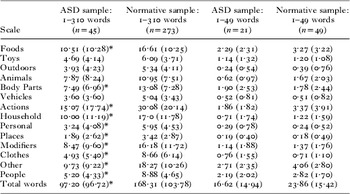
Semantic category analyses. The main goal of the semantic category analysis was to test if children with ASD and children with typical development differed in semantic category scores once vocabulary size was controlled. For each child in the ASD and normative samples, words were summed by semantic category to yield fourteen scores. After excluding the twenty-two children in the ASD sample and the one child in the normative sample with no reported words, mean semantic category scores for the ASD and normative samples were computed. Additionally, mean semantic category scores were computed for all children in the two groups with 1 to 49 words. The four sets of scores appear in Table 1. For children with 1 to 310 words, the ASD group had significantly lower mean scores for ten of the fourteen semantic categories at p < 0·001 based on univariate ANOVAs, with ESs expressed in η2 ranging from 4 percent for food, household and personal words to 8 percent for people words. This finding reflects the very big group difference in Total Vocabulary for the two groups (97·20 vs. 168·31 words), even after excluding children with 0 words. By contrast, the semantic category ANOVAs for children in each group with 1–49 words yielded no significant group differences, consistent with the non-significant difference in Total Vocabulary scores (16·62 vs. 23·86 words).
Semantic category scores by group and vocabulary size

note: *Mean for ASD sample significantly lower than mean for normative sample at p < ·001.
Word-class analyses. The purpose of the word-class analysis was to see whether children with ASD differed from typically developing children in the degree to which they ‘filled up’ five basic word classes when vocabulary size was controlled. For this analysis, the words on the LDS were re-grouped into five basic word-class categories (common nouns, people words, verbs, adjectives and closed-class words), drawing on definitions suggested by Bates et al. (Reference Bates, Marchman, Thal, Fenson, Dale, Reznick, Reilly and Hartung1994). For this re-grouping, animal sounds (e.g. woofwoof, meow), baby-talk words (booboo, yumyum), and routine words (hi, hello, yes, no, byebye, welcome, please, thank you) were excluded; these words comprise <4% of the checklist. For the category of common nouns, all LDS words in the categories foods, toys, outdoors, animals, body parts, vehicles, household, personal, places and clothes were used, plus six other words like breakfast, lunch and any letter (183 words, 59% of the entire checklist). The fifteen words in the category of people words comprised 5% of the total checklist. The category of verbs included all words from the LDS category of actions that are typically used as main verbs (have was omitted), for a total of 44 verbs (14% of the checklist). The category of adjectives contained all 26 words in the LDS modifiers category (8% of the checklist). Finally, the category of closed-class words included prepositions, adverbs, pronouns, possessives and question words, e.g. up, down, in, outside, off, out, on, under, away, more, never, here, there, me, mine, my, you, myself, this, that, where, why, and what (23 items, 7%).
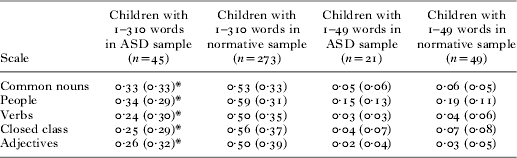
Table 2 contains ‘opportunity scores’ for each group, consisting of the mean percentage of words in a given LDS word class that the children in each group had acquired. As with the semantic category analysis, children with no reported words were excluded from the analysis. Opportunity scores for each child were obtained by dividing the number of words reported for a given category by the number of possible words in that category on the checklist. These opportunity scores thus describe percentage of each word class ‘filled up’. The ANOVAs for the ASD and normative samples (using children with 1 to 310 words) yielded a significant group difference for each word class (ESs ranging from 4% to 8%), consistent with the large group difference in Total Vocabulary. By contrast, the word-class ANOVAs for children in each group with 1–49 words yielded no significant group differences, consistent with the non-significant difference in Total Vocabulary scores. Interestingly, for both the ASD sample and the normative sample, the word class that was most ‘filled up’ for children with lexicons of 1–49 words was people words, despite the social interaction impairments children with ASD typically manifest.
Word-class opportunity scores by group and vocabulary size
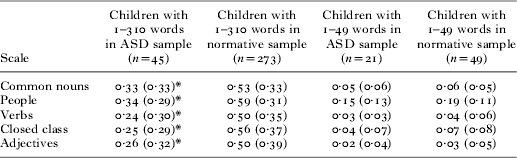
note: *Mean for ASD sample significantly lower than mean for normative sample at p < ·001. Opportunity scores = words acquired per class/words per class.
Word-level analyses. The word-level analyses were the most innovative aspect of our study. First, we compared percentage use scores for children with ASD, typically developing children, and young children with lexicons of <50 words. Second, we addressed similarities across samples in words with the highest percentage use scores, in order to present qualitative findings on the composition of early lexicons.
For the first set of analyses, the percentage of children reported to use each of the 310 words on the LDS was calculated for the sixty-seven children in the ASD sample (including the twenty-two children reported to produce no words). Q correlations were computed between these percentage use scores for the ASD sample and those obtained for the 274 children aged 1;6 to 2;11 in the normative sample for the LDS (Achenbach & Rescorla, Reference Achenbach and Rescorla2000) and for the 422 children age 2;0 to 2;4 in the Pennsylvania general population sample (Rescorla et al., Reference Rescorla, Alley and Christine2001). The Q correlation for LDS percentage use scores between the ASD and the LDS normative sample was 0·76 and between the ASD and the Pennsylvania sample was 0·79. These correlations were almost as high as the correlation of 0·85 between the normative sample and the Pennsylvania sample, with all three correlations p < ·001.
Because the children in the ASD group varied so widely in vocabulary size, they were divided into two subgroups, the forty-three children with <50 words, twenty-two of whom had no words (mean Total Vocabulary score = 8·12, SD = 13·30) and the twenty-four children with ≥50 words (mean Total Vocabulary score = 167·71, SD = 81·15). For the children in the ASD group with <50 words, Q correlations for percentage use scores were calculated with three sets of children from the LDS normative sample with <50 words. All Q correlations were significant at p < ·001 and comparable to those of the full ASD sample (Q = 0·73 with the sixteen late talkers who were >two years; Q = 0·80 with the thirty-four children with <50 words who were <two years; and Q = 0·80 with all fifty children in the normative sample with <50 words). For the twenty-four children in the ASD group with ≥50 words, Q correlations were 0·71 with the normative sample and 0·79 with the Pennsylvania sample, both significant at p < ·001 and comparable to those of the full ASD sample. Thus, ASD and typically developing children had high percentage use scores for the same words, a pattern seen in children with <50 words as well as children with ≥50 words.
Within this ASD sample of sixty-seven children, the mean percentage use score was 21%, whereas it was 54% and 59% for the normative and Pennsylvania samples, respectively. For the full ASD sample, the highest percentage use score for the ASD sample was 54% (for the word ball), with the remaining 309 words having percentage use scores <50%. In contrast, 179 of the 310 LDS words had percentage use scores ≥50% in the normative sample and 216 of the 310 words had percentage use scores ≥50% in the Pennsylvania sample. These results demonstrate that even the most commonly used words were not reported for more than half the ASD sample, with the exception of the word ball at 54%.
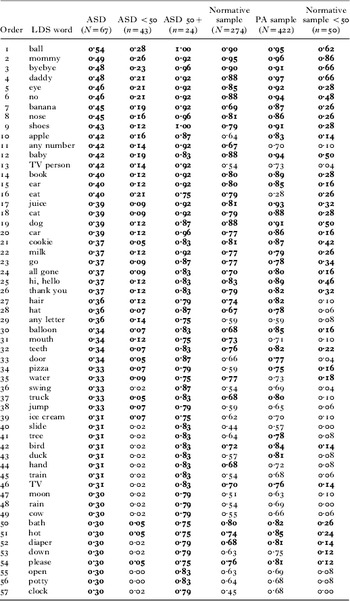
Although this sample of children with ASD did not acquire words at the rate of typically developing children, the Q correlations indicate that there was a great deal of overlap between the words they were acquiring and the words typically developing children acquire. To analyze this qualitatively, we listed all 310 words in descending order of percentage use score for the ASD sample in order to identify the 50 words with the highest percentage use scores (see Table 3). Because words with rank orders 46 to 57 all had scores of 0·30 for the ASD sample, we decided to analyze the top 57 words.
Top 57 Words in ASD sample: percentage use scores across samples

note: Bold font indicates that the word was in the top 57 words for that column's sample.
Most of the 57 words with highest percentage use scores in the ASD sample were nouns, including eight food words (banana, apple, juice, cookie, milk, pizza, water and ice cream), seven body parts (eye, nose, ear, hair, mouth, teeth and hand), five toys (ball, book, swing, slide and balloon), four people words (mommy, daddy, baby and ‘name of TV character’), three vehicles (car, truck and train), three outdoors words (tree, moon and rain), three clothes items (shoe, hat and diaper), five animals (dog, cat, bird, duck and cow), and four household items (door, TV, potty, clock). The top 57 words also included six words designating actions (eat, go, jump, bath, down and open), seven words used for social routines or other words (byebye, no, hi, thank you, ‘any letter’, please and ‘any number’), and two modifiers (all gone, hot). It is notable that despite the social impairments manifested by children with ASD, the ASD group did have four people words and seven words related to social routines among the 57 words with highest percentage use scores. However, it is also important to note that the people words with the highest percentage use scores (e.g. daddy, mommy) were still only reported for 48% and 49% of the ASD group.
As shown in Table 3, of the top 57 words in the full ASD sample, 41 were in the top 57 words for the ASD subsample with <50 words (72%), all 57 were in the top 57 for the children in the ASD sample with ≥50 words (100%), 38 were among the top 57 words in the normative sample (67%), 38 were in the top 57 words for the Pennsylvania sample (67%), and 35 were in the top 57 words for the fifty children in the normative sample with <50 words (61%). As seen in Table 3, most of the top 57 ASD words not present among the top 57 words in the normative and Pennsylvania samples still had quite high percentage use scores, indicating that they were relatively common in the lexicons of these typically developing children. These results indicate that the commonly acquired words in the ASD sample were very similar to the commonly acquired words in the two general population samples. These words included juice, banana, cookie, apple, ball, book, dog, cat, bird, eye, nose, ear, hair, daddy, mommy, baby, shoes, diaper, hat, car, truck, bath, hot, no, byebye, hi, thank you, please and allgone.
The words ‘any number,’ ‘TV person/character’ and ‘any letter’ were among the top 57 words in the ASD sample as well as the ASD subsamples of <50 words and ≥50 words, but less common among the top 57 words in the other samples. This may reflect the well-known interest of some children with ASD in letters and numbers, as well as the fascination many show with media figures such as Thomas the Tank Engine. However, many typically developing children have these same interests, suggesting that they are not very unusual. Words in the top 57 for the full ASD sample that were not among the top words for the fifty children in the <50 word subgroup in the normative sample (thirty-four of whom were <two years) included potty, swing and slide. These words were relatively common in the lexicons of the full normative sample, but seem more likely to be acquired by older children than by those <two years. Overall, the lexicons of the children with ASD did not appear to reflect atypical or idiosyncratic interests to any noteworthy degree.
DISCUSSION
Our findings that early language skills varied widely but were generally delayed in this ASD sample corroborate results of previous studies, such as Charman et al. (Reference Charman, Drew, Baird and Baird2003), Ellis Weismer et al. (Reference Ellis Weismer, Lord and Eisler2010), and Luyster et al. (Reference Luyster, Kadlec, Carter and Tager-Flusberg2008). We found a weaker association of vocabulary size with age than found in typically developing children. On the other hand, the correlation between vocabulary size and phrase length (0·82) was as strong or stronger in this ASD sample as has been reported for typically developing children (Rescorla & Alley, Reference Rescorla and Alley2001), although inconsistent with Ellis Wiesmer et al. (Reference Ellis Weismer, Gemsbacher, Stronach and Karasinski2011).
Our study yielded several important findings about lexical composition in children with ASD. When children with 1–49 words were compared, the ASD children did not differ from typically developing children in the semantic category distributions of their lexicons, with both groups showing the largest means for foods, actions, body parts, people and other. Similarly, opportunity score analyses for children with 1–49 words showed that children with ASD and typical development were ‘filling up’ word classes in a similar fashion. These findings are consistent with semantic category and word class findings reported by Charman et al. (Reference Charman, Drew, Baird and Baird2003) and Ellis Weismer et al. (Reference Ellis Weismer, Lord and Eisler2010), the only two previous studies that have examined lexical composition in children with ASD. Both our semantic category and word-class findings suggest a delayed but not deviant pattern of word learning.
A novel aspect of our study is extending to an ASD sample the use of Q correlation methodology to compare percentage use scores across samples (Rescorla et al., Reference Rescorla, Alley and Christine2001). The Q correlations for percentage use scores of 0·76 (ASD with the normative sample) and 0·79 (ASD with the Pennsylvania sample) indicated that the children with ASD were learning essentially the same words commonly acquired by typically developing younger children. These correlations were almost as high as the correlation of 0·85 between the normative sample and the Pennsylvania sample. Furthermore, when Q correlations were computed for ASD and typically developing groups matched on lexicon size, they were all very large.
Important qualitative information about lexicons in children with ASD was obtained from our analysis of the 57 words with the highest percentage use scores. Many of the highest-frequency words for the ASD children were among the highest-frequency words reported for typically developing children as well as for children with <50 words. The highest-frequency words also tend to be the earliest words acquired, because these are words almost all children say if they are talking much at all. These words are primarily nouns and represent a variety of semantic categories, including foods (e.g. banana, cookie), body parts (e.g. eye, nose), toys (e.g. ball, book), people words (e.g. mommy, daddy, baby), vehicles (e.g. car, truck), outdoors words (e.g. tree, moon), clothes (e.g. shoe, hat), animals (e.g. dog, cat, bird), household items (e.g. door, TV), actions (e.g. eat, go, jump), social routines (e.g. byebye, no, thank you), and modifiers (e.g. all gone). That these same words are also the most common words acquired by children with ASD suggests that, despite their atypical development in many spheres, their lexical development is more delayed than deviant. An important clinical implication of our findings is that these words with highest percentage use scores in typical samples are good targets for intervention efforts aimed at teaching vocabulary to children with ASD, as they are also the words reported to have highest frequencies in verbal children with ASD.
Our lexical composition findings have theoretical implications for our understanding of vocabulary development in young children. The high-frequency words consistently found in lexicons of typically developing toddlers as well as late talkers – whether acquiring English or other languages – refer to ubiquitous actions, objects, people and properties in the world of young children. This suggests that some major features of early lexical development are rather universal across wide variations both culture and development. This also suggests that early lexical development is a very robust process that proceeds in a rather similar fashion whenever children begin to acquire vocabulary, whatever language they are learning, and whatever their other characteristics may be.
Although this study provides a more detailed description of early lexical and phrase development in young children with ASD than most previous studies, several limitations of the research should be noted. First, although details about the specific diagnostic procedures used to identify ASD were lacking, no uniform set of diagnostic procedures appears to have been used in the clinic for all children suspected of having ASD during the period these children were seen. For example, some children in the sample had scores on the Autism Diagnostic Observation Schedule (ADOS; Lord, Rutter, DiLavore & Risi, Reference Lord, Rutter, DiLavore and Risi1999) or a score on a DSM-IV checklist of Pervasive Developmental Disorder criteria, but not enough children had these measures to include them in our analyses. All sixty-seven children in the sample had CARS scores, but fifteen of the children diagnosed as having ASD were in the range of ‘non-autistic’, suggesting that CARS scores were not used as criteria for an ASD diagnosis. An additional limitation is that we did not have IQ scores or other indices of non-verbal cognitive ability in the sample. Such information would have helped contextualize our lexical findings. We also did not have birth position information about the children. It should also be noted that the LDS does not provide information about the contexts in which the child uses each word, how often the word is used, or the apparent meaning and range of extension of each word. Thus, we do not know the range of extension of the words reported for the children with ASD, nor what features they used in applying words to new referents (e.g. shape vs. texture, function vs. color, etc.). Furthermore, although the LDS has 310 words and includes words varying in frequency of use by typically developing children, it does not contain every word a young child might have in his/her lexicon. Therefore, it could be that the children with ASD were acquiring some atypical or idiosyncratic words, but that this could not be detected in these data as these words are not on the LDS and additional words parents might have written in were not entered in the database.
In summary, findings from the present study confirmed that most of these children with ASD had delayed lexical and phrase development, despite what seems to be an increasing number of children with relatively mild conditions receiving an ASD diagnosis. However, there was great variability in vocabulary size in this ASD sample, consistent with previous studies. Many children had no words, whereas other children had lexicons of more than 250 words. Results from ANOVAs of semantic category scores and word-class opportunity scores were also consistent with the few other studies that have examined these aspects of lexical composition. The most novel contributions of this study are the word-level findings, as word-level findings have not been reported in previous research with ASD samples, to our knowledge. Our Q correlation analyses of percentage use scores and our qualitative analysis of the 57 words with the highest percentage use scores all indicate that the children with ASD, although delayed in lexical acquisition, were learning the same words as typically developing children and hence not showing deviance in their lexicons.
Findings from this study suggest that future research might profitably use the time-honored language diary methodology to learn more about how the lexical acquisition process unfolds in children with ASD. Questions that might profitably be examined in such research might include the following: (a) When children with ASD are acquiring their first 50 words, how much spontaneous extension of reference do they show for words they may have learned in their intervention programs? (b) Do children with ASD overextend the same words as typically developing children? (c) Do children with ASD show the same degree of overextension as typically developing children? (d) Do children with ASD use all three types of overextension identified by Rescorla (Reference Rescorla1980), namely categorical overinclusions (e.g. dog for wolf), analogical overextensions (e.g. comb for a centipede), and predicate statements (cat for a cat's usual location when not present)? (e) Do children with ASD overextend words based on atypical features, or do they use the same kinds of perceptual, action-functional, affective and contextual information as bases for applying words they learn as typically developing children (Rescorla, Reference Rescorla1980)? Multiple case studies using language diaries with children who have ASD would provide valuable information about these aspects of early lexical development in ASD that cannot be gained from checklist and lab studies.