INTRODUCTION
State-owned enterprises (SOEs) are considered a key tool of state control over the economy and therefore a pillar of the recent so-called ‘return of state capitalism’ (Alami & Dixon, Reference Alami and Dixon2020; Bremmer, Reference Bremmer2008; Kurlantzick, Reference Kurlantzick2016). Traditionally, this perspective assumed that the state uses SOEs as ‘instruments’ or ‘tools’ to achieve certain economic policy goals such as innovation (Bernier, Reference Bernier2017; Tonurist & Karo, Reference Tonurist and Karo2016), social and political unification, as well as promoting economic growth (Thynne, Reference Thynne2011). The implicit assumption is that state control over SOEs is very far reaching and SOE goals are closely aligned with state goals. More recently, however, a more nuanced view of SOE-state relationship has been emerging. Peng, Bruton, Stan, and Huang (Reference Peng, Bruton, Stan and Huang2016) acknowledge SOEs may pursue their own interests which diverge from those of their state owners. This view is in line with findings from earlier studies on SOEs, especially in the context of post-socialist transition (Markus, Reference Markus2008; McDermott, Reference McDermott2004, Reference McDermott2007), whereby SOEs could explore spaces of agentic autonomy (and thereby autonomously pursue institutional change or maintenance) by drawing on resources arising from their close relationship with the state apparatus (Okhmatovskiy, Reference Okhmatovskiy2010), building alliances with other stakeholders (Choudhury & Khanna, Reference Choudhury and Khanna2014), or both. Others have gone further by arguing that SOEs have agency beyond simple autonomy from SOEs (Hafsi, Kiggundu, & Jorgensen, Reference Hafsi, Kiggundu and Jorgensen1987; Hofman, Moon, & Wu, Reference Hofman, Moon and Wu2017; Witt & Redding, Reference Witt, Redding, Witt and Redding2014). The kind of SOE managers’ agency explored in the literature so far is primarily that driven by the need to navigate between state control and business imperatives (Rodrigues & Dieleman, Reference Rodrigues and Dieleman2018). However, an emergent stream of research has turned the spotlight on SOE managers as institutional actors (Raynard, Lu, & Jing, Reference Raynard, Lu and Jing2020; Voinea & van Kranenburg, Reference Voinea and van Kranenburg2018), often within the constraints of conflicting institutional logics (Guo, Huy, & Xiao, Reference Guo, Huy and Xiao2017; Jing & McDermott, Reference Jing and McDermott2013).
In this article, we extend this conversation on SOE TMTs as institutional actors and argue that SOE top managers are not just agents of the state but are actively engaged in either changing or maintaining the institutional setting within which SOEs operate. Due to their inherent political nature, we argue that their role may be particularly important regarding their influence over the country's institutional environment. Specifically, we focus on the factors, institutional and otherwise, which determine SOEs’ institutional work (IW), which we conceive of here as purposeful action geared towards maintaining or altering SOEs’ institutional environment (Lawrence, Suddaby, & Leca, Reference Lawrence, Suddaby and Leca2011). Our main research question is therefore: What factors determine SOE TMTs’ motivation and leeway to pursue IW?
To answer this question, we draw on two literatures: the literature on IW, mentioned above, and the historical institutionalist (HI) literature, which has developed as an original and fruitful approach to the issue of embedded agency which is key to understanding SOEs’ institutional agency. Indeed, we conceive of SOEs as purposive and boundedly rational agents that are embedded in an institutional environment that shapes both their motives to act on it and their capability to do so. This is an important premise in the HI literature on institutional change (Mahoney & Thelen, Reference Mahoney and Thelen2010; Pierson, Reference Pierson2004; Thelen, Reference Thelen2004), whereby even institutional maintenance requires purposeful action. These two literatures usefully complement each other in the understanding of the issue. Indeed, while we use a more micro-level IW perspective to complement HI's broader, more macro-level understanding of embedded agency at the heart of processes of institutional change and persistence, we also draw on HI's political economic conceptualization of institutional dynamics to compensate for the limitations of IW. In particular, this article fully recognizes the importance of the political factors characterizing SOEs’ institutional environment. Thus, we contribute both to the understanding of SOEs’ agency, on the one hand, and to the theorization of institutional change in both IW and HI literatures.
In this article, we define SOEs as any commercial enterprise that is either part of the state bureaucracy or that is a legally independent unit, but whose shares are to a significant degree owned by the state or its agencies. Such ownership can range from full to a minority stake held by the state. We do not include in our definition companies where the state influences private companies through means other than ownership – e.g., through heavily subsidized loans or regulation and governance mechanisms such as ‘golden shares’ – to achieve certain political goals (Fuller, Reference Fuller2016; Musacchio, Lazzarini, & Aguilera, Reference Musacchio, Lazzarini and Aguilera2015). With increasing numbers of SOEs that are not fully state-owned, scholars recognize that the relationship between the state and SOEs is far from straightforward. Indeed, the state is often not the only shareholder in SOEs (Rodrigues & Dieleman, Reference Rodrigues and Dieleman2018). When SOEs are only partly state-owned and listed on a stock exchange, minority shareholders may have considerable rights that give them some influence over SOE decisions (Musacchio et al., Reference Musacchio, Lazzarini and Aguilera2015). Such complex ownership structure may weaken the direct influence the state has over SOEs and provide SOE top management teams (TMTs) with more autonomy from the state than the ‘SOEs as tool’ view would allow (Markus, Reference Markus2008, Reference Markus2012; Stark & Vedres, Reference Stark and Vedres2012).
Furthermore, states differ in terms of the vehicles they use to manage their shareholdings in SOEs. In some countries, state ownership is directly managed through ministries. In others, the state sets up an investment fund, or uses a public pension fund to do so. Finally, with time some SOEs might choose to pursue a stronger focus on commercial goals despite the persistent scrutiny from the government (Guo et al., Reference Guo, Huy and Xiao2017). Even in settings where SOEs are wholly owned by the state and the state plays a very dominant role – such as in state-socialist Europe before 1989 – SOE managers have leeway to pursue their own goals (Stark & Bruszt, Reference Stark and Bruszt2001). These goals may or may not be aligned with state goals and may lead SOE TMTs to actively seek to shape the institutional environment in which their enterprises operate in order to achieve these goals. In this article, we focus on the institutional arrangements of state ownership that shape the motivation, resources, and scope for SOE TMTs to engage in institutional work (IW) (Lawrence et al., Reference Lawrence, Suddaby and Leca2011) in pursuit of their goals.
In this article, we develop a theoretical framework that allows us to conceive of SOEs' top management teams as institutional actors positioned in a multi-layered institutional environment that serves as a source of strategic resources and constraints for agency. We then consider how institutional factors shape motivation, scope, and resources for SOE TMTs’ IW,[Footnote 1] formulating testable propositions. To illustrate our arguments, we draw on examples from emerging economies, where SOEs have been major players in both the economic and the political arena and where SOE TMTs have the potential to contribute to the shaping of local institutions (Yan, Zhu, Fan, & Kalfadellis, Reference Yan, Zhu, Fan and Kalfadellis2018), and from developed economies, where SOEs have been a staple of past development and may still represent significant sources of IW.
The article is organized as follows: Section 2 discusses the theoretical foundations of our framework, which is presented in detail in Section 3; Section 4 discusses the wider theoretical contributions of our approach as well as its limitations.
THEORETICAL BACKGROUND: A MULTI-LEVEL INSTITUTIONAL WORK PERSPECTIVE ON SOE AGENCY
The extant literature does not provide us with adequate theoretical tools to understand the increasing variety of SOEs, the variety of their relationships with the state, and especially, SOEs’ various strategies and actions geared towards maintaining or altering their institutional environment. To fill this gap, we use the concept of institutional work (IW), developed within an emerging literature (Lawrence & Suddaby, Reference Lawrence, Suddaby, Clegg, Hardy, Lawrence and Nord2006; Lawrence, Suddaby, & Leca, Reference Lawrence, Suddaby and Leca2009; McGaughey, Kumaraswamy, & Liesch, Reference McGaughey, Kumaraswamy and Liesch2016). We also draw on previous literature on bottom-up institution-building by firms (in particular, in the post-socialist transformation context) to develop a theoretical framework of how SOEs attempt to shape their institutional environment and alter their relationships with the state (McDermott, Reference McDermott2007; Stark & Bruszt, Reference Stark and Bruszt2001).
IW encompasses the purposeful actions of individuals and organizations aimed at maintaining, creating, and/or disrupting institutions, the ‘(more or less) enduring elements of social life that affect the behavior and beliefs of individuals and collective actors by providing templates for action, cognition, and emotion, nonconformity with which is associated with some kind of costs’ (Lawrence et al., Reference Lawrence, Suddaby and Leca2011: 53). IW is therefore akin to the concept of institutional entrepreneurship (Garud, Hardy, & Maguire, Reference Garud, Hardy and Maguire2007; Leca & Naccache, Reference Leca and Naccache2006; Willmott, Reference Willmott2011) that seeks to understand the ‘paradox of embedded agency’, namely that according to neo-institutional theory, actors behave in isomorphic ways, but nevertheless maintain the ability to bring about institutional change endogenously (Garud et al., Reference Garud, Hardy and Maguire2007). However, beyond institutional entrepreneurship which it encompasses (Tracey, Phillips, & Jarvis, Reference Tracey, Phillips and Jarvis2011), IW adds three nuances. Firstly, IW includes types of actions that lead to not only radical but also incremental institutional change (Liu, Zhang, & Jing, Reference Liu, Zhang and Jing2016). Secondly, it acknowledges the cumulative and quotidian nature of institution-building by actors who are embedded in the institutional fabric (Lawrence et al., Reference Lawrence, Suddaby and Leca2011). Indeed, unlike the path-breaking focus of institutional entrepreneurship and attempts to change formal institutions – the domain of the corporate political activity (CPA) literature (Mellahi, Frynas, Sun, & Siegel, Reference Mellahi, Frynas, Sun and Siegel2016; Mizruchi, Reference Mizruchi1992) – IW is broader and also includes actions that take place outside of formal channels (Lawrence et al., Reference Lawrence, Suddaby and Leca2009). Thirdly, this also implies that while purposive, IW is not always directly targeted at institutions but can affect institutional change or maintenance as a byproduct of broader behaviors and actions. We prefer the concept of IW to other concepts because it allows for a broader understanding of the manifold and complex interactions between actors and institutions and bridges critical and institutional views of organizations.
Within the IW literature, considerable attention has been paid to the interactions of actors with authorities and particularly the state apparatus. For instance, Micelotta and Washington (Reference Micelotta and Washington2013) examined how Italian legal professionals curbed government attempts to introduce reform that would have disrupted the profession. Yan and colleagues (Reference Yan, Zhu, Fan and Kalfadellis2018) theorized IW in the context of internationalizing Chinese firms and how their interactions with the state co-produce the policy environment for outward foreign direct investment (OFDI).
Crucial to the concept of IW is the notion of intentionality (Battilana & D'Aunno, Reference Battilana, D'Aunno, Lawrence, Suddaby and Leca2009). Although intentionality is seemingly at odds with the tenets of institutional theory such as stability and embeddedness, IW sees agency as ‘an ongoing activity whereby actors reflect on and strategically operate within the institutional context where they are embedded’ (Lawrence et al., Reference Lawrence, Suddaby and Leca2011: 55). Hence, intentionality can take the form of habitual enactment of taken-for-granted schemas, or a more conscious and strategic future-oriented reshaping of extant institutions, but equally a pragmatic response to environmental forces (Battilana & D'Aunno, Reference Battilana, D'Aunno, Lawrence, Suddaby and Leca2009; Emirbayer & Mische, Reference Emirbayer and Mische1998). In other words, institutions are not always the intended object of agency, but actors may, inadvertently or not, shape institutions while seeking to reach other objectives (Smets & Jarzabkowski, Reference Smets and Jarzabkowski2013).
SOEs are generally considered to be highly institutionally embedded. As such, they may benefit from heightened political legitimacy (Li & Zhang, Reference Li and Zhang2007; Marquis & Qian, Reference Marquis and Qian2013). Their actions are likely to have political consequences and may be expected, in many cases, to be supportive of government policies and ideology (Hofman et al., Reference Hofman, Moon and Wu2017), whether these policies aim at altering or reinforcing the existing institutional environment. However, in periods of ‘institutional transition’ and ‘liberalization’ (Peng, Reference Peng2003), SOEs’ clout and legitimacy may be challenged, which may lead them to oppose policies of pro-reform governments. In such a context, SOEs would tend to be a conservative force and pursue conservative strategies of institutional order maintenance (Micelotta & Washington, Reference Micelotta and Washington2013). These stances – opposing or supporting institutional change – can be held by SOEs irrespective of the goals of the state. Whether or not their goals align with state goals in specific cases, SOE top management teams may be driven to use their political resources as leverage to reach their goals related to their institutional environment.[Footnote 2]
In yet other cases, SOEs TMT may also resent the institutional status quo for a variety of reasons (which will be spelled out below) and thus seek to actively change their institutional environment. In particular, SOEs may seek to perform IW to counterbalance the potential constraints arising out of their close ties with the state. This has been particularly evident in the research on SOE internationalization, which traditionally started with the assumption of SOEs as ‘captives of the state’ (Rudy, Miller, & Wang, Reference Rudy, Miller and Wang2016: 76). This logic dictates that SOEs internationalize to benefit their home country and are largely guided by political, rather than managerial, objectives. However, an emergent ‘power escape’ perspective (Clegg, Voss, & Tardios, Reference Clegg, Voss and Tardios2018; Cuervo-Cazurra Inkpen, Musacchio, & Ramaswamy, Reference Cuervo-Cazurra, Inkpen, Musacchio and Ramaswamy2014; Rodrigues & Dieleman, Reference Rodrigues and Dieleman2018) challenges these assumptions and shows that internationalization can be a means to escape the confines of state ownership by reducing resource dependence on the government. Alternatively, internationalization can serve as a precursor to recognizing the need for power escape in the first place. Rodrigues and Dieleman (Reference Rodrigues and Dieleman2018: 40) cite the example of Malaysia's Petronas whose ‘top management was quoted as saying they regretted being the government's number one “piggy bank” as they would rather invest in continued globalization’.
Understanding SOEs’ engagement in IW requires considering the multi-layered institutional environment they face – both as a target of IW and its determinant. The notion, implied by the expression of ‘institutional environment’, of institutions as external to the firm may be debatable in the case of SOEs (even more than in the case of private firms; see Battilana & D'Aunno, Reference Battilana, D'Aunno, Lawrence, Suddaby and Leca2009; Bitektine, Haack, Bothello, & Mair, Reference Bitektine, Haack, Bothello and Mair2020), given that institutions are often constitutive of SOEs themselves – and the understanding that institutions can emerge through organizational strategies (Lawrence & Suddaby, Reference Lawrence, Suddaby, Clegg, Hardy, Lawrence and Nord2006). Accordingly, the literature has increasingly treated SOEs as hybrid organizations (Bruton, Peng, Ahlstrom, Stan, & Xu, Reference Bruton, Peng, Ahlstrom, Stan and Xu2015; Peng et al., Reference Peng, Bruton, Stan and Huang2016), characterized by their multiple bottom lines, that is, the fact that they contemporaneously pursue financial or business goals and social, political, or environmental goals (Musacchio et al., Reference Musacchio, Lazzarini and Aguilera2015; Teng, Fuller, & Li, Reference Teng, Fuller and Li2018). The hybridity of SOEs implies the porousness of the boundaries between ‘the state’ and non-state entities. Such porousness is also more broadly implied by the variety of governance arrangements characterizing state-firm relations, explored inter alia by Musacchio and colleagues (Reference Musacchio, Lazzarini and Aguilera2015), suggesting, rather than a sharp dichotomy between the state and private firms, a more nuanced continuum, and, consequently, a variety of degrees to which SOEs are exposed to business and state institutional logics (Rodrigues & Dieleman, Reference Rodrigues and Dieleman2018; for institutional logics, see Thornton, Ocasio, & Lounsbury, Reference Thornton, Ocasio and Lounsbury2012).
For these reasons, more than privately-owned firms, SOEs face the ‘paradox of embedded agency’ (Seo & Creed, Reference Seo and Creed2002): SOEs are simultaneously constrained by their institutional environment while actively involved in trying to affect that environment. There are different ways to address this paradox. The IW literature deals with it upfront (Lawrence et al., Reference Lawrence, Suddaby and Leca2011) by acknowledging the various dimensions along which IW may take place and the various levels where institutions may influence agency. Battilana and D'Aunno (Reference Battilana, D'Aunno, Lawrence, Suddaby and Leca2009), for example, distinguish between field-level, organization-level, and individual-level conditions for IW. Our framework builds on these foundations but supplements it with a more macro-level focus (Hwang & Colyvas, Reference Hwang and Colyvas2011), by unpacking the multi-layered institutional environment in which SOEs operate and differentiating the degrees of agency associated with each layer or component. Specifically, we identify three main layers of SOEs’ institutional environment: (i) the national institutional level; (ii) the regime of state-SOE relations (governance system); (iii) sector-specific or market-level institutions. Each one of these three levels of SOEs’ institutional embedding can become the target of SOE IW but at the same time also correspond to particular sets of resources and constraints that determine SOE IW.
The degree and nature of IW may vary across these different layers. For instance, sector-specific rules and regulations are typically the target of corporate political activity as a particular category of IW (see Lawton, Rajwani, & Doh, Reference Lawton, Rajwani and Doh2013), such as lobbying to maintain existing entry barriers that favor the firm (Oliver & Holzinger, Reference Oliver and Holzinger2008), influencing public agencies to obtain favorable regulation, or adhering to government signals to obtain political legitimacy and avoid radical regulatory change (Guo et al., Reference Guo, Huy and Xiao2017; Marquis & Qian, Reference Marquis and Qian2013). By contrast, higher-level institutions are less amenable to such direct non-market strategies. Here, individual SOEs may be encouraged to seek to build broader coalitions with actors within and outside the state apparatus. The level of the state-SOE governance system, on the other hand, may exercise mainly a moderating effect on the extent to which SOEs are able to exercise IW.
Given the multiplicity of layers that constitute SOEs’ institutional environment, we may expect across- as well as within-country variation in the institutional determinants of SOEs’ IW. Thus, our attempt to theorize SOE IW is necessarily a multi-level enterprise – involving the investigation of the interaction between firms’ characteristics, strategic behavior, and institutional environment at various levels.
Our additional focus on the macro-level determinants of SOEs’ institutional work enables us to fully consider the political factors underpinning institutional change, as emphasized in the historical institutionalism (HI) literature (Mahoney & Thelen, Reference Mahoney and Thelen2010; Pierson, Reference Pierson2004; Streeck & Thelen, Reference Streeck and Thelen2005; Thelen, Reference Thelen2004). Indeed, institutions are ‘the object of ongoing political contestation’, and thus ‘political dynamics […] drive institutional genesis, reproduction, and change’ (Thelen, Reference Thelen2004: 31). In particular, political factors partly determine the coalitional foundations of institutions (Mahoney & Thelen, Reference Thelen2004; Thelen, Reference Thelen2004). Our framework further draws on HI by conceiving SOEs’ agency as distinct both from ‘actor-centered functionalism’ (Pierson, Reference Pierson2004) that may be nested in institutional entrepreneurship, and the complete absence of agency implied by structuralist accounts of institutional stasis (Mahoney & Thelen, Reference Mahoney and Thelen2010; Thelen, Reference Thelen2004). As Hall puts it, ‘[a]cknowledging [institutions’] plasticity raises questions about when institutions should be seen as determinants of behavior and when as objects of strategic action themselves’ (Hall, Reference Hall, Mahoney and Thelen2010: 204).
HI is equally useful in helping us think about institutional change and maintenance, the outcomes of SOEs’ institutional work, as causally equivalent, that is, resulting from similar processes. In other words, as shown by Thelen (Reference Thelen2004) and Pierson (Reference Pierson2004), institutional stasis does not simply result from mechanistic processes of self-reinforcement or positive feedbacks. Thelen argues that institutional survival often entails both institutional adaptation and transformation so these ‘inherited’ institutions better fit with current political, social, and economic trends (Thelen, Reference Thelen2004: 293). Vice versa, institutional change should not be expected to automatically ‘emerge from actors with transformational motives’ (Mahoney & Thelen, Reference Mahoney and Thelen2010: 22). In fact, Streeck and Thelen (Reference Streeck and Thelen2005) and especially Mahoney and Thelen (Reference Mahoney and Thelen2010) have precisely re-framed institutional persistence and change as different modes of institutional change, seen as a continuum. In turn, these different modes of change are brought about by different types of ‘change agents’ – the latter forming ‘the intervening step through which the character of institutional rules and political context do their causal work’ (Mahoney & Thelen, Reference Mahoney and Thelen2010: 28).
This is where our own framework, while building on the broad foundations laid out by HI, diverges from the specific theory of institutional change proposed by Mahoney and Thelen (Reference Mahoney and Thelen2010). Indeed, for us the question of outcome and directionality (of institutional change) needs to remain an empirical question. Attempts to theorise directionality in the literature remain – in our view – unconvincing. Thelen and Mahony (Reference Thelen, Mahoney, Mahoney and Thelen2010) propose a theorisation of directionality by making strong assumptions about situations of institutional changes being struggles over status quo. Such attempts at theorising change contradict some fundamental assumptions on which HI is otherwise based (e.g., Streeck & Thelen, Reference Streeck and Thelen2005, on continuity and change through embedded agency; see also Zara & Delacour, Reference Zara and Delacour2020).
Mostly, however, our divergence with HI accounts of institutional change is rooted in a different analytical focus: while the analysis of Mahoney and Thelen (Reference Mahoney and Thelen2010) is mostly an analysis of processes that cause certain types of institutional change, we are focusing on the determinants of SOE agency, which may equally drive SOEs to pursue institutional work (and thus institutional change or persistence) or not. Our analytical framework is a more ‘upstream’ investigation into the relationship between the institutional environment and SOEs’ impetus to pursue change, while Mahoney and Thelen's framework is a ‘downstream’ analysis of the ‘affinity between particular kinds of actors and modes of change’ (Mahoney & Thelen, Reference Mahoney and Thelen2010: 27).
The next section builds on these theoretical foundations to develop a full, multi-level framework to understand the determinants of SOEs’ institutional work.
UNDERSTANDING THE DETERMINANTS OF SOES’ IW: TOWARDS AN ENCOMPASSING FRAMEWORK
Resources, Motivation, and Scope of IW
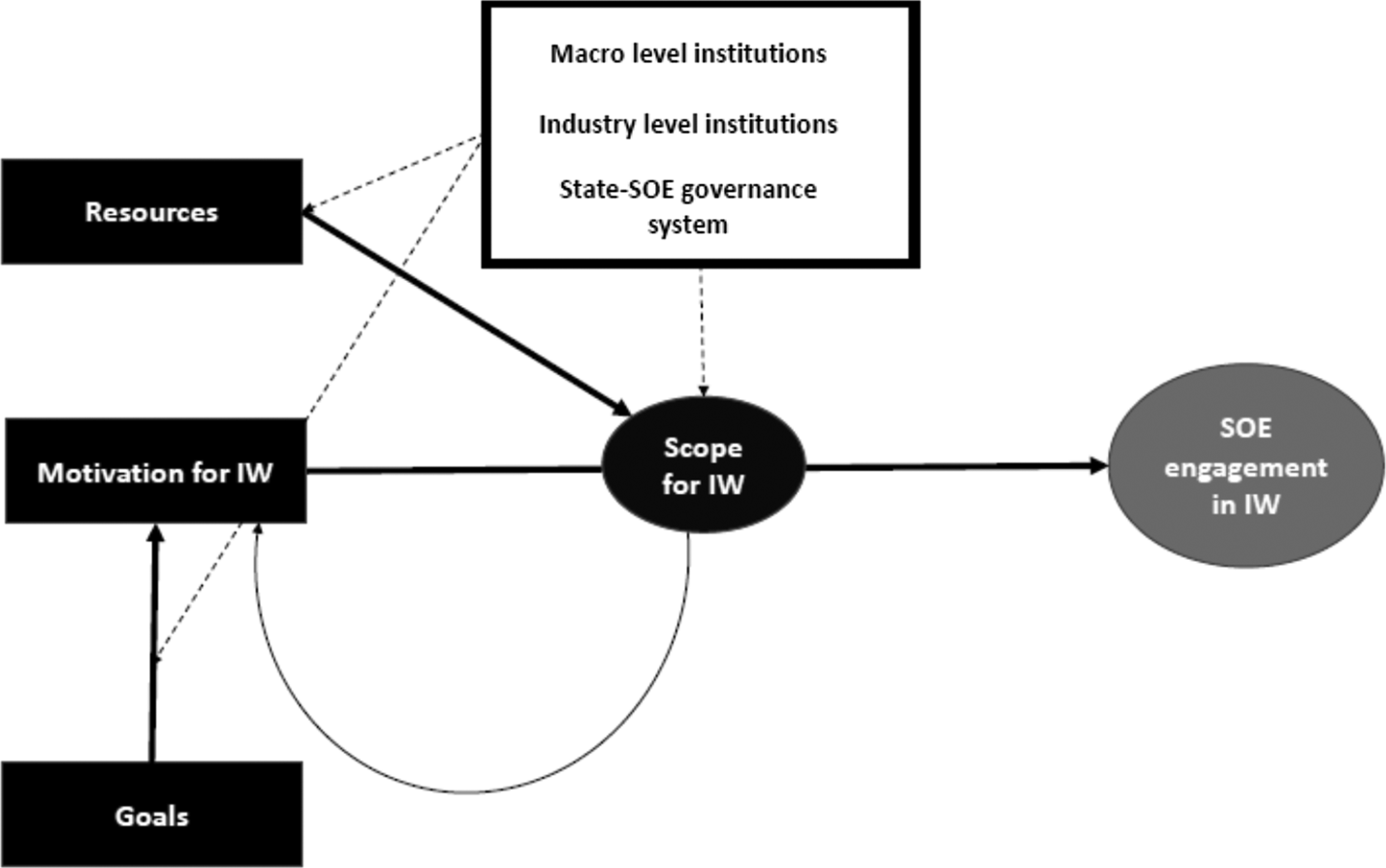
Our conceptual framework is premised on the notion that in order for an SOE[Footnote 3] to be able to engage in IW, it requires three necessary elements. Each one of these are shaped by determinants situated at one of the three levels of SOEs’ institutional environment described above. More specifically, the three elements can be defined as 1) SOEs’ capacity to perform IW by mobilizing the required resources;[Footnote 4] 2) SOEs’ reasons and willingness to take action to change or maintain their institutional environment, which in turn derives from the congruence – or lack thereof – between SOE TMT goals and the institutional framework (motivation for IW); and 3) the nature and extent of constraints on SOEs’ IW stemming from its embedding in a specific state-SOE governance system, which – in combination with the resources available to SOEs – may increase or reduce the opportunities for SOEs to perform IW (scope for IW). We will discuss these three factors – summarized in Figure 1 – before moving on to identifying their main determinants and formulate theoretical propositions by drawing on illustrative examples from developed and emerging markets.
Basic causal model

It is important to be explicit about the key assumption of our framework, i.e., that the main locus of SOE agency is their TMTs. This assumption is in line with the economic literatures on managerial discretion (Williamson, Reference Williamson1963) and agency theory (Jensen & Meckling, Reference Jensen and Meckling1976) that hint at potential conflicts of interest between SOE's TMT and the state as a shareholder. However, it is less consistent with sociological approaches to the firm, which hint at the role that actors at all levels of the organization play in the core studies in the IW perspective. Within an SOE context, actors other than the firm's TMT might be politically important and as well-connected to parts of the state apparatus and/or policy-making bodies as TMTs. For instance, unions and union members might be on the front lines of IW in certain contexts (Pandey & Varkkey, Reference Pandey and Varkkey2020). Such IW certainly deserves to be considered. However, SOEs’ IW presents characteristics that support our choice to focus on TMT's agency. First, SOEs are mostly sizeable, established organizations with, in many instances, a past of being a state bureaucracy – and when not, the experience of being tied to state bureaucracy through ownership and other ties. This makes it reasonable to expect politically sensitive IW to be performed by top managers. Secondly, the more macro layers of SOEs’ institutional environment lend themselves less to the micro-oriented practice and boundary work IW scholars have in mind when analyzing actors’ agency (cf. Zietsma & Lawrence, Reference Zietsma and Lawrence2010).
Resources
SOEs’ ability to perform IW will be determined by the nature and number of resources they will be able to draw on (Battilana, Leca, & Boxenbaum, Reference Battilana, Leca and Boxenbaum2009). The literature distinguishes different types of resources on which SOEs may draw when carrying out IW, including financial resources, organizational resources, allowing them to influence political choices (e.g., PR expertise), and political resources, such as their ties with policy-makers at various levels (regulatory agency, law-making body, state shareholding managing body) (Boddewyn, Reference Boddewyn1994; Bonardi, Reference Bonardi2011; Schnyder & Sallai, Reference Schnyder and Sallai2020).[Footnote 5] The availability of these resources is related to firm-level characteristics – in particular, firm size and strategic value.
Size matters because of the financial resources associated with it, and thus the financial capacity to perform costly non-market activities such as lobbying.[Footnote 6] Moreover, bigger SOEs have greater political clout; they are affecting a larger number of people and, consequently, a larger number of politicians’ constituents (see Salamon & Siegfried, Reference Salamon and Siegfried1977). Political clout leads to more political resources (e.g., direct access to high-ranking public officials).
Strategic value, on the other hand, captures how much importance the state places on a sector or industry where any given SOE is active. Such importance may be associated with national security reasons, reasons linked to regime survival, to economic development/wealth generation, or broader social priorities (Hsueh, Reference Hsueh2016). Commonly, states at a minimum regard defense and energy sectors as having strategic value. Strategic value can be a substitute for size: SOEs that operate in strategic industries such as defense, energy, or telecommunications, regardless of their size, will have more political clout as well. SOEs that are deemed as ‘national champions’ correspond to these characteristics (Thun, Reference Thun2004).
Scope
A second factor that influences SOE IW is scope, which we define here as the ability and leeway of any given SOE to engage in IW as determined by its resources and embeddedness in the governance system. Scope relates both to the extent to which the state-SOE governance system provides channels for IW and to the nature of these channels. While motivation and resources are firm-level features, scope – while partly determined by SOE resources – also reflects the state-SOE governance system more broadly. SOEs’ political resources influence scope for IW, e.g., by providing channels for IW through political connections – a key political resource. Yet, regardless of resources, SOEs' scope to perform IW can still be constrained/enabled by the range of actions made available by the configuration (i.e., the nature and extent) of the state-SOE governance system. We understand the state-SOE governance system as the system of rules, regulations, and institutions that govern the relationships between the state as owner and SOEs in any given country. While we conceive scope as determining SOEs’ capacity to engage in IW, regardless of SOE TMT's motivation to do so, we also hold scope to influence motivation for undertaking IW in the first place. Indeed, perceived opportunities for meaningful action may induce agents to act on their goals. Thus, the relationship between scope for IW and motivation for undertaking IW closely mirrors the relationship between perceived opportunities and institutional agency as conceptualized by Dorado within an ‘institutional entrepreneurship’ context (Dorado, Reference Dorado2005).
Motivation and goals
Finally, the likelihood of IW is strongly determined by SOE TMT's motivation to perform IW. The latter derives from both perceived opportunities for effective IW and from the likely effects of (desired or envisioned) institutional change on SOEs’ position, and how that affects – in turn – the TMT interests or values. To understand SOE TMT motivation to perform IW, we therefore need to understand what these interests and values are.
Our framework is based on a model of action where economic behaviors can be driven either by striving for satisfaction of material interests or behavior that follows ‘shared scripts’ derived from social norms and values. Action is purposive, but not necessarily rational, self-seeking, and maximizing. To accommodate this multidimensionality of human action, we therefore prefer talking about ‘goals’ rather than interests or values. The notion of ‘goal’ allows us to capture a desired outcome that a social actor pursues – be it a collective actor (state, government), or an individual (SOE manager) – without making any a priori assumptions about the underlying driver of the action. The key question is not whether TMTs behave out of selfishness or belief in some public good, but rather whether the goals that they pursue are aligned or not with those of the state and the institutional framework.
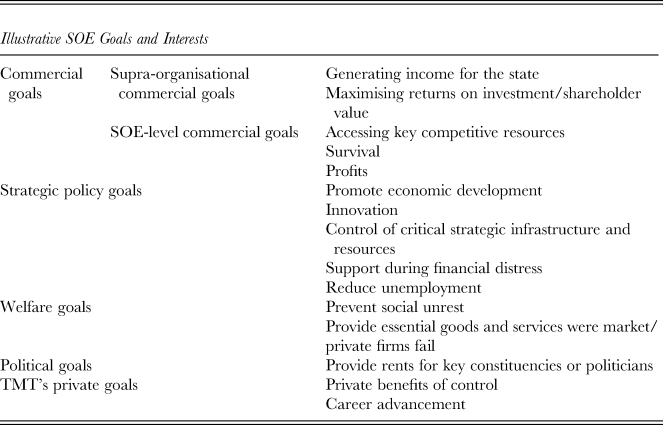
The SOE literature derives the goals that the state, SOEs, and SOE managers pursue in two different ways. One is to theoretically derive them from existing theories of the firm (Peng et al., Reference Peng, Bruton, Stan and Huang2016); the second one is to infer them from empirical studies of SOE motivations to undertake certain business activities, e.g., acquiring other firms (Florio, Ferraris, Superiore, Boella, & Vandone, Reference Florio, Ferraris, Superiore, Boella and Vandone2018), or from historical cases (Cuervo-Cazurra et al., Reference Cuervo-Cazurra, Inkpen, Musacchio and Ramaswamy2014). Combining these approaches, we identify five broad goals that SOEs and their managers pursue: commercial goals, strategic policy goals, welfare goals, political goals, and TMT's private goals (see Table 1 below). Importantly, these categories of goals are not mutually exclusive, but any given SOE action may fulfil different types of goals at once.
SOE goals and interests

The traditional view of SOEs starts from the point of view of the state (or government) and seeks to answer the question ‘why do states establish SOEs?’ From a purely commercial point of view, the income generated by an SOE's commercial activity may be reason enough for the state to own firms (see Table 1 ‘supra-organizational commercial goals’). Yet, beyond such commercial goals, a key argument refers to market failures or imperfections. On this account, governments establish SOEs or take ownership stakes in firms when markets or private firms are unable to efficiently allocate resources (Cuervo-Cazurra et al., Reference Cuervo-Cazurra, Inkpen, Musacchio and Ramaswamy2014) or to produce goods and services that are instrumental for social welfare. Such goals can hence either fall into the categories of ‘welfare goals’ (when the goal is to provide a social service to citizens as individuals) or ‘strategic policy goals’ (e.g., providing people and businesses in a country with access to electricity).
Other historical reasons for state ownership of SOEs are ideological, e.g., referring to nationalist, socialist, or developmentalist ideologies, which consider state control of critical resources as essential. Such ideological reasons mostly fall within the category of ‘strategic policy goals’. Other strategic policy goals derive from economic theories that see state-ownership as an important tool for national economic development, e.g., through import substitution strategies or other industrial policies that target specific strategically important sectors (Cuervo-Cazurra et al., Reference Cuervo-Cazurra, Inkpen, Musacchio and Ramaswamy2014).
The ‘SOEs-as-policy-tool view’ assumes that these collective goals the government pursues in establishing SOEs will be closely reflected in SOE motivation and behavior. In particular, if the state's reason for owning companies is to pursue strategic and macro-economic goals, we would expect these to be key motivations of SOE managers.
However, as we have argued above, this is too narrow a view. Even if we accept the instrumental view of SOEs as tools of the state, in reality, state goals tend to go beyond economic considerations. Indeed, theories of SOEs have pointed out the multi-dimensional nature of goals that SOEs may pursue. Thus, Peng and colleagues (Reference Peng, Bruton, Stan and Huang2016: 299; Table 2) summarize the goal of SOEs as finding the ‘[o]ptimal balance for a “fair” deal for all stakeholders. Maximizing profits is not the sole objective of the firm. Protecting jobs and minimizing social unrest are legitimate goals’.
Propositions: Institutional levels, actors, and causal pathways

We classify goals such as ‘protecting jobs’ or ‘minimizing social unrest’ as welfare goals and strategic policy goals, respectively. The simultaneous presence of commercial interests (such as pursuing profit maximization, market share, or shareholder value for their company), societal interests (e.g., reducing unemployment), and political interests (e.g., providing jobs for certain politicians’ constituencies) is seen by many authors as one of the key reasons for alleged financial underperformance of SOEs compared to privately owned companies (Megginson & Netter, Reference Megginson and Netter2001; Shleifer & Vishny, Reference Shleifer and Vishny1998).
While these studies shed some light on motivations that SOEs may pursue, they do not inform us about the motivations of SOE managers themselves. Indeed, these approaches assume that governments’ – and hence SOEs’ – main motivation is one of pursuing collective interests, be they commercial, strategic, or social. Yet, the contention of this article is precisely that SOE managers’ goals and the goals of the state may or may not be aligned. Agency theory, for instance, states that rather than pursuing any collective state goals, SOE managers will seek to maximize their own private benefits (Lazzarini, Mesquita, Monteiro, & Musacchio, Reference Lazzarini, Mesquita, Monteiro and Musacchio2020; Musacchio et al., Reference Musacchio and Lazarini2012; Peng et al., Reference Peng, Bruton, Stan and Huang2016). On this account, SOE managers will not pursue societal or commercial goals, but rather purely private interests such as career advancement, on the job consumption, or high remuneration (Cuervo-Cazurra et al., Reference Cuervo-Cazurra, Inkpen, Musacchio and Ramaswamy2014).
Applying this agency theory reasoning not just to SOE TMTs but also to politicians, a further category of goals emerges, namely political goals. Indeed, while the first categories of commercial, strategic, and welfare goals are largely collective in nature, agency theory would suggest that politicians may not be interested in achieving collective goals unless they are instrumental in securing their own personal goals, most importantly conservation of power. In a democracy, this will most likely be achieved through reelection which creates incentives for politicians to provide rents to key constituencies, e.g., through (over-)investment in certain geographical areas. But even in no-democratic systems, using SOEs to generate rents for citizens can contribute to regime legitimacy and stability and hence be in politicians’ individual self-interest.
Depending on the SOE TMTs’ perceived goals, politicians pursuing personal goals may create reasons for SOE TMTs to seek autonomy from state bureaucracy. For instance, when politicians seek to use SOEs as a means to guarantee reelection or regime legitimacy, but TMTs are committed to SOEs’ commercial goals, pursuing a strategy of increased autonomy from the state may become a key goal for SOE TMTs. Conversely, SOE TMTs that pursue self-seeking goals may seek autonomy from a collectively orientated state to escape close monitoring and obtain more leeway in generating private benefits of control.
Yet, extant literature is ambiguous about SOE managers’ pursuit of autonomy. The resource dependency theory would lead to the prediction that SOEs (and SOE TMTs) seek to strengthen their political ties with the state bureaucracy to secure crucial resources and to enhance ‘the mutual dependency between these SOEs and officials’ (Peng et al., Reference Peng, Bruton, Stan and Huang2016: 309). A preference for close ties with the state can also be derived from agency theory when close ties with politicians can be considered to be conducive to SOE managers’ career advancement.
However, both agency and resource-dependence theories construe managers’ interests, and hence goals, rather narrowly. Managers may, of course, be driven by their material self-interest but also by norms and values. This was, indeed, the object of the managerial discretion literature since the 1960s. Once these assumptions are broadened to accommodate equally valid motivations such as trust or loyalty (see the essays in Gintis, Bowles, Boyd, & Fehr, Reference Gintis, Bowles, Boyd and Fehr2005), agency theory may be replaced with other frameworks, such as stakeholder theory (Shankman, Reference Shankman1999). The conception of the manager as a self-interest-seeking individual is further eroded when considering broader organizational values managers might identify with. In particular, top managers (as other organizational actors) might be interested in the survival and success of their organization, as the literature on ‘organizational citizenship behavior’ has shown (see Bolino & Turnley, Reference Bolino and Turnley2003; Smith, Organ, & Near, Reference Smith, Organ and Near1983). In the cases where such behavior can be observed, employees of an organization display a disposition to ‘subordinate their individual interests for the good of the organization, and to take a genuine interest in its activities and overall mission’ (Bolino & Turnley, Reference Bolino and Turnley2003: 61). The ‘good of the organization’, moreover, may be identified with broader social welfare; there is some evidence that managers play a leading role in driving their firms’ corporate social responsibility efforts (Swanson, Reference Swanson, Crane, McWilliams, Matten, Moon and Siegel2008).
Moreover, and closer to our argument, the hybrid nature of SOEs (their dual or multiple bottom lines) may imbue their top management teams with the equivalent of a ‘public service ethos’ found in civil service organizations (Horton, Reference Horton2006; Van der Wal, De Graaf, & Lasthuizen, Reference Van der Wal, De Graaf and Lasthuizen2008), which might be tied to organizational citizenship behavior (see Rayner, Lawton, & Williams, Reference Rayner, Lawton and Williams2012). The degree to which TMTs adhere to such ethos depends on the type and origins of SOEs, which may vary significantly, as we have previously noted. However, we may expect that similar principles still drive the conduct of top management in certain SOEs and/or countries.
Furthermore, the goals of SOEs’ managers might be driven by something akin to class interest, which may or may not align their goals with the state bureaucrats managing state shareholdings in SOEs or the senior staff in regulatory agencies. This ‘class-wide rationality’ of corporate elites has attracted some scholarly attention in the past (e.g., Useem, Reference Useem1982). Given the persistent common social origins and educational background of corporate elites and top state bureaucrats in countries such as France, we may expect these common class interests to survive in some contexts.
Alternatively, SOE TMTs may have formed, or may express the functioning of, sociopolitical networks involving state bureaucrats as well (McDermott, Reference McDermott2004). Beyond the material or immaterial interests of individual managers, the existence of such networks may induce top managers to behave in a way that conforms to those networks’ collective interests or norms (Windolf, Reference Windolf2002). In addition, membership in such networks may have framing effects, i.e., it might help managers to frame their interests in a way that is consistent with their expectations of what their peers/other network members see as valuable.
This ambiguity hints at a more fundamental point, namely that different, seemingly incompatible SOE and SOE TMT goals may be contingent on firm-level, sector-level, or national-level factors. This can also be illustrated by changes in SOE preferences over time. Recent empirical studies have found based on international evidence on SOE's merger and acquisition (M&A) behavior that a vast majority (60%) of acquisitions undertaken by SOEs were motivated by commercial goals that are related to shareholder value maximization (Florio et al., Reference Florio, Ferraris, Superiore, Boella and Vandone2018). Strategic motivations – such as the development of strategic sectors (e.g., renewable energies) and control of key natural resources – as well as welfare goals – such as bailing out firms in financial distress – are secondary motivations (Florio et al., Reference Florio, Ferraris, Superiore, Boella and Vandone2018: 144). Florio and colleagues (Reference Florio, Ferraris, Superiore, Boella and Vandone2018) interpret this as the result of a shift of ‘modern’ state capitalism towards a higher importance of commercial goals compared to welfare or political goals which dominated earlier forms of state-dominated economic systems.
Based on this categorization of SOE (and) TMT goals, our framework suggests that SOE TMTs’ motivation to perform IW will depend on whether SOE TMTs perceive potential advantages in achieving their goals by promoting/opposing institutional change or stability. We focus on institutional change because we assume here that IW is essentially geared to either spur institutional change, when SOE TMTs (believe to) increase their ability to achieve their goals by changing the rules of the game – for instance, by supporting a government's proposed reform; or to favor institutional maintenance, when, on the contrary, SOE TMTs perceive changes in the rules of the game to lead to a decreased ability to achieve their goals. As such, SOE TMTs’ motivation to pursue IW will depend on two aspects: the goal configuration at hand in any given context and the way in which TMTs evaluate the congruence of their goals with the existing institutional framework or proposed changes thereto. Therefore, the IW approach complements the agency view, in the sense that the opposition of SOE TMT and state interests is just one special case among a series of possible configurations.
As explained above, different sub-goals should not be seen as exclusively associated with one higher-order goal. Thus, reducing unemployment can be a strategic policy, a welfare, as well as a political goal. Similarly, any given action may allow actors to achieve several goals at once. Motivation for IW, on the other hand, results from the interaction of goals and institutions at various levels. Table 1 summarizes these key goals. Figure 1 summarizes our causal model to explain the possibility of the occurrence of SOE IW. Next, we identify the key factors that determine the motivation, resources, and scope of IW by SOEs.
THE DETERMINANTS OF SOE TMTS’ IW
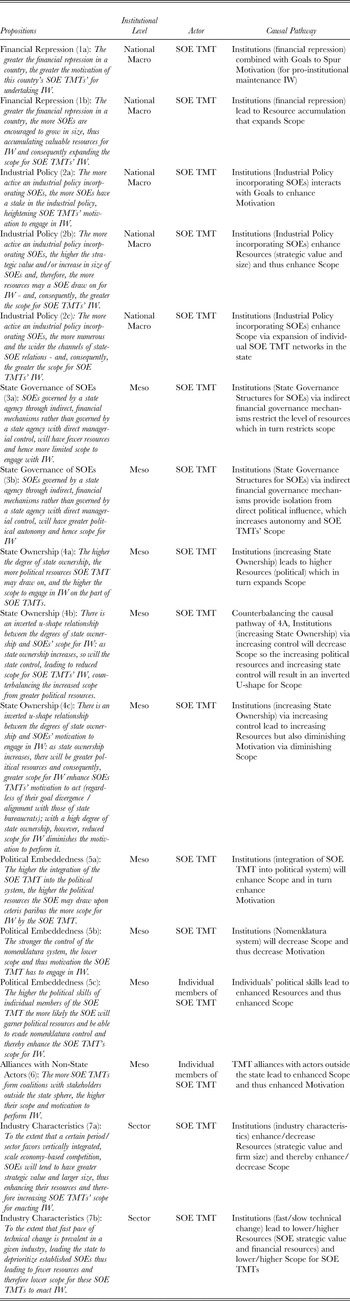
We identify eight factors, situated at three different levels, affecting SOE TMTs’ IW: At the macro level, financial repression and industrial policy are key elements of a national institutional environment that influence SOE TMTs’ IW. At the level of the state-SOE governance system, the key determinants are the nature and structure of state-SOEs' relations in terms of the number (fragmentation) of formal lines of authority, the degree of state ownership, the embedding of SOE top managers in the political system or the nomenklatura, and the autonomy of the state shareholding authority from the government. At the industry level, the extent to which a sector is characterized by vertical integration and the place of technical change are key determinants. We discuss these determinants in turn and formulate propositions.
National Macro-Level Institutions
Financial repression
Financial repression consists of policies that ‘keep nominal interest rates lower than would otherwise prevail’ (Reinhart, Reference Reinhart2012).[Footnote 7] Thus financial repression typically features controls over interest rates on both bank deposits and loans with spreads substantial enough to keep the banks viable while the interest rates are set below market value (Park & Patrick, Reference Park and Patrick2013; Pettis, Reference Pettis2013).[Footnote 8] Governments have historically used financial repression to encourage investment in those sectors they prioritize. Several emerging and industrializing economies have undertaken financial repression to foster economic and industrial development: from Nazi Germany (Tooze, Reference Tooze2006) to the Northeast Asian industrializers of Japan, Korea, and Taiwan during their 20th century boom (Patrick & Park, Reference Patrick and Park1994) to China today (Park & Patrick, Reference Park and Patrick2013; Pettis, Reference Pettis2013).
Where it exists, financial repression can be a key feature of SOEs’ macro institutional environment, determining both the motivation for SOEs’ IW and the nature and number of resources SOEs may draw upon to engage in IW. For instance, China has not only had some of the strongest financial repression (measured in terms of the transfer of wealth from household savers to industrial investors as a percentage of GDP) in history (Pettis, Reference Pettis2013), but in contrast to countries such as Korea and Japan, China, due to its Leninist party-state, has prioritized SOEs as the targets of cheap loans for industrial investment. Top managers at SOEs have been able to utilize financial repression to entrench themselves in the Chinese economy. Financial repression has provided China's SOE top managers with the financial wherewithal to empire build. The key is to become large enough to achieve too-big-to-fail status in the eyes of the state leadership and the cheap capital provided by financial repression helps SOEs do just that (Fuller, Reference Fuller2016; Huang, Reference Huang2003, Reference Huang2008; McMahon, Reference McMahon2018; Pettis, Reference Pettis2013).
Moreover, financial repression combined with the use of state-owned commercial banks whose lending is guided towards state-privileged SOEs, often at very advantageous conditions such as the absence of a requirement for collaterals (O'Connor, Reference O’Connor2000), provides SOEs with a further lever over government, namely Non-Performing Loans (NPLs). Indeed, in countries like China and Vietnam, the loans taken out by SOEs can acquire a systemic importance that locks the government into a mutual-hostage situation making it difficult to reform SOEs, and thus securing the latter's privileged position in the financial system (cf., O'Connor, Reference O’Connor2000).
In this context, Chinese SOEs strategically strive to enhance mutual dependence between themselves and the state (Peng et al., Reference Peng, Bruton, Stan and Huang2016: 309–310).[Footnote 9] This behavior can be interpreted as a case of IW by SOEs, which has resulted in institutional maintenance (in this case, the maintenance of the system of SOE-oriented financial repression) promoted by the SOEs themselves. Since the announcement of major reforms to end the system of financial repression and concomitant lending bias towards SOEs at the Third Plenum of the 18th CPC Central Committee in November 2013, top leaders, such as Premier Li Keqiang, have often alluded to interest groups including SOEs as blocking these economic reforms (Fuller, Reference Fuller2016; McMahon, Reference McMahon2018). Indeed, one of the major optimists who earlier interpreted Chinese financial data as heralding the burgeoning of its private economy in place of SOEs, Lardy (Reference Lardy2014) has recently admitted that the financial system continues to be heavily biased towards supporting SOEs and points out that loans to private firms have collapsed since 2012 whereas the share of loans going to SOEs has tripled.[Footnote 10]
In juxtaposition to the maximalist Chinese case of high financial repression with the cheap credit of that repression being directed to SOEs, the Taiwanese minimalist case of financial repression allows us to understand under what conditions financial repression increases resources and motivations for SOEs to engage in IW. Taiwan pursued financial repression from the 1950s into the 1980s (Patrick & Park, Reference Patrick and Park1994). However, its financial repression was much lighter (less credit shifted from households to firms and at less generous interest rates) than what occurred in Korea, Japan, and China (Park & Patrick, Reference Park and Patrick2013; Pettis, Reference Pettis2013) and less directed to SOEs in preference of other firms (Fields, Reference Fields1995; Patrick & Park, Reference Patrick and Park1994).
Yet, the prominence of state ownership in Taiwan's economy was quite pronounced. State-owned firms comprised almost half (49%) of manufacturing value-added in 1951. Even as private enterprise boomed and the public share of manufacturing value-added slipped below twenty percent by 1976, the state in the 1970s was still investing in large SOEs in shipbuilding, steel, petrochemicals, autos, and semiconductors (Chu, Reference Chu2017; Hsueh, Hsu, & Perkins, Reference Hsueh, Hsu and Perkins2001).
Despite their former prominence, by the late 1980s, the state had managed to remove SOEs from a leading role in most of these sectors. Even the most ambitious and successful of the SOEs to emerge from the heavy industrialization push of the 1970s, China Steel, was unable to prevent the liberalization of the steel trade and failed in its bid to consolidate Taiwan's private minimills under its ownership. Instead, the firm faced new private competitors (Noble, Reference Noble1998). Similarly, in the mid-1980s, private mid-stream petrochemical producers were allowed to invest in their own upstream, naphtha cracker plant in competition with state monopoly producer, China Petroleum Corporation (Hsueh et al., Reference Hsueh, Hsu and Perkins2001).
The main reason Taiwanese SOEs were not able to engage in effective IW to block privatization, even though many of them tried to do so (Hsueh et al., Reference Hsueh, Hsu and Perkins2001; Noble, Reference Noble1998), was the nature of the financial repression in Taiwan. With less generous terms of credit and less credit directed towards SOEs per se, Taiwanese SOEs never had the opportunity to amass the resources to become too big to fail. Furthermore, the financial system did not give them such lavish treatment in terms of interest rates that they could rely on being embedded within the current system alone to survive, i.e., these firms were always more market-facing with fewer resources than China's big SOEs. Thus, their motivations to engage in IW to maintain the current system of financial repression were weaker.
Thus, we formulate the following propositions:
Proposition 1a: The greater the financial repression in a country, the greater the motivation of this country's SOE TMTs’ for undertaking IW.
Proposition 1b: The greater the financial repression in a country, the more SOEs are encouraged to grow in size, thus accumulating valuable resources for IW and consequently expanding the scope for SOE TMTs’ IW.
Industrial policy
Industrial policy refers to a heterogeneous and evolving set of policy goals and instruments targeting the structure of an economy to improve its growth potential (see e.g., Rodrik, Reference Rodrik2004, Reference Rodrik2007). Following Warwick (Reference Warwick2013), industrial policy is ‘any type of intervention or government policy that attempts to improve the business environment or to alter the structure of economic activity towards sectors technologies or tasks that are expected to offer better prospects for economic growth or societal welfare than would occur in the absence of such intervention’ (Warwick, Reference Warwick2013: 16). Historically, state ownership has been a major instrument of industrial policy – especially in the immediate post-World War II period when state ownership associated with economic planning often constituted the core of industrial policy strategies in advanced economies (Nude, Reference Nude2010). Subsequent decades starting in the 1970s and 1980s saw a reduction in the role of SOEs (Toninelli & Toninelli, Reference Toninelli and Toninelli2000). However, the recent rise of economic regulation, originally thought of as an alternative to industrial policy, has not put an end to the state's role in the economy nor to state ownership (Thatcher, Reference Thatcher2014; Vogel, Reference Vogel1996). Quite the opposite; partial privatization and sale of shares has enabled SOEs to internationalize, expand into new markets, and establish alliances with private firms, becoming truly ‘national champions’ (Thatcher, Reference Thatcher2014).
Industrial policy to the extent that it utilizes SOEs as the targeted firms enhances the resource endowments and motivation for institutional work. For example, Datang Telecommunications in China took advantage of SOE-centric policies in the telecommunications and semiconductor industries to accumulate resources and motivation for IW. Embracing China's 3G TD-SCDMA technology strategy allowed Datang to survive in a period where its market share had fallen precipitously low. These SOE-friendly industrial policies also incentivized Datang to push for further industrial policies. The firm then used these resources to play an active role in investing in the semiconductor industry and concomitantly to push the state to create even more ambitious, SOE-friendly industrial policies (Fuller, Reference Fuller2016). This leads us to formulate the following propositions:
Proposition 2a: The more active an industrial policy incorporating SOEs, the more SOEs have a stake in the industrial policy, heightening SOE TMTs’ motivation to engage in IW.
Proposition 2b: The more active an industrial policy incorporating SOEs, the higher the strategic value and/or increase in size of SOEs and, therefore, the more resources may a SOE draw on for IW - and, consequently, the greater the scope for SOE TMTs’ IW.
Proposition 2c: The more active an industrial policy incorporating SOEs, the more numerous and the wider the channels of state-SOE relations - and, consequently, the greater the scope for SOE TMTs’ IW.
State-SOE Governance System
Structuration of authority within state shareholdings
State-SOE relations are structured by a certain state-SOE governance system that determines the lines of command and authority. These can be more or less centralized within the state apparatus and more or less fragmented across state agencies (see e.g., Marquis, Zhang, & Zhou, Reference Marquis, Zhang and Zhou2011 on China). These structural components of the state-SOE governance system determine what we label the ‘structural’ autonomy of SOEs vis-a-vis state bureaucrats and agencies. However, beyond its structural aspect, SOE autonomy also encompasses less structural links – such as TMT's social links to parts of the state bureaucracy or policymakers. Also, we distinguish lines of authority from ownership ties. SOEs are embedded in structures of control and supervision that may or may not be underpinned by ownership ties. Thus, central banks or ministries of finance can have oversight rights over SOEs regardless of whether or not they have ownership stake in the SOEs they oversee. We therefore discuss ownership ties separately in the next section.
International financial institutions usually distinguish three types of SOE governance structures. First, there is the traditionally wide-spread decentralized model where various ‘line ministries’ directly control and manage their ownership rights over their own portfolio of SOEs. Second, there is a so-called ‘dual model’ where line ministries exercise their ownership rights over SOEs, with the Ministry of Finance exercising some overarching oversight over financial performance (OECD, 2005, 2015; World Bank, 2006, 2014). Third, there is a centralized model where the management and control over state-owned assets is unified in a single entity that manages these assets based on financial and commercial rather than political criteria. Such financial management vehicles for SOE governance are typically asset management entities. Recent reform guidelines by the OECD and the World Bank are encouraging a move away from the decentralized model towards the fully centralized one, with the ‘dual model’ constituting an acceptable ‘second best’ solution. For our purpose, the key difference is whether or not the designated state unit or units govern the SOE through indirect, financial means or through direct intervention into the management of the SOE. Indirect financial means are financial performance targets. The international organizations’ preference for the centralized model stems from the belief that such a structure will isolate SOEs from undue direct political interference from politicians, making SOEs more focused on financial goals and thus more efficient. Indeed, such ‘agencification’ – whereby ownership and control over SOEs is transferred from bureaus within the state bureaucracy to autonomous agencies – will lead to stronger incentives for SOE TMTs to pursue and deliver on commercial goals (Vining, Laurin, & Weimer, Reference Vining, Laurin and Weimer2015).
The indirect, financial model of governance has two contradictory effects on the likelihood of SOEs to perform IW; this structure implies a heightened financial and commercial accountability towards the asset managing entity. SOEs will be pushed to more narrowly focus on commercial and financial goals. At the same time, indirect asset management entities have a more limited mandate and goals, and fewer resources at their disposal. From the SOE perspective, replacing state agencies’ direct management control with state agencies utilizing indirect, financial control therefore implies a decrease in the resources they can draw on to perform IW. According to our model, this will negatively affect SOE's scope to perform IW.
On the other hand, however, the indirect, financial governance structure means SOEs are politically more autonomous from the state as it becomes harder for politicians to control SOEs directly (World Bank, 2014: 79). Indeed, ‘agencificiation’ has been shown to lead to increased managerial discretion towards the state (Vining et al., Reference Vining, Laurin and Weimer2015). We would therefore expect that SOEs embedded in a governance structure that isolates them from direct managerial control will have more leeway to pursue IW especially when their goals diverge from the government's goals.
In France, for instance, all state shareholdings are managed by a specialized entity, the Agence des Participations de l’État (APE), created in 2004,[Footnote 11] which is autonomous from the Treasury. Of course, although an autonomous entity, APE has very close ties to the Treasury, both in terms of its governance and of its staffing: as pointed out by the Cour des Comptes (France's supreme public accounting body) in a 2017 report, the 4 most senior positions at APE are held by members of the Treasury. Yet, the objectives of APE are very different from the very traditional hierarchical relationships characterizing the Treasury-SOE relationships in the postwar era. The goal is to use equity ties to sustain ‘national champions’ or companies representing the ‘national interest’ – which is, as per APE's official mission statement to ‘embody the shareholder State’ by investing into companies ‘deemed strategic by the state’, ‘to stabilize their equity or accompany them in their development or transformation’.[Footnote 12] For SOEs this change in governance structures does mean becoming more isolated from the more political goals of the Treasury, which increases their structural autonomy.
Emerging and developing economies, too, have started reforming their SOE-governance structures, with potential implications for SOE scope for IW. Thus, Paraguay implemented a reform in 2008 – under the maverick President Fernando Lugo – that centralized SOE control and removed control from ministries to transfer it to an inter-ministerial SOE Council supported by an SOE Monitoring Unit (World Bank, 2014: 268–269). While political influence in this system is still potentially strong, because ministries remain represented on the Council, SOEs are more isolated from political interference by individual ministries and may benefit from more political leeway due to the multiplication of potentially divergent political interests represented on the SOE Council. Taken together, these developments in SOE governance are likely to favor both market and nonmarket strategic autonomy by SOEs, thus enlarging the scope for IW.
Thus, we make the following propositions:
Proposition 3a: SOEs governed by a state agency through indirect, financial mechanisms rather than governed by a state agency with direct managerial control will have fewer resources and hence more limited scope to engage with IW.
Proposition 3b: SOEs governed by a state agency through indirect, financial mechanisms rather than governed by a state agency with direct managerial control will have greater political autonomy and hence scope for IW.
Which effect will dominate (reduced resources or increased political autonomy) is contingent on the factors enunciated in propositions 5a and 5b below. The state's ability to control SOEs is dependent upon the political integration of SOE elites with other states and the nomenklatura system in each polity. It is also important to acknowledge that these propositions are not standalone ones, and our integrated approach to SOE IW requires combining the considerations from different propositions in order to assess SOE IW behavior.
Degrees of State Ownership
Closely related to the factor mentioned above is the extent or degree of state shareholdings in SOEs. We know from the existing literature on state capitalism that there is significant variation in the degrees of state ownership across countries and across SOEs. This has led Musacchio and Lazzarini, in a series of works, to contrast ‘Leviathan as a minority investor’ with ‘Leviathan as a majority investor’ (Inoué, Lazzarini, & Musacchio, Reference Inoue, Lazzarini and Musacchio2013; Lazzarini & Musacchio, Reference Lazzarini and Musacchio2018; Musacchio & Lazzarini, Reference Musacchio and Lazzarini2014; Musacchio, Lazzarini, & Aguilera, Reference Musacchio, Lazzarini and Aguilera2015). There is increasing empirical evidence that these two modalities of state ownership generate effects on SOEs’ strategic behavior (Musacchio et al., Reference Musacchio, Lazzarini and Aguilera2015). In particular, Arreola and Bandeira-de-Mello (Reference Arreola and Bandeira-de-Mello2018) and Kalasin, Cuervo-Cazurra, and Ramamurti (Reference Kalasin, Cuervo-Cazurra and Ramamurti2020) show how different degrees of state ownership affect SOEs’ internationalization. According to Inoué and colleagues (Reference Inoue, Lazzarini and Musacchio2013), varying degrees of state ownership translate into different degrees of firm-level performance. Further, as demonstrated by Cui and Jiang (Reference Cui and Jiang2012), different levels of state ownership are also associated with varied degrees and types of institutional pressures experienced by SOEs. It is thus reasonable to expect that the degree of state ownership is likely to affect SOEs TMTs’ willingness and capacity to perform IW.
Importantly for our purpose here, the above-mentioned literature shows that there is no linear or constant relationship between state ownership and SOE behavior and/or performance. This reflects the contradictory effects of state control. Within the framework of Musacchio and Lazzarini (see, in particular, Musacchio & Lazzarini, Reference Musacchio and Lazzarini2014), the causality between state ownership and SOE performance runs like this: varying degrees of state ownership determine degrees of state control, which affect the ability of SOE managers to pursue objectives of their own – their own interest, assumed to diverge from state actors’ interest. In this view, greater performance is associated with lower degrees of control because the latter enable SOE TMT to evade political interference. Thus, decreasing state ownership will favor an SOE's strategic autonomy, to the benefit of firm-level performance. On the other hand, with state ownership come resources, in particular, state ownership promotes capital expenditure in SOEs facing constraints on their ability to fund investment – for instance, because of a defective institutional environment (Inoué et al., Reference Inoue, Lazzarini and Musacchio2013). Thus, increasing state ownership is associated with increasing firm-level performance. The overall, net effect of state ownership is thus theoretically indeterminate and can only be assessed empirically (Lazzarini & Musacchio, Reference Lazzarini and Musacchio2018).
Similarly, Kalasin et al. (Reference Kalasin, Cuervo-Cazurra and Ramamurti2020) find an ‘S-shaped’ relationship between state ownership and internationalization of SOEs: low degrees of state ownership are associated with low internationalization;[Footnote 13] as state ownership increases, internationalization increases, until it decreases again with high degrees of state ownership. This S-shaped relationship is due to two opposite effects of state ownership, according to Kalasin and colleagues (Reference Kalasin, Cuervo-Cazurra and Ramamurti2020), a ‘hindering hand’ effect, whereby increasing state ownership compounds multilevel agency problems and a ‘helping hand’, whereby increasing state ownership provides SOEs with increasing resources. This argument is very much in line with the agency framework proposed by Musacchio, Lazzarini, and colleagues (Inoué et al., Reference Inoue, Lazzarini and Musacchio2013; Lazzarini & Musacchio, Reference Lazzarini and Musacchio2018).
While we hypothesize, similarly, that varying degrees of state ownership will lead to different degrees of likelihood of SOEs performing institutional work, our explanations differ from those offered by Musacchio, Lazzarini, Kalasin, and colleagues on two grounds. First, institutional work is not exclusively driven by attempts to challenge the government's orientation or to change the institutional work in a way that better fits an SOE's TMT's goals or interests; as argued in the previous section, SOEs might have a stake in/SOEs TMT might be interested in maintaining the existing institutional framework, i.e., in performing institutional work that strengthens the government's policy goals. This understanding of IW, drawn from the IW literature (Micelotta & Washington, Reference Micelotta and Washington2013), is compounded by our own assumptions regarding the drivers, or motivations, of SOEs' TMT. In particular, we reject the agency view of the relationship between SOE TMT (the agents) and state bureaucrats (the principals), which posits that agents will tend to pursue different interests (and certainly not political ones) from the principals. By contrast, we have argued above that we hold the goals driving SOE TMTs to be much more multi-faceted than in this narrow agency view. Thus, we do not assume an a priori divergence or alignment of interests between state bureaucrats and SOE TMTs.
For these reasons we do not hold the view that an increased degree of state ownership may reduce IW by impeding SOE managers to further their own interests and, accordingly (with the narrow agency view), seek to change their institutional environment. Rather, we hypothesize here that if varying degrees of state ownership have an effect on the likelihood of IW on the part of SOEs, such effect is not linear, due to the concurrent causal mechanisms that relate degrees of state ownership with SOE's IW. In particular, we argue that increasing state ownership does not act only as a deterrent for (institutional) action on the part of SOE managers, as held by Cui and Jiang (Reference Cui and Jiang2012). In this case, as at other levels of the institutional environment faced by SOEs, institutions may act as enablers of agency. In particular, increasing state ownership may generate increasing political resources that will feed into SOEs’ IW. For example, SMIC, China's largest integrated circuit manufacturer, had minority stakes from the central government and Shanghai government, and as a consequence, despite its large size, was not prioritized by the central government or Shanghai government and had little influence over China's IC industry policies (Fuller, Reference Fuller2016). Importantly, the political resources created by state ownership are often associated with non-ownership related factors, such as the embeddedness of SOE TMTs within networks of state bureaucrats. But these two sets of factors are analytically distinct, and the effects of varying embeddedness will be discussed next.
Such political resources contribute to opening up scope for institutional work on the part of SOEs. Scope, however, does not depend on political resources only; it also directly reflects the opportunities to act built into SOEs’ institutional environment. Therefore, it is reasonable to expect that as state ownership increases, causing political resources to rise, scope for IW will increase as well. However, scope is also increasingly limited by the degree of state control that, as state ownership increases, also increases. A good illustration of this is France's Engie, partially owned by the French State (with a 24% equity stake), which is simultaneously much more proactive with respect to regulatory reform than GDF, its fully state-owned predecessor, and less imbued with political resources necessary for successful IW, a fact illustrated by the recent turnover at the helm of the company.[Footnote 14]
Here the logic of our argument is not fundamentally dissimilar to the one put forward by Lazzarini and Musacchio (Reference Lazzarini and Musacchio2018), whereby the good performance of SOEs across the world (across their panel) may be attributed to the extra resources provided by state ownership. Of course, in Lazzarini and Musacchio's framework, these resources (which they call ‘protection’ and ‘rents’ rather than political resources) only mitigate the negative impact of state ownership on SOE performance via agency conflicts. We, on the other hand, do not think about TMT's interests and goals as a priori misaligned with state bureaucrats’ goals.
As explained above, we construe the motivation of SOEs’ TMT as (a) reflecting multiple potential goals and (b) being affected by TMT's perceived scope for action. In other words, we have argued that the perception of opportunities to maintain or transform SOEs’ institutional environment prompts actors to enact their goals in that regard.
In accordance with the above discussion, we hold that degrees of state ownership have indeterminate effects on the ‘interest/goals’ drivers of SOE TMT motivation (to do IW). In other words, varying state ownership does not imply greater alignment/divergence of interest between state bureaucrats and SOEs TMT. If motivation to perform IW is affected at all by degrees of state ownership it is through its relationship with scope – i.e., because of the perceived opportunities for IW (Battilana et al., Reference Battilana, Leca and Boxenbaum2009; Dorado, Reference Dorado2005); like scope, therefore, the motivation of SOEs' TMT to perform IW will rise with increasing degrees of state ownership, until the high degree of state ownership starts reducing scope and, consequently, disincentives SOEs' top management to seek to act in order to change or maintain their institutional framework. This argument is similar to the one made by Boies on large American firms' political activities, whereby a firm's interest in engaging in CPA is compounded by the extent and depth of that firm's relationship with the state apparatus (Boies, Reference Boies1989).
We do argue that greater state ownership ceteris paribus provides greater political resources via two mechanisms. Increasing state ownership increases the formal and informal interactions between the SOE TMT and the state and thus enhances TMT's political resources by expanding informal and formal ties to other state elites. Increasing state ownership also increases the economic and strategic value of the SOE in the eyes of the state. The SOE TMT can wield this enhanced valuation as a political resource.
Hence, we put forward the following propositions:
Proposition 4a: The higher the degree of state ownership, the more political resources SOE TMT may draw on, and the higher the scope to engage in IW on the part of SOE TMTs.
Proposition 4b: There is an inverted u-shape relationship between the degrees of state ownership and SOEs’ scope for IW: as state ownership increases, so will the state control, leading to reduced scope for SOE TMTs’ IW, counterbalancing the increased scope from greater political resources.
Proposition 4c: There is an inverted u-shape relationship between the degrees of state ownership and SOEs’ motivation to engage in IW; as state ownership increases, there will be greater political resources and, consequently, greater scope for IW enhancing SOEs TMTs’ motivation to act (regardless of their goal divergence / alignment with those of state bureaucrats); with a high degree of state ownership, however, reduced scope for IW diminishes the motivation to perform it.
For propositions 4b and 4c, we acknowledge that the level of state autonomy in terms of how impervious the state is from interference will change the shape of the curvilinear effect. The more state autonomy the flatter the curve of increased scope from greater political resources (proposition 4b) and the flatter the curve of increased motivation from political resource-based scope (proposition 4c). Political science scholars from a wide variety of traditions have arrived at something approaching a consensus on the basic requirements for state autonomy: 1) broad political coalition supporting the state (Acemoglu & Robinson, Reference Acemoglu and Robinson2012; Evans, Reference Evans1995; Haggard, Reference Haggard2018; Kohli, Reference Kohli2004) and 2) professionalization of the state bureaucracy (Fukuyama, Reference Fukuyama2013; Haggard, Reference Haggard2018; Johnson, Reference Johnson1982; Rauch & Evans, Reference Rauch and Evans2000; Wade, Reference Wade1990).
Top Management Embedding in Political System: Political and Nomenklatura Ties
State-SOE relations do not start and end with equity ties. Other, non-equity relationships tie SOEs to the state apparatus and also affect the nature and scope of SOEs’ IW. In particular, we argue that SOEs’ political ties are a crucial determinant of the latter. This argument is parallel to that made by Schneider when analyzing the role of personal networks in determining the political strategies of business in South America (Schneider, Reference Schneider1992). As argued by Schneider, they were especially significant in the case of Mexico, Chile, and Colombia throughout the 20th century, where business associations formed the locus of tight informal ties between businesses and politicians, enhancing the collective action of businesses with regard to government policy and regulation.
The economic literature – particularly agency theory – has often treated political ties as constraints negatively affecting SOEs’ operations and bottom lines. In this perspective, state control carries with it a political logic, alien to the business objectives of the firm, thereby hampering these objectives and damaging its performance (Shirley & Walsh, Reference Shirley and Walsh2000; Shleifer & Vishny, Reference Shleifer and Vishny1998). The management literature qualifies this picture, underscoring the benefits that companies can draw from ties with the state. Indeed, such ties can increase performance by permitting access to resources, information, and preferential treatment (Johnson & Mitton, Reference Johnson and Mitton2003; Lester, Hillman, Zardkoohi, & Cannella, Jr., Reference Lester, Hillman, Zardkoohi and Cannella2008; Xin & Pearce, Reference Xin and Pearce1996). Okhmatovskiy (Reference Okhmatovskiy2010) argues that ties with the government may be important for firms to influence policies, although they may not help in accessing resources. However, Sun, Mellahi, and Thun (Reference Sun, Mellahi and Thun2010) find that the value of political ties can change dramatically as a country's institutional system moves towards a more market-based system. In short, political embeddedness does have important, if complex, implications for firms.
For SOEs, ties to the government are a key channel of influence. Recent literature shows that the ties that bind SOEs to state agencies and bureaucrats are multiple and heterogeneous (see Cuervo-Cazurra et al., Reference Cuervo-Cazurra, Inkpen, Musacchio and Ramaswamy2014), including equity (minority and majority shareholdings), debt (subsidized credit), board seats, regulation, and other, softer forms of control, such as staffing and contracts. There is also a great variation in the legal status and degree of state embeddedness of SOE staff: from SOE employees as civil servants to a complete separation between careers of state employees and SOE employees (see e.g., Grindle, Reference Grindle2010; Liang, Ren, & Sun, Reference Liang, Ren and Sun2015). Political ties can take several forms, from interchangeable career paths (revolving doors) to common educational backgrounds. Various studies have pointed to the links between political and managerial careers as a key component of state capitalism in China (see, in particular, Boisot & Child, Reference Boisot and Child1988; Fan, Wong, & Zhang, Reference Fan, Wong and Zhang2007; Groves, Hong, McMillan, & Naughton, Reference Groves, Hong, McMillan and Naughton1995; Lin & Milhaupt, Reference Lin and Milhaupt2013). In France, a high proportion of senior staff and top managers at the largest French firms have historically been trained in the prestigious ‘Grandes écoles’ system that works as a breeding ground for future civil servants. In 2010, according to one study, 41% of top managers in SOEs belonged to state corps (Dudouet & Joly, Reference Dudouet and Joly2010). This peculiar form of socialization ensures common views and informal communication channels between state authorities and SOEs. But this shared background is not limited to public enterprises: more generally, a high proportion at the largest French listed firms still, in the early 2000s, shared the same education and training with top civil servants; a phenomenon that endures despite privatization and globalization, leading Dudouet and Joly (Reference Dudouet and Joly2010: 43) to qualify this as the ‘survival of a relationship with the State through the grands corps’.
In a number of state-planned and formerly state-planned economies, the state often attempts to exert strict control over SOEs’ TMT via bureaucratic procedures concerning personnel or ‘nomenklatura’, which derives from the Russian term for the list of important posts in government and industry to be filled by Communist Party members in the Soviet Union. For example, in China nomenklatura refers to lists of positions directly appointed by the CCP's Central Organization Department (Leutert, Reference Leutert2018). When this nomenklatura system functions in terms of its Leninist intent, the party-state exerts strong control over the appointment and monitoring of the top management team in SOEs. In such situations, one would expect that SOEs would have little space in which to pursue IW. However, if the nomenklatura system is fractured or the SOEs can somehow buck control of the nomenklatura system by playing the party-state organ in charge of nomenklatura against other party-state organizations in control and monitoring of the SOE, then the SOE can have more space to pursue IW. For example, among China's central government SOEs, some are formally under SASAC's control,[Footnote 15] but the Organization Department and the SOE top managers’ own accumulated rank and power can be used to thwart control by SASAC or any other authority (McGregor, Reference McGregor2012; Walter & Howie, Reference Walter and Howie2011).
It is important to draw a clear distinction between the functioning of the nomenklatura system and the level of integration of SOE management into the wider political elite. A functioning nomenklatura system means that the party-state maintains effective control over the SOE management it appoints. However, integration of SOE managers into the political elite has often led to the breakdown of nomenklatura control as SOE managers either outrank their nominal supervisory agencies or their connections to top leaders thwart such control.
There is an indeterminate relationship between political embeddedness of the TMT and motivation. On the one hand, the more embedded the TMT is in the political system the more it has the political resources and enhanced scope for institutional work. Enhanced scope feeds back into enhanced motivation. On the other hand, the greater the political embeddedness of the TMT, the less likely the TMT will be motivated to engage in institutional work because the TMT will be more likely to embrace whatever beliefs about institutional creation, maintenance or disruption the ruling political elite has. With ideological agreement with the political leadership, the TMTs will be passive followers rather than active champions of institutional work.
Thus, we argue:
Proposition 5a: The higher the integration of the SOE TMT into the political system, the higher the political resources the SOE may draw upon ceteris paribus the more scope for IW by the SOE TMT.
Proposition 5b: The stronger the control of the nomenklatura system, the lower scope and thus motivation the SOE TMT has to engage in IW.
Proposition 5c: The higher the political skills of individual members of the SOE TMT, the more likely the SOE will garner political resources and be able to evade nomenklatura control and thereby enhance the SOE TMT's scope for IW.
Alliances with Non-State Stakeholders
Although close ties to the state and political decision-makers provide SOEs with IW-enabling political resources, a key question remains of how SOE TMTs create a degree of autonomy from the state bureaucracy in order to increase their scope and enhance their motivation to perform IW. In line with the previously discussed ‘power escape’ argument (Cuervo-Cazurra et al., Reference Cuervo-Cazurra, Inkpen, Musacchio and Ramaswamy2014; Cui & Xu, Reference Cui and Xu2019; Huang, Xie, Li, & Reddy, Reference Huang, Xie, Li and Reddy2017), which postulates that SOEs can reduce their political liabilities by reducing their dependence on the state, not least through external connections, strengthened by HI's emphasis on the ‘coalitional foundations’ of processes of institutional change (Thelen, Reference Thelen2004, Reference Thelen2012), we argue that this might be achieved by nurturing alliances with a range of relevant non-state stakeholders.
Research in the post-socialist context provides insights into the mechanisms and outcomes of such alliance forging (Clark & Soulsby, Reference Clark and Soulsby1995; McDermott, Reference McDermott2007). For instance, Markus's work shows that firms actively use coalition-building to protect themselves from state predation or indeed predation by private actors. Such stakeholder alliances initiated by firms can lead to the emergence of what Lawrence, Hardy, and Phillips (Reference Lawrence, Hardy and Phillips2002) called ‘proto-institutions’. This ‘local informal consensus regarding property rights’ protection’ often ‘preexisted (and was later acknowledged by) formal national institutions’ (Markus, Reference Markus2012: 272). As such, firm strategies can become the kernel of bottom-up institution building and change.
Markus (Reference Markus2008) has shown in the case of private firms in Russia under the Putin government of the early 2000s that voluntarily implementing firm-level corporate governance reforms that go beyond the legally required minimum allows firms to attract foreign investors, which then become the firm's ‘political insurance’ against state predation. More generally, in contexts of either predatory states or weak states that cannot enforce property rights against private actors’ predatory behaviours, Markus (Reference Markus2012: 274) demonstrates that ‘by forging alliances with stakeholders around their firms, owners force the state and rival businesses to respect their rights’. The argument can be extended at least to listed and partial SOEs; SOE TMTs may be able to implement best practices to attract foreign investors who become allies that may defend the SOE's autonomy from the government. Stark's (Reference Stark1996) notion of ‘recombinant property’ based on the Hungarian case describes a similar ownership-based strategy by firms (newly privatised or partially state-owned) to create some stability and certainty in a context where formal institutions are weak. By integrating foreign ownership into such ‘recombinant property’ networks, firms in Hungary have found an effective organisational response to the challenges of an uncertain institutional environment and an increasingly internationalised economy (Stark & Vedres, Reference Stark and Vedres2012). Creating network ties through ownership strategies may well be a way in which SOEs bolster their autonomy from a one-sided overdependence on the state.
In addition to ownership strategies, SOEs can build stakeholder alliances in a number of ways, including diversifying their political ties through strategic board appointments (Musacchio & Lazzarini, Reference Musacchio, Lazzarini and Cuervo-Cazurra2018; Wang, Jin, & Yang, Reference Wang, Jin and Yang2016), forging links with local communities (Markus, Reference Markus2015; McDermott, Reference McDermott, Grabher and Stark1997), and commercial contracts. Choudhury and Khanna (Reference Choudhury and Khanna2014), for example, showed that Indian state-owned laboratories increased their ‘global footprint’ by licensing patents to major multinational firms, thus generating a cash flow independent of the Indian state.
Corporate social responsibility strategies constitute another important means by which firms pursue alliance building (Johns & Wellhausen, Reference Johns and Wellhausen2016; Markus, Reference Markus2008). Frye (Reference Frye2006) has shown how newly privatised firms invest in public goods in order to increase their legitimacy in the broader population arguably reducing the risk of renationalisation by the state. Such legitimacy strategies can be expected to be open to SOEs, too, if we accept that SOEs have some autonomy from the State to begin with and thus can make such strategic investments in legitimacy-enhancing projects (Marquis, Yin, & Yang, Reference Marquis, Yin and Yang2017).
Based on these arguments, we propose:
Proposition 6: The more SOE TMTs form coalitions with stakeholders outside the state sphere, the higher their scope and motivation to perform IW.
Industry Characteristics
Industry characteristics shape the resources SOEs have for IW. Several resources stand out in particular size and strategic value. The latter are likely to be particularly influenced by vertical integration and technical change within a given industry and time period.
Drawing on the industrial organization-inspired works of the classic external approach to strategy (cf. Porter, Reference Porter2008), vertically integrated firms can lower competition in their industry (i.e., increase their market power) by threatening suppliers and even buyers with backward or forward integration, and this threat is more credible when a firm already is quite vertically integrated. As a parallel to this firm-level strategy view, firms have greater clout in their respective economy the more market power they exercise. Furthermore, this clout is also enhanced in vertically integrated industries because firms tend to be bigger in such industries. Industrial policy interacts with this tendency for vertical integration in that under conditions conducive to vertical integration the state will favor a select few national champions in sectors that favor vertical integration (Gerschenkron, Reference Gerschenkron1962; Nolan, Reference Nolan2001) and thus provide the targets of such industrial policies with even more resources.
Conversely, the global value chains and other industry studies literature recognize that there are often sectoral pressures for segmentation/de-verticalization/disaggregation of the value chain (Arndt & Kierzkowski, Reference Arndt and Kierzkowski2001; Berger, Reference Berger2005; Fuller et al., Reference Fuller, Akinwande and Sodini2003; Gereffi, Humphrey, & Sturgeon, Reference Gereffi, Humphrey and Sturgeon2005; Langlois, Reference Langlois2003; Thun, Reference Thun and Ravenhill2007). With the fragmentation/disaggregation of value chains, small firms engage a multitude of external suppliers while concentrating/specializing on a narrow band/segment of activity (Fuller, Reference Fuller2013; Thun, Reference Thun and Ravenhill2007). Thus, vertically disintegrated value chains tend give rise to vertically specialized firms that have less strategic value and smaller size so the SOEs in such industries will be hard pressed to leverage their limited value and size as vertical specialists to enact IW.
While much of the work on vertical specialization assumes that it depends on the sector or sub-sector (Berger, Reference Berger2005; Fuller et al., Reference Fuller, Akinwande and Sodini2003; Gereffi et al., Reference Gereffi, Humphrey and Sturgeon2005; Thun, Reference Thun and Ravenhill2007), there are arguments that different periods of time favor either more vertical integration or vertical specialization. Scholars of industrial change (Gereffi et al., Reference Gereffi, Humphrey and Sturgeon2005) have argued that a combination of high complexity of information, transaction costs, and asset specificity will encourage vertical integration. Critically, these factors combine in a tipping point fashion to move from industries favoring de-verticalization to ones favoring vertical integration. Thus, the proposition does not include these three factors as metrics as it is only when the three reach some critical threshold that vertical integration becomes the dominant competitive mode of organization. Many have talked about distinct periods favoring vertical integration and other periods favoring greater vertical specialization (Langlois, Reference Langlois2003). While there is some debate (cf. Newman & Zysman, Reference Newman, Zysman, Zysman and Newman2006) as to how strong these wider, cross-sectoral trends are, to the extent that they exist, periods of vertical integration should be ones where SOEs enjoy relatively greater capacities to pursue greater IW compared to periods of vertical specialization. Historically, these periods of vertical integration and industrial concentration enhanced the strategic value and logic of using SOEs to pursue industrial success because many states felt more comfortable handing the keys to the commanding heights of the economy to a select small group of firms directly under government ownership (Amatori, Reference Amatori, Chandler, Amatori and Hikino1997; Hsueh et al., Reference Hsueh, Hsu and Perkins2001). Conversely, in periods of vertical specialization, these state-owned industrial behemoths begin to look outdated, costly, and unnecessary so SOEs lose strategic value in addition to scale due to shedding what have become scale diseconomies in the new period of vertical disintegration. For example, French, Italian, and Taiwanese models of vertical integration predicated in large part on SOEs in the 1950s and 1960s began to face pressures during the 1970s (Hsueh et al., Reference Hsueh, Hsu and Perkins2001; Piore & Sabel, Reference Piore and Sabel1984; Zysman, Reference Zysman1977).
We therefore propose:
Proposition 7a: To the extent that a certain period/sector favors vertically integrated, scale economy-based competition, SOEs will tend to have greater strategic value and larger size, thus enhancing their resources and therefore increasing SOE TMTs’ scope for enacting IW.
The faster the pace of technical change (incorporating both fast product life cycles and fast clockspeeds [Footnote 16]) in a given industry is, the more likely it is for newcomers to disrupt incumbent firms’ competitive advantages (Christensen, Reference Christensen1997; Fine, Reference Fine1998, Reference Fine2000; Utterback & Suarez, Reference Utterback and Suarez1993). Therefore, incumbent SOEs in industries with a fast pace of technical change will be more likely to become less strategically valuable (in the eyes of state bureaucrats or politicians) and/or have diminished resources. SOEs in those industries will, as a result, have fewer resources to pursue IW.
It must be conceded that fast clockspeeds sometimes will work via mechanisms covered in other propositions. For example, fast clockspeeds often accelerate vertical specialization (Fine, Reference Fine1998; Steil, Victor, & Nelson, Reference Steil, Victor and Nelson2002). However, this is dependent on the extent of standardization with non-standardized activities difficult to de-verticalize (Christensen, Reference Christensen1997). In a similar fashion, in those sectors with a fast pace of technical change, state industrial targeting is probably less effective as state policy and has difficulty keeping pace with changing requirements within the industry (Schmitz, Reference Schmitz2007). Thus, we could imagine that industrial policy in these sectors would be less effective in building up the resources SOEs draw upon to engage in IW.
We therefore formulate the following proposition:
Proposition 7b: To the extent that fast pace of technical change is prevalent in a given industry, leading the state to deprioritize established SOEs thus leading to fewer resources and therefore lower scope for these SOE TMTs to enact IW.
It should be acknowledged that there could be institutional feedback mechanisms from contexts favoring vertical integration into an industrial policy incorporating SOEs (i.e., propositions 2a, b, c). However, this is not the only mechanism through which industrial characteristics affect SOE TMTs’ IW.
DISCUSSION
The return of SOEs as major players in the world economy has sparked a new interest in their diversity and the institutional determinants of their strategy and performance (Musacchio, Farias & Lazzarini, Reference Musacchio, Farias and Lazzarini2014; Musacchio et al., Reference Musacchio, Lazzarini and Aguilera2015). With few recent exceptions, most theories suggest that SOEs are merely agents of the state that are closely controlled through personal and ownership ties amongst others. As a result, the question of SOE agency has received only very limited attention. The study of the internationalization of SOEs, for instance, has at times hinted at a certain divergence of SOE and state preferences (Rodrigues & Dieleman, Reference Rodrigues and Dieleman2018). Thus, internationalization may provide SOE top managers with a means of emancipating themselves somewhat from too close governmental control. These findings suggest that SOEs do have considerable leeway even though they are integrated to some extent into the state structure of the country. The purpose of our article was to suggest that these findings from the case of SOE internationalization may apply much more broadly to SOEs’ ability to shape their institutional environment through institutional work, as hinted in the more micro-level studies examining the institutional agency of SOE managers (Guo et al., Reference Guo, Huy and Xiao2017; Raynard et al., Reference Raynard, Lu and Jing2020). Focusing on situations where SOE TMTs may attempt to either promote or oppose institutional change in their home country, we attempted to develop a systematic model that explains what factors determine the extent of leeway they might have to exercise institutional work. Our propositions and examples are summarized in Table 2.
Our multilevel model consists of eight factors at three different institutional levels that shape SOEs' motivation, resources, and scope to perform institutional work. The propositions that we have formulated regarding these eight determinants of SOE work should be seen as cumulative and complementary. Our argument is that an SOE embedded in a context – macro (institutional), meso (governance system), and industry – characterized by determinants that favor SOE IW, will be more likely to engage in such activity than an SOE embedded in an institutional framework where elements are present that constitute barriers to SOE IW by either reducing their motivation, resources, or scope to perform IW. Thus, an SOE embedded in an institutional system with financial repression, active industrial policy towards SOEs, fragmented lines of authority, autonomous state shareholdings agency, sizeable minority shareholdings by the state, medium degree of integration with the nomenklatura, vertically integrated production, and slow product life cycles will be very likely to engage in IW to either support or resist institutional change. An SOE in an institutional system where these factors are absent or point in the opposite direction will be likely to be pure agents of the state.
Theoretical Contributions
Our theoretical contribution is fourfold. First, we contribute to the SOE literature by extending existing studies of the institutional embedding of SOEs (Cui & Jiang, Reference Cui and Jiang2012; Fuller, Reference Fuller2016; Fuller, Shih, & Tao, Reference Fuller, Shih and Tao2015; Huang, Reference Huang2003; Inoué et al., 2Reference Inoue, Lazzarini and Musacchio013; Lazzarini & Musacchio, Reference Lazzarini and Musacchio2018; Musacchio & Lazzarini, Reference Musacchio and Lazzarini2014; Musacchio et al., Reference Musacchio, Lazzarini and Aguilera2015). Our article builds on these studies but adds to them by providing a framework that can explain when and why SOEs may break free from the control of the state and pursue their own (institutional) strategic interests, and also conceptualizing SOE institutional agency as not strictly a byproduct of potential agency conflicts between the SOE managers and the state. Given the increasing importance of SOEs in the world economy – both domestically and internationally – the alignment or divergence of interests, preferences, and motivations between SOEs and the governments who control them is a tremendously important issue not just for management scholarship, but also for policy makers interested in questions of national security.
Second, we build on the complementarities between IW and HI to contribute to HI theories of institutional change, by highlighting the ‘upstream’ factors that may drive individual SOEs to pursue institutional change (or maintenance), regardless of their position as ‘change agent’ within processes of institutional change (Mahoney & Thelen, Reference Mahoney and Thelen2010). This could improve HI accounts of institutional persistence or limited institutional change by identifying additional factors through which the ‘coalitional foundations’ (Thelen, Reference Thelen2004) of institutions may change (or not). Critically, our theoretical focus on micro-mechanisms of IW could help to flesh out the motivations and scope for active institutional maintenance that only some HI scholarship, such as Thelen (Reference Thelen2004), have recognized.
Third, we leverage the insights from HI literature to contribute to theorizing on IW, particularly linking the ‘positions, endowments and capacities of societal actors’ with their capacity to perform institutional work (Hotho & Saka-Helmhout, Reference Hotho and Saka-Helmhout2017: 10). Responding to the calls by Hwang and Colyvas (Reference Hwang and Colyvas2011) to engage more critically with the context of IW and extending the work of Battilana and colleagues (Reference Battilana, Leca and Boxenbaum2009), we problematize SOE TMTs as a unique type of institutional actors (cf. Yan et al., Reference Yan, Zhu, Fan and Kalfadellis2018) and identify a series of institutional determinants across multiple levels of analysis that explain in what settings their IW is more or less likely to occur. Further, while we use an IW perspective to complete a broader HI understanding of embedded agency at the heart of processes of institutional change and persistence, we also draw on HI's political economic conceptualization of institutional dynamics to compensate for the limitations of IW. We particularly strengthen and expand the understanding of the state and state-affiliated actors in IW, which to date has been relatively narrow (Clegg, Reference Clegg2010), and often confined to policing existing rules or initiating policy change endorsed or resisted by focal actors.
Lastly, by drawing on a range of examples we also hope to have contributed to the research on transition economies by highlighting similarities across salient elements of the institutional environment and SOE experiences in transition and market economies. A growing number of studies have started to explore agency by SOE managers, particularly in the context of China (Guo et al., Reference Guo, Huy and Xiao2017; Raynard et al., Reference Raynard, Lu and Jing2020). Our framework outlines enabling and constraining conditions for IW that are likely to be shared across countries, thus enabling and encouraging further comparative work.
Limitations and Future Research Directions
Our study has two main limitations. First, we purposely focused on the determinants of IW by SOEs. Our framework therefore does not allow us to understand under what circumstances such activity – when it does take place – is likely to be successful or to fail. As we have argued earlier, this question is more likely to be successfully tackled through empirical research.
Second, our study drew on empirical illustrations from a limited number of countries. As such, we expected the choice of these countries to allow us to control for certain factors but still provide some evidence for the breadth of the applicability of our framework. Nevertheless, it offers a research agenda with propositions that can and should be tested against evidence from a much larger number of countries and geographical regions.
Finally, a particularly promising avenue for extending our theorizing would involve disentangling the different types of IW (creation, disruption, or maintenance) by SOE TMTs; and, in parallel, tie these different types to the different modes of institutional change identified by historical institutionalism. Although this discussion is beyond the scope of our article, we expect that this discussion would further nuance the relationships outlined in our propositions.