Introduction
The deliberative turn in contemporary democratic theory has begun to transform ways in which scholars analyse and evaluate parliaments (Steiner et al., Reference Steiner, Bächtiger, Spörndli and Steenbergen2004), supranational decision-making bodies (Naurin, Reference Naurin2009), and the workings of various interest-groups (Klüver, Reference Klüver2009). But little has yet been written on the discursive politics of the Members of the European Parliaments (MEPs; with some notable exceptions, e.g. Costa, Reference Costa2001). To fill the gap, this paper adapts the Discourse Quality Index (DQI) developed by Steenbergen et al. to the study of justification in the European Parliament (EP).
The DQI aims to give the empirical and comparative study of parliamentary institutions a stronger grounding in the political philosophy literature on deliberation. Its authors set themselves the ambitious task of formulating empirically measurable indicators of discourse quality in ‘a theoretically justifiable way, linking (them) in particular to the ideas of Jürgen Habermas’ (Steiner et al., Reference Steiner, Bächtiger, Spörndli and Steenbergen2004: 2). Inter alia the DQI uses Habermas’ discourse ethics to propose indicators of levels of participation, justification, and respect in parliamentary debate. So far, the DQI has been used to assess and explain discourse quality in debates of the Swiss, German, British, and US parliaments. It has not, however, been used to study debates in the EP, although the EP is particularly interesting due to its multi-lingual and pluri-national character. It is, moreover, freer than most national parliaments to deliberate in the absence of executive domination or rigid party disciplines.
In building on the DQI, this paper proceeds as follows. In the second section, we ‘return to political philosophy’ in order to derive our own somewhat modified indicators of ‘discourse quality’ from a normative analysis of what parliamentary deliberation has to contribute to democratic legitimation. In the third section, we identify causal factors that are likely to influence the quality of discourse in the EP. These include institutional factors (Co-decision, Council decision-rules, majority–minority relations in the EP, and differences in MEPs’ domestic political systems), attributes of particular issues (polarization), and the personal characteristics of MEPs (socialization and gender). In the fourth section, we present a preliminary statistical analysis of how our indicators of discourse quality vary across six debate topics of the 2004–09 EP, and of how far that variation can be attributed to each of our causal hypotheses. In sum then, the paper is both evaluative and analytical. It asks ‘how well the EP deliberates?’ and ‘what causes variation in the quality of its deliberations?’ We conclude with some brief reflections on whether our answers to those questions have any wider lessons for how deliberation, legitimacy, democracy, and institutions fit together in the European arena.
Theory and indicators
Political scientists have mainly studied legislatures through roll call analyses of how representatives vote. Why go further and include an empirical analysis of the way in which representatives deliberate with one another? Can the second really tell us anything that the first cannot? Roll call analysis of voting implies that the primary purpose of parliamentary representation is to aggregate preferences into collective decisions. Thus, the focus is on how votes are aggregated into representation as a result of elections, and then on how representatives, in turn, aggregate their votes into legislation, given their promises to voters in previous elections, or their anticipation of voter behaviour in future elections (Mansbridge, Reference Mansbridge2003).
One difficulty with this focus on aggregation is that it is inadequate on its own terms, by which we mean that it is inadequate even assuming that the mere translation of preferences into collective decisions is all that needs concern representatives. Ever since Arrow's (Reference Arrow1951) ‘impossibility theorem’, social choice theory has been aware of the difficulty of designing any system for aggregating preferences – representative institutions included – that simultaneously satisfies what Armatya Sen describes as the following ‘mild-looking conditions’: (a) pareto efficiency; (b) avoidance of interpersonal comparisons in which some preferences are assumed to be better than others; (c) independence of preferences; and (d) complete and consistent rankings of preferences (Sen, Reference Sen2002: 72). Under further conditions – that are equally well understood – aggregation will often be indeterminate (anything is possible; McKelvey, Reference McKelvey1976) or even arbitrary (excessively dependent on manipulative selections of procedures; Riker, Reference Riker1986: 305). The less there is party discipline and the more preferences are multidimensional, the more this will be a difficulty.
We mention these difficulties, since one reason why justification does and ought to feature so strongly in any representative process is that it is needed to ‘rescue’ the politics of aggregation. As has been explored in detail by a number of authors – notably Goodin (Reference Goodin1986), Miller (Reference Miller1996), and Sen (Reference Sen2002) – predicaments in the aggregation of preferences can be significantly ameliorated where actors are prepared, as Goodin puts it, to ‘launder their preferences’ by justifying them one to another. Although this is not the place to reproduce their conclusions in full, they have demonstrated that deliberations can help actors overcome dilemmas involved in aggregating and arbitrating preferences by (a) removing disagreements that are simply based on misapprehensions; (b) identifying how far their disagreements are of fact or value; (c) clarifying the dimensionality of disagreement; (d) testing the sincerity; and (e) intensity of contrasting positions.
Yet, even if problems of aggregation did not exist there are deeper reasons why the act of representation – making decisions on behalf of others – requires processes of justification. However, the act of representation is conceived, it is hard to imagine it functioning without some mechanism of account giving. Even if the represented is quite happy to trust the representative to make decisions on his or her behalf most of the time, the reasons why the representative acted in the way he or she did must be available to the represented if there is to be any possibility of public control. One obvious role of deliberation, then, is simply to record, during the course of legislation itself, the reasons why representatives acted as they did in the making of the laws.
On top of all that, democracy presupposes that collectively binding decisions should be justified to losers or, to put the point more politely, to those who are out-voted. To understand this point it helps to remove any illusion that democracy is a non-coercive form of rule. Majority decisions require individuals to do many things they would sooner not do; and, even if democracies are usually less cruel than other political systems in their means of coercion, the very fact of majority endorsement is often used to justify systems of collective choice – such as those made by welfare states or even by well-regulated market economies – that are remarkably encompassing in their effects on individual lives and limited in the exit options they allow those same individuals.
It was precisely the preceding point – that being out-voted by others is a harsh discipline that many of us are only prepared to accept where reasons are available for why we have been out-voted – which Dewey (Reference Dewey1927) had in mind when he famously observed that voting is unlikely to be enough on its own to make democracy an acceptable form of political rule. Indeed, democratic legitimacy presupposes that each individual has a right to a justification (Forst, Reference Forst2007) for each collectively binding decision. As Reference RawlsRawls argues, liberal polities are committed to the belief that their own citizens are morally autonomous individuals who should judge for themselves what is good and right. It follows that liberal polities are also committed only to enforce obligations coercively in ways their citizens themselves accept as right (1993: 38). Thus, as Reference HabermasHabermas puts it (1996: 67), legitimacy in liberal societies is limited to those ‘political obligations’ individuals ‘put themselves under’ through the ‘propositional logic of their own moral claims’. Even majorities who are elected in free and fair elections by one person, one vote owe minorities a justification that they are, indeed, using the coercive powers of the polity in ways that oblige all. The frequently used definition of democracy as ‘public control with political equality’ (Weale, Reference Weale1999) could, therefore, do with being expanded to ‘public control with political equality and justification’.
In sum, then, justification is an essential part of what parliaments do for two reasons. First, deliberation is needed to ‘rescue’ aggregation from its own indeterminacy and arbitrariness. Second, justification is needed during the course of legislation if the latter is to be legitimate. It is the empirical investigation of the second of these roles that interests us here. To avoid any doubt we would like to make one limit to what we are attempting clear from outset. The chances are that the observable behaviour of parliaments will always be too ambiguous – too open to differences of interpretation – for researchers to be able to design a set of tests that are collectively sufficient to indicate where parliamentary deliberations satisfy rights to justification. However, that need not preclude the identification of a handful tests that are individually necessary. With that more limited objective in mind, we propose the following as indicators for our own revised version of the DQI:
Indicator 1. Respect and Recognition. How far do representatives show respect (a) for other participants and (b) for other arguments in parliamentary debates?
Indicator 2. Reason-giving. How far do representatives justify their statements with reasons?
Indicator 3. How far do representatives include interests, values, and rights in their justifications?
Indicator 4. How far do representatives justify their views with reference to some notion of the common good, and, if so, whose common good, that of (a) national publics, (b) the European public, and (c) all affected individuals?
Indicator 5. How far do representatives give and demand accounts?
So, why these indicators? Here it helps to distinguish those indicators we adopt from the original DQI (1 and 2) from those we either propose or refine ourselves (3, 4, and 5). Amongst the former, the need for indicator (2) follows straightforwardly from all we have said about the need for justification in any collective-binding democratic process. But why also require that speakers show respect for other representatives and their arguments (indicator 1)? Reference March and OlsenMarch and Olsen note how common it is in many parliaments for even ‘political enemies to address each other with elaborate forms of politeness’ (1995: 85). To see this as absurd or exaggerated, is to miss the point. Representatives do not owe one another respect on account of their personal characteristics. Rather they owe it on account of the persons they represent. Each is the chosen representative of citizens who are assumed to be equal in their rights to recognition (Hönneth, Reference Hönneth1995) and equal in their rights to receive a hearing through the representatives who talk, listen, and quibble on their behalf for different points of view, particularly where some of those views may need to be set aside in any process of collective decision-making (Mill, Reference Mill1972 [1861]).
Since indicators 3–5 are our own additions to – or refinements of – the original DQI, they may need rather more justification. We incorporate (3) as an indicator of completeness across the different types of reasons that may need to be combined to form adequate justifications for binding collective actions. That different types of justification may need to be combined is suggested by Habermas’ argument that legislatures need to be able to answer three distinct questions simultaneously if they are to make legitimate law: namely, what ought to be done if interests are to be aggregated fairly? What ought to be done if the values of the governed are to be promoted? What ought to be done if the rights of all affected individuals – and not just the governed – are to be respected (Habermas, Reference Habermas1996: 157–162)? Thus, we code speeches for how far they offer interest-based, value-based, and rights-based justifications.
We include (4) as an indicator of inclusiveness across different persons to whom justifications can conceivably be owed. Political philosophers often observe that laws can only be justified by ‘public reason’ even where they are also motivated by private ends. As Reference RawlsRawls puts it, ‘in a democracy, public reason is the reason of equal citizens who exercise political and coercive power over one another’. He further remarks that ‘public reason is public in three ways’: first, it is the ‘reason of the public’; second, its ‘subject is the good of the public’ and its conceptions of justice; third, it is ‘conducted’ in public (1993: 213–214).
But who is the ‘public’ to whom ‘public reason’ is owed in the making of European Union (EU) laws? Depending on different conceptions of the Union polity, a case can presumably be made that MEPs should justify their decisions as ‘good’ for particular member state publics, the EU public as a whole, or even for all affected persons, quite regardless of whether they are EU citizens. The former two possibilities highlight the difficulty that democracy always contains potential for conflict between the levels at which it is practised (Goodin, Reference Goodin2005). There may, in other words, be limited means of deciding within democratic principles themselves how publics at different levels should be prioritized in decision-rules or in rights to justification. That problem is, in turn, compounded by the difficulty of ‘affected outsiders’ who have neither ‘votes’ nor ‘voice’ within the polity (Joerges, Reference Joerges2006). Representatives are unlikely to have incentive or mandate to consider outsiders. Yet, negative externalities and rights conceptions within the polity itself may limit how far outsiders can be ignored altogether. If, then, indicator (3) attempts to accommodate the need for any parliament to satisfy rights to justification in relation to interests, values, and rights, indicator (4) attempts to capture a further complexity: namely, the room for legitimate disagreement on how far MEPs should justify their decisions in relation to national publics, all Union citizens or all affected persons.
Yet, there may be another fine balance that needs to be achieved. Justification cannot be exclusively orientated towards reaching agreement. To the contrary, it is an important part of any process of public justification that arguments should undergo ‘the trial of debate’ (Manin, Reference Manin1997: 6). Somehow a willingness to ‘hear the other party’ (per audere partem) needs to be combined with more critical – and even adversarial – practices in which, as John Stuart Mill puts it, representatives test one another's arguments in ‘adverse controversy’ (Mill, Reference Mill1972 [1861]). Hence, we also include indicator (5), as a measure of how far speakers give and demand accounts of each other. It is plainly possible for a parliament to score well on indicator 2 and poorly on indicator 5: for its members to be assiduous in how far they justify their statements with reasons (indicator 2) but reticent in how far they cross-examine one another on those reasons and their relationship to other beliefs and behaviours (indicator 5).
Framing the EP DQI hypotheses
A first objective in building up the updated DQI is to tackle fragmentation in the study of deliberative politics and establish a unified analytical framework capable of providing comparable measures of deliberation in distinct parliamentary settings (national and supranational). Deliberative instruments that focus on deliberation rather than its outcome range from speech act analysis (Holzinger, Reference Holzinger2001) to the DQI that abides by a Habermasian logic in the study of deliberation (Steenbergen et al., Reference Steenbergen, Bächtiger, Spörndli and Steiner2003) to Stromer Galley's (Reference Stromer-Galley2007) content focused codebook in studying group interaction and finally to Klüver's (Reference Klüver2009) quantitative text analysis of Commission and interest group debates juxtaposing manual coding to automated text analysis. In an attempt to tame such polyphony, we abide by the DQI not only because – like us – it focuses on the analysis of parliamentary speeches but also because it is a dynamic research instrument that has considerably evolved over the years (Bächtiger et al., Reference Bächtiger, Rosenberg, Pedrini, Ryser, Patterson and Steenbergen2009). Our study of European Parliaments speeches will also add, crucially, to the diversity of the settings to which the DQI has been applied moving from a national to a supranational level.
As seen, the EP DQI does two things. First, it evaluates the quality of deliberation in the EP using the indicators set out above. Second, it explains variations in the quality of deliberation. It investigates possible causal influences at three levels of analysis. Four hypotheses examine the influence of structural features of the Union's political system (Co-decision, Council voting rules, the multi-level character of the Union's polity, and majority–minority relations within the EP's party system). One hypothesis tests the influence of a characteristic of the debates themselves (the degree of issue polarization). Two hypotheses test the influence of personal characteristics of MEPs (socialization and gender). The following paragraphs explain each hypothesis in detail (see Figure 1).
The European Parliament (EP) Dicourse Quality Index Continuum. MEPs = Members of the European Parliaments.

Let us start with the possible effects of Council voting rules on deliberation within the Parliament. Whereas the association between the two may not at first be obvious, the role of veto powers is one of the main issues in studies of discursive politics.Kleine and Risse in a detailed analysis of the European Convention argue that the deliberative process tends to collapse under the unanimity deadlock. They predict that actors are less likely to deliberate under unanimous voting, since outlier positions and veto threats often dominate ( Reference Kleine and Risse2004: 11). Austin-Smith and Feddersen (Reference Austin-Smith and Feddersen2006) similarly, argue that veto power and unanimous voting rules create incentives for some actors to hide information in ways that disrupt the deliberative process. Conversely, in his study of the EU's Council of Ministers, Naurin (Reference Naurin2009: 35) argues that unanimity encourages deliberation, as the veto power allows actors to control the outcome of the decision-making process. This generates feelings of security that favour higher quality deliberative exchanges. Similarly, Bächtiger and Hangartner consider unanimity as an ‘enabling constraint’ that encourages political actors to engage in serious arguing so as to achieve deliberative agreement on fundamentals (Reference Bächtiger and Hangartner2010: 614).
In this paper, we follow the original DQI in hypothesizing that veto points do indeed require actors to rely more on persuasion and deliberation. Here it is important to note how political debate in the EP may be affected by the decision-rules of the Council. Where the Council decides by Qualified Majority, MEPs who want to influence policy outcomes may feel they are able to pay less attention in their own ‘reason-giving’ to what are likely to be outlier positions in the Council. Where, in contrast, the Council decides by unanimity, they will need to anticipate the relevant preferences of all member governments. Moreover, the wider the range of views that needs to be anticipated on account of Council decision-rules, the higher will be the proportion of MEPs who are able to deliberate in the security of knowing that positions of importance to them are protected by veto points in one or other of the two institutions. Thus, we claim that:
Hypothesis 1: The quality of parliamentary deliberation increases in the context of unanimous voting.
Likewise, Co-decision – now called the ‘ordinary legislative procedure’ since Lisbon – might be expected to be a further institutional mechanism that affects deliberation. Here we want to test the claim that Co-decision ‘fosters deliberative virtues in that it spurs co-operation, conciliation and anticipated reactions among all key decision makers’ (Eriksen and Fossum, Reference Eriksen and Fossum2002: 413). This claim is not as self-evident as it might appear at first sight. Indeed, the Parliament largely developed its present deliberative practices during a long period when it had no co-decision: when it was only consulted on new legislation. A case might even be made that one advantage of merely consulting MEPs on new legislation is that it leaves them with little alternative to ‘relying on the force of the better argument’. Sure, Co-decision may give MEPs greater incentive to identify arguments capable of convincing others to the extent it gives them greater powers over policy outcomes. But, by conferring veto powers on the Parliament, it may also tempt it to substitute bargaining for arguing. Indeed, some argue that Co-decisions increasingly take the form of a behind-the-scenes negotiation between Council and Parliament, rather than a publicly open process of justification during the course of legislation (Stie, Reference Stie2010: 3–4). Still, on the assumption that Co-decision remains positive on balance for the quality of parliamentary discourse, we hypothesize:
Hypothesis 2: Deliberative quality is higher where the Parliament and the Council co-decide.
A third institutional factor relates to the multi-level character of the EP. Since MEPs are elected in their member states – under the rules their member states adopt for European elections and largely under the party systems of each member state – each MEP has, in effect, to work simultaneously in two different political systems. Deliberation in the EP may, therefore, be affected by differences in the national political systems in which MEPs are elected. We therefore ask whether it makes a difference that some MEPs originate from consensual systems and others from majoritarian systems (Lijphart, Reference Lijphart1999). One aspect of consensus democracy stands out in promoting deliberation: the existence of broad coalition arrangements (Steiner et al., Reference Steiner, Bächtiger, Spörndli and Steenbergen2004: 80). Justification may be needed to overcome disagreements among coalition partners, while respect and recognition may be required if the coalition is to function constructively. Voters may also expect coalition partners to take shared responsibility for justifying decisions (Bächtiger and Hangartner, Reference Bächtiger and Hangartner2010: 613). Justifications may, therefore, need to encompass a wider range of persons, interests, values, and rights where parties govern in coalition, rather than alone. In contrast, majoritarian systems are less conducive to open, comprehensive discourse. Since the stakes in losing or winning are so high, actors are more likely to compete by exaggerating differences; by denigrating, rather than respecting, opponents; and by articulating exclusive conceptions of the common good, designed to appeal to winning majorities, as opposed to a broad consensus. Thus, we claim that:
Hypothesis 3: Deliberative quality is higher amongst MEPs who come from member states with consensus rather than majoritarian political systems.
Yet, turning back to the Union's own political system, it also seems likely that deliberative behaviour is influenced by the EP's own party politics. The EP has only a weak and indirect government-opposition divide (as some MEPs come from national parties of government and others from national parties of opposition). Moreover, its consensual character has been illustrated both by scholarly research (Corbett et al., Reference Corbett, Jacobs and Shackleton2000) and by European parliamentary data showing just how often the majority of each political group has been on the winning side. Yet, the statistics on how MEPs voted in roll calls of the sixth parliamentary term compiled by VoteWatch (available at http://www.votewatch.eu) show that consensus is still a matter of degree. While the three biggest political groups (European People's Party (EPP), Party of European Socialists (PES), and Alliance of Liberals and Democrats for Europe (ALDE)) participated on average in 86% of winning majorities, the mean participation of the remaining parties in winning majorities was only 56%. Thus, there is scope for investigating whether the deliberative behaviour of MEPs differs with the likelihood of their participation in the consensus of the Parliament. After all, Hagemann (Reference Hagemann2009) shows that in the 2004–09 euro-parliament the larger centrally placed groups moved closer together while the smaller parties on each side of the left–right divide appear to be located further towards the margins. MEPs who are more likely to be in the minority may feel less need to justify outcomes for which they have little responsibility, or to show respect for the views of other groups in the expectation that they are likely to combine together to form winning coalitions. In so far as they are unlikely to affect policy outcomes, their main interest may lie in denigrating the majority, while portraying themselves as the only ‘real accountable opposition’ in the Parliament or even in the system as a whole. Thus, we claim that:
Hypothesis 4: Deliberative quality is lower amongst MEPs most likely to vote with the minority as they have a strong interest in encouraging the ‘protest vote’ by becoming non-cooperative in a policy process dominated by bargaining.
Issue polarization may also influence discourse quality. Deliberation may be more difficult in controversial issue areas where actors’ preferences are intense and consequences are less predictable (Magnette and Nicolaïdis, Reference Magnette and Nicolaïdis2004: 394). In contrast, where policy preferences converge – in those regulatory, rather than distributive settings, where ‘the cake does not have to be divided up’ – deliberation is likely to be more respectful, justified, and accountable (Ulbert and Risse, Reference Ulbert and Risse2005: 364). As ideological distances decrease, actors may be more likely to appeal to shared values and encompassing conceptions of the common good. Thus, in accordance with the original DQI we predict:
Hypothesis 5: Non-polarized issues result in higher quality parliamentary deliberation.
Turning to personal characteristics that may affect deliberation, we first use the distinction between MEPs from old and new member states to test for the influence of socialization. ‘Socialization’ refers to a diffusion of shared values and cognitive structures that results in the internalization of norms so that they assume a taken for granted status (Checkel, Reference Checkel2000). In the context of parliamentary deliberation, we might expect differences in socialization to be associated with lower deliberative quality amongst MEPs whose member states had no experience of the EP before 2004–09 (see Naurin (Reference Naurin2009) for a similar finding in relation to the Council of Ministers).
Given that the 2004 accession states are often considered ambiguous in how they combine features of consensus and majoritarian systems, any finding that MEPs from new and old member states scored differently on any of our indicators of discourse quality seems to us more likely to reflect temporary challenges of socialization into the deliberative practices of the Parliament itself, as opposed to structural differences in MEPs’ domestic political systems of a kind considered by Hypothesis 3. Note too that the finding in the literature that MEPs from new member states quickly adapted to the voting behaviours of their party groups after 2004 (Hix et al., Reference Hix, Noury and Ronald2009) does not necessarily mean that they adapted as quickly to the EP's deliberative practices. Indeed, Hoyland and Godbout (Reference Hoyland and Godbout2008) show that a divergence between deliberative and voting behaviours is a general feature of the EP. By comparing a computational linguistic analysis of plenary debates with voting behaviour in roll calls, they show that MEPs often express views that differ from the rest of their groups during debates while voting with their groups in roll calls themselves. Thus, we hypothesize:
Hypothesis 6: Representatives of new member states are characterized by a lower level of parliamentary deliberation than the more socialized legislators of old and democratically experienced member states.
Gender is also extensively discussed in the literature on deliberative democracy. Grunenfelder and Bächtiger (Reference Grunenfelder and Bächtiger2007) find no difference between the sexes in their study of Swiss parliamentary debates, much like Childs (Reference Childs2004: 11) who argues that gender may not matter for deliberation since the pressures of the ‘system’ are so powerful that any differences between men and women wither away. Conversely, Karpowitz and Mendelberg (Reference Karpowitz and Mendelberg2007) using data on small group deliberations demonstrate that gender makes a difference for the quality of deliberation. Paraphrasing Nedelsky (Reference Nedelsky1991), we claim that women's strong socialization skills and role in childrearing, could render female MEPs not just more respectful, accountable, and open to justification but also more inclusive in their common good evocations, over and above the national sphere, and complete in the justification content making room for values and rights besides utilitarian interests. Summing up,
Hypothesis 7: The quality of parliamentary deliberation increases in the context of female participation and arguing.
Data and methods
Research design and case selection
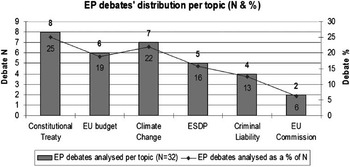
To test the hypotheses set out in the previous section, we coded 884 speeches from the English language transcripts of 32 of the 84 plenary debates that the 2004–09 Parliament held on six topics. We are well aware that plenary debates are but the public face of a complex deliberative process that is mainly centred on the Parliament's committees. Yet, a glance at our indicators reveals that it is precisely those aspects of the deliberative process that involve the justification of views in public – and to the public – that most interest us.
The six topics were: the Constitutional and Lisbon Treaties; the financial perspective for 2006–12: EU proposals to deal with climate change; the 2009 work programme of the Commission; advances in the European Security and Defence Policy field; and Justice and Home Affairs proposals to co-ordinate criminal liability at the EU level. In choosing high profile topics, we follow the original DQI in adopting a strategy of ‘theoretical sampling’ (Auerbach and Silverstein, Reference Auerbach and Silverstein2003: 92). As Reference Steiner, Bächtiger, Spörndli and SteenbergenSteiner et al. put it, ‘a key selection criterion for the debates is that they should focus on critical decision cases as opposed to minor issues’ (2004: 104). Provided it is possible to avoid making deliberative quality of whole debates the dependent variable – about which more in a moment – a study of important debates avoids what could be a fatal weakness in the random selection of topics. The greater the difference between major and minor debates in number or salience, the greater the risk that a study that includes minor debates in a random sample would report poor discourse quality, even where representatives correctly judge that their own constituents would prefer them to concentrate their deliberative efforts on what they believe to be a few major issues.
So, is there a way to study only major debates without that amounting to sampling on the dependent variable? Yes, there is. The obvious solution is to make the discourse quality of individual speeches the dependent variable. This allows plenty of room for within-case variation. It is possible to demonstrate that each of our hypotheses is wrong – or that they reveal no causal influences at all – using data that scores individual speeches against the indicators of discourse quality set out in the second section. Once, moreover, it is accepted that a focus only on major debates is justified, it is feasible to code all speeches from those debates – 884 in total – thus avoiding any need for sampling of any kind within the cases themselves. As regards generalization of our findings, it is always an open question whether a causal account that fits one Parliament and a specific term will fit others. However, what is at issue here is that a causal mechanism has been identified via earlier research on deliberation and we now have a framework – the EP DQI to check whether those initial causal claims also fit recent experience of the EP. This will allow us to judge whether the EP is theoretically ‘near’ to national parliaments in its discourse quality as well as in the institutional and other factors, which shape that quality.
Of course, a focus only on critical cases could conceivably narrow things down to the point at which the cases allow for little possibility of variation in independent variables. However, our case selection avoids that difficulty too. Our six topics cover instances where the 2004–09 Parliament deliberated with or without Co-decision, and in the shadow of either unanimous or majority decision-making by member states. The selection of topics is also likely to bring out differences in how far MEPs justify their positions with reference to national, European, or global conceptions of the common good. Thus debates about the old pillars 2 and 3 might be expected to produce an ‘inter-governmental’ style of justification with reference to ‘national interests’, while debates on the Commission's work programme and on the budget might plausibly produce a greater focus on shared justifications for acting together at the European level. For their part debates on climate change, legislation might focus more global common conceptions of the common good. Moreover, debates on European Security and Defence Policy (ESDP) and the Union budget focus on strategic, economic, and security interests, while the constitutional treaty, climate change, and criminal liability topics are considered as value laden and rights oriented. Likewise, the debates are likely to produce different levels of issue polarization. The six cases vary in their distributive implications. Climate change legislation perhaps approximates most closely to pure regulatory ideals where it should at least be theoretically possible to identify pareto-improving solutions. The budget, in contrast, as well as some of the constitutional issues, contain more scope for zero-sum disagreements, while the ESDP and questions of criminal liability are all potentially re-allocative of political or ethical values (Figure 2).
Selected European Parliament (EP) debate topics. EU = European Union; ESDP = European Spatial Development Perspective

Measures and method
To measure the quality of discursive politics in the EP we have, as seen, developed an updated ‘Discourse Quality Index’ (Steenbergen et al., Reference Steenbergen, Bächtiger, Spörndli and Steiner2003) the ‘EP DQI’, with six indicators that comprise: 1. Respect and Recognition (a) for other participants in plenary debates and (b) for other arguments employed in such debates (Do MEPs degrade, ignore, treat neutrally or explicitly respect (a) their interlocutors and (b) their arguments?), 2. Justification level (Do MEPs offer no reasons, one reason or two reasons for positions taken?), 3. Justification completeness (How far justifications are complete in their content advancing interests, values and rights?), 4. Justification inclusiveness (How far justifications are inclusive in their addressees promoting a national, European or global common good?), 5. Justification consequentiality (Do MEPs give or demand an account in their speeches?). Indicators (1) and (2) are used in the original DQI, (3) and (5) are indicators of our own which go beyond the original DQI, while finally indicator (4) builds upon an earlier DQI indicator but refines and extends it. It should be noted that in a series of tests reported in Appendix 3, we demonstrated excellent inter-coder reliability on the EP DQI ranging from 0.861 for justification completeness to 0.902 for accountability, while overall across the 216 judgements made on a single debate, the authors acting as two independent coders agreed 90.3% of the time. Similarly, Cohen's kappa, which controls for inter-coder agreements by chance, ranges from 0.767 for justification completeness to 0.957 for respect toward other arguments indicating substantial reliability. An example of the coding decisions regarding the various EP DQI indicators across five distinct EP debate topics is provided for in Appendix 4.
In the ensuing empirical analysis, the different EP DQI dimensions are assessed individually – except for the respect and recognition items – since the six indicators are weakly correlated and do not satisfy the criterion of scale homogeneity. For the respect and recognition category, we use a combined index that ranges from low (0) to medium (1) and finally high respect (2). It adds together two dichotomous indicators we had initially constructed for the respect and recognition variables, where 0 indicated no respect and/or no reference and 1 denoted implicit and/or explicit respect to (a) other MEPs and (b) other arguments. Besides overall respect, justification level is employed as an ordinal variable ranging from low (0 – no justification) to medium (1 – inferior and qualified) and finally highly justified MEP statements (2 – sophisticated justification). Justification completeness and inclusiveness on the other hand, are nominal indicators constituting the scope conditions rather than the richness of parliamentary justification. Completeness in particular measures neutral (0), interest specific (1), value laden (2), and rights based (3) utterances in MEPs justifications, while inclusiveness assesses how comprehensive are MEPs in the addressees of their justifications by being neutral (0) or evoking a national (1 – my country, my country and other member states), European (2), and a global (3) common good. The consequentiality of justification is finally a dichotomous variable measuring MEPs reluctance (0) or willingness (1) to give and/or demand an account for the utterances and actions of themselves and/or those of their colleagues.
The predictors in our analysis in turn, comprise the institutional, speaker, and issue characteristics set out in the hypotheses section. We specify issue polarization as an ordinal variable. Using VoteWatch data on the percentage of MEPs who voted against the majority across our six debate topics, we assign a value of 2 to the more contentious issues (EU budget and Climate change), 1 to those that display medium level polarization (the Lisbon treaty and ESDP), and 0 to more consensual topics of the Commission work programme and criminal liability. On the basis of pre-2009 arrangements, questions requiring unanimous agreement of member states are measured through a dummy variable. Thus, a value of 1 is assigned to debates on the Lisbon Treaty, ESDP, criminal liability and the EU budget, and a value of 0 to the rest. Co-decision is similarly a dichotomous indicator assuming the value 1 for climate change and the EU budget and 0 otherwise.
Moving from systemic to individual institutional factors, we have built a nominal variable to capture the quality of deliberation amongst MEPs who come from Member States with consensus rather than majoritarian political system. Following Lijphart (Reference Lijphart1999), we distinguish between those from majoritarian systems that assume the value 0 and comprise the United Kingdom, Greece, Portugal, Spain, Ireland, France, and Malta and those from consensus systems that assume the value 2 and comprise the remaining nine member states out of the ‘old’ fifteen plus Cyprus. The 10 Central and Eastern European Countries (CEECs) are assigned the value 1 as a separate category in between these two extremes following Spinner (Reference Spinner2007) who argues that while the Central and Eastern Europe (CEE) democracies strongly resemble Lijphart's consensus type of democracy in their institutional set-up, it is far from clear that CEE elites have developed a similarly consensual political culture compared with their West European counterparts.
A dichotomous distinction is finally drawn between MEPs from groups that vote with the majority vs. those in the minority. Thus, MEPs from the EPP, PES, and ALDE are coded as 0 and those from the Union for a Europe of Nations (UEN), Greens, European Unitary Left–Nordin Green Left (EUL–NGL), and Independence/Democracy Group (ID) as 1.
To capture possible gender differences in the discursive quality of EP debates, male MEPs are assigned the value 0 and female ones the value 1. Variations in speakers’ socialization are similarly assessed via nationality. We distinguish between MEPs that originate from the ‘old’ 15 member countries and take the value 1 and those coming from the 12 ‘new entrants’ assuming the value 0. A detailed description of the original EP DQI indicators and the predictors can be found in Appendix 1.
To measure the quality of deliberation in the EP and estimate in turn the factors that affect it we take two analytical steps. First, we simply report our assessment of what was the quality of deliberation as measured by our indicators in the EP as a whole and across the six selected debate topics (Part A). Second, we assess how far our hypotheses explain variations in the quality of supranational deliberation using frequency distributions (Part B). Last but not least, we test whether our findings are statistically significant using a series of non-parametric tests depending on the measurement levels of the dependent and the independent variables. In particular, we employ a Kruskal–Wallis test for our ordinal dependent indicators that is the non-parametric version of Analysis of Varience, and a Chi-square test accompanied by a Cramer's V-value for the nominal ones (see results in Appendix 2). We refrain from using advanced parametric methods that assume an interval level dependent variable since the EP discourse quality indicators do not meet so strong an assumption. In addition, non-parametric methods are ‘distribution free’ as they do not rely on the known distribution characteristics of a sample's population (e.g. the mean, standard deviation, normality) and thereby match the characteristics of typological sampling used in deliberation since ‘it is difficult to construe what a population of debates is’, as Steiner et al. (Reference Steiner, Bächtiger, Spörndli and Steenbergen2004) point out. The idea behind such testing is to assess whether a predictor exerts a systematic effect on the quality of the specific EP deliberation, not so much to generalize our results to the universe of all deliberations, for generalization can be ‘unimportant’ in case studies as McKeown contends (Reference McKeown1999: 184). If we were to find that the theory behind EP DQI does not hold true for these EP debates this would cast doubt on the theory regardless of the fact that these cases do not constitute a random sample.
Results
Part A: Discourse quality
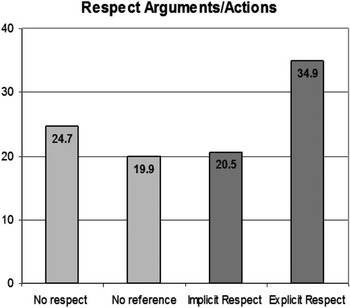
The figures presented in this section show how the debates we studied rate against each of our indicators of discourse quality. They broadly indicate a high quality of deliberation, comparable to that recorded in studies of national parliamentary systems (Bächtiger and Steenbergen, Reference Bächtiger and Steenbergen2004). The respect and recognition levels to begin with, are very high, slightly surpassing in magnitude those recorded by the original DQI applied to a linguistic debate in the Swiss parliament (Bächtiger et al., Reference Bächtiger, Rosenberg, Pedrini, Ryser, Patterson and Steenbergen2009: 6). More than 50% of coded speeches showed evidence of respect to other speakers (Figure 3) and their arguments or actions (Figure 4). Only 16% showed disrespect to other speakers and only 25% towards their arguments or actions. Although, this is far above the impressive 5% registered in the discussion on Swiss linguistic policies, it should be borne in mind that the Swiss language bill is a topic of lower salience than the majority of the EP debates included in the present analysis, a point confirmed by Bächtiger et al. when mentioning that disrespect grows to 20% in more polarized debate issues in Switzerland.
Respect and Recognition Level 1.

Respect and Recognition Level 2.

As for levels of justification, a high proportion of speeches included one or even two justifications that explicitly spelled out reasons for positions taken. In this sense ‘supranational parliamentary deliberation’ compares well with national MPs in competitive systems, such as the British and the German parliamentarians analysed by Steiner et al. (Reference Steiner, Bächtiger, Spörndli and Steenbergen2004: 112, 115). However, it compares less well with consensual systems like Switzerland where qualified and sophisticated levels of justification reach an impressive level of 80%. Still, in comparison with the Swiss Parliament MEPs, arguably, operate in an even more complicated environment, where diversity of language, political culture, and national democracies of origin are even more constraining of deliberation. Given that the EP operates in 23 languages, MEPs might be expected simply to state their positions in the limited time available to them without always offering detailed reasons that might get lost in translation. As it happens, remarkably few speeches offer no justification at all (9.6%). In that regard, the EP compares favourably to national consensual systems (Figure 5).
Justification Level.

Turning now to the ‘completeness’ and ‘inclusiveness’ of EU-wide justifications – two elements that go beyond the original DQI – we found that 72% of speakers justified their arguments by some reference to shared interests, rights, or values. Of those, 44% of the speakers advanced utility-oriented justifications. It does not, however, follow that deliberations in the EP are mainly based on appeals to ‘national interests’ as might be expected where representatives mostly see themselves as ‘delegated’ from the national level to represent considerations relevant only to their own member states within a functional scheme of co-operation that does not primarily concern itself with the shared concepts of values and rights constitutive of a political community. Quite apart from the obvious possibility that interest-based justifications may also be transnational in nature, utilitarian arguments have no monopoly on deliberation in the EP. Value-laden justifications accounted for 17% of our sample and rights-based justifications for a further 12%. MEPs would seem to switch between those patterns of justification that are most distinctive of delegated democracy (member state interests), supranational democracy (the shared values of an imagined multi-national political community), and cosmopolitan democracy (the rights of all affected persons). Thus, the complexity of the Union's ‘multi-level’ and ‘polycentric’ polity would seem to be reflected in variation in how far different representatives justify their arguments by appealing to interests, values, or rights. Even if few individual speakers had the time or inclination to cover all three categories, a range of views from within each category was often cumulatively covered by different speakers during the course of debates (Figures 6 and 7).
Completeness of Justification.

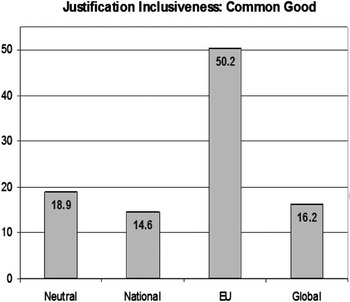
Inclusiveness of Justification.

The distinctive challenges of deliberating in the supranational parliament of a multi-level ‘polycentric’ polity are also reflected in the inclusiveness of MEPs’ justifications. Almost 80% of the reasons put forward by speakers made some reference to a concept of a ‘common good’, whether national, European, or global. Of those, 50% referred to European citizens. Country-specific and global conceptions of a ‘common good’ only featured in around 15% of speeches apiece. A combination of the high frequency with which MEPs appeal to an EU-wide conception of a ‘common good’ with their common tendency to justify arguments by appeals to shared interests would suggest that MEPs mix deliberative frames typical of a functional system scheme of co-operation with those that are more ‘federal’ in the sense that they claim to identify the common good of a ‘European people’ brought together in a shared polity. Only marginally, however, does the EP engage in a fully cosmopolitan deliberation of global human rights or of different conceptions of a global common good.
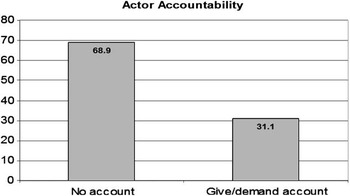
Accountability, finally, is the weakest link in our indicators of the discursive qualities of the EP. Only 31% of the speeches in our sample gave or demanded an account for justifications advanced. This confirms the growing scholarly concern that the shift from nationally inspired policy-making to a transnational and polycentric mode of European governance with multiple stakeholders is not being matched by proper accountability regimes (Bovens, Reference Bovens2007). Summing up, deliberation in the EP shows high levels of respect and justification, but a certain reticence when it comes to demanding fuller accounts of justifications offered (Figure 8).
Level of Accountability.

Part B: Explanations
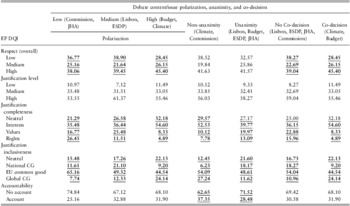
Turning to the institutional and issue attributes of the selected debates, we test our hypotheses on unanimous voting and co-decision debate topics as well as on issue polarization. The empirical results in Table 1 confirm the evidence of high-quality EP discourse presented in part A but lend mixed support to our theoretical expectations. Issue polarization in particular (Hypothesis 5), does not preordain poor deliberation in the supranational arena. When policy preferences diverge, there are no substantive and significant differences in the levels of justification and accountability, which even tend to increase as the level of polarization increases. Moreover, highly respectful utterances are more common when issue polarization is medium and high (39.4% and 45.4%) than when it is low (38.1%). Disrespect levels, on the other hand, that do not differ when moving from low to medium polarization, decrease the more actors’ preferences move away. Such significant differences indicate that the danger of arguments or personalities being trivialized in the EP is not analogous to the degree of polarization. Furthermore, while supranational representatives focus more on interests, when the political stakes are high rather than low (54.6% vs. 35.5%), it should still be noted that as MEPs move from low to medium polarization topics, shared EU values gain substantially, moving from 16.7% to 25.4%. As ideological distances increase over the distributive implications of the Lisbon treaty, MEPs insist on bringing up values showing that the latter serve a uniting rather than dividing purpose. Last but not least, justifications are more focused on a global conception of the common good when issue polarization is medium and high rather than low (12.3% and 24.1% vs. 7.7%).
The EP DQI across debate-specific characteristics

EP = European Parliament; DQI = Discourse Quality Index; ESDP = European Spatial Development Perspective; JHA = Justice and Home Affairs; EU = European Union; CG = Common Good.
Note: The bold and/or underlined differences between groups are highly significant (P < 0.001), and the plain ones insignificant.
These findings do not essentially disconfirm the results obtained by Steiner et al. (Reference Steiner, Bächtiger, Spörndli and Steenbergen2004) in the original DQI. While the latter report considerable differences in discourse quality between less polarized and highly polarized issues (Steiner et al., Reference Steiner, Bächtiger, Spörndli and Steenbergen2004: 131), they point out that institutional arrangements can help overcome the difficulty. Consensual, rather than competitive, institutions make it easier to combine high-quality discourse with divisive topics (Steiner et al., Reference Steiner, Bächtiger, Spörndli and Steenbergen2004: 135). In this respect, the capacity of the EP to sustain high discourse quality even where issues are polarized, fits the view that it benefits from a wider institutional framework created by the Union's consensual decision-rules and the oversized majorities they require (Hix and Lord, Reference Hix and Lord1997: 18).
The role of the veto power in European parliamentary politics in turn, yields mixed results that do not fully corroborate our expectations. The pressure to find unanimous agreement in the Council does not seem to affect the quality of deliberation in the Parliament, since both respect and justification levels either increase slightly or remain unchanged when veto power is strong, producing statistically unreliable scores. In studies of national parliaments, Bächtiger and Hangartner (Reference Bächtiger and Hangartner2010: 622) likewise find that veto powers have an insignificant impact on respect, while Steiner et al. (Reference Steiner, Bächtiger, Spörndli and Steenbergen2004: 119) demonstrate they have no statistically significant effects on levels of justification. The only effect of unanimity is on the scope of MEPs’ justifications. Yet, here its effects would seem to pull in different directions. On the one hand, unanimity actually makes it more likely that MEPs will use arguments that go beyond statements of utilitarian interest to explore shared EU norms (19.9% vs. 10.1%) and global rights (13% vs. 7.7%) so as to achieve deliberative agreement on fundamentals. Matters are, however, the other way round when it comes to the frequency with which MEPs justify themselves with reference to national, European, or global conceptions of the common good. MEPs are more inclined to refer to a more encompassing European and global common good when the veto power is weak (81% approximately) rather than when it is strong (60%) indicating that the deliberative process gets disrupted under unanimity. Similarly, accountability tends to collapse under the unanimity deadlock. When veto power is strong accountability dynamics are adversely affected (28.8% vs. 37.3%).
An entirely different picture emerges when the veto power of the EP is taken into account in support of our second hypothesis. The results obtained indicate a greater quality of supranational deliberation when the Parliament acts as a co-legislator with the Council. Co-decision in the EP leads to significantly higher respect levels. In fact, the gap between the highest and lowest respect levels grows wider among the topics that fall within the scope of the co-decision procedure (16.95%) than among those that are not subject to co-decision, where disrespect is almost equated with respect. Justification on the other hand, remains unaffected in terms of degree as well as in its consequentiality, but not in its scope conditions. Co-decision leads to greater inclusiveness in justification. Where MEPs have to co-decide with the Council references to European or global common conceptions of the ‘common good’ reach an impressive 68.7%. In contrast, reference to the ‘good’ of specific member states is double where co-decision is not used (18.3% vs. 9.2%). Contrary to our expectations, though, justifications are more utilitarian (54.6% vs. 36.1%), less concerned with shared EU values (8.3% vs. 22.9%) and less concerned with global rights (4.9% vs. 16%) where co-decision is used.
Amongst other institutional factors, MEPs from consensual democratic systems display a small but systematic increase in their quality of deliberation compared with their colleagues from majoritarian cultures. CEECs are closer to the latter. Thus, lower levels of deliberation would seem to result where institutions with some consociational features are not supported by a consensus political culture. In general, differences in how far MEPs from majoritarian and consensual political cultures show medium and high respect levels are minimal (66.2% vs. 68.1%) but statistically significant. Much the same goes for variation in the level of justification, where extensive reason giving ranges between 57.7% and 61.2%, respectively. Similarly, MEPs from the two different political cultures vary significantly but just by 1.5% in their account claiming and giving tendency. It is only the inclusiveness in MEPs’ addressees that varies significantly and substantially between the two kinds of political system. While they both appeal to an EU centred (50.4% vs. 51.2%) and partially globally oriented common good (14.6% vs. 17.8%), appeals to ‘national interests’ are twice as high among competitive majoritarian systems. The impact of national political affiliation on the completeness of MEPs’ arguments is in turn largely insignificant.
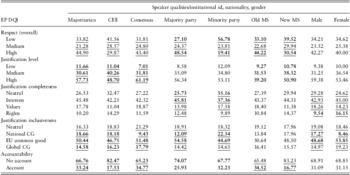
The level of partisanship in the EP makes a significant and sizeable difference. Discourse quality is systematically higher amongst MEPs from the larger groups, which are more likely than the smaller groups to take part in majority formation. Just as Hix et al. (Reference Hix, Kreppel and Noury2003: 326–327) report strategic differences in how large and small party groups co-operate and compete in votes, we detect evidence of differences in how they deliberate in plenaries. Respect levels vary significantly. The gap between the highest and lowest levels of respect amongst MEPs less likely to vote with the majority is much higher (37.4%) than among those who form the majority (21.4%). MEPs who usually vote in the minority are much less likely to show high levels of respect (19.5% vs. 48.5% for their majority voting colleagues) and much more likely to record disrespectful utterances (56.7% compared with 27.1% amongst those who form the majority in voting; Table 2).
The EP DQI across speaker-specific characteristics

EP = European Parliament; DQI = Discourse Quality Index; CEE = Central and Eastern Europe; MS = Member State; EU = European Union.
Note: The bold and/or underlined differences between groups are highly significant (P < 0.001), those in bold are marginally insignificant (P = 0.06) and the plain ones insignificant.
Justification levels on the other hand vary little between the three biggest EP groups (PES, EPP, and ALDE) and the smaller minority forming parties (UEN, Green, EUL, and ID), but are not statistically robust. In addition, political contestation has a significant negative effect on the scope conditions of justification. MEPs who are more likely to vote with the minority are also more likely to offer only neutral justifications, which make no claims about interests, values, or rights (35.2% vs. 25.7%). They are also more likely than those who vote with the majority to appeal to national (22.3% vs. 12%) rather than European conceptions of the common good (54.6% vs. 44.7%). As we had expected, MEPs from less influential groups are, however, much more likely to demand accounts. But the effect is not statistically robust.
In line with our sixth hypothesis, socialization has a positive effect on the quality of supranational deliberation. Representatives from the original 15 EU countries display higher deliberative quality than their colleagues from the 10 new member states. Our results indicate marked differences between the two groups in the respect levels. Among the new entrants disrespectful utterances surpass in magnitude highly respectful references by 9%, while the exact opposite trend is observed among the ‘old’ 15 where respect (44.2%) comfortably prevails over contempt (33.1%). High justification levels are similarly far more common among MEPs belonging to the socialized group of member states (59.2%) than among the newcomers (50.9%). We fail, however, to obtain statistically significant differences on the scope conditions of justification. How complete MEPs are in their content and how inclusive in the addressees of their assertions does not seem to be affected by socialization measured by differences between MEPs from new and old member states. The consequentiality of justification, on the other hand, is strongly significant at the 0.001 level and lends full support to our hypothesis. Account claiming and giving is an exercise clearly preferred by more experienced MEPs (36.5%) than those that have just entered supranational deliberative politics (16.8%).
Gender differences in supranational deliberation finally are very much in line with the original DQI findings running counter to our theoretical expectations. In terms of respect we corroborate Grunenfelder and Bächtiger (Reference Grunenfelder and Bächtiger2007: 18) finding that there is no ‘gendered deliberation’. The respect levels display miniscule differences that are statistically unreliable. Similarly, there are no distinct and robust differences between sexes in justification and accountability. Only in the scope conditions of justification is there some limited room for a feminist approach to deliberation. Women put forward a more encompassing understanding of the common good scoring 53.8% and 19.2% in EU and global common good evocations, respectively, as opposed to the 48.6% and 14.9% of men, who only surpass women in nationalistic considerations (17.2% vs. 8.4%). In terms of justification completeness, however, male and female MEPs do not deliberate that differently since the slight emphasis of men on shared EU values seems to be counterbalanced by a corresponding focus of women on human and civic rights. In this light, gendered deliberation does not affect the supranational parliamentary politics in any other aspect than in terms of inclusiveness in the addressees of MEPs justifications.
Conclusions
This paper has sought to evaluate and explain the quality of deliberation in the EP using a modified version of the DQI. Where we have used similar indicators to the original DQI, deliberation in the EP would seem to compare favourably with that in national legislatures. The one exception is that MEPs give and demand fewer accounts in their speeches. This might indicate that the transfer of policy-making from a national to a transnational mode of governance is not being matched by a demanding accountability apparatus.
However, we also added two indicators to the original DQI designed to evaluate what we have termed the completeness and inclusiveness of justifications. Here we found that justifications in the EP are complete in the sense that they include arguments about values and rights, and not just claims about interests. On the other hand, they are inclusive in so far as they appeal more frequently to EU-wide conceptions of a common good than to national ones. They are not, however, so inclusive that they give much attention to ‘global’ conceptions of the common good. The particular balance that MEPs strike between the deliberation of interests, values, rights and national, European, and global conceptions of the common good has implications for how they understand representation beyond the state, as well as the particularities of the Union's polity itself. Our findings suggest that both functional and federal conceptions feature strongly in MEPs’ deliberations, cosmopolitan conceptions less so.
Our analysis of explanatory factors also produced some conclusions of note. Both the domestic political systems in which MEPs are elected and the EP's own party system would seem to affect deliberative quality. Those MEPs from consensual domestic systems, and those from party groups which are most likely to vote with the majority of the Parliament, perform systematically better across the indicators of deliberative quality on which EP DQI is based. The EU's own institutional rules, on the other hand, only impact on certain aspects of deliberation. Co-decision improves levels of respect and increases the frequency with which actors’ justifications appeal to European and even global conceptions of a common good. The levels of justification and accountability are, however, unaffected by Co-decision, while justifications under Co-decision are even more likely to appeal to interests, as opposed to values and rights. Finally, the quality of deliberation in the Parliament is resilient in the face of unanimous decision-making in the Council. Respect and reason giving are unaffected. References to shared values and global rights even increase. Only the inclusiveness of justifications (i.e. reference to an encompassing common good) and accountability are adversely affected.
Issue polarization influences supranational deliberation but not in the expected direction. The personal characteristics of MEPs, on the other hand, produce mixed results. Gender seems to make little difference, while socialization and experience are important. Deliberative standards amongst experienced MEPs from the ‘old’ 15 EU member states were higher in terms of respect, reason giving, and accountability. In sum, this paper shows that the EP DQI as an extension to the original DQI instrument is a powerful research tool that can be applied to the supranational parliamentary arena. The EP DQI then brings out deliberation as a reality in EU politics rather than a philosophical affair.
Supplementary material
The supplementary material referred to in this article is available online at http://www.journals.cambridge.org/epr
Acknowledgements
We gratefully acknowledge the work of Jörg Steiner et al. in constructing the Discourse Quality Index, which has been such an inspiration to us. We particularly thank André Bächtiger for his comments. We also thank the three anonymous referees who commented so helpfully on this paper, as well as all the participants in seminars to which the paper was presented at ARENA in Oslo and the IEP in Paris.