Introduction
Depressive symptoms occur in 20–40% of patients with coronary heart disease (Allen et al. Reference Allen, Fisher, Kop, Plumhoff, Allen and Fisher2011). Depressive symptoms impair quality of life (Ruo et al. Reference Ruo, Rumsfeld, Hlatky, Liu, Browner and Whooley2003), and are associated with an increased risk for future cardiac events and death (Nicholson et al. Reference Nicholson, Kuper and Hemingway2006; Whooley et al. Reference Whooley, de Jonge, Vittinghoff, Otte, Moos, Carney, Ali, Dowray, Na, Feldman, Schiller and Browner2008). Antidepressants reduce depressive symptoms in coronary heart disease patients (Baumeister et al. Reference Baumeister, Hutter and Bengel2011), and rates of antidepressant use in cardiac patients have risen from less than 5% before 1995 to 10–15% after 2000 (Czarny et al. Reference Czarny, Arthurs, Coffie, Smith, Steele, Ziegelstein and Thombs2011).
Nevertheless, the use of antidepressants in coronary heart disease patients remains a topic of debate. Tricyclic antidepressants (TCA) are not recommended as a first-line treatment for depression in coronary heart disease patients because of their unfavourable side-effect profile (Licht et al. Reference Licht, de Geus, Zitman, Hoogendijk, van Dyck and Penninx2008, Reference Licht, de Geus, van Dyck and Penninx2010, Reference Licht, Penninx and de Geus2012; Kemp et al. Reference Kemp, Quintana, Gray, Felmingham, Brown and Gatt2010). However, they may still be occasionally prescribed, for example because of treatment resistance to other classes of antidepressants, or because of indications other than depression (e.g. pain syndromes). Selective serotonin reuptake inhibitors (SSRI), on the other hand, are regarded relatively safe in coronary heart disease patients and have even been shown to be associated with reduced mortality (Taylor et al. Reference Taylor, Youngblood, Catellier, Veith, Carney, Burg, Kaufmann, Shuster, Mellman, Blumenthal, Krishnan and Jaffe2005). However, other studies have raised doubts regarding the safety of SSRI in coronary heart disease patients (O'Connor et al. Reference O'Connor, Jiang, Kuchibhatla, Mehta, Clary, Cuffe, Christopher, Alexander, Califf and Krishnan2008; Fosbøl et al. Reference Fosbøl, Gislason, Poulsen, Hansen, Folke, Schramm, Olesen, Bretler, Abildstrøm, Sørensen, Hvelplund, Køber and Torp-Pedersen2009; Krantz et al. Reference Krantz, Whittaker, Francis, Rutledge, Johnson, Barrow, McClure, Sheps, York, Cornell, Bittner, Vaccarino, Eteiba, Parashar, Vido and Merz2009).
Therefore, we examined whether the use of TCA and SSRI is associated with mortality in patients with coronary heart disease over a 7-year observational period. We further determined whether a potential association is mediated by autonomic function, assessed as heart rate variability (HRV) and norepinephrine (NE) concentrations.
Method
Participants
Recruitment procedures of the Heart and Soul Study have been previously described (Ruo et al. Reference Ruo, Rumsfeld, Hlatky, Liu, Browner and Whooley2003). The study protocol complied with the Declaration of Helsinki and was approved by the appropriate institutional review boards. All participants provided written informed consent. We used administrative databases to identify out-patients with documented coronary heart disease at two Department of Veterans Affairs medical centres, one university medical centre, and nine public health clinics in the Community Health Network of San Francisco. Patients were eligible to participate if they had at least one of the following: a history of myocardial infarction, angiographic evidence of ⩾50% stenosis in one or more coronary vessels, prior evidence of exercise-induced ischaemia by treadmill or nuclear testing, a history of coronary revascularization, or a diagnosis of coronary heart disease documented by an internist or cardiologist.
A total of 1024 participants were enrolled. All participants completed a baseline examination that included an interview, fasting blood draw, questionnaire, echocardiogram, exercise treadmill test, 24-h ambulatory electrocardiogram and 24-h urine collection. Of the 1024 participants who completed the baseline examination, we were not able to contact four participants (<1%) during the follow-up period, and no information on antidepressant use was available for nine participants (<1%). We further excluded patients who used antidepressants other than TCA or SSRI (n = 55) because of the large heterogeneity of antidepressants within this group. Thus, 956 subjects were available for this analysis.
Antidepressant use
All participants brought their medication bottles to the baseline study appointment, and study personnel recorded all medications including antidepressants. Medications were categorized using Epocrates Rx (USA). We grouped participants in users of TCA, SSRI, and non-users of antidepressants.
Assessment of depressive symptoms
Depressive symptoms were assessed using the nine-item Patient Health Questionnaire (Kroenke et al. Reference Kroenke, Spitzer and Williams2001), a self-report instrument that measures the frequency of depressive symptoms corresponding to the nine Diagnostic and Statistical Manual of Mental Disorders, fourth edition (DSM-IV; APA, 1994) criteria for depression. The Patient Health Questionnaire has demonstrated excellent validity when compared with a structured diagnostic interview for depression in patients with coronary heart disease (McManus et al. Reference McManus, Pipkin and Whooley2005).
Assessment of HRV
Three-channel 24-h ambulatory Holter electrocardiography was used to assess HRV (Gehi et al. Reference Gehi, Mangano, Pipkin, Browner and Whooley2005). Tapes were scanned at 500 times real time, and electrocardiography data were digitized at a sampling frequency of 128 Hz. Computer software (General Electric Medical System Software for Holter Analysis; GE Healthcare, USA) was used to detect and label each QRS complex using beats that had normal morphological characteristics. An independent and blinded reviewer processed all Holter electrocardiograms and modified any inappropriate computer labels. The standard deviation of NN intervals (SDNN) and the root-mean square of differences between adjacent normal RR intervals (RMSSD) were calculated as time-domain measures of HRV. Frequency-domain parameters of HRV (high-frequency power and low-frequency power) were obtained by power spectral analysis, using a fast Fourier transformation model.
Assessment of 24-h urinary NE excretion
Details regarding the analysis of 24-h urinary NE excretion have been described elsewhere in greater detail (Otte et al. Reference Otte, Neylan, Pipkin, Browner and Whooley2005). In brief, the participants were instructed to collect all urine for 24 h between the study appointment and the time when a researcher visited their home the next day. Urinary NE was measured with gas chromatography–mass spectrometry at ARUP Laboratories (USA). Since the detection limit was 1.0 mg/dl for NE, levels for participants whose excretion was below this detection limit were coded as 1.0 mg/dl. The inter-assay coefficient of variance was <10%, and the intra-assay coefficient of variance was <8%.
Assessment of plasma NE levels
Blood samples were drawn from an intravenous catheter (21 g butterfly), mostly placed in the antecubital fossa. A blood pressure cuff inflated to a maximum pressure of 40 mmHg was used as a tourniquet. After placement of the catheter, the blood pressure cuff was deflated, and subjects rested for 30 min in a quiet windowless room with dimmed lights before blood was drawn. Plasma NE was measured with chromatography at LSM Laboratories (Göttingen, Germany). The detection limit was 5 pg/ml. The inter-assay coefficient of variance and the intra-assay coefficient of variance both were <2.5%.
Plasma NE levels are known to vary depending on situational factors and time of day, and 24-h urinary measurement of NE may thus more accurately reflect overall sympathetic activity during the course of the day. On the other hand, urinary catecholamine levels are considerably influenced by renal metabolism, and plasma NE levels may thus more accurately reflect actual sympathetic activity in the vascular system (Kennedy et al. Reference Kennedy, Rao, Botiglieri, Sharma, Lillie, Ziegler and O'Connor2005).
Assessment of mortality
Between the baseline examination and the last day of follow-up, we conducted annual telephone follow-up interviews with participants (or their proxy). If death of the participant was reported, death certificates and coroners' reports were retrieved and reviewed by two independent blinded adjudicators.
Potential confounding or moderating variables
Age, sex and medical history were determined by self-report questionnaire. We measured height and weight, and calculated body mass index. Smoking and alcohol use were determined by self-report questionnaire. Left ventricular ejection fraction was determined by resting echocardiography. Exercise capacity was measured with a treadmill test according to a standard Bruce protocol and expressed as the total number of metabolic equivalent tasks achieved. To assess medication adherence, we asked, ‘In the past month, how often did you take your medications as the doctor prescribed?’ Possible responses were all of the time (100%), nearly all of the time (90%), most of the time (75%), about half the time (50%), or less than half the time (<50%). We defined medication non-adherence as taking prescribed medications 75% or less of the time (Gehi et al. Reference Gehi, Ali, Na and Whooley2007).
Statistical analysis
Statistical analyses were performed using SAS 9.2 for Windows (SAS Institute, Inc., USA). Baseline differences in characteristics of TCA users, SSRI users and non-users of antidepressants were compared using Kruskal–Wallis tests and χ 2 tests. We calculated odds ratios (ORs) for being in the lowest tertile of SDNN, and for being in the highest tertile of plasma and urinary NE, each for users of TCA and SSRI compared with non-users of antidepressants. HRV values were log-transformed before the analysis to achieve normal distribution.
We estimated the risk of death within the observational period associated with the use of TCA or SSRI using Cox proportional hazards models. Non-users of antidepressants served as the reference group. Both unadjusted and adjusted analyses were performed, with variables that differed between the three groups used as covariates. To estimate whether a potential association with increased mortality was mediated by autonomic dysfunction, we additionally adjusted for baseline differences in plasma NE and SDNN.
Results
Patients
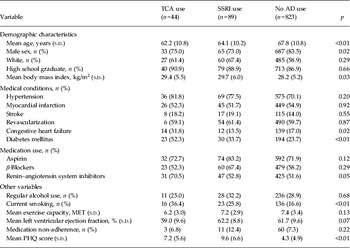
Of the 956 patients, 44 (4.6%) used TCA, 89 (9.3%) used SSRI, and 823 (86.1%) did not use antidepressants. Those participants taking a TCA and any other antidepressant were considered TCA users (n = 12). Those participants taking an SSRI and any other antidepressant but TCA were considered SSRI users (n = 21). Characteristics of the three groups are shown in Table 1. Significant baseline differences were observed with respect to age, sex, body mass index, smoking status, depressive symptoms score, use of renin–angiotensin system inhibitors, and presence of heart failure and diabetes mellitus.
Demographic and clinical variables according to AD use

AD, Antidepressants; TCA, tricyclic antidepressants; SSRI, selective serotonin reuptake inhibitors; s.d., standard deviation; MET, metabolic equivalent tasks; PHQ, Patient Health Questionnaire.
Baseline HRV
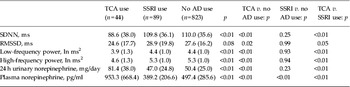
TCA users had a significantly lower SDNN, low-frequency power and high-frequency power at baseline compared with controls (Table 2). SSRI users did not significantly differ from controls in any HRV measure. For all further analyses, we used SDNN as an index of HRV because group differences for SDNN were the most pronounced, and previous studies had shown that SDNN predicted mortality in coronary heart disease patients (Janszky et al. Reference Janszky, Ericson, Mittleman, Wamala, Al-Khalili, Schenck-Gustafsson and Orth-Gomer2004).
Heart rate variability, and urinary and plasma norepinephrine according to AD use

Data are given as mean (standard deviation).
AD, Antidepressants; TCA, tricyclic antidepressants; SSRI, selective serotonin reuptake inhibitors; SDNN, standard deviation of NN intervals; RMSSD, root-mean square of differences between adjacent normal RR intervals.
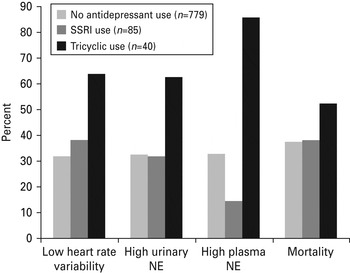
TCA users had a greater than 1.5-fold increased risk of being in the lowest tertile of SDNN [OR = 1.56, 95% confidence interval (CI) 1.24–1.97, p = 0.0002; Fig. 1]. Adjustment for age, sex, smoking, body mass index, diabetes, congestive heart failure, use of renin–angiotensin system inhibitors and depressive symptoms did not change the results (OR = 1.50, 95% CI 1.17–1.90, p = 0.001). SSRI use was not associated with low SDNN (OR = 1.07, 95% CI 0.95–1.21, p = 0.24; Fig. 1).
Proportion of patients in the lowest tertile of heart rate variability, highest tertile of 24-h urinary norepinephrine (NE), highest tertile of plasma NE, and mortality, according to antidepressant use: no use; selective serotonin reuptake inhibitor use; or tricyclic antidepressant use.

Baseline 24-h urinary and plasma NE
TCA users had significantly higher urinary and plasma NE levels compared with controls (Table 2). TCA users had a greater than 1.5-fold increased risk for being in the highest tertile of 24-h urinary NE (OR = 1.52, 95% CI 1.22–1.89, p < 0.001; Fig. 1) and a greater than 2-fold increased risk for being in the highest tertile of plasma NE (OR = 2.31, 95% CI 1.68–3.19, p < 0.001; Fig. 1). Adjustment for age, sex, smoking, body mass index, diabetes, congestive heart failure, use of renin–angiotensin system inhibitors and depressive symptoms did not change the results (OR = 1.50, 95% CI 1.19–1.89, p < 0.001 for urinary NE; and OR = 2.49, 95% CI 1.78–3.49, p < 0.001 for plasma NE).
SSRI users did not significantly differ from controls with respect to urinary NE, and they had significantly lower plasma NE levels compared with controls (Table 2). SSRI use was not associated with high urinary NE (OR = 0.99, 95% CI 0.88–1.12, p = 0.91; Fig. 1), but with a decreased risk of having high plasma NE (OR = 0.77, 95% CI 0.65–0.93, p = 0.005; Fig. 1). Again, adjustment for covariates did not change the results (OR = 0.99, 95% CI 0.85–1.11, p = 0.67 for urinary NE; and OR = 0.78, 95% CI 0.65–0.93, p = 0.005 for plasma NE).
We also compared HRV and NE levels between patients on antidepressant monotherapy and patients on combination therapy (TCA and any other antidepressant; SSRI and any other antidepressant except for TCA). There were no significant differences with respect to autonomic parameters between treatment groups except for even higher plasma NE levels in patients on TCA monotherapy compared with combination therapy [1111.3 (s.d. = 735.7) v. 608.7 (s.d. = 288.7) pg/ml, p < 0.01].
Mortality
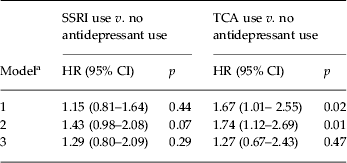
At the end of the mean observational period of 7.2 (s.d. = 2.6) years, 23 patients (52.3%) in the TCA group, 34 patients (38.2%) in the SSRI group and 306 patients (37.3%) in the control group had died. TCA use was associated with increased mortality compared with controls (Table 3). Adjustment for age, sex, smoking, body mass index, diabetes, congestive heart failure, use of renin–angiotensin system inhibitors and depressive symptoms did not change the results. Additional adjustment for SDNN and plasma NE strongly reduced the association between TCA use and mortality to non-significance (Table 3). In the final adjusted model, age [adjusted hazard ratio (HR) = 1.05, 95% CI 1.04–1.07, p < 0.001], smoking (adjusted HR = 1.67, 95% CI 1.07–2.50, p = 0.02), diabetes mellitus (adjusted HR = 1.68, 95% CI 1.23–2.28, p = 0.001), congestive heart failure (adjusted HR 1.51, 95% CI 1.08–2.10, p = 0.01), SDNN (adjusted HR = 0.99, 95% CI 0.99–0.99, p = 0.001) and plasma NE (adjusted HR = 1.001, 95% CI 1.00–1.001, p = 0.03) were significantly associated with mortality.
Association between antidepressant use and mortality

SSRI, Selective serotonin reuptake inhibitors; TCA, tricyclic antidepressants; HR, hazard ratio; CI, confidence interval.
a Model 1 = unadjusted; model 2 = adjusted for age, sex, body mass index, diabetes, congestive heart failure, use of renin–angiotensin system inhibitors and depressive symptoms; model 3 = additionally adjusted for heart rate variability and plasma norepinephrine.
In contrast to TCA, SSRI use was not associated with increased mortality compared with controls in unadjusted analysis (Table 3). After adjustment for age, sex, smoking, body mass index, diabetes, congestive heart failure, use of renin–angiotensin system inhibitors and depressive symptoms, the HR increased but still failed to reach significance.
Discussion
We found that patients with coronary heart disease treated with TCA had a 70% greater risk of mortality during 7 years of follow-up, compared with coronary heart disease patients not using antidepressants. This association remained strong even after adjusting for potentially confounding variables including depressive symptoms. The association between TCA use and mortality was partially mediated by autonomic dysfunction, as indexed by low HRV and high NE concentrations. In contrast, autonomic function was not impaired in SSRI users, and plasma NE concentrations were even lower compared with non-users of antidepressants. However, our data do not suggest a beneficial effect of SSRI on mortality.
Several studies have previously examined the association of antidepressant use and cardiovascular outcomes. However, most studies did not examine whether the association between antidepressant use and cardiovascular outcomes was independent of depressive symptoms, which per se are associated with worse cardiovascular outcome (Nicholson et al. Reference Nicholson, Kuper and Hemingway2006; Whooley et al. Reference Whooley, de Jonge, Vittinghoff, Otte, Moos, Carney, Ali, Dowray, Na, Feldman, Schiller and Browner2008). Furthermore, many previous studies were not able to differentiate between different classes of antidepressants. Thus, it remained unclear whether an association was driven by use of TCA, SSRI, or use of other antidepressants. Finally, the potential mechanisms linking antidepressant use and cardiovascular outcomes have not been evaluated.
To our knowledge, our study is the first to examine the effects of antidepressants on mortality in patients with stable coronary heart disease. We were able to differentiate effects of TCA versus SSRI while controlling for depression and other potentially confounding variables. Additionally, by implementing measures of autonomic function, we evaluated possible mechanisms linking antidepressant use and mortality.
In line with our results, several studies have found that TCA use, but not SSRI use, was associated with a higher risk of incident cardiovascular disease (Hamer et al. Reference Hamer, Batty, Seldenrijk and Kivimaki2011), myocardial infarction (Cohen et al. Reference Cohen, Gibson and Alderman2000) and sudden cardiac death (Ray et al. Reference Ray, Meredith, Thapa, Hall and Murray2004; Honkola et al. Reference Honkola, Hookana, Malinen, Kaikkonen, Junttila, Isohanni, Kortelainen and Huikuri2012). However, none of these studies controlled for the effects of depression.
Among studies examining the association between antidepressants as a group and cardiovascular outcomes, two studies (Tata et al. Reference Tata, West, Smith, Farrington, Card, Smeeth and Hubbard2005; Fosbøl et al. Reference Fosbøl, Gislason, Poulsen, Hansen, Folke, Schramm, Olesen, Bretler, Abildstrøm, Sørensen, Hvelplund, Køber and Torp-Pedersen2009) observed increased risks of myocardial infarction and mortality in SSRI and TCA users. Again, both studies did not control for depression.
O'Connor et al. (Reference O'Connor, Jiang, Kuchibhatla, Mehta, Clary, Cuffe, Christopher, Alexander, Califf and Krishnan2008) found an association of antidepressant use and increased risk of mortality in heart failure patients, but after controlling for depression this association was no longer significant. Similarly, Sherwood et al. (Reference Sherwood, Blumenthal, Trivedi, Johnson, O'Connor, Adams, Dupree, Waugh, Bensimhon, Gaulden, Christenson, Koch and Hinderliter2007) found an increased risk of mortality associated with antidepressant use in heart failure patients. However, results were not reported according to class of antidepressant. In the Women's Ischemia Syndrome Evaluation (WISE) Study (Krantz et al. Reference Krantz, Whittaker, Francis, Rutledge, Johnson, Barrow, McClure, Sheps, York, Cornell, Bittner, Vaccarino, Eteiba, Parashar, Vido and Merz2009), only the combined use of antidepressants and anxiolytics (but not antidepressants alone) was associated with increased mortality after adjustment for covariates including baseline psychopathology. The Nurses' Health Study suggested an increased risk of sudden cardiac death but not other cardiovascular events in women without coronary heart disease using antidepressants (Whang et al. Reference Whang, Kubzansky, Kawachi, Rexrode, Kroenke, Glynn, Garan and Albert2009). Again, effects were not reported separately for SSRI and ‘other antidepressants’. In the Women's Health Initiative Study (Smoller et al. Reference Smoller, Allison, Cochrane, Curb, Perlis, Robinson, Rosal, Wenger and Wassertheil-Smoller2009), both TCA and SSRI use were associated with an increased risk of all-cause mortality both before and after adjustment for depressive symptoms.
There are also studies specifically examining SSRI use and cardiovascular outcomes. One study found an increased mortality in patients taking SSRI before coronary artery bypass surgery (Xiong et al. Reference Xiong, Jiang, Clare, Shaw, Smith, Mahaffey, O'Connor, Krishnan and Newby2006). However, this study did not control for depressive symptoms. In contrast, numerous randomized controlled trials showed a favourable safety profile of SSRI in coronary heart disease patients. The Sertraline Antidepressant Heart Attack Randomized Trial (SADHART) did not find differences in cardiac safety between sertraline and placebo during 24 weeks in patients after an acute coronary event. The study even found a numerically but non-significantly lower rate of severe cardiovascular events in the sertraline group (Glassman et al. Reference Glassman, O'Connor, Califf, Swedberg, Schwartz, Bigger, Krishnan, van Zyl, Swenson, Finkel, Landau, Shapiro, Pepine, Mardekian, Harrison, Barton and McLvor2002). In the Canadian Cardiac Randomized Evaluation of Antidepressant and Psychotherapy Efficacy (CREATE) Trial, cardiovascular events were not more frequent in patients receiving citalopram during a 12-week observational period (Lesperance et al. Reference Lesperance, Frasure-Smith, Koszycki, Laliberte, van Zyl, Baker, Swenson, Ghatavi, Abramson, Dorian and Guertin2007). The Enhancing Recovery in Coronary Heart Disease (ENRICHD) Study showed that depressed patients after an acute myocardial infarction who were treated with SSRI even had a lower risk of death or recurrent myocardial infarction within 29 months (Taylor et al. Reference Taylor, Youngblood, Catellier, Veith, Carney, Burg, Kaufmann, Shuster, Mellman, Blumenthal, Krishnan and Jaffe2005). The Understanding the Prognostic Benefits of Exercise and Antidepressant Treatment (UPBEAT) Study found that 4 months of treatment with sertraline was safe and efficacious in reducing depressive symptoms in coronary heart disease patients (Blumenthal et al. Reference Blumenthal, Sherwood, Babyak, Watkins, Smith, Hoffman, O'Hayer, Mabe, Johnson, Doraiswamy, Jiang, Schocken and Hinderliter2012). Finally, the SADHART-CHF (in chronic heart failure) Trial (O'Connor et al. Reference O'Connor, Jiang, Kuchibhatla, Silva, Cuffe, Callwood, Zakhary, Stough, Arias, Rivelli and Krishnan2010) demonstrated the safety of sertraline in patients with heart failure. Additionally, several case–control studies supported the view that SSRI may have moderate protective effects against incident myocardial infarction, possibly because of inhibitory effects on platelet function (Sauer et al. Reference Sauer, Berlin and Kimmel2001, Reference Sauer, Berlin and Kimmel2003; Schlienger et al. Reference Schlienger, Fischer, Jick and Meier2004). It should be noted, however, that SSRI users in our study did not significantly differ from antidepressant non-users with respect to mortality.
We did not observe a significant effect of depressive symptoms on mortality in our fully adjusted model. It was previously shown that depressive symptoms were associated with an increased rate of adverse cardiac events in patients from the Heart and Soul Study. However, the effect was no longer significant after adjustment for behavioural mediators (Whooley et al. Reference Whooley, de Jonge, Vittinghoff, Otte, Moos, Carney, Ali, Dowray, Na, Feldman, Schiller and Browner2008). Thus, it is likely that variables, which were previously shown to partially mediate the depression–cardiovascular risk association (e.g. smoking), decreased the strength of association in our fully adjusted model.
We identified decreased HRV and elevated NE concentrations as mechanisms that may be responsible for the association between TCA use and mortality. Reduced HRV and elevated NE were shown to predict mortality in cardiac patients (Anand et al. Reference Anand, Fisher, Chiang, Latini, Masson, Maggioni, Glazer, Tognoni and Cohn2003; Janszky et al. Reference Janszky, Ericson, Mittleman, Wamala, Al-Khalili, Schenck-Gustafsson and Orth-Gomer2004), rendering autonomic dysfunction a likely mechanism of adverse TCA effects. Indeed, adverse effects of TCA on HRV, plasma NE levels and sympathetic control have been previously described (Veith et al. Reference Veith, Raskind, Barnes, Gumbrecht, Ritchie and Halter1983; Licht et al. Reference Licht, de Geus, Zitman, Hoogendijk, van Dyck and Penninx2008, Reference Licht, Penninx and de Geus2012; Kemp et al. Reference Kemp, Quintana, Gray, Felmingham, Brown and Gatt2010), but had so far never been tested as mediators of increased mortality associated with TCA use. Low cardiac vagal tone increases the risk for cardiac arrhythmias and sudden cardiac death (Odemuyiwa et al. Reference Odemuyiwa, Malik, Farrell, Bashir, Poloniecki and Camm1991), but has also been shown to be associated with increased inflammation, insulin resistance, dyslipoproteinaemia and other cardiovascular risk factors (Thayer & Lane, Reference Thayer and Lane2007). NE has been shown to have direct toxic effects on cardiocytes (Mann et al. Reference Mann, Kent, Parsons and Cooper1992) as well as pro-arrhythmogenic (Meredith et al. Reference Meredith, Broughton, Jennings and Esler1991) and pro-aggregatory effects (Benedict et al. Reference Benedict, Shelton, Johnstone, Francis, Greenberg, Konstam, Probstfield and Yusuf1996). Apart from autonomic side effects, other factors such as unfavourable drug interactions or metabolic changes may additionally contribute to the adverse effect of TCA use on mortality.
In contrast to TCA, SSRI use was not associated with lower HRV in our study. While our finding is in line with a previous meta-analysis (Kemp et al. Reference Kemp, Quintana, Gray, Felmingham, Brown and Gatt2010), data from the Netherlands Study of Depression and Anxiety (NESDA) suggest unfavourable effects of both SSRI and TCA on HRV (Licht et al. Reference Licht, de Geus, Zitman, Hoogendijk, van Dyck and Penninx2008, Reference Licht, de Geus, van Dyck and Penninx2010). Prospective data from SADHART, however, showed better HRV in coronary heart disease patients treated with sertraline, although this difference primarily resulted from decreased HRV in the control group (Glassman et al. Reference Glassman, Bigger, Gaffney and Van Zyl2007). Additionally, the UPBEAT Study found that 4 months of treatment with sertraline improved HRV compared with placebo (Blumenthal et al. Reference Blumenthal, Sherwood, Babyak, Watkins, Smith, Hoffman, O'Hayer, Mabe, Johnson, Doraiswamy, Jiang, Schocken and Hinderliter2012). Our finding of decreased plasma NE levels in patients treated with an SSRI is in line with the finding that SSRI treatment reduced cardiac sympathetic control (Licht et al. Reference Licht, Penninx and de Geus2012).
Several limitations of our study must be acknowledged. First, our study has an observational character and was not a randomized controlled trial of antidepressant use. Therefore, inferences about causality are limited. Second, because our study comprised predominantly male and white participants, the results may not generalize to other populations. Third, the study population consisted of patients with stable coronary heart disease, and our findings may not apply to patients with chronic heart failure or acute cardiac events. Fourth, the number of subjects who used antidepressant medication was relatively low. Nevertheless, we were able to demonstrate a significant association between TCA use and mortality, even after adjustment for potential confounders. Fifth, we were not able to take into account the duration of antidepressant treatment or potential changes of antidepressants. Given the relatively long duration of follow-up, it is possible that a proportion of deaths occurred after discontinuation or change of treatment, which may have influenced the results. Further, antidepressants are also used in anxiety disorders such as panic disorder, generalized anxiety disorder, obsessive–compulsive disorder, post-traumatic stress disorder as well as pain syndromes or sleep disorders. Therefore, we cannot completely rule out that these potentially underlying conditions may have in part contributed to our findings of adverse effects of TCA. However, we controlled for depression in our analyses, which still appears to be the most likely cause of antidepressant use. Finally, TCA users were more affected by somatic co-morbidities such as heart failure or diabetes. Although we adjusted our analyses for these factors, it is possible that residual confounding might have contributed to the between-group differences regarding mortality.
Conclusions
In summary, we found that the use of TCA, but not SSRI, was associated with increased mortality in coronary heart disease patients. The harmful effects of TCA appeared to be partially mediated by autonomic dysfunction. In conclusion, our findings support previous evidence that TCA should be avoided in coronary heart disease patients.
Acknowledgements
The Heart and Soul Study was funded by: the Department of Veterans Affairs, Washington, DC; the National Heart, Lung and Blood Institute (no. R01HL079235), Bethesda, MD, USA; the American Federation for Aging Research (Paul Beeson Faculty Scholars in Aging Research Program), New York, NY, USA; the Robert Wood Johnson Foundation (Generalist Physician Faculty Scholars Program), Princeton, NJ, USA; and the Ischemia Research and Education Foundation, South San Francisco, CA, USA. None of these funding sources had any role in the design and conduct of the study; collection, management, analysis and interpretation of the data, and preparation, review or approval of the manuscript.
The authors assert that all procedures contributing to this work comply with the ethical standards of the relevant national and institutional committees on human experimentation and with the Helsinki Declaration of 1975, as revised in 2008.
Declaration of Interest
C.O. has received honoraria for scientific lectures from Lundbeck and Servier.