Introduction
An 1865 resolution of the Home Department, Government of India, noted the following on the deforestation taking place in northern India:
The attention of the Government has been directed to the partial denudation of trees that has of late years been taking place in some parts of the Upper Provinces and particularly in the tract known as the Doab, to meet the large demand of the East India Railway for wood-fuel. The consumption of wood has been, and is, going on at a rapid pace while little if anything is being done to supply its place.Footnote 1
This was an example of the denudation of the forests that took place due to the heavy firewood demand by the railways in the North-Western Provinces and Oudh in colonial India. When railway construction began the initial railway demand from the forests was mainly for sleepers or ties. However, by the mid-1860s when the trains started operating, another demand developed in the form of firewood for railway fuel. The increasing firewood demand of the railways in turn led to the exhaustion of forests in colonial India.
The depletion of forests was more pronounced during the peak periods of railway line openings, especially in areas distant from the coalfields. One such area, far from the coalfields of eastern and central India, was the Punjab in northern India, where railway expansion was pursued vigorously between 1860 and 1884. Hence the Punjab is an excellent case to study to what extent the firewood demand of the railways denuded the forests—the focus of this paper. In addition, the role of the colonial state in shaping this impact on the forests will be analysed.
Historians studying the forest history of colonial India can be broadly divided into two groups based on whether they see the colonial period as forest destructive or not. The first group of forest historians glorifies the colonial phase as bringing a halt to the deforestation that had taken place before.Footnote 2 They contend that with the advent of scientific forestry, deforestation was brought under control. Grove has argued that there was significant deforestation in the pre-colonial period that continued into the colonial phase.Footnote 3 Overall, this group of historians sees the pre-colonial phase as a forest destructive period. The second group of forest historians, led by Ramachandra Guha, argues that the colonial period was a watershed in the ecological history of India as unprecedented and large-scale deforestation took place.Footnote 4 For Guha and Gadgil in the pre-colonial phase there was ecological equilibrium due to the customary practices of the local forest communities.Footnote 5 More recently, Guha's ecological equilibrium thesis of pre-colonial India has been criticized by scholars.Footnote 6 However, it is not wrong to argue that in the pre-colonial phase the ecological crises were largely localized and took more time to develop.Footnote 7 Furthermore, not all regions in colonial India experienced the ecological impact of colonial rule to the same extent. There were some regions that saw drastic and irreversible ecological changes more than others during early colonial rule.Footnote 8 This was especially so in ecologically fragile areas such as the Himalayas, which Ramachandra Guha focuses on.Footnote 9 Hence, his analysis of colonial deforestation showing a qualitative and quantitative break with the pre-colonial phase is largely correct.
One important reason for the qualitative break in the extent of denudation from the pre-colonial to the colonial phase was the increased extraction of resources from India by Britain. This took place especially in the second half of the nineteenth century when the Indian economy was tied and subordinated to the British industrial capitalist economy. The ecological problems worsened and became irreversible especially during this period due to the introduction of technologies such as the construction of dams and railways. Thus, the ecological impact of British colonial rule on India varied not only spatially but also temporally.
Amongst the studies dealing with the causes of deforestation and its impact in colonial India, few have touched upon the adverse impact of railways on forests.Footnote 10 Studies by Tucker and others examine the impact of railways on forests as part of the wider phenomenon of deforestation under colonial rule, but they do not offer a detailed provincial analysis of the relation between deforestation and the railway in colonial India.
Recent studies have stressed the need for an examination of micro-histories of the environment so that important differences and similarities at local, regional and national level can be revealed.Footnote 11 Most of the studies on deforestation in the Punjab focus on the Himalayan forests rather than on the plains forests.Footnote 12 The rapid establishment of the railway and its expansion by the colonial state not only led to the depletion of the Himalayan forests it was also mainly responsible for the denudation of the plains forests in the Punjab. Also, these studies have not widely analysed the processes and patterns of environmental degradation at regional level, and its implication at the level of empire. As Cederlof and Sivaramakrishnan argue, there is a need to bring ‘regionally specific patterns of environmental and political history back into the larger-scale consideration of empire’.Footnote 13
By examining deforestation due to railway expansion in the Punjab, this paper shows not only the regional specificity of colonial state environmental intervention, it also highlights how regional patterns shaped colonial state environmental interaction at the all-India level. The Punjab is an important case study for examining the deforestation impact of railway expansion in colonial India because of two reasons. First, it was one province where rapid railway expansion was promoted vigorously by the colonial state in the second half of the nineteenth century. Second, the deforestation impact of railway expansion in the Punjab led to the colonial state implementing forest ‘conservation’ for the first time at provincial level as well as at the all-India level.
The rest of the paper is divided into three sections. The first section discusses the reasons for railway establishment in the Punjab and its spatial and temporal expansion. The next section examines the impact of the demand for railway firewood on the forests of the Punjab between 1860 and 1884, in particular, the conditions that facilitated the increased dependence of the railways on firewood, as well as the temporally varying nature of the deforestation, given that the railway firewood demand was determined by railway line openings. The nature of colonial state response to the deforestation crisis and its role in maintaining fuel supply to the railways is also discussed. In the final section, consideration is given as to why and how the change of railway fuel from firewood to coal took place. A summary of findings forms the concluding section.
Railway establishment and expansion in the Punjab
Towards the middle of the nineteenth century the colonial state promoted the expansion of railways in order to efficiently extract resources from India through trade by boosting agricultural exports. It encouraged investment in railways rather than in other public works as it was more profitable.Footnote 14 Of all the colonial railway networks built by the end of the nineteenth century, India had the largest and most advanced railway network with the total number of railway lines growing from 20 in 1853 to 23,627 in 1900.Footnote 15 However, most of the railway lines were export oriented, to connect India's agricultural interior with the sea ports.Footnote 16 This enabled India's transformation into an exporter of agricultural products such as cotton, jute, tea, coffee, wheat and oilseeds.Footnote 17
One such transformation was seen in the Punjab where railway investment as a percentage of total investment in other public works averaged 51.4 per cent between 1859–1860 and 1883–1884. During the same period, however, the Madras Presidency averaged only 37 per cent.Footnote 18 The main reason why the British increasingly invested so highly in railways in the Punjab can be seen in the following extract of a letter from the Chief Commissioner of the Punjab to the Department of Public Works, Government of India:
Indeed these two. . .viz the Railroad and the Steamers may be said with truth to be the crying wants of the Punjab in the department of Public works. . . . [T]he commerce and produce of these territories will be turned to their due course viz. The Indus and its feeders and to their natural outlet viz. the Port of Kurrachee [Karachi]. . . . The Chief Commissioner while deprecating any general extension of the Public works Department in the Punjab for the present would yet beg most earnestly to press these cardinal objects on the attention of the Government. He believes that if carried out they would effect [sic] more for the development of the resources of these territories than any other work or number of works that would be devised.Footnote 19
The above excerpt shows that the main motive for railway establishment in the Punjab, as at the all-India level, was to facilitate and increase the export of agricultural produce such as wheat and cotton. This was possible by connecting the Punjab's agricultural interior to Karachi, the nearest port, through the railways. Thus, one of the key motives behind the establishment of railways in the Punjab was to convert it into the breadbasket of the empire.Footnote 20
The construction and opening of the railways in the Punjab can be broadly divided into two phases. In the first phase, between 1859 and 1870, ownership of the railway lines was held by two private guaranteed railway companies, namely, the Punjab Railway and Punjab and Delhi Railways.Footnote 21 Although these two companies constructed the lines, the state remained actively involved by its supervision and control over the works.
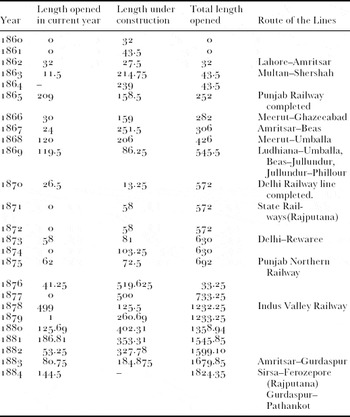
In the second phase of railway building, from 1871 to 1884, all the railway lines were built and operated directly by the state. These were the Punjab Northern Railways, the Indus Valley Railway, the Rajputana State Railway and the Amritsar-Pathankot Railway.Footnote 22 By the end of 1884, of the total railway mileage opened, about 1,300 miles were within the provincial limits of the British Punjab.Footnote 23 The total railway mileage constructed by the state directly was about 833 miles by 1884, or 64 per cent of the total railway mileage in the Punjab. The high proportion of railway lines constructed by the state is an indicator of the importance the state attached to railway establishment in the Punjab. Also, by the end of 1884 all the major railway lines, including those connecting Punjab with Bombay and Calcutta, had been laid. Table 1 shows the expansion of railways in the Punjab from 1860 to 1884.
Railway expansion in the Punjab, 1860–1884 (lengths in miles).34

Some specific examples are helpful to demonstrate how economic concerns of the colonial state played out at local level. The first line to be laid was the Amritsar-Multan line via Lahore, part of the trunk line connecting Calcutta with Lahore that Dalhousie had prioritized in his railway plan for India. As the state had done at the all-India level, in the Punjab too it prioritized the laying of such trunk lines with long term profitability in mind. Although the Amritsar-Multan line was militarily important, the state expected it to be commercially profitable.Footnote 24 Also, this line connected the commercial capital of Amritsar with the political capital of Lahore in the Punjab.Footnote 25 The main purpose of the Multan-Lahore-Amritsar line was to connect the port of Karachi with the agriculturally rich plains of the Punjab.Footnote 26 In order to connect Multan with Karachi more efficiently, the line was extended from Multan to Shershah or Jullalpoor at the junction of the Chenab and Sutlej rivers.Footnote 27 This reduced the voyage time of the steamers from three to four days to about two hours.Footnote 28
In order to increase trade in the Punjab, especially on the Indus route, the state constructed the Indus Valley Railway which was an extension of the earlier built trunk line connecting Amritsar with Multan. By 1881–1882, two to three years after its opening, the line became an economic success due to the increase in wheat trade and lowering of wheat carriage rates by the state,Footnote 29 which proved to be a successful ploy to maximize the use of railways as a channel for increasing global trade for the Punjab.
The state also took up the construction of the Punjab Northern Railway, which opened in 1875.Footnote 30 This line was built mainly for strategic purposes, although after 1882 it was also successful commercially due to the expansion in the wheat trade.Footnote 31 This illustrates how a railway line, laid specifically for political/strategic purposes, was also commercially important.Footnote 32
The impact of railway operations on the forests of the Punjab
The railway fuel situation in the Punjab
Rail steam engines needed fuel, preferably coal, for their operation. However, until the late 1870s, coal of suitable quality and quantity for the railways had not yet been discovered in India. Hence, it was suggested that a mixture of imported English coal and Indian coal be used as railway fuel.Footnote 33
Imported coal had to be shipped in huge quantities from England at huge expense to the railway companies.Footnote 35 However, it was not until the mid-1860s, when more than 3,000 miles of railway lines were open, that the state became concerned regarding the lack of coal in India and the high costs of importing it from England. The cost of imported coal in India was four times that of coal used in England due to high freight charges.Footnote 36 Given the active involvement of the state in railway establishment and expansion, its concern regarding fuel supply to the railways was not surprising. Hence, the state explored the use of cheaper, locally available coal for the railways.
The state undertook surveys of coal distribution in India in the 1860s to locate locally available coal of suitable quality and quantity for use by the railways. The results of these surveys were, however, not very encouraging and showed the limited distribution of coal in India.Footnote 37 Coal suitable for the railways was found only in a few areas such as Bengal and Central India. It was too expensive to use this coal as railway fuel in the non-coal producing areas because of high transportation costs.Footnote 38 This can be seen in the following excerpt of a letter from the Public Works Department, Government of India, to the Secretary to the Government of Madras:
It is clear that wood-fuel will hold its own against coal on the greater part of the system of the Madras Railway Company for long, if not permanently. . . . The price of English coal is so high that so long as the duty of the wood-fuel is not less than one-fourth that of coal, the former should be used.Footnote 39
Fuel availability for the railways was especially problematic in the Punjab, as pointed out in a letter by an agent of the Punjab and Delhi Railways:
The position of the Punjab and Delhi Railways with regard to fuel is exceptional to that of any other line in India; all others enjoy the advantages of a supply either of wood or of coal. The Punjab, throughout its length and breadth is, with the exception of actual deserts, the most arid Province in India.Footnote 40
The use of imported coal as fuel on the Punjab's railways was out of the question due to its excessive cost. Although within the Punjab there was some coal in the Salt Range, it was insufficient in quantityFootnote 41 and not of the quality needed for steam engines,Footnote 42 and also transportation costs to Lahore for use on the Punjab Railways were high.Footnote 43
Given the high cost of imported coal and the lack of suitable quality and quantity of coal in the Punjab, non-local sources of coal supply were next explored. Because the coalfields of Bengal and Central India were quite far away from the Punjab, the coal from these coalfields had to be transported by train.Footnote 44 The non-Punjab railway companies engaged in coal transportation such as the East India Railway Company, in turn, wanted to make profits from their operations. Hence, they maintained high carriage rates for coal transportation which added to the cost of coal delivered in the Punjab.Footnote 45 The attraction of using wood-fuel was obvious. Pointing out the importance of wood-fuel for the railways in the Punjab, the Secretary of State for India wrote to the Government of India, ‘Independently of the demand for sleepers and other purposes of construction, it is evident that wood is the only fuel that can be relied upon for a long time to come, the nearest coal being too distant to cover the cost of carriage’.Footnote 46 Hence, even though the amount of firewood needed by the railways was three times its requirement of coal, firewood was still a cheaper fuel than coal, a realization that came earlier in the Punjab than nationally.
The most important source of firewood for the railways was the rukhs or rakhs about which Dr Edward BalfourFootnote 47 wrote:
The great value of the wood-bearing rakhs consists in their being the source from which all the fuel for railway consumption is to be taken. The trees most commonly met with in ‘rakhs’ are the jhand, Prosopis spicigera. This is the best fuel wood, being heavy and compact, and burns slowly. . . .Footnote 48
The rakhs or rukhs were the plains forests found in areas of scanty rainfall and poor sandy and saline soil to the west of Lahore.Footnote 49 They were the dry forests found interspersed with large treeless areas in Lahore, Montgomery, Multan, Chenab, Jhelum and Shahpur regions.Footnote 50 Apart from jhand, Prosopis spicigera, the other firewood yielding trees in the rukhs were phulahi, Acacia modesta, dhak, Butea frondosa, and the farwa, Tamarisk orientalis. Footnote 1
As railway construction in the Punjab progressed it was soon realized that the existing rukhs were not sufficient to meet demand, hence it was necessary to calculate how much firewood the rukhs contained. J. L. Stewart, the officiating Conservator of Forests, was then asked to undertake a survey of the rukhs so that the fuel supply for the Punjab Railways could be calculated. He calculated that the fuel trees in the rukhs required 10 to 20 years to attain maturity, and estimated that the total yield of 287,000 acres of rukhs was 3,278,000 maunds.Footnote 52 He then calculated that the annual requirement for 252 miles of railways was 1,100,000 maunds for both workshops, engines and steamers. Of this, 613,000 maunds of firewood would actually be consumed by the engines annually.Footnote 53 This was 55.5 per cent of the total firewood required by the railways at that time. This calculation was based on the length of the railway lines that the engines travelled in each of the four districts.Footnote 54 Thus, the colonial state maintained an inventory of the firewood produced by the rukhs so that the railways could operate smoothly. Firewood was just another commodity whose supply had to be calculated and monitored.
Deforestation and the response of the colonial state
A recapitulation of the pattern and magnitude of railway line openings in the Punjab between 1860 and 1884 sets the stage for an appreciation of the temporal variations in fuel demand in the area. Also, given the colonial state's interest in railway expansion, its response to firewood shortage for the railways can especially be seen in the peak periods of railway opening. The average mileage of railway lines opened between 1862 and 1884 was 83.68 miles per year. The years where the mileage of opened railways was above average were in 1865 when the Punjab Railways opened 209 miles, 1868 and 1869 when the Punjab and Delhi Railways opened about 120 miles in each of those years, 1878 when the Indus Valley Railway opened 499 miles, 1880 when the Punjab Northern Railway opened 124 miles, and in 1881 when the Punjab Northern Railway and Indus Valley Railway opened 135 miles and 151 miles respectively. Given these peak years of railway openings in the Punjab and the dependence of the railways on firewood, how far did railway expansion affect fuel availability in the Punjab?
The insufficiency of firewood from the rukhs became apparent when the Punjab Railways opened 209 miles of railway lines for traffic in 1865 taking the total opened mileage in the Punjab to 252 miles. Dr Cleghorn, who was later appointed the first Joint Commissioner of Forests, noted in his ‘Memorandum on the supply of firewood to the Punjab railways’ that, ‘The railway has hitherto drawn its fuel from the rukhs estimated to contain three to seven or at most ten years’ supply, when all will be exhausted in regard to immediate use’.Footnote 55 By comparing the total amount of fuel required by the railways and the total amount of fuel actually produced by the rukhs as calculated by Dr Stewart, Dr Cleghorn's calculation that the rukhs contained only about three years supply of fuel for railways and steamers was confirmed. Thus, expansion of the railways in the Punjab would exhaust the firewood in the rukhs in seven to ten years. Hence, fuel supply to the Punjab and Delhi Railways, the next railway line to open, was ‘one of the gravest questions of the day, connected with railway management and forest administration’.Footnote 56
By the mid-1860s the rukhs, being the primary existing fuel sources in the Punjab, were denuded, resulting in a fuel scarcity that threatened to stop the railways from operating, as can be seen in the following note by the Agent of the Punjab and Delhi Railways:
[T]he fuel supply for many years past has been derived from jungles and forests, that is tracts of uncultivated land in which stunted trees and shrubs have managed to vegetate. . . . The jungle was then cut down never to sprout again, and the supplies of fuel, of necessity, restricted and enhanced in value to an extraordinary degree before the introduction of railways. What before this event was a scarcity, is now rapidly resolving itself into a [timber] famine. . . .Footnote 57
Given that the rukhs were the dry forests found in the more arid parts of the Punjab where vegetation was sparse, the cutting of trees to meet the fuel needs of the railways exacerbated the denudation problem leading to the firewood famine. Thus, a short-term solution, using firewood to stoke the engines rather than coal, which was a solution to an earlier fuel problem,Footnote 58 itself, became a problem as railway expansion continued.
The fuel scarcity in the Punjab, however, did not become a fuel crisis due to the timely intervention of the state. Measures taken by the colonial state to prevent a fuel crisis were primarily motivated by concern about the working of the railways, however, rather than about the hardships for Indian households. Faced with a potential crisis, the state at last showed environmental concern.Footnote 59 As Dr Cleghorn would later note, in his address to the nineteenth annual meeting of the Scottish Arboricultural Society, ‘The introduction into India of railways, and the rapidly increased demand for timber for sleepers (ties) and fuel, at length forced the attention of the Government to the vital question of forest management’.Footnote 60 Privileging ecological conservation of forests at the expense of railway construction and fuelling would have delayed the economic transformation of India into a satellite economy of Britain. Therefore, in order that resource extraction from India would continue through railway expansion, the state adopted forest ‘conservation’ in 1865 with the creation of a Forest Department. Before the timber and firewood shortage for the railways the state had paid no attention to forest conservation in India. In fact until the 1830s when the colonial state's dominant mode of surplus extraction from India was through land revenue, it encouraged the felling of forests to make way for cultivation, both by the natives and by European planters.Footnote 61
But before carrying out conservation the state first brought the forests under its control and restricted the existing use-rights of local communities.Footnote 62 In the case of the Punjab, this involved reservation of not only the hill forests to meet the sleeper (ties) needs of the railways but also the maintenance of the rukhs or plains forests as reserves. As Dr Cleghorn noted ‘The great and increasing importance of these fuel reserves, the need of husbanding their resources and of turning them to the best account, is admitted by all. The Punjab Government have [sic] ordered that rukhs are not to be sold or alienated without special report and permission. . . .’Footnote 63 Thus, the state placed the management of the rukh or ‘rakh’ lands under the Punjab Forest Department so that the supply of firewood to the railways in the Punjab would continue.Footnote 64 The state, thus, had an instrumentalist conception of forests.
The state reserved a certain minimum area of rukhs so that fuel supply to the railways would not be interrupted. These reserved rukhs would be utilized by the railways for fuel when all other sources of fuel had been exhausted.Footnote 65 Hence a new division called the Fuel Reserve Division was started under the Forest Department ‘for the purpose of protecting and working systematically the existing rakhs [rukhs] or wood-lands in the plains’.Footnote 66
In addition to the management of existing rukhs for railway fuel supply, the colonial state developed new sources of fuel supply through afforestation by establishing firewood plantations under the Forest Department. It was calculated that these trees needed between 10 and 17 years to mature and yield firewood. Plantations were the best source of firewood for the railways because they were cheaper compared with coal or other sources of firewood. However, the operation of each mile of railway required about 20 acres of plantation for its fuel supply.Footnote 67 Hence, the firewood plantations had to be extensive to meet the huge fuel demands of the railways, not only of the present but also of the future.Footnote 68 Given the large up-front cost for establishing fuel plantations and delay until returns were gained on the investment, no private railway company was willing to invest at the necessary scale.Footnote 69 Hence, the state itself was forced to establish and maintain plantations for railway fuel supply, as this resolution of the Government of India, Public Works Department stated:
[I]t has been settled, in correspondence with the Secy. of State, that it is undesirable that Railway Companies should undertake such operations as forming plantations for fuel. . . . Thus the Forest Department is the agency, if any, by which the plantations must be formed and managed in the Punjab. . . . Further, there is no present prospect of private enterprise coming forward for the establishment of plantations, this being an undertaking in which no profits could be secured for a long period.Footnote 70
In establishing the fuel plantations for meeting the needs of the railways, the colonial state held a long-term view of railway establishment and its benefits to Britain. It did not want the firewood supply to be completely exhausted, especially in the future, in order that railway expansion could continue.Footnote 71 This was contrary to the private railway companies, who were interested only in short-term gains such as immediate profits from railway operations through the reduction of railway working expenses. Even though the establishment of fuel plantations was not remunerative and involved quite a lot of expenditure, the colonial state saw the long-term benefits of providing a continuous supply of firewood for the railways.Footnote 72 By doing so the state ensured that British capitalists and Britain would continue to derive long-term economic benefits from India. The capitalist, colonial state was concerned with the long-term benefit of railways to Britain as a whole, rather than with the short-term benefit to individual capitalists such as private railway companies.Footnote 73 Hence, just as it had promoted and provided the conditions suitable for railway establishment and expansion to take place, it now provided the right conditions for the continued working of the railways by establishing fuel plantations.
As the railways expanded and consumed more firewood the colonial state found it increasingly difficult to obtain firewood to keep them working.Footnote 74 Hence, with the fuel plantations yet to mature and the reserved rukhs of 1865–1866 denuded, the state brought more rukhs under reserve. These rukhs were in the vicinity of mostly the Punjab's Railway lines and to some extent the Punjab and Delhi Railways.Footnote 75 By 1870 about 391,708 acres of rukhs were reserved, which would provide a total yield of about 4,473,305 maunds. This yield would last only two years, given the annual railway firewood demand of approximately 2,300,000 maunds as calculated by Dr Stewart.Footnote 76 Thus, given the railway firewood demand already made on the rukhs leading to their exhaustion by the 1870s, the ‘conservation’ attempt by the state through the reservation of rukhs was insufficient for long-term provision.
Given that the existing rukh reserves had only a few years’ supply of firewood for the existing railways the state looked to increase firewood supply from plantations especially bearing in mind the needs of future railway lines. By 1870 the total area of fuel plantations had increased to 12,315 acres.Footnote 77 It was calculated that at least 20,000 acres alone would be required to supply the line from Delhi to Multan.Footnote 78 However, the existing plantations in the Punjab were not sufficient to supply the Delhi line, as this extract from the Punjab Forest Administration report for 1870–1871 states:
[A]s regards our existing plantations, we have hardly effected [sic] anything for a supply of the line. For though I may refer to the plantations of Jullundur, Philor and Loodiana, roughly aggregating 480 acres, as fairly complete, they are little more than way side groves capable of meeting a small local demand.Footnote 79
Similarly, the existing rukhs in the Punjab did not have sufficient firewood to supply the Punjab Northern Railway, even before it actually opened its lines in 1875.Footnote 80 By the early 1870s the firewood from the rukhs was barely enough for preliminary works and for the railway workshops.Footnote 81 Thus the rukhs could not be expected to supply firewood to the railways for long. Hence, the state extended the plantations.Footnote 82 However, the cost of the extension of plantations was high and the yield distant.Footnote 83 Therefore, the state began to explore other sources of fuel for railways.Footnote 84
Clearly, the firewood supply from the rukhs would last only a couple of years and non-local firewood sources had to be relied on in neighbouring areas (outside the Punjab) including the forests on the banks of the Jumna and its tributaries and the forests of Meerut division or the Gurhwal forests.Footnote 85 However, these outside sources of firewood were also subject to exhaustion in the form of deforestation due to the fuel demand of local railways in those areas. Such an example of deforestation was reported in the Pioneer newspaper drawing the attention of the Under Secretary, who noted,
[T]he undersigned is directed to invite the attention of the Public works Department to the paragraph noted in the margin, which appeared in the Pioneer newspaper of the 17th ultimo. . . . ‘It is a great shame to see large, old, splendid topes of trees daily being felled down for fuel to burn bricks, &c., for the Oudh and Rohilkhund Railway. Government should take the matter in hand to prevent the destruction of topes of trees by passing a Bill for the purpose.’Footnote 86
Thus, the increase in the use of firewood by railways in wood-scarce regions such as the North-Western Provinces and Oudh, due to the high carriage rates of coal, denuded the forests there.Footnote 87
The Punjab, unlike Bengal or Central India, continued to depend mostly on firewood and on English coal for its railway operations, which caused a shortage of firewood by the early 1870s. To meet the fuel demand of the expanding railways, the area under reserved rukhs was increased, along with their cutting by the Forest Department. For example, in 1873–1874 nearly a million cubic feet of firewood were sold by the Fuel Reserve division to the Railway Department.Footnote 88 At this time the total opened railway mileage was 468 miles within Punjab's provincial limits. By 1878 the total opened railway mileage had increased to 610 miles and the fuel supplied by the Central Fuel Reserve Division increased to 2,284,500 cubic feet of firewood in 1877–1878.Footnote 89 Thus, technological fixes such as reservation of the rukhs adopted by the state did not prevent deforestation, rather, the cutting of the forests increased as railways expanded. Like all technological ‘fixes’ which address the effect but not the cause of ecological degradation, the reservation of the rukhs did not stop their depletion.
In fact, the increased cutting of the rukhs quickly exhausted them, raising concern about the future capability of the Punjab rukhs to supply fuel to the Punjab Northern Railway, as noted in the Forest Administration Report 1878–1879:
The whole of the Lahore rakhs have now been cut out, and I doubt if a rakh can be found anywhere to cut, poor as they are, and yielded about 40,000 cubic feet. The difficulty of supplying the requirements of the Northern State [Punjab Northern Railway] line at present is very great. The Bhera and Phallian rakhs are too far off. The Salt Range area sufficiently near is very limited; from rakhs Nili and Manki 855,837 cubic feet, chiefly Phulai, were supplied during the year. In Rawalpindi some of the kahuta forests have supplied 122,500 cubic feet of green hard wood fuel to the Railway.Footnote 90
The denudation of the rukhs occurred despite the fact that from 1876 until 1880, the Punjab Northern Railway operated only 103 miles of its railway lines. This denudation was so severe that the state encouraged the Indus Valley Railway to buy firewood, which it did, at a cheaper rate from private contractors, who were most likely to get their fuel supply from outside the state-owned forests and reduce the destruction of the state forests.Footnote 91 Thus a spatial ‘fix’ was used by the state to solve the firewood scarcity problem by shifting the problem outside rather than putting a stop to railway expansion.
Despite the above technological and spatial fixes adopted by the state to maintain or increase firewood supply to the railways, the problem of increased cutting of the rukhs was exacerbated by the high mileage of opened railways by the late 1870s and the early 1880s. These opened lines included 499 miles of the Indus Valley Railway in 1878, and 124.5 miles and 135 miles respectively in 1880 and 1881 of the Punjab Northern Railway. By March 1881 the total opened railway mileage in the Punjab's provincial limits was 1,048.5 miles. This high mileage of opened railway line required a total of 18,307,142 cubic feet or 4,576,785 maunds of firewood.
By 1881 the total firewood yield of the fuel plantations and of the rukhs altogether was 93,254,200 cubic feet or 23,313,550 maunds.Footnote 92 This firewood yield could last for about five years if the opened railway mileage remained the same. Since the plantations required about 10 to 15 years to mature, the rukhs and the matured plantations would be completely denuded after five years of railway fuel supply. Thus, what began as a firewood scarcity in the 1870s deepened into a crisis in the 1880s.
The pressure on the colonial state to provide firewood to the railways became so intense that it issued orders to cut wood from the woodlands regardless of conservancy. The drastic measures adopted by the state to increase the fuel supply to the railways can be seen in the following selection taken from a memorandum written by the Secretary to the Government of India to the Secretary, Government of Punjab.
The requirements of the new railways, however, introduce an additional element of great importance into the question; and, in the opinion of the Governor General in Council, it will now be necessary to take a comprehensive view of the measures that must be adopted to ensure a permanent supply of fuel from the woodlands in the vicinity of these lines. . . . In order to hasten on the construction of the line and its working at the outset, it may be necessary to sacrifice future interests, and to cut fuel without regard to the requirements of conservancy. . . . I am further directed to suggest that a competent forest officer be placed specially in charge of the operations that may be undertaken to supply the railways with fuel, and to ensure, as far as may be practicable, the protection of the areas which it may be necessary to cut over in order to satisfy the requirements of the railway. . . .Footnote 93
Therefore, despite the implementation of forest ‘conservation’ practices, over-cutting of the trees in the rukhs continued and was justified by the state as being necessary to meet the fuel demand of the railways. Thus, for the colonial state, the forests became a crop to be maintained and harvested for the railways rather than for ecological reasons. Hence, the cutting of trees, without any systematic and consistent efforts to regenerate the forests from an ecological point of view continued, leading to deforestation as railways expanded.Footnote 94 Neither ecological nor social concerns were the main motive of forest ‘conservation’.
The fuel demand of the railways in the late 1870s, especially that of the Punjab Northern Railway (which was due to open about 589 miles of its lines to traffic between 1880 and 1881), was so high that firewood was procured even from the village forests leading to their complete denudation. This can be seen in the following excerpt from a letter written by Secretary to the Governor-General of India to the Secretary, Government of Punjab:
Mr. Baden-Powell feels anxiety about the Northern State Railway [Punjab Northern Railway] fuel-supply, and he states that at present wood is being brought up for the railway all round, while the fields and the villages are denuded.Footnote 95
This over-cutting of forests, especially those near the villages, must have not only upset the forest ecology of the region but would also have caused firewood deficiency to the local population.Footnote 96 The colonial state was, however, more concerned about maintaining adequate firewood supplies to the railways so that efficient resource extraction from the colony would continue.
Coal as railway fuel
The scarcity of firewood due to deforestation led to the popularity of coal as railway fuel and, as the railways expanded further in the 1870s all over India, there was additional pressure on the colonial state to procure coal so that the newly opened lines could be worked.Footnote 97 Therefore, the colonial state steadily increased coal import from England in the late 1870s. The total amount of fuel such as coal, coke and patent fuel, imported from Britain into India increased from 45,530 tons in 1869–1870 to 239,650 tons in 1877, despite its cost and the fact that the railways were beginning to utilize some Indian coal.Footnote 98 Meanwhile, the production of Indian coal increased as more mines were opened and became connected by railways. Hence, from 1878 onwards, and especially in the 1880s, there was increased use of Indian coal and a decrease in the amount of imported coal for the railways.Footnote 99
Coal had been used on certain railway lines in the Punjab such as the Ghazeeabad-Phillour line and the Delhi-Lahore line in the mid-1870s but the use of coal increased as its advantages over the use of firewood were soon realized.Footnote 100 These advantages included lessened loss by risk of fire, lessened detention of trains in wood depots and more importantly no expenditure on expensive establishments such as fuel plantations.Footnote 101 These advantages of coal over firewood coupled with the scarcity of firewood due to deforestation outweighed the increased cost of coal over firewood. By the end of the 1870s, the notion of using coal as railway fuel gained ground, as the following excerpt shows.
It may also be taken for granted that wood cannot be economically burnt on any sections very much longer. First, between Delhi and Lahore, and then on the Punjab Northern Railway, wood fuel has had to be abandoned owing to its increasing scarcity.Footnote 102
When the advantages of coal over wood as railway fuel were realized the state began to explore the local availability and use of suitable coal on railways in the Punjab. Hence, coal samples were extracted from the Salt Range in the Punjab and subjected to experiments in order to determine their suitability for railways.Footnote 103 When the Salt Range coal was found suitable for use as railway fuel its existing royalty (tax) was reduced by the state making it cheaper.Footnote 104 By reducing the cost of coal the colonial state once again saw to it that the fuel needs of the already operating railways and those to be opened in the future were met so that their operation was not halted.
Accordingly, whilst the supply of coal as fuel to the Punjab Northern Railway increased, its demand for firewood began to decrease.Footnote 105 It began to use a combination of Salt Range coal and Bengal coal. Although it continued to use firewood on certain sections of its lines, its overall consumption of firewood decreased, despite the fact that by this time many of the plantations in the Punjab had started producing good yields of firewood.Footnote 106
Overall, the decrease in firewood consumption by the railways in the Punjab was reflected in the decreased firewood sold by the Forest Department. Total firewood sold from the Punjab plantations in 1878–1879 was 640,017 cubic feet whilst the amount felled was 1,186,276 cubic feet.Footnote 107 Thus, the Punjab Forest Department was able to sell only about 50 per cent of the total firewood felled in its plantations. Also, in 1879–1880 the total firewood cut and sold from the plantations in the Punjab decreased to 397,960 cubic feet.Footnote 108 Thus, there was a decrease of about 50 per cent year-on-year in the total firewood sold from the plantations to the railways between 1878 and 1880.
With the decreasing use of firewood there was an increased use of coal as fuel on all the railways of the Punjab from 1878 onwards.Footnote 109 In the Punjab, the Indus Valley Railway began using a combination of wood and English coal. This was because, once the line had opened, it connected the only port of the Punjab, Karachi, to the rest of the lines in the Punjab making it cheaper to use imported English coal for its operation. The Sind, Punjab and Delhi Railways started using a combination of Bengal coal, English coal and wood. Here too, because of the expansion of the railway lines in the Punjab and their connection to the port of Karachi, the use of English coal became popular. In addition, the use of Bengal coal on the lines became cheaper as the lines became well connected with the lines of the East Indian Railway (the chief transporter of Bengal coal). The Rajputana State Railway, some of whose lines were in the Punjab, also used a combination of Bengal and English coal.Footnote 110 Coal as railway fuel became so popular in the Punjab that the extension of firewood plantations in the late 1870s was seen in terms of the cost of the wood they would produce versus the cost of coal delivered to the railways.Footnote 111 Finally, the cost of extending or even establishing plantations for railway fuel was seen as expensive because of the problems associated with the use of firewood in railway engines. Hence, the formation of new fuel plantations was discouraged and had eventually ceased by 1880.Footnote 112 As firewood demand decreased, so did the state's concern with ‘conservation.’
Conclusion
The pre-colonial phase in India's environmental history was not a period of ecological equilibrium. However, the colonial phase was marked by unprecedented ecological changes that were irreversible. This was especially in the arena of forests, in the second half of the nineteenth century, which had to bear the brunt of (amongst other things) the introduction and development of technology such as the railways by the colonial state.
The main cause of deforestation was the incessant demand of the continually expanding railways for wooden sleepers or ties and firewood (as fuel). This depletion of the forests in the plains or rukhs was especially notable in the agriculturally rich province of the Punjab which saw huge railway expansion in order to convert it into the bread-basket of the empire. This exhaustion of the rukhs led to fuel scarcity for the railways and in turn threatened to delay or stop their operation in the Punjab.
This paper shows that, despite the above deforestation and firewood scarcity, the state did not stop the expansion of railways. Rather, it adopted measures that would maintain railway fuel supply so that its long-term interest of efficient resource-extraction from India would continue. These measures included the establishment of the Imperial Forest Department along with the creation of fuel reserves and fuel plantations. Hence, contrary to Grove's argument, social and ecological concerns did not lead to the establishment of forest conservation in India. Extraction from and exploitation of forests rather than their ‘conservation’ was the main aim of the colonial Forest Department. As Guha rightly argues, forest conservation was only undertaken to meet railway needs and later to protect revenue.Footnote 113
Forest ‘conservation’ by the state in the Punjab largely involved the harvesting of forests as crops to meet infrastructural needs, especially those of the railways. This can be seen from the fact that, even after the implementation of forest ‘conservation’ in the Punjab, the colonial state ordered the cutting of forests without any regard to their conservation to meet the railway fuel needs in the late 1870s when there was a fuel crisis. Similarly, forests near the villages were denuded to meet the need for railway fuel in the 1880s. Also, when the railways switched from firewood to coal as fuel the state abandoned the fuel plantations which were part of the afforestation policy. Rather than for ecological reasons, the main motive behind the moves by the state in the ‘conservation’ of the forests in the plains by creation of fuel reserves and in the development of the fuel plantations was only in order to exploit them as firewood sources for the railways. Thus, neither ecological nor social concerns were the main motive behind forest ‘conservation.’
In its ‘conservation’ policy, the colonial state created fuel reserves, which restricted access by local communities to the firewood of the forest and, of course, denied any control over the fuel woodlands to these local communities.Footnote 114 Thus exploitation of firewood sources included both their development and their exhaustion, and did not involve concern for indigenous needs. This paper has mainly focused on deforestation per se and the colonial state's response to it rather than the social impact of deforestation, especially on the indigenous population and their response to it. Future interesting research questions worth investigation might include:
• Before the establishment of fuel reserves by the colonial state, how were firewood-yielding forests used by the local people in the Punjab?
• What was the impact of the colonial state's creation and expansion of fuel reserves on the agricultural needs, especially on land use pattern and/or on firewood needs of the local population?
• In what ways did the indigenous people negotiate access to the forests that had been denied to them?
Both the natural reproduction of forests through scientific forestry and the establishment of firewood plantations as technological fixes did not prove to be long-term solutions in solving the deforestation crisis caused by railway expansion. In fact, deforestation continued with both these measures in place. Conservation, indeed, was only undertaken to meet railway needs but then abandoned in the throes of a fuel shortage, which crisis forced the fuel conversion from firewood to coal.