Single ventricle CHDs occur in about 1350 newborns each year in the United States of America.Reference Oster, Lee, Honein, Riehle-Colarusso, Shin and Correa1 The management of most single ventricle patients culminates in the Fontan palliation that forms a passive systemic venous return to the lungs aiming to separate the pulmonary from the systemic venous return. This unique physiology allows the single ventricle patients to survive into adolescence and adulthood, but their course is complicated by multiple morbidities.Reference Anderson, Sleeper and Mahony2–Reference Pundi, Johnson and Dearani6 As the lifespan after Fontan procedure has increased, it is important to recognise and prevent long-term morbidities resulting from the unique Fontan physiology with elevated central venous pressure, and often diminished cardiac output. Post-Fontan sequelae include among others reduced bone density and quality.Reference Avitabile, Goldberg and Zemel7–Reference Goldberg, Dodds and Avitabile9
Data on quantitative analysis of bone health by dual x-ray absorptiometry or peripheral quantitative CT in children with Fontan palliation are scarce.Reference Avitabile, Goldberg and Zemel7,Reference Bendaly, DiMeglio, Fadel and Hurwitz8,Reference Witzel, Sreeram, Coburger, Schickendantz, Brockmeier and Schoenau10 Small series of Fontan patients have shown decreased bone mineral density by dual x-ray absorptiometry or significant bone deficits by peripheral quantitative CT.Reference Avitabile, Goldberg and Zemel7–Reference D’Ambrosio, Tran and Verrall11 While peripheral quantitative CT studies showed reductions in bone quality at either the radius or the tibia individually, there is no study that examined bone mineral density by dual x-ray absorptiometry and bone microarchitecture by peripheral quantitative CT of the tibia and radius in the same individuals. With this study, we aimed to (1) determine whether a distal radius or a distal tibia is more sensitive to identify bone deficits and (2) examine the correlation between relevant dual x-ray absorptiometry and peripheral quantitative CT parameters.
Methods
Patients
Ten Fontan patients (7 males, 12.2 ± 1.69 years) were enrolled in this cross-sectional study from the outpatient paediatric cardiology clinics of two participating sites (Children’s Hospital and Clinics of Minnesota and the Masonic Children’s Hospital at the University of Minnesota, Minneapolis, Minnesota, United States of America). Inclusion criteria for Fontan patients were a history of Fontan palliation more than 5 years prior to enrolment, being ≥7 years of age with Tanner stage ≤ 3. Fontan patients were recruited from the cardiology services at the University of Minnesota and the Children’s Hospitals and Clinics of Minnesota as part of an ongoing multi-centre study evaluating end-organ biomarkers in the Fontan circulation and coordinated by the Cincinnati Children’s Hospital. Exclusion criteria were active protein-losing enteropathy, current steroid treatment for an independent disease process, bone fracture within the last 12 months, known endocrine disorders, autoimmune diseases, independent disease process leading to moderate or severe liver or kidney impairment, paraplegia or hemiplegia, patients with electronic pacemaker or persistent arrhythmias, patients on the transplantation list or having received cardiac transplantation, and participants unable to comply with study procedures. Control patients were identified from two separate cross-sectional studies at the University of Minnesota evaluating cardiometabolic risk factors in healthy children. These included 11 healthy controls (9 males, 12.0 ± 1.45 years) for the peripheral quantitative CT study and 4 additional (2 males, 11.1 ± 1.49 years) for the biomarker studies.
Clinical characteristics, anthropometry, and pubertal development
Patient’s underlying diagnoses, type and timing of surgical procedures as well current medications were obtained from medical records. Functional assessment was performed by the NYHA classification score system at the time of the clinical evaluation. Standing height and weight were measured for all patients and their controls. Height and weight z scores were calculated using GenenCALC 3.0 Software (Genentech Inc., South San Francisco, California, United States of America), which uses the Centers for Disease Control and Prevention (CDC) 2000 growth data (available at www.cdc.gov/growthcharts). The data for the CDC 2000 growth curves incorporate data from white, black, Mexican American, and other ethnic groups but do not provide ethnic-specific data. White children were the majority of those children made to generate the CDC data and the population in our study.Reference Khan, Gonzalez-Bolanos, Holm, Miller and Sarafoglou12 Body mass index was calculated using height and weight and converted to z scores using standard growth charts from the CDC.Reference Kuczmarski, Ogden and Grummer-Strawn13 Although breast development was assessed in females, testicular examination was not performed in males; therefore, Tanner staging was recorded based only on pubic hair development in females and males for consistency.Reference Tanner14 Bone age was calculated by radiographs of the non-dominant hand and wrist by the Greulich–Pyle method and was available only for the Fontan population.Reference Greulich and Pyle15 The Fontan patients (9 out of 10) underwent physical activity tracking with a GT3 accelerometer for 3–5 consecutive days including weekdays and weekend days. On average, the Fontan patients engaged in 94.5 ± 50.9 min/day of moderate–vigorous physical activity with 6 out of 9 patients averaging more than 60 min of moderate–vigorous physical activity per day over the assessment period, which is consistent with the American Heart Association recommended activity for children per day.Reference Steinberger, Daniels and Hagberg16
Dual x-ray absorptiometry
Height-adjustedReference Zemel, Leonard and Kelly17 bone mineral density z scores for the posterior–anterior lumbar spine at L1–L4 and total body less head were measured in Fontan patients by dual x-ray absorptiometry (GE Healthcare Lunar Prodigy scanner; Madison, Wisconsin, United States of America) using enCORE software version 9.3. Sex- and age-specific bone mineral density z scores were calculated using enCORE reference data based on healthy, ambulatory patients from the general population. The enCORE reference database consists of data from children 5 to 18 years old of multiple ethnicities participating in the National Health and Nutrition Examination Survey Dual X-ray Absorptiometry Database (NHANES 1999–2004) (available at www.cdc.gov/nchs/nhanes/dxx/dxa.htm). The heights of individuals in NHANES 1999–2004 who received dual x-ray absorptiometry scans were representative of the US population and were incorporated into the CDC 2000 growth curves, so they should have a mean height z score of zero. Dual x-ray absorptiometry bone mineral density z scores were adjusted for height as suggested by Zemel et al.Reference Zemel, Leonard and Kelly17
Peripheral quantitative CT
Measures of cortical and trabecular bone and estimated bone strength were obtained using peripheral quantitative CT (XCT-3000; Stratec Medizintechnik GmbH, Pforzheim, Germany), taken at the 3 and 38% sites of the left tibia, and the 3 and 33% sites of the non-dominant radius as previously described.Reference Petryk, Polgreen, Grames, Lowe, Hodges and Karachunski18 Tibia and radial length were measured to adjust for bone architectural measures. The reference line for both tibia and radius was placed at the proximal end of the distal growth plate. Image processing and calculation of bone parameters were completed using the manufacturer’s software (version 6.0). Phantom scanning was done daily for quality control.
Bone outcome measuresReference Zemel, Bass and Binkley19 at metaphyseal sites included total and trabecular volumetric bone mineral density (mg/cm3), total and trabecular cross-sectional area (mm2), and total bone strength index (mg2/mm4). At diaphyseal sites, the measures included cortical bone mineral density, cortical cross-sectional area, cortical bone mineral content (mg/mm), cortical thickness (mm), periosteal and endosteal circumference (mm), non-weighted polar section modulus (mm3), and strength–strain index (mm3). Muscle and fat cross-sectional areas (mm2) were measured at the 66% site of the left tibia to assess for possible sarcopenia.
Laboratory studies
A number of laboratory studies were performed in the Fontan patients to rule out protein-losing enteropathy and liver, renal, endocrine, or nutritional abnormalities that may affect bone health. These included serum albumin, calcium, thyroid-stimulating hormone (TSH), serum and urine creatinine (measured at Fairview Diagnostics Laboratory, Minneapolis, Minnesota, United States of America by standard techniques), cystatin-C, 25-OH vitamin D, B-type natriuretic peptide and alkaline phosphatase, and intact parathormone (measured by the LabCorp laboratory services, Denver, Colorado, United States of America). Faecal alpha-1-antitrypsin was measured by ARUP Laboratories (Salt Lake City, Utah, United States of America) to detect subclinical protein-losing enteropathy.
In addition, we performed a panel of serum and urine bone biomarkers for both patients and a group of control patients to assess for potential differences in bone formation, calcification, or bone resorption. The serum biomarkers included the bone formation marker osteocalcin, the mineralization inhibitor osteopontin, the inhibitor of osteoclastogenesis osteoprotegerin, and intact parathormone that were measured in plasma using the commercially available Human Bone Panel Luminex 4-plex immunoassay (Millipore Corporation, Billerica, Massachusetts, United States of America). The bone resorption marker tartrate-resistant acid phosphatase was measured by a commercially available ELISA assay (QuidelTRAP5b; Quidel Corporation, Bilerica, Massachusetts, United States of America). The urine biomarkers, urinary pyridinoline and deoxypridinoline were measured as markers of bone resorption using the MicroVue pyridinoline and deoxypridinoline EIA kit, respectively (Quidel Corporation) and are expressed as ratios to creatinine to adjust for urinary concentration. All bone metabolic markers were measured at the cytokine reference lab of the University of Minnesota. Not all biomarkers were measured in each patient and control patients due to insufficient sample.
Cardiac MRI
Cardiac MRI was performed on the Fontan group of patients on a 1.5 Tesla Siemens Symphony scanner (Munich, Germany) to estimate indexed systemic cardiac output. Patients were free breathing for acquisition of localising, cine steady-state free precession, and flow quantification sequences. The ventricular short-axis sequence was performed with a cine steady-state free precession sequence with 7 mm slices with no gap for quantification of ventricular size, systolic function, and cardiac output. Flow quantification in the ascending aorta, inferior and superior caval veins, and branch pulmonary arteries was performed to assess cardiac output and flow patterns. MRI scans were performed on the same day with the laboratory and physical examinations.
Statistical analysis
Descriptive statistics were tabulated separately for Fontan and control groups. These included the mean and standard deviation for continuous variables and frequency for categorical variables. p-Values for differences in means were evaluated using a t-test with unequal variance and Welch’s degrees of freedom, while differences in categorical variables were evaluated using a chi-square test. Peripheral quantitative CT bone density and strength measures were adjusted for Tanner stage and sex. In addition, geometric bone measures were also adjusted for either radius or tibia length. Sensitivity analysis was performed by adjusting for age instead of Tanner stage. Adjusted differences between Fontan patients and controls were evaluated using linear regression and the t-distribution with corresponding model degrees of freedom for confidence intervals and p-values. Since this is a pilot exploratory study, no adjustments were made for multiple comparisons. Analyses were conducted using SAS version 9.4 (SAS Institute Inc., Cary, North Carolina, United States of America) and R v2.15.2 (Vienna, Austria).20
Results
Clinical characteristics
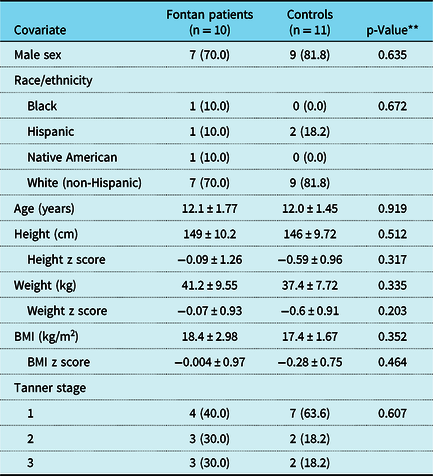
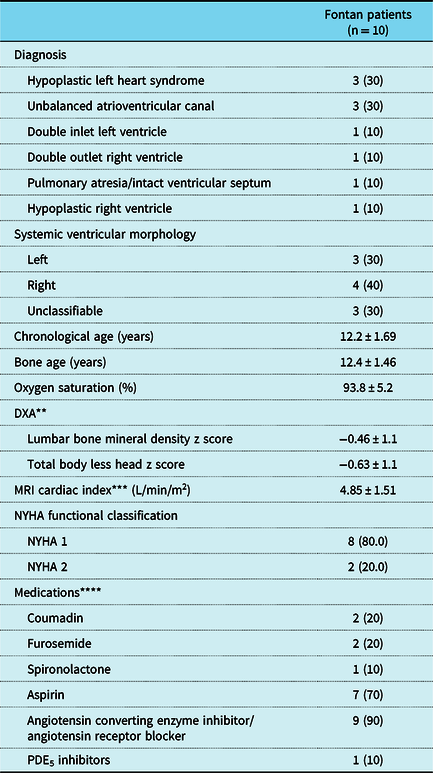
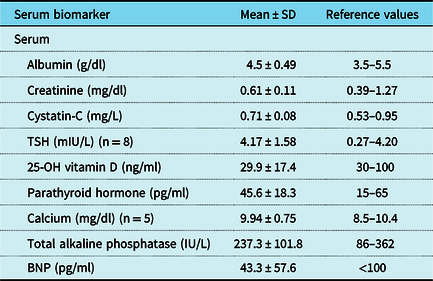
Most patients with Fontan physiology were classified as NYHA class 1 (80%) except two who met criteria for NYHA class 2 (20%). Table 1 summarises demographic characteristics of 10 Fontan patients and 11 controls with Tanner stage ≤3. There were no significant differences with regard to sex, race, age, pubic hair development, or anthropometrics. Clinical characteristics and main laboratory findings in Fontan patients are presented in Tables 2 and 3, respectively. None of the patients had symptoms of protein-losing enteropathy or faecal leakage of alpha-1-antitrypsin. Three of the Fontan patients received medications such as coumadin and/or furosemide that can interfere with bone metabolism when used long term.
Demographic and anthropometric characteristics of Fontan patients and control patients*

* Values presented are mean ± standard deviation or n (%) where indicated.
** p-Values were derived from two sample t-tests for continuous variables or Fisher’s exact tests for categorical variables
Clinical characteristics of Fontan patients*

DXA = dual x-ray absorptiometry
* Values presented are mean ± standard deviation or n (%) where indicated.
** DXA-based cardiac index is available for n = 8 patients.
*** MRI-based cardiac index is available for n = 9 patients.
**** Some patients are exposed to more than one medication; three patients (30%) were exposed to bone metabolism affecting medications (warfarin and/or furosemide)
Laboratory values in Fontan patients

Bone measurements
Dual x-ray absorptiometry measures
In Fontan patients, the mean height-adjusted L1–L4 bone mineral density z score was −0.46 ± 1.1 and total body less head z score was −0.63 ± 1.1, which are below the average (32 and 26%, respectively). These values reflect a downwards shift from the general population, but they are still within normal range for age and sex.
Peripheral quantitative CT results
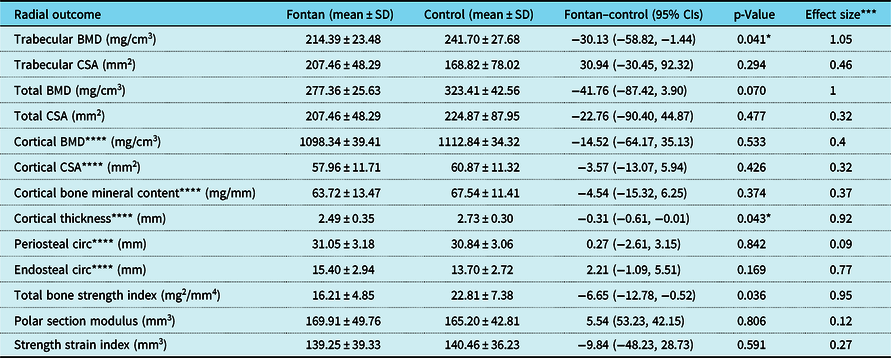
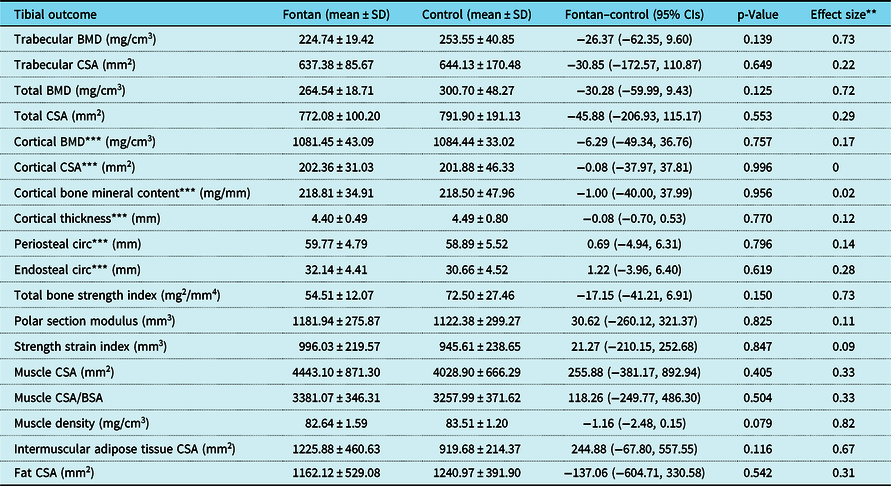
Among Fontan patients, reduction in bone measurements was seen at the radius compared to controls after adjustment for sex and Tanner stage (Table 4). The adjusted differences in means for Fontan versus control patients were −30.13 mg/cm3 (95% confidence interval −58.82, −1.44; p = 0.041) for trabecular bone mineral density, −0.31 mm (95% confidence interval −0.61, −0.01; p = 0.043) for cortical thickness, and −6.65 (95% confidence interval −12.78, −0.52; p = 0.036) for bone strength index with a Cohen’s effect size value d of 1.05, 0.93, and 0.95, respectively, suggesting high clinical significance.Reference King, Stockler and Cella21 However, no significant differences between Fontan patients and controls were seen for the tibial peripheral quantitative CT parameters (Table 5). There were no significant differences in tibial muscle and fat cross-sectional area, muscular density, intermuscular adipose tissue between Fontan and control patients, although we noted a downward shift in tibial muscle density in the Fontan patients (Table 5, Supplementary Table 2). Sensitivity analysis of bone peripheral quantitative CT measures with adjustment for age (instead of Tanner stage) and sex revealed similar findings with mild variations in the levels of statistical significance (Supplementary Tables 1 and 2). No significant associations were detected between peripheral quantitative CT bone measurements and MRI-based cardiac output, NYHA class, or use of medications (data not shown).
Tanner stage and age-adjusted comparison of peripheral quantitative CT radial measurements between Fontan and control patients**

BMD = bone mineral density; circ = circumference; CIs = confidence intervals; CSA = cross-sectional area; SD = standard deviation.
* Statistical significance at p < 0.05.
** Differences, 95% CIs, and p-values are calculated from linear regression adjusting for Tanner stage and sex.
*** Effect size is calculated as absolute difference in means divided by pooled SD at baseline (Cohen’s d).
**** Geometrical parameters are also adjusted for radial length.
Tanner stage and sex adjusted comparison of peripheral quantitative CT tibial measurements between Fontan and control patients*

BMD = bone mineral density; circ = circumference; CIs = confidence intervals; CSA = cross-sectional area; SD = standard deviation.
* Differences, 95% CIs, and p-values are calculated from linear regression adjusting for Tanner stage and sex.
** Effect size is calculated as absolute difference in means divided by pooled SD at baseline (Cohen’s d).
*** Geometrical parameters are also adjusted for tibial length.
Bone biomarkers
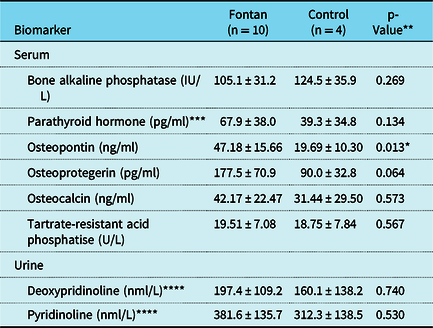
Fontan patients had borderline low 25-OH VitD (29.9 ± 17.4 ng/ml) and borderline elevated TSH levels (4.17 ± 1.58 mIU/L). A selected list of available serum and urine biomarker measures for comparison between Fontan and the second group of control patients is presented in Table 6. Comparison of bone biomarkers between Fontan and the control patients demonstrated increased levels of osteopontin in the Fontan patients (47.18 ± 15.66 versus 19.69 ± 10.30, p = 0.013) (Table 6). In addition, there was a trend towards higher osteoprotegerin and parathormone levels in Fontan patients that did not reach statistical significance.
Comparison of selected bone biomarkers between Fontan and control patients

Values presented are mean ± standard deviation.
* Statistical significance at p < 0.05.
** p-Values are calculated from linear regression adjusting for Tanner stage and sex
*** Parathyroid hormone was measured by the Human Bone Panel Luminex 4-plex immunoassay for comparison with controls and not by LabCorp as in Table 3.
**** Two patients in Fontan group are missing their urine markers.
Discussion
Bone has long been known to be an exquisitely mechanosensitive organ, and its homoeostasis depends on the ability of bone cells to sense and respond to mechanical stimuli including blood flow alterations.Reference Singh and Brookes22 In addition, hypoxia has been shown in cell models in vitro and in hypoxemic patients in vivo to be an important stimulator of osteoclast differentiation and bone resorption.Reference Fujimoto, Fujimoto, Ueda and Ohata23–Reference Arnett, Gibbons and Utting25 Therefore, survivors with Fontan palliation may have decreased bone formation and/or increased bone resorption resulting in bone loss and ultimately osteoporosis due to low cardiac output and chronic, albeit, mild hypoxia.Reference D’Ambrosio, Tran and Verrall11 In addition, protein-losing enteropathy, vitamin D deficiency and other nutritional deficiencies,Reference Goldberg, Dodds and Avitabile9 anticoagulant therapy,Reference Bendaly, DiMeglio, Fadel and Hurwitz8,Reference Avgeri, Papadopoulou and Platokouki26 chronic use of diuretics,Reference Mazziotti, Canalis and Giustina27 decreased exercise capacity,Reference Mahle, Wernovsky, Bridges, Linton and Paridon28 muscle wasting with decreased weight-bearing activity,Reference Cordina, O’Meagher and Gould29 and chronic kidney dysfunctionReference Lee, Levin and Kiess30 may impose additional risks to bone health. The overall incidence of fractures among patients with Fontan physiology is not known, but a small series from Australia recently reported a 32% incidence of non-pathologic fractures in their cohort.Reference D’Ambrosio, Tran and Verrall11 Another small series of critically ill patients with CHDs that suffered bone fractures while hospitalised identified that 40% of them had single ventricle physiology.Reference Cheng, Carmona and McDavitt31 Published data suggest that patients with Fontan palliation or single ventricle have low bone mineral density, and this is considered to be the best non-invasive predictor available for bone fracture risk.Reference Avitabile, Goldberg and Zemel7–Reference D’Ambrosio, Tran and Verrall11,Reference Borer32 As survival after the Fontan palliation is improving, it is important to identify patients with decreased bone density to initiate early therapy and prevent fractures.
Our study examined bone health in a homogeneous age group of a clinically well cohort of active young Fontan patients using both dual x-ray absorptiometry and peripheral quantitative CT, the latter at both radius and tibia. The data showed potentially clinically significant reductions in total and trabecular bone mineral density, cortical thickness, and bone strength index at distal radius. The study also showed that dual x-ray absorptiometry may not be as sensitive as peripheral quantitative CT in detecting changes in bone density in Fontan patients because mean height-adjusted L1–L4 and total body less head bone mineral density z scores were within normal range.
Only five studies examined bone parameters in Fontan patients with three of them using dual x-ray absorptiometry to evaluate bone density, and two using peripheral quantitative CT to evaluate bone mineral density and geometry.Reference Avitabile, Goldberg and Zemel7–Reference D’Ambrosio, Tran and Verrall11 The dual x-ray absorptiometry studies by Bendaly et al and Goldberg et al reported lower bone mineral density z scores in Fontan patients compared to our study.Reference Bendaly, DiMeglio, Fadel and Hurwitz8,Reference Goldberg, Dodds and Avitabile9 Bendaly et al studied 26 Fontan patients aged 5–12 years and showed reduced lumbar bone mineral density z score (−1.0 + 0.2 standard deviations) and total body less head z score (−0.8 + 0.2 standard deviations) compared to the normal populationReference Goldberg, Dodds and Avitabile9. Sixteen out of 26 children who were on warfarin tended to have lower bone mineral density z-scores compared to the ones who were not on warfarin. The D’Ambrosio study from Australia with predominantly young adults described osteoporotic findings in trabecular bones (spine and hip) in a third of their cohort.Reference D’Ambrosio, Tran and Verrall11 The investigators of this older cohort found correlations between the osteoporotic findings with lower oxygen saturation, echocardiographic indices of diastolic dysfunction and biochemical evidence of secondary hyperparathyroidism, but no correlation with medications affecting bone metabolism such as diuretics and anticoagulants. Goldberg et al studied 12 Fontan patients with protein-losing enteropathy, aged 7.2–25.2 years and showed decreased mean bone mineral density z scores of −1.73 standard deviations; 5 out of the 12 patients had bone mineral density z score below −2 standard deviationsReference Bendaly, DiMeglio, Fadel and Hurwitz8. The lower bone mineral density z scores seen in this study are most likely due to the presence of protein-losing enteropathy in these patients, which none of our patients had.
A peripheral quantitative CT study by Witzel et al of 29 post-pubertal patients with various forms of CHD found adjusted bone mineral content at distal radius significantly reduced in 6 patients with Fontan palliation compared to the reference values.Reference Witzel, Sreeram, Coburger, Schickendantz, Brockmeier and Schoenau10 Another peripheral quantitative CT study by Avitabile et al. focused on the distal tibia in 43 Fontan patients between 5 and 33 years of age.Reference Avitabile, Goldberg and Zemel7 The study reported decreased tibial cortical area, periosteal circumference, trabecular bone mineral density, and muscle area in Fontan patients when compared to healthy reference participants.Reference Avitabile, Goldberg and Zemel7 The investigators in this mixed-age cohort did not find any association with age, Fontan characteristics, or biochemical markers of hyperparathyroidism.
In contrast to the Avitabile study, we did not identify any significant bone or muscle deficits in the tibia, probably a reflection of the younger age and “healthier” background of our cohort. The data for our fundamentally different cohort suggest that the radius, a non-weight bearing bone, may be a more vulnerable bone site to be impacted by the unique haemodynamics in the Fontan circulation. Therefore, radius and not tibia may be the most sensitive bone to screen for the early detection of reduced bone density and quality in Fontan patients even in those considered clinically well and without associated significant morbidities. In accordance with the concept of “Muscle-Bone Unit,” bone modelling and strength are achieved in relation to mechanical needs.Reference Frost and Schonau33 We speculate that the tibial exposure to weight-bearing is able to compensate up to some degree for the adverse bone remodelling effects of the Fontan circulation. As a result, in states of compromised bone health, the first areas in which changes can be appreciated are unloaded bones such as radius. These findings are in congruence with previous studies documenting greater impairment of trabecular parameters at the distal radius as compared to tibia in post-menopausal women and mineral loss from unloaded bones in amenorrhoeic athletes and anorexic individuals.Reference Borer32,Reference Szulc, Boutroy and Chapurlat34–Reference Vilayphiou, Boutroy and Sornay-Rendu36 Of importance, the radial trabecular parameters were shown to be better predictors of fracture at distant sites in both osteoporotic men and women.Reference Sornay-Rendu, Boutroy, Duboeuf and Chapurlat35,Reference Vilayphiou, Boutroy and Sornay-Rendu36
Although the small number of patients does not allow a comprehensive analysis of the impaired bone pathophysiology in the Fontan circulation, several potential leading points emerge. Of particular interest are the elevated osteopontin and osteoprotegerin in the Fontan patients. Osteopontin is not only a non-collagenous component of bone matrix but also a multifunctional protein that has been implicated in a number of physiological and pathological events related to the regulation of inflammation, vascular tone, and both bone and cardiac remodelling.Reference Denhardt, Noda, O’Regan, Pavlin and Berman37–Reference Lambert, d’Udekem and Cheung39 In addition, osteopontin has been found to have predictive value for poor outcomes in heart failure with preserved ejection fraction,Reference Tromp, Khan and Mentz40 which in some aspects may be more suitable for the model of circulatory failure in the Fontan population.Reference Saiki, Eidem, Ohtani, Grogan and Redfield41 The osteoprotegerin is a potent inhibitor of osteoclast differentiation and activity, and the observed increase in the Fontan group may represent a reactive process aiming to protect against bone loss from osteoclast remodelling associated with increased parathormone and borderline low vitamin D, found to be at the upper and lowest normal ranges, respectively, in our study.Reference Simonet, Lacey and Dunstan42,Reference Khosla43
This study has several limitations, one of them being the small sample size that did not allow us to detect differences between Fontan and controls, but this does not change the fact that the osteopenia was more pronounced in the same sample of patients. Tanner stage in males was not fully assessed because the testicular volume was not measured, but use of age instead of Tanner stage yielded similar findings. Another limitation is the use of a second set of controls for some parts of the study that limits the interpretation of the findings related to the measured biomarkers. Additional research will be required to understand the long-term consequences of these findings and potential relevance for other CHDs. Most importantly, further research is warranted to assess whether based on these findings, early preventive measures and therapeutic interventions with vitamin D/calcium supplementationReference Cheung, Cheuk and Yu44,Reference Yao, Bennett and Mafham45 and prescribed physical activityReference Borer32 will improve relevant clinical outcomes in the growing population of survivors with complex CHD.
Supplementary Material
To view supplementary material for this article, please visit https://doi.org/10.1017/S1047951120000293
Acknowledgements
The authors would like to acknowledge Susan Anderson for coordinating the clinical evaluation of the Fontan patients and Amanda Thomas for her editorial assistance.
Financial Support
This study was supported by the NHLBI R01HL110957, NCATS UL1TR000114, Irvine McQuarrie Research Scholar award, and the Children’s Heart Foundation. Some of the biomarkers were measured by LabCorp at no cost as part of a contract with the Cincinnati Children’s Hospital to provide support for the multi-centre biomarker study funded by the Children’s Heart Foundation.
Conflicts of Interest
None.
Ethical Standards
The study was approved by the Institutional Review Board at the University of Minnesota, Children’s Hospitals and Clinics of Minnesota, and the Cincinnati Children’s Hospital. Informed consent was obtained from a legal guardian, and assent was taken from all study participants.
Authors’ Contributions
K.S. contributed to study design, interpreted data, and wrote the manuscript. A.P. contributed to study design, interpreted peripheral quantitative CT, and dual x-ray absorptiometry studies. P.E.M. drafted the manuscript. L.E. P. contributed to study design and funding, recruited patients, acquired data, and interpreted data. A.P.-M. performed biochemical analysis and interpreted data. R.B. performed statistical analysis. B.S.M. contributed to study design and funding, acquired data, and recruited patients. D.G. recruited patients and acquired data. C.S. performed and interpreted MRI. A.S.K. recruited study patients, acquired data, and contributed funding. B.S.M. recruited study patients and contributed to study design. K.R. contributed to statistical analysis. C.M. contributed to statistical analysis. L.K.K. conceived the study, contributed funding, interpreted results, and edited final manuscript. All authors reviewed and approved the submitted manuscript.