1. INTRODUCTION
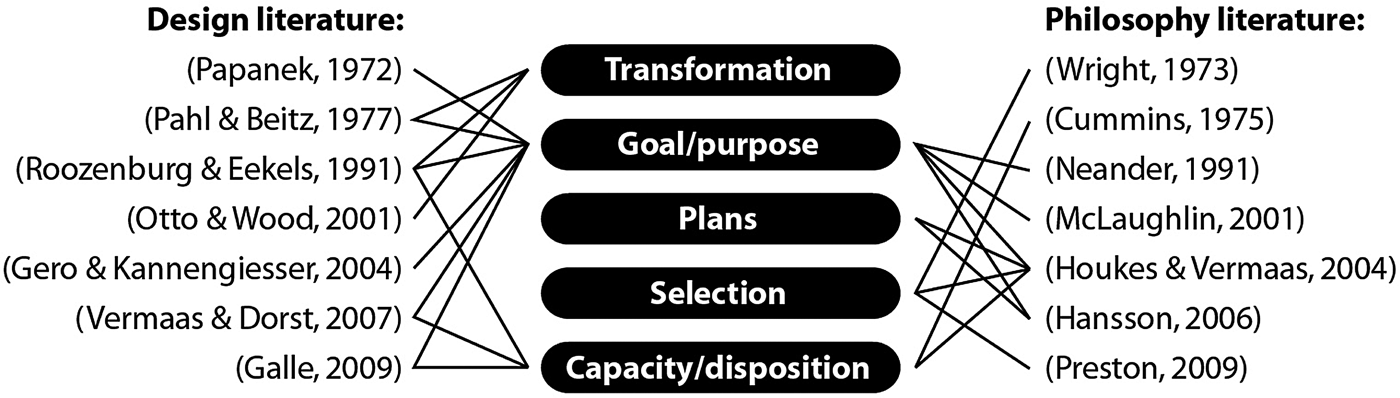
Concepts of function occupy a curious position in the study and practice of design. It is seemingly easy to state what the function of something is, and such statements are often freely made about existing or imagined objects. In contrast, the meaning of function is very difficult to pin down, and many definitions have been offered. This is the case in both design research and philosophy, the two disciplines that have considered the concept most (see reviews in Vermaas & Dorst, Reference Vermaas and Dorst2007; Erden et al., Reference Erden, Komoto, van Beek, D'Amelio, Echavarria and Tomiyama2008; Preston, Reference Preston and Meijers2009; Crilly, Reference Crilly2010; Houkes & Vermaas, Reference Houkes and Vermaas2010). These definitions of function typically emphasize one or more common concepts, including the transformation of an input to an output, satisfying the goal or purpose of an agent, the plans that such an agent may have, the effect of selective pressure, and the capacity or disposition of a system (see Fig. 1). Across this variety of definitions, two broad meanings of function can be distinguished: one meaning is that function describes how a thing works internally by the operation of its components; the other meaning is that function describes how a thing works externally to affect its environment (e.g., Chandrasekaran & Josephson, Reference Chandrasekaran and Josephson2000).Footnote 1 This article will focus on the second of these two meanings, but they are related; internal functions are the means by which external functions are realized (Chandrasekaran, Reference Chandrasekaran2005; Bell et al., Reference Bell, Snooke and Price2007).
Different definitions of function emphasize one or more common concepts. To illustrate this, some definitions from the design literature and the philosophy literature are here connected to the concepts that they emphasize. These definitions and others are collected in Crilly (Reference Crilly2010).

At its most basic level, function is usually expressed in statements that take the form “the function of S is R,” where S is a functioning system (often referred to as a “device”) and R is the role that the system plays.Footnote 2 Simple examples of such statements might be that the function of a pen is to transfer ink onto a page (Brown & Blessing, Reference Brown and Blessing2005; Vermaas, Reference Vermaas2009), or that the function of a door buzzer is to enable a visitor to inform someone inside a building that there is someone at the door (Chandrasekaran & Josephson, Reference Chandrasekaran and Josephson2000). In these examples, the pen and the buzzer are the systems (S), and the ink transfer and the informing are the roles (R) that those systems play. Function statements such as these are a type of design representation and are useful for developing methods and tools to support designers in their work. They are also used in artificial intelligence research aimed at formalizing design knowledge so that designing might be automated (Umeda & Tomiyama, Reference Umeda and Tomiyama1997; Rosenman & Gero, Reference Rosenman and Gero1998; Chakrabarti et al., Reference Chakrabarti, Shea, Stone, Cagan, Campbell, Hernandez and Wood2011; Vermaas & Eckert, Reference Vermaas and Eckert2013).
Statements of the form “the function of S is R” are often implicitly or explicitly referring to S's context or environment. More precisely, they might refer to a particular supersystem, Z, within which S is functioning.Footnote 3 After all, roles are played in something, such as the role that a stage actor plays in a theatrical performance or the role that a pen (or buzzer) plays in a communication process. As such, statements of the form “the function of S is R” can be expanded to “the function of S is R in Z.” At least two different expansions of this kind have been proposed: for Cummins (Reference Cummins1975, p. 762) and Kitcher (Reference Kitcher1993, p. 390), S functions with respect to a capacity of Z;Footnote 4 for Searle (Reference Searle1995, p. 19) and Houkes and Vermaas (Reference Houkes and Vermaas2009, p. 407), S functions with respect to a capacity to fulfill the goals of a user contained by Z.Footnote 5 These expansions are useful for making explicit how the function of a system is determined by the perspective we take on that system's supersystem. In this article, I want to also emphasize that S is not the only thing that contributes to the performance of R, and that S is not the only thing that R does. Thus, in the example of the pen inking the paper, the pen playing this role must be distinguished from systems other than the pen that contribute to the inking, such as the writer (i.e., contact and movement), the paper (i.e., friction and absorption), the planetary system (i.e., gravity) or the atmospheric system (i.e., pressure); and from other roles that the pen plays, such as taking up space or emitting noise. Any function statement is made against a background of these other systems and these other roles.
This article uses diagrams to make explicit the many systems, supersystems, and roles that are selected from when a function statement is made. To establish a context for the diagrams that are developed, the article starts by reviewing some existing representations of function (Section 2). With a view to developing a more general representation of function, the article then explores the different types of system that function and the different types of function that they perform (Section 3). A scheme of diagrams is then developed that first represents hierarchical systems (Section 4) and then multiple systems playing multiple roles (Section 5). This initially abstract argument is then applied to an example (Section 6), before the implications for future work are considered (Section 7). Overall, it is hoped that the representations developed and the arguments surrounding them might contribute to a clearer conception of what function statements are and the alternatives that they are selected from.
2. REPRESENTATIONS OF FUNCTION
To explore the selective nature of function statements and the perspectives that drive such selection, this article develops and uses diagrammatic representations that emphasize three aspects of function statements: the nested hierarchy of systems that the function relates to, the different systems that contribute to performing any given function, and the different functions that any given system might perform. Prior research on function has proposed various formal and diagrammatic notations, which in their different ways represent some of these aspects. However, each of these only represents some of what is required to make the arguments that this article sets out.
Artificial intelligence research has developed ontologies that distinguish the function of a system from its behavior and its structure (or its state). These include the function–behavior–structure ontology (Gero, Reference Gero1990; Gero & Kannengiesser, Reference Gero and Kannengiesser2004; also see Vermaas & Dorst, Reference Vermaas and Dorst2007; Galle, Reference Galle2009), the function–behavior–state ontology (Umeda et al., Reference Umeda, Takeda, Tomiyama, Yoshikawa and Gero1990; Umeda & Tomiyama, Reference Umeda and Tomiyama1997), and the structure–behavior–function ontology (Goel & Chandrasekaran, Reference Goel and Chandrasekaran1989; Goel et al., Reference Goel, Rugaber and Vattam2009). These function–behavior–structure and structure–behavior–function schemes sometimes distinguish between the intended effects that a system has and other side effects, thus indicating that systems perform multiple roles. However, for the most part, these schemes aim to represent the translation and comparison processes that are involved in activities of designing a component. The schemes do not emphasize the multiple levels of abstraction from which that component can be viewed or the multiple systems that contribute to a given role.
Attention to function in engineering design has traditionally taken a top-down approach, decomposing overall functions into subfunctions and assembling systems from components (or subsystems) that perform those subfunctions (Hubka & Eder, Reference Hubka and Eder1982; Pahl & Beitz, Reference Pahl, Beitz and Wallace1984; Hubka et al., Reference Hubka, Andreasen and Eder1988). This is sometimes represented with opposing tree diagrams that branch at each level of functional decomposition and that merge at each level of system composition (Umeda & Tomiyama, Reference Umeda and Tomiyama1997, p. 43; also see Chakrabarti & Bligh, Reference Chakrabarti and Bligh2001, p. 497).Footnote 6 The system performing a function can be viewed as the solution (the means) to solve a problem (the ends). The function and system trees can thus be viewed as comprising means–effects chains, where what is a means at one level of abstraction is an effect at another (Dym & Brown, Reference Dym and Brown2012, p. 35). These perspectives emphasize the hierarchical nature of systems but not the multiple roles played by any one of those systems.
The multiple roles played by any given system are represented by the function analysis diagram (Devoino et al., Reference Devoino, Koshevoy, Litvin and Tsourikov1997; Aurisicchio et al., Reference Aurisicchio, Bracewell and Armstrong2013). Here, components of a system are connected to each other through the effect that one has on the other. Components can affect multiple components and can experience multiple effects. The function analysis diagram notably depicts the functioning elements of a system rather than just the functions that unspecified elements perform (cf. Van Wie et al., Reference Van Wie, Bryant, Bohm, McAdams and Stone2005). However, unlike the functional decomposition and system composition diagrams, the function analysis diagram does not emphasize any hierarchy of nested systems. Freeman and Newell (Reference Freeman and Newell1971, p. 624) depicted such a hierarchy in a simple diagram aimed at introducing the notion of functional reasoning, and this was later elaborated into a set of diagrams to depict the functional relationships between different levels of hierarchy (Crilly, Reference Crilly2013). However, these schemes do not emphasize the multiple roles played by any given system or the multiple systems that contribute to performing any given role.
3. DIFFERENT TYPES OF SYSTEM AND DIFFERENT TYPES OF ROLE
The functional role that a system plays is often taken to be causal. For example, Chandrasekaran and Josephson (Reference Chandrasekaran and Josephson2000, p. 170) say of a door buzzer, “Its function is to provide a means by which a person at location1 may cause sound to be produced,” and considering a pen, Brown and Blessing (Reference Brown and Blessing2005, p. 3) say that “the function of the pen is to cause ink to flow” (emphasis added in both cases). Function might thus be considered as a concept that relates a system to the causal role that it plays. In many cases, that role is also taken to be transformative; it converts an input to an output (e.g., Pahl & Beitz, Reference Pahl, Beitz and Wallace1984; Otto & Wood, Reference Otto and Wood2001). However, just as the operation of a system can cause an effect, a system can also prevent something from occurring, permit a change to occur, encourage an action from a user, and so on. If we asked why certain systems or features are present in a design, or if we asked what they usefully do, we could identify not only the causal roles that such systems or features play but also, for example, their preventative, permissive, and encouraging roles, among others (e.g., Warell, Reference Warell1999).
In recognition of the nontransformative roles that systems play, the concept of affordances is sometimes used (e.g., see Maier & Fadel, Reference Maier and Fadel2009; Maier et al., Reference Maier, Fadel and Battisto2009). This relational concept emphasizes how two or more entities mutually permit interactions, whether the consequences of those interactions are positive or negative (from some point of view). Because this approach does not require direct causation, interpretive, psychological, and social roles are admitted, such as buildings affording aesthetics too occupants and passersby (Maier et al., Reference Maier, Fadel and Battisto2009, p. 396). However, outside of design research, function theory has long been applied to nontechnical systems that perform their functions in various ways and in some combination of ways (e.g., Searle, Reference Searle1995; Preston, Reference Preston1998, Reference Preston and Meijers2009). Consequently, function terminology is adopted in this article but with the view that all sorts of systems perform all sorts of roles, including not just those that are mechanical, structural, chemical or biological, but also those that are social, legislative, logical, aesthetic, and so on (see Crilly, Reference Crilly2010).
With the objective of developing a general representation of function, we must aim to accommodate the variety of functional roles that systems play. This is important because although many functions are traditionally described in physicochemical (i.e., technical) terms, other functions are often expressed with respect to people, requiring some human interpretation and action for the function to be fulfilled. For example, the pen and the buzzer both play a role in a communication process and therefore require social conventions (as well as physical behaviors) for their functions to be fulfilled (Searle, Reference Searle1995; Franssen & Jespersen, Reference Franssen and Jespersen2009). More generally, as we expand the boundaries of the system we consider, most designed or engineered systems either contain or interact with a variety of people, organizations, economies, and other entities that are often best understood on a sociotechnical basis (Kroes et al., Reference Kroes, Franssen, van de Poel and Ottens2006).
The sociotechnical systems that designers or engineers must analyze, understand, and improve are often partially designed and partially evolved (de Weck et al., Reference de Weck, Roos and Magee2011). This requires engineers to grapple with the complexity of systems that they only incompletely understand and to interpret emergent behavior that was not anticipated (Frei & Serugendo, Reference Frei and Serugendo2011a, Reference Frei and Serugendo2011b). The traditional top-down view of function decomposition and system composition is challenged by systems that might partially arise through bottom-up processes (Buchli & Santini, Reference Buchli and Santini2005). Some of a system's components may already exist rather than requiring design. Not all of their roles may be apparent and the roles that they are seen to play are determined by the level of abstraction adopted when viewing the hierarchy of systems that they are embedded in. Representations of functions should ideally be able to account for at least some of this complexity, permitting different types of system and different types of role to be considered, and for not all of these systems and roles to be fully designed or understood. This article approaches this objective by considering the nesting of hierarchical systems, the multiple roles that those systems play, and the multiple systems that perform each role.
4. NESTED SYSTEMS AND PROPAGATING ROLES
Saying that “the function of S is R in Z” involves taking a view of systems and their supersystems, a view that is supported by concepts from a number of researchers working on function (see review in Chakrabarti et al., Reference Chakrabarti, Srinivasan, Ranjan and Lindemann2013, p. 273). Although not often discussed in function theory, such a view leads to the observation that supersystems are systems in their own right and that they, in turn, have their own supersystems. There is nothing inherent in a hierarchy of systems that determines how many levels of hierarchy should be identified or that any one of those levels is naturally the system, with other systems only being defined relative to it (Umeda et al., Reference Umeda, Takeda, Tomiyama, Yoshikawa and Gero1990, p. 184; Craver, Reference Craver2001). In design practice, this implies that the system being considered by one group of engineers might be the subsystem of another group and the supersystem of another, or that one person's architecture is another person's component and vice versa (Buede, Reference Buede2000, p. 3; Maier & Rechtin, Reference Maier and Rechtin2009, p. 397). A function theory that connects different levels of a system hierarchy must therefore consider the possible supersystems that are of interest and the perspectives that define that interest.
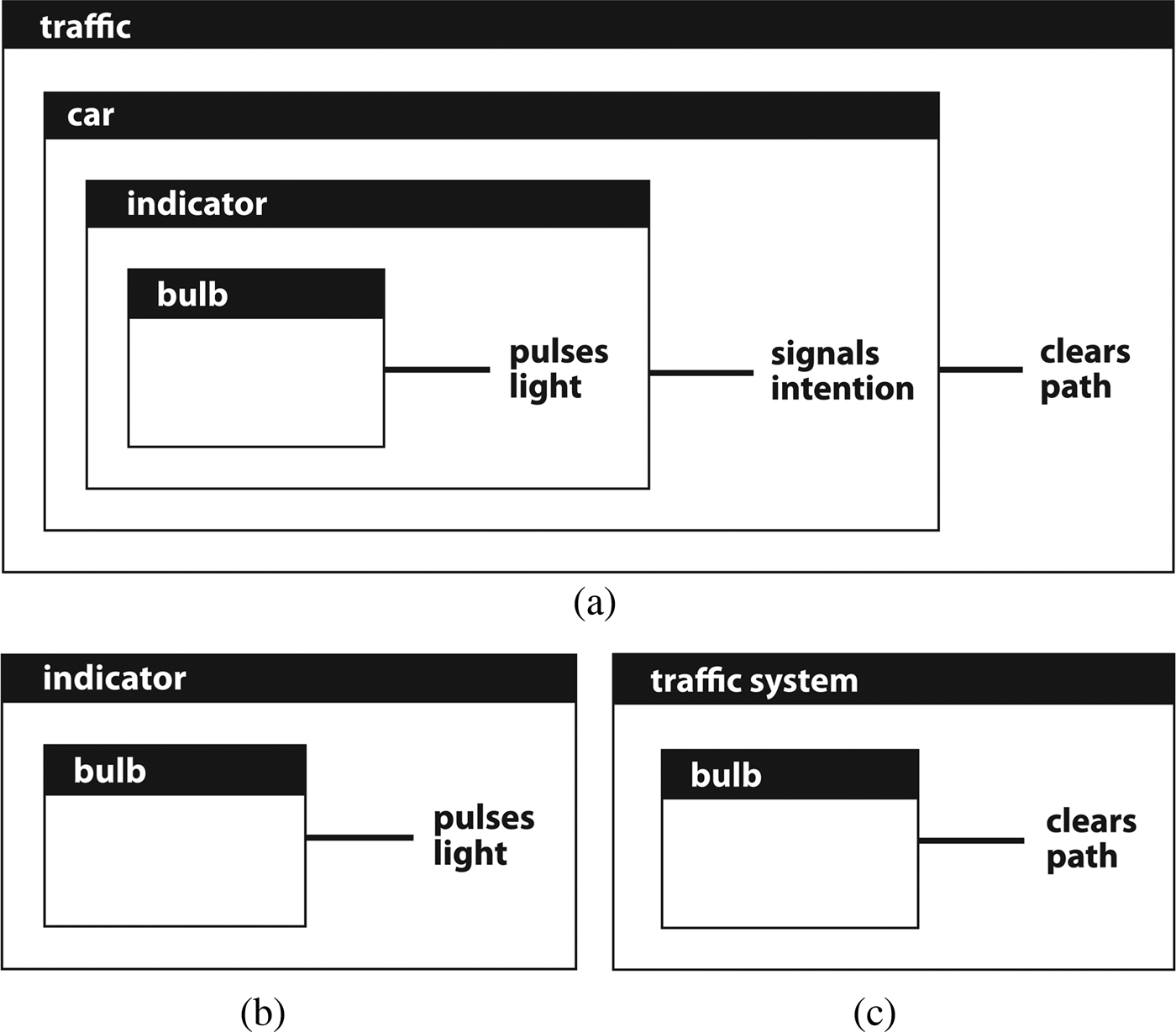
In considering a set of hierarchically nested systems, it is possible to consider that functions propagate from one layer of the nest to another (Crilly, Reference Crilly2013). On this account, a functioning system exists somewhere in a nest of systems, and it functions not only with respect to the roles it plays in its immediate supersystem but also with respect to its more distant supersystems (for supporting arguments, see Neander, Reference Neander1995, p. 117; McLaughlin; Reference McLaughlin2001, p. 55; Lewens, Reference Lewens2005, pp. 133, 158; also see Chakrabarti, Reference Chakrabarti1998).Footnote 7 To give an example, consider the indicator bulb (turn signal bulb) of a motor vehicle. In particular, consider a context in which the driver of a stationary vehicle uses the indicator to signal his or her intention to pull out into moving traffic; the other drivers respond by permitting a gap in the traffic to open up, and the first driver thereby pulls out into the traffic stream.Footnote 8 We could say that the bulb pulses light, which allows the indicator to signal intention, which allows (with the cooperation of other drivers) the car to clear a path in the traffic (see Fig. 2a).
Function propagation, illustrated with (a) an example of nested systems, (b) a function assignment that relates a system to a relatively immediate supersystem, and (c) a function assignment that relates a system to a relatively distant supersystem.
From this description of the indicator bulb, we might say that the function of the bulb is to pulse light with respect to the indicator system, a system that filters that light and directs it (see Fig. 2b). However, according to the notion of function propagation, a system performs functions not only with respect to its immediate supersystem but also with respect to all the supersystems within which its own supersystems play roles. For example, we might instead say that a function of the bulb is to clear a path in the traffic (see Fig. 2c), thus bypassing various layers of the nest described previously. The bulb's ability to perform this very distant function is contingent on a very broad range of other systems playing supporting roles. However, this is a change in degree rather than a change in kind because even the bulb's pulsing of light requires the support of other systems, such as those that supply energy and switch between an on and off state.
Function propagation implies that a statement of the form “the function of S is R in Z” involves identifying a system of interest, S, from somewhere in a nest of systems and then identifying a role, R, that S plays in a supersystem of interest, Z. The analytic perspectives from which function statements are made are seldom acknowledged, and the alternative systems, supersystems, and roles are thus hidden in conventional representations of function. In the following sections of this article, I aim to elaborate some of what is typically omitted from such representations and do so by working with a diagram that depicts how functions propagate (extend) and proliferate (branch) through nested systems. This is first done in an abstract way (Section 5) and then by returning to the example above (Section 6). Those readers who prefer to start with examples and then proceed to abstraction might like to begin with Section 6 and then return to Section 5 to see how the representation was developed.
5. NESTED SYSTEMS AND PROLIFERATING ROLES
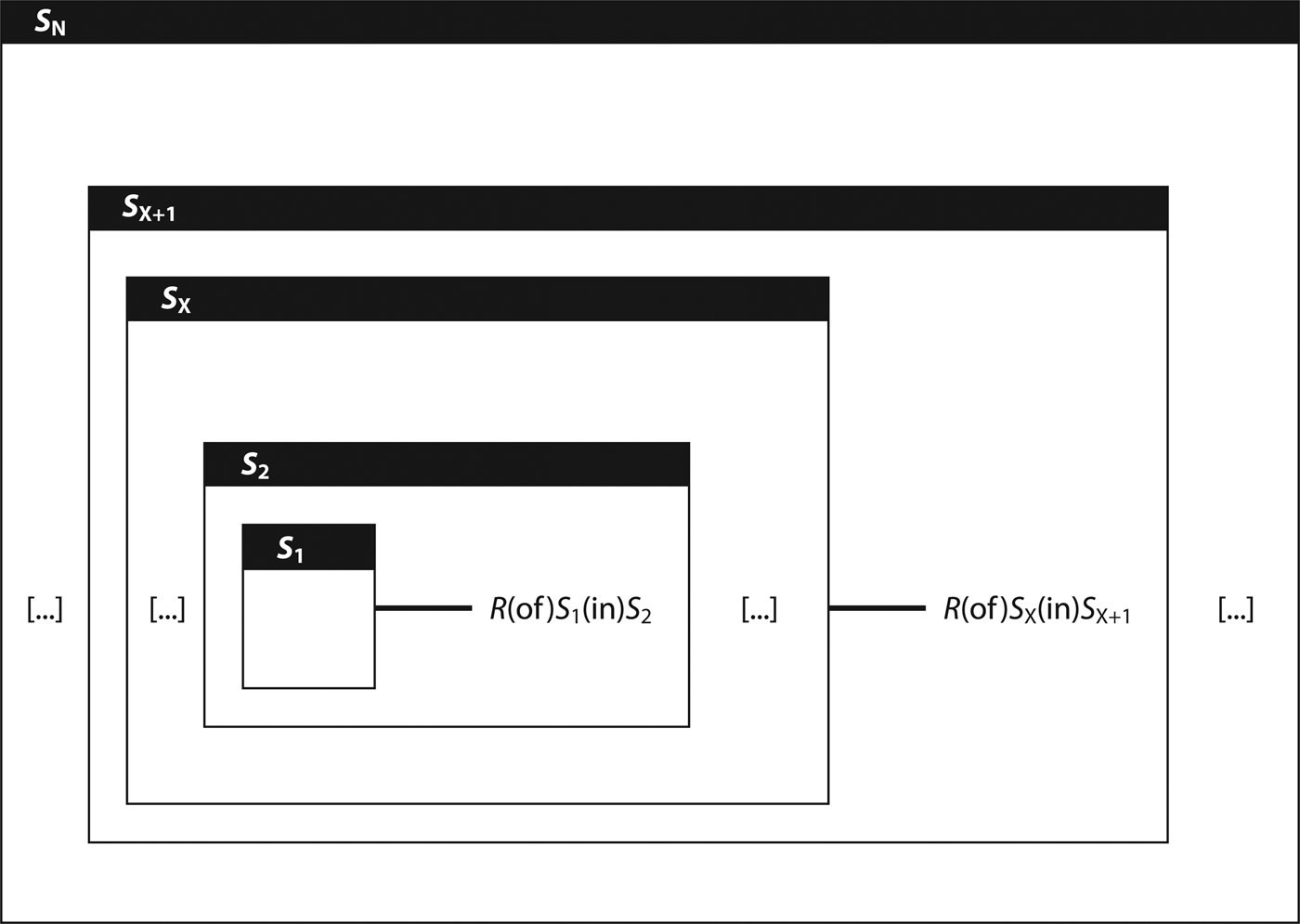
To start, we might identify a particular system, S X, which is located in an immediate supersystem of S X that we can denote as S X+1. (We drop the Z notation here, because there are many possible supersystems of S X. The system, S X, might function in each of these supersystems, and each of these supersystems might also be a functioning system in its own right.) If S X plays a role in S X+1, then we can call that role R(of)S X(in)S X+1; if S X+1 plays a role in S X+2, then we can call that role R(of)S X+1(in)S X+2, and so on. This can be represented with a set of nested boxes as shown in Figure 3. For completeness, if we consider function propagation, then S X also plays a role in S X+2, and we can call that role R(of)S X(in)S X+2; if S X plays a role in S X+3, then we can call that role R(of)S X(in)S X+3, and so on. In this basic notation, the “of” and the “in” are not required if the relation between the roles and systems is implied by their ordering (e.g., “R.S X.S X+1” would be sufficient), but the “of” and “in” are retained here to be explicit. Furthermore, the relation between the roles and systems is explicit in the diagrams because of the relative placing of the notation (within one system or another). As such, the use of the expanded notation in the diagrams is redundant but permits correspondence with the discussion in the text.
Nested hierarchy of systems and supersystems. There are N levels of system hierarchy (S 1 to S N), with any given system, S X, playing a role in its immediate supersystem, S X+1. Although not shown explicitly, any system might also be seen to play a role in any of its more distant supersystems.
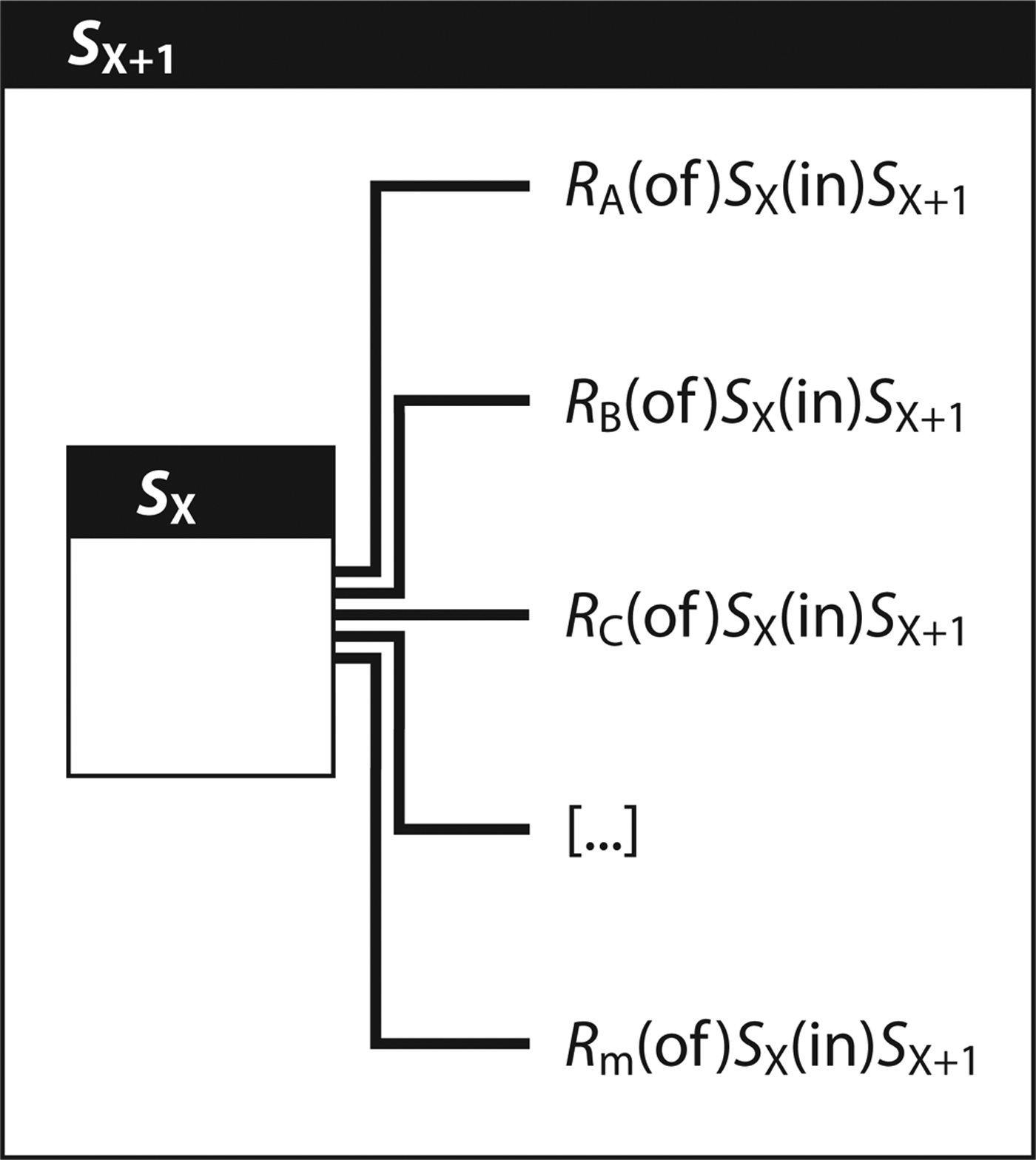
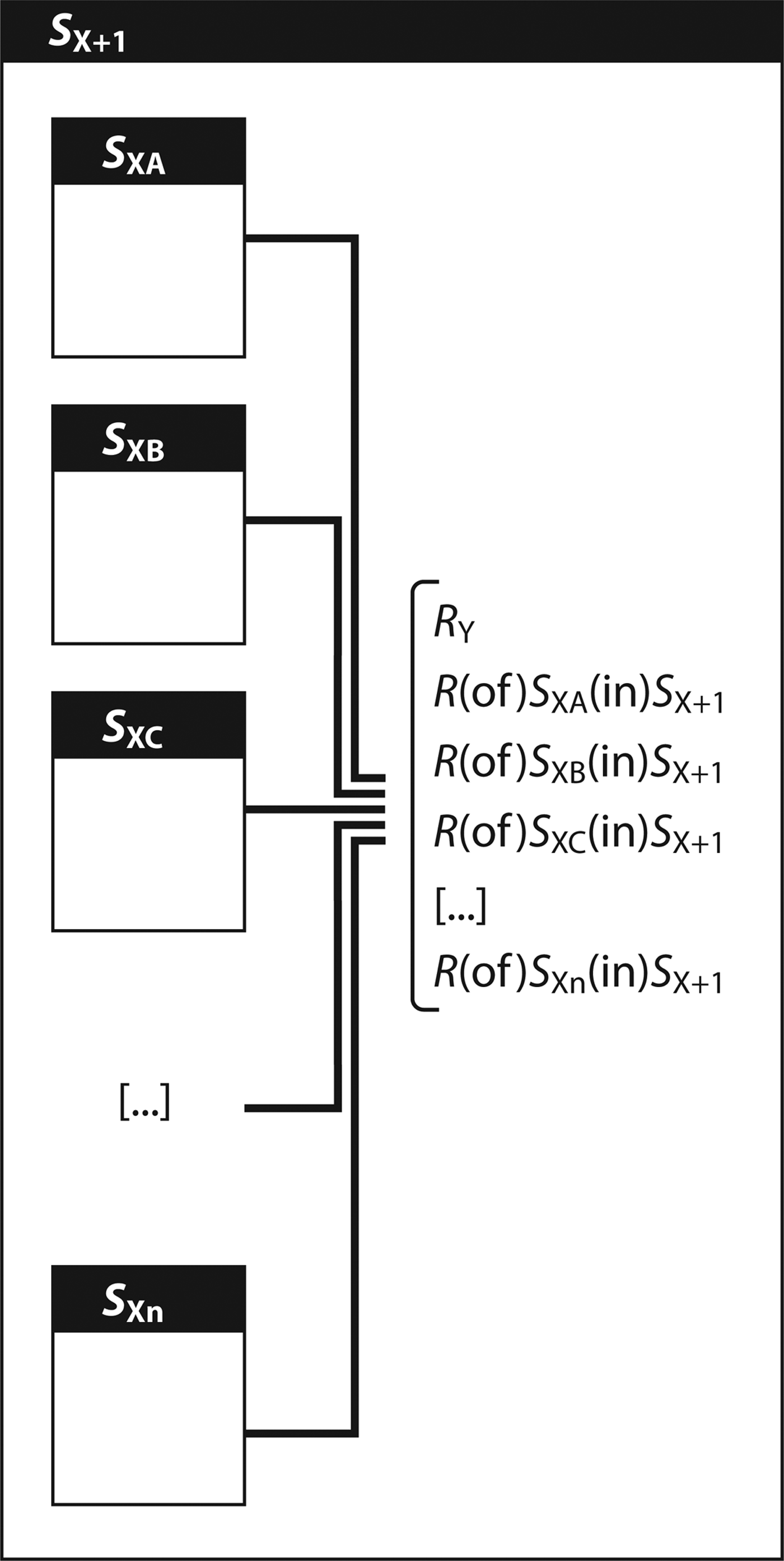
Any system may perform more than one role in its supersystem. If we identify a system, S X, which plays various roles in its supersystem, S X+1, then these roles might be referred to as R A, R B, R C, and so on. More completely, these roles might be written as R A(of)S X(in)S X+1, R B(of)S X(in)S X+1, R C(of)S X(in)S X+1, and so on. These multiple roles can be represented with a tree structure of branching roles as shown in Figure 4. However, not only do systems play multiple roles, but roles are played by multiple systems. If we identify a role, R Y, that is performed by (immediate) subsystems of S X+1, then these subsystems might be referred to as S XA, S XB, S XC, and so on. These systems perform roles R(of)S XA(in)S X+1, R(of)S XB(in)S X+1, R(of)S XC(in)S X+1, and so on. Here, the subsystems of S X+1 are collectively performing a single role, which can be referred to as R Y or as R(of)S XA(in)S X+1, R(of)S XB(in)S X+1, or R(of)S XC(in)S X+1. This can be represented by another tree structure, this time of systems converging on a given role as shown in Figure 5. (In this basic notation, incrementing numbers denote different layers of a nested hierarchy, and incrementing letters denote different systems or roles at the same layer in the nest.)
Tree structure of multiple roles played by a system. System S X plays m roles (R A – R m) in its supersystem, S X+1. The diverging tree structure is similar in principle to the “event tree” diagrams used in reliability engineering (Roush & Webb, Reference Roush and Webb2006, pp. 264–266).
Tree structure of subsystems performing a role. System S X+1 has n immediate subsystems playing a role, R. The bracketed roles are all equivalent; there is a single role being played in S X+1, and that role is collectively played by S XA to S Xn. The converging tree structure is similar in principle to the “fishbone” diagrams used in quality engineering (Ishikawa, Reference Ishikawa1990, pp. 229–233).
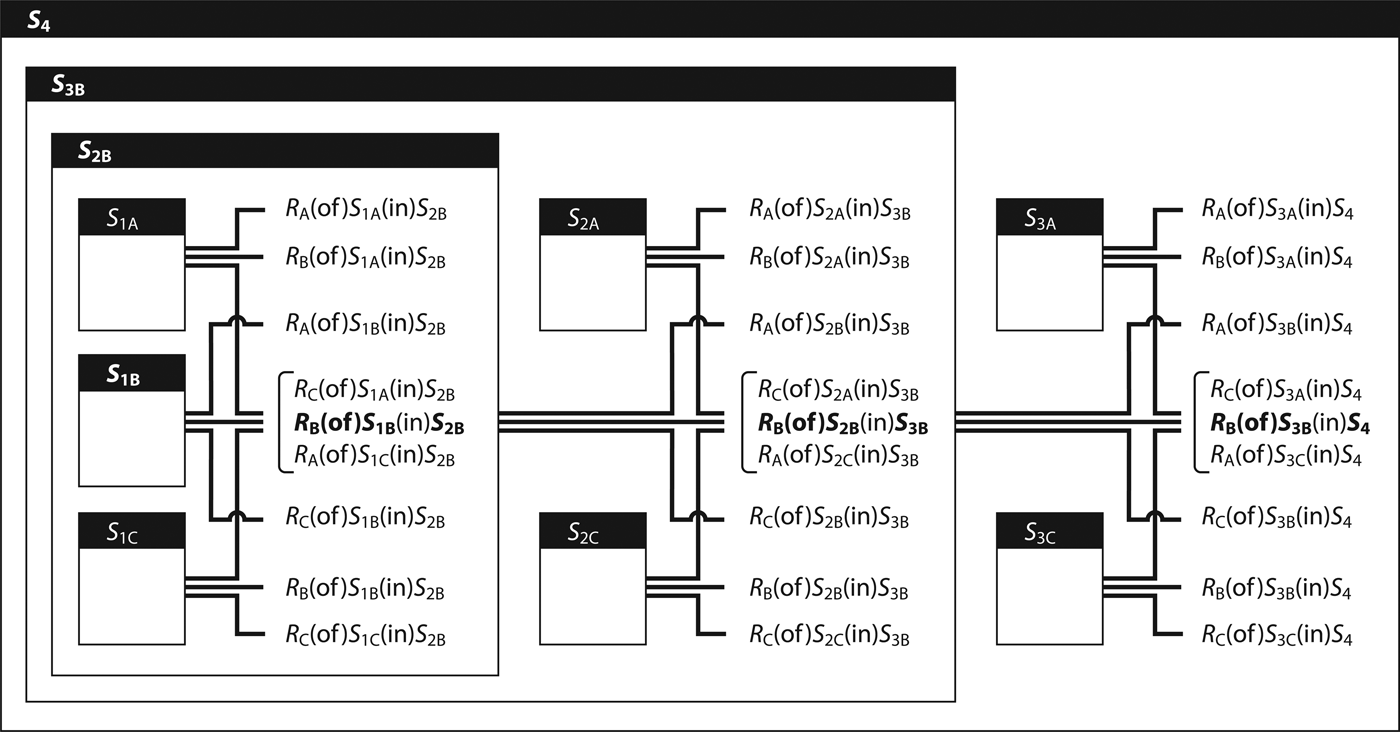
If a given system can play multiple roles, and if a given role can be collectively played by multiple systems, then the different types of tree shown in Figures 4 and 5 can be combined to form a pair of opposing trees. If functions are considered within the context of a nested hierarchy, such as that shown in Figure 3, then these opposing trees propagate through the nest to form a network of possible functions (see Fig. 6). The network gets very dense very quickly as we increase the number of nested systems, the number of roles that each system might play, and the number of subsystems that comprise each system.
A combination of nested hierarchies, branching roles, and branching systems. To avoid taking up too much space here, only four levels of hierarchy are shown (N = 4), each subsystem only performs three roles (m = 3 at each level), and each supersystem only has three subsystems contributing to a role (n = 3 at each level). In this basic diagram, a role such as “R B(of)S 1B(in)S 2B” could be more simply denoted as “R B” because the system playing the role (S 1B) and the supersystem that that role is played within (S 2B) are indicated diagrammatically.
Regarding the systems and roles that are arranged along the central axis of Figure 5, we could say that system S 1B plays roles R A, R B, and R C in system S 2B. We could also say that R B, or more precisely, R B(of)S 1B(in)S 2B, is supported by both systems S 1A and S 1C, which play roles R C(of)S 1A(in)S 2B and R A(of)S 1C(in)S 2B, respectively. Thus, in combination, S 1A, S 1B, and S 1C permit S 2B to perform its own R B, or more precisely, R B(of)S 2B(in)S 3B. Similarly, we could also say that R B(of)S 1B(in)S 2B is supported by both S 2A and S 2C, which play R C(of)S 2A(in)S 3B, and by R A(of)S 2C(in)S 3B, respectively. This pattern of collective and multiple role-playing is here called proliferation of functions. It extends out to the third and fourth levels of the system hierarchy, and would extend further if other systems were considered.
The proliferation of functions is distinct from the concept of function propagation, where the function of S 1B might be to perform R B(of)S 1B(in)S 2B, R B(of)S 1B(in)S 3B, or R B(of)S 1B(in)S 4. Instead, considering the proliferation of functions means acknowledging that the function of S 1B might otherwise be to perform R A(of)S 1B(in)S 2B or R C(of)S 1B(in)S 2B (depending on perspective), just as performing R B(of)S 1B(in)S 2B is something that S 1B does in conjunction with S 1A and S 1C. Thus, if we were to make a simple statement like “the function of S X is R Y in S Z,” then we have selected systems S X and S Z from somewhere in the nest, and we have selected a role, R Y, from somewhere in the network of branches between them. We could also describe the function of some other system, but even if we do select system S X to be the functioning system, we can still say that the function of S X is to play some role other than R Y, simply by selecting a different supersystem that S X functions within, by selecting some other role that S X plays within the same supersystem, or by selecting some other system that contributes to R Y. These matters are at the discretion of the analyst.
With so many systems playing so many roles in so many other systems, what is it that determines that we select S X, R Y, and S Z rather than some other systems and some other role? First, it is determined by our being interested in a certain type of system; in design that is often a system that we can specify, introduce, or improve. Second, it is determined by our being interested in a certain supersystem that the system plays a role within; in different design disciplines, this varies from relatively local technical systems to more global sociotechnical systems. Third, it is determined by our being interested in a certain type of role rather than other types; in design, that is often those intended beneficial roles that the first system plays with respect to the second. Those reasons for selecting S X, R Y, and S Z can be made explicit by contrasting them with the alternatives drawn out in a function network such as that shown in Figure 5 but are perhaps more easily considered by applying the concept of proliferation to an example.
6. APPLICATION TO AN EXAMPLE
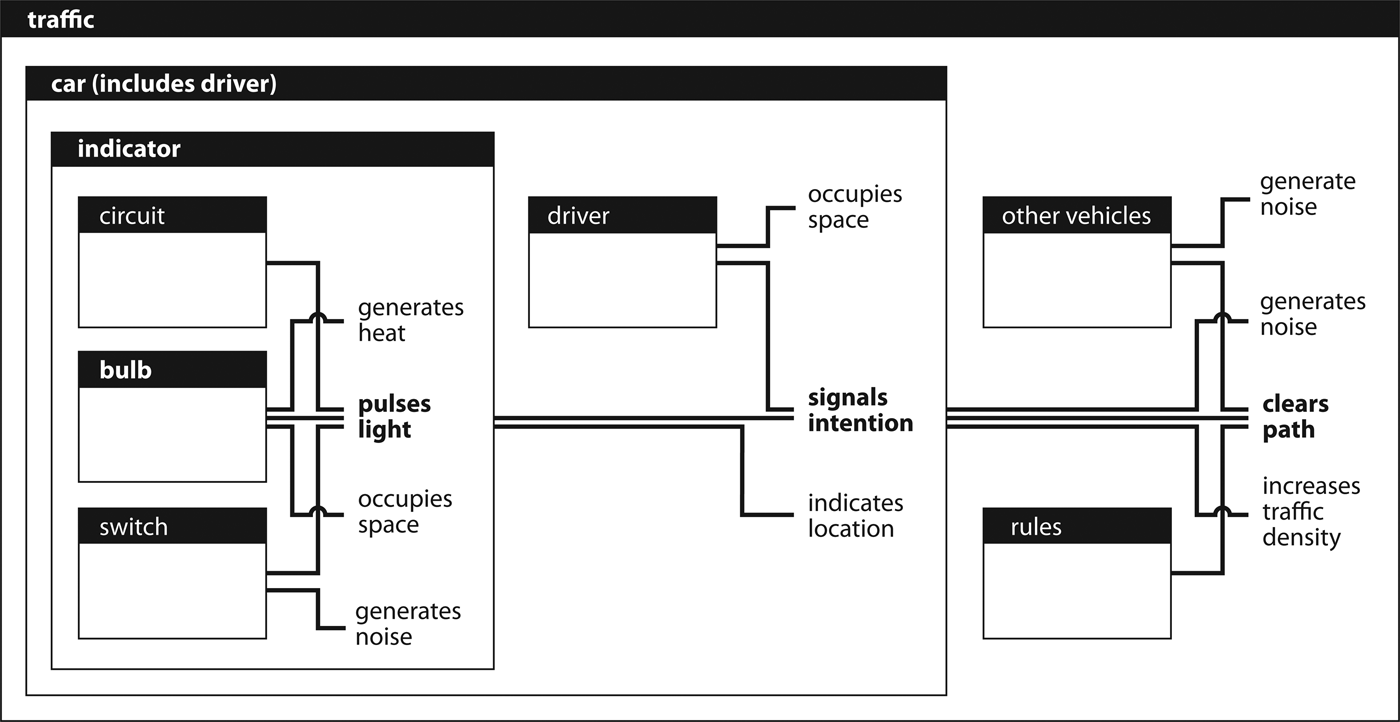
To illustrate the general argument developed above, let us return to the example of the indicator bulb of a motor vehicle. In particular, let us again consider the situation in which the driver of a stationary vehicle uses the indicator to signal his or her intention to pull out into moving traffic. As before, when activated in the right way, the indicator bulb pulses light that signals intention (the driver's intention to turn), which encourages other drivers to clear a path (in the traffic). It is by means of the bulb's pulsing light that the indicator system signals the driver's intention. However, the indicator bulb does much more than just pulse light; it also (as side effects) generates heat, occupies space, and so on. Furthermore, by pulsing light, the indicator system not only signals intention but also, for example, indicates the location of the vehicle, and so on. Finally, although the signaling of intention permits the car (including the driver) to clear a path in the traffic, it also does other things, such as generate noise and increase the local traffic density (see Fig. 7).
Example of how functions proliferate through nested systems. The diagram is necessarily incomplete, but attention has been focused on developing the central chain that runs from the bulb to the clearing of the path.
Each system only plays its role with respect to another system if certain other systems also play their roles. The bulb only pulses light if it is connected in an electrical circuit, if a switch alternates between an on and off state, and so on. In this sense, we could say that the electrical circuit pulses light only if the bulb and the switch play their roles, or conversely, that the switch pulses light only if the circuit and the bulb play their roles. At the next level out in the nest of systems, the driver, in combination with the indicator, signals intention. Whether the function of the driver is to signal intention (with the support of the indicator) or whether the function of the indicator is to signal intention (with the support of the driver) is a matter of perspective. Similarly, the signaled intention only clears a path if the other vehicles respond and if there is a set of rules (e.g., legal or social rules) that tells them how to respond. Clearing a path can be seen as a function of the rules or a function of the other vehicles, the car, its driver, its indicator, the switch, the circuit, or the bulb. It is at our discretion how we specify which is the functioning system and which are the supporting systems, just as we must distinguish functions from side effects.
Despite the complexity outlined above (which in any case is only for a small set of systems), in many instances analysts will adopt a perspective where there is one simple route through the network of branches that is considered functional. If we pick a line through the network that connects the pulsing of the bulb to the clearing of the path, then we have simply picked the line that most interests us. If the network had been drawn out more completely, then it would be possible to pick some other line through the network and thereby connect the pulsing of the bulb with some other final role, or connect the clearing of the path with some other functioning system. Although function statements can often seem objective and descriptive, they are subjective and normative. The relevant systems and roles that define a function are selected from a wide range of alternatives, and that selection is determined by the interests and preferences of the analyst.
7. SUMMARY AND DISCUSSION
In this article, I have sought to make explicit the range of alternatives from which a function statement is selected. Where such statements take the general form “the function of S is R,” then three things have been left implicit. First, the functioning system, S, may perform the role, R, in one supersystem but might perform other roles in other supersystems; the number of systems that support S in performing R increases as the supersystems become more distant. Second, the functioning system, S, does not perform the role, R, all by itself; those other systems that support S in performing R might also have been considered functional, with S then being a supporting system. Third, there are many other roles that S plays in a given supersystem apart from R; the role, R, is not the only role that S performs, and those other roles might also have been considered functional.
This article has used diagrams that depict functions propagating through hierarchies of nested systems and proliferating at each layer of the nest, thus forming a network of functions. That picture can be complicated in three ways: by how much branching occurs at each node of the trees (how many systems shall we consider for each role and how many roles for each system?); by the possible variation in how fine-grained the distinction is between system boundaries (how many systems do we see mediating between the “smallest” subsystems and the “largest” supersystems?); and by what we define to be those smallest and largest systems (when shall we stop asking what the subsystems and supersystems of our systems are?). There is no definite answer to these questions, they are perspective dependent and may reasonably vary according to what different systems are identified and what different roles are seen to be played by and in those systems.
Although we could complicate the representations used here by attending to the three questions above, this would not necessarily change the basic structure of that representation. Still, that structure might be changed by taking a more sophisticated step. Not all systems nest in the relatively neat way considered here, with all of a system's subsystems also being subsystems of that system's supersystems. Instead, it might be that a system is contained by two or more encompassing supersystems that overlap rather than nest within each other. Those roles that are considered nonfunctional with respect to one set of supersystems (i.e., considered as side effects) might still be considered functional with respect to another. Especially when large, complex sociotechnical systems are considered, technical devices might be seen as subsystems of a broad range of other systems, including not only larger technical systems but also social, economic, and political systems. Those systems and roles that are considered nonfunctional with respect to one set of supersystems (i.e., those that are assumed or are considered as side effects) might still be considered functional with respect to another.
Whether in simple or complex form, explicitly representing the range of alternatives from which a function statement is selected encourages statements that are more complete. This is of interest when developing design methods or tools that recognize the many different types of system and different layers of systems that designers might be working on and the many different types of roles that those systems play, often in concert. This might be relevant to a single project with a design team working on specific components, systems, and environments. In contrast, it might be used for communication across projects and teams, where different types of systems and different types of roles are considered functional. Explicitly representing the range of options from which a function statement is selected also encourages consideration of the analytic perspectives that are used to construct such statements. This is of interest when researchers strive to formalize design knowledge, especially for developing computing technologies that can represent and reason about a device's function, rather than just its structure.
The arguments presented in this article raise two important questions when we consider the formalizzation and representation of function statements. First, if a system plays many roles in many supersystems, how should we specify which of these roles are the functions of interest? Second, if a given role is collectively performed by many systems, how should we specify which of these systems is the functional one and which are supporting that functioning system? Considering the traditional example of a pen inking paper, a human analyst might intuitively distinguish inking as the functional role rather than any other side effect of the pen's existence or operation, such as taking up space or emitting noise. Similarly, a human analyst might intuitively consider the pen to be the functioning system rather than any other system that contributes to the inking, such as the writer, the paper, the planetary system, or the atmospheric system. However, only by making intuitions such as these explicit and by distinguishing them from the alternatives can we begin to formalize and encode them, and thus develop more complete representations of function.
Acknowledgments
The author is grateful to the reviewers for helpful suggestions that improved the structure and content of the article. This work was partly supported by an Early Career Fellowship (EP/K008196/1) from the United Kingdom's Engineering and Physical Sciences Research Council (EPSRC) and by an Interdisciplinary Fellowship in Philosophy (Crausaz Wordsworth 2013/14) from the Centre for Research in the Arts, Social Sciences and Humanities (CRASSH) at the University of Cambridge.
Nathan Crilly is a Lecturer in engineering design at the University of Cambridge. He is a Fellow in Engineering at Clare College, Cambridge, and a member of the Design Research Society and the Design Society. He also serves on the International Editorial Board of Design Studies. Mr. Crilly's research interests are in the areas of design, technology, and communication. He employs an interdisciplinary approach to studying how products are developed, the properties they exhibit, and the ways in which people use them.