Introduction
Anxiety disorders are common among individuals with bipolar disorder; nearly one in two has a lifetime diagnosis of at least one anxiety disorder (Pavlova et al. Reference Pavlova, Perlis, Alda and Uher2015). Co-morbidity between bipolar disorder and anxiety disorders has been gaining increasing attention in recent years (Provencher et al. Reference Provencher, Guimond and Hawke2012) and numerous studies have highlighted the association of anxiety disorders with unfavourable outcomes in people with bipolar disorder, including greater number of recurrences (Simon et al. Reference Simon, Otto, Wisniewski, Fossey, Sagduyu, Frank, Sachs, Nierenberg, Thase and Pollack2004; Sala et al. Reference Sala, Goldstein, Morcillo, Liu, Castellanos and Blanco2012; Hawke et al. Reference Hawke, Provencher, Parikh and Zagorski2013), more severe depressive episodes (Simon et al. Reference Simon, Otto, Wisniewski, Fossey, Sagduyu, Frank, Sachs, Nierenberg, Thase and Pollack2004; Gaudiano & Miller, Reference Gaudiano and Miller2005; O'Garro-Moore et al. Reference O'Garro-Moore, Adams, Abramson and Alloy2015), higher rates of substance abuse (Boylan et al. Reference Boylan, Bieling, Marriott, Begin, Young and MacQueen2004; Simon et al. Reference Simon, Otto, Wisniewski, Fossey, Sagduyu, Frank, Sachs, Nierenberg, Thase and Pollack2004; Gao et al. Reference Gao, Chan, Verduin, Kemp, Tolliver, Ganocy, Bilali, Brady, Findling and Calabrese2010), less favourable response to treatment (Henry et al. Reference Henry, Van den Bulke, Bellivier, Etain, Rouillon and Leboyer2003) and more frequent suicide attempts (Simon et al. Reference Simon, Otto, Wisniewski, Fossey, Sagduyu, Frank, Sachs, Nierenberg, Thase and Pollack2004; Goes et al. Reference Goes, McCusker, Bienvenu, Mackinnon, Mondimore, Schweizer, Depaulo and Potash2012; Thibodeau et al. Reference Thibodeau, Welch, Sareen and Asmundson2013; Schaffer et al. Reference Schaffer, Isometsä, Tondo, Moreno, Turecki, Reis, Cassidy, Sinyor, Azorin, Kessing, Ha, Goldstein, Weizman, Beautrais, Chou, Diazgranados, Levitt, Zarate, Rihmer and Yatham2015).
Some reports suggest that the increased prevalence of anxiety disorders in individuals with bipolar disorder may be fully explained by symptoms arising during depressive episodes. For example, Mantere et al. (Reference Mantere, Isometsa, Ketokivi, Kiviruusu, Suominen, Valtonen, Arvilommi and Leppamaki2010) described a longitudinal association between anxiety and depression in patients with bipolar disorder and a small study showed that obsessive–compulsive disorder may wax and wane with mood episodes in this population (Strakowski et al. Reference Strakowski, Sax, McElroy, Keck, Hawkins and West1998).
However, other pieces of evidence indicate that the prevalence of anxiety disorders remains high during euthymia. Studies that assessed anxiety disorders in euthymic individuals with bipolar disorder reported that the current and lifetime prevalence rates were very similar (Tamam & Ozpoyraz, Reference Tamam and Ozpoyraz2002; Zutshi et al. Reference Zutshi, Reddy, Thennarasu and Chandrashekhar2006; Albert et al. Reference Albert, Rosso, Maina and Bogetto2008). Moreover, anxiety disorders often precede the emergence of the first episode of bipolar disorder by a number of years (Duffy et al. Reference Duffy, Horrocks, Doucette, Keown-Stoneman, McCloskey and Grof2013). Most co-morbidity studies do not distinguish between participants who are in a current mood episode and participants who are euthymic. Those that focus on current anxiety disorders in people with bipolar disorder during euthymia report a wide range of estimates; between 7% (Vieta et al. Reference Vieta, Colom, Corbella, Martinez-Aran, Reinares, Benabarre and Gasto2001) and 50% (Tamam & Ozpoyraz, Reference Tamam and Ozpoyraz2002; Zutshi et al. Reference Zutshi, Reddy, Thennarasu and Chandrashekhar2006). Therefore, it is unclear whether the prevalence of anxiety disorders is also increased outside of the depressive episodes. This question has implications for service provision. If the prevalence of anxiety disorders is low outside depressive episodes, anxiety in people with bipolar disorder will be best addressed by treating and preventing depression. If the prevalence is increased even outside depressive episodes, additional treatments for anxiety disorders in people with bipolar disorder are needed.
To better estimate what proportion of euthymic individuals with bipolar disorder meet diagnostic criteria for anxiety disorders, we carried out a meta-analysis of current prevalence rates of anxiety disorders amongst individuals with bipolar disorder during euthymia, and compared it with population controls.
Method
Inclusion and exclusion criteria
We included reports of current prevalence rates of Diagnostic and Statistical Manual of Mental Disorders, 3rd edition (DSM-III) or DSM, 4th edition (DSM-IV) anxiety disorders (i.e. panic disorder, agoraphobia, social anxiety disorder, generalized anxiety disorder, specific phobia, obsessive–compulsive disorder, post-traumatic stress disorder, and anxiety disorder not otherwise specified) in adults with bipolar disorder who were euthymic at the time of the interview. We defined euthymia as an absence of a mood episode established by a validated diagnostic interview and/or as a score below recognized cut-offs on validated symptom measures; i.e. the Montgomery–Åsberg Depression Rating Scale or Hamilton Depression Rating Scale for depression and the Young Mania Rating Scale or Beck–Rafaelsen Mania Scale for mania. We included only non-overlapping original datasets from studies that recruited participants regardless of co-morbidity and used a validated diagnostic interview to diagnose bipolar disorder and anxiety disorders. We contacted authors to provide additional data. Studies that only reported lifetime prevalence rates or that were unclear on whether they focused on lifetime or current prevalence rates were excluded.
For the analyses of current prevalence of any anxiety disorder, we included studies where at least two anxiety disorders were assessed (in fact, each study included assessed at least four anxiety disorders) and the prevalence of any anxiety disorder was provided or could be obtained from the authors. For the current prevalence of specific anxiety disorders, we included studies that reported the current prevalence of at least one anxiety disorder. For the comparison between euthymic people with bipolar disorder and controls, we included studies that reported the prevalence rates for both groups. In samples where we had access to individual-level data, we selected controls as all individuals without a lifetime diagnosis of bipolar disorder and without any major mood episode in the past 12 months.
Search strategy
We searched PubMed/Medline and Web of Science for studies published from the database inception up until 31 December 2015 regardless of language. We used a combination of the search term ‘bipolar’ and terms describing anxiety disorders (‘anxiety’, ‘panic disorder’, ‘agoraphobia’, ‘social phobia’, ‘social anxiety’, ‘generalized anxiety disorder’, ‘specific phobia’, ‘obsessive compulsive disorder’, ‘post-traumatic stress disorder’). We searched bibliographies of the identified articles. We also gathered additional data by contacting the authors.
Data extraction
Two authors (B.P. and R.U.) extracted the following information from the identified articles: author, study year, sampling (clinical or community), number of individuals with different subtypes of bipolar disorder, number of males and females, their age (mean and standard deviation), interviewers’ professional background, diagnostic instrument used to diagnose bipolar disorder, diagnostic instrument used to diagnose anxiety disorders, the number of anxiety disorders assessed, the number of individuals assessed and the number of individuals with the diagnosis of any anxiety disorder and with each specific anxiety disorder that was assessed (i.e. panic disorder, agoraphobia, social anxiety disorder, generalized anxiety disorder, specific phobia, obsessive–compulsive disorder, and post-traumatic stress disorder). From papers with information on current prevalence of anxiety disorders in a comparison group of individuals without bipolar disorder, we also extracted data on the number of control individuals assessed, the number of control individuals who met criteria for any anxiety disorder and the number of those that met criteria for the specific anxiety disorders. We resolved inconsistencies in consensus meetings and by contacting the authors.
Meta-analysis
We used Stata programs metaprob and metan (Bradburn et al. Reference Bradburn, Deeks, Altman, Sterne, Newton and Cox2009) to synthesize the prevalence rates and to compare these between people with and without bipolar disorder. To provide estimates that generalize to populations beyond those sampled in existing studies, we carried out random-effects meta-analyses using the DerSimonian and Laird method to establish random-effects estimates. This method incorporates between-study variance into the study weights and into the standard errors of the overall estimate. We tested heterogeneity in the prevalence of current anxiety disorders between studies with Cochran's Q and we quantified heterogeneity as I 2, which reflects the proportion of between-study variance that is due to heterogeneity as opposed to chance. We present results as absolute rates and risk ratios with 95% confidence intervals (CIs). We interpret tests with a p < 0.05 as statistically significant. All p values are two-sided.
Results
Identification of studies and description of the sample
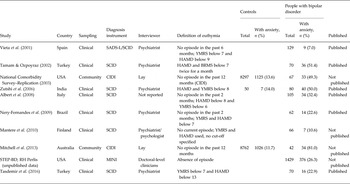
We identified 10 studies that reported data on the current prevalence of any anxiety disorder in individuals with bipolar disorder during euthymia (Table 1, online Supplementary Fig. S1). Two of these were studies of general community samples and eight were studies of clinical samples. Jointly, these 10 studies reported on 2120 individuals with bipolar disorder, including 1558 with bipolar I disorder, 551 with bipolar II disorder, five with bipolar disorder not otherwise specified and six from a study that did not distinguish between bipolar II disorder and bipolar disorder not otherwise specified. All individuals were euthymic at the time of the interview. The mean age of participants was 40.2 (s.d. = 12.9) years, and 56% were women. For four of these datasets, comprising 1604 individuals, the rates of current anxiety disorders during euthymia were not previously published: three were extracted from the datasets provided by study authors for the present meta-analysis [Jorvi Bipolar Study (O Mantere, personal communication); Australian National Survey of Mental Health and Well-Being (P Mitchell, personal communication); Systematic Treatment Enhancement Program for Bipolar Disorder (STEP-BD; RH Perlis, personal communication)] and one dataset was publicly available and accessed online (National Comorbidity Survey–Replication, 2003). The rates in the remaining six samples included in the meta-analysis had been published before (Vieta et al. Reference Vieta, Colom, Corbella, Martinez-Aran, Reinares, Benabarre and Gasto2001; Tamam & Ozpoyraz, Reference Tamam and Ozpoyraz2002; Zutshi et al. Reference Zutshi, Reddy, Thennarasu and Chandrashekhar2006; Albert et al. Reference Albert, Rosso, Maina and Bogetto2008; Nery-Fernandes et al. Reference Nery-Fernandes, Quarantini, Galvao-de-Almeida, Rocha, Kapczinski and Miranda-Scippa2009; Tasdemir et al. Reference Tasdemir, Tamam, Keskin and Evlice2016). One additional published study of a clinical sample (Kruger et al. Reference Kruger, Braunig and Cooke2000) reported only rates of individual anxiety disorders and was used in analyses of specific anxiety disorders, but did not contribute to the meta-analysis of any current anxiety disorder.
Studies included in estimating the rates of current prevalence of any anxiety disorder among people with bipolar disorder during euthymia

SADS-L, Schedule for Affective Disorders and Schizophrenia, lifetime version; SCID, Structured Clinical Interview for DSM Disorders; YMRS, Young Mania Rating Scale; HAMD, Hamilton Depression Rating Scale; BRMS, Bech–Rafaelsen Mania Scale; CIDI, World Health Organization World Mental Health Composite International Diagnostic Interview; STEP-BD, Systematic Treatment Enhancement for Bipolar Disorder; MINI, M.I.N.I. International Neuropsychiatric Interview.
Current prevalence of anxiety disorders in people with bipolar disorder during euthymia
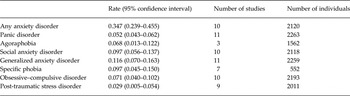
Based on 10 non-overlapping datasets including 2120 euthymic people with bipolar disorder, the current prevalence of any anxiety disorder was 34.7% (95% CI 23.9–45.5%; Fig. 1). There was a significant heterogenity between studies (Q = 223.81, 9 degrees of freedom, p < 0.001, I 2 = 96.0%, 95% CI 94.2–97.2%). Generalized anxiety disorder was most common (11.6%), followed by social anxiety disorder (9.7%), specific phobia (9.7%) and obsessive–compulsive disorder (7.1%) (Table 2).
Current prevalence of any anxiety disorder among people with bipolar disorder during euthymia. ES, Estimate; CI, confidence interval; NCSR, National Comorbidity Survey–Replication; STEP-BD, Systematic Treatment Enhancement for Bipolar Disorder.

Current prevalence of anxiety disorders in individuals with bipolar disorder during euthymia

As more than a half of the individuals included in the meta-analysis came from the STEP-BD dataset, we performed a sensitivity analysis to establish whether the result was not driven by this dataset. Based on the nine remaining datasets with 691 participants (after excluding STEP-BD), the current prevalence of anxiety disorders was 36% (95% CI 20.55–51.42%), a result nearly identical to the main result.
Comparison with general population controls
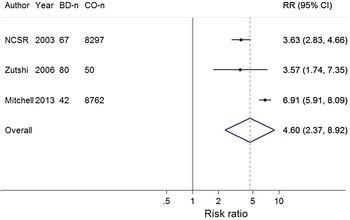
We identified three samples that included both individuals with remitted bipolar disorder and control subjects. The majority of the included data has not been published before and comes from two community surveys [Australian National Survey of Mental Health and Well-Being (P Mitchell, personal communication) and National Comorbidity Survey–Replication, 2003]. The remaining data come from a published study that compared a clinical sample of people with remitted bipolar disorder with a convenience control sample of individuals without bipolar disorder (Zutshi et al. Reference Zutshi, Reddy, Thennarasu and Chandrashekhar2006). A random-effects meta-analysis of these three studies of 189 euthymic individuals with bipolar disorder and 17 109 controls showed a 4.6-fold increase (risk ratio 4.60, 95% CI 2.37–8.92, p < 0.001) in the current prevalence of any anxiety disorder in people with bipolar disorder (Fig. 2) compared with the 12.7% rate in controls (95% CI 11.0–14.4%). There was a significant heterogeneity between studies (Q = 31.77, 2 degrees of freedom, p < 0.001, I 2 = 93.7%, 95% CI 85.0–97.4%).
Comparison of current prevalence of any anxiety disorder between euthymic people with bipolar disorder (BD) and general population controls (CO). RR, Risk ratio; CI confidence interval; NCSR, National Comorbidity Survey–Replication.

Discussion
We found that more than a third of people with bipolar disorder meet diagnostic criteria for one or more anxiety disorders even when they are not in a major mood episode. Euthymic individuals with bipolar disorder are 4.6-fold more likely to have a current anxiety disorder than people without bipolar disorder.
These findings suggest that the high prevalence of anxiety disorders in bipolar disorder cannot be fully explained by anxiety arising only in the setting of depressive episodes. It is possible that challenges of living with bipolar disorder may make individuals more prone to anxiety disorders; individuals with bipolar disorder experience more stressful events than controls (Bender et al. Reference Bender, Alloy, Sylvia, Urosevic and Abramson2010) and stressful events have been linked to anxiety disorders (Kendler et al. Reference Kendler, Hettema, Butera, Gardner and Prescott2003). However, onset of anxiety disorders usually precedes the first mood episode in those with bipolar disorder (Duffy et al. Reference Duffy, Horrocks, Doucette, Keown-Stoneman, McCloskey and Grof2013; Meier et al. Reference Meier, Uher, Mors, Dalsgaard, Munk-Olsen, Laursen, Mattheisen, Nordentoft, Mortensen and Pavlova2016), which suggests that factors present before the mood disorder onset play a role in the development of anxiety disorders. The increased prevalence of anxiety disorders in biological relatives of people with bipolar disorder (Goes et al. Reference Goes, McCusker, Bienvenu, Mackinnon, Mondimore, Schweizer, Depaulo and Potash2012; Rasic et al. Reference Rasic, Hajek, Alda and Uher2014; Song et al. Reference Song, Bergen, Kuja-Halkola, Larsson, Landen and Lichtenstein2015) points to a common genetic susceptibility. On the other hand, history of childhood maltreatment is associated with both bipolar disorder and with anxiety and is even more common in individuals with bipolar disorder who also have an anxiety disorder (Agnew-Blais & Danese, Reference Agnew-Blais and Danese2016; Pavlova et al. Reference Pavlova, Perroud, Cordera, Uher, Dayer and Aubry2016), which may indicate a contribution of the environment to bipolar disorder co-morbid with anxiety. Finally, the possibility of anxiety disorders causally contributing to the risk of developing bipolar disorder, e.g. through avoidance leading to failure experiences (Silk et al. Reference Silk, Davis, McMakin, Dahl and Forbes2012), remains an intriguing not yet tested hypothesis.
Among individual anxiety disorders, panic disorder stands out with a different pattern of current and lifetime prevalence in individuals with bipolar disorder. The 5.1% current prevalence of panic disorder in euthymic individuals with bipolar disorder is substantially lower than the lifetime prevalence of 19% (Pavlova et al. Reference Pavlova, Perlis, Alda and Uher2015). This contrasts with the general population, where the ratio of lifetime:current panic disorder is less than two-fold (Kessler et al. Reference Kessler, Berglund, Demler, Jin, Merikangas and Walters2005a , Reference Kessler, Chiu, Demler, Merikangas and Walters b ). This difference in lifetime:current ratio of panic disorder prevalence may suggest that panic is more tightly bound to mood episodes than other anxiety disorders. This may reflect a shared genetic susceptibility for bipolar disorder and panic disorder, in line with previous observations that panic disorder is common in biological relatives of individuals with bipolar disorder and prospectively predicts the development of bipolar disorder (Birmaher et al. Reference Birmaher, Kennah, Brent, Ehmann, Bridge and Axelson2002; Mackinnon et al. Reference Mackinnon, Zandi, Cooper, Potash, Simpson, Gershon, Nurnberger, Reich and Depaulo2002; Päären et al. Reference Päären, Bohman, von Knorring, Olsson, von Knorring and Jonsson2014). Whether this means that panic disorder is more likely to be mood dependent remains to be answered by future research.
Our findings highlight the importance of assessing anxiety disorders in individuals with bipolar disorder during euthymia. Lifetime anxiety disorders are associated with an increased risk of adverse outcomes in bipolar disorder, including relapses (Simon et al. Reference Simon, Otto, Wisniewski, Fossey, Sagduyu, Frank, Sachs, Nierenberg, Thase and Pollack2004; Sala et al. Reference Sala, Goldstein, Morcillo, Liu, Castellanos and Blanco2012; Hawke et al. Reference Hawke, Provencher, Parikh and Zagorski2013) and suicide attempts (Simon et al. Reference Simon, Otto, Wisniewski, Fossey, Sagduyu, Frank, Sachs, Nierenberg, Thase and Pollack2004; Goes et al. Reference Goes, McCusker, Bienvenu, Mackinnon, Mondimore, Schweizer, Depaulo and Potash2012; Thibodeau et al. Reference Thibodeau, Welch, Sareen and Asmundson2013). Although in one sample (Coryell et al. Reference Coryell, Solomon, Fiedorowicz, Endicott, Schettler and Judd2009, Reference Coryell, Fiedorowicz, Solomon, Leon, Rice and Keller2012) anxiety disorders present outside of mood episodes did not predict time spent in a depressive episode, data from other samples (Otto et al. Reference Otto, Simon, Wisniewski, Miklowitz, Kogan, Reilly-Harrington, Frank, Nierenberg, Marangell, Sagduyu, Weiss, Miyahara, Thas, Sachs and Pollack2006; Albert et al. Reference Albert, Rosso, Maina and Bogetto2008) suggest that euthymic individuals with current anxiety disorders experience lower quality of life and impaired social functioning. Additionally, a prospective study showed that current anxiety disorders present during remission from bipolar disorder predict faster relapse into a mood episode (Otto et al. Reference Otto, Simon, Wisniewski, Miklowitz, Kogan, Reilly-Harrington, Frank, Nierenberg, Marangell, Sagduyu, Weiss, Miyahara, Thas, Sachs and Pollack2006). This suggests that while euthymia remains the main goal of treating bipolar disorder, people with bipolar disorder may need additional treatment for their anxiety even when their mood is stabilized. Standard first-line treatment for anxiety disorders can include selective serotonin reuptake inhibitors (SSRIs) or cognitive–behavioral therapy (CBT) (Cuijpers et al. Reference Cuijpers, Sijbrandij, Koole, Andersson, Beekman and Reynolds2013). While SSRIs may lead to mood destabilization in some cases (Viktorin et al. Reference Viktorin, Lichtenstein, Thase, Larsson, Lundholm, Magnusson and Landen2014), CBT appears to be a safe (Stratford et al. Reference Stratford, Cooper, Di Simplicio, Blackwell and Holmes2015) and effective (Fracalanza et al. Reference Fracalanza, McCabe, Taylor and Antony2014) intervention for anxiety disorders in individuals with bipolar disorder. The current results suggest that approximately one-third of individuals with bipolar disorder in remission may require CBT or other treatment for anxiety.
As far as we are aware, this is the first meta-analysis of the rates of anxiety disorders in people with bipolar disorder during euthymia. It benefits from inclusion of clinical and community samples and a large volume of previously unpublished data. By including only euthymic participants, we also decreased the likelihood of a mood-related recall bias and of increased arousal present during bipolar mood episodes (Koukopoulos & Sani, Reference Koukopoulos and Sani2014) being misdiagnosed as anxiety disorders. However, the findings need to be interpreted in the light of several limitations. First, even with including all available data, the sample is still relatively small. The large heterogeneity of estimates suggests that differences in current prevalence rates between studies are at least partly due to factors other than chance and a larger number of studies are needed to explore the reasons for this heterogeneity, such as sampling, diagnostic interview used or interviewers’ professional background. While the present result provides the best available estimate of current prevalence rates of anxiety among people with bipolar disorder during euthymia, we have not been able to establish why some studies find substantially higher prevalence rates than other studies. Second, the number of people with bipolar disorder in the comparison of current prevalence rates of anxiety disorders between people with bipolar disorder during euthymia and controls was small. However, the current anxiety disorders prevalence of 35% estimated in the much larger combined sample of people with bipolar disorder is well above the range of prevalence of current anxiety disorders in the general population (Baxter et al. Reference Baxter, Scott, Vos and Whiteford2013). Third, our definition of euthymia does not preclude residual depressive symptoms to at least partially account for the high prevalence of current anxiety disorders in the group of individuals with bipolar disorder. Euthymia was defined as absence of major mood episode, remission from previously established mood episode or scores below established cut-offs on depressive and manic symptom rating scales. Individuals with bipolar disorder spend a substantial proportion of time with various degrees of subthreshold mood symptoms (Judd et al. Reference Judd, Akiskal, Schettler, Endicott, Maser, Solomon, Leon, Rice and Keller2002, Reference Judd, Akiskal, Schettler, Coryell, Endicott, Maser, Solomon, Leon and Keller2003) and it is possible that milder levels of these symptoms may be associated with anxiety and yet be compatible with the definitions of euthymia used in the contributing studies. Fourth, we were also unable to establish the impact of the duration of euthymia on the current prevalence rates of anxiety disorders. Fifth, we did not compare individuals with bipolar disorder with those with other mood and psychotic disorders. Sixth, we did not collect data on medication. As mood-stabilizing medication can also have anxiolytic effects (Vazquez et al. Reference Vazquez, Baldessarini and Tondo2014), it is possible that the rates of current anxiety disorders during euthymia are underestimated.
Future studies would benefit from a stringent definition of euthymia, larger samples and inclusion of individuals with major depressive disorder and schizophrenia. Longitudinal observation studies are also needed to help elucidate the trajectory of anxiety disorders as individuals transition in and out of euthymia. Finally, treatment options for anxiety in people with bipolar disorder during euthymia need to be tested.
Conclusion
Anxiety disorders are common among people with bipolar disorder even in the absence of a mood episode. Since this co-morbidity predicts adverse outcomes, people with bipolar disorder should be systematically assessed for anxiety disorders. Treatment of co-morbid anxiety may be indicated in approximately one-third of cases of bipolar disorder.
Supplementary material
The supplementary material for this article can be found at https://doi.org/10.1017/S0033291716003135
Acknowledgements
This work was supported by the Capital Health Research Fund.
Declaration of Interest
B.P., O.M., C.M.S., E.I., P.B.M., M.A. and R.U. report no conflicts of interest. R.H.P. has served on scientific advisory boards or received consulting fees from the following: Genomind, Healthrageous, Perfect Health, Psybrain and RID Ventures.