Introduction
Over the past several years, there has been an increase in attention and need for studies on personalized psychosocial care interventions to support people with dementia and their informal caregivers (Moniz-Cook et al., Reference Moniz-Cook, Vernooij-Dassen, Woods and Orrell2014).
The definition of personalized or individualized dementia care differs among people, settings, and context (Brooker and Surr, Reference Brooker and Surr2006). In this paper, we refer to personalized care as care and support that is attuned to individual needs of clients, who are they as a person, and how will they benefit most from this. A lot of recent literature on person-centered care interventions focuses on intramural settings. Fossey et al. (Reference Fossey, Masson, Stafford, Lawrence, Corbett and Ballard2014) and Testad et al. (Reference Testad2014) recently conducted systematic literature reviews on personalized psychosocial care interventions in the nursing home. However, the implementation of psychosocial interventions is not always adequate and needs more attention (Vernooij-Dassen and Moniz-Cook, Reference Vernooij-Dassen and Moniz-Cook2014). Several studies report on facilitators and barriers to the implementation of intramural person-centered interventions in general (Hill, Reference Hill2004; Kurucz, Reference Kurucz2010; Clisset et al., Reference Clissett, Porock, Harwood and Gladman2013). These studies focus on how staff in nursing homes and acute care settings can adopt a “person-centered” care approach in taking care of their residents. Similar research focusing on the implementation of personalized care in a home setting is scarce. However, several studies that report on the effects of different types of personalized psychosocial interventions also provide insight into barriers and facilitators of the implementation of these individual interventions (Meiland et al., Reference Meiland, Dröes, de Lange and Vernooij-Dassen2005; Minkman et al., Reference Minkman, Ligthart and Huijsman2009; Van't Leven et al., Reference Van't Leven, Graff, Kaijen, de Swart, Olde Rikkert and Vernooij-Dassen2012).
In order to provide efficient care for people with dementia and their informal caregivers in the community, it is important to know the subgroups of people with dementia that benefit from specific psychosocial interventions. To date, there has been little research into the effects of psychosocial interventions for subgroups of people with dementia or their caregivers. Our previous reviews (Van Mierlo et al., Reference Van Mierlo, Van der Roest, Meiland and Dröes2010; Reference Van Mierlo, Meiland, Van der Roest and Dröes2012b) provided the first insights into the personal characteristics of people with dementia and their informal caregivers that are related to positive psychosocial intervention outcomes. These results emphasized the importance of developing and implementing personalized care interventions for specific target groups. Again, as with personalized care in general, we found that the majority of studies describing interventions for subgroups of people with dementia were aimed at institutional settings, while relatively few focused on home settings.
In order for personalized interventions to find their way into practice, guidelines are needed that promote and support the implementation of personalized care. Implementation research can also help to interpret outcomes of intervention studies by assessing whether the intervention was executed per protocol, or whether there occurred an implementation error (Vernooij-Dassen and Moniz-Cook, Reference Vernooij-Dassen and Moniz-Cook2014). Interventions proved effective or beneficial are not automatically implemented on a large scale (Meiland et al., Reference Meiland, Dröes, De Lange and Vernooij-Dassen2004), or necessarily personalized. Implementation of interventions is dependent on effective implementation strategies, which can be derived from the existing theoretical models such as the Implementation of Change model (Grol et al., Reference Grol, Wensing and Eccles2005), Intervention Mapping Framework (Bartholomew et al., Reference Bartholomew, Parcel, Kok and Gottlieb2001), the Reach Effectiveness Adoption Implementation Maintenance (RE-AIM) Framework (Glasgow et al., Reference Glasgow, Vogt and Boles1999; Reference Glasgow, McKay, Piette and Reynolds2001), the MIDI Instrument (Fleuren et al., Reference Fleuren, Paulussen, Van Dommelen and Van Buuren2012), and the Theoretical Model of Adaptive Implementation (Dröes et al., Reference Dröes2003; Meiland et al., Reference Meiland, Dröes, De Lange and Vernooij-Dassen2004). The latter model is partly based on the model of Innovative Management Ability of Institutions (Vrakking and Cozijnsen, Reference Vrakking and Cozijnsen1990; Nies, Reference Nies1994) and partly on research into the national implementation of the meeting centers support program for people with dementia and their caregivers (Meiland et al., Reference Meiland, Dröes, de Lange and Vernooij-Dassen2005). It provides a systematic guideline to care innovations and states that several phases can be distinguished in the implementation of an innovation: the implementation phase (preparation and execution phase) and the continuation phase. Factors that may influence different phases of implementation are as follows: characteristics of intervention, operational preconditions, personal and financial resources, and organizational conditions. The above-mentioned models provide a holistic insight into implementation issues, based on numerous steps that involve planning, adapting, introducing, and evaluating the implementation of an intervention on micro-, meso-, and macro-levels. However, these models do not focus on components relevant to personalized care. Based on our previous research (Van Mierlo et al., Reference Van Mierlo, Van der Roest, Meiland and Dröes2010; Reference Van Mierlo, Meiland and Dröes2012a; Reference Van Mierlo, Meiland, Van der Roest and Dröes2012b; Reference Van Mierlo, Meiland, Van Hout and Dröes2014; Reference Van Mierlo, Bootsma-Van der Wiel, Meiland, Van Hout, Stek and Dröes2015a; Reference Van Mierlo, Meiland, Van de Ven, Van Hout and Dröes2015b) and the literature, we developed an evidence-based model/checklist for the implementation of personalized care interventions for community-dwelling people with dementia and their informal caregivers. Although the model is based on the existing literature, it was constructed by extracting only the content related to personalized care and by synthesizing that information together into a practical tool, providing a unique overview of important aspects of personalized dementia care. The aim was to develop an evidence-informed model that focuses specifically on factors that enable the provision of individualized care (and indicates potential barriers so that they can be dealt with), and thus facilitates and promotes community-based personalized dementia care interventions.
Method
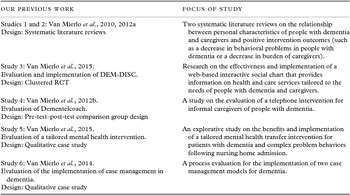
For the development of the evidence-based model for implementation of personalized care interventions in dementia, we used our own previous work as key publications (see Table 1 for a list of these publications).
Our previous studies; key publication for the construction of the model for implementation of personalized care

From these publications, we extracted information about factors that facilitate and impede the delivery of personalized care by dementia care professionals. The theoretical model of adaptive implementation (Dröes et al., Reference Dröes2003; Meiland et al., Reference Meiland, Dröes, De Lange and Vernooij-Dassen2004) was used as the generic model for our study and was operationalized for personalized care by incorporating those facilitating and impeding factors that are considered relevant for the implementation of personalized care in the community. We distinguished between preconditions that can influence the implementation of personalized care at the start and throughout the process, and the factors that influence the implementation during the execution and continuation phases of implementation. The relevant factors were discussed in the project group of researchers (all the authors of this paper) and synthesized into a new evidence-based implementation model and checklist for personalized dementia care in the community.
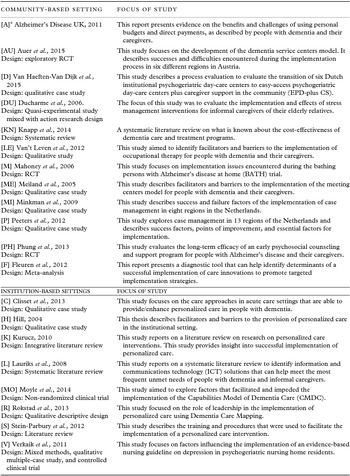
Additional literature searches were conducted to trace any other studies investigating the implementation of personalized care interventions for people with dementia or caregivers that could be integrated in our model. The Pubmed and Web of Science search engines were used with the following key words: implementation, integration, personalized care, person-centered care, psychosocial, dementia, support program, and interventions. Inclusion criteria were the studies that describe facilitators or barriers to the implementation of personalized psychosocial care interventions for people with dementia or informal caregivers. Exclusion criteria were the studies that described outcomes of effect evaluations without describing the implementation process. The Pubmed search resulted in 59 papers and Web of Science in 81 papers. Based on expert advice we also traced and used a report on validated barriers and facilitators for implementation of innovations (Fleuren et al., Reference Fleuren, Paulussen, Van Dommelen and Van Buuren2012), used recent published work describing the transformation of nursing home-based day-care centers into socially integrated community day care (Van Haeften-Van Dijk et al., Reference Van Haeften-van Dijk, Meiland, Van Mierlo and Dröes2015) and cross-referenced recent reviews on personalized dementia care (Fossey et al., Reference Fossey, Masson, Stafford, Lawrence, Corbett and Ballard2014; Testad et al., Reference Testad2014; Boersma et al., Reference Boersma, Van Weert, Lakerveld and Dröes2015). A total of 16 out of 140 papers met the inclusion criteria and were relevant for our model, eight described community-based interventions and eight were institution-based. Table 2 provides an overview of the papers that were included in our study. These papers were analyzed on barriers and facilitators that influenced the implementation of psychosocial interventions. Factors that were relevant to our model (that influenced the provision of personalized care) were extracted and compared with the results of our own previous work (Table 1). Barriers and facilitators described in institution-based studies were examined on relevance for community-dwelling people having dementia.
Studies included for the construction of the model for implementation of personalized care

Note: aLetters in square brackets refer to the references in Figure 1.
Since the results of our own previous studies did not cover implementation aspects related to the macro-level (e.g. laws and legislation that could influence the delivery of personalized care), we conducted an additional search to specifically target research papers that covered law and legislation aspects that were associated with costs and self-management of dementia through personal budgets via health insurance for people with dementia. (Personal budgets are direct payments provided by health insurers to people with dementia, giving them an individual choice to select, and have control over care services that they want to buy and use.) Keywords were: dementia, personal budget, self-management, and costs. This resulted in two additional publications relevant to our model (Alzheimer's Disease UK, 2011; Knapp et al., Reference Knapp, Iemmi and Romeo2014).
Results
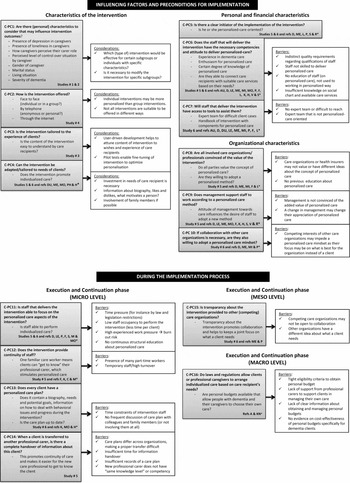
Figure 1 presents the constructed evidence-based model for the implementation of personalized care interventions. The model comprises different implementation components containing core questions and detailed sub-questions, all based on the factors that affect the implementation of personalized care in a community setting. For each component of personalized care, we described certain considerations to keep in mind, and potential barriers that negatively affect the delivery of personalized care. The model includes preconditions that can influence the implementation as well as factors that are relevant during the execution and continuation phases of implementation. The different “core components of personalized care” (C-PC1, C-PC2, etc.) of the evidence-based model as well as the considerations and barriers are explained in the text.
Evidence-based model of implementation of personalized care (interventions).
*Reference list of model
Our own studies
Study 1: Van Mierlo et al., Reference Van Mierlo, Van der Roest, Meiland and Dröes2010; Study 2: Van Mierlo et al., Reference Van Mierlo, Meiland and Dröes2012a; Study 3: Van Mierlo et al., Reference Van Mierlo, Bootsma-Van der Wiel, Meiland, Van Hout, Stek and Dröes2015a; Study 4: Van Mierlo et al., Reference Van Mierlo, Meiland, Van der Roest and Dröes2012b; Study 5: Van Mierlo et al., Reference Van Mierlo, Meiland, Van de Ven, Van Hout and Dröes2015b; Study 6: Van Mierlo et al., Reference Van Mierlo, Meiland, Van Hout and Dröes2014
Community-based implementation studies
A: Alzheimer's Disease UK, 2011; AU: Auer et al., Reference Auer, Span and Reisberg2015; D: Van Haeften-Van Dijk et al., Reference Van Haeften-van Dijk, Meiland, Van Mierlo and Dröes2015; DU: Ducharme et al., Reference Ducharme, Lebel, Lachance and Trudeau2006; KN: Knapp et al., Reference Knapp, Iemmi and Romeo2014; LE: Van't Leven et al., Reference Van't Leven, Graff, Kaijen, de Swart, Olde Rikkert and Vernooij-Dassen2012; M: Mahoney et al., Reference Mahoney, Trudeau, Penyack and MacLeod2006; ME: Meiland et al., Reference Meiland, Dröes, de Lange and Vernooij-Dassen2005; MI: Minkman et al., Reference Minkman, Ligthart and Huijsman2009; P: Peeters et al., Reference Peeters, de Lange, Spreeuwenberg, Veerbeek, Pot and Francke2012; PH: Phung et al., Reference Phung2013; F: Fleuren et al., Reference Fleuren, Paulussen, Van Dommelen and Van Buuren2012
Nursing home-based implementation studies
C: Clisset et al., Reference Clissett, Porock, Harwood and Gladman2013; H: Hill, Reference Hill2004; K: Kurucz et al., 2010; L: Lauriks et al., Reference Lauriks, Osté, Hertogh and Dröes2008; MO: Moyle et al., Reference Moyle, Venturato, Cooke, Hughes, van Wyk and Marshall2014; R: Rokstad et al., Reference Rokstad, Røsvik, Kirkevold, Selbaek, Saltyte Benth and Engedal2013; S: Stein-Parbury et al., Reference Stein-Parbury, Chenoweth, Jeon, Brodaty, Haas and Norman2012; V: Verkaik et al., Reference Verkaik, Francke, van Meijel, Ouwerkerk, Ribbe and Bensing2011

For each component of the model, we refer to our previous studies (1 through 6, see “Research Methods”), more specifically the study from which the specific component was derived. Additional literature was found on the implementation of personalized care related to both community and institutional settings. Elements from these studies that corresponded to our own results are included with a reference in the model as well.
Important factors and barriers for personalized care
Influencing factors and preconditions: characteristics of the intervention
Core component of personalized care 1 (C-PC1)
Our two previous reviews (studies 1 and 2) provide an overview of different subgroups that experienced positive effects from psychosocial interventions. These results indicate that the presence of depression or loneliness, the way in which informal caregivers perceive their role of caregiver, their perceived level of control over the situation, their gender, marital status, and living situation may influence intervention outcomes. Personal characteristics such as mentioned here are therefore important to consider when implementing personalized care interventions in dementia care. This helps to target these interventions to specific care recipients, resulting in better intervention outcomes. Positive experiences by care recipients and care professionals will enhance the implementation.
While some papers included in our reviews reported positive outcomes for their whole study sample, which could be identified or categorized as a subgroup (for instance, they were all females), other studies reported post hoc analyses that revealed specific subgroups from their sample that seemed to benefit more from their intervention than others. While for people having dementia who live at home, we only traced one post hoc subgroup effect, i.e. for people having mild to moderate dementia (Mittelman et al., Reference Mittelman, Ferris, Shulman, Steinberg and Levin1996: individual and family counseling), many subgroup effects were reported for informal caregivers, such as informal caregivers with high levels of depression (Coon et al., Reference Coon, Thompson, Steffen, Sorocco and Gallagher-Thompson2003: depression management class), high levels of anger expression (Coon et al., Reference Coon, Thompson, Steffen, Sorocco and Gallagher-Thompson2003: anger management class), positive beliefs about their role of caregiver (Hepburn et al., Reference Hepburn, Tornatore, Center and Ostwald2001: Minnesota Family Workshop), female spouses as well as caregiver with low to medium levels of mastery (Mahoney et al., Reference Mahoney, Tarlow and Jones2003: automated telephone support), female caregivers of people with dementia who live at home (Vernooij-Dassen et al., Reference Vernooij-Dassen, Huygen, Felling and Persoon1995: an emotional support program), and informal caregivers who are lonely (Dröes et al., Reference Dröes, Meiland, Schmitz and van Tilburg2006: meeting centers support program).
Core component of personalized care 2 (C-PC2)
Today, professional support can be delivered by telephone, thru face-to-face meetings, or by online support services, individually or in a group. It is important to consider which of these means of care delivery suits best to each individual. Individual interventions, for instance, may be better suited to provide personalized care than group interventions. Also, not all interventions are suited to be offered in different ways.
In the Dementelcoach study (study 4), informal caregivers were offered telephone contacts with a professional coach, receiving emotional, social, and practical support for 20 weeks. While the majority of caregivers were satisfied with the support, some people felt the telephone coaching was less personal and they would have preferred more face-to-face contact. This indicates that the way in which interventions are offered to care recipients is of importance.
Core component of personalized care 3 (C-PC3)
An important aspect of personalized care is that it is tailored to the experience of people with dementia and informal caregivers. In general, this can be achieved through user-driven designing or user-participation designing (and pilot tests) from the start of development until the final product. This enables people with dementia and informal caregivers to deliver input about the intervention to ensure that the intervention meets the user-perspective, and will be personalizable.
In the DEMentia specific Digital Interactive Social Chart (DEM-DISC) study (study 3), informal caregivers could use a web-based digital interactive social chart (DEM-DISC) to help them find care and welfare services in their region, based on their needs. User behavior differed among participants: caregivers who used the DEM-DISC less often felt that the terminology of the questions in DEM-DISC did not always match the needs as they experienced them. Although several iterations with user feedback were included during the development of DEM-DISC (Van der Roest et al., Reference Van der Roest2008), the final product was still not satisfactory to all users, implying that further attention for personalization of DEM-DISC is needed.
Core component of personalized care 4 (C-PC4)
One of the key components of personalized care is to adapt the care to individual needs of clients, as was shown in the tailored mental health intervention to improve the transfer of people with dementia to the nursing home (study 5) and in the process evaluation of case management (study 6). This requires an investment in assessing what these needs are, including information about a person's biography, likes and dislikes, and what motivates a person to accept care support.
Influencing factors and preconditions: personal and financial characteristics
Core component of personalized care 5 (C-PC5)
There should be a clear leader who promotes and stimulates personalized care for the implementation of an intervention to be successful (studies 5 and 6).
Core component of personalized care 6 (C-PC6)
Certain characteristics of professional caregivers can play a role in their ability to provide personalized care (studies 5 and 6). They should have experience in dementia care, have enthusiasm for the job, have a certain degree of relevant education, and be available for their clients in case of an emerging care need. Furthermore, they should have adequate knowledge of the social chart of care and welfare services in the area, so that they can give their clients the best possible advice. Insufficient quality requirements or qualifications of professional caregivers lead to inconsistent quality of (personalized) care. Lack of proper (structural) education about individualized care also impedes the quality of care provided by professional caregivers.
Core component of personalized care 7 (C-PC7)
The availability of tools, such as an expert team or quality handbook of the intervention, to help professional caregivers in their work can contribute to personalized care provision (study 6). The ability to discuss complex client cases with an expert team can support them in their work. Exchange of knowledge and frequent consultation with other care professionals, especially when the situation of a client or informal caregiver changes, creates a strong network around them. Barriers may be absence of an expert team, difficult to reach expert team, and expert team that lacks personalized care orientation.
Influencing factors and preconditions: organizational characteristics
Core component of personalized care 8 (C-PC8)
The ability to provide personalized care is influenced by the attitude of professional caregivers in the care organizations toward this concept (study 5). Providing continuous education to them about the importance of personalized care is necessary to maintain a positive attitude. Furthermore, all relevant care organizations that are primarily involved in implementation need to be convinced of the value of personalized care intervention. Care organizations having different opinions about personalized care or insufficient knowledge on its value impede collaboration and implementation.
Core component of personalized care 9 (C-PC9)
Management plays an important role as well, as they can motivate and support their employees to adopt a personalized care approach (study 5). Management or leaders who do not promote personalized care, or a change of leader or management during the implementation, are definite barriers.
Core component of personalized care 10 (C-PC10)
It is important that other care organizations with which collaboration is necessary adopt a personalized care mindset (study 6). Competing care organizations may pose a barrier if they refuse to collaborate, or lack the right mindset.
During the implementation process: execution and continuation phase (micro-level)
Core component of personalized care 11 (C-PC11)
The ability of professional caregivers to adopt an individualized care approach can be affected by external factors (studies 5 and 6). They often experience time pressure (large caseloads and time restraints following administration procedures due to law and legislation regulations). Combined with a low staffing level, this can result in high work pressure that negatively affects the quality of care and available time for individual clients.
Core component of personalized care 12 (C-PC12)
Providing personalized care can be best ensured if there is continuity in the professional caregivers who deliver the intervention. This allows them to get to know a care recipient, their favorite leisure activities, what they like and what motivates them, and helps them attune care to their needs. The presence of many part-time workers and temporary staff impedes this continuity.
The study that explored a tailored mental health intervention for people with dementia and behavioral problems who were admitted to the nursing home (study 5) emphasized the importance of continuity of care during this transition by providing professional caregivers with biographical information about clients, and advice on how to deal with their behavioral problems. This information can also be gathered through family members, if present.
Core component of personalized care 13 (C-PC13)
The presence of an individual care plan that is attuned to the wishes and needs of clients can assist care professionals to provide personalized care and needs to be regularly evaluated with family members and other care professionals to keep it up-to-date (study 6).
Core component of personalized care 14 (C-PC14)
When a client is transferred to another professional caregiver, a proper transfer of information between care professionals is essential (study 5). In practice, barriers to a complete transfer of information are that care plans differ across organizations, there is insufficient time to conduct the transfer, the care plan is not well documented, or the new care professional does not function on the same level as the previous care professional.
During the implementation process: execution and continuation phase (meso-level)
Core component of personalized care 15 (C-PC15)
When collaborating with other care professionals it is important to provide transparency about the care that professional caregivers provide, as this enables good collaboration and the ability to focus on specific needs of clients instead of the interest of care organization. This aspect was retrieved from the process evaluation of case management (study 6).
During the implementation process: execution and continuation phase (macro-level)
Core component of personalized care 16 (C-PC16)
Personal budgets for people having dementia via their health insurance enable them to arrange their own individualized care based on their needs. In practice, criteria to obtain such personal budgets can be strict and there is a lack of clear information about how to obtain these budgets. Also, professional caregivers may not always adequately support informal caregivers in how to use personal budgets. As a result, personal budgets are not adequately received or used by care recipients. This was retrieved from additional literature on law and legislation aspects of the implementation of personalized care (Alzheimer's Disease UK, 2011; Knapp et al., Reference Knapp, Iemmi and Romeo2014).
Discussion
In this paper, we presented evidence-based core components that facilitate the implementation of personalized care. At the same time this provides a checklist for researchers, healthcare providers, policy-makers, and other care professionals who are involved in the development or implementation of personalized care interventions in the community. The checklist contains 16 factors that explain essential conditions to effectively implement personalized care along with potential barriers to consider. The purpose of making this evidence-based model was to integrate knowledge gained from several reviews (on the relationship between positive intervention outcomes and personal characteristics of people with dementia and informal caregivers) and implementation studies (including our own studies into personalized care) with the aim to facilitate/guide the implementation of personalized dementia care interventions and to promote better sustainability of these interventions.
The model may not comprise all aspects of implementation but it focuses on crucial components that are particularly relevant to the implementation of personalized community-based dementia care. In order for care professionals to be able to use, and refer people with dementia to, personalized care interventions, knowledge of their benefits is essential. It is also necessary that these interventions are well implemented so that these can be used accordingly. This is where our evidence-based model and checklist for the implementation of personalized care can be of value.
Pre-existing models on the implementation of psychosocial interventions for dementia did not cover the aspect of personalized care. However, our new model can be used in combination with other implementation models (Bartholomew et al., Reference Bartholomew, Parcel, Kok and Gottlieb2001; Dröes et al., Reference Dröes2003; Meiland et al., Reference Meiland, Dröes, De Lange and Vernooij-Dassen2004; Grol et al., Reference Grol, Wensing and Eccles2005) for a holistic and integrated implementation approach.
The widely used RE-AIM model to assess the implementation of interventions is an interesting framework relevant for implementation research and practice (Glasgow et al., Reference Glasgow, Vogt and Boles1999; Reference Glasgow, McKay, Piette and Reynolds2001). The model lists five dimensions that need to be considered when evaluating the implementation of an intervention. The framework states that it is important to consider the target group that is reached by the intervention (Reach), the probable impact or positive outcomes of the intervention (Effectiveness), how many and which care organizations or settings use the intervention and how many partners have adopted the program (Adoption), how well the intervention is implemented in real life according to the principles and essential components of the intervention (Implementation), and how well the intervention and positive effects on participants are sustained over time (Maintenance). Ideally, personalized care interventions should have a high Reach (as they can be altered to fit personal needs to serve a large group of clients) and high Effectiveness (as they can be targeted to specific problems and offer the right care). The RE-AIM framework can be used not only to assess strengths and weaknesses of interventions but also to guide (further) development and implementation of interventions. Many studies have used the RE-AIM model to either develop an intervention or to conduct an interim evaluation of implementation (Gitlin et al., Reference Gitlin, Jacobs and Earland2010; Gaglio et al., Reference Gaglio, Shoup and Glasgow2013; Altpeter et al., Reference Altpeter, Gwyther, Kennedy, Patterson and Derence2015). Our evidence-based model for implementation of personalized care can be used in a similar way not only to evaluate already implemented interventions but also to trace the causes or origins of (potential) problems when preparing or executing the implementation (are problems with providing personalized care related to collaboration problems or due to rigid content of the intervention?), and can help solve these problems efficiently to increase personalized care.
While this model aims to promote the implementation of personalized care interventions in a community setting, the checklist can also be adopted by nursing homes to help implement or develop individualized care interventions in the residential setting. The key components that were traced in our previous studies, such as full management support toward practicing personalized care and the necessity to invest in assessing needs of care recipients, are comparable with essential components described in the literature for the implementation of personalized care in nursing home settings (e.g. Hill, Reference Hill2004; Kurucz, Reference Kurucz2010).
Limitation of this study is that we did not perform a systematic literature search on the implementation of personalized care interventions, and therefore may have missed other relevant studies. Furthermore, the essential components of our model were not independently reviewed by the researchers. It must be mentioned, however, that all components were derived from previous studies in which facilitators and barriers to implementation were traced by two independent reviewers. Strength of the study is that we have incorporated multiple studies, covering a range of different types of interventions (telephone, Internet, and face-to face interventions as well as systematic literature studies) and integrated their results into our model. The additional literature that we found on the implementation of personalized care interventions in both community and nursing home confirmed our own findings and strengthens the scientific basis of our model. The evidence-based model for implementation of personalized care aims to promote the use and development of tailored interventions based on abilities, needs, wishes, and personal characteristics of people with dementia and their informal caregivers. Interventions should ideally be adaptable to individual clients in both content and the way of care delivery to optimize its effectiveness.
Future research should be targeted at evaluating the application of this evidence-based model in different care settings to estimate its expediency to improve the implementation of personalized care and psychosocial interventions.
Disclosure of conflict of interest
None.
Description of authors’ roles
L. D. Van Mierlo, F. J. M. Meiland, H. P. J. Van Hout, and R. M. Dröes contributed to the conceptualization of the study. L. D. Van Mierlo was responsible for the literature searches and extracting data to develop the new model. F. J. M. Meiland, H. P. J. Van Hout, and R. M. Dröes supervised and provided assistance with the literature search, development of new model, and editing the final manuscript. All authors reviewed and approved the final manuscript.
Acknowledgments
This study was investigator-initiated and not sponsored or funded by any company or grants.