Introduction
Chronic rhinosinusitis is an inflammatory disease affecting the paranasal sinuses in which at least two of the following symptoms are necessary: nasal congestion, nasal discharge, facial pain or olfactory dysfunction. The aforementioned symptoms need to last for more than 12 weeks with documented objective evidence of inflammation in the sinuses or ostiomeatal complex based on endoscopic or radiological examination.Reference Fokkens, Lund, Hopkins, Hellings, Kern and Reitsma1 Medical therapy, commonly used in this disease, includes steroids and antibiotics. In case of failure, endoscopic sinus surgery should be performed.
Chronic rhinosinusitis is a common disease; its prevalence in European countries reaches approximately 10.9 per cent, but it may vary depending on applied diagnostic criteria.Reference Hastan, Fokkens, Bachert, Newson, Bislimovska and Bockelbrink2 In the USA, this number is even higher; chronic rhinosinusitis affects roughly 14 per cent of the population.Reference Shashy, Moore and Weaver3 Chronic rhinosinusitis is a great burden to societies because of its associated problems such as sleep disorders and facial discomfort. These issues decrease health-related quality of life.Reference Speth, Hoehle, Phillips, Caradonna, Gray and Sedaghat4 According to studies by Rudmik and DeConde and Soler, direct costs associated with chronic rhinosinusitis treatment are unbelievably high. They range from 10 to 13 billion dollars per year in the USA.Reference Rudmik5,Reference DeConde and Soler6
Acute exacerbation of chronic rhinosinusitis, which is defined as the abrupt worsening of symptoms in a patient with chronic rhinosinusitis,Reference Orlandi, Kingdom and Hwang7 is estimated to occur in 6–15 per cent of chronic rhinosinusitis cases.Reference Tan, Yan, Ong, Chow, Shi and Wang8 This can be caused by various factors, including bacteria. The role of bacteria in chronic rhinosinusitis exacerbation development is not yet completely understood. Chronic rhinosinusitis pathophysiology is influenced by a complex interaction between several factors, such as microbiota of sinuses, the ability of pathogens to form biofilm and host immune reactions.Reference Lam, Schleimer and Kern9 Acute bacterial exacerbations of chronic rhinosinusitis are caused predominantly by mixed aerobic and anaerobic bacterial flora.Reference Brook10
No universal guidelines for the management of bacterial exacerbation of chronic rhinosinusitis after endoscopic sinus surgery have been created so far.Reference Fokkens, Lund, Hopkins, Hellings, Kern and Reitsma1,Reference Orlandi, Kingdom and Hwang7 Currently, acute exacerbation of chronic rhinosinusitis is usually treated as an episode of acute rhinosinusitis or recurrent acute rhinosinusitis. The management of acute exacerbation of chronic rhinosinusitis is based mainly on empiric antibiotic therapy or different therapeutic options when this is not effective.
The purpose of this study was to analyse the effectiveness of empiric and culture-guided antibiotic therapy in acute exacerbations of chronic rhinosinusitis because the pathophysiology, role and types of bacteria in chronic rhinosinusitis and acute rhinosinusitisReference Orlandi, Kingdom and Hwang7 are different. Perhaps in the future it will be possible to standardise care for acute exacerbation of chronic rhinosinusitis according to the latest evidence.Reference Kaper, Aarts, van Benthem and van der Heijden11 It would shorten the time of treatment and also reduce the total cost relating to this condition.
Materials and methods
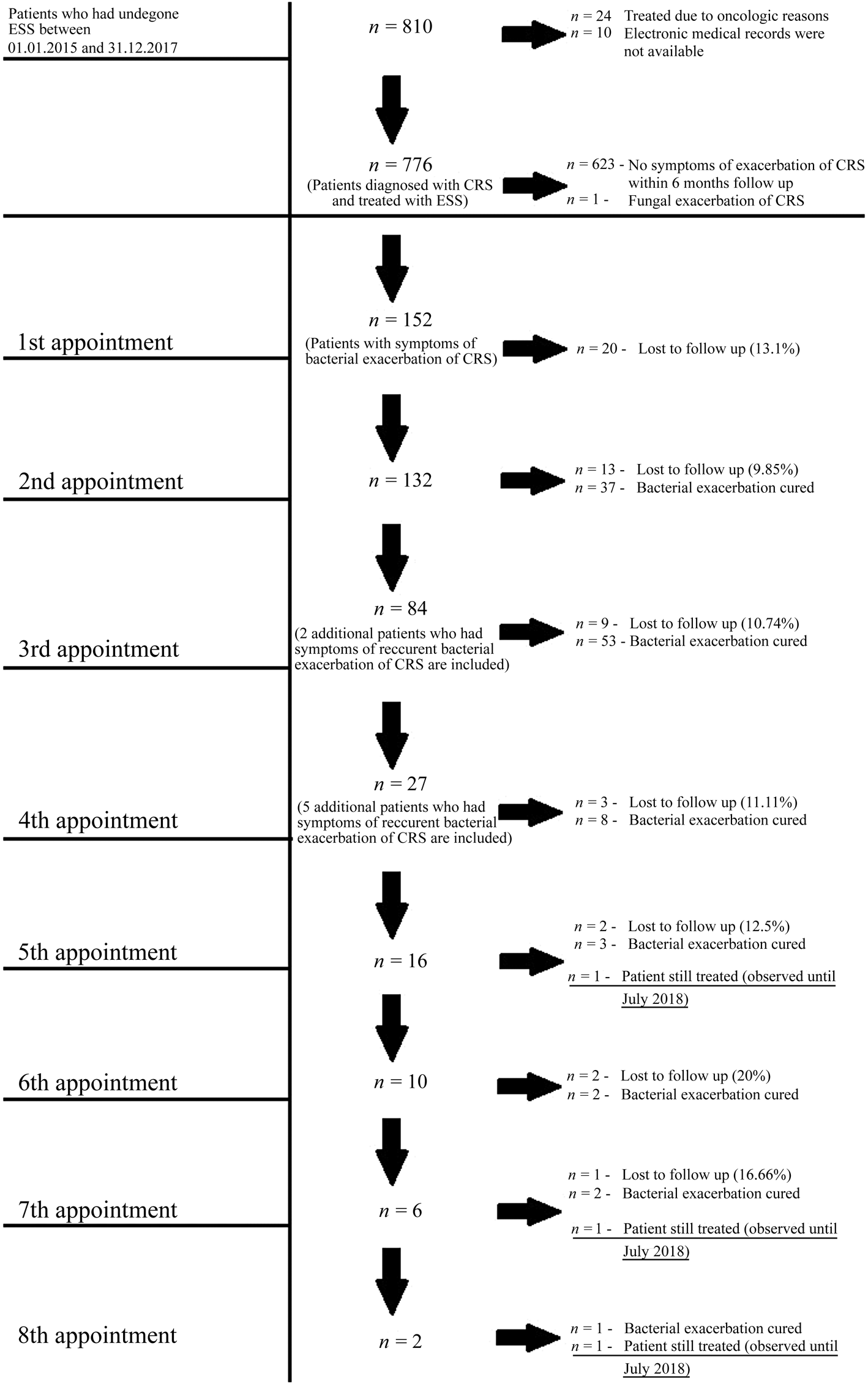
The study flow-chart is presented in Figure 1. Medical data of 810 patients who had undergone endoscopic sinus surgery in years 2015 to 2017 in the Department of Otolaryngology of the University Hospital in Krakow, were analysed retrospectively. Among these patients, 776 patients who were previously diagnosed with chronic rhinosinusitis according to the European Position Paper on Rhinosinusitis and Nasal Polyps 2012 criteriaReference Fokkens, Lund, Mullol, Bachert, Alobid and Baroody12 and had failed the maximal medical therapy were enrolled in further analysis.
Study flow-chart. ‘Patient still treated’ means the treatment was not completed until the end of the observation period. CRS = chronic rhinosinusitis; ESS = endoscopic sinus surgery

Subsequently, only the patients who presented with symptoms of bacterial exacerbation of chronic rhinosinusitis within six months of endoscopic sinus surgery were included in this study (152 cases). These patients’ medical records were then evaluated in terms of the treatment administered and microbiological tests performed. The study protocol complied with the Declaration of Helsinki. The study was retrospective and therefore did not require ethics approval.
Treatment methods
The treatment course was evaluated in every included patient. The type of administered antibiotics, doses and time of treatment were assessed. The results of treatment effectiveness were compared in groups of empiric and targeted antibiotic therapy. The median time of follow up was 3.9 months (range, 0.5–14.1 months; Figure 1). The microbiological cultures and antibiotic susceptibility test results were obtained from the swabs collected under endoscopic visualisation from the pathological secretions in the middle nasal meatus or directly from the sinuses. All samples were analysed in the Department of Microbiology, University Hospital in Krakow.
Statistical analysis
The statistical analyses were performed with Statistica statistical analysis software (version 13.3; Tibco Software, Palo Alto, USA). The quantitative data were described by means, medians and standard deviations. Continuous variables were first checked for normal distribution by the Shapiro–Wilk test and then were compared by Student's t-test or Mann–Whitney U test if the distribution was normal or different than normal, respectively. All of the categorical data were presented with frequencies and percentages. Categorical variables were analysed by the chi-square test or Fisher's exact test. A two-sided p-value of less than 0.05 was considered statistically significant. Patients who were lost to follow up during the observation time were excluded from statistical analysis.
Results
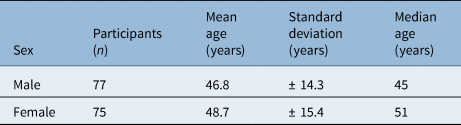
The demographic characteristics of the participants are presented in Table 1. There were no significant differences in terms of age and time of observation between male and female participants of the study. During the study, 50 patients became lost to follow up (32.89 per cent).
The demographic characteristics of the studied group

Empiric antibiotic therapy
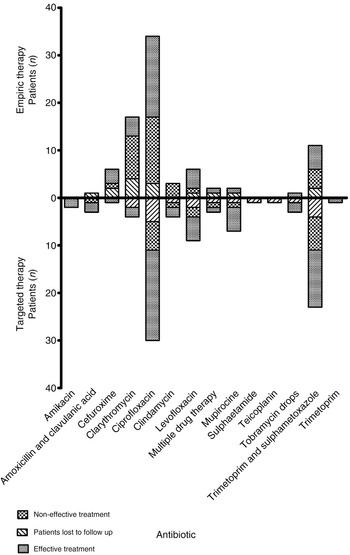
Out of 152 patients, 83 were treated with empiric antibiotic therapy (54.6 per cent). The treatment was successful in 35 cases (42.17 per cent), and 15 patients were lost to follow up (18.07 per cent). The most commonly used antibiotic was ciprofloxacin (in 33 cases, 39.76 per cent) with effectiveness of 53.33 per cent. The most effective empiric antibiotics were levofloxacin (80 per cent) and cefuroxime (75 per cent), but each of these was used in only 6 cases. Multiple drug therapy was prescribed in only two cases. The first was the combination of sulfamethoxazole-trimethoprim and ciprofloxacin, and it was not effective. The second was the combination of mupirocin ointment and amoxicillin-clavulanic acid. In this case, the patient was lost to follow up. The detailed information about the effectiveness of empiric antibiotic therapy is presented in Figure 2.
The effectiveness of empiric and targeted therapy.

Targeted antibiotic therapy
Targeted antibiotic therapy was implemented in 94 cases (61.8 per cent). In 29 patients (30.9 per cent), it was introduced after the failure of empiric treatment. In 40 cases (42.6 per cent), patients were treated with targeted antibiotics without a previous course of empiric drugs. However, among these cases, 2 patients (2.1 per cent) were previously successfully treated empirically, but they developed the symptoms of another bacterial exacerbation of chronic rhinosinusitis. In the rest of the cases, targeted antibiotic treatment was tried after the failure of the previous targeted antibiotic therapies (Figure 2).
Moreover, 21 patients (22.3 per cent) were lost to follow up in the targeted therapy group. In 52 patients, targeted therapy was successful (71.23 per cent). The effectiveness of targeted antibiotic treatment was statistically significantly higher compared with an empiric approach (p = 0.025).
The most effective antibiotics were topical mupirocin (83.33 per cent) and ciprofloxacin (81.82 per cent; Figure 2). Similarly to empiric therapy, multidrug therapy was administered only in 3 patients (3.1 per cent). Two of the patients received a combination of amoxicillin or clavulanic acid and ciprofloxacin, and in one case it was a successful treatment. The third patients received the combination of four drugs (amoxicillin, levofloxacin, metronidazole and ciprofloxacin drops), but the patient was lost to follow up. The symptoms of acute exacerbation of chronic rhinosinusitis were alleviated in 12 cases (12.8 per cent) without the implementation of antibiotic therapy. The detailed results of targeted antibiotic treatment are presented in Figure 2.
Microbiology
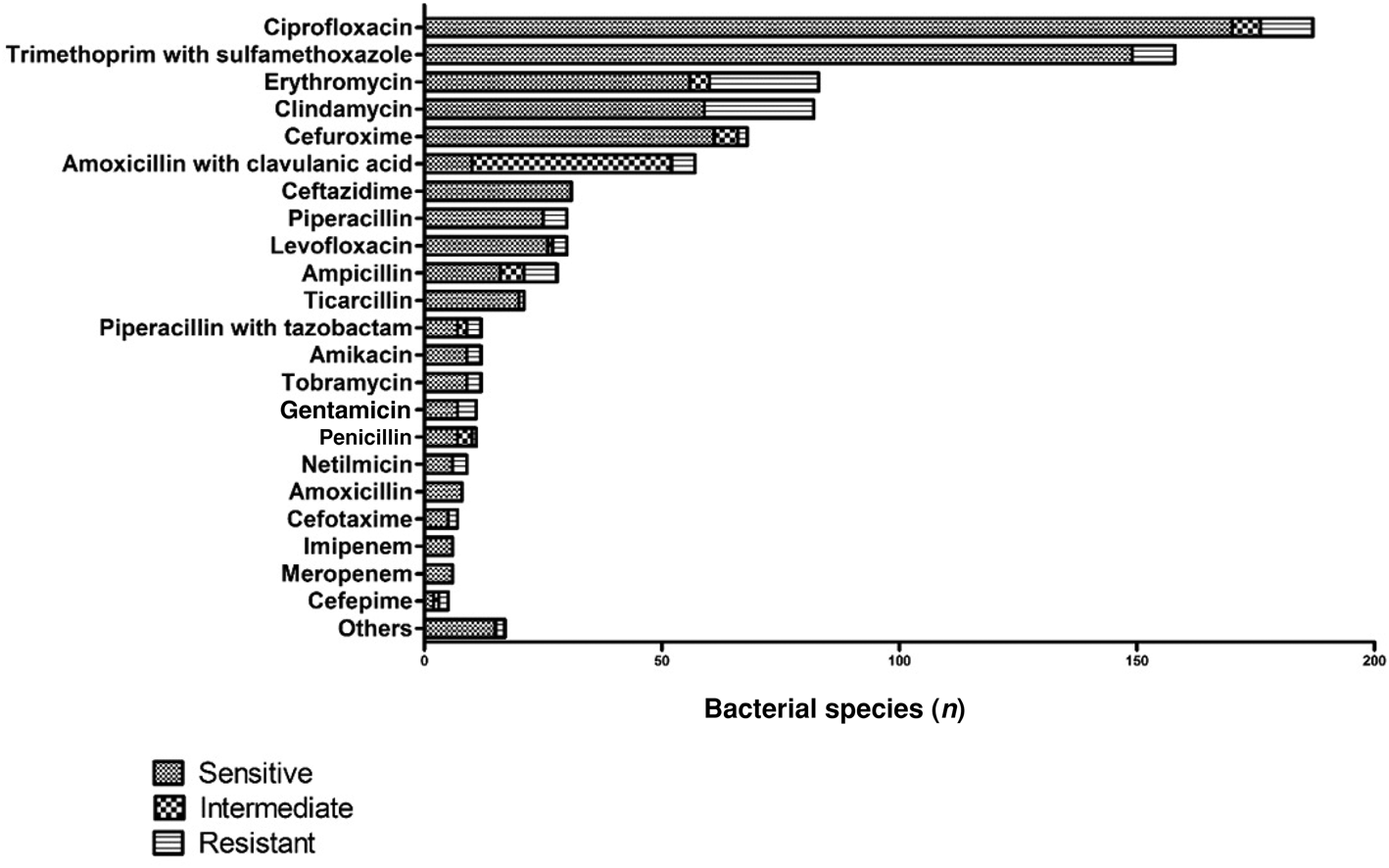
A total of 210 bacterial isolates were identified during the observation time. The most common bacterial species detected were: Staphylococcus aureus (methicillin-sensitive S aureus, 35.71 per cent and methicillin-resistant S aureus, 2.86 per cent), Pseudomonas aeruginosa (12.86 per cent) and Escherichia coli (10.95 per cent). All results of microbiological culture growth tests are presented in Figure 3. The antibiogram was also checked for the most common bacteria.
The number of antibiotic-sensitive and antibiotic-resistant bacterial isolates.

In antibiograms, methicillin-sensitive S aureus bacteria were additionally susceptible to: sulfamethoxazole-trimethoprim in 89.71 per cent (61 of 68 antibiograms), ciprofloxacin in 82.35 per cent (56 of 68 antibiograms), erythromycin in 75 per cent (51 of 68 antibiograms) and clindamycin in 75 per cent (51 of 68 antibiograms). Escherichia coli bacteria were susceptible to: ciprofloxacin in all tested antibiograms, cefuroxime in 95.65 per cent (22 of 23) and sulfamethoxazole-trimethoprim in 95.65 per cent (22 of 23). Furthermore, in antibiograms, P aeruginosa bacteria were susceptible to: ceftazidime in 96.30 per cent (26 of 27), ciprofloxacin in 92.59 per cent (25 of 27), piperacillin in 81.48 per cent (22 of 27) and ticarcillin in 70.37 per cent (19 of 27).
Importantly, methicillin-sensitive S aureus was most commonly resistant to clindamycin (15 of 68; 22.06 per cent) and erythromycin (14 of 68; 20.59 per cent). Escherichia coli was resistant to ampicillin (6 of 23; 26.09 per cent) and amoxicillin with clavulanic acid (4 of 23; 17.39 per cent). There was one case of extended-spectrum beta-lactamases positive E coli detected. The bacterium was resistant to tobramycin, gentamicin, netilmicin, ciprofloxacin and trimethoprim with sulfamethoxazole. It was susceptible to imipenem and meropenem. Pseudomonas aeruginosa was resistant to piperacillin with tazobactam (2 of 27; 7.41 per cent), piperacillin alone (1 of 27; 3.7 per cent), ticarcillin (1 of 27), levofloxacin (1 of 27), amikacin (1 of 27), tobramycin (1 of 27), gentamicin (1 of 27) and netilmicin (1 of 27). There were no cases of P aeruginosa resistant to imipenem or meropenem. We have also observed cases of resistance to ciprofloxacin (4 of 27), ampicillin (1 of 27) and trimethoprim with sulfamethoxazole (1 of 27). Methicillin-resistant S aureus comprised 2.86 per cent of all bacteria detected.
Discussion
Microbiology
According to the results of this study, the most common pathogens associated with the bacterial exacerbation of chronic rhinosinusitis were S aureus (35.7 per cent for methicillin-sensitive S aureus and 2.86 per cent for methicillin-resistant S aureus), P aeruginosa (12.86 per cent) and E. coli (10.95 per cent). These results were consistent with the study conducted by BrookReference Brook10 and Jiang et al.Reference Jiang, Kou and Batra13 and with the results of a previous prospective study by Szaleniec et al. of a smaller group of patients.Reference Szaleniec, Gibala, Pobiega, Parasion, Skladzien and Strek14 However, the method of obtaining bacterial cultures in our study did not detect anaerobic bacteria. In accordance with the systematic review by Brook, the role of anaerobes was significant in the group of adults suffering from chronic rhinosinusitis and their percentage ranges from 19 to 88 per cent of pathogens found depending on the study.Reference Brook10 In the study by Jiang et al., the most common bacteria were: S aureus (29.5 per cent), P aeruginosa (23.8 per cent) and methicillin-resistant S aureus (11.4 per cent).Reference Jiang, Kou and Batra13
The microbiology of recurrent acute rhinosinusitis may be different from bacteria detected in exacerbation of chronic rhinosinusitis. In another study by Brook and Frazier,Reference Brook and Frazier15 recurrent acute rhinosinusitis was caused in most cases by Streptococcus pneumoniae, Haemophilus influenzae and Moraxella catarrhalis. These species were rarely detected in our study group.
Moreover, antibiotic therapy on its own seems to have a significant influence on bacterial flora in sinuses. However, the effects are still poorly understood. According to Merkley et al., microbiome diversity increases after antimicrobial treatment, whereas the abundance of bacteria drops.Reference Merkley, Bice, Grier, Strohl, Man and Gill16 In a study by Liu et al., the diversity of the microbiome of the sinuses was decreased; however, in this study, the treatment scheme was more homogeneous.Reference Liu, Soldanova, Nordstrom, Dwan, Moss and Contente-Cuomo17
It is important to note that currently the general level of antibiotic resistance among bacteria is significantly higher than 10 to 15 years ago. According to the World Health Organization Report of Surveillance,18 the increase of antimicrobial resistance is becoming a worldwide problem connected with misuse, overuse and abuse of the most common antibiotics. In order to preserve the effectiveness of existing antibiotics, there is a need to optimise therapy of most common diseases; hence, therapeutic doses of antibiotics used in the treatment of acute exacerbation of chronic rhinosinusitis should be higher to prevent the selection of resistant bacteria. Besides, the latest research provides more persuasive conclusions. In 2002, Namyslowski et al.Reference Namyslowski, Misiolek, Czecior, Malafiej, Orecka and Namyslowski19 published a study that presented the efficacy of the combination of amoxicillin and clavulanic acid in patients with acute exacerbation of chronic rhinosinusitis. Surprisingly, a randomised controlled trial published in 2017Reference Sabino, Valera, Aragon, Fantucci, Titoneli and Martinez20 warned us that this combination is not more effective than placebo in patients with acute exacerbation of chronic rhinosinusitis contemporarily. Our study also emphasised this topic. The microbiological tests conducted during our study have proved that 8.77 per cent of bacteria were resistant to amoxicillin with clavulanic acid and 73.68 per cent had intermediate sensitivity. Taking into account bacteria that already have proven resistance to mentioned antibiotics (e.g. Pseudomonas, methicillin-resistant S aureus), these numbers may be even higher.
Treatment
In contemporary knowledge, there are no guidelines for the diagnosis and treatment of acute exacerbation of chronic rhinosinusitis after endoscopic sinus surgery.Reference Orlandi, Kingdom and Hwang7 According to the most current version of the European Position Paper on Rhinosinusitis and Nasal Polyps (2020), the quality of evidence supporting the use of antibiotics in patients with acute exacerbation of chronic rhinosinusitis is very low, and it is uncertain whether antibiotics have an impact on the outcomes of treatment.Reference Fokkens, Lund, Hopkins, Hellings, Kern and Reitsma1
In our study, we distinguished several different therapy approaches: empiric antibiotic therapy (effective in 42 per cent of our patients and replaced with targeted antibacterial therapy in 35 per cent of them) or primary targeted antibiotics (first therapy option for 40 of our patients). The targeted antibiotic therapy proved to be more effective than empiric antibiotic therapy (71.23 per cent vs 42.17 per cent); however, this result does not diminish the role of empiric treatment.
In the study by Yan et al.,Reference Yan, Tangbumrungtham, Maul, Ma, Nayak and Hwang21 empiric and culture-directed antibiotic therapy for acute exacerbation of chronic rhinosinusitis were analysed, and the authors pointed out that primary targeted treatment improved long-term endoscopy scores compared with empiric treatment. Nevertheless, in that study, the short- and long-term quality of life and short-term endoscopy scores were comparable. The different results in the current study might be the effect of worse quality of actual data about the prevalence of the most common microbes in our medical practice. Based on this difference, the usefulness of empiric treatment is associated with regular analysis of the current prevalence of microbes, their resistance to antibiotics and conclusions regarding proper recommendations of antibiotic treatment schemes in each medical centre. However, sufficient detailed data is commonly unavailable. In these situations, we recommend sinus culture prior to the introduction of empiric therapy and modification of treatment in case of lack of improvement. In the literature, Cincik and Ferguson described similar observations. The change of antibiotic therapy according to the result of endoscopic culture was noted in around 51 per cent of analysed cases.Reference Cincik and Ferguson22 Moreover, Jiang et al. confirmed this suggestion. In their study, the result of the culture changed the therapeutic scheme in 77 per cent of patients.Reference Jiang, Kou and Batra13
It is interesting that use of amoxicillin is recommended in cases of acute rhinosinusitis whereas our research shows that this antibiotic should not be used to treat acute exacerbation of chronic rhinosinusitis. Acute rhinosinusitis is most commonly caused by S pneumoniae, M catarrhalis or H influenzae, whereas the bacteria isolated from patients with acute exacerbation of chronic rhinosinusitis are entirely different and frequently resistant to amoxicillin.
• There are no universal guidelines for treatment of acute bacterial exacerbations of chronic rhinosinusitis
• They are frequently treated following the recommendations for acute rhinosinusitis
• This study shows that acute bacterial exacerbations of chronic rhinosinusitis and acute rhinosinusitis are distinct diseases
• Amoxicillin should not be the first choice for patients with acute bacterial exacerbations of chronic rhinosinusitis
• Empiric antibiotic therapy in acute exacerbation of chronic rhinosinusitis should be determined by analyses of local patterns of resistance
• Culture-directed therapy is often necessary and significantly more effective than empiric therapy
The cause of acute exacerbation of chronic rhinosinusitis is still unclear, and it leaves room for speculations about probable causes. The results of microbiological tests might not fully reflect the complexity of sinuses microbiota and there is a probability that a viral component might be present. As a result, it might lower the success of the implemented treatment. Aside from this, the usage of antibiotics might change previous flora. Either way, these could be reasons for the limited effectiveness of culture-directed treatment. The above-mentioned situations require further and wider research to confirm or exclude these theories.
However, our study has several limitations. This was a retrospective research study based only on the medical histories of patients. A large percentage of patients were lost to follow up meaning all collected data might not fully reflect the reality and numbers might have been slightly over- or underestimated. Besides, the limited number of previous studies on this topic could not provide us with a complete theoretical foundation to support our investigation. The prevalence of bacteria could be better determined by studies using molecular methods. However, in clinical practice, the role of bacterial cultures is still significant, mostly because of their low cost and their convenience in clinical practice.
Conclusion
It should be clearly explicit that based on our collected data, it is worth taking swabs to detect the culturable pathogens at least. While waiting for the results, it is recommended to implement empirical treatment if there are clinical signs of bacterial infection. Also, we should avoid using amoxicillin in post-endoscopic sinus surgery acute exacerbation of chronic rhinosinusitis because of the high prevalence of resistance to this antibiotic. Instead of using amoxicillin, the results of our study suggest using ciprofloxacin or the combination of sulfamethoxazole and trimethoprim, which presented the highest effectiveness in our patients. Medical centres should conduct regular analyses to identify the most common pathogens and most prevalent patterns of antibiotic resistance in their unique settings and provide frequently updated recommendations for empiric treatment. This matter is extremely important because we are standing in the face of the increasing usage of antibiotics. We have to bear in mind that the growing resistance is becoming an actual worldwide issue, and we should take determined steps to limit overuse of antibiotics and prevent long-term serious consequences. Finding proper and effective management of chronic rhinosinusitis would certainly have a positive impact on this global problem.
Competing interests
None declared