Introduction
A long tradition of twin research dating back to the early 20th century has examined the role of genetic factors in criminal behavior (CB) (Lange, Reference Lange1929; Rosanoff et al. Reference Rosanoff, Handy and Plesset1934). This research was followed by twin studies performed utilizing national registers in Denmark (Christiansen, Reference Christiansen and Hood1974) and Norway (Dalgard & Kringlen, Reference Dalgard and Kringlen1976) that both found heritable influences on officially defined criminality. Two meta-analyses have summarized the now extensive twin and adoption literature, both of which concluded that familial resemblance for broadly defined antisocial behaviors results largely from genetic factors with some contribution from the shared environment (Rhee & Waldman, Reference Rhee and Waldman2002; Ferguson, Reference Ferguson2010).
As is true for many behavioral traits and psychiatric disorders, a large proportion of our current information on the heritability of CB comes from twin studies. However, there has been a long history of criticisms of the twin method that have raised questions about its validity (Jackson, Reference Jackson and Jackson1960; Lewontin et al. Reference Lewontin, Rose and Kamin1985; Pam et al. Reference Pam, Kemker, Ross and Golden1996; Joseph, Reference Joseph2002). These concerns have been highlighted in a recent review in a prominent criminology journal, which argued that twin studies of crime were so flawed that further use of this method should be halted (Burt & Simons, Reference Burt and Simons2014).
Of the many methodological concerns about twin studies, two have been most prominent: the equal environment assumption and the generalizability problem (Kendler et al. Reference Kendler, Neale, Kessler, Heath and Eaves1994; LaBuda et al. Reference LaBuda, Svikis and Pickens1997). The equal environment assumption is that the trait-relevant environmental similarity of monozygotic (MZ) and dizygotic (DZ) twins is the same. If the environments of MZ twins are appreciably more similar than DZ twins, that could result in upward biases on the estimation of heritability. The generalizability problem arises from the unique developmental processes involved in twins that are not shared by singletons. Twins have higher rates of obstetric complications and congenital malformations, and lower birth weights (Bryan, Reference Bryan1992; Bush & Pernoll, Reference Bush, Pernoll and DeCherny2007). Twins always share the same intra-uterine environment, are the same age, are typically emotionally closer than regular siblings and even sometimes develop their own private language when young (Bakker, Reference Bakker1987; Rutter & Redshaw, Reference Rutter and Redshaw1991; LaBuda et al. Reference LaBuda, Svikis and Pickens1997). Why, this argument goes, should we assume that results from twins should extrapolate to other more common familial relationships?
In this report, we estimate, in a large Swedish national sample, the role of genetic, shared environmental and unique environmental risk factors in the etiology of CB in full- and half-siblings using the same structural modeling approach commonly applied to twins (Neale et al. Reference Neale, Boker, Xie and Maes2003). The correlation of additive genetic effects in full- and half-siblings (0.50 and 0.25, respectively) has the same 2:1 ratio seen in MZ and DZ twins (1.00 and 0.50, respectively). However, full- and half-siblings are more common familial relationships and have not shared the same womb at the same time.
We address three major questions in this report. First, using full- and half-siblings reared together and apart, what estimates will we find for the etiological importance of genetic, shared environmental and unique influences in CB? Second, how will these estimates compare with those we recently obtained using the same assessment methods for CB in our traditional twin design – utilizing MZ and DZ pairs – from the Swedish Twin Registry (Kendler et al. in press)? Third, will examining full- and half-siblings also provide an opportunity to explore the nature of the shared environmental influences on CB? Unlike twins, full- and half-siblings differ in age, and half-siblings are often reared in different households. We attempt, in a series of models, to examine the impact of age and rearing differences on sibling resemblance for CB.
Method
Sample
We linked nationwide Swedish registers via the unique 10-digit identification number assigned at birth or immigration to all Swedish residents. The identification number was replaced by a serial number to ensure anonymity. From the Swedish Multi-Generation Registry, we selected sibling pairs born between 1958 and 1991, and within 10 years of each other. As the modeling assumes that the correlation between pairs is zero, we randomly selected one pair from each family, meaning that if one individual and his or her (full- or half-) sibling are included in the model, all other possible pairs of full- or half-siblings from that family are excluded. These were matched to the Swedish Crime Register containing all convictions in the district court, which is the first court for all criminal cases in Sweden, from 1973 to 2011. We constrained the population to individuals born at the latest in 1991, as the age for criminal responsibility in Sweden is 15 years.
We assessed, using the Swedish national census and total population registries, the cohabitation status of the sibling pairs as the proportion of possible years lived in the same household until the oldest turned 18 years, the age of majority in Sweden. We defined pairs as ‘reared together’ when this proportion was ⩾80% and ‘reared apart’ when this proportion was ⩽10%. Other pairs were excluded from these analyses. In this report, we examined full-siblings reared together (FSRT), half-siblings reared together (HSRT) and half-siblings reared apart (HSRA). We did not include full-siblings reared apart in these analyses because they were very rare and probably atypical.
Measures
We assessed CB based on the following criminal conviction types: (i) violent crimes: (aggravated) assault, illegal threats, intimidation and illegal coercion, threats or violence against a police officer, (aggravated) robbery, murder, manslaughter or filicide, kidnapping, arson, sexual crimes (excluding prostitution and the buying of sexual services but including child pornography); (ii) white-collar crimes: fraud, forgery, and embezzlement; and (iii) property crimes: theft, vandalism, vandalism causing danger to the public, and trespassing. CB was defined as having one or more lifetime registrations for any of these crime classes.
Statistical model
As in classical twin modeling, we assumed a liability threshold model with three sources of liability to CB: additive genetic (A), shared environment (C) and unique environment (E). The model assumes that full-siblings share on average half and half-siblings a quarter of their genes identical by descent. Shared environment reflects family and community experiences that render the siblings more similar for the phenotype in question, while unique environment includes random developmental effects, environmental experiences not shared by siblings, and random error. The prevalence of criminal registration in our twins declined in more recent birth years (data not shown). We know this is a result of right censoring (individuals have lower lifetime rates of CB because they have not completed their age at risk) because government data show a slight increase in total CB over these years (Crime and Statistics, 2014). To account for this time-dependent effect, we included an age regression parameter in all of our models.
In this report, we divide for analytic purposes the shared environment (C), into two components. C S indicates the ‘specified’ shared environmental influences that are indexed by age differences in the siblings (which would equal zero for twins). We expect, for example, that the sharing of social environments and peers would tend to decrease for siblings with increasing age differences between them. We assume C S to equal 1 for all siblings ⩽2 years apart in age, 2/3 for siblings 3–5 years apart in age, 1/3 for those 5–10 years apart in age, and zero for siblings reared apart. C B indicates the ‘background’ shared environment that would reflect effects of being reared by the same parents in the same household, and typically sharing the same neighborhood influences and attending the same schools. We assume this to equal 1 for all siblings reared together and zero for those reared apart. In models in which we do not estimate C S and C B separately, we use the traditional C parameter (which includes the impact of specified and background environment) and call it, for clarity, C T for ‘total’ shared environment.
Our prior twin modeling produced evidence for both qualitative and quantitative sex differences for CB as well as evidence for substantial shared environmental influences (Kendler et al. in press). Qualitative sex effects are traditionally captured by the parameters r g and r c that reflect, respectively, the degree to which the genetic or shared environmental risk factors are correlated in the two sexes. However, in twin samples with both A and C effects, r g and r c are confounded, as the only information we have is from opposite-sex DZ twins, and cannot be separately estimated. Our sibling analyses, however, have both opposite-sex full- and half-sibling pairs, and we therefore could theoretically estimate the two parameters. However, to facilitate the comparisons with the results from our prior twin modeling (Kendler et al. in press), in these analyses, we fit a qualitative sex model with r f = r g = r ct or r f = r g = r cs = r cb, where r f is defined as the correlation of ‘familial’ factors (e.g. genetic and shared environmental) across the sexes. To facilitate the comparison of the results across models, we present here only the results of the full models. Prior simulations have also suggested that parameter estimates from a full model are typically more accurate than those from submodels (Sullivan & Eaves, Reference Sullivan and Eaves2002). Models were fit in OpenMx software (Boker et al. Reference Boker, Neale, Maes, Wilde, Spiegel, Brick, Spies, Estabrook, Kenny, Bates, Mehta and Fox2011).
Results
Descriptive findings
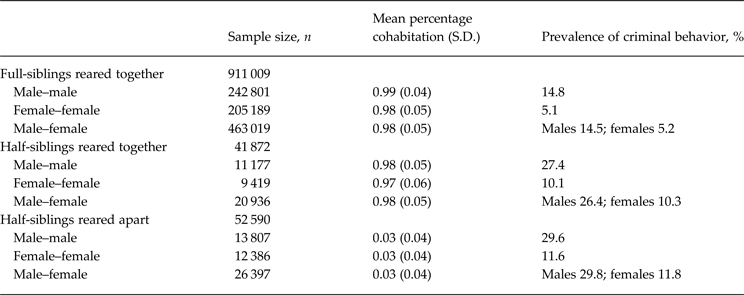
Table 1 depicts, for our three groups of relatives (FSRT, HSRT and HSRA), the (i) sample size of male–male, female–female and opposite-sex pairs, (ii) the percentage cohabitation (defined as the proportion of possible years lived together until the oldest turned 18 years) and (iii) the prevalence of CB. As expected, we have many more FSRT than HSRT pairs but they are well matched for their degree of cohabitation, which varied between 97 and 99%. We have modestly more HSRA than HSRT and the former group had quite low mean cohabitation (3%). The prevalence of CB is substantially higher in half-siblings than in full-siblings (and we take account of this by utilizing different thresholds in our modeling). In an effort to understand this difference, we examined the rates of CB in the parents of our three sibling groups. CB in at least one parent was much more common for the HSRT (34%) and HSRA (37%) than for the FSRT (13%).
Sample size, mean percentage cohabitation and prevalence of criminal behavior in full-siblings reared together and half-siblings reared together and apart

s.d., Standard deviation.
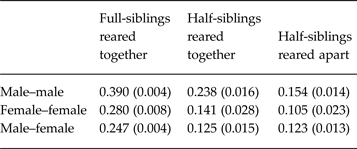
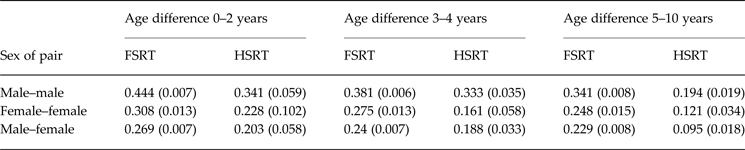
Table 2 presents the tetrachoric correlations for CB in the FSRT, HSRT and HSRA. In the male–male, female–female and opposite-sex pairs, the pattern was the same: the highest correlation was observed in the FSRT, next highest in HSRT and lowest in HSRA. Table 3 presents the tetrachoric correlations for our FSRT and HSRT pairs divided into three groups by their age differences. In all six sibling groups (full-siblings and half-siblings each with three sex combinations), the correlations were greatest in the sibling pairs 0–2 years different in age, intermediate in those 3–4 years apart in age and lowest in those 5–10 years different in age.
Tetrachoric correlations for criminal behavior in full- and half-siblings reared together and half-siblings reared apart

Data are given as tetrachoric correlation (standard error).
Tetrachoric correlations for criminal behavior in FSRT and HSRT as a function of age differences in the sibling pair

Data are given as tetrachoric correlation (standard error).
FSRT, Full-siblings reared together; HSRT, half-siblings reared together.
Model-fitting results
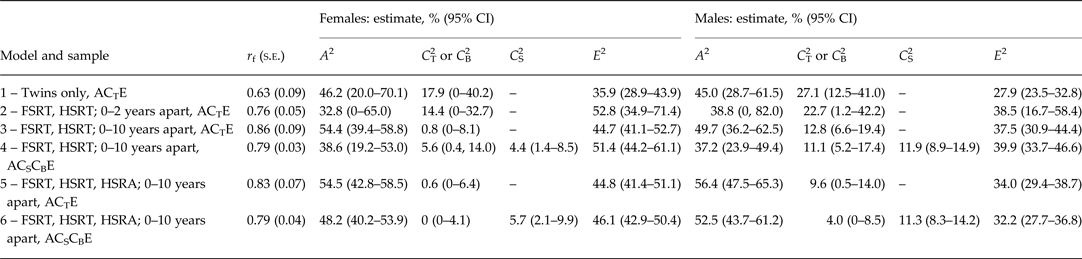
Model 1, in Table 4, presents the parameter estimates for our prior results for CB in MZ and DZ twins using what we would now term an ACTE model (Kendler et al. in press). In model 2, we applied the same model to reared-together full- and half-siblings 0–2 years different in age. Estimates for both genetic and total shared environmental effects were somewhat lower than those seen with twins. The confidence intervals (CIs) in these estimates were relatively large because of the modest number of siblings and half-siblings so close in age to one another. In model 3, the same ACTE model was applied to FSRT and HSRT 0–10 years apart in age. Estimates of heritability were slightly higher in both sexes than that seen in twins, but shared environmental effects were lower, especially in females. Model 4 added to model 3 an estimate of specified family environment (i.e. we fitted an ACBCSE model). Compared with model 3, heritability declined and the combined shared environmental influences (background and specified) increased in both sexes. Compared with the twin analyses, estimates of genetic and combined shared environmental effects were both modestly lower in males and females.
Full model parameter estimates for genetic and shared environmental influences on criminal behavior as estimates from twins only and four different full- and half-sibling models

CI, Confidence interval; r f, correlation of ‘familial’ factors (e.g. genetic and shared environmental) across the sexes; s.e., standard error; A, genetic influences; CT, total shared environment influences; CB, background shared environment influences; CS, specified shared environment influences; E, unique environment influences; FSRT, full-siblings reared together; HSRT, half-siblings reared together; HSRA, half-siblings reared apart.
Model 5 utilized the ACTE model but now applied it to FSRT, HSRT and HSRA. Heritability estimates were, in this model, modestly higher than those seen in the twins in both sexes while shared environmental effects were lower. In model 6 – our final model – we added to model 5 an estimate of the specified family environment (hence an ACBCSE model). In both males and females, heritability estimates for CB were slightly greater in this model than seen in twins only. Shared environmental influences were much lower in females and modestly lower in males.
Discussion
We had three major goals in this report. The first was to use sibling models to estimate the contributions made by genetic and environmental risk factors to CB. Using a range of specific models applied to full- and half-sibling pairs, we found that genetic risk factors contributed substantially to the etiology of CB, with heritability estimates ranging from 33% to 55% in females and 39% to 56% in males. Across all models, shared environmental factors were considerably less important than genetic influences. In females, estimates ranged from 1% to 14% and often did not differ significantly from zero. In males, by contrast, estimates for the total shared environment varied from 10% to 23% and were always significantly different from zero.
Our results were in line with previous estimates of the heritability of ‘antisocial behavior’ (Rhee & Waldman, Reference Rhee and Waldman2002), and ‘antisocial personality and behavior’ (Ferguson, Reference Ferguson2010) from two recent meta-analyses based on twin and adoption studies which were 41% and 56%, respectively. Neither of these meta-analyses found significant heterogeneity of heritability estimates across sexes (Rhee & Waldman, Reference Rhee and Waldman2002; Ferguson, Reference Ferguson2010) consistent with our findings of small overall differences. Our estimates for the shared environment were also broadly similar to what has been found previously in the two meta-analyses: 16% (Rhee & Waldman, Reference Rhee and Waldman2002) and 11% (Ferguson, Reference Ferguson2010).
Estimates for the familial correlation (r f) ranged across models from +0.76 to +0.85, with most of these estimates differing significantly from unity. These results indicated that the genetic and/or shared environmental influences on CB in male and female siblings were not entirely the same. The degree to which familial risk factors for crime were similar in males and females was not addressed in the prior meta-analyses (Rhee & Waldman, Reference Rhee and Waldman2002; Ferguson, Reference Ferguson2010). Our estimated correlations are in the same direction as, but higher than, those we obtained in the Swedish twins (+0.63, s.e. = 0.09) (Kendler et al. in press) and the one other previous twin study that addressed this question (+0.61, s.e. = 0.28) (Cloninger et al. Reference Cloninger, Christiansen, Reich and Gottesman1978).
Our second major question was the degree to which estimates obtained from our sibling analyses agreed with those obtained using twins from the same population and the same assessment procedures for CB. With respect to heritability estimates, in females, three of the five sibling models produced higher estimates and two produced lower estimates. More importantly, every one of the sibling estimates contained within their 95% CIs the twin estimate of heritability and every sibling estimate of heritability was contained within the CIs of the twin estimate. In the males, the picture was identical with one exception. In model 5, the lower-bound CI of 47.5% slightly exceeded that found in the twins (45.0%). These results strongly support the hypothesis that for CB, the heritability as assessed from MZ and DZ twins is essentially the same as that estimated from full- and half-siblings.
These results have important implications for the validity of the twin method at least with respect to CB. Most critics of the twin method suggest that its failures – especially violations of the equal environment assumption – would lead to overestimates of the heritability because the ‘extra’ environmental similarities for MZ twins would increase the MZ–DZ differences and hence bias the heritability estimates upward (Jackson, Reference Jackson and Jackson1960; Lewontin et al. Reference Lewontin, Rose and Kamin1985; Pam et al. Reference Pam, Kemker, Ross and Golden1996; Joseph, Reference Joseph2002). This indeed is the specific argument put forward by Burt and Simons in their recent highly critical review of twin studies of crime (Burt & Simons, Reference Burt and Simons2014). Furthermore, siblings are typical of the general population and do not share with twins the higher obstetric risks and lower birth weights (Bryan, Reference Bryan1992; Bush & Pernoll, Reference Bush, Pernoll and DeCherny2007). Along with a range of other empirical studies of the twin method (e.g. Morris-Yates et al. Reference Morris-Yates, Andrews, Howie and Henderson1990; Kendler et al. Reference Kendler, Neale, Kessler, Heath and Eaves1993b , Reference Kendler, Neale, Kessler, Heath and Eaves1994; Hettema et al. Reference Hettema, Neale and Kendler1995; LaBuda et al. Reference LaBuda, Svikis and Pickens1997), our findings provide further support for the validity of this important research tool. Our results also suggest that non-additive genetic variance is unlikely to make major contributions to the etiology of CB. Because MZ twins are identical genetically, all sources of genetic variance including all non-additive effects contribute to their similarity. By contrast, with DZ twins and full-siblings, non-additive effects are much less influential and do not contribute at all to half-sibling resemblance. Therefore, if non-additive effects were making large contributions to CB, we would expect heritability estimates from twins to be appreciably greater than that seen with full- and half-siblings.
The third goal of this report was to gain further insight into the nature of the shared environmental influences on CB. In our descriptive analyses, we found evidence both for rearing effects (consistently higher correlations in half-siblings reared together versus reared apart) and, congruent with our regression-based analyses (Kendler et al. Reference Kendler, Morris, Lönn, Sundquist and Sundquist2014), age difference effects (consistently higher correlations in both full- and half-sibling pairs for pairs closer versus more distant in age). In our modeling, we found evidence for both C B and for C S as a function of age differences in both sexes in model 4, but only in males in model 6. In general, the magnitudes of these influences were modest. Since models 3 and 4, and 5 and 6 were both nested, we were able to evaluate statistically whether the addition of the specified shared environment (C S) indexing age differences actually improved model fit. In each case, the fit index (Akaike's information criterion; Akaike, Reference Akaike1987) improved substantially (80.4 and 76.4 units, respectively). For traits like CB where social and peer group effects might be important (Thornberry et al. Reference Thornberry, Krohn, Lizotte and Chard-Wierschem1993; Dishion et al. Reference Dishion, Andrews and Crosby1995; Gatti et al. Reference Gatti, Tremblay, Vitaro and McDuff2005), modeling resemblance in siblings should probably take into account age differences.
Estimates of the total shared environmental effects from our sibling designs were in all instances lower than those seen using twins. This difference was generally larger for the females than for the males. The most obvious explanation for this result is the effect of what has been called ‘a special twin environment’. This would include sources of environmental resemblance that apply only to twins such as intra-uterine effects, the impact of being exactly the same age when exposed to stressors or other family changes, and the special social closeness sometimes seen in twins. Our results support the potential importance of such an effect for CB as resemblance for CB, as indexed by the tetrachoric, was higher in DZ twins than in siblings 0–2 years different in age in male–male [0.50 (s.e. = 0.04) v. 0.44 (s.e. = 0.01)], female–female [0.43 (s.e. = 0.06) v. 0.28 (s.e. = 0.01)] and in male–female pairs [0.29 (s.e. = 0.03) v. 0.27 (s.e. = 0.01)].
We are not the first to apply model fitting for CB to sibling and half-sibling data in Sweden. Frisell et al. (Reference Frisell, Pawitan, Långström and Lichtenstein2012) examined what they called a sibling model using a similar sample and the same Swedish registries but only for violent CB. They fitted a standard ACE model to full- and half-sibling pairs within 5 years of age of one another assuming that all full- and maternal half-siblings were reared together, and all paternal half-siblings were reared apart. Their definition does not agree entirely with ours, as 8.8% of the half-siblings meeting our definition of ‘reared together’ were paternal and 11.6% of the pairs meeting criteria for ‘reared apart’ were maternal. Despite these differences, their overall conclusions of their analyses were congruent with ours – that twin and siblings models produced broadly similar genetic and environmental estimates for violent CB (Frisell et al. Reference Frisell, Pawitan, Långström and Lichtenstein2012).
Limitations
These results should be considered in the context of four potentially important methodological limitations. First, the Swedish Crime Register contains only data on criminal convictions. As in most countries, a majority of many crimes are not officially reported or do not result in a conviction in Sweden. For example, in the 2008 National Swedish Crime Victim Survey, the proportion of crimes reported to the police ranged from 14% for sexual offenses to 55% for serious assaults (Swedish National Council for Crime Prevention, 2008). Bias might arise if the probability that a committed crime is reported, or that a reported crime leads to a conviction, differs across social strata or between members of sibling pairs.
Second, full- and half-siblings differ substantially in their rates of CB – which are probably in part a result of the substantially higher rates of CB in the parents of half- versus full-siblings. However, prevalence in our modeling influences the placement of thresholds but should not make an impact on correlations or the results of parameter estimates. Third, the reduced correlations in siblings as a function of age differences could result from age x gene interactions rather than a reduction in the shared environment. Given the short time period involved, and the prior evidence that longitudinal models of behavioral traits over adulthood find very high genetic correlations (Kendler et al. Reference Kendler, Neale, Kessler, Heath and Eaves1993a ; O'Neill & Kendler, Reference O'Neill and Kendler1998; Kandler et al. Reference Kandler, Bleidorn, Riemann, Spinath, Thiel and Angleitner2010; Ystrom et al. Reference Ystrom, Reichborn-Kjennerud, Aggen and Kendler2011), this strikes us as implausible. However, it is possible that we might be slightly overestimating the effects of what we called the specified shared environment (C S). It is also possible that differences in follow-up periods for siblings, but not of course for twins, could bias downward sibling correlations as a function of their age differences.
Fourth, so as to maximize the similarity between our results and the prior twin analyses of CB in this population (Kendler et al. in press), we assumed equality for our estimates of the genetic (r g) and familial–environmental correlation (r c) for risk factors for CB between the sexes. Because we had two relative groups (full- and half-siblings), we had the ability to estimate these separately [assuming equality between our total and specified shared environmental effects (i.e. r cs = r cb)]. We re-estimated all the sibling models in Table 4 including these two parameters: r g and r c. In only one of the five models (no. 6) was the fit improved by allowing these separate estimates compared with assuming their equality. In that model, the estimate of the genetic correlation for CB between the sexes was considerably higher (+0.91) than the shared environmental correlation (+0.51). Therefore, most of our results suggest that our assumption that r g = r c for CB was appropriate. However, with our largest sample, this assumption may have resulted in an underestimate of r g and an overestimate of r c.
Conclusions
We found that heritability estimates for CB from full- and half-siblings closely approximated those found from MZ and DZ twins in the same population. These results provide evidence in favor of the validity of the twin method at least with respect to CB. Shared environmental estimates were lower in our analyses than found in twins, suggesting the presence of shared environmental factors for CB specific to twins. When rearing status can be assessed, full- and half-siblings offer an additional potentially powerful method for assessing the role of genetic and environmental factors in complex disorders. However, age differences in siblings may need to be included in such models.
Acknowledgements
This project was supported by the Ellison Medical Foundation, the Swedish Research Council to K.S. (K2012-70X-15428-08-3), the Swedish Research Council for Health, Working Life and Welfare (in Swedish: Forte; reg. no. 2013-1836) to K.S., the Swedish Research Council to J.S. (2012-2378) as well as ALF funding from Region Skåne awarded to J.S. and K.S.
Declaration of Interest
None.