Introduction
Bathymodioline mussels (Bivalvia: Mytilidae) are large shelled (with shells up to 360 mm) chemosymbiotic bivalves which live at hydrocarbon seeps, hydrothermal vents, sunken wood or whale falls, where they obtain their nutrition primarily through their symbiosis with bacteria hosted in gill tissue (Saether et al., Reference Saether, Little, Campbell, Marshall, Collins and Alfaro2010). To date, this Mytilidae subfamily is represented by about 50 species in eight genera; of these, Gigantidas Cosel & Marshall, Reference Cosel and Marshall2003, which currently encompasses 10 extant species, has the most distinctive features among bathymodioline mussels, owing to their shell elongation and shape, most of them with a concave ventral margin and narrowly rounded anterior margin, as well as in the characteristic muscle scars of the anterior byssal retractor, different from all the other species in the group (Cosel & Marshall, Reference Cosel and Marshall2003; Jang et al., Reference Jang, Ho, Jun, Kim and Won2020).
Although the genus Gigantidas has been recorded from the Western Pacific, Indian and Atlantic Oceans, most of these species have only been recently recognized and described (after 2003), as they live in deep-water habitats, often in infaunal or semi-infaunal communities in patchy distributions at either seeps or vents, and in some cases at both environments (Hashimoto & Yamane, Reference Hashimoto and Yamane2005; Kyuno et al., Reference Kyuno, Shintaku, Fujita, Matsumoto, Utsumi, Watanabe, Fujiwara and Miyazaki2009). Three Gigantidas species had been cited previously for Taiwan waters: Gigantidas platifrons (Hashimoto & Okutani, Reference Hashimoto and Okutani1994), one of the most widely distributed bathymodioline mussels in the Western Pacific (Xu et al., Reference Xu, Feng, Tao and Qiu2019), Gigantidas securiformis (Okutani et al., Reference Okutani, Fujikura and Sasaki2003) known from seep sites at Kuroshima Knoll and Nankai Trough in Japan, and at Four Way Closure Ridge, south of Taiwan, and Gigantidas taiwanensis (Cosel, Reference Cosel2008) only found between 200–350 m depth in a hydrothermal vent area on the Tashi fishing grounds at Kueishan Island, NE Taiwan (Cosel, Reference Cosel2008; Kuo et al., Reference Kuo, Kang, Chang, Chao, Wang, Chen, Su, Chen, Lai, Lin and Liu2019).
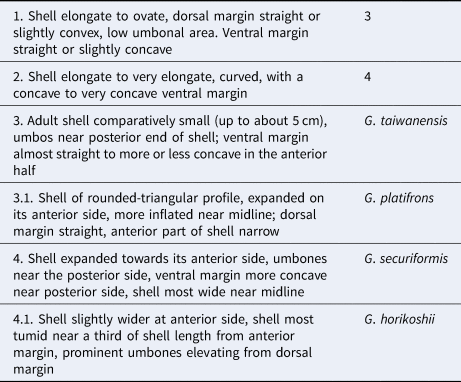
In this work we present a new record for a Gigantidas species in Taiwan waters, based on a juvenile specimen of Gigantidas horikoshii Hashimoto & Yamane, Reference Hashimoto and Yamane2005 collected by fishermen east of Taiwan. Gigantidas horikoshii was originally described from hydrothermal vent sites in the Kaikata Seamount, south-west of the Ogasawara (Bonin) Islands, southern Japan (Hashimoto & Yamane, Reference Hashimoto and Yamane2005), and subsequently recorded in the Nikko Seamount, and the Sumisu Caldera, along the Izu-Ogasawara Island-arc (Kyuno et al., Reference Kyuno, Shintaku, Fujita, Matsumoto, Utsumi, Watanabe, Fujiwara and Miyazaki2009). This is the fourth Gigantidas species for Taiwan waters and it extends the distribution of the species by about 1916 km westwards from its previous documented distribution at southern Japan (Hashimoto & Yamane, Reference Hashimoto and Yamane2005). An identification key, based on shell characters, is given for all extant species of Gigantidas present in Taiwan (Table 1).
Key for the identification of extant species of Gigantidas present in Taiwan, based on shell characters

Material and methods
The single specimen (Figure 1) was apparently collected alive, as it consists of both empty matching valves, preserving both ligament and complete periostracum (with no soft parts recovered). The shells were collected by shrimp trawlers in about 400–500 m at the Taishi fishing grounds east of Taiwan (24°50.8′N 121°59.9′E). According to Bouchet & Cosel (Reference Bouchet and Cosel2004) most of the Tashi fishing ground consists of a gently sloping bottom of fine sediments, with occasional deep coral outcrops and diffuse gas seepage, in a site known for its high molluscan biodiversity. The specimen is deposited in the collections of the Museo de Zoología de la Universidad de Concepción, at Concepción, Chile (MZUC, unnumbered). The distribution map (Figure 2) was prepared using SimpleMappr (Shorthouse, Reference Shorthouse2010). The terminology of shell morphology and the measurements follow Hashimoto & Yamane (Reference Hashimoto and Yamane2005). Dimensions were measured with Vernier callipers (±0.1 mm).
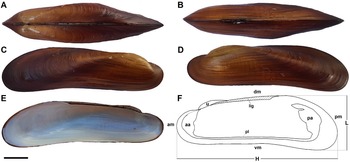
Shell of Gigantidas horikoshii Hashimoto & Yamane, Reference Hashimoto and Yamane2005 from the Tashi Fishing grounds, NE Taiwan. (A) dorsal view; (B) ventral view; (C) lateral view of right valve; (D) lateral view of left valve; (E) internal view of left valve; (F) sketch of internal view of right valve. aa, scar of anterior adductor; am, anterior margin; dm, dorsal margin; H, shell height; L, shell length; lig, ligament; pa, scar of posterior adductor; pl, pallial line; pm, posterior margin; u, umbo; vm, ventral margin. Scale bar is 10 mm.

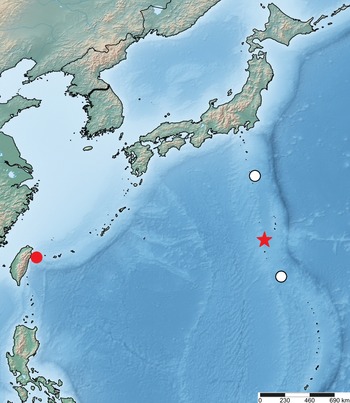
Geographic distribution of G. horikoshii. The red star indicates the type locality at the Kaikata Seamount, south-west of the Ogasawara (Bonin) Islands, south of Japan (Hashimoto & Yamane, Reference Hashimoto and Yamane2005), while the white circles indicate subsequent records for the species (Kyuno et al., Reference Kyuno, Shintaku, Fujita, Matsumoto, Utsumi, Watanabe, Fujiwara and Miyazaki2009). The red circle represents the record presented in this work.

Results
Family Mytilidae Rafinesque, 1815
Subfamily Bathymodiolinae Kenk & Wilson, 1985
Genus Gigantidas Cosel & Marshall, Reference Cosel and Marshall2003
Type species Gigantidas gladius Cosel & Marshall, Reference Cosel and Marshall2003 (by original designation)
Gigantidas horikoshii Hashimoto & Yamane, Reference Hashimoto and Yamane2005
Figure 1A–F.
Bathymodiolus sp
Hashimoto & Horikoshi, Reference Hashimoto and Horikoshi1989: 32, Figures 2 & 4. Gigantidas horikoshii Hashimoto & Yamane, Reference Hashimoto and Yamane2005: 3, Figures 2–12. Huber, Reference Huber2010: 126. Saether et al., Reference Saether, Little, Campbell, Marshall, Collins and Alfaro2010: 33, Figure 10D (idealized internal right valve).
Description of examined specimen
Shell solid, stout, elongate modioliform, inflated, equivalve and markedly inequilateral, of small size for the species (67.5 mm long, 19.7 mm high and 16 mm broad). Shell curved dorso-ventrally, most inflated at about 68% of shell length from anterior end (Figure 1A–E), height/length ratio 0.28. Umbones subterminal, prosogyrate, positioned at about 16% of shell length from anterior end. Umbonal region extremely elongated and prominent, occupying about 20% of whole dorsal margin, slightly eroded along the border of the ridges which run from umbones to postero-ventral corner. Anterior end narrowly rounded, protruding anteriorly, dorsal margin and postero-dorsal margin slightly convex, postero-dorsal corner slightly angular, posterior margin broadly rounded, ventral margin slightly concave. Shell surface smooth, with well-developed irregular commarginal growth lines (Figure 1C, D). Fine radial striae running from umbones to ventral margin. Periostracum strong and smooth, without periostracal hairs, mostly glossy, of dark brown colour; umbonal region of lighter colour (Figure 1A). Shell exterior white, interior smooth and nacreous (Figure 1E).
Hinge edentulous, anterior hinge margin protruding ventrally. Ligament opisthodetic, planivincular, strong, extending about 80% of posterodorsal margin in front of postero-dorsal corner. Ligament plate slightly convex. Posterior end of ligament tapering (Figure 1G). Muscle scars distinct. Anterior adductor scar large, arched, situated well in front of umbones, near antero-dorsal margin. Anterior retractor scar situated closer to umbonal cavity. Posterior adductor scar large, elliptical, united with scar of posterior bundle of posterior byssus retractor scar. Anterior bundle scar of posterior byssus retractor separated, situated high in position, united with posterior pedal retractor scar. Pallial line indistinct, almost parallel to ventral margin (Figure 1G).
Type locality: Kaikata Seamount (26°42.30′N 141°04.47′E, 480 m depth), south-west of the Ogasawara (Bonin) Islands in southern Japan (Hashimoto & Yamane, Reference Hashimoto and Yamane2005).
Distribution
Previously recorded only at vents in the Izu-Ogasawara Island-arc, south-west of the Ogasawara (Bonin) Islands, from Sumisu Caldera, and Nikko and Kaikata Seamounts, between 435–762 m depth (Hashimoto & Yamane, Reference Hashimoto and Yamane2005; Kyuno et al., Reference Kyuno, Shintaku, Fujita, Matsumoto, Utsumi, Watanabe, Fujiwara and Miyazaki2009). The present study extends its distribution by about 1916 km westwards to Taiwan (Figure 2).
Habitat
So far this species has been only found in hydrothermal vents, living partly burrowing in sediments in vertical or oblique position, in large communities (Hashimoto & Yamane, Reference Hashimoto and Yamane2005).
Discussion
The present Taiwanese G. horikoshii specimen differs in some details from the type specimens in the original description by Hashimoto & Yamane (Reference Hashimoto and Yamane2005), for example, even when considering that this is a juvenile specimen, the 0.29 height/length ratio of the shell is lower than that reported for juvenile specimens (0.38–0.41), being more elongated than the type specimens of the original description: paratype #7 measures similarly (63.7) to the present specimen (67.5), but its height and width are larger than the Taiwanese specimen herein examined. On the other hand, the position of the umbo, proportion of the hinge and disposition and form of the adductor muscles agree precisely with the description of the juvenile Japanese type specimens described by Hashimoto & Yamane (Reference Hashimoto and Yamane2005).
The presence of Gigantidas horikoshii in Taiwanese waters is not unexpected, particularly considering the recent records of other bathymodioline mussels (G. platifrons (Hashimoto & Okutani, Reference Hashimoto and Okutani1994), G. securiformis (Okutani et al., Reference Okutani, Fujikura and Sasaki2003) and G. taiwanensis (Cosel, Reference Cosel2008)), which have been made in the area (Cosel, Reference Cosel2008; Kuo et al., Reference Kuo, Kang, Chang, Chao, Wang, Chen, Su, Chen, Lai, Lin and Liu2019). Two of these species (G. platifrons and G. securiformis) harbour methanotrophic symbionts (Fujiwara et al., Reference Fujiwara, Takai, Uematsu, Tsuchida, Hunt and Hashimoto2000; Jang et al., Reference Jang, Ho, Jun, Kim and Won2020), so their distribution is limited by the availability of methane seepage on the ocean floor. Although there are no studies on the symbionts of G. horikoshii, it is probable, considering its phylogenetic relationship to G. gladius and its type locality habitat at hydrothermal vents, that it harbours thiotrophic symbionts, as G. gladius does (Jang et al., Reference Jang, Ho, Jun, Kim and Won2020). On the other hand, there are records of Gigantidas species living in both seeps and vents (and thus suggesting both methanotrophic and thiotrophic symbionts) (Koito et al., Reference Koito, Hashimoto, Nemoto, Kitajima, Kitada and Inoue2012), which may be the case for G. horikoshii, depending of course on which kind of environment it lives in at its Taiwanese habitats. The Tashi fishing grounds, the locality where the present specimen was collected, has been previously cited as the location of infaunal cold seep bivalves, including an extremely large lucinid clam, described in similar circumstances to the present material (Bouchet & Cosel, Reference Bouchet and Cosel2004).
In particular, the wide geographic distribution of some Gigantidas species (e.g. G. childressi), which is a common feature of many other species endemic to deep-sea seeps and vents that have large geographic distributions, is apparently explained by their long-lived larvae, which may facilitate a long-distance dispersal (Arellano et al., Reference Arellano, Van Gaest, Johnson, Vrijenhoek and Young2014). Some Gigantidas species have been originally described from a single location – often unexpectedly as in the case of Gigantidas mauritanicus (Cosel, Reference Cosel2002) – and have been subsequently recorded from larger areas; it is thus probable that Gigantidas horikoshii has a wider geographic distribution along deep-sea features between Japan and Taiwan. The absence of previous records of this vent species may be explained by the patchy distribution of its habitat, although considering that the larvae of these bathymodioline species can stay in the waters for comparatively long periods of time (Dixon et al., Reference Dixon, Lowe, Miller, Villemin, Colaço, Serrão-Santos and Dixon2006; Tyler et al., Reference Tyler, Young, Dolan, Arellano, Brooke and Baker2007), it is not surprising that they may have colonized other vent areas outside their type location, following their chemosynthetic environment habitat requirements (Génio et al., Reference Génio, Johnson, Vrijenhoek, Cunha, Tyler, Kiel and Little2008).
Acknowledgements
We are thankful to Jun Hashimoto (Nagasaki University, Nagasaki, Japan) for helping with the identification of the examined specimen and with literature on the matter, and to the reviewers and editors for their very helpful suggestions on the manuscript.
Author contributions
Claudio Mellado, Nicolás Zambrano and Juan Francisco Araya: analysis and taxonomy, literature review, supervision, writing – review and editing. Juan Francisco Araya, Juan Antonio Aliaga and Luis Ballesteros: concept, conceptualization, supervision, writing – review and editing.
Financial support
This research received no specific grant from any funding agency, commercial or not-for- profit sectors.
Conflict of interest
None.