Introduction
How many words a child is able to comprehend or produce is critical for language development and has been linked to other language and academic skills such as grammatical development, higher reading competence, and to higher school achievement (Duff et al., Reference Duff, Tomblin and Catts2015; Marchman et al., Reference Marchman, Martínez-Sussmann and Dale2004). For bilingual children, learning distinct lexical items in two different languages can be a long and effortful process that leads to a discrepancy between how many words they can comprehend and produce in each language; children have been shown to comprehend significantly more words than they produce, especially when tested in their weaker language (Haman et al., Reference Haman, Łuniewska, Pomiechowska, Armon-Lotem, de Jong and Meir2015). This significant difference in performance between production and comprehension tasks has been coined as the receptive–expressive gap in vocabulary development (Gibson et al., Reference Gibson, Oller, Jarmulonowicz and Ethington2012). The receptive–expressive gap is greater in the bilingual children’s weaker than in their stronger or more dominant language (Gibson et al., Reference Gibson, Oller, Jarmulonowicz and Ethington2012) and larger than the gap reported for typically developing monolingual children (Leonard, Reference Leonard2009). This is because vocabulary development is a language domain distinctly susceptible to the amount and quality of exposure the child receives (Hoff & Core, Reference Hoff and Core2013), as well as the educational setting within which development takes place (Gathercole & Thomas, Reference Gathercole and Thomas2009). Whereas most studies to date have investigated the child-specific or individual factors that affect vocabulary development in bilingual children, fewer studies have examined the psycholinguistic factors that could potentially influence vocabulary development (Haman et al., Reference Haman, Łuniewska, Pomiechowska, Armon-Lotem, de Jong and Meir2015) such as the lexical class a word belongs to (noun or verb), the age at which a word is reported to be acquired (AoA; Łuniewska et al., Reference Łuniewska, Haman, Armon-Lotem, Etenkowski, Southwood, Anđelković, Blom, Boerma, Chiat, de Abreu, Gagarina, Gavarró, Håkansson, Hickey, de López, Marinis, Popović, Thordardottir, Blažienė and Ünal-Logacev2016; Łuniewska et al., Reference Łuniewska, Wodniecka, Miller, Smolík, Butcher, Chondrogianni, Hreich, Messarra, A. Razak, Treffers-Daller, Yap, Abboud, Talebi, Gureghian, Tuller and Haman2019), or its morphophonological complexity (Haman et al., Reference Haman, Łuniewska, Hansen, Simonsen, Chiat, Bjekić, Blažienė, Chyl, Dabašinskienė, Engel de Abreu, Gagarina, Gavarró, Håkansson, Harel, Holm, Kapalková, Kunnari, Levorato, Lindgren and Armon-Lotem2017). To our knowledge, no other study to date has examined how these factors influence the receptive–expressive gap in bilingual children.
Against this background, the present study investigated a set of psycholinguistic and individual factors that could potentially modulate minority language vocabulary development, in this case Scottish Gaelic (Gaelic from this point onward), in majority language dominant children (English) who are becoming bilingual through Gaelic-medium education (GME), a minority language immersion programme found in Scotland. The examination of the language abilities of children in minority second language (L2) immersion education offers a unique opportunity to investigate the individual factors that affect language development under limited exposure to a minority heritage language and to better understand what psycholinguistic properties may affect bilingual children’s vocabulary performance in this bilingual exposure setting. Our study is also one of the few studies to examine how the receptive–expressive gap changes as a function of schooling (measured by the school year children are in; Gibson et al., Reference Gibson, Peña, Bedore and McCarter2020; Oller & Eilers, Reference Oller and Eilers2002) and, in this case, of minority language immersion education. By focusing on the early years of Gaelic-medium primary education (GMPE), this is the first study to investigate how psycholinguistic variables, such as word class, AoA, and morphophonological complexity, and child-level factors such as age, length, and frequency of exposure to Gaelic and English, modulate vocabulary development and the receptive–expressive gap in the minority language.
Lexical development in minority immersion education
Psycholinguistic factors
Bilingual school-aged children are often assessed on their vocabulary size using assessments standardized with monolingual children. This practice has led to a well-documented lag in vocabulary development in bilingual children compared with their monolingual peers, especially when they are tested in each language separately and in their less dominant language (Chondrogianni, Reference Chondrogianni, Miller, Bayram, Rothman and Serratrice2018; Haman et al., Reference Haman, Łuniewska, Pomiechowska, Armon-Lotem, de Jong and Meir2015). Furthermore, standardized tasks, despite their rigorous development, do not always take into account psycholinguistic variables that modulate vocabulary development, such whether a lexical item is a noun or a verb, the age at which a particular word was estimated to be acquired, or its morphophonological complexity (Haman et al., Reference Haman, Łuniewska, Pomiechowska, Armon-Lotem, de Jong and Meir2015). These psycholinguistic variables have been shown to modulate performance on lexical tasks in both monolingual and bilingual children, with nouns and early acquired words eliciting higher accuracy on lexical tasks in both monolingual and bilingual children than verbs or late acquired words (Haman et al., Reference Haman, Łuniewska, Pomiechowska, Armon-Lotem, de Jong and Meir2015; Martin & Tokowicz, Reference Martin and Tokowicz2019).
Why do these measures matter for children’s performance on lexical tasks? Nouns have been shown to have an advantage over verbs not only in terms of early production (Bloom, Reference Bloom2000; Gentner, Reference Gentner, Bowerman and Levinson2006) but also during lexical access and retrieval (Cordier et al., Reference Cordier, Croizet and Rigalleau2013; De Simone & Collina, Reference De Simone and Collina2016; Gollan et al., Reference Gollan, Montoya, Fennema-Notestine and Morris2005). This primacy of nouns over verbs seems to hold even when the morphosyntactic complexity of verbs (De Simone & Collina, Reference De Simone and Collina2016; Kauschke et al., Reference Kauschke, Lee and Pae2007), the concreteness of nouns (Martin & Tokowicz, Reference Martin and Tokowicz2019), or the semantic dichotomy between actions (verbs) and objects (nouns) are partialed out (De Simone & Collina, Reference De Simone and Collina2016) or when input frequency (Piccin & Waxman, Reference Piccin and Waxman2007) is controlled for. This suggests that there are other inherent properties to verbs and nouns that differentiate them in acquisition and processing. Verbs carry information about argument structure and the thematic roles assigned to the verbal arguments within the sentence. They are also constrained by language specific properties, for example, their position in the sentence (e.g., SVO in English vs. VSO in Gaelic), their transitivity, and the number and type of arguments they license, which may in turn modify their meaning and lead to multiple meanings or ambiguity. Pictures denoting objects also tend to be named in a more uniform way than pictures denoting verbs, which may elicit multiple words to describe a depicted event (Gertner et al., Reference Gertner, Fisher and Eisengart2006; Haman et al., Reference Haman, Łuniewska, Pomiechowska, Armon-Lotem, de Jong and Meir2015). All these factors may work in isolation or in tandem to modulate word learning and have also been shown to underlie behavioural and neurophysiological responses to the two word classes (Vigliocco et al., Reference Vigliocco, Vinson, Druks, Barber and Cappa2011).
Another word-related property associated with lexical accuracy and processing efficiency is the AoA of different words. AoA is a psycholinguistic construct used to refer to the age at which a particular word is acquired (e.g., see Carroll & White, Reference Carroll and White1973). There are three main ways of measuring a word’s AoA: an objective AoA measurement that relies on establishing when a word first occurs in child speech based on child language corpora (Juhasz, Reference Juhasz2005; Smolík & Filip, Reference Smolík and Filip2022); a quasi-objective way based parental reports, an indirect but highly reliable measurement of when children produce or comprehend words (Łuniewska et al., Reference Łuniewska, Wodniecka, Miller, Smolík, Butcher, Chondrogianni, Hreich, Messarra, A. Razak, Treffers-Daller, Yap, Abboud, Talebi, Gureghian, Tuller and Haman2019); and a subjective AoA measurement that involves asking adult raters to estimate the age or the relative order that they thought they learned a particular word (Johnston & Barry, Reference Johnston and Barry2006; Smolík & Filip, Reference Smolík and Filip2022). Subjective AoA ratings, albeit indirect, when compared with more objective and direct corpus-based AoA estimations or parent-report data on children’s vocabulary, have been shown to correlate well with measures of word knowledge and processing efficiency (Johnston & Barry, Reference Johnston and Barry2006). The subjective nature of AoA based on adult ratings has given rise to a debate in the literature regarding whether or not AoA effects can be found independently from frequency effects, as the two measures are highly correlated; how subjective AoA relates to other psycholinguistic variables such as typography, imageability, concreteness, and familiarity, among other variables (Bonin et al., Reference Bonin, Barry, Méot and Chalard2004; Zevin & Seidenberg, Reference Zevin and Seidenberg2002); and given the relationship between subjective AoA and these variables, whether subjective AoA is really a measure for the age of acquiring words or a proxy for other psycholinguistic variables (Smolík & Filip, Reference Smolík and Filip2022). Results on the relationship between AoA and other psycholinguistic variables are mixed. Studies have reported independent effects of frequency and AoA, with AoA effects on word processing persisting even after frequency was controlled for (Brysbaert, Reference Brysbaert2017; Pérez, Reference Pérez2007) or with studies reporting larger AoA than frequency effects (Cortese & Khanna, Reference Cortese and Khanna2007; Menenti & Burani, Reference Menenti and Burani2007). Other studies have reported no frequency effects once AoA was controlled for (Gilhooly & Logie, Reference Gilhooly and Logie1980; Schwanenflugel et al., Reference Schwanenflugel, Harnishfeger and Stowe1988) or have argued that reported frequency effects on picture-naming speed are really masked AoA effects (Morrison et al., Reference Morrison, Ellis and Quinlan1992). At the same time, adult AoA ratings have been seen as a proxy for other surface word properties such as typography, familiarity, frequency (Bonin et al., Reference Bonin, Barry, Méot and Chalard2004), which, in turn, may influence memory and subsequently adult judgments about AoA (Smolík & Filip, Reference Smolík and Filip2022).
In recent years, AoA has been adopted in developmental studies in an attempt to better understand how this psycholinguistic construct about when a word is (estimated to be) acquired may influence lexical accuracy in school-aged children (Haman et al., Reference Haman, Łuniewska, Pomiechowska, Armon-Lotem, de Jong and Meir2015; van Wonderen & Unsworth, Reference van Wonderen and Unsworth2020). However, its adoption in the developmental research has not been without criticism (Smolík & Filip, Reference Smolík and Filip2022; Wikse Barrow et al., Reference Wikse Barrow, Nilsson Björkenstam and Strömbergsson2019). Two main issues have been raised. First, subjective AoA ratings have traditionally been based on judgments from young adults, usually undergraduate students with little or no experience with interacting with children. These AoA ratings have recently been shown to be less reliable when compared with objective AoA measures (e.g., child corpora; Smolík & Filip, Reference Smolík and Filip2022) or with ratings from adults who regularly interact with children—for example, child carers or teachers (Wikse Barrow et al., Reference Wikse Barrow, Nilsson Björkenstam and Strömbergsson2019). The second issue relates to what exactly subjective AoA ratings are said to indicate. By triangulating AoA measures based on corpora, parental reports, and adult ratings, Smolik and Filip (Reference Smolík and Filip2022) showed that adult AoA ratings may be better at capturing the relative order of when different words are acquired rather than the precise age of acquisition (see also Wikse Barrow et al., Reference Wikse Barrow, Nilsson Björkenstam and Strömbergsson2019 for similar conclusions). Despite its limitations, relative AoA order can be particularly helpful for minority languages where the acquisition context is much more complex than what is reported for majority languages. This is because not all minority language speakers are exposed to the minority language from birth or at the same age, especially if a minority language is being revitalized through education, such as the case of Gaelic. In the present study, we addressed these two issues by targeting AoA raters who were parents or grandparents of children in GME and/or from the same community as the children we tested. We also take these subjective AoA ratings as a proxy for relative order of acquisition rather than exact age of acquisition (see Method section).
Despite its limitations and complexity, subjective AoA ratings have been found to be consistent across speakers and languages regardless of their majority or minority status in acquisition studies based on adult AoA ratings as our study (Haman et al., Reference Haman, Łuniewska, Pomiechowska, Armon-Lotem, de Jong and Meir2015; Łuniewska et al., Reference Łuniewska, Wodniecka, Miller, Smolík, Butcher, Chondrogianni, Hreich, Messarra, A. Razak, Treffers-Daller, Yap, Abboud, Talebi, Gureghian, Tuller and Haman2019) and to strongly correlate with parental reports on young children’s lexical development (Łuniewska et al., Reference Łuniewska, Haman, Armon-Lotem, Etenkowski, Southwood, Anđelković, Blom, Boerma, Chiat, de Abreu, Gagarina, Gavarró, Håkansson, Hickey, de López, Marinis, Popović, Thordardottir, Blažienė and Ünal-Logacev2016). AoA also reliably predicted accuracy on nouns and verbs in expressive and receptive vocabulary tasks similar to the ones used in the present study with monolingual and bilingual children, with the earlier the AoA, the higher the accuracy on the word (Altman et al., Reference Altman, Goldstein and Armon-Lotem2017; Juhasz, Reference Juhasz2005; van Wonderen & Unsworth, Reference van Wonderen and Unsworth2020), and in certain cases, AoA overrode effects of the child’s chronological age (Chondrogianni et al., Reference Chondrogianni, Judge-Clayden and Butcher2022). This might be because the earlier a word is acquired the more experience the speaker has with using this word in various contexts and the easier it is to access it (see Menenti & Burani, Reference Menenti and Burani2007 for similar findings regarding lexical processing speed). Thus, lexical selection of earlier acquired words may be facilitated over later acquired words. In the context of the present study, and in the absence of child corpora or other psycholinguistic measures for Gaelic, such as frequency, imageability or typography, among other things, variables usually available in studies with majority languages such as English, the calculation of subjective AoA allowed us to obtain ratings about word properties that have been shown to reliably predict word knowledge and to better understand what modulates the acquisition of a word when learning a minority language.
Whether a word’s morphophonological complexity modulates vocabulary development is less clear. In previous studies that used the same lexical complexity index (CI) as the one in the present study—namely, a composite measure that takes into account the word’s phonology (e.g., word length in phonemes, consonant clusters), morphology (e.g., derivation and compounding), loanwords, and lexical borrowings—CI effects were observed for some languages but not all, and no clear typological patterns emerged in the results (Haman et al., Reference Haman, Łuniewska, Hansen, Simonsen, Chiat, Bjekić, Blažienė, Chyl, Dabašinskienė, Engel de Abreu, Gagarina, Gavarró, Håkansson, Harel, Holm, Kapalková, Kunnari, Levorato, Lindgren and Armon-Lotem2017; Hansen et al., Reference Hansen, Simonsen, Łuniewska and Haman2017; van Wonderen & Unsworth, Reference van Wonderen and Unsworth2020). This was attributed to the fact that, despite differences in word length, words may be acquired at the same time in Italian-speaking children, who prefer multisyllabic words, and in English-speaking children, where mono- or disyllabic words may be more prevalent (Hansen et al., Reference Hansen, Simonsen, Łuniewska and Haman2017). It may also be the case that the word’s phonological properties modulate lexical learning in less proficient children at early stages of acquisition—that is, before the age of four years, as in the case of the younger Spanish-Dutch bilingual children in van Wonderen & Unsworth (Reference van Wonderen and Unsworth2020).
Environmental, child-related factors and vocabulary development
Studies investigating the development of the minority language in immersion education have shown that the language used at home affects both the minority and the majority vocabulary skills. In previous research focusing on the majority language skills (English) of the same English-Gaelic bilingual children as in this study, children who were exposed to Gaelic later in childhood tended to have larger vocabularies in English than children with an earlier age of exposure (AoE), although AoE was a contributing factor rather than a strong predictor in the study (Chondrogianni et al., Reference Chondrogianni, Judge-Clayden and Butcher2022). The effect of exposure is larger on minority vocabulary development because it reinforces the contexts outside the school context where the minority language can be used (Dijkstra et al., Reference Dijkstra, Kuiken, Jorna and Klinkerberg2016; Hoff et al., Reference Hoff, Rumiche, Burridge, Ribot and Welsh2014; Gathercole et al., Reference Gathercole, Thomas and Hughes2008; O’Toole et al., Reference O’Toole, Ní Shíthigh, Molamphy and Walsh2019; Smithson et al., Reference Smithson, Paradis and Nicoladis2014). This is over and above the effect of the language of schooling, which also leads to minority vocabulary size increase (Gathercole et al., Reference Gathercole, Thomas, Roberts, Hughes, Hughes and Gathercole2013; Gathercole et al., Reference Gathercole, Thomas and Hughes2008). Studies with children in Welsh-immersion education have shown that children from Welsh-speaking homes outperformed their younger and more English-dominant peers on Welsh receptive vocabulary tasks (Gathercole & Thomas, Reference Gathercole and Thomas2009; Rhys & Thomas, Reference Rhys and Thomas2013). The results regarding whether the English receptive vocabulary scores differed as a function of home language background are mixed. Gathercole and Thomas (Reference Gathercole and Thomas2009) reported language exposure effects only in the younger child group (3;6–5; 0-year-old children, age in years;months) in their study, but these effects disappeared by the age of 7 years. Conversely, in the Rhys & Thomas (Reference Rhys and Thomas2013) study, children from mixed Welsh/English or Welsh-speaking families, especially from more prominent Welsh-speaking areas, performed 1 SD below the mean on English vocabulary, indicating that the language of the wider community plays a crucial role for vocabulary development. In the study by Smithson et al. (Reference Smithson, Paradis and Nicoladis2014) on vocabulary development in French-English bilingual children attending French immersion programmes in Alberta, Canada, the level of maternal education and exposure to French in the home positively predicted accuracy on the French vocabulary task and negatively predicted accuracy on the English vocabulary task, whereas exposure to English negatively predicted performance on the French vocabulary task.
Two studies are particularly relevant for the present study due to the immersion context they investigated and the adopted tasks. Chondrogianni et al. (Reference Chondrogianni, Judge-Clayden and Butcher2022) focused on the majority language abilities (English) of the English-Gaelic bilingual children in GMPE using the British English version of the CLT (Haman et al., Reference Haman, Łuniewska, Pomiechowska, Armon-Lotem, de Jong and Meir2015). They found that children performed better on English nouns than on verbs and on the English receptive than the expressive task, although, overall, their performance across both modalities was high (overall receptive: 98%; overall expressive: 85%). Children’s vocabulary size in the majority L1 English was influenced by AoA over and above any improvement of their lexical skills across year groups. Children who had later exposure to Gaelic tended to perform better on the English receptive and expressive tasks, although age of exposure (AoE) was a contributing rather than a significant factor in the study.
In a study with the Irish immersion educational context, O’Toole et al. (Reference O’Toole, Ní Shíthigh, Molamphy and Walsh2019) measured the receptive vocabulary abilities in Irish-speaking children aged between 5 and 7 years. The children were attending Irish-medium schools from English-speaking and bilingual homes, where English was the dominant language and Irish was spoken to a variable degree. Irish is another Celtic language along with Gaelic undergoing revitalization through education. The vocabulary developed in the study followed some of the criteria adopted in the present study in that all words tested were native Irish words and not borrowings from English, Irish-English cognates were excluded, and words were checked for age of acquisition following the Irish Communicative Development Inventory (O’Toole & Fletcher, Reference O’Toole and Fletcher2010). The Irish receptive vocabulary task differed from the one in the present study in that it targeted various word classes, not only nouns and verbs, as in the present study, and words acquired after the age of 40 months were not checked for AoA. The AoA measure in the Irish study was also based on child language data, not on adult estimates, as in our study. O’Toole et al. (Reference O’Toole, Ní Shíthigh, Molamphy and Walsh2019) reported that, overall, children’s performance on the vocabulary task improved with age and that children from bilingual homes had higher accuracy in Irish than children from English-speaking homes. These findings are in line with what has been reported for languages in other minority contexts such as Welsh (Gathercole & Thomas, Reference Gathercole and Thomas2009) and Spanish (Hoff et al., Reference Hoff, Rumiche, Burridge, Ribot and Welsh2014) but not in contexts where the two languages have equal status such as French-English in Montreal (Thordardottir, Reference Thordardottir2011), where no differences between the two languages were reported. In the present study, we investigated how frequency of exposure to English and Gaelic in the early years in the home/nursery and frequency of current exposure to the two languages in the home modulates performance on vocabulary comprehension and production.
The receptive–expressive gap in bilingual children
The receptive–expressive gap, in which children perform better on vocabulary comprehension than production tasks, is well attested in bilingual children. The majority of studies use standardized tasks to ascertain the magnitude of the gap (Gibson et al., Reference Gibson, Oller, Jarmulonowicz and Ethington2012; Oller et al., Reference Oller, Pearson and Cobo-Lewis2007). Despite the diagnostic benefits of using standardized tasks in clinical settings to ascertain the magnitude of the receptive–expressive gap, and thus the nature of the disorder (e.g., only expressive, or receptive as well), there are inherent limitations to their use, especially with typically developing emergent bilingual children. First, as Gibson et al. (Reference Gibson, Peña, Bedore and McCarter2020) point out, many standardized tasks are constructed and normed to provide separate receptive and expressive scores to begin with (Leonard, Reference Leonard2009), and this may formalize a distinction between the language modalities that may not be real (Gibson et al., Reference Gibson, Jarmulowicz and Oller2018). In the case of bilinguals more specifically, whereas the discrepancy between the receptive and expressive tasks is interpreted as real difference in ability and an indication of clinical status in the case of monolingual children (Leonard, Reference Leonard2009), the discrepancy between receptive and expressive language abilities is well documented in studies with bilingual children, including children with typical development (Chondrogianni, Reference Chondrogianni, Miller, Bayram, Rothman and Serratrice2018; Gibson et al., Reference Gibson, Peña and Bedore2014a; Hoff et al., Reference Hoff, Rumiche, Burridge, Ribot and Welsh2014). Second, despite the rigorous procedures that underlie standardized task development, they do not always examine or take into account psycholinguistic properties that have been shown to modulate performance on these tasks, such as word class, AoA, or the word’s CI (Haman et al., Reference Haman, Łuniewska, Hansen, Simonsen, Chiat, Bjekić, Blažienė, Chyl, Dabašinskienė, Engel de Abreu, Gagarina, Gavarró, Håkansson, Harel, Holm, Kapalková, Kunnari, Levorato, Lindgren and Armon-Lotem2017; Haman et al., Reference Haman, Łuniewska, Pomiechowska, Armon-Lotem, de Jong and Meir2015; Hansen et al., Reference Hansen, Simonsen, Łuniewska and Haman2017; van Wonderen & Unsworth, Reference van Wonderen and Unsworth2020). Finally, standardized assessments may not always be available for less widely spoken minority languages, which makes the examination of their lexical development and the factors that may affect their development harder to investigate in these contexts (Thordardottir, Reference Thordardottir, Armon-Lotem, Meir and de Jong2015).
Which environmental, child-related factors modulate the magnitude of the receptive–expressive gap in bilingual children is the subject of recent but continuous investigation. In the study by Gibson et al. (Reference Gibson, Oller, Jarmulonowicz and Ethington2012) with preschool Spanish-English bilingual children in the United States, preschool attendance, maternal education, and proficiency in English affected minority and majority language vocabulary development but failed to explain the magnitude of the gap in the minority language (Spanish). However, in the study by Gibson et al. (Reference Gibson, Peña and Bedore2014a) with Spanish-English bilingual children with mixed dominance profiles, older children had a smaller receptive–expressive gap in both Spanish and English than younger children, whereas children with more exposure to English had a larger gap in Spanish and a smaller gap in English. Systematic nursery attendance, use of the L2 German in the family by the parents or other speakers was also shown to modulate the size of the gap in German L2 children (Keller et al., Reference Keller, Troesch and Grob2015). Age of systematic exposure to the majority L2 has been reported to reduce the magnitude of the gap in school-aged children (7–9 years; Gibson et al., Reference Gibson, Peña and Bedore2014b).
To our knowledge, only two studies to date have investigated how the magnitude of the receptive–expressive gap changes as a function of schooling. Both studies have been conducted with Spanish-English bilingual children in the United States. In a cross-sectional study with Spanish-English bilingual children in English-immersion education, Oller and Eilers (Reference Oller and Eilers2002) reported that the gap between receptive and expressive standardized assessments decreased by 14 standard points from kindergarten (average score of 34 points) to the fifth grade (average score of 20 points) in L1 Spanish, whereas at no point was there a significant gap in English, the language of instruction and the majority language of the community. In the only longitudinal study to date to investigate the magnitude of the gap as a function of age and exposure (Gibson et al., Reference Gibson, Peña, Bedore and McCarter2020), Spanish-English bilingual children were tested in kindergarten (5;8 years, age in years;months) and then the first grade (6;9 years). Children had higher English than Spanish language scores at kindergarten, but the difference disappeared by the first grade, and children improved their scores across both languages from kindergarten to the first grade. However, the magnitude of the receptive–expressive gap in both English and Spanish did not change across the year groups.
Why is there a gap between the two modalities, and why might the gap be larger in the child’s weaker language? Two accounts have been proposed to explain this difference, the frequency-lag hypothesis (Gibson et al., Reference Gibson, Oller, Jarmulonowicz and Ethington2012), and the suppression or relative activation mechanism (Gibson et al., Reference Gibson, Peña, Bedore and McCarter2020), both capitalizing on how frequency of use and exposure affect lexical access. The frequency-lag hypothesis (Gibson et al., Reference Gibson, Oller, Jarmulonowicz and Ethington2012, Gibson et al., Reference Gibson, Peña, Bedore and McCarter2020; Gollan et al., Reference Gollan, Montoya, Cera and Sandoval2008; Yan & Nicoladis, Reference Yan and Nicoladis2009) also known as the weaker links hypothesis (Gollan et al., Reference Gollan, Montoya, Cera and Sandoval2008), assumes that the frequency with which a word is used modulates lexical access. Limited experience with words may result in weak associations between semantic and phonological representations for those words, which, in turn, may impede lexical access. As language exposure increases, the link between phonological and semantic representations is enhanced and lexical access is improved. These assumptions of the frequency-lag hypothesis about the weaker link between phonological and semantic representations can explain the semantic receptive–expressive gap (Gibson et al., Reference Gibson, Oller, Jarmulonowicz and Ethington2012; Gibson et al., Reference Gibson, Peña, Bedore and McCarter2020). Namely, with increased language use, the links between the phonological and semantic representations and the representations themselves become more highly specified. This, in turn, leads to a smaller receptive–expressive gap in individuals with more phonological or semantic knowledge compared with individuals with less phonological or semantic knowledge. Underspecified semantic or phonological representations may be sufficient for success on less demanding receptive tasks, which minimize the influence of potentially interfering variables such as lexical access and pronunciation (Clark, Reference Clark2009), but not with more demanding expressive tasks, leading thus to a receptive–expressive gap. This account predicts that the gap will be larger in the individual’s weaker language and that performance will increase as a function of exposure or age to this language, and this has been partly confirmed in previous studies (Gibson et al., Reference Gibson, Peña and Bedore2014b; Keller et al., Reference Keller, Troesch and Grob2015; Oller & Eilers, Reference Oller and Eilers2002).
The suppression or relative activation mechanism relies on Green and Abutalebi’s (Reference Green and Abutalebi2013) Inhibitory control model, according to which the two languages of the bilingual individual are activated and in constant competition during speaking in bilingual settings. For the target lexical item to be selected, the nontarget language needs to become inhibited or temporarily deactivated to allow access to the other language. For example, when an L2 learner is in a majority L2 context, the L2 receives higher levels of activation than the L1 due to more frequent L2 use and exposure, and it would need to be suppressed for the target item to be selected. This suppression mechanism and selection of the target item may be more successful when the bilingual is carrying out a cognitively less demanding task, such as pointing to pictures in receptive tasks, than when producing words (Gibson et al., Reference Gibson, Peña, Bedore and McCarter2020). As language use in general increases, the difficulty in accessing representations decreases. This means that the magnitude of the gap will reduce over time as a function of increased experience.
Both of these accounts are compatible with the revised hierarchical model (RHM) (Kroll et al., Reference Kroll, van Hell, Tokowicz and Green2010; Kroll & Stewart, Reference Kroll and Stewart1994) for lexical access, which proposes an asymmetrical access and mappings for words and concepts for the (more dominant) L1 than the (weaker) L2. Specifically, according to the RHM, word-to-concept connections are stronger for the L1 or for highly proficient L2 learners, whereas lexical access from the L2 to the L1 is stronger at early stages of L2 learning. The link with the conceptual system may become stronger for L2 learners as their L2 proficiency increases (Sunderman & Kroll, Reference Sunderman and Kroll2006).
As proficiency and exposure are closely linked in vocabulary development (Chondrogianni, Reference Chondrogianni, Miller, Bayram, Rothman and Serratrice2018; Thordardottir, Reference Thordardottir2011), one may assume that with increased proficiency and exposure lexical access will become less effortful and more accurate, leading to a smaller receptive–expressive gap as children also receive more exposure in their L2.
Present study
Against this background, the present study investigated the lexical abilities of English L1- Gaelic L2-speaking children in Gaelic-medium education using expressive and receptive tasks and the psycholinguistic and child-related factors that modulate their performance. Gaelic-medium education (GME) is an immersion model distinct to Scotland that spans across preschool, primary, and secondary education and targets the acquisition of both Gaelic and English with the view to making children fully bilingual by the time they enter secondary education. Gaelic is prioritized in the first 3 years of GMPE, and English is introduced slowly in lessons (O’Hanlon et al., Reference O’Hanlon, Paterson and McLeod2013). Pupils entering GMPE come from a variety of backgrounds. Most pupils come from families with no Gaelic at home and are immersed in Gaelic at school (Stephen et al., Reference Stephen, McPake, McLeod, Pollock and Carroll2010). A small proportion of parents (approximately 18%) are native speakers of Gaelic (O’Hanlon et al., Reference O’Hanlon, Paterson and McLeod2013), and there are currently no monolingual speakers of Gaelic in Scotland. As nursery provision may or may not be attached to school(s) in regions that offer GMPE, pupils enter primary schools with mixed former experience of formal instruction in Gaelic. According to the most recent Census, only 1.1% of the Scottish population can speak Gaelic (National Records of Scotland, 2015), although there has been an increase in the proportion of young people who speak Gaelic since then. In 2017–18, there were 54 preschool, 58 primary, and three secondary Gaelic-medium schools in Scotland (Bòrd na Gàidhlig, 2018).
The present study complements the study that focused on the majority L1 English language abilities of the same children as the ones in this analysis (Chondrogianni et al., Reference Chondrogianni, Judge-Clayden and Butcher2022). In that study, we examined the relationship between English vocabulary development and nonword repetition and the psycholinguistic (e.g., number of syllables and consonants, neighbourhood density, among others) and individual factors that modulated performance on these tasks. Specifically, the current study differs from the Chondrogianni et al. (Reference Chondrogianni, Judge-Clayden and Butcher2022) study in two important ways. First, this study focuses on the psycholinguistic (word class, AoA, complexity index) and individual factors that modulate vocabulary development in the minority L2 (Gaelic), which was not previously examined. Second, we investigate how these factors modulate the receptive–expressive gap in both the majority and the minority language. In the previous study on the English language abilities of this population, we reported that the bilingual children’s receptive vocabulary skills were better than their expressive skills, and that the difference was larger for verbs (English CLT-Ex(pressive) verbs = 72%; CLT-Ex verbs = 99%) than for nouns (English CLT-R(eceptive) nouns = 94%; CLT-R nouns = 96%). However, this difference was not statistically scrutinized. In the present study, we investigate whether child-level factors or schooling modulate the magnitude of the receptive–expressive gap in both L1 English and L2 Gaelic.
Specifically, in the present paper, we addressed the following research questions:
-
1. What item- and child-related variables modulate expressive and receptive vocabulary development in the minority language Gaelic in English L1–Gaelic L2-speaking children in the early primary years of Gaelic-medium immersion education?
-
2. What is the magnitude of the receptive–expressive lexical gap in Gaelic and in English?
-
3. How do word class and child-level variables related to schooling and frequency of exposure to the two languages modulate the size of the gap in the early years of immersion education?
Regarding the first research question, we expected verbs to have lower accuracy than nouns due to the inherent properties of verbs related to their argument structure and influence on sentence structure, among other things (see also section on Psycholinguistic factors above), compared with nouns. We also expected words with early AoA to have higher accuracy than words with late AoA (Haman et al., Reference Haman, Łuniewska, Hansen, Simonsen, Chiat, Bjekić, Blažienė, Chyl, Dabašinskienė, Engel de Abreu, Gagarina, Gavarró, Håkansson, Harel, Holm, Kapalková, Kunnari, Levorato, Lindgren and Armon-Lotem2017, Haman et al., Reference Haman, Łuniewska, Pomiechowska, Armon-Lotem, de Jong and Meir2015). Whether this would surface to an equal degree for both nouns and verbs and across modalities is an empirical issue in the present study. With respect to the CI, we expected that this may modulate children’s performance in Gaelic because, despite being primary school-age children, they were at initial stages of learning Gaelic, when the morphophonological properties of a language may play a more crucial role in word learning (Hansen et al., Reference Hansen, Simonsen, Łuniewska and Haman2017; van Wonderen & Unsworth, Reference van Wonderen and Unsworth2020). However, CI effects were not uniformly attested in a previous large-scale cross-linguistic study using the CLT, and CI could differentially affect word class in this study, as reported in previous studies (Haman et al., Reference Haman, Łuniewska, Hansen, Simonsen, Chiat, Bjekić, Blažienė, Chyl, Dabašinskienė, Engel de Abreu, Gagarina, Gavarró, Håkansson, Harel, Holm, Kapalková, Kunnari, Levorato, Lindgren and Armon-Lotem2017).
Turning to the child-specific factors, we anticipated that children with more exposure to Gaelic and/or less exposure to English at home would have higher vocabulary skills than children with more exposure to English. We also expected children’s vocabulary skills to improve as a function of age and schooling.
Regarding the second and third research questions, we expected the receptive–expressive gap to be larger in the minority L2 Gaelic, which is also the weaker language of the children in our sample, than in their L1 English. If the frequency-lag hypothesis is at play and the lexico-semantic knowledge is lower in Gaelic compared with English, we expect to see a larger gap in the minority language. The larger gap in Gaelic may also result from more limited experience with the minority language, whose use is primarily restricted within the school context. We, thus, anticipated that children with more experience in the minority language and less in the majority language outside the school setting to have a smaller gap. In the context of the present study, the magnitude of the receptive–expressive gap in Gaelic may be modulated not only by the weaker links in this language but also by the fact that the majority language (English) is generally more activated, as it is used in more contexts. This means that accessing lexical items in Gaelic is challenging not only due to insufficient proficiency in Gaelic but also because the competing items in English may be more highly activated and, thus, more readily accessible to the bilingual child. Given that lexical access and word learning may also be modulated by word class, we expect the gap to be larger for verbs than for nouns. Specifically, we expected the current inferential analysis to confirm that the magnitude of the lexical gap is modulated by word class in English (Chondrogianni et al., Reference Chondrogianni, Judge-Clayden and Butcher2022), with a larger gap for verbs than for nouns. In the present study, we investigated whether word class also modulates the magnitude of the receptive–expressive gap in the minority L2, where children are expected to have overall lower language skills than in the majority language.
Method
Participants
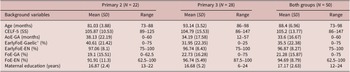
Fifty-five children (31 female) aged between six- to eight-years were recruited from three local authorities where Gaelic-medium primary education is offered (Edinburgh, Glasgow, and the Isle of Skye) in Scotland, UK. All children were exposed to the majority community L1 English from birth and had varied exposure to the minority L2 Gaelic outside the school setting (see Table 1). Parents provided information about children’s language use and history, hearing problems, ear infections, and parental education level using the Questionnaire for Parents of Bilingual Children (PABIQ; Tuller, Reference Tuller, Armon-Lotem, de Jong and Meir2015). To identify and exclude from the sample children with potential developmental language disorder, we administered the core screener of the Clinical Evaluation of Language Fundamentals (CELF-5) given that English was the dominant language for all children (Semel & Wiig, Reference Semel and Wiig2017). Five children had a score of one standard deviation or greater below the age-appropriate norms, which would indicate concerns for language impairment (Leonard, Reference Leonard2014) and, thus, were excluded from the final sample (three out of the five children also had a formal diagnosis for language impairment). This resulted in a final sample of 50 children. Twenty-two children were attending Primary 2 (P2, mean age in months: 81.13, SD: 3.96, range: 73–82) and 28 children Primary 3 (P3, mean age in months: 92.68, SD: 4.27, range: 79–98). As testing took place between February and May of the school year, children attending P2 will have had 1.5 to almost 2 years of primary school attendance at the time of testing and children in P3 2.5 to almost 3 years of primary school attendance Descriptive data for background variables can be found in Table 1.
Participant background information

Note. CELF-5 = Clinical Evaluation of Language Fundamentals; AoE-G = Age of exposure to Gaelic; earlyFoE-GA/EN = Frequency of early exposure to Gaelic/English; FoE-GA/EN = current frequency of exposure to Gaelic/English.
Materials
Overall language skills
To assess children’s language abilities, we used the Screener component of the Clinical Evaluation for Language Fundamentals 5 (Semel & Wiig, Reference Semel and Wiig2017). This allowed us to confirm the typical language development of these English-dominant children as shown in Table 1.
Parental questionnaire
To examine children’s onset and frequency of exposure to Gaelic and English in the home and/or the nursery, we administered the Parental Bilingual Questionnaire (PABIQ; Tuller, Reference Tuller, Armon-Lotem, de Jong and Meir2015). Parents estimated how frequently children were exposed to Gaelic and English in the home and/or attended Gaelic-speaking nursery in the early years (before formal schooling, earlyFoE_Gaelic/EN) or currently in the home (FoE_Gaelic/EN) by selecting one of the following categories and percentages for each language separately (Always – 100%, Usually – 75%, Sometimes – 50%, Rarely – 25% or Never – 0%). To calculate early exposure, parents/carers were asked to indicate how much exposure to Gaelic and English the child had before attending formal schooling (around the age of 4 years in Scotland). They were then asked in a different item to separately indicate the different interlocutors and contexts in which this exposure took place (mother, father, siblings, grandparents, other adults/carers, childminder, nursery). For current exposure, there were questions targeting exposure to different family members (siblings/grandparents/other adults/carers). Current language exposure to Gaelic and English in the home was calculated after averaging the percentage of exposure specified for each interlocutor. Children had large variation in their AoE to Gaelic, as well as how frequently they were exposed to Gaelic before formal schooling started and currently (Table 1). Out of the 50 children, seven children had no early or current exposure of Gaelic in the home or early in the nursery; four children had exposure of Gaelic in the home (although rarely/25% spoken, as indicated by parents) but did not attend bilingual English-Gaelic nurseries. All remaining children had some exposure to Gaelic in the home, albeit to variable degree (between 12.5% and 75%) and attended bilingual English-Gaelic nurseries. The questionnaire also allowed us to collect information about children’s socioeconomic status (SES) as measured through maternal education. The majority of mothers had either a university degree or further university training, and four mothers had only secondary education or vocational training. This suggested that the children in our sample belonged to families from mid-to-high SES.
Vocabulary comprehension and production
To assess children’s language abilities, we used the British English version of the Crosslinguistic Lexical Task (LITMUS CLT, henceforth CLT; Haman et al., Reference Haman, Łuniewska, Pomiechowska, Armon-Lotem, de Jong and Meir2015) and we followed the CLT guidelines to develop the Gaelic CLT version (CLT-Gaelic). The development of the English CLT is described in (Haman et al., Reference Haman, Łuniewska, Pomiechowska, Armon-Lotem, de Jong and Meir2015). Gaelic is a language of the Celtic family (Lamb, Reference Lamb2002). Nouns and verbs in Gaelic are morphologically richer than English nouns and verbs. Nouns in Gaelic bear grammatical gender, case, and number information and undergo morphophonological processes such as lenition, that is initial consonant mutation, depending on the preceding context (e.g., prepositions or definite articles). Gaelic lexical verbs also inflect for tense, aspect, modality, voice, person, and number, giving rise to an inflectionally rich system (Lamb, Reference Lamb2002).
For the Gaelic CLT, Gaelic words were selected following a naming and AoA study (Łuniewska et al., Reference Łuniewska, Haman, Armon-Lotem, Etenkowski, Southwood, Anđelković, Blom, Boerma, Chiat, de Abreu, Gagarina, Gavarró, Håkansson, Hickey, de López, Marinis, Popović, Thordardottir, Blažienė and Ünal-Logacev2016) as a first step, which allowed us to measure, for the first time, when nouns and verbs are estimated to be acquired in Gaelic by proficient Gaelic speakers (see Łuniewska et al., Reference Łuniewska, Wodniecka, Miller, Smolík, Butcher, Chondrogianni, Hreich, Messarra, A. Razak, Treffers-Daller, Yap, Abboud, Talebi, Gureghian, Tuller and Haman2019, for further details on the Gaelic AoA study). It is important to note that the AoA raters in our study differed from the typical AoA raters used in other adult psycholinguistic studies (undergraduate university students) in that our participants were older (mean age: 40.7, range: 27–62), and came from the same community as the children we tested in our study. Out of the 21 participants tested, more than half (17) were parents or grandparents of Gaelic-speaking children in GME (13) or reported professions involving daily or frequent interaction with children and young people (4), and the ratings were consistent across all participants. Importantly, there was also high degree of consistency in AoA ratings across the 32 typologically different languages tested in the studies by Łuniewska and colleagues (Łuniewska et al., Reference Łuniewska, Haman, Armon-Lotem, Etenkowski, Southwood, Anđelković, Blom, Boerma, Chiat, de Abreu, Gagarina, Gavarró, Håkansson, Hickey, de López, Marinis, Popović, Thordardottir, Blažienė and Ünal-Logacev2016; Łuniewska et al., Reference Łuniewska, Wodniecka, Miller, Smolík, Butcher, Chondrogianni, Hreich, Messarra, A. Razak, Treffers-Daller, Yap, Abboud, Talebi, Gureghian, Tuller and Haman2019). The calculation of the relative AoA for Gaelic allowed us to split nouns and verbs in Gaelic in two categories of early and late acquired words. For nouns, the mean AoA was 5.9 years, whereas for verbs, it was 6.2 years. The mean AoA for early acquired nouns was 4.1 years and for late acquired nouns 7.9 years. The mean AoA for early acquired verbs was 5.2 and for late acquired verbs 8.5. Nouns and verbs were also coded by a Gaelic linguist for phonological (word length in phonemes, consonant clusters, initial frication) and morphological (derivational morphology and compounding) complexity, which gave rise to a complexity index. The AoA and CI properties of nouns and verbs for the Gaelic CLTs are presented in Table 2. Apart from the criteria outlined in Haman et al. (Reference Haman, Łuniewska, Pomiechowska, Armon-Lotem, de Jong and Meir2015) for selecting the target items and the distractors (for the comprehension task only), we tried to avoid homophones between English and Gaelic to the degree that was possible. This led to four categories of words based on the AoA and the CI criteria: high/low CI and early/late AoA, which we used to select the final 128 items for the comprehension and the production tasks. Each task contained 32 target words and consisted of four distinct parts: noun receptive, verb receptive, noun expressive, and verb expressive. In the two CLT receptive subtasks (comprehension of nouns/verbs), children saw a four-picture panel that consisted of the target item and distractors manipulated for AoA, CI, and semantic properties and were asked to point to the picture that corresponded to the word they heard. In the two CLT expressive subtasks (production of nouns/verbs), children saw one picture and were asked to name it. Examples of items from the Gaelic CLT-R/Ex are presented in the Appendix.
AoA and CI properties for nouns and verbs used in the Gaelic LITMUS CLT-receptive/expressive

Note. AoA = Age of Acquisition word; CI = complexity index.
Procedure
Children were tested individually in a quiet room in their school or the University’s Child Development lab by two bilingual Gaelic-English research assistants using the paper versions of the Gaelic and English CLTs. The administration of the CLTs was part of a larger project where children were tested on a battery of Gaelic and English language tasks. The Gaelic and the English language sessions took place on separate days, usually at least a week apart. The administration of each language session was counterbalanced so that half children started with the English and the other half with the Gaelic tasks. The presentation of the four subtasks (nouns production/comprehension, verbs production/comprehension) was also counterbalanced across participants. All responses on the production task were audio recorded and later transcribed and analyzed. Prior to the children’s participation in the study, we sought parental consent and the child’s assent. The study was approved by the School’s Research Ethics Committee of the University.
Data coding and scoring
To code and score correct and incorrect responses, we followed the scoring scheme indicated in Haman et al. (Reference Haman, Łuniewska, Pomiechowska, Armon-Lotem, de Jong and Meir2015) for English, which we also adapted to Gaelic (see also Appendix with scoring scheme and sample responses). Correct responses involved all accurate productions of the target word in Gaelic or English (for the expressive task) or selection of the target item (for the receptive task) for the Gaelic and English CLTs, respectively. In the production task, correct responses also included mispronunciations, unexpected, or incorrect inflection, especially related to mutation/lenition in Gaelic—for example, bogh-fhrois instead of bogha-frois.NOM (rainbow)—derivations within or across class, providing the root of the word instead of the inflected verb of the form—for example, “coisich” instead of “a coiseachd” (walking). Independent raters checked 10% of all responses in the English and Gaelic CLTs, and interrater reliability was high in both languages (>95%).
We calculated the magnitude of the receptive–expressive gap in two different ways. First, and given that the comprehension and the receptive tasks have different task demands in that the participant could pick the correct picture on the comprehension task by chance given the four-picture panel but they would need to be able to produce the correct Gaelic word,Footnote 2 we converted the raw accuracy scores on the two tasks (CLT-R/Ex) into z scores. This allowed us to check how the categorical variables in our study (language, word class, school year) affected children performance. Because z scores are normalized for variance (Song et al., Reference Song, Lin, Ward and Fine2013), to check how the gap was affected by the continuous variables in our sample, we used the raw accuracy scores on each task to calculate the receptive–expressive gap and subtracted each child’s proportion score on the production task from that on the comprehension task in each language and word class (nouns, verbs) separately.
Data analysis
Data were analyzed using R-Studio (version 4.1103) and the R packages “lme4,” “lmerTest,” and “Hmisc” were used. We constructed generalized logistic mixed-effects models for the accuracy analysis and linear mixed-effects models for the lexical gap analysis. We used an overfitting anticonservative model, which contained all variables as fixed effects and only by-participant and by-item random intercepts. We decreased the number of variables using a backward stepwise selection procedure. At each step, we compared alternate models with each variable removed in turn and chose the model with the lowest Akaike information criterion (AIC), which reflected a better goodness of fit while accounting for the complexity of the model. When the AIC value no longer decreased, the most important predictors were found, and this was the final model for the task. We used the package “MuMin” to calculate marginal and conditional R 2 values. The marginal R 2 indicated how much variance was explained by the fixed effects, whereas the conditional R 2 indicated the variance explained by both fixed and random effects. We tested for interactions using the package “emmeans” and adjusted multiple pairwise comparisons with Bonferroni correction.
For research question one, the mixed-effects logistic regression included the following categorical item-specific variables: word class (nouns, verbs), task type (comprehension, production), AoA; (early, late), and its CI (low, high). The factor in bold indicates the reference level. The participant-related variables that we examined were current Age, AoE to Gaelic (AoE-GA), frequency of exposure to Gaelic and English at an early age (earlyFOE-GA/EN), and current exposure to Gaelic and English (FoE-GA/EN). These were entered into the models as continuous variables in our analysis. Participants and items were entered as random effects into the models.
To investigate the factors that modulate the magnitude of the receptive–expressive gap in Gaelic and English (Research Question 2), we ran a mixed-effects linear regression analysis with the difference between the comprehension and production per word class as the dependent variable and word class, task, language (for the z-score analysis) and word class, current age, AoE-GA, early FoE-GA/EN, and current FoE-GA/EN as fixed variables for the raw score analysis. We also included school year (P2, P3) as a categorical predictor variable into the model to examine whether the lexical gap decreases as a function of schooling and, thus, whether the children in P3 have a smaller gap than the children in P2. Models with interactions were checked, and the ones with simple main effects and the model with the best fit was retained as the final model. Participants were entered into the model as random effects.
Results
Collinearity checks
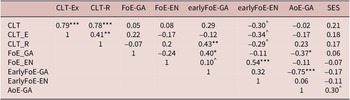
To check for potential collinearity among the different child-related variables and how they relate to the performance on the CLT, we ran multiple correlations (Table 3).
Correlations between the Gaelic Crosslinguistic Task—Receptive/Expressive and the child-related variables

Note. CLT-R/Ex = Crosslinguistic task—Receptive/Expressive; AoE-G = Age of exposure to Gaelic; earlyFoE-GA/EN = Frequency of early exposure to Gaelic/English; FoE-GA/EN = current frequency of exposure to Gaelic/English. *p < .05; **p <. 01; ***p < .001; ^p < .1.
Due to the high correlation between earlyFoE-GA and AoE-GA, we decorrelated the two variables before entering them into the models. No other high correlations were observed, which allowed us to enter the various variables as discrete variables into the models.
Accuracy
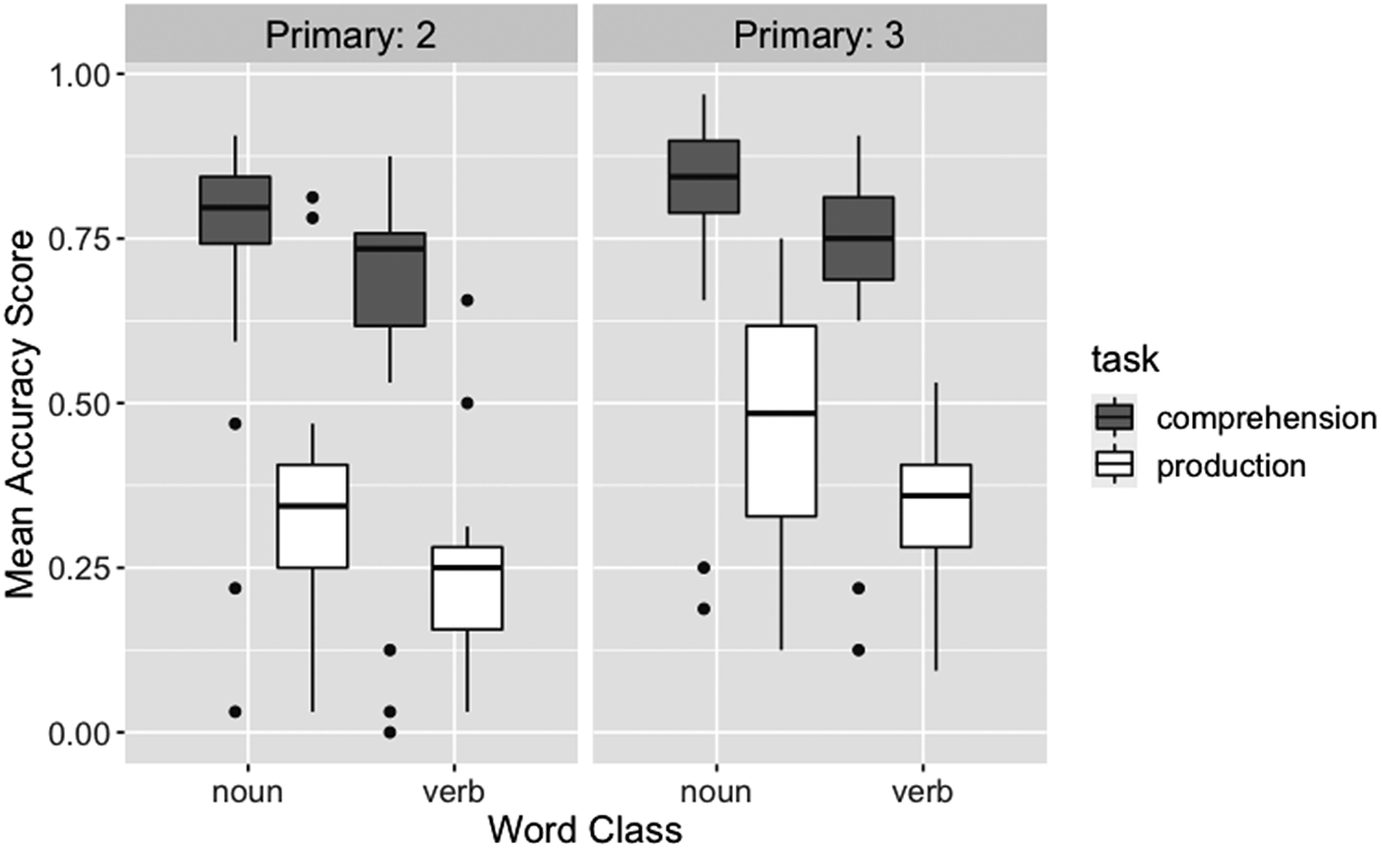
Figure 1 and Table 4a break down children’s accuracy on verbs and nouns as a function of school year (P2/P3), task type (comprehension, production), and word class (noun, verb) for the Gaelic CLT. Table 4b also presents children’s performance on the English CLT-R/Ex.
Means and standard deviations (SD, in parentheses) for children’s performance on the Gaelic CLT-Receptive/Expressive

Means and standard deviations (SD, in brackets) for children’s performance on the English CLT-Receptive/Expressive

Mean accuracy (proportion) on the Gaelic comprehension and production tasks as a function of word class and school year (Primary 2 and 3).

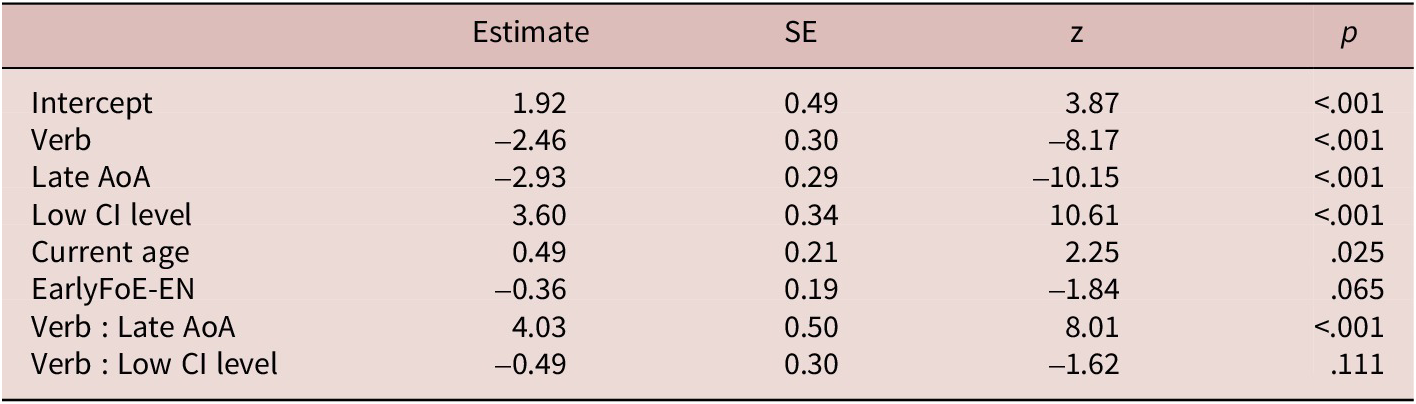
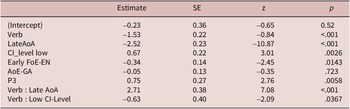
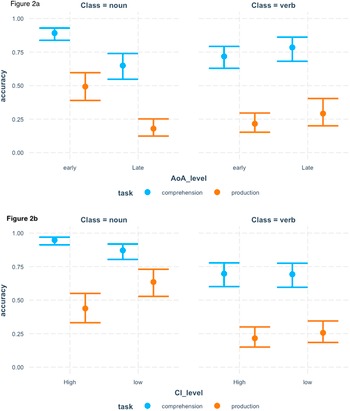
To address research question 1 (RQ1), we first carried out an initial analysis of the logistic regression model with all item-related variables included. This revealed a three-way interaction among word class, task and AoA level. and CI level, respectively, (visualized in Figure 2a and b). To disentangle the three-way interaction and to better understand what item- and child-related ([early]FoE-GA-En, AoE-GA, current age, school year) variables modulated performance on vocabulary comprehension and production separately (RQ1), we ran separate models for the Gaelic CLT-R and CLT-Ex. Tables 5 and 6 present the optimal models for the two modalities.
Optimal model for the Gaelic CLT-Receptive

Marginal R 2 = 0.36; Conditional R 2 = 0.77
Note. CLT-R = Crosslinguistic task—Receptive; AoA = age of acquisition word; CI = complexity index; earlyFoE-EN = frequency of early exposure to English.
Optimal model for the Gaelic CLT-Expressive (CLT-Ex)

Marginal R 2 = 0.18; Conditional R 2 = 0.54
Note. CLT-EX = Crosslinguistic task—Expressive; AoA = age of acquisition word; CI = complexity index; earlyFoE-EN = frequency of early exposure to English; AoE-GA = age of exposure to Gaelic.
Interactions between accuracy and item-related variables (AoA, CI, word class, and task type) for the Gaelic CLT.

Overall, the item-related variables significantly contributed to children’s performance across both tasks, as the coefficients indicate, and in both tasks AoA and CI level affected children’s accuracy. In the Gaelic CLT-R (Table 5), children’s performance improved with age, and children with more early exposure to English at an early age had lower accuracy on the Gaelic task. The negative effect of more exposure to English at an early age was more pronounced for the Gaelic CLT-Ex (Table 6), whereas children in P3 did better than the children in P2 on this task too. For both tasks, there was an interaction between word class and AoA because early acquired nouns had higher accuracy on both tasks, whereas performance did not differ for verbs (Figure 2a). Nouns with low CI also tended to have better performance on the production task, whereas this was not the case for verbs (Figure 2b).
Lexical gap
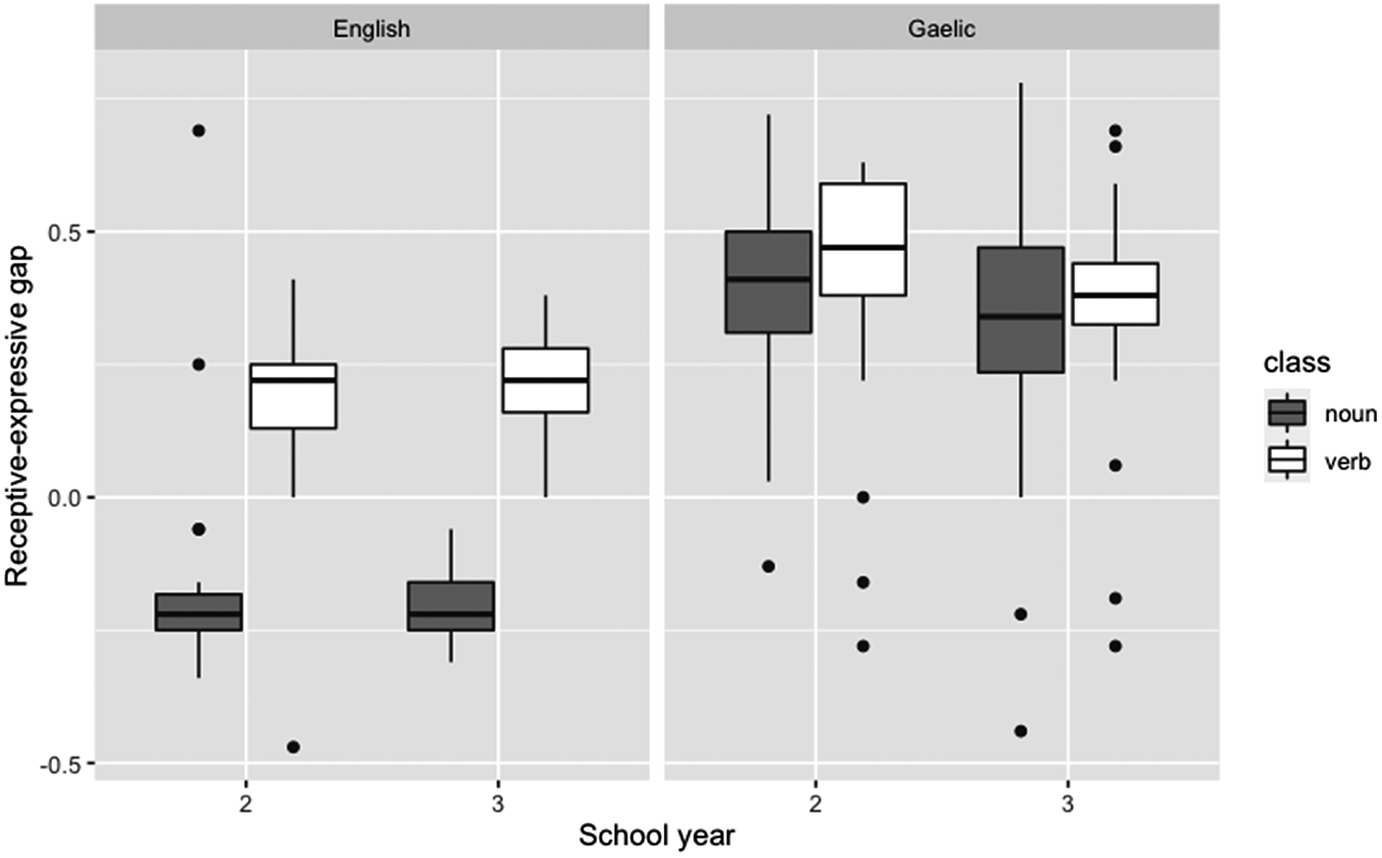
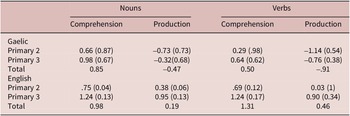
To address Research Questions 2 and 3, we calculated the magnitude of the receptive–expressive gap in Gaelic and English as a function of school year (P2, P3), word class (noun, verb) and language (Gaelic, English; Figure 3). The receptive–expressive gap was also examined after converting the scores on the comprehension and production tasks for verbs and nouns separately into z scores to accommodate task-related differences (Table 7). The descriptive z scores confirmed that there was (at least) one standard deviation difference between the two modalities for each word class across school years.
Receptive–expressive gap as a function of school year (P2, P3) and word class for Gaelic and English.

Mean z scores (and SDs) for the English and Gaelic CLT

To further scrutinize how z scores were affected by the categorical variables in our study, we ran linear mixed-effects regression using z scores as the dependent variable and the categorical variables (language: Gaelic/English; task: production/comprehension; word class: verb/noun, school year: P3/P2) as predictors. This revealed a main effect of language (E = 0.36, t = 4.77, p < .0001), a main effect of task (E = -0.31, t = -3.19, p < .01), of word class (E = 0.72, t = 8.57, p < .001), and school year (E = 0.24, t = 2.97, p < .01) and an interaction between language and word class (E = -1.11, t = -10.32, p < .0001) and between language and task (E = -1.08, t = -9.14, p < .0001). To disentangle the interaction between language and word class and task, we ran regressions for each language separately. For English, there was a main effect of task (E = -0.31, t = -5.99, p < .0001), as production had lower z scores than comprehension, of word class (E = 0.72, t = 16.09, p < .0001), as nouns had significantly more positive z scores than verbs, and of school year (E = 0.08, t = 2, p < .05). These factors accounted for 59% of the variance in the data. For Gaelic, the regression analysis revealed that production led to significantly lower z scores than comprehension (E = -1.41, t = -18.79, p < .0001), and this was more pronounced in Gaelic than in English as the effect sizes indicate, which may have given rise to the interaction. Verbs had significantly lower z scores than nouns (E = -0.39, t = -5.27, p < .0001), and the magnitude of the difference between the two languages may have given rise to the interaction between language and word class. Children’s z scores in the Gaelic tasks improved with school year (E = 0.35, t = 2.47, p < .05). The fixed effects in the model accounted for 54% of the variance in the data, and along with the individual variability, the model accounted for 73% of the variability in the data.
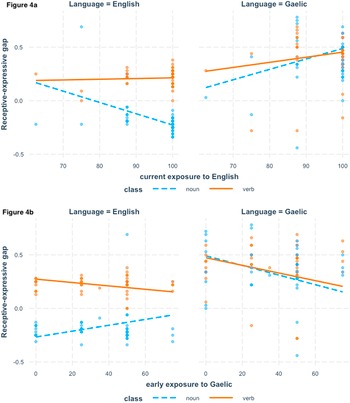
To investigate the relationship between the receptive–expressive gap and the background variables (frequency of exposure; RQ3), we ran a mixed-effects linear regression analysis on the difference between the raw scores on each task and language. Given that word class was a significant predictor in the z-score and accuracy analysis, we decided to include it in this analysis as well. The model with both languages together revealed a two-way interaction between language and word class (E = -0.39, t = -4.28, p < .001), as the magnitude of the gap was smaller for nouns compared with verbs in English, t(148) = 4.14, p < .001, but not in Gaelic, where there was no effect of word class (t(148) = -0.37, p = 1). There was also a two-way interaction between Gaelic and current FoE-EN (E = 0.18, t = 4.01, p < .001) and a negative interaction between language (Gaelic) and early FoE-GA (E = -0.17, t = -2.21, p = .03), indicating that children who had more exposure to Gaelic before attending primary school had a smaller gap in Gaelic. We also found a three-way interaction among language, word class and current FoE-EN (E = -0.18, t = -2.64, p < .01). This was because children with more current exposure to English had a larger receptive–expressive gap in Gaelic compared with children with less exposure to English regardless of word class, whereas children with more exposure to English had a smaller receptive–expressive gap for nouns in English but not for verbs. For English, the exposure variables accounted for 16% of the variance. For Gaelic, they accounted for 79% of the variance, with the fixed effects contributing less (33%) than the individual variability induced by the participants (46%) in the study. These interactions are visualized in Figures 4a and 4b.
Interactions between language, word class, and child-related variables (current exposure to English-FoE-EN, early exposure to Gaelic-early FoE-GA).

Discussion
The present study investigated the psycholinguistic and child-level factors that modulated vocabulary development in Gaelic-English bilingual children attending the early years of primary Gaelic immersion education. Specifically, we addressed the following research questions: (a) what are the item and child-level factors that modulate accuracy on receptive and expressive vocabulary in the minority L2 in English L1–Gaelic L2 bilingual children, (b) does the magnitude of the receptive–expressive lexical gap differ in Gaelic and in English, and (c) do word class and child-level variables modulate the size of the gap in the early years of immersion education. Our first analysis on accuracy on nouns and verbs in L2 Gaelic offers further evidence on the language abilities of English–Gaelic-speaking children. The second and third research questions offer new insights into the psycholinguistic and environmental factors that modulate the receptive–expressive gap in an immersion education context. We discuss these in turn below.
Vocabulary development in the minority language in immersion education
In the present study, we found that children had overall higher accuracy on the receptive than the expressive tasks, in line with previous studies in the literature (e.g., Haman et al., Reference Haman, Łuniewska, Pomiechowska, Armon-Lotem, de Jong and Meir2015, for an overview). In line with what was reported for the majority L1 in Chondrogianni et al. (Reference Chondrogianni, Judge-Clayden and Butcher2022), the item-level factors were stronger predictors of children’s performance. In the present study, word class interacted with CI to differentially modulate accuracy. That is, earlier acquired nouns and nouns with low CI had higher accuracy than later acquired nouns, with higher CI in both production and comprehension, but this modulation of AoA and CI was not found for verbs. These findings are in line with previous studies examining the effect of AoA in bilingual (Altman et al., Reference Altman, Goldstein and Armon-Lotem2017; Haman et al., Reference Haman, Łuniewska, Pomiechowska, Armon-Lotem, de Jong and Meir2015; van Wonderen & Unsworth, Reference van Wonderen and Unsworth2020) and monolingual children (Haman et al., Reference Haman, Łuniewska, Hansen, Simonsen, Chiat, Bjekić, Blažienė, Chyl, Dabašinskienė, Engel de Abreu, Gagarina, Gavarró, Håkansson, Harel, Holm, Kapalková, Kunnari, Levorato, Lindgren and Armon-Lotem2017; Hansen et al., Reference Hansen, Simonsen, Łuniewska and Haman2017; van Wonderen & Unsworth, Reference van Wonderen and Unsworth2020) using similar subjective measures of AoA based on adult ratings. At the same time, they offer further insight into how psycholinguistic factors may interact to influence children’s expressive and receptive skills, and more specifically, how CI may interact with word class to modulate performance on lexical tasks in the minority language. Previous studies investigating the effects of CI in monolingual children speaking a range of typologically different languages have provided mixed results. For example, CI affected accuracy on the CLTs in some languages (e.g., Finnish and Polish) but not in others (e.g., German or English) or it affected both verbs and nouns (e.g., Finnish), only nouns (e.g., Polish), or only verbs (e.g., Lithuanian, Serbian, and Afrikaans). In the context of minority L2 acquisition in the present study, CI modulated children’s accuracy on verbs but not on nouns, and this was evidenced more in production than in comprehension. This may be due to two reasons. First, verbs overall elicited different accuracy from nouns due to their inherent properties discussed below. This coupled with the fact that CI modulated production but not comprehension suggests that the word’s morphophonological complexity may be more taxing for articulation needed for production rather than when only lexical access and retrieval are required, as in the case of the expressive tasks (Clark, Reference Clark2009). Second, CI in the present study was entered into the models as a categorical variable rather than a continuous variable because this is how it was calculated in the task design. However, this may have limited its potential influence on accuracy. Importantly, though, previous studies with CI as a continuous predictor also reported small contribution of this variable to children’s accuracy on the CLTs (van Wonderen & Unsworth, Reference van Wonderen and Unsworth2020).
Turning to the individual, child-related factors that modulated performance, children’s accuracy on the receptive and expressive tasks improved as a function of age and schooling, respectively, and both factors were good at predicting children’s performance on the receptive and expressive tasks, respectively. Similarly to what has been reported for other immersion education settings (Dijkstra et al., Reference Dijkstra, Kuiken, Jorna and Klinkerberg2016; Gathercole et al., Reference Gathercole, Thomas and Hughes2008; Gathercole & Thomas, Reference Gathercole and Thomas2009; Gathercole et al., Reference Gathercole, Thomas, Roberts, Hughes, Hughes and Gathercole2013; Hoff et al., Reference Hoff, Rumiche, Burridge, Ribot and Welsh2014; O’Toole et al., Reference O’Toole, Ní Shíthigh, Molamphy and Walsh2019; Smithson et al., Reference Smithson, Paradis and Nicoladis2014), children with less exposure to the majority language in the early years and before formal primary school attendance tended to have better performance on the Gaelic vocabulary task. However, in the present study, frequency of exposure was a moderate negative predictor only in the case of the production task but not for the receptive vocabulary component, which again suggests that the processes involved in producing and comprehending a word are differentially affected by exposure.
The receptive–expressive gap in minority immersion education
The bilingual children in the present study exhibited a larger receptive–expressive gap in the minority L2 Gaelic than in their majority L1 English. Importantly, the effect of word class was influenced by whether the analysis was based on the standardized z scores or the raw accuracy scores. When tasks differences are minimized with the use of z scores, word class affected children’s performance on English and Gaelic and children had more positive z scores with nouns than with verbs. When raw accuracy scores were considered, there was a main effect of word class in English, but word class did not modulate children’s receptive–expressive gap in Gaelic. Children had relatively good performance on comprehension of Gaelic nouns and verbs (around 75%), whereas their average production accuracy for nouns and verbs was around 40%. Two questions arise at this point: First, why is the lexical gap different for verbs than for nouns? Second, why did word class surface as a significant contributing factor to the receptive–expressive gap in the z-score analysis but not the raw score analysis for the minority language?
Starting from the first question, verbs have been shown to be accessed more slowly than nouns (Cordier et al., Reference Cordier, Croizet and Rigalleau2013; Gentner, Reference Gentner, Bowerman and Levinson2006; Vigliocco et al., Reference Vigliocco, Vinson, Druks, Barber and Cappa2011), and this difference overrides any effects of morphosyntactic complexity (De Simone & Collina, Reference De Simone and Collina2016; Kauschke et al., Reference Kauschke, Lee and Pae2007), concreteness (Martin & Tokowicz, Reference Martin and Tokowicz2019), semantic differences between actions (verbs) and objects (nouns; De Simone & Collina, Reference De Simone and Collina2016), and input frequency (Piccin & Waxman, Reference Piccin and Waxman2007). Why is this difficulty though only attested in the majority but not the minority language? We believe that children may have more difficulty accessing verbs in their majority English due to the inherent semantic and distributional properties of verbs that distinguish them in acquisition and processing from nouns (Gertner et al., Reference Gertner, Fisher and Eisengart2006) and that may continue to modulate lexical development in the L1 during the early primary school years.
The lack of word class effect in the Gaelic receptive–expressive gap when raw scores are entered in the analysis but not in the standardized (z scores) analysis may reflect the effect of task differences. First, a comprehension such as the one in our study, which involves selecting a picture out of an array of pictures, may by chance inflate accuracy, as the child had 25% chance of selecting the right picture in the comprehension task but they cannot apply the same strategy to the production task. Standardizing the raw accuracy scores on the two tasks may have removed the noise created by task effects and, thus, allowed other categorical variables, such as word class, to emerge as significant.
The lack of word class effect in the raw score analysis may also be an artifact of the Haman et al. (Reference Haman, Łuniewska, Pomiechowska, Armon-Lotem, de Jong and Meir2015) scoring scheme, as one anonymous reviewer pointed out. In this scheme, children are not penalized for any inflectional errors they make with verbs and nouns. Given that verbs carry more complex morphosyntactic information, not considering inflectional errors as erroneous responses may have inflated accuracy for verbs in relation to nouns. It is worth pointing out, though, that both nouns and verbs carry complex morphosyntactic information in Gaelic, and thus the scoring scheme may not have necessarily been biased toward one word class over the other. We are currently working on a separate paper where we examine how different types of errors as a function of word can offer insights into children’s vocabulary development.
Furthermore, the lack of a word class effect in Gaelic when background and psycholinguistic variables are taken into account in the raw score analysis may indicate the distinct contribution of exposure and item-level variables to vocabulary learning. Namely, in the raw score analysis for Gaelic, exposure factors accounted for as much of the variance as the item-level variables did in the z-score analysis. This suggests that the exposure variables and the variability from the individual participants may have removed effects of word class, when raw scores were considered. Interestingly, exposure variables contributed much less in the raw score analysis for English, and there was little variability in individual performance on the English vocabulary tasks.
Finally, issues with lexical access and articulation in production, on one hand, and with lexical knowledge and overall proficiency, on the other, may have also contributed to the lack of word class effect. Difficulty with accessing and articulating a word gives rise to the receptive–expressive gap in the first place (e.g., Gibson et al., Reference Gibson, Peña, Bedore and McCarter2020). Because lexical access is modulated by proficiency (Kastenbaum et al., Reference Kastenbaum, Bedore, Peña, Sheng, Mavis, Sebastian-Vaytadden, Rangamani, Vallila-Rohter and Kiran2019), this may explain why the gap is larger in the minority/weaker L2 than the majority L1. Additionally, when proficiency is low, as in the case of the L2 Gaelic for the children in this sample, psycholinguistic factors, such as AoA and CI, may be stronger predictors of lexical performance above and beyond word class (Hansen et al., Reference Hansen, Simonsen, Łuniewska and Haman2017; van Wonderen & Unsworth, Reference van Wonderen and Unsworth2020), and thus word class does not surface as a predictor of the receptive–expressive gap. Put more simply, children’s lexical skills are at a level where AoA and CI are more important factors than word class, and thus both nouns and verbs are equally challenging for comprehension and production. Disentangling the individual contribution of these variables merits further investigation in future studies.
The receptive–expressive gap in Gaelic can be explained in our study within the frequency-lag hypothesis, which assumes that the links between the phonological and semantic representations and the representations themselves become more specified with increased language exposure. In our study, children with more current exposure to English had a larger receptive–expressive gap in Gaelic compared with children with less exposure to English regardless of word class, whereas children with more exposure to English had a smaller receptive–expressive gap for nouns in English. Also, children who were exposed to Gaelic more in the early years before primary school attendance had a smaller gap compared with their peers with less early exposure to Gaelic.
Given the low Gaelic language abilities of the children in our sample, children in this study may also have had difficulty suppressing their more dominant language (English) when producing Gaelic words. This means that access of the L2 lexical items in this group followed the L1 route rather than a direct access of the conceptual system, as the RHM would predict for low-proficiency learners (Kroll & Stewart, Reference Kroll and Stewart1994; Sunderman & Kroll, Reference Sunderman and Kroll2006). Although error types were not examined in the present study, children resorted to the L1 English word or to lexical blends of the L1 and the L2 when not producing the target item in the L2 Gaelic. These results are currently being analyzed in a separate study. Finally, in the present study, lexical access improved for children with more exposure, and the receptive–expressive gap decreased in each language as a function of more exposure to that language or less exposure to the other, suggesting that increased exposure in each language facilitates the suppression of the nontarget language.
Limitations, implications, and conclusions
One of the first limitations of the present study was its small sample size compared with other studies conducted within a school setting (Gibson et al., Reference Gibson, Oller, Jarmulonowicz and Ethington2012; Gibson et al., Reference Gibson, Peña and Bedore2014b). However, given the overall size of the school population in P2 and P3 GME (1,058 pupils in 2017–18, Bòrd na Gàidhlig, 2018), our sample represents approximately 5% of the overall school population and approximately 15% of the pupils in P2 and P3 in the local authorities we investigated.
A further limitation of the present study relates to its cross-sectional nature. Given the project’s duration limitations, it was not possible to test the same children in P2 and, after a year, in P3. This individual variability at the child level may have masked any true developmental and/or environmental effects on the size of the gap and may explain why child-related, environmental variables—for example, degree of exposure—contributed less to the size of the receptive–expressive gap compared with the item-related variables. We are currently collecting data from the same children after 3 years of GME using the same lexical tasks to examine whether and to what extent the receptive–expressive lexical gap has decreased. Future studies would benefit from a longitudinal design to better understand the linguistic- and participant-related variables that modulate this asymmetry and how they interact over time within the same group of children (Gibson et al., Reference Gibson, Peña, Bedore and McCarter2020).
In our study, AoA was based on subjective ratings that we elicited from (near-)native adult speakers of Gaelic and did not derive from objective AoA measures based on Gaelic child corpora, primarily because none is currently available. Importantly, our study differs from typical (adult) psycholinguistic studies targeting lexical processing in that our AoA raters were not adult undergraduate university students with little or no contact with children. Our raters were older adults, parents, or grandparents of children in GME or professionals with regular contact with children and young people. In this respect, the AoA raters in our study represent a group that has been shown to provide more valid AoA ratings compared with the “typical” young adult raters in adult psycholinguistic studies (Wikse Barrow et al., Reference Wikse Barrow, Nilsson Björkenstam and Strömbergsson2019). As we also state and as it has been recently argued, subjective AoA ratings may be more reliable in indicating the relative order of the acquisition of words rather than the exact age; in the context of minority language acquisition and in the absence of any psycholinguistic measures for Gaelic, this allows us to answer questions about how relative reported word acquisition order may influence bilingual children’s accuracy. This is particularly important for the generalizability of these measures in the acquisition of lesser studied languages (Kidd & Garcia, Reference Kidd and Garcia2022). What is more, the AoA ratings for Gaelic were shown to have crosslinguistic validity when compared with other subjective AoA ratings that derived from a range of minority and majority languages (Łuniewska et al., Reference Łuniewska, Haman, Armon-Lotem, Etenkowski, Southwood, Anđelković, Blom, Boerma, Chiat, de Abreu, Gagarina, Gavarró, Håkansson, Hickey, de López, Marinis, Popović, Thordardottir, Blažienė and Ünal-Logacev2016; Łuniewska et al., Reference Łuniewska, Wodniecka, Miller, Smolík, Butcher, Chondrogianni, Hreich, Messarra, A. Razak, Treffers-Daller, Yap, Abboud, Talebi, Gureghian, Tuller and Haman2019). This is particularly important given the lack of measures of frequency, imageability, and other related psycholinguistic ratings for Gaelic, measures that have been shown to interact with AoA ratings (Zevin & Seidenberg, Reference Zevin and Seidenberg2002).
Finally, in our study, the fact that early exposure to the majority language (English) rather than the minority language (Gaelic) modulated later minority language performance may be related to the fact that most parents/guardians in our study were not native speakers of Gaelic themselves, which might, in turn, have influenced the way the parents/guardians in our study reported exposure to Gaelic. Although the negative relationship between majority language use in the home and minority language school performance has also been reported for French immersion education (e.g., Smithson et al., Reference Smithson, Paradis and Nicoladis2014), in our study, the majority of parents/guardians indicated that they speak Gaelic with “little fluency” or they “just get along,” which, in turn, may have given rise to the lack of significant effect of Gaelic used in the home. This interaction between input quantity reported by parents along with the quality of input they provide to their children merits further investigation.
Despite these limitations, this study offers new insights into the psycholinguistic and environmental, child-related factors that modulate vocabulary development and the receptive–expressive gap in bilingual children. It also provides us with a first picture of how these factors modulate performance in emergent bilingual children in the early years of primary Gaelic-medium education, a minority context. Our study showed that in the early stages of acquisition of a minority language through immersion education, psycholinguistic factors such as word class, AoA, and CI modulate minority language acquisition more than child-related factors, although these are also important. Our study also demonstrated that at this level of schooling, bilingual children exhibit a larger receptive–expressive gap in the minority compared with their majority language and that this gap is mediated by the types of words that the children are learning and how much exposure they had in the early years or currently have to the two languages.
Acknowledgments
This study was funded by Bòrd na Gàidhlig (Ref. N: R45026). We would like to thank Euan Dickson for assisting with the data collection. We would also like to thank the schools, the children and their guardians who participated in this study.
Competing interest
The author(s) declare none.
Appendix
A. Sample items from the Gaelic LITMUS CLT-Receptive and CLT-Expressive
1 Sample verb item
a Comprehension

Item A: A’ lasadh (“to light”): Low CI / Early AoA / Human action
Item B: A’ leaghadh (“to melt”): High CI / Late AoA /State
Item C (target): A’ goil (“to boil”): Low CI / Late AoA/ State
Item D: A’ tiormachadh (“to dry”): High CI / Late AoA / Human action
b Production

Target word: a’ gàireachdainn (“to laugh”): High CI / Late AoA)
2. Sample noun item
a Comprehension

Item A = ubhal (“apple”): Low CI / Early AoA
Item b = mullach (“roof”) Low CI / Late AoA
Item C = eun (“bird”) Low CI / Early AoA
Item D = bò (“cow”) Low CI / Early AoA
b. Production

Target word: losgann (“frog”): Low CI / Late AoA
B. Scoring scheme for the English and Gaelic CLT (categories applicable to our data)