Introduction
Although cerumen (‘ear wax’) is a normal constituent of the external ear canal, excessive build-up is a common problem, accounting for over two million patient consultations a year in the UK, the majority to general practitioners.Reference Guest, Greener, Robinson and Smith1 Presentations may include otalgia, deafness or tinnitus. Excess wax, even when not directly implicated, may also need to be removed to facilitate a view of the tympanic membrane or to allow accurate audiometry.
Pressurised irrigation is by far the most commonly employed method of wax removal, used by 95 per cent of general practitioners.Reference Sharp, Wilson, Ross and Barr-Hamilton2 However, not all patients are suitable candidates. Previous ear surgery, perforations, the presence of ventilation tubes and active infection are all potential contraindications to syringing. Such patients, along with those who cannot tolerate wet irrigation, are often referred to the otolaryngology department of their local hospital. Here, removal is usually facilitated by the use of instruments or microsuction devices under direct microscopic vision. This has the benefit of providing a detailed view of the ear canal and tympanic membrane. A vast array of topical cerumenolytic agents may also be employed, either alone or as an adjunct to syringing or direct removal.
Despite wax impaction being such a common condition, there is a paucity of evidence to guide best practice in its treatment. Much of the research to date has focused on the relative merits of the many cerumenolytic preparations available. Unfortunately, no clear consensus has been reached.Reference Burton and Doree3–Reference Clegg, Loveman, Gospodarevskaya, Harris, Bird and Bryant5 To date, no formal data have been presented specifically relating to the safety and tolerability of wax removal by microsuction. This study was instigated to quantify the patient experience of aural microsuction in terms of the commonly reported side effects of pain, excessive noise and the provocation of vertiginous symptoms. We also aimed to determine the rate of adverse events associated with the procedure. Finally, we hoped to identify patient groups that may be at particular risk of side effects or adverse events. In this regard, we looked at two variables: the presence of a mastoid cavity and the prior use of cerumenolytic ear drops.
Materials and methods
A prospective study was undertaken of adult patients undergoing wax clearance by microsuction under microscopic vision within an ENT out-patient department over a total period of six months. Microsuction was performed by clinicians of a range of grades using a Zoellner suction device with or without size 18 standard wire gauge fine ends. Vacuum pressures ranged from 90 to 120 mmHg. Before leaving the clinic, all patients were asked to complete a questionnaire relating to their experience of the procedure. Patients under the age of 18 years, those with evidence of an active ear infection and those who had undergone ear surgery within the previous six weeks were excluded from the study.
The questionnaire, which comprised 10-point scales, asked patients to indicate the amount of pain they had experienced, how uncomfortable the noise associated with the procedure had been and, if they had experienced any vertiginous symptoms, how severe these had been. Patients were also asked whether they had used any topical ear preparations in the week leading up to the procedure.
The attending clinician recorded their seniority (i.e. rank), whether the patient had a mastoid cavity (including atticotomies) and whether wax removal had been sufficient to view the tympanic membrane. Finally, clinicians were asked to record any adverse events that occurred during the procedure, including but not limited to trauma and tympanic membrane perforation, and to make a note of any patients who were unable to tolerate the procedure.
Data were collated and analysed using Prism 6 statistics software (GraphPad Software, La Jolla, California, USA).
Results
A total of 159 questionnaires were fully completed and returned during the study period. Fifty per cent of procedures were conducted by a registrar grade doctor, 12 per cent by a senior house officer, 4 per cent by a consultant and 34 per cent by an associate specialist. Wax removal was recorded as being successful in 91 per cent of cases. With regard to patient perceptions, the mean scores (95 per cent confidence interval (CI)) across all patients were: 2.34 (2.06–2.62) for pain, 3.03 (2.71–3.35) for noise discomfort and 1.95 (1.66–2.25) for vertigo. Multivariate analysis did not demonstrate any significant difference in patient response between clinician grades.
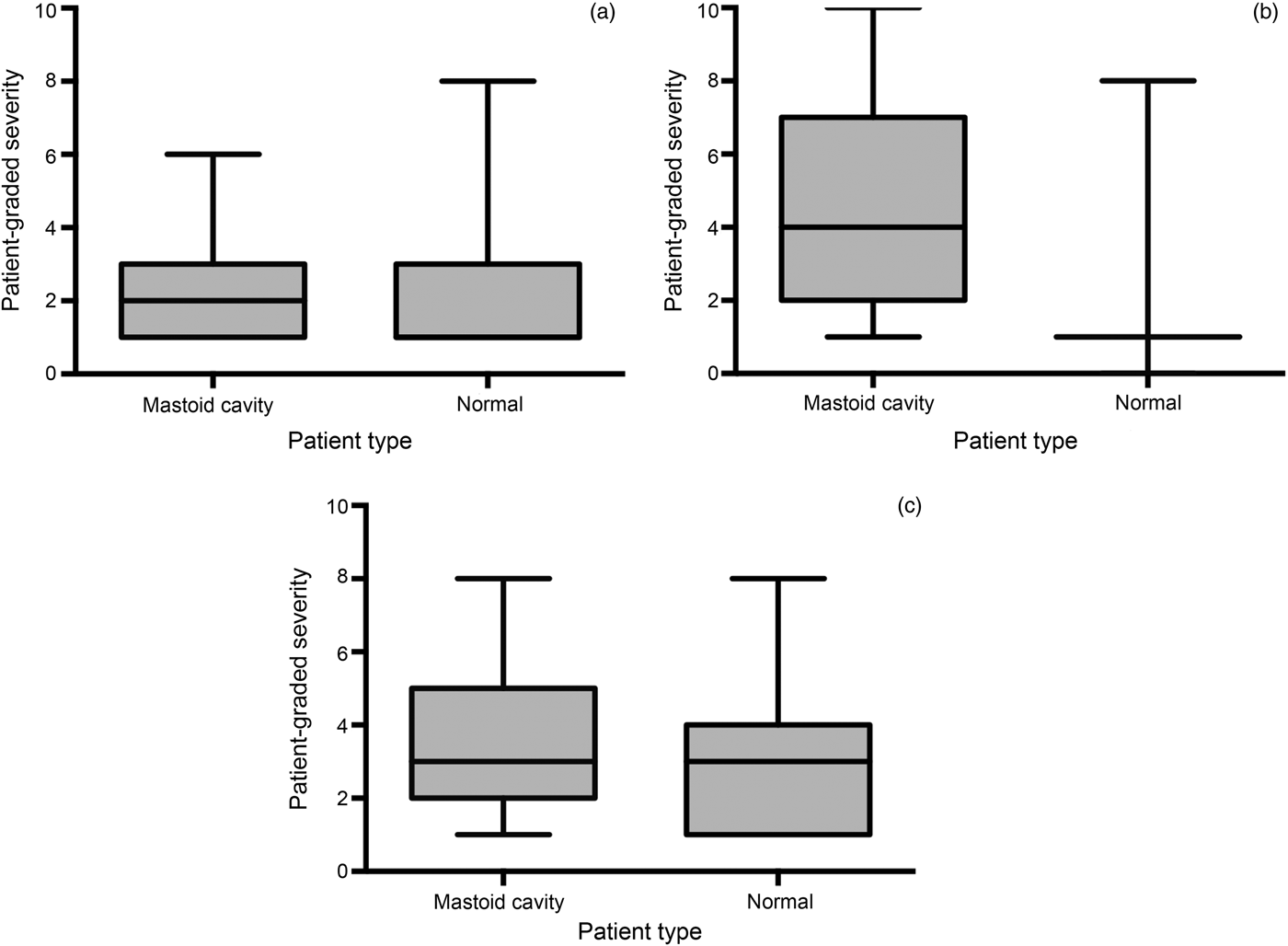
Twenty-six patients were reported as having a mastoid cavity (16 per cent). These patients reported significantly greater levels of vertigo, with a mean score (95 per cent CI) of 4.32 (3.08–5.55), compared to 1.61 (1.37–1.86) for patients without a cavity (Student's t-test, p <0.001). Responses for pain and noise were not significantly different from those of other patients (Figure 1).
Box and whisker plots showing patient-reported perceptions of (a) pain, (b) vertigo and (c) noise in those who underwent wax removal by microsuction, comparing patients with and without mastoid cavities. (Central box rule indicates mean; upper and lower box borders represent 95 per cent confidence intervals; and whiskers indicate minimum and maximum values.)

Forty-one per cent of patients had used some form of topical cerumenolytic agent in the week prior to the procedure. Of these patients, 40 per cent had used olive oil, 40 per cent had used a 5 per cent solution of sodium bicarbonate, 6 per cent had used Cerumol drops (5 per cent chlorobutanol with 57.3 per cent arachis oil) (Thornton and Ross, Huddersfield, UK) and 14 per cent had used Otex drops (5 per cent urea hydrogen peroxide) (DDD, Watford, UK).
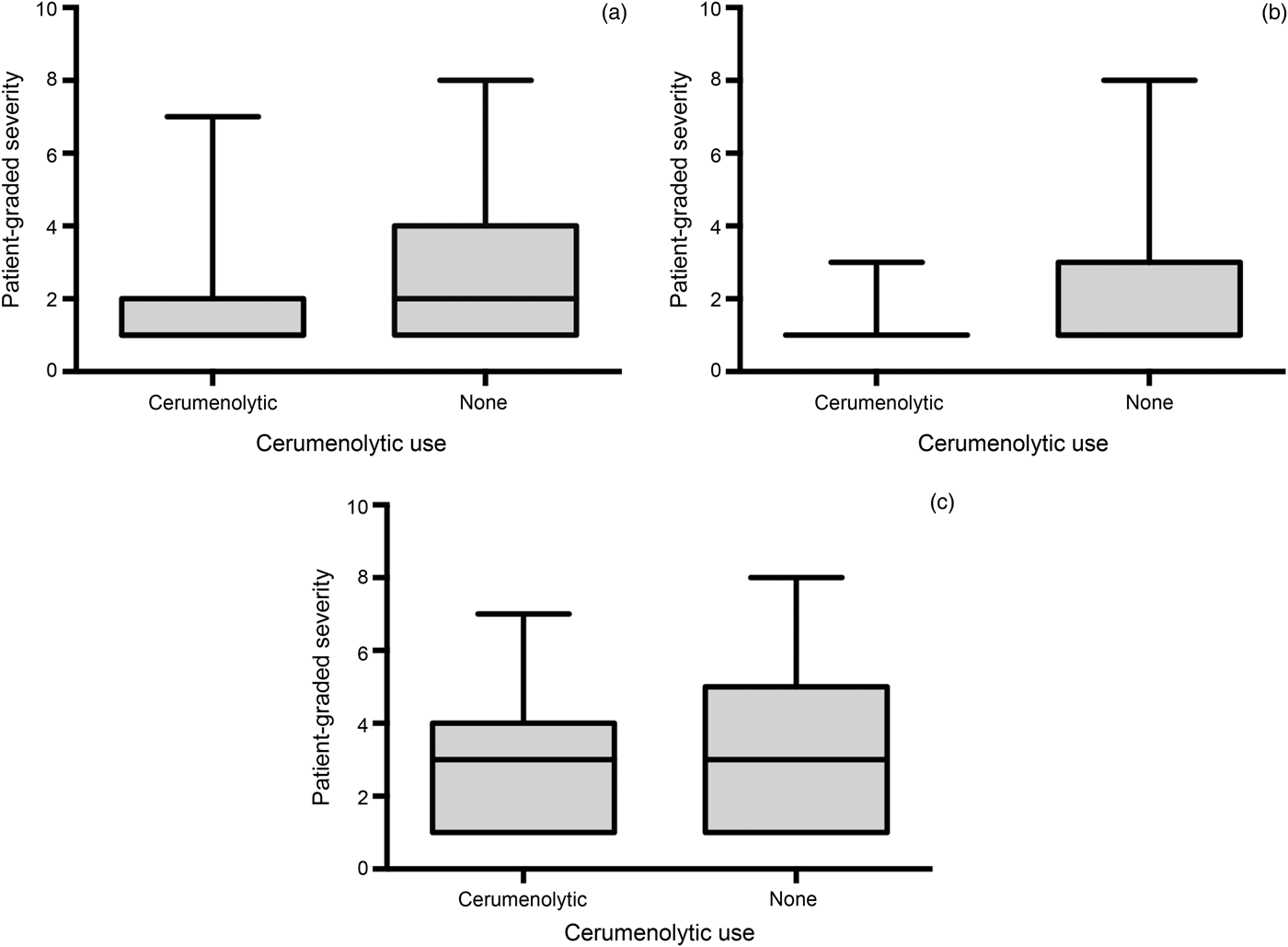
Patients with mastoid cavities were less likely to have used cerumenolytics before the procedure than patients without a cavity (15 per cent usage vs 46 per cent). Because of this disparity, it was decided to exclude patients with mastoid cavities when analysing the impact of cerumenolytic drops on patient-reported side effects. As summarised in Figure 2, patients who had used cerumenolytics experienced significantly less pain and vertigo than those who had not (Student's t-test, p = 0.008 and p < 0.001, respectively). There was no statistically significant difference between the various preparations used. Adverse events were rare, with only five recorded (3 per cent). The procedure had to be stopped in three cases because of patient distress caused by pain, and in two cases (both with mastoid cavities) because of vertigo. No instances of ear canal trauma or tympanic membrane perforation were recorded.
Box and whisker plots showing patient-reported perceptions of (a) pain, (b) vertigo and (c) noise in those who underwent wax removal by microsuction (excluding those with mastoid cavities), comparing patients who did and did not use a cerumenolytic prior to the procedure. (Central box rule indicates mean; upper and lower box borders represent 95 per cent confidence intervals; and whiskers indicate minimum and maximum values.)
Discussion
Cerumen, commonly referred to as ear wax, is a normal constituent of a healthy ear canal. The accumulation of cerumen or the perception of such may therefore appear to be a trivial complaint. It is, however, a frequent cause of patient attendance. Many consultations for wax impaction may be the result of the ‘worried well’ labouring under the misconception that wax accumulation is a pathological entity. Such misconceptions are not new: the ancient Egyptians believed that wax impaction predisposed individuals to ill health, and they developed cypress oil and frankincense salves to facilitate its removal.Reference Stevenson and Guthrie6 These misconceptions aside, an excessive build-up of wax in the external ear can lead to symptoms such as otalgia, deafness and tinnitus. Even when wax is not the direct cause of such complaints, its removal is often required to ensure that an underlying abnormality is not missed. With some 2.3 million people per year suffering from cerumen problems serious enough to warrant intervention in the UK, this condition represents a significant source of healthcare expenditure.Reference Guest, Greener, Robinson and Smith1
In the UK, most cases are dealt with by general practitioners. The most commonly used method of wax removal is pressurised water irrigation, commonly referred to as ‘ear syringing’. This method of wax removal is usually highly efficacious, but can be associated with significant side effects.Reference Memel, Langley, Watkins, Laue, Birchall and Bachmann7 A survey of general practitioners found that 38 per cent of respondents had experienced problems following syringing.Reference Sharp, Wilson, Ross and Barr-Hamilton2 These included perforation of the tympanic membrane, otitis externa, injury to the external ear canal and otitis media. The authors of that study estimated that major complications (defined as needing referral to secondary care) occurred in 1 in every 1000 ears syringed.Reference Sharp, Wilson, Ross and Barr-Hamilton2 Figures from the Medical Defence Union suggest that up to one-fifth of the negligence claims filed against general practitioners relates to ear syringing.Reference Bird8 Consequently, many general practitioner practices no longer offer this procedure. Even where syringing is offered, pre-existing ear conditions or personal preference means that not all patients are able to tolerate the procedure. It is for these reasons that increasing numbers of patients are referred to their local otolaryngology department for the management of cerumen impaction. Here, removal is usually facilitated by the use of a microsuction device or instruments under direct microscopic vision. The personal experience of most otolaryngologists is that this is a safe and well-tolerated procedure with a very low incidence of adverse events. However, to date few studies have sought to quantify this experience.
A review of the literature was conducted. The Medline database was searched for English language articles using the Medical Subject Headings term ‘cerumen’ and the key words ‘clearance’, ‘removal’ and ‘microsuction’. The results and reference sections were reviewed for articles pertaining to aural microsuction. This search was conducted on 14 June 2012. Three articles were found, including one randomised, controlled trial (RCT) specifically related to wax removal under direct vision.Reference Pothier, Hall and Gillett9–Reference Addams-Williams, Howarth and Phillipps11
Two of the articles, both from the same unit, describe the use of otoendoscopy as an alternative to conventional microscopy when using instrumentation to clear the ear canal of wax; the techniques included the use of microsuction. In the first study, an RCT, 100 patients were randomly assigned to have wax clearance carried out using either an otoendoscope or a conventional microscope.Reference Pothier, Hall and Gillett9 In contrast to our study, however, wax removal was primarily conducted with a Jobson–Horne probe; microsuction was used in only nine cases. Outcome measures comprised 0–100 visual analogue scales of patient-rated pain and discomfort. Both techniques elicited low responses in these categories (5–25 out of 100), with endoscopic clearance reported as being significantly less painful and less uncomfortable for patients. The endoscopic technique was also reported to be quicker than the conventional technique. A follow-up study reported success when training an audiologist in endoscopic dewaxing, thus reducing the need for referral to a doctor for wax clearance.Reference Pothier and Nieuwoudt10
The final study, by Addams-Williams et al., consisted of a survey of 164 patients who had undergone aural microsuction for a variety of reasons not limited to wax removal and including patients with active infections.Reference Addams-Williams, Howarth and Phillipps11 The authors concluded that dizziness, tinnitus and unpleasantness secondary to loudness were the most common adverse effects. Twenty-seven per cent of patients reported previous bad experiences associated with microsuction, mostly due to pain. However, no attempt was made to quantify the severity of these sensations; one would expect the reports of pain to be greater in the 32 per cent of patients who had an active infection. The study also reported that side effects were greater in patients with mastoid cavities.
Our data support the notion that patients with mastoid cavities experience significantly greater sensations of vertigo during microsuction, compared to those without. This is a well-recognised phenomenon thought to be due to the caloric effect of turbulent airflow within the cavity induced by microsuction. Patients with mastoid cavities may be better served by minimising suction within the cavity during clearance procedures or by using alternative instruments such as the Jobson–Horne probe and wax hook.
• Aural microsuction is well tolerated
• Side effects such as pain, vertigo and unpleasant noise are usually mild
• Prior use of cerumenolytics is associated with lower perceptions of pain and vertigo
• Patients with mastoid cavities report increased vertigo; special care should be taken when performing microsuction on these patients
To date, ours is the only study to specifically assess the safety and tolerability of wax clearance by microsuction. The results confirm that this is an effective, safe and generally well-tolerated method for managing cerumen impaction. Wax removal was sufficient to view the tympanic membrane in 91 per cent of procedures. Furthermore, patient-rated perceptions of pain, noise discomfort and vertigo were low. Only 3 per cent of patients were unable to tolerate the procedure and no other complications were recorded. As can be seen in Figure 2, discomfort associated with the loud noises generated during the procedure was the greatest cause of complaint from patients. This is perhaps not surprising, as sound levels of over 120 dB have been recorded in those undergoing aural microsuction, which is well within the range capable of causing discomfort.Reference Snelling, Smithard and Waddell12 Despite the high noise intensity frequently associated with microsuction, this procedure does not appear to be associated with demonstrable shifts in the auditory thresholds.Reference Snelling, Smithard and Waddell12
Our study further demonstrates that the already low perceptions of pain and vertigo associated with microsuction were significantly reduced in the group of patients who had used cerumenolytic preparations in the week prior to their procedure. The relatively small number of patients using each preparation prevents us from commenting on their relative efficacy. The merits of the commonly available cerumenolytics have been extensively investigated in the past; however, studies have failed to demonstrate statistically significant differences between preparations.Reference Burton and Doree3–Reference Clegg, Loveman, Gospodarevskaya, Harris, Bird and Bryant5 Indeed, Eekhof et al. showed there to be no specific benefit from proprietary cerumenolytics and that treatment with water at body temperature for 15 minutes prior to wax removal was equally efficacious.Reference Eekhof, De Bock, Le Cessie and Springer13 We therefore suggest that, where possible, patients undergoing microsuction clearance of wax should be instructed to use a cerumenolytic agent prior to their procedure, but we cannot recommend any specific agent.
Conclusion
It is difficult to draw any firm conclusions to guide best practice in the management of cerumen impaction because the body of evidence lacks high-quality, placebo-controlled randomised, controlled trials and is complicated by inconsistent outcomes between studies. This study confirms microsuction under direct microscopic vision to be a safe, efficacious and well-tolerated means of managing wax impaction. Expanding the availability of this technique beyond its traditional home of the otolaryngology out-patient clinic should be strongly considered by commissioning groups.
Side effects are usually mild and the prior use of cerumenolytics appears to be associated with a reduction in their severity. Special care is required for patients with mastoid cavities, who are more likely to experience vertiginous side effects.