I. INTRODUCTION
High-performance dielectric polymeric films and coating materials have been widely used as circuit boards, high-performance capacitors, gate dielectrics, and power storage devices in electronic applications.Reference Dang, Lin and Nan1–Reference Wang, Shen and Tang3 Aromatic polyimide (PI) is a kind of classic polymer matrix for its high thermal stability, excellent mechanical properties, and good chemical resistance. Based on the percolation theory, a great deal of work has been carried out to get high permittivity composites by embedding high dielectric permittivity ceramic particles,Reference Lunkenheimer, Rudolf and Hemberger4–Reference Nonaka, Hara and Asshi7 metal oxides,Reference Hamciuc, Hamciuc and Olariub8–Reference Kim and Nam11 or different conductive fillersReference Dang, Peng and Xie12–Reference Xu, Wen and Li16 into polymer. When the volume fraction of the filler is very close to, but does not exceed, the percolation threshold, a great enhancement in electrical conductivity and dielectric permittivity will be observed near the insulator–conductor transition. In general, the sharp increase in conductivity is either caused by the formation of conducting path network or by the tunneling conduction.Reference Chen, Wu, Weng and Wu17, Reference Balberg18
Among the efforts to prepare high dielectric constant composites, much work has been focused on the preparation of ceramic–polymer composites. But the dielectric constant of ceramic–polymer composites can only be enhanced obviously by loading with high concentration of fillers, such as BaTiO3,Reference Nonaka, Hara and Asshi7 LaTiO3,Reference Lunkenheimer, Rudolf and Hemberger4 NiO,Reference Bhadra, Biswas and Sarkar5 and CaTiO3,Reference Dang, Zhou and Yao6 which can lead to a sharp decrease of their mechanical properties. However, the dielectric constant is just enhanced a little when metal oxides, e.g., SiO2,Reference Zhang, Zeng and Fan9 TiO2,Reference Tong, Li, Xie and Ding10 and Al2O3,Reference Kim and Nam11 are embedded. Recently, more and more studies focus on conductive fillers, especially on carbon nanotube,Reference Hirana, Tanaka, Niidome and Nakashima14 graphite,Reference Xu, Dang and Bing13 and metal fillers, such as AgReference Dang, Peng and Xie12 and Ni.Reference Xu, Wen and Li16 Generally, obtaining inorganic fillers with super high dielectric constant is the key to give high dielectric constant composites. Therefore, preparation of high dielectric constant inorganic fillers is still the challenge of forming high-performance dielectric composites.
Antimony-doped tin oxide (ATO) conductive particles prepared by sol–gel or chemical coprecipitation method have been used in solar cellsReference Claes19, Reference Outemzabet and Bouras20 recent years. In this study, ATO conductive particles with narrow size distribution are prepared by reverse microemulsion method for the first time and initially used as dielectric constant fillers to prepare ATO/PI composites. High dielectric constant composites are inferred since the good conductivity of ATO. For comparison, ATO particles prepared by chemical coprecipitation are also be used to form composite films.
II. EXPERIMENTALS
A. Materials
SnCl4•5H2O and SbCl3 were analytical grade and from Beijing Chemistry corporation. Pyromellitic anhydride (PMDA) was obtained from Tianjin Tian Yuan Electronic Material Company Limited (Tianjin City, China) and 4,4′-oxydianiline (ODA) was bought from Japan Mitsubishi Chemical Corporation (Tokyo, Japan) and used without purification. Hexadecyltrimethylammonium bromide (CTAB) was from Jingwen Chemical Inc. (Guangdong, China) The solvent, N,N-dimethylacetamide, was purchased from Shanghai Xilong chemical Inc. (Shanghai, China) and used after purification by 4-Å molecular sieves. The other chemicals were analytical grades and used as received.
B. Preparation of ATO conductive particles
The ATO particles were prepared by reverse microemulsion and chemical coprecipitation. The preparation of ATO via chemical coprecipitation was based on the literature and would not describe here in detail.Reference Gu, Wang, Lu, Zhou, Xu and Yuan21 The median diameter of the produced particles was 4.20 μm. The procedure for preparation of ATO with 1.11 μm median diameter via reverse microemulsion was as followingReference Bagwe and Khilar22, Reference Tai and Chen23: 0.37 g of SbCl3, 6.98 g of SnCl4•5H2O, 2 mL of H2O, and 8 mL of HCl solution were mixed in a flask, and then, 4.60 g of CTAB surfactant, 9.20 g of n-butyl alcohol, and 90 mL of cyclohexane were added into this mixture under agitation until the transparent microemulsion A was obtained. At the same time, 5.00 g of NaOH and 8 mL of H2O were mixed in another flask, and equal amount of CTAB, n-butyl alcohol, and cyclohexane as in microemulsion A were added to give the transparent microemulsion B. The microemulsion B was slowly added to microemulsion A at 60 °C under quick agitation within 1 h. The emulsion was then allowed to age for 24 h at the same temperature to give the precursor of ATO particles. The precipitates were then collected by centrifuge at 5000 rpm and washed with distilled water for several times until Cl− could not be examined in the aqueous solution. Finally, the collected products were dried in a vacuum oven at 80 °C for 12 h and subsequently calcined at 700 °C for 30 min to give the ATO particles.
C. Preparation of ATO/PI composite films
ATO/PI composite films were prepared by in situ polymerization of functional monomers (ODA and PMDA) at the presence of ATO particles and then imidization of the formed polyamic acid (PAA) system.Reference Lv, Wu, Zhang, Shang and Chu24 The preparation procedure of ATO/PI composite film with 1 wt% ATO loading was as following: 0.0426 g of ATO, 2.0024 g of ODA (0.0100 mol), and 40.9 mL of DMAc were placed in a dry clean beaker and then homogenized for 30 min at room temperature in the ultrasonicator. Then, the mixture was transferred into a three-neck flask with a mechanical stirrer, and the PMDA (2.2139 g, 0.0102 mol) was added three times to maintain proper viscosity of the system. The system was maintained at room temperature for 6 h after complete introduction of PMDA to give the yellow-colored PAA system. The resultant PAA system was cast on a glass slide and imidized in an oven with a heating program as follows: 100, 200, 250, and 300 °C each for 1 h. The sample-coated glass substrate was then immersed into distilled water for 1 h to obtain the yellow transparent films. The films formed contain 0, 1, 1.5, 1.8 2.1, 2.7, 3, 5, 8, and 15 wt% of ATO.
D. Characterizations
The measurement of the size and size distribution of ATO was carried out by BT-9300H laser particle size analyzer. The crystal structure of the composites were measured by D/MAX 2000 x-ray diffraction (XRD) with CuKα radiation (λ = 1.541806 Å), and the chemical bonds among various species of the films were tested by Spectrum 100 FTIR Spectrometer from PerkinElmer (Norwalk, CT). Thermal gravimetric analyses (TGA) were performed on PerkinElmer TGA 7 with a heating rate of 20 °C/min ranging from 25 to 800 °C. The distribution of ATO particles in the composites and the morphology of the cross-fractured surface of the composites were observed with JEOL 6301F scanning electron microscopy (SEM). The electrodes were painted on with silver paste for the dielectric measurements. The electrical and dielectric properties of the samples were measured using an Agilent 4294A impedance analyzer (Santa Clara, CA) in the frequency range of 100 to 5 × 10⁶ Hz at room temperature.
III. RESULTS AND DISCUSSION
A. Morphology and size of ATO conductive particles
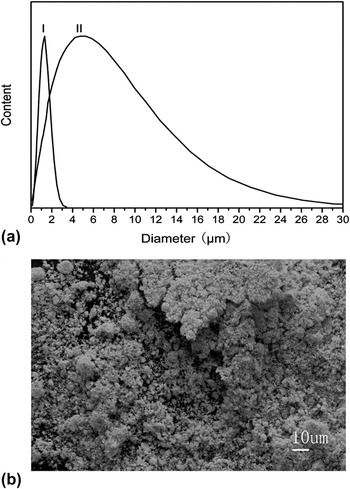
Figure 1(a) is the size and size dispersions of ATO particles prepared via reverse microemulsion and chemical coprecipitation method with the corresponding medium diameter of 1.11 and 4.20 μm. It is worth to point out that not only the size of ATO particles prepared by reverse microemulsion becomes smaller, but also the size distribution of ATO becomes narrower and the diameter of 92 vol% of the particles is lower than 2.00 μm. The typical morphology of ATO powders prepared by reverse microemulsion method is shown in Fig. 1(b) where the particles are nearly spherical in shape and most of the particles are aggregates of small ones assembling together by loose packing, which may result from the dehydroxylation process in calcination.
(a) Size distribution of ATO particles prepared by (I) reverse microemulsion and (II) chemical coprecipitation methods. (b) SEM photograph of ATO obtained via reverse microemulsion.

B. Structure and morphology of ATO/PI composite films
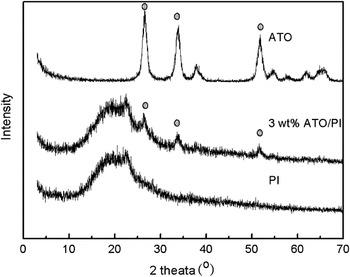
Figure 2 shows the XRD curves of pure PI, ATO particles, and ATO/PI composite film. In the pattern of ATO particles, the specific peaks of SnO2 centered at 26.59°, 33.95°, and 51.80° are broad. It indicates that the crystalline structure of ATO is not perfect due to the nanostructure and substitution of Sn4+ by Sb3+or Sb5+, which is consistent with the report.Reference Zhang, Deng, Zhang and Chen25 In the curve of pure PI, there is a broad peak at about 15–25°, which can be attributed to the regularity of the PI polymer chain.Reference Dang, Zhou and Yao6 In the curve of ATO/PI (3 wt%) composite films, the diffraction peaks of PI and ATO are both unchanged in comparison with pure PI and ATO particles. Hence, the crystal structure of ATO is stable in the preparation procedure of the composites.
XRD curves of pure PI, ATO particles, and ATO/PI composite film containing 3 wt% of ATO.

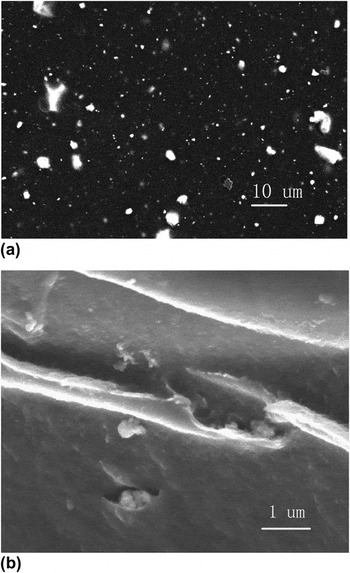
The surface and fractured cross surface morphologies of ATO/PI composite film with 3 wt% of ATO are shown in Fig. 3. In Fig. 3(a), the ATO grains are dispersed in the PI matrix homogenously due to the proper viscosity and protection of PAA coatings against the agglomeration of ATO particles in the preparation procedure.
SEM images of ATO/PI composite film with 3 wt% ATO particles, (a) film surface and (b) fractured cross surface.

From the fractured cross surface picture, which is shown in Fig. 3(b), it can be seen that the interface between PI and ATO with large size is obvious indicating poor interaction between the two phases. Even ATO clusters can be seen in the fractured cross surface photograph of composite with 15 wt% of ATO loading (not given). The ATO particles fail to uniformly disperse in the PAA, as a result, nonhomogeneous composite film is got after imidization.
C. Interaction between ATO particles and PI matrix
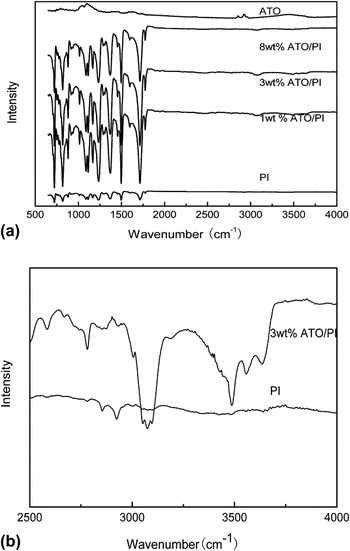
SEM results show that the interface between ATO and PI is not tight enough. To clarify the interaction between ATO and PI as well as if the PI has been completely imidized, FTIR measurement is carried out. The FTIR spectra of pure PI film, ATO/PI composites, and ATO particles are displayed in Fig. 4. The presence of characteristic peaks of PI can be clearly observed. The intense absorptions at 1780 and 1720 cm−1 are assigned to the asymmetrical and symmetrical carbonyl stretching vibrations, respectively. The carbonyl flexural vibration appears at 725 cm−1 in the fingerprint region.Reference Hu, Zhang and Yang26 The peaks at 1380 and 1500 cm−1 correspond to the C–N stretching vibration and the vibration of benzene ring in PI, respectively. The lack of amide (–CONH) peaks, which will appear clearly at about 2900–3200 cm−1, indicates that the PAA polymers are fully imidized.Reference Zha, Fan, Dang, Li and Chen27 In the FTIR spectra of the composite films, no new peak appears below 2000 cm−1, but in the enlarged FTIR spectra [Fig. 4(b)] of the composite films, two obvious triple peaks appear at 3000–3100 cm−1 and 3400–3700 cm−1 owing to the vibrations of active –OH or –NH.Reference Magaraphan, Lilayuthalert, Sirivat and Schwank28 This phenomenon shows that either the PAA is not been imidized fully because of the strong interaction between ATO and PAA or the produced water does not release out completely due to the hydrophilic surface of ATO. Although the former condition is not good for the property improvement, such as mechanical and thermal properties, it is benefit of the connection of the two phases. Combining the fact that poor interface has been observed from SEM, it can be concluded that the hydrophilic surface of ATO is not helpful of tight connection of the two phases and the ATO particles do not connect with PI through chemical bond.Reference Ha, Choi and Kim29, Reference Tao, Yang and Liu30
FTIR spectra of pure ATO, PI, and ATO/PI composite films.

D. Thermal stability of the ATO/PI composite films
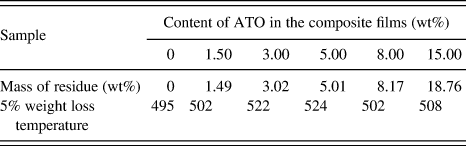
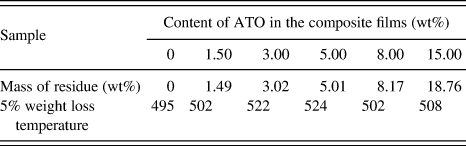
To appreciate the influence degree of ATO introduction, the thermal stability of the ATO/PI composite films is tested. Table I shows the data from the thermogravimetric curves of both pure PI and the ATO/PI composite films. The temperature at 5.0% weight loss are 495, 502, 522, 524, 502, and 508 °C for pure PI and the ATO/PI films with 1.5, 3, 5, 8, and 15 wt% ATO, respectively. The loading of ATO in the composite films has positive effect on the thermal stability. The thermal stability of the ATO/PI films is as good as or even slightly better than that of the pure PI film. When the content of ATO is larger than 5 wt%, the mass of residue is not accord with the theoretical value indicating the serious inhomogeneous of the composite films.
Thermal stability of the ATO/PI composite films.
E. Electrical properties of the ATO/PI composite films
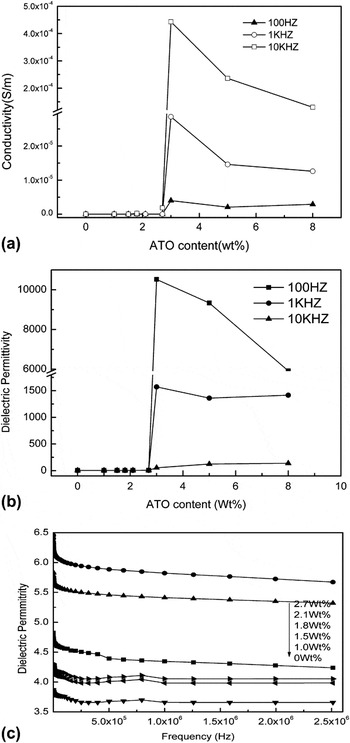
Till now, different modelsReference Dang, Peng and Xie12, Reference Li, Kowk, Li and Tjong31, Reference Xu and Wong32 about the effect of inorganic particles on dielectric properties of composites are performed and the model of percolation threshold theoryReference Dang, Zhou and Yao6, Reference Dang, Peng and Xie12, Reference Xu and Wong32 is considered to be the best fit for spherical fillers. Figures 5(a)–5(c) show the relationship of ATO content with the electrical conductivity and dielectric constant of ATO/PI composite films at the sweep frequencies of 100 Hz, 1 kHz, and 10 kHz at room temperature. The electrical conductivity and dielectric constant increase slowly at a low concentration of ATO loading,but increase dramatically when the concentration of filler larger than 1.5 wt%. For instance, at the sweep frequency of 10 kHz, the dielectric constant slowly increases from 3.79 to 4.20 with the concentration of ATO achieving 1.5 wt% from 0 wt% and remarkably increased from 4.20 to 6.15 and even 53.3 as the ATO content increases from 1.5 to 2.7 and 3.0 wt%. According to the percolation theory,Reference Xu and Wong32 when the concentration of the filler is up to the percolation threshold, a large amount of conductive ATO clusters will be isolated by thin film of polymer matrix to form “super capacitor network”’ and then, the dielectric constant increases dramatically. Below the percolation threshold, the major dielectric polarization of the composites origins from the insulator matrix, e.g., molecular (dipolar) polarization of a polymer matrix. So, the dielectric constant increases slightly. Above the percolation threshold, the conductive filler agglomerated together causing the material converts from a capacitor to a conductor. Therefore, the experimental results are in good accordance with the power law as followsReference Bhadra, Biswas and Sarkar5, Reference Dang, Zhou and Yao6, Reference Dang, Peng and Xie12:
 $${\rm{\varepsilon }}_{{\rm{eff}}} \propto (\,f_{\rm{c}} - f_{{\rm{ATO}}} )^{ - S} ,\,\,\,\,\,\,{\rm{for}}\,\,\,f_{{\rm{ATO}}} < f_{\rm{c}}\quad ,$$
 $${\rm{\sigma }}_{{\rm{eff}}} \propto (f_{\rm{c}} - f_{{\rm{ATO}}} )^{ - S} ,\,\,\,\,\,\,{\rm{for}}\,\,\,f_{{\rm{ATO}}} < f_{\rm{c}}\quad ,$$
Dependence of (a) electrical conductivity and (b) dielectric permittivity of the ATO/PI composite films on the filler loading and (c) frequency at room temperature.

where εeff is the effective dielectric permittivity of the ATO/PI films, σeff is the effective conductivity of the ATO/PI films, f ATO is the volume fraction of the ATO filler, f c is the percolation threshold, and s is the critical exponent of about 1. Determined from Fig. 5, the percolation threshold of the composites is between 2.7 and 3 wt% as the sweep frequency is lower than 10 kHz and much lower than that of BaTiO3/PI, Ag/PIReference Nonaka, Hara and Asshi7, Reference Dang, Peng and Xie12 composites. Even more, the percolation threshold region is very narrow. Since near the percolation threshold, the conducting tunnel began to establish in the films, therefore, the dielectric loss began to increase seriously under the ac electric field. Dielectric permittivity of the materials as a function of frequency with ATO up to the percolation threshold is studied to clarify the different type of polar contribution. Just as inferred, at fixed ATO loading below percolation threshold, the dielectric constant decreases and then levels off as the frequency increases indicating that with the increase of sweeping frequency, less dipole could follow the switching field as frequency increases [Fig. 5(d)]. The higher the frequency field is applied, the shorter time the dipolar has to polarize. Therefore, large dipolar cannot keep up with the change of frequency. The interfacial polarization, which plays important role at low frequency, cannot keep up with the increase of sweeping frequency at high frequency and results in the decrease of dielectric constant. The dielectric permittivity almost does not change above 1000 Hz, which is benefit of utilization in high frequency.
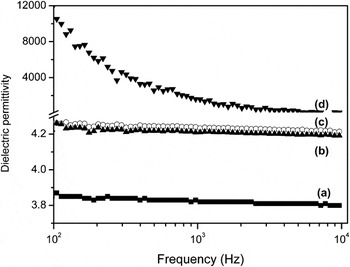
Figure 6 shows the effect of ATO size on dielectric constant of the ATO/PI composite films. The dielectric constant increases dramatically when the size and size distribution of ATO particles become small and narrow. The reason is that the smaller the particle size become, the more the tiny capacitor is formed, in which the interfacial polarization and the polarization of small inorganic particle are improved greatly. Therefore, the dielectric constant of the composite with smaller size ATO increases remarkably. But due to the interface polarization cannot match the frequency change, at higher sweep frequency, the dielectric permittivity decreases significantly. So this kind of material has high dielectric constant at low frequency.
Dependence of dielectric permittivity of PI and the 3 wt% ATO/PI composite films as the function of frequency on different average sizes at room temperature. (a) Pure PI, (b) 4.2 μm, (c) 1.30 μm, and (d) 1.11 μm.

IV. CONCLUSIONS
High dielectric constant ATO/PI composite films are synthesized by in situ polymerization in which conductive ATO particles with narrow size distribution prepared by inverse microemulsion act as dielectric constant improvement filler. The SEM, FTIR, and TGA studies show that ATO homogeneously disperse in the composite at low concentration and the obtained composite films have good thermal stability, although the organic–inorganic interface is not good enough. The novel composite films of ATO/PI have high dielectric constant and low percolation threshold. As the size and size distribution of conductive particles become smaller and narrower, the dielectric permittivity can be improved remarkably due to the contribution of interfacial polarization of the two phases and the formation of tiny capacitors.
ACKNOWLEDGMENTS
This study was financially supported by the Fundamental Research Funds for the Central Universities (2010ZY46), national key laboratory of minerals (09B003), China, the Key Project of Chinese Ministry of Education (107023), Special fund of Co-construction of Beijing Education Committee and City University of Hong Kong Strategic Research Grant (SRG, 7008009).