INTRODUCTION
Amnestic mild cognitive impairment (aMCI) is a selective decline in memory in the context of otherwise normal cognition and normal daily functioning (Petersen, 2004). It is considered a transition between normal aging and Alzheimer's disease (AD), because most aMCI individuals develop AD within 3 to 6 years (Petersen). Classification of aMCI depends on cognitive assessment and, as such, investigation of cognitive profiles in aMCI is important. Examining similarities in cognitive patterns between aMCI and AD may be particularly crucial to our ability to identify the evolution of cognitive impairment in dementia and to evaluate dementia risk. For example, individuals with aMCI exhibit reduced episodic memory on objective testing but to a much lesser extent than occurs in AD. Furthermore, by definition, aMCI is not associated with impairment in other cognitive domains, including those selectively affected in AD, such as visuospatial construction, confrontation naming, and verbal fluency. Nonetheless, individuals with aMCI might show patterns of relative strengths and weaknesses on nonmemory measures that are qualitatively similar to those observed in AD.
A recent meta-analysis of verbal fluency performance in AD (Henry et al., 2004) found converging evidence for the commonly observed pattern of greater impairment in semantic than phonemic verbal fluency in AD. Both fluency tasks place demands on strategic search and retrieval of information from semantic memory; however, semantic fluency requires a constrained search of exemplars from a superordinate category and relies on semantic associations within the category (i.e., animals), whereas phonemic fluency may be accomplished with a relatively less constrained search from a broader set of lexical exemplars (e.g., words starting with F). Neuropathological changes in AD are relatively restricted to the medial temporal lobe and temporal-parietal association areas. Thus, reduced semantic relative to phonemic fluency in AD is consistent with focal lesion research demonstrating that semantic but not phonemic fluency is compromised by temporal-lobe damage, whereas the opposite pattern of performance is seen following frontal-lobe damage (Stuss et al., 1998).
We compared the performance of healthy older adults, individuals with aMCI, and individuals with AD on generation of words starting with the letter F(phonemic fluency) and belonging to the category animals (semantic fluency). Our primary measure was the number of words generated; however, we also explored the data using measures of clustering and switching. Clustering refers to the generation of contiguous words from within the same subcategory, and depends on verbal memory and word storage. Switching refers to shifting from one subcategory to another, and requires cognitive flexibility. Generally, clustering is compromised with temporal-lobe dysfunction, whereas switching is compromised with frontal-lobe dysfunction (reviewed in Troyer & Moscovitch, 2006).
Given that aMCI is considered to represent the earliest phase of AD, we hypothesized that individuals with aMCI would show a pattern of performance similar to those with AD when compared to healthy controls, namely greater reduction in semantic relative to phonemic fluency ability, even though by definition aMCI is not associated with impaired verbal fluency performance. In addition, similar to AD (reviewed in Troyer & Moscovitch, 2006), we expected individuals with aMCI to show decreased clustering and switching on semantic fluency and decreased clustering on phonemic fluency.
METHODS
Participants
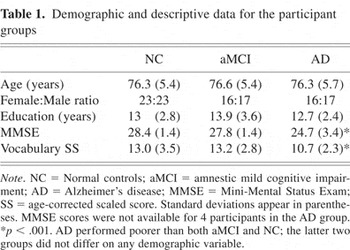
Demographic information for normal control participants (NC) and individuals with aMCI and AD appear in Table 1. A general estimate of cognitive status was obtained with the Mini-Mental Status Examination (MMSE; Folstein et al., 1975), and an estimate of current verbal ability was obtained with a vocabulary test (Wechsler, 1997), a test correlated with verbal intelligence (Wechsler). There were no differences between the NC and aMCI groups on any demographic variable. Although the AD group obtained lower test scores than the other two groups, their MMSE scores fell in the mild range of dementia, and their vocabulary scores were within the average range.
Demographic and descriptive data for the participant groups

NC group
Forty-six healthy older adults (age 66–86) were recruited from community talks and databases of research volunteers. On interview there was no history of neurological, medical or psychiatric disorder, substance abuse, or medications affecting cognition. Performance was within normal limits for age and education on measures of: (a) general cognitive status (MMSE; Folstein et al., 1975); (b) immediate and delayed memory (i.e., Hopkins Verbal Learning Test-Revised, HVLT-R; Brandt & Benedict, 2001; Brief Visuospatial Memory Test-Revised, BVMT-R; Benedict, 1997; Logical Memory, Wechsler, 1987); and (c) self-reported mood (i.e., Geriatric Depression Scale, GDS; Yesavage et al., 1983).
aMCI group
Thirty-three individuals (age 65–86), 14 recruited from physician referrals and 19 from newspaper advertisements, were classified as aMCI by consensus according to criteria by Petersen (2004). Specifically, each participant: (a) reported a memory complaint during interview; (b) exhibited objective memory impairment for age on cognitive testing (i.e., HVLT-R; BVMT-R; Logical Memory or Verbal Paired-Associates, Wechsler, 1987), defined as memory scores lower than expected based on age, education and IQ (Petersen, 2004). To illustrate, on HVLT-R immediate and delayed recall respectively, our aMCI group obtained z scores of −1.1 and −1.6 based on HVLT-R norms, and this is substantially lower than demonstrated verbal ability (i.e., Vocabulary z score of 1.0); (c) demonstrated normal general cognitive status for age and education on the MMSE or Dementia Rating Scale-II (Jurica et al., 2001) and on measures of attention (Digit Span; Wechsler, 1997), confrontation naming (Boston Naming Test; Kaplan et al., 1983), and visuospatial construction (Rey-Osterrieth Complex Figure copy; Spreen & Strauss, 1998); (d) no substantial interference with normal daily activities as determined through detailed clinical interview (e.g., personal banking, grocery shopping); and (e) the absence of medical or psychiatric conditions that could account for the memory decline, determined by review of medical history and current self-reported mood status on the GDS or Hospital Anxiety and Depression Scale (HADS; Zigmond & Snaith, 1983).
AD group
Thirty-three individuals with AD (age 61–87) were recruited from physician referrals. All participants met NINCDS-ADRDA criteria for probable AD (McKhann et al., 1984). The tests described previously for the aMCI group were used to determine the presence of impairments in multiple areas of cognition. Participants were not significantly depressed on the GDS or HADS.
Procedure
Two one-minute word generation trials were administered on an individual basis as part of a larger test battery. Participants generated words beginning with the letter F for phonemic fluency and then generated animals for semantic fluency. Three dependent measures were obtained from each trial: (a) total number of words generated, excluding errors and repetitions, consistent with standard scoring rules (Spreen & Strauss, 1998); (b) average cluster size, defined as the mean number of words (minus one) generated within subcategories, including words with the same first two letters or rhyming words for phonemic fluency (e.g., flight-flute or fly-fry), or animals from the same semantic subcategory (e.g., types of insects, farm animals) for semantic fluency; and (c) number of switches, defined as the raw number of transitions between subcategories. The scoring principles for cluster size and switches are described elsewhere (Troyer et al., 1997). These measures were not corrected by number of words generated. In clustering the measure is an average. In switching, the raw number, not a proportion, is the variable of interest (i.e., how many times one can switch to a new category). Past research shows that proportion scores fail to capture differences between patient groups that are impaired on traditional fluency measures (for rationale see Troyer & Moscovitch, 2006).
Analyses
The dependent measures (i.e., total number of words generated, average cluster size, and number of switches in each fluency condition) were analyzed using a three (between-group: NC, aMCI, AD) by two (within-subject fluency condition: phonemic, semantic), repeated measures ANOVA. Planned comparisons were conducted with alpha set at .05. To analyze the relative difference in word generation between the two fluency tasks, we conducted a 1-way ANOVA on the difference scores (i.e., words generated on semantic minus phonemic fluency).
Results
Words generated
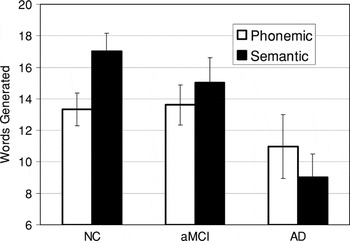
Total number of words generated by each group on each fluency task is shown in Figure 1. Mean words generated (and SDs) for the NC, aMCI, and AD groups respectively were 13.33 (3.48), 13.61 (3.55), and 10.97 (5.75) for phonemic fluency and 17.0 (3.84), 15.03 (4.44), and 9.03 (4.15) for semantic fluency. There were main effects of group, F(2,109) = 22.01, p < .001, ηp2 = .29, and fluency task, F(1.109) = 5.89, p < .02, ηp2 = .05, and a group-by-task interaction, F(2,109) =14.71, p < .001, ηp2 = .21. Planned comparisons showed the difference between the fluency tasks was significant for the NC and AD groups but not the aMCI group. Further, the AD group exhibited the opposite pattern, relative to the NC and aMCI groups, whereby they generated more words in the phonemic condition. The aMCI and NC groups exhibited comparable performance on phonemic fluency but not on semantic fluency where aMCI achieved a significantly lower score. The performance level of the AD group on both fluency tasks was significantly reduced relative to aMCI and NC performance.

Total words generated in the phonemic and semantic fluency conditions for the three participant groups. Error bars represent 95% confidence intervals. NC = normal control participants, aMCI = amnestic mild cognitive impairment, AD = Alzheimer's disease.
As seen in Figure 1, the advantage in the semantic fluency condition, which was absent in the AD group, was attenuated in the aMCI group compared to the control group. To investigate this observation further the difference scores, calculated as semantic minus phonemic scores, were submitted to a 1-way ANOVA. Mean difference scores (and standard deviations) for the NC, aMCI, and AD groups were 3.67 (4.37), 1.42 (4.72), and −1.94 (4.58), respectively. The group main effect was F(2,109) =14.71, p < .001, ηp2 = 0.21. All planned comparisons between groups of these difference scores were significant, with effect sizes (d) of 0.49 for NC versus aMCI, 1.07 for NC versus AD, and 0.68 for aMCI versus AD. In order to examine what would be a clinically meaningful difference between the two fluency tasks, we calculated z scores for each participant using the overall mean and standard deviation of the difference score obtained by the NC group. The percentage of individuals showing an advantage on the semantic task that was less than or equal to one standard deviation below the NC group average was 17%, 30%, and 58% of the NC, aMCI, and AD participants respectively.
Clustering
Mean cluster sizes (and SDs) for the NC, aMCI, and AD groups respectively were 0.50 (0.43), 0.37 (0.31), and 0.34 (0.33) for phonemic fluency, and 1.28 (0.59), 1.12 (0.54), and 0.86 (0.51) for semantic fluency. There were main effects of group, F(2,109) = 6.17, p < .01, ηp2 = 0.10, and fluency task, F(1,109) = 141.32, p < .0001, ηp2 = 0.57, but no interaction, F(2,109) = 6.17, p = .16, ηp2 = .03. Cluster size was largest in the NC group and smallest in the AD group. All participants showed greater clustering on semantic, as compared to, phonemic fluency, consistent with past research (reviewed in Troyer & Moscovitch, 2006). Planned comparisons showed groups performed comparably on phonemic clustering, whereas the AD group exhibited significantly smaller clusters on semantic fluency compared to the NC group.
Switching
Mean switches (and SDs) for the NC, aMCI, and AD groups respectively were 9.24 (3.03), 10.76 (3.33), and 8.55 (4.00) for phonemic fluency and 7.70 (2.80), 7.09 (2.12), and 5.00 (2.93) for semantic fluency. There were main effects of group, F(2,109) = 6.70, p < .01, ηp2 = .11, and fluency task, F(1,109) = 78.36, p < .001, ηp2 = 0.42, and a significant group-by-task interaction, F(2,109) = 4.86, p < .01, ηp2 = .08. All groups exhibited greater switching in phonemic than in semantic fluency. The magnitude of this difference in switching was comparable in the aMCI and AD groups and larger than in the NC group. Switching was comparable on both fluency tasks between the NC and aMCI groups. The AD group switched less on semantic fluency as compared to the aMCI and NC groups and less on phonemic fluency as compared to the aMCI group.
In sum, the NC and aMCI groups performed comparably for dependent measures of phonemic fluency, whereas the aMCI group showed intermediary performance between the NC and AD groups on dependent measures of semantic fluency.
DISCUSSION
Our findings demonstrate that verbal fluency performance is sensitive to semantic memory degradation in a preclinical phase of AD. The aMCI group showed a decline in semantic relative to phonemic fluency compared to controls, despite the fact that their overall performance level was similar to controls and the fact that their semantic fluency performance falls within the normal range of ability (Spreen & Strauss, 1998). The aMCI group performed significantly better than the AD group on both fluency tasks and the decline in semantic relative to phonemic fluency was significantly greater in the AD group.
The most likely explanation for the relative difference observed between these fluency tasks concerns their respective cognitive demands. Both tasks require strategic search and retrieval of information from memory; however, generating items from a particular semantic category relies on semantic associations between exemplars of subcategories to a greater extent than does generating words beginning with a particular letter, which instead requires the search of lexical representations. Our task differences do not appear to simply reflect the fact that generating animals is an easier task than generating words beginning with the letter F. One can manipulate the difficulty levels by choosing different categories and letters (e.g., animals > the letter S > vegetables), but this does not tend to change the pattern of fluency performance (Bayles et al., 1989). The important finding is the performance difference between tasks by patient populations in comparison to healthy controls, rather than any numerical difference in isolation.
Previous research showing a selective vulnerability of semantic relative to phonemic fluency in AD has been contrasted with equivalent performance reductions on these two tasks in disorders affecting frontal-subcortical circuits, such as Huntington's disease (Monsch et al., 1994). These differential patterns of performance have been attributed to a degradation of the semantic network in AD versus a generalized retrieval deficit in Huntington's disease.
We contend that semantic fluency is vulnerable in aMCI because it relies more on associations between exemplars of subordinate categories than does phonemic fluency. The episodic memory decline that characterizes aMCI is consistent with evidence of early hippocampal changes in this population (Masdeu et al., 2005). Our findings of reduced efficiency in accessing semantic associations indicates that the early neuropathology of AD may extend beyond the hippocampus to include cortical areas supporting semantic memory (see Moscovitch et al., 2005 for theories regarding functional neuroanatomy of memory). We would not necessarily expect to observe the same pattern of results in other MCI subtypes (i.e., single nonmemory domain or multiple cognitive domains slightly impaired), because other etiologies likely underlie these subtypes (Petersen, 2004). The pattern of disproportionately impaired semantic relative to phonemic fluency is specific to AD and now to the amnestic subtype of MCI, which is believed to be a precursor to AD.
The similar fluency pattern in aMCI and AD underscores the importance of assessment of cognitive domains outside of episodic memory in individuals with aMCI. An analysis of the components of cognitive processes in aMCI provides information about the earliest cognitive changes (i.e., semantic associative processing) and consequently information about the early neural changes in incipient AD. Obvious clinical applications of this type of investigation include earlier identification of incipient AD, which is necessary for timing interventions aimed at delaying dementia onset.
ACKNOWLEDGMENTS
Research supported in part by an Alzheimer Society of Canada research grant to AKT and KJM and Desjardins Financial.