

Introduction
The oldest document in the History of Neuropsychology was not written, but an archaeological record. Since antiquity, man has sought to understand the relationships between the brain, behavior and cognition, and craniotomy emerged as an instrumental procedure for comprehending the anatomical features of our brain. Today, decompressive craniectomy (DC) is used as a treatment for refractory intracranial hypertension that involves extracting part of the skull to release the swelling and relief intracranial hypertension. Harvey Cushing was the first to describe the procedure. This technique and its variants have been used for decades for treating stroke, traumatic brain injury (TBI) and other distinct pathologies (Cushing, Reference Cushing1905).
Despite the decrease in mortality associated with this surgical technique, morbidity is still high among patients undergoing DC (Amorim et al., Reference Amorim, Bor-Seng-Shu, Gattás, Paiva, de Andrade and Teixeira2012; Cushing, Reference Cushing1905; Kjellberg & Prieto, Reference Kjellberg and Prieto1971; Kondziolka & Fazl, Reference Kondziolka and Fazl1988). Many patients have early and late problems, namely hernia on the edge of the craniectomy (51%), resulting in brain damage (6 to 58%) (Honeybul, Reference Honeybul2010), subdural hygroma (16 to 62%), (Honeybul, Reference Honeybul2010; Jiang et al., Reference Jiang, Xu, Li, Xu, Zhang, Bao and Luo2005; Stiver, Reference Stiver2009) Hydrocephalus (2 to 29%), (Chibbaro & Tacconi, Reference Chibbaro and Tacconi2007; Flint et al., Reference Flint, Manley, Gean, Hemphill and Rosenthal2008) motor impairment (Chibbaro & Tacconi, Reference Chibbaro and Tacconi2007; Flint et al., Reference Flint, Manley, Gean, Hemphill and Rosenthal2008; Yang et al., Reference Yang, Hong, Su and Yang2003) infections (Yang et al., Reference Yang, Hong, Su and Yang2003), and sinking skin flap syndrome (26%) (Ashayeri et al., Reference Ashayeri, M.J., Huang, Brem and Gordon2016; Stiver, Reference Stiver2009).
Patients with major cranial defects (>100 cm2) are particularly at risk for sinking skin flap syndrome, characterized by headaches, dizziness, changes in mood and behavior, seizures, fatigue, motor deficits, and language problems (Reference Stiver, Wintermark and Manley2008b; Grant & Norcross, Reference Grant and Norcross1939, Stiver et al., Reference Stiver, Wintermark and Manley2008a; Yamaura & Makino, Reference Yamaura and Makino1977).
Little is known about the pathophysiological mechanisms of this syndrome. Some authors believe in the hypotheses of abnormal cerebral pulsatility (Grantham & Landis, Reference Grantham and Landis1948), atmospheric pressure effect through the bone defect (Farrington, Reference Farrington1945; Stula, Reference Stula1985; Tabaddor & LaMorgese, Reference Tabaddor and LaMorgese1976; Yamaura & Makino, Reference Yamaura and Makino1977), changes in the cerebrospinal fluid dynamics and venous drainage (Fodstad et al., Reference Fodstad, Love, Ekstedt, Fridén and Liliequist1984; Langfitt, Reference Langfitt1969; Royall et al., Reference Royall, Mahurin and Gray1992; Segal et al., Reference Segal, Oppenheim and Murovic1994), as well as changes in blood flow and brain metabolism (Erdogan, Reference Erdogan, Düz, Kocaoglu, Izci, Sirin and Timurkaynak2003; Isago et al., Reference Isago, Nozaki, Kikuchi, Honda and Nakazawa2004; Kemmling et al., Reference Kemmling, Duning, Lemcke, Niederstadt, Minnerup, Wersching and Marziniak2010; Kuo et al., Reference Kuo, Wang, Chio and Cheng2004; Maeshima et al., Reference Maeshima, Kagawa, Kishida, Kobayashi, Makabe, Morita and Tsubahara2005; Richaud et al., Reference Richaud, Boetto, Guell and Lazorthes1985; Sakamoto et al., Reference Sakamoto, Eguchi, Kiura, Arita and Kurisu2006; Stiver et al., Reference Stiver, Wintermark and Manley2008b; Suzuki et al., Reference Suzuki, Suzuki and Iwabuchi1993; Winkler et al., Reference Winkler, Stummer, Linke, Krishnan and Tatsch2000; Yoshida et al., Reference Yoshida, Furuse, Izawa, Iizima, Kuchiwaki and Inao1996).
Cranioplasty is a secondary procedure after DC to restore cranial bone morphology, traditionally recommended for esthetic purposes and brain protection. Of note, some published case reports and clinical series have suggested functional improvements in neurological deficits, cognition and cerebral hemodynamics after cranioplasty (Chieregato, Reference Chieregato2006; Lezak, Reference Lezak1995; Nakamura et al., Reference Nakamura, Takashima, Isobe and Yamaura1980; Ng & Dan, Reference Ng and Dan1997; PV, Reference PV2015; Schiffer et al., Reference Schiffer, Gur, Nisim and Pollak1997; Sujit Kumar et al., Reference Sujit Kumar, Chacko and Rajshekhar2004). However, little is known about these potential neuropsychological changes after cranioplasty. This study aims to assess patients' changes in cognition following cranioplasty after DC.
Material and methods
Study design and settings
A cohort study was conducted from February 2015 to July 2017 in a single tertiary academic center with three repetitive assessments: the first up to 30 days before cranioplasty and then after one and six months following cranioplasty.
Clinical and surgical management were performed at the discretion of the attending teams according to national and local guidelines. The cranioplasty was performed as in routine practice, with autologous bone as the first choice or methyl methacrylate polymer. Patients underwent general anesthesia, lying supine and with cephalic lateralization contralateral to the craniectomy.
After trichotomy and rigorous asepsis with chlorhexidine, the existing incision was reopened with careful separation of the cutaneous flap from the dura mater. The temporal muscle was also isolated and separated from the dura mater whenever possible. Autologous bone was replaced with a nylon 2.0 fixation when possible. When not possible, we used methyl methacrylate prostheses molded during the procedure. In all cases, we made 4 to 8 fixations from the dura mater to the bone or prosthesis with using Prolene to reduce dead space and bring the dura mater as close as possible to its original position. A drain under the galea was routinely placed and maintained with a vacuum for 24 h. Patients were discharged around the fifth postoperative day and the stitches were removed around the fourteenth postoperative day.
This study was approved by the local institutional ethics committee (Comissão de Ética Para Análise de Projetos de Pesquisa do HCFMUSP number 13023, protocol 00119/10).
Participants
Patients were eligible if previously submitted to DC due to malignant ischemic stroke or TBI with cerebral edema causing deviation of the midline structures >5 mm and aged between 17 and 65 years old. Exclusion criteria were less than 3 years of schooling and inability to understand and follow the instructions during the evaluations.
Patients were consecutively enrolled and assessed for eligibility criteria at the neurorehabilitation outpatient clinic. They were followed up for 6 months after the recruitment. There was no control group.
Variables and data sources/measurement
An experienced neuropsychologist (FC) performed the neuropsychological assessments (Fig. 1). Instruments used were: Colorful Trail Test I and II (Trial Making Test standardized version for the Brazilian population), Digit Tests, Logical Memory Tests, Visual Reproduction (all them Subtests of Wechsler Memory Scale), ‘Rey Auditory Verbal Learning Test' (RAVLT), Phonemic and Semantic Verbal Fluence Test, Arithmetics, Numbers Sequences Test, Letters Sequences Test (all subtests of WAIS-III), Stroop Test (Victoria version), Cubes Test (subtest of WAIS-III) and Rey Complex Figure Copying. For depression and anxiety symptoms, we used the Beck Depression and Anxiety Inventories (BDI and BAI, respectively). In addition, the Pfeffer questionnaire (Functional Activities Questionnaire – FAQ) was used to verify the ability to perform activities of daily living.
Fluxogram of patients evaluation.

The primary outcome was the change from baseline in the Digits Tests after 1 and 6 months.
Secondary outcomes included the Logical Memory Tests, Visual Reproduction, RAVLT, each subtest of WAIS-III (Arithmetic, Numbers Sequences, Letter Sequences), Rey Complex Figure Copying, BDI, BAI and FAQ.
Study size
The obtained convenience sample for the study (one group, three repeated measures) was satisfactory for the detection of an effect size f equal to 0.25 or higher with 0.8 power and alpha 0.05.
Statistical methods
For descriptive purposes, categorical variables were presented through relative and absolute frequencies. Continuous variables were normally distributed and were presented as mean and standard deviations.
Repeated measures general linear models were employed to assess the patients' evolution and interactions with baseline characteristics when appropriate. When the sphericity assumption was not met, the Greenhouse-Geisser or Huynh-Feldt correction was applied, as indicated. Effect size was estimated by the partial η2.
All tests were two-sided and final p values under 0.05 were considered statistically significant. All analyses were conducted with the software SPSS (IBM Corp. SPSS Statistics para Windows, version 24.0. Armonk, NY).
Results
Participants
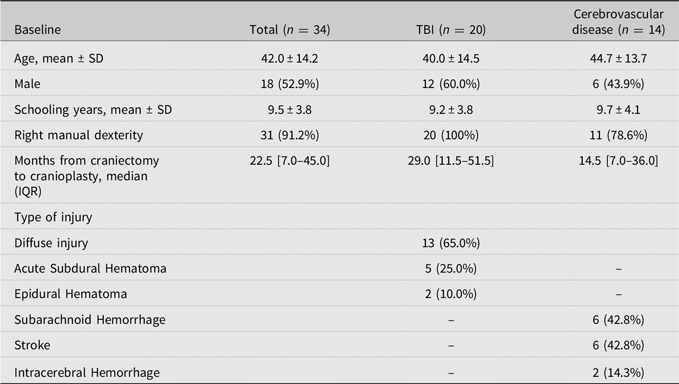
A total of 41 patients were initially included in the study, of which 13 were excluded (6 lost follow-up, 6 had infections leading to the removal of the cranioplasty material and one was diagnosed with a tumor) (Fig. 1). The 34 patients who attended the second evaluation were included in the analysis. Demographic and clinical data are described in Table 1.
Baseline data

IQR, Interquartile range; SD, standard deviation; TBI, traumatic brain injury.
Twenty out of 34 participants sustained a TBI (58,8%), of which 12 were male (60%). Mean age was 40.0 ± 14.5 years old (range 17–64), average schooling time 9.2 ± 3.8 years (range 4–18 years) and the median time from injury was 22.5 months (range 2–240 months). Diffuse injury was DC’s most common underlying indication (Table 1). Participants submitted to DC with cerebrovascular diseases were 14 out of 34 patients (41.2%). In this group, 8 were female (57.1%), the mean age was 44.7 ± 13.7 years old (range 27–65), average schooling was 9.7 ± 4.1 years (range 3–16) and the average time to cranioplasty was 28.6 months. Spontaneous aneurysmal subarachnoid hemorrhage and stroke comprised 6 patients (42.8%) each one, whilst intraparenchymal spontaneous hemorrhage comprised 2 (14.3%) out of 14 patients (Table 1).
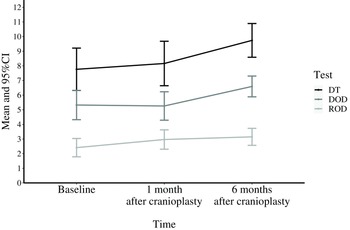
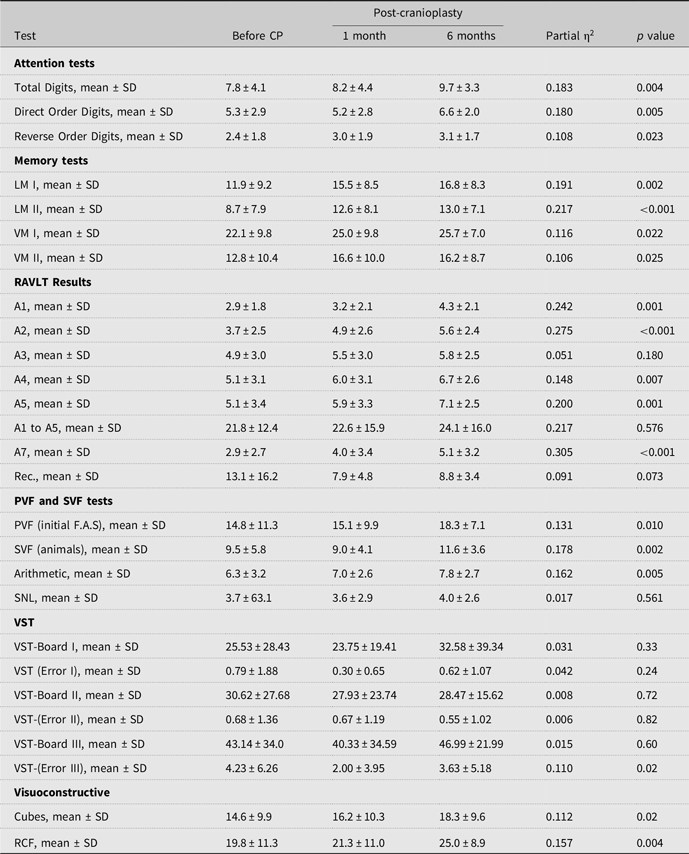
There were significant cognitive improvements on hearing-verbal attention, episodic memory, verbal fluency, constructive visual and visuospatial function (p < 0.05). Digit tests (total, direct order and reverse order) significantly improved after 1 and 6 months following cranioplasty (Table 2, Fig. 2).
Digit Tests performance over time.

Primary and secondary outcome measures (n = 34)

SD: Standard deviation.
LM I. LMII: Logical Memory Tests I and II.
VM I; VM II: Visual Reproduction Tests I and II.
RAVLT: Rey Auditory Verbal Learning Test.
A1: application 1; A2: application 2; A3: application 3; A4: application 4; A5: application 5.
(A1-A5) – Sum of points from applications A1 to A5.
A7 – Late recall; Rec.: memory by recognition.
PVF: phonemic verbal fluency test (initial F.A.S.); SVF – semantic verbal fluency test (animal category).
SNL – Sequence of numbers and letters.
VST – Stroop Test version Victoria.
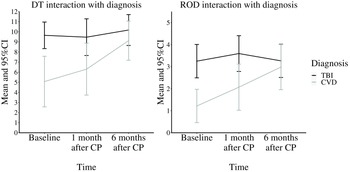
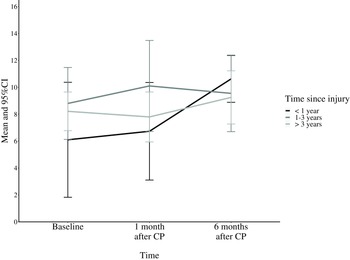
There were interactions between DT evolution and etiology (p = 0.010) (Fig. 3), ROD evolution and etiology (p = 0.004) (Fig. 3), and A1-A5 evolution and etiology (p = 0.037). Time since diagnosis had interactions with DT (p = 0.018) (Fig. 4), DOD (p = 0.035), and A4, A5, and A7 (p = 0,022; 0,040 and 0,041, respectively).
Digit Test (direct and reverse order) behavior according to etiology.

Digit Test (direct and reverse order) behavior according to time from diagnosis.

Memory process evaluations through Logical Memory Tests (p = 0.002 and p < 0.001), Visual Reproduction (p = 0.022 and p = 0.025), (Table 2, Figure S1) and most of the parameters of ‘Rey Auditory Verbal Learning Test' (RAVLT) had a significant improvement (Table 2, Figure S2). Language functions also showed significant differences on Phonemic Verbal Fluence Test (p = 0.01) and Semantic Verbal Fluence Test (p = 0.002) (Table 2, Figure S3).
Analysis of executive functions (EF) showed significant pre- to postoperative differences on Arithmetic (p = 0.0050) and Vitoria Stroop Tests – mean of errors on board III (p = 0.022) (WAIS-III Wechsler) used as measures of working memory and inhibitory control respectively. However, the Sequence of Numbers and Letters Test (cognitive flexibility) did not show any significant change (p = 0.561) (Table 2). Cubes Test (subtest of WAIS-III) and Rey Complex Figure copying showed significant differences (p = 0.02 and 0.04 respectively) (Table 2, Figure S4).
Neither the Pfeffer questionnaire nor the scores expressed through the BDI and BAI showed significant differences over time, and there were no interactions observed between their evolution and age, sex, or education level.
Discussion
We observed significant improvements in multiple cognitive domains after cranioplasty regardless of age, sex, or education level.
Memory evaluation consists of different components mediated by different neural circuits. These components are mediated by modules of the nervous system that act independent or cooperatively. This system includes long-term memory divided into explicit and implicit (dual system), which proved to be useful to understand functions and deficits in individuals with brain dysfunctions. Declarative or explicit memory refers to the capacity of storage and conscientious evocation of previous experiences and has a functional and anatomical difference from implicit memory. Declarative memory system involves two subsystems: episodic memory (autobiography) and semantic memory.
In a comparative analysis of the measures (mean by points of execution) obtained before and after surgery (1 month and 6 months), a significant improvement was observed in the measures A1 (short-term memory) and A7 (spontaneous evocation). The RAVLT test involves descriptive analysis of short-term tasks retention (measure A1), of the learning tests (the acquisition was characterized by the addition of the number of words learned over five tests A1 to A5), spontaneous evocation (measure A7, retention after 20 min) and recognition (measures recognition by memory).
Language processes involve phonological, morphological, syntactic and semantic aspects that allow balance in form, content and use, giving functionality to the language. We used the phonemic verbal fluency test (PVF) and semantic verbal fluency test (SVF, animal category) as our outcome measures for language skills. Pre- and postoperative verbal fluency expected averages (execution points) were compared, and both improved significantly. These results go in line with the previous literature (Coelho et al., Reference Coelho, Oliveira, Paiva, Freire, Calado, Amorim and Neville2014; Corallo et al., Reference Corallo, De Cola, Lo Buono, Cammaroto, Marra, Manuli and Calabrò2020; Corallo et al., Reference Corallo, De Cola, Lo Buono, Marra, De Luca, Trinchera and Calabrò2017; Di Stefano et al., Reference Di Stefano, Rinaldesi, Quinquinio, Ridolfi, Vallasciani, Sturiale and Piperno2016; Jelcic et al., Reference Jelcic, Della Puppa, Mottaran, Cecchin, Manara, Dam and Cagnin2013; Kim et al., Reference Kim, Kim and Hyun2017) regarding significant improvements in language functionality post-cranioplasty after TBI.
Despite the critical variability in terms of injury time (between DC and cranioplasty) in our series, it did not interact with language recovery, as seen in other studies (Coelho et al., Reference Coelho, Oliveira, Paiva, Freire, Calado, Amorim and Neville2014; Jelcic et al., Reference Jelcic, Della Puppa, Mottaran, Cecchin, Manara, Dam and Cagnin2013).
Among the cognitive functions investigated in a neuropsychological assessment, EF constitute the least consensual operational definitions in the literature (Jelcic et al., Reference Jelcic, Della Puppa, Mottaran, Cecchin, Manara, Dam and Cagnin2013). It is known that, like other psychological procedures, EF are not one-dimensional constructions, being related to different areas in the frontal lobe and functionally connected to other brain regions (Julio-Costa et al., Reference Julio-Costa, Moura and Haase2018; Malloy-Diniz et al., Reference Malloy-Diniz, Fuentes, Mattos and Abreu2018). Despite the multifactorial nature of EF, which is not fully theorized, there is a relative consensus on the existence of three essential components: inhibition, working memory and cognitive flexibility (Coelho et al., Reference Coelho, Oliveira, Paiva, Freire, Calado, Amorim and Neville2014). The scope of this work was restricted to analyzing only these three elements, for pedagogical and objective reasons. Our data showed significant differences (p < 0.05) on working memory and inhibitory control, but not in terms of cognitive flexibility, considering pre- to postoperative comparisons.
Visuospatial and constructive visual capabilities were evaluated using the Cubes Test (a subtest of WAIS-III) and Rey Complex Figure Copying (RFC), and both improved over time after cranioplasty. Based on these results, both constructive visual activities presented improvements after the bone reconstruction procedure. This significant improvement in visuoconstructive skills evidenced by the RFC test is in accordance with previous findings (Jelcic et al., Reference Jelcic, Della Puppa, Mottaran, Cecchin, Manara, Dam and Cagnin2013; Ng & Dan, Reference Ng and Dan1997; Nitrini et al., Reference Nitrini, Caramelli, Bottino, Damasceno, Brucki, Anghinah and Neurologia2005).
Brain injuries can be responsible for the inability to perform simple or complex activities, when the compromised region is involved with several functions (Nitrini et al., Reference Nitrini, Caramelli, Bottino, Damasceno, Brucki, Anghinah and Neurologia2005). This functional loss can be assessed with the FAQ and the Pfeffer Questionnaire. Neither showed significant differences in our study.
Some limitations of our study should be noted. The main limitation is the absence of a control group without DC, which would exceed our scope. We cannot exclude the possibility that the observed improvements are partially spontaneous, constituting a part of the natural history of disease rather than an effect of DC. Indeed, we found a significant interaction between the cranioplasty effect and time since DC. Patients with <1 year from the lesion, a period with higher neuroplasticity, showed higher improvements in the primary outcome. Nevertheless, since not all outcomes were affected by time since DC, we believe the cranioplasty has a true effect over cognitive prognosis, although its effect size might have been overestimated in this study due to some spontaneous improvement. The observation that some patients improve even after the first year after injury reinforces our conclusion.
Also, the absence of blinding for the sequential assessments after cranioplasty might have introduced some bias from the evaluator. Third, as factors such as etiology and time to cranioplasty were correlated, we cannot be sure whether interactions owe to the time from craniectomy to cranioplasty or the etiologies themselves. Lastly, being a unicentric study restricted to a convenience sample from the Brazilian public health service, our results might not be fully generalizable to other populations. Finally, one should consider the pathophysiological differences and the heterogeneity of the participants' underlying brain pathologies.
In conclusion, patients who undergo cranioplasty following stroke or TBI seem to have an improved prognosis on auditory verbal attention, episodic memory, verbal fluency, working memory, inhibitory control, visuoconstructive and visuospatial functions. Of note, this effect was consistent regardless of age, sex, or education level and persisted after 6 months. Some degree of spontaneous improvement might have contributed to the results. Patients submitted to cranioplasty earlier after injury presented greater improvements in the primary outcome.
Supplementary materials
For supplementary material for this article, please visit https://doi.org/10.1017/BrImp.2023.2
Acknowledgements
This research was partially funded by the National Council for Scientific and Technological Development (CNPq), Brazil.
Authors Contributions
FC, GS, DJFS, WSP, AFA, MJT and RA contributed to the study design and data collection.
DJFS and PNM performed the statistical analysis.
All authors participated in the writing and revised the final manuscript.
Financial Support
This research was partially funded by the National Council for Scientific and Technological Development (CNPq), Brazil.
Competing interests
Authors have no conflicts of interest to disclose.
Ethical Standard
The authors assert that all procedures contributing to this work comply with the ethical standards of the relevant national and institutional committees on human experimentation and with the Helsinki Declaration of 1975, as revised in 2008.