Introduction
Host–parasite interactions may vary in accordance with ecological factors, habitat characteristics and phylogeny (Dobson, Reference Dobson2009; Lafferty, Reference Lafferty2009; Akoll et al., Reference Akoll, Konecny, Mwanja and Schiemer2011). An interesting question in parasitology is why some species or populations are more parasitized than others. Information on this issue is scarce, and studies on a number of species and environments are necessary in order to understand the diversity of parasitism. Here we examine the influence of host characteristics and habitat on parasite prevalence in a reophilous newt member of the Salamandridae, the Pyrenean brook newt Calotriton asper (Dugès, 1852).
To our knowledge, there are no previously published studies of the helminths of the genus Calotriton. Nevertheless, other Salamandridae have been studied (Barus & Groschaft, Reference Barus and Groschaft1962; Barus et al., Reference Barus, Groschaft and Otcenasek1963; Vojtková et al., Reference Vojtková, Moravec and Nabelkova1963; Vojtek & Vojtkova, Reference Vojtek and Vojtková1972; Sattmann, Reference Sattmann1986, Reference Sattmann1990; Shimalov et al., Reference Shimalov, Shimalov and Shimalov2001; Yildirimhan, Reference Yildirimhan2008; Yildirimhan & Öz, Reference Yildirimhan and Öz2008), including the Corsican brook newt Euproctus montanus, which shares a similar reophilous lifestyle with Calotriton. The Corsican brook newt has been found to harbour Brachycoelium salamandrae (with a prevalence of 25% and from 1 to 36 individuals per host) and Acanthocephalus falcatus (with a prevalence of 13% and from 1 to 5 individuals per host) (Combes & Knoepfler, Reference Combes and Knoepfler1968).
Therefore, the study of the parasitic helminths of this reophilous newt has an inherent interest if compared with the parasitological fauna of other newts that inhabit lentic waters. These lentic habitats have more trophic resources and so it is likely that there will be greater diversity and density of invertebrates that can act as intermediate hosts for parasites with complex life cycles. Thus, it is to be expected that newts inhabiting lentic waters, such as Lissotriton and Triturus, will have greater helminth diversity and levels of infestation than reophilous newts such as C. asper.
We also compared prevalence between metamorphic and paedomorphic individuals, which use habitats in different ways. Paedomorphic individuals show a fully aquatic life cycle but metamorphics have a terrestrial life stage. The habitat or use of habitat could determine the richness of helminth communities in amphibians. In fact, amphibians with semi-aquatic life cycles show a peak in helminth species richness (Aho, Reference Aho, Esch, Bush and Aho1990; Hamann et al., 2013). Furthermore, as far as we know, no previous studies have ever been undertaken on the prevalence of infection in ontogenetic stages. Moreover, one might expect certain species to show a sex-biased prevalence due to sexual dimorphism in body size or different life span depending on sex. Also, age-biased prevalence might occur due to differences in immune defences depending on age (Dare & Forbes, Reference Dare and Forbes2008).
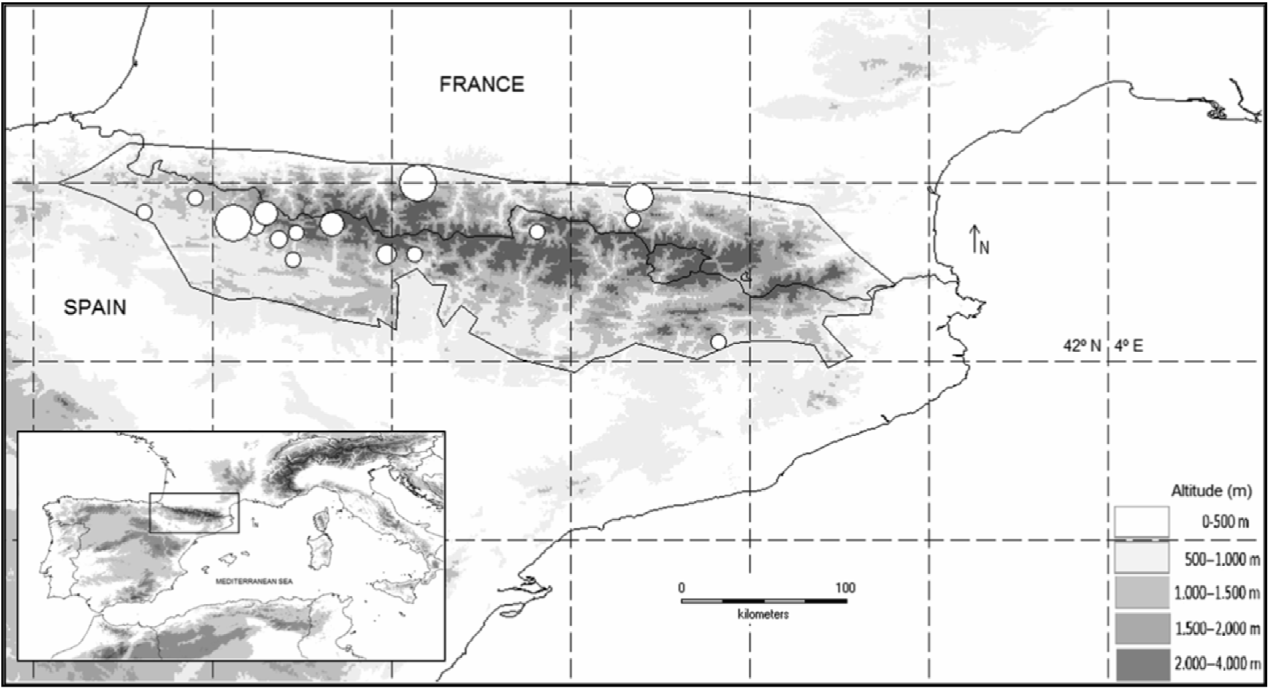
The Pyrenean brook newt is endemic to the Pyrenees and nearby mountain ranges. The only other member of its genus is the Montseny brook newt Calotriton arnoldi Carranza & Amat, Reference Carranza and Amat2005. Although sub-adults have a terrestrial life stage (García-París et al., Reference García-París, Montori and Herrero2004), adults essentially occur in cool, oligotrophic, well-oxygenated mountain streams. The species is found at altitudes between 700 and 2500 m (Carranza & Amat, Reference Carranza and Amat2005) and is widely distributed throughout most of the Pyrenees (Andorra, France and Spain) and pre-Pyrenees (see fig. 1). Its large geographic range and wide vertical distribution greatly influence this species' annual activity period, which varies from 3 to 12 months (García-París et al., Reference García-París, Montori and Herrero2004). The Pyrenean brook newt generally shares its habitat with only one other caudate, Salamandra salamandra, which as an adult is terrestrial but whose larvae co-occur in syntopy with those of C. asper.
The distribution and collecting sites of C. asper in the Pyrenees; circle size (○) is approximately proportional to the size of the sample collected from each point; smaller circles have been magnified ( × 4) for clarity.

In this first-ever study of the helmintofauna of the Pyrenean brook newt, we examined the influence of habitat and factors such as the sex, ontogeny (paedomorphosis or metamorphosis), body size and age of the host on prevalence and parasite richness. We also tested for possible differences in prevalence in Pyrenean populations.
Materials and methods
Collection and examination of newts
A total of 167 preserved Pyrenean brook newts from the following institutions were studied: Muséum National d'Histoire Naturelle de Paris (MNHN), Museo Nacional de Ciencias Naturales de Madrid (MNCN), Museu de Granollers de Ciències Naturals (MDGCN) and Museu de Zoologia de Barcelona (MZB), along with individuals from private collections. The studied newts came from several localities homogeneously distributed throughout the Pyrenees (fig. 1) and the sample used was a representative sample of the whole population of C. asper (Milá et al., Reference Milá, Carranza, Guillaume and Clobert2010). Localities from Spain were: Ibón Acherito and Barranco de Acherito (42.8°N, 0.9°W), Escuaín Cuello Viceto (42.6°N, 0.1°E), San Juan de la Peña (42.6°N, 0.6°W), Canfranc, Ibón de Ip (42.7°N, 0.5°W), Sallent de Gallego (42.8°N, 0.3°W), Aísa (42.7°N, 0.6°W), Fanlo, Valle de Añisclo (42.6°N, 0°W), Selva de Oza (42.8°N, 0.7°W), Alto Aragón (42.8°N, 0.8°W), Huesca, Aragon; Ochagavía (42.9°N, 1.1°W) and Ustárroz (42.8°N, 1.5°W), Navarre; Vall d'Aran (42.7°N, 0.8°E) and Berga (42.1°N, 1.8°E), Catalonia. Localities from France were: Bagnères de Bigorre, Torrent de Castelmouly, Hautes Pyrénées (43.0°N, 0.1°E), Aulus-les-Bains (42.8°N, 1.3°E) and Ariège (42.9°N, 1.4°E).
Before dissection, the following biometric measurements were taken: length from snout to posterior side of the cloacal protuberance (snout–vent length; SVL), length from posterior angle of the cloacal protuberance to tip of tail (tail length; Tail.L) and total length (TL), where TL = SVL+Tail.L (table 1).
Descriptive statistics (snout–vent length (SVL), total length (TL), mean ± SD, in mm) of Calotriton asper relative to sex and ontogenetic stages; n=sample size.

Measurements were taken to the nearest 0.01 mm using a digital calliper. Other than the newts whose state of preservation was deficient, all the brook newts dissected were included in the biometrical analyses. Sex was determined by vent morphology and tail length (shorter in males) and confirmed after dissection by examination of the gonads. The sex ratio was almost 1:1 (75 males and 76 females). The presence of paedomorphosis was determined by examining gill development (Denoël, Reference Denoël2002; Denoël et al., Reference Denoël, Joly and Whiteman2005, Reference Denoël, Ficetola, Ćirović, Radović, Džukić, Kalezić and Vukov2009). A total of 22 paedomorphic individuals (with gills and/or gill slits) were analysed. Individuals were classified as either adult or juveniles according to the presence of mature gonads (151 adults and 15 juveniles).
The gastrointestinal tract (oesophagus, stomach, and small and large intestines), as well as the lungs, urinary bladder, liver, heart and kidneys, were dissected and placed separately in Petri dishes containing 0.9% saline solution. Then they were examined separately for helminths under a stereomicroscope. Recovered helminths were placed in vials in 70% ethanol for subsequent examination. Nematodes were examined on a temporary mounting in Amann lactophenol. Trematodes were post-fixed in Bouin's solution, stained in Semichon's acetocarmine and mounted in Canada balsam. Helminth identification was carried out according to the literature (López-Neyra, Reference López-Neyra1947; Hartwich, Reference Hartwich1960; Căpuşe, Reference Căpuşe1967; Ribas et al., Reference Ribas, Amat and Veciana2010). A subset of helminths recovered was deposited in the Museu de Zoologia de Barcelona (MZB), Catalonia, Spain, with accession numbers MZB 2013–2609 (Megalobatrachonema terdentatum) and MZB 2013–2610 (Brachycoelium salamandrae).
Data analysis
In order to determine differences in parasite populations and the proportion of infected hosts, prevalence, mean abundance and mean intensity were calculated for each helminth species according to Bush et al. (Reference Bush, Lafferty, Lotz and Shostak1997). Mean diversity or mean species richness is the sum of helminth species per individual divided by the total sample size. Numerical dominance was determined using the Berger–Parker dominance index (Berger & Parker, Reference Berger and Parker1970). One-tailed Fisher exact tests were performed to analyse the effects of sex, ontogenetic stage (paedomorphosis or metamorphosis) and age on both parasite prevalence and parasite richness. The effect of host sex on parasite abundance and intensity was tested using a Mann–Whitney (U) test, given that data did not follow a normal distribution (according to a Kolmogorov–Smirnov test). When data followed a normal distribution and showed homoscedasticity, Student's t-test was used, specifically to test sexual dimorphism in body size and differences in body length (SVL) according to ontogenetic stage and age. Logistic regression analysis was used to determine the differences in both parasite prevalence and parasite richness (as dichotomous dependent variables) related to host body length (as a continuous independent variable). A logistic regression analysis was performed in order to test possible differences in prevalence (as a dichotomous dependent variable) depending on the newts' distribution (latitude and longitude as continuous independent variables). Means of descriptive statistics are given with the standard deviation. All statistical analyses were performed using STATISTICA 10.0 (StatSoft Inc., Tulsa, Oklahoma, USA).
Results
The helminth community of the Pyrenean brook newts consisted of two species with a total prevalence of 7.2%. Both recovered species were present at low levels of prevalence. The nematode Megalobatrachonema terdentatum (Linstow, 1890) showed a prevalence of 5.99%, mean intensity of 3 and mean abundance of 0.192 ± 0.1. The trematode Brachycoelium salamandrae (Frolich, 1789) showed a prevalence of 1.2%, mean intensity of 1 and mean abundance of 0.012 ± 0.1. Megalobatrachonema terdentatum had the highest prevalence, abundance and intensity and had a Berger–Parker index value of 0.34. Thus, M. terdentatum can be considered a core species, unlike the scarce B. salamandrae, of which only two individuals were recovered. The mean diversity was 0.072. Only 12 parasitized newts were found, all with just one helminth species and 1–11 individuals; the remaining individuals (155) were found to be uninfected.
No sexual dimorphism was found with respect to snout–vent length (T 140= 1.6, P= 0.1). Nevertheless, marginally significant differences were found in prevalence between sexes (Fisher exact test, P= 0.067), with females being more parasitized than males (prevalence in males was 4% and in females was 11.84%). However, there were no significant differences in either parasite abundance by sex (mean abundance in males = 0.08 ± 0.43 and in females = 0.34 ± 1.47; U= 11.5, P= 0.72) or by intensity (mean intensity in males = 2 ± 1 and in females = 2.89 ± 3.48; U= 11.5, P= 0.71).
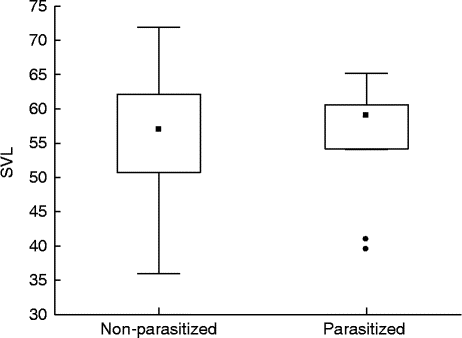
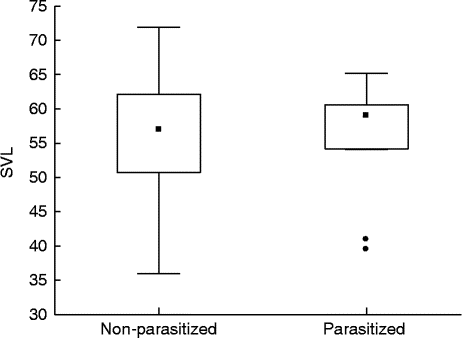
Paedomorphic individuals showed smaller snout–vent length than metamorphic ones (T 146= 3.46, P< 0.001), and as expected, immatures were smaller than adults (T 153= 7.05, P< 0.001). Nevertheless, no significant differences were found in the prevalence of infection as a result of snout–vent length (chi-square = 0.047, df = 1, P= 0.828, fig. 2). Although no parasitized paedomorphic or immature individuals were found, there were no significant differences in prevalence between paedomorphic and metamorphic individuals (Fisher exact test, P= 0.158), either in adults or immature individuals (P= 0.285). Lastly, our results showed that in the Pyrenees there are no significant differences in prevalence depending on the newts' distributions (longitude or latitude; chi-square = 2.438, df = 2, P= 0.295).
The relationship between snout–vent length (SVL, mm) of Pyrenean brook newts and parasitic status, with median values (black squares), ranges between the quartiles 25 and 75 (boxes) and ranges between non-outliers (bars) and outliers (black circles).
Given that only one parasite species was found in parasitized individuals, parasite richness had exactly the same pattern as prevalence for all the host ecological factors studied.
Discussion
The helminth community in the Pyrenean brook newts was composed of only two species, each present with low prevalence, intensity and diversity. To our knowledge, these low values of prevalence, intensity and diversity are the lowest recorded to date in amphibians, at least, that is, with a sample size as large as ours (Sattmann, Reference Sattmann1986, Reference Sattmann1990; Aho, Reference Aho, Esch, Bush and Aho1990; Paredes-Calderón et al., Reference Paredes-Calderón, León-Regagnon and García-Prieto2004; Hamann et al., Reference Hamann, González and Kehr2006; Hamann et al., 2013). The mean species richness per individual host recorded in other amphibian species in temperate regions is 0.8 (Aho, Reference Aho, Esch, Bush and Aho1990), much less than in amphibian species from tropical regions, where values range from 2.4 to 3.49 (Paredes-Calderón et al., Reference Paredes-Calderón, León-Regagnon and García-Prieto2004; Hamann et al., Reference Hamann, González and Kehr2006). The mean diversity values per host found in the present study were much lower (0.072), even in comparison with those reported for other temperate regions (0.7 on average for Caudata; Aho, Reference Aho, Esch, Bush and Aho1990). Only two species of helminths were found within a large sample size, a surprisingly low number in comparison with other newts in which the number of helminths reported ranges from 3 to 11, even with much smaller sample sizes (Aho, Reference Aho, Esch, Bush and Aho1990). In comparison with studies with similarly large sample sizes, the diversity found for the Pyrenean brook newt was much smaller than in other species, such as Nothophtalmus viridescens which harbours six helminth species (n = 127) (Aho, Reference Aho, Esch, Bush and Aho1990).
In fact, parasite richness exhibited exactly the same pattern as parasite prevalence for all the ecological factors studied, since all parasitized individuals harboured just one helminth species. Given the low levels of parasite richness found in this study, the likelihood of a newt being parasitized by one helminth species is 0.07, while the likelihood of it being parasitized by two helminth species is 0.005. Thus, even with a large sample size, it is highly unlikely that a newt will be parasitized by two helminth species. Consequently, the helminth communities in the present study may be considered as pauperized, particularly in comparison with helminth communities found in other amphibians (Combes & Knoepfler, Reference Combes and Knoepfler1968; Sattmann, Reference Sattmann1986, Reference Sattmann1990; Aho, Reference Aho, Esch, Bush and Aho1990; Shimalov et al., Reference Shimalov, Shimalov and Shimalov2001; Paredes-Calderón et al., Reference Paredes-Calderón, León-Regagnon and García-Prieto2004; Hamann et al., Reference Hamann, González and Kehr2006; Yildirimhan, Reference Yildirimhan2008; Yildirimhan & Öz, Reference Yildirimhan and Öz2008; Hamann et al., 2013).
Calotriton asper was found to be infected with one nematode species, M. terdentatum, and a trematode species, B. salamandrae, thereby adding to the list of species known to host these parasites. Although both of these helminth species are widely distributed throughout Europe (Combes & Knoepfler, Reference Combes and Knoepfler1968; Galeano et al., Reference Galeano, Navarro and Lluch1990; Yildirimhan et al., Reference Yildirimhan, Bursey and Goldberg2005), to our knowledge, neither has previously been recorded in the study area.
Both detected helminths have an indirect life cycle. In the nematode M. terdentatum the intermediate hosts are molluscs (Planorbidae), tadpoles and annelids (Petter & Chabaud, Reference Petter and Chabaud1971), while in the genus Brachycoelium, terrestrial molluscs act as first intermediate hosts (Cheng, Reference Cheng1960; Jordan & Byrd, Reference Jordan and Byrd1967). Megalobatrachonema terdentatum has been found in the sister group Triturus, with prevalence ranging from 71.4 to 80% (Shimalov et al., Reference Shimalov, Shimalov and Shimalov2001), as well as in the alpine newt Ichthyosaura alpestris, with prevalence ranging from 25 to 28.6% (Sattmann, Reference Sattmann1986, Reference Sattmann1990). Such values are much higher than those found in C. asper during this study. Brachycoelium salamandrae was only found in two individuals (from a total of 167) with a very low prevalence (1.2%), particularly in comparison with other caudates such as Euproctus montanus, Mertensiella caucassica and Salamandra salamandra, in which prevalences range between 14 and 43% (Combes & Knoepfler, Reference Combes and Knoepfler1968; Yildirimhan et al., Reference Yildirimhan, Bursey and Goldberg2005; Ribas et al., Reference Ribas, Amat and Veciana2010).
The results of the present study show that females are more parasitized than males. In many populations, females live longer than males (Montori, Reference Montori1990; Miaud & Guillaume, Reference Miaud and Guillaume2005) and so one would expect females to have greater parasite loads. Moreover, no parasitized immature individuals were found. This may reflect infrequent infection in young newts, as occurs in other species (Aho, Reference Aho, Esch, Bush and Aho1990; Sanchis et al., Reference Sanchis, Roig, Carretero, Roca and Llorente2000), possibly because larger individuals harbour more helminths owing to their greater exposure to parasite transmission. However, the present results do not show any significant differences in parasite prevalence according to snout–vent length. Likewise, studies of other amphibian species have revealed no relationship between snout–vent length and parasite prevalence (Santos & Amato, Reference Santos and Amato2010; González & Hamann, Reference González and Hamann2012).
Paedomorphic newts were significantly smaller than metamorphic individuals, probably because paedomorphic individuals inhabit oligotrophic habitats such as caves or alpine lakes with few trophic resources (Denoël, Reference Denoël2004). Amphibians that exploit semi-aquatic habitats have higher values of parasite species richness than those that have a fully aquatic or terrestrial life (Hamann et al., 2013), which may indicate that metamorphics that present a terrestrial phase are exposed to a greater diversity of parasites (e.g. metamorphic newts are exposed to terrestrial snails that can act as intermediate hosts, as in the case of B. salamandrae; Avery, Reference Avery1971). Consequently, paedomorphic individuals are less likely to harbour parasites because they are only exposed to helminth infective stages in aquatic environments. In fact, no parasitized paedomorphic newts were found.
No significant differences were found in prevalence among the different Pyrenean populations. Despite the large sample size, the low levels of prevalence found in newts complicated the task of discerning any distribution pattern in the parasites and of determining the influence of ecological factors.
The pauperized parasite fauna of this newt and its low prevalence may be a consequence of its long hibernation period (Baur & Baur, Reference Baur and Baur2005) and its ecological isolation (Sanchis et al., Reference Sanchis, Roig, Carretero, Roca and Llorente2000). It has little interaction with other amphibian species and low metabolism, which would reduce the consumption of potential intermediate hosts due to the low energetic demands of poikilothermy (Aho, Reference Aho, Esch, Bush and Aho1990; Schabetsberger, Reference Schabetsberger1994).
However, the influence of habitat should also be taken into account. Parasite species richness is influenced by the local availability of parasite species, the possibilities of colonization (Poulin, Reference Poulin1997), and host and parasite dispersal (Aho, Reference Aho, Esch, Bush and Aho1990). Consequently, one of the factors that would restrict the exposure of the host to many helminth species is a lack of colonization possibilities by parasites and their poor vagility.
Water speed may interrupt parasite transmission pathways (Akoll et al., Reference Akoll, Konecny, Mwanja and Schiemer2011), which would imply lower levels of both prevalence and diversity in lotic habitats than in lentic habitats. Our results show that there is a lower prevalence in C. asper than in other newts such as Lissotriton, Triturus and Ichthyosaura that occur in lentic habitats (Sattmann, Reference Sattmann1986, Reference Sattmann1990; Aho, Reference Aho, Esch, Bush and Aho1990; Shimalov et al., Reference Shimalov, Shimalov and Shimalov2001). Even in newts such as the alpine newt I. alpestris that live at high altitudes, the prevalence and diversity of helminth communities (Sattmann, Reference Sattmann1990) are higher than the prevalence found in the Pyrenean brook newt. Consequently, this low prevalence and diversity might also be due to an effect of its lotic habitat. If lotic habitats interrupt the control of parasite transmission pathways, then parasitism could be controlled by increasing water speed, an issue of certain importance for aquicultural enterprises and one that should be considered in future studies.
Acknowledgements
Special thanks are due to Fèlix Amat, for his contributions for increasing the sample size of this study and for his helpful improvements to the early drafts of this manuscript. We also thank Gregorio Moreno-Rueda, Francesc Oliva and Francesc Carmona for their statistical advice. We are also grateful to the two anonymous referees, the editor Sharon Ryan, the English referee, Laia Mestre, Daniel Escoriza, Laura Mihaela Stefan and Gregorio Moreno-Rueda, who provided helpful improvements to the manuscript. We are also grateful to Pilar Navarro and Javier Lluch Tarazona. Salvador Carranza and Ferran Bargalló allowed us to examine individuals from their private collections. We are also indebted to the staff of the Centre de Recuperació de Fauna Salvatge de Torreferrussa and to all the museums that allowed us to examine their collections: the Muséum National d'Histoire Naturelle of Paris (MNHN), above all to Laure Pierre and Victoire Koyamba, the Museu de Granollers de Ciències Naturals (MDGCN), Museu de Zoologia de Barcelona (MZB) and the Museo Nacional de Ciencias Naturales de Madrid (MNCN), especially to Enrique Fernández.
Financial support
The Museu de Granollers-Ciències Naturals has partially supported this study.
Conflict of interest
None.