Introduction
Julius Steiner was an Austrian lichenologist who had a special interest in various genera such as Aspicilia, Buellia and Verrucaria. He described eleven taxa of Buellia s. lat. from Europe, nine from Africa, seven from Asia, seven from South and North America and two from unknown localities. Most of his descriptions were published in “Über Buellia saxorum und verwandte Flechtenarten” (Steiner Reference Steiner1907) and “Buelliae novae” (Steiner Reference Steiner1919a), this latter publication being published posthumously. Generally, Steiner's types are deposited in the Natural History Museum in Wien [Vienna] (W) or University of Vienna Herbarium (WU), but exceptions are some Buellia specimens loaned from other herbaria (Steiner Reference Steiner1919a), specimens lent out by G. Woronoff (Steiner Reference Steiner1919b) and isolectotypes which were distributed as exsiccatae to other herbaria.
The genus Buellia de Not. s. lat. includes at least 453 species world-wide (Kirk et al. Reference Kirk, Cannon, Minter and Stalpers2008). European taxa and saxicolous species in North and South America have been studied most closely, resulting in several revisions of the genus being published in the second half of the 20th century. Scheidegger (Reference Scheidegger1993) gives a comprehensive overview of the studies on Buellia until the 1990s. Since then several additional reviews have been published. These have emphasized lichen chemistry and concentrated on saxicolous European taxa (Scheidegger & Ruef Reference Scheidegger and Ruef1988; Scheidegger Reference Scheidegger1993), corticolous taxa of the tropics and subtropics (Marbach Reference Marbach2000) and pluriseptate taxa worldwide (Nordin Reference Nordin1996, Reference Nordin1999, Reference Nordin2000). Most recently Bungartz has published several papers in collaborations with various authors (2004a, b, c, d, 2008) focusing on Buellia s. lat. in south-western North America, in particular the Sonoran Desert Region.
Nevertheless, the type specimens for many taxa that were originally published by Steiner are still not established and a revision of the problematic taxa is provided here. However, this study has a purely nomenclatural objective, in which typifications are clarified and erroneous typifications are corrected, and does not presume to be a taxonomic review.
Material and Methods
Type specimens of Buellia taxa described by Julius Steiner were studied. All material housed in W and WU was exhaustively searched for possible type specimens with a focus on taxa that have been reported from Turkey. Searching and analyzing the material took five months and about 300 000 specimens were checked envelope-by-envelope. During this process, every type specimen was labelled as such and transferred to the type cabinets in W or placed in the red folders in WU. All newly discovered types are cited here with their herbarium accession numbers.
Specimens were studied with a stereo microscope and a compound microscope; single original specimens were regarded as the holotypes. When there were more than one original specimen available, all were compared with their original descriptions to designate lectotypes.
High performance thin-layer chromatography (HPTLC) was performed on the lectotypes of B. gotlandica, B. saxorum var. flavescens and B. skutariensis and a specimen of B. sardiniensis. The analysis followed the methods of Arup et al. (Reference Arup, Ekman, Lindblom and Mattsson1993). Buellia subdisciformis was used as reference for atranorin, connorstictic and norstictic acids, and a specimen of B. leptoclinoides for placodiolic acid.
Results
New combinations
Amandinea skottsbergii (J. Steiner & Zahlbr.) Şenkard. comb. nov
Mycobank No.: MB516004
Basionym: Buellia skottsbergii J. Steiner & Zahlbr. in Zahlbr., Kongl. Svenska Vetensk.-Akad. Handl. 57 (6): 50 (1917); type: “Westfalkland, Rabbit Island, Skottsberg” (W 1915–12356!—holotype).
This corticolous species from the Falkland Islands has not previously been treated in any revision. The protologue begins with “Thallus epilithicus…”, but when the collection site of the type material is specified, the description mentions that the species is found “auf abgestorbenen Zweigen von Chiliotrichum diffusum [on dead branches of Chiliotrichum diffusum]”. Therefore, the original material is not epilithic as initially mentioned in the original description but is corticolous as noted in the remarks about the collection site.
Following Scheidegger (Reference Scheidegger1993), this species belongs to the genus Amandinea Choisy ex Scheidegger & Mayrhofer with its filiform conidia. Although the generic concept of Amandinea appears problematic (Bungartz et al. Reference Bungartz, Nordin, Grube, Nash, Ryan, Gries and Bungartz2008) the species is nevertheless transferred here because it is very similar to A. insperata (Nyl.) H. Mayrhofer & Ropin. Both species, however, form an isolated group within Amandinea because they differ from all other species by their ascospores with distinct septal thickenings. Amandinea skottsbergii can be distinguished from the latter species by its thicker thallus (80–110 µm against 35–80 µm), broader apothecia (0·5–0·8 mm against 0·25–0·5 mm) and longer conidia (15–19 µm against 12–15 µm). A detailed description is provided in Zahlbruckner (Reference Zahlbruckner1917).
Buellia flavescens (J. Steiner) Şenkard. comb. nov
Mycobank No.: MB516006
Basionym: B. saxorum var. flavescens J. Steiner, Verh. Zool.-Bot. Ges. Wien 22: 345 (1907); type: France “Sur les grès, Falaise” (WU 41393!—lectotype, designated here, [HPTLC: atranorin and placodiolic acid]; G!—isolectotype).
This saxicolous taxon described from France has not previously been treated in any revision.
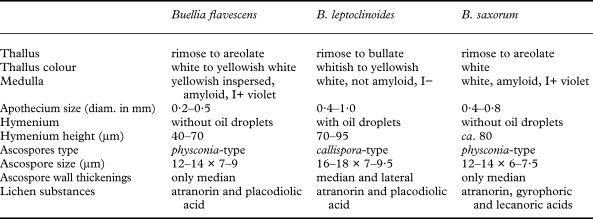
Steiner (Reference Steiner1907) cites three specimens as type material: exsiccata “nr. 247” of Massalongo, “nr. 129” of Trevisan and “nr. 240” of Malbranche. Only the last exsiccata was found in WU; it is here, therefore, designated as the lectotype. There are three specimens in the envelope; HPTLC analysis was performed on the extracts of the specimen WU 41393 on the left-hand side. The results indicate placodiolic acid, previously known in saxicolous Buellia species only from B. leptoclinoides (Nyl.) J. Steiner (Scheidegger Reference Scheidegger1993). Buellia flavescens differs from this species in its amyloid medulla with I+ violet reaction, and lower hymenium without oil droplets. The major differences between B. flavescens, B. leptoclinoides and B. saxorum are listed in Table 1. Because of these differences, the new combination B. flavescens (Steiner) Şenkard. is proposed here.
Comparison of some major characteristics of B. flavescens, B. leptoclinoides and B. saxorum. (following Scheidegger Reference Scheidegger1993)

Steiner provides only a short description for his variety: he mentions that the thallus is yellowish in colour, with the medulla as well as the cortex yellowish inspersed and giving a distinct C+ reaction. Therefore, a more detailed description is provided here:
Thallus saxicolous, crustose, thin, rimose to areolate, white to yellowish white, not pruinose; medulla yellowish inspersed, amyloid, I+ violet; soredia, isidia and pseudocyphellae absent; prothallus black and rather evident.
Apothecia lecideine, sessile with a constricted base, 0·2–0·5 mm diam., disc black, not pruinose; apothecial margins concolorous with the disc, thick, entire, prominent; epihymenium brown, c. 15–20 µm high, N−; hymenium 40–70 µm tall, without oil droplets; hypothecium dark reddish brown. Asci clavate, 8-spored; ascospores Physconia-type, oblong, 1-septate, spore wall with median thickening, but without lateral thickening, 12–14 × 7–9 µm.
Chemistry. Pd−, K+ yellow, KC+ yellow, C+ deep yellow (atranorin and placodiolic acid).
One additional specimen from Italy was studied and identified here as B. flavescens.
Additional specimen examined. Italy: Alle falde del monte Faiallo nell'Apennino di Voltri, 1871, Baglietto (WU 41394!).
New types for accepted species in Buellia s. lat
Buellia caesioatra J. Steiner
Verh. Zool.-Bot. Ges. Wien 20: 478 (1902); type: Algeria “Zone des gr. Atlas, Sandstein, 900–1000 m, 1898, F. v. Kerner” (WU 41213!—holotype).
This saxicolous species from Algeria is accepted here as a distinct species. It differs from the European taxa in that its bluish grey pruina is restricted to the margins of apothecia, while the disc remains always non pruinose, and a combination of several other characters and chemical reactions that do not match any other Buellia species. A brief description is provided here:
Thallus white to ochre white, areoles thin and dispersed along the margins, rather thick and swollen in the centre. Prothallus not visible.
Apothecia to 0·4 (0·5) mm diam., lecideine, numerous, occasionally sparsely and equally distributed across the thallus surface, sometimes dense, round or irregular when dense, sessile, disc black, not pruinose, subconcave to deeply concave when young, margins with dense bluish grey pruina, which occasionally disappears, thin to becoming thick, persistent, entire; hymenium to 60 µm high; epithecium indistinctly dark brown to reddish brown; hypothecium brown. Ascospores up to 8, weak brown, 1-septate, elongate, obtuse in apices, not constricted at septum, 12–15 × 4–5µm, both cells often with oil droplets.
Pycnidia not seen.
Chemistry. Pd−, K−, KC−, C− (no secondary metabolites).
New types for taxa regarded as synonyms of other Buellia species
Buellia alboatra var. epipolioides J. Steiner
Oesterr. Bot. Z. 68: 147 (1919); type: Greece “Santorin, Pyrgos gegen Hagios Elias, Universitätsreise nach Griechenland, 8–26 April 1911, Prof. Schiffner” (WU 41359!—holotype).—Diplotomma margaritaceum var. epipolioides (J. Steiner) Szatala, Ann. hist.-nat. Mus. Natl. Hungarici, ser. nov. 7: 279 (1956, comb. invalid.)
This saxicolous variety was described twice (Steiner Reference Steiner1919a, Reference Steinerb); both descriptions being published posthumously. Only the specimen from Santorini (Greece) was studied here. This variety differs from the typical variety only in thallus thickness and should be regarded as a synonym of B. alboatra (Hoffm.) Th. Fr. A detailed description of this variety is available in the original publication (Steiner Reference Steiner1919a).
The specimen from Mikra Delos (Greece) cited in Steiner (Reference Steiner1919c) was not found in WU or in W.
Buellia gotlandica J. Steiner
Oesterr. Bot. Z. 68: 143 (1919); type: Sweden “Gotland, 1869, J. F. Laurer” (UPS L–114898–213745!—lectotype, designated here [HPTLC: atranorin + unidentified substance A5/B'5/C8].
Steiner (Reference Steiner1919a) refers to the type as “Example originale in herbario Berolinensis sub ‘Buellia insignis’ in insula Gotland supracorticem Sorbi et Betulae, sine indicatione collectoris”. However, the Berlin specimen was lost during a fire in 1943. Because the holotype material was destroyed, the duplicate at UPS is here designated as the lectotype according to Art 9.14 of ICBN (McNeill et al. Reference McNeill, Barrie, Burdet, Demoulin, Hawksworth, Marhold, Nicolson, Prado, Silva and Skog2006). This specimen was identified by Th. Fries as “Buellia insignis corticola Naeg. = Buellia parasema (Ach.)”. Santesson et al. (Reference Santesson, Moberg, Nordin, Tonsberg and Vitikainen2004) mention this species as a synonym of B. disciformis (Fr.) Mudd, but it is not clear from this citation if Santesson et al. (Reference Santesson, Moberg, Nordin, Tonsberg and Vitikainen2004) examined any type material. However, the thalline chemistry (atranorin) and principal diagnostic characters of this epiphytic lichen, such as distictly inspersed hymenium, dispersa-type exciple, and Callispora-type ascospores support this synonymy.
Buellia leptina J. Steiner
Oesterr. Bot. Z. 51: 223 (1911); type: Canary Islands “Ins. Canariensis, Gomera, Barranco de Bilbao, May” (W 1911-3765!—holotype).
The type occurs together with Caloplaca gomerana J. Steiner, and the rock is covered by a mosaic of both Buellia and Caloplaca thalli. Buellia leptina and C. gomerana were collected on hard lava rock, which may be the reason why the Buellia thalli are not well developed. The areoles of the thalli measure only 1 mm × 0·25 mm. Nevertheless, this specimen can be identified as Diploicia subcanescens (Werner) Hafellner & Poelt. Soralia are absent on the type specimen, and apothecia are well developed, up to 0·5 mm diam., not inspersed, and with a hymenium up to 50 µm tall. Ascospores 8 per ascus, 1-septate, subellipsoid to subcylindrical and 9–12 × 4–7µm.
Buellia procellarum var. continuior J. Steiner
In Zahlbr., Engler Bot. Jahrb. 60: 551 (1926); type: South Africa “Kapland, Port Elizabeth Baakens River Valley, Quarzitfelsen, ca 100–150 m, 21 November 1909, J. Brunnthaler” (W 1927–426!—holotype).
This saxicolous variety from South Africa was not treated by Dodge (Reference Dodge1971) and is here reduced to synonymy with B. procellarum A. Massal. Steiner considered prothallus thickness (Saumlinie) to be an important taxonomic character, and he distinguished B. procellarum var. continuior from B. procellarum, and B. skutariensis J. Steiner (later as B. subdisciformis var. skutariensis) from B. disciformis only because of their different prothalli. Today, prothallus thickness may best be interpreted as a variation.
Buellia skutariensis J. Steiner
Denkschr. Kaiserl. Akad. Wiss., Wien. Math.-Naturwiss. Kl. 68: 233, fig. 5a (1899); type: Turkey “Umgebung von Konstantinopel: Dschamlidscha [Çamlıca], 1896/97, J. Nemetz” (WU 41222!—lectotype, designated here [HPTLC: Atranorin, norstictic acid and connorstictic acid]; WU 40934! and WU 40997!—isolectotypes), Turkey “Asia: ad saxa granitica prope Scutari [Üsküdar], Lichenes Rariores Exsiccati Nr. 17” (W 1902–5130!, W 1910–19385! and WU 41219!—isolectotypes).—B. subdisciformis var. skutariensis (J. Steiner) J. Steiner, Verh. Zool.-Bot. Ges. Wien 22: 362 (1907).
This saxicolous species was described from the vicinity of Istanbul on the Asian side of the Bosphorus. Bungartz et al. (Reference Bungartz, Nordin, Grube, Nash, Ryan, Gries and Bungartz2008) mention B. subdisciformis var. skutariensis (J. Steiner) J. Steiner as a synonym of B. subdisciformis (Leight.) Vain., but do not cite any reference for this synonymization. It is not clear from this citation if Bungartz et al. (Reference Bungartz, Nordin, Grube, Nash, Ryan, Gries and Bungartz2008) examined any type material. Analysis with HPTLC confirms that the lectotype contains the same secondary metabolites as reported from B. subdisciformis, which confirms that the taxon should be interpreted as a synonym of this species.
Buellia skutariensis f. compacta J. Steiner
Denkschr. Kaiserl. Akad. Wiss., Wien. Math.-Naturwiss. Kl. 68: 233 (1899); type: Turkey “Umgebung von Konstantinopel: Su Dere bei anatol. Hissar, 1896/97, J. Nemetz (WU 41220!—holotype).—B. subdisciformis f. compacta (J. Steiner) Zahlbr., Cat. Lich. Univ. 7: 419 (1931).
The form compacta is an extremely verrucose form of B. skutariensis with more spherical apothecia. These differences are minor and the form is treated here as a synonym of B. subdisciformis.
Buellia skutariensis f. geographica J. Steiner
Denkschr. Kaiserl. Akad. Wiss., Wien. Math.-Naturwiss. Kl. 68: 233 (1899); type: Turkey “Umgebung von Konstantinopel: Dschamlidscha, 1896/97, J. Nemetz” (WU 41221!—lectotype, designated here; W 2007–67!—isolectotype, deposited with Rhizocarpon similimum).—B. subdisciformis f. geographica (J. Steiner) Zahlbr., Cat. Lich. Univ. 7: 419 (1931).
The form geographica differs from B. skutariensis only by its small thallus and broader prothallus. For this reason, this form is synonymized here with B. subdisciformis.
Buellia subtumida J. Steiner
Oesterr. Bot. Z. 68: 146 (1919); type: Chile “Valdivia, 1870/71, R. Rabenhorstii fil.” (W 2008–104!— lectotype, designated here).
Steiner (Reference Steiner1919a) wrote for the type material “Exemplar originale in herbario Musei Botanici Berolinensis”. This saxicolous specimen appears to have been destroyed during the fire in 1943, which was confirmed by Marbach (Reference Marbach2000). After an extensive search in W and WU, a specimen was discovered (W 2008–104) in an envelope labelled “Buellia Rabenhorstii Stnr”. The specimen was collected by Rabenhorst fil. from Valdivia and is considered here to be part of original material and designated as lectotype.
According to the original description, this species resembles B. tumida Bagl., which is now accepted as a synonym of B. dispersa A. Massal. (e.g. Scheidegger Reference Scheidegger1993; Bungartz et al. Reference Bungartz, Nordin, Grube, Nash, Ryan, Gries and Bungartz2008). Because the apothecial, spore and conidial measurements, and other characters, are all in accord with those of B. dispersa, B. subtumida is proposed here as a synonym of B. dispersa A. Massal.
Corrections of the status of the types in the genus Buellia s. lat
Buellia incrustans J. Steiner
In Zahlbr., Engler Bot. Jahrb. 60: 550 (1926); type: Namibia “Deutsch-Südwestafrika, Haifischinsel an der Lüderitzbucht, Fincke” (W 1927–1063!—lectotype, designated here; “Africa austro-occidentalis, Haifischinsel in sinu Lüderitzbucht, W. Fincke; A. Zahlbruckner, Lichenes rariores exsiccati N. 260”; W 1920–718! and WU 41358!—isolectotypes).
Marbach (Reference Marbach2000) transferred this taxon into Amandinea as A. incrustans (J. Steiner) Marbach, assuming that the holotype was an exsiccata specimen “N. 260” of Zahlbruckner's “Lichenes rariores exsiccati” (WU). However, a duplicate specimen of this exsiccata is also hosted at W (1927–1063), accessioned to this herbaria in 1927 and, during the comprehensive search of W, a further specimen was discovered that was accessioned several years earlier (W 1920–718). The holotype cited by Marbach (Reference Marbach2000) is corrected here to the lectotype, with the latter specimen and the remaining exsiccata becoming isolectotypes.
Buellia sardiniensis J. Steiner
Verh. Zool.-Bot. Ges. Wien 22: 348 (1907); type: Italy “Ad rupes granitoideas circam Orri in Sardinia merid., Baglietto” (W 2008–105!—lectotype, designated here).
Steiner cites two specimens in the protologue; the “Exsiccate Nr. 1702 in Arnold (as “admixt.”)” at WU and “circa Orri in Sard. merid., exempl. dextrum” as B. leptacine (leg. Baglietto)” at W. Scheidegger (Reference Scheidegger1993) studied the first specimen and he considered this to be the holotype. However, this interpretation is not correct according to Art 9.8. Consequently, the holotype cited by Scheidegger (Reference Scheidegger1993) is designated here as the lectotype, which is deposited in W together with the holotype of B. sejuncta J. Steiner. A search for other original material, especially exsiccata nr. 1702 of Arnold, at W was unsuccessful. However, Julius Steiner wrote B. sardiniensis on the envelope of a specimen of Rinodina alba collected from France and HPTLC analysis of this specimen revealed atranorin, norstictic acid, ±connorstictic acid and ±gyrophoric acid; that is, the same secondary metabolites as found in the analysis of the lectotype of B. sardiniensis. Consequently, this specimen is identified as B. sardiniensis.
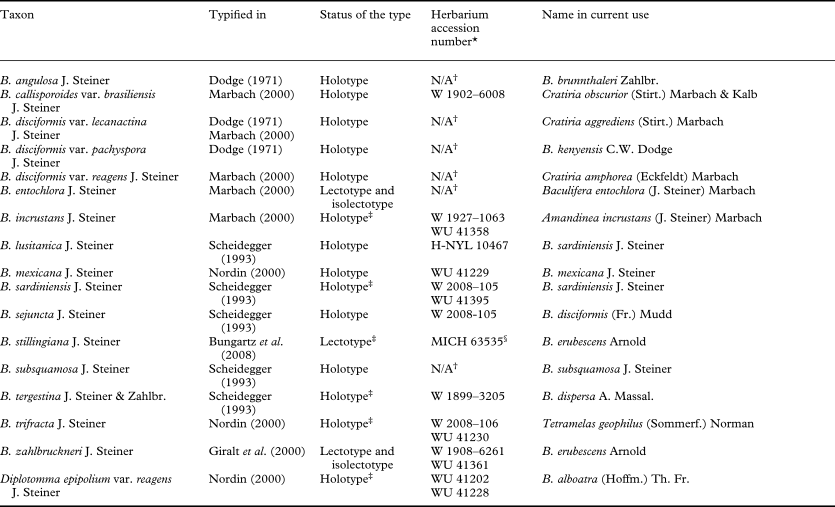
Some known types of Buellia s. lat. taxa described by Julius Steiner

* The accession number is given for the first time; they were neglected in previous studies.
† Type specimen not seen in W nor in WU. They could be on loan, not have been refiled correctly after a loan was returned, or they might be completely lost and cannot be recovered.
‡ The status of this type is corrected in this study above.
§ Corrected to H-NYL-10439.
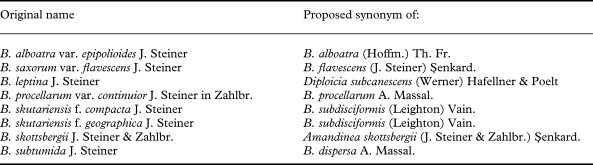
Synonyms of Buellia s. lat. taxa proposed in present study

Additional specimen examined. France: Hyéres, 1867, Metzler, Nr. 66 (WU 41395 [HPTLC: atranorin, norstictic acid, ±connorstictic acid and ±gyrophoric acid]).
Buellia stillingiana J. Steiner
Oesterr. Bot. Z. 68: 144 (1919); type: USA “Amer. boreal. Tennessee, Calkins” (H-NYL 10439b!—holotype; TLC: norstictic acid, atranorin, det. P.W. James, 1 October 1976).
Bungartz et al. (Reference Bungartz, Nordin, Grube, Nash, Ryan, Gries and Bungartz2008) designated the specimen MICH 63535 as the lectotype. However, Steiner (Reference Steiner1919a) clearly indicates “Exemplar originale in herbario Helsingforsiensi” and, because the original material exists, the specimen in H is therefore the holotype. The designation by Bungartz et al. (Reference Bungartz, Nordin, Grube, Nash, Ryan, Gries and Bungartz2008) violates Art 9.17 and their lectotype must be rejected.
Buellia tergestina J. Steiner & Zahlbr
In Zahlbr., Ann. Naturhist. Mus. Wien 9: 134, tab. III, fig. VI. (1894); type: Austria “Krypt. Exs. Vindob. Nr. 58: Litorale austriacum, ad saxa arenaria in agro tergestina, Schuler” (W 1899–3205!—lectotype, designated here).
Scheidegger (Reference Scheidegger1993) selected the exsiccata specimens in W and GZU as isolectotypes but did not designate a lectotype. Because B. tergestina was described and published only in sched. the material at W, from where the exsiccate was distributed, is designated here as the lectotype. Another isolectotype (belonging to the exsiccate) has been seen in BP.
Buellia trifracta J. Steiner
In Zahlbr., Verh. Zool.-Bot. Ges. Wien 68 (6): 34 (1918); typus: Austria “Ochsenboden in Schneeberg, 1883, Eggerth” (WU 41230!—lectotype, designated here; W 2008–106!; BP!—isolectotypes).
Nordin (Reference Nordin2000) interpreted the specimen at WU as the holotype, but another specimen belonging to the original material was discovered in W. For this reason, the holotype of Nordin (Reference Nordin2000) is designated here as lectotype and the W specimen as an isolectotype.
Diplotomma epipolium var. reagens J. Steiner
Denkschr. Kaiserl. Akad. Wiss., Wien. Math.-Naturwiss. Kl. 68: 233 (1899); type: Turkey “Umgebung von Konstantinopel: Kiat-Hane (in Publ. Su Dere), 1896/97, J. Nemetz” (WU 41228!—lectotype, designated here; WU 41202!—isolectotype, deposited with Xanthoria aureola).
Nordin (Reference Nordin2000) interpreted the specimen at WU as the holotype but during the careful search conducted at WU, another specimen was discovered. The material was probably overlooked because it was deposited jointly with Xanthoria aureola. To clarify the type designation of this taxon, the specimen interpreted by Nordin as a holotype, is designated here as the lectotype; the other specimen is an isolectotype.
Discussion
Steiner validly published 36 species and varieties of Buellia s. lat. (incl. Diplotomma). Effective typifications exist for 16 of these (14 holotypes and 2 lectotypes; Table 2). Here, clarification and corrections of the type assignation for an additional 11 taxon names are provided; the holotypes for six taxa are identified for the first time. For five taxa, lectotypes were selected. In addition eight new synonyms are proposed that are summarized in Table 3. For eight names of taxa described by Steiner, types could not be located; viz. Buellia callisporoides J. Steiner, B. callisporoides var. submodesta J. Steiner, B. lechleri J. Steiner, B. leptocline var. sublutescens J. Steiner, B. perspersa J. Steiner, B. procellarum var. repens J. Steiner, B. substellulata J. Steiner and B. zahlbruckneri var. microspora J. Steiner. Steiner (Reference Steiner1919a) indicates that the types of B. lechleri and B. substellulata are deposited in Berlin, but this material appears to have been destroyed during the fire in 1943. No specimen was found for B. zahlbruckneri var. microspora. The type material of this taxon was supposedly transferred to Tbilisi, but these specimens could not be found (Dr. Ketevan Batsatsashvili and Dr. Tsimi Inashvili, TBI, pers. com.). The specimens were presumably lost during the transfer. For all other taxa where I failed to locate type material, the specimens could be on loan, not have been refiled correctly after a loan was returned, or they might be completely lost and cannot be recovered.
For several taxa, previous reviewers erroneously identified a particular specimen as the holotype, although duplicates could be located during the present study. To clarify the species concept for these taxa, the specimens previously erroneously referred to as the holotypes were thus designated as lectotypes, that is B. incrustans, B. sardiniensis, B. tergestina, B. trifracta and Diplotomma epipolium var. reagens. These specimens were erroneously interpreted as holotypes because it was not always clear what type material Steiner deposited in Wien. Sometimes specimens were deposited in W, at other times in WU, sometimes in both herbaria. Before 2008, only 10% of Steiner's type material was labelled as such, and only a few specimens were actually deposited in the type specimen collections of these herbaria. Therefore, the material has repeatedly been overlooked, a problem that is not just restricted to the genus Buellia. When researching type material, more care should be taken to find specimens also hidden among the general collections. Meanwhile, a catalogue of Steiner's type materials seems to be necessary and this is in preparation to help scientists search available type material. Until this catalogue is prepared, the present study will fulfil this purpose for the genus Buellia and allied genera.
Although Buellia s. lat. is one of the most studied genera, this study shows the importance of such a contribution and is only one step towards a more comprehensive review. It is noteworthy that the unprocessed taxa were not ignored by the previous reviewers, rather they were overlooked because of the complexity of the deposition of Steiner's type materials. It is hoped that these deficiencies will be off-set by this study. In addition, these type specimens will probably benefit new research on the revision of Asian and African Buellia species. The clarification of these problematic materials is clearly helpful for future taxonomic research, but this should ideally be carried out as part of taxonomic research based on an analysis of many more specimens than only type specimens.
As with most genera segregated from Buellia s. lat., the delimitation of the genus Amandinea requires further study because of the current heterogeneous concept. The new combination A. skottsbergii will hopefully provide new information concerning the delimitation of the genus and remind scientists of the existence of a forgotten species within it.
Finally, this study will stimulate future research on the distribution of B. flavescens by studying fresh or herbarium material collected from Europe and identified as B. leptoclinoides, B. saxorum or B. subdisciformis. Among these species, specimens with I+ violet and C+ deep yellow reactions should be checked for further characters provided in this study to accept as, or revise to, B. flavescens.
My sincerest thanks go to Dr Anders Nordin (Uppsala) and Dr Olga Nadyeina (Kiev) for their helpful comments and for proof reading on earlier versions of this manuscript and to Dr Frank Bungartz (Galapagos) for correction of grammatical errors. Dr Christoph Scheidegger (Bern) kindly helped me to identify placodiolic acid with HPTLC. I also wish to thank the curators of BP, G, H and UPS for their loans of type material and the curators of B and TBSI for checking some of the type specimens not available in Vienna. The studies in W were supported by the mobility programme of The Scientific and Technological Research Council of Turkey (TUBITAK) and those for WU has received support from the SYNTHESYS Project.