





1. Introduction
Transport phenomena, including diffusion, migration and collective behaviours of biological organisms and engineered artificial swimmers have emerged as central topics in active matter physics and biomedical engineering due to their fundamental importance and wide-ranging applications (Wu et al. Reference Wu, Chen, Mukasa, Pak and Gao2020; Ishikawa Reference Ishikawa2025). These processes manifest across diverse systems, ranging from collective bacterial swimming and bioconvection to oceanic red tides and microrobot-assisted targeted drug delivery. A better understanding of the transport phenomena of swimmers enables the quantitative prediction of phenomena such as the formation of complex collective structures and the migration dynamics of populations through intricate biological and geophysical environments (Pedley & Kessler Reference Pedley and Kessler1992; Lauga Reference Lauga2020; Ishikawa et al. Reference Ishikawa, Sato, Omori and Yoshimura2025b ).
In previous studies, transport phenomena in microswimmer suspensions have been investigated from various perspectives (Ishikawa Reference Ishikawa2025). The self-diffusion coefficient of microswimmers in the dilute limit has been analytically derived (Berg Reference Berg1993; Lauga Reference Lauga2020). Early experiments suggest that the large-scale coherent motion observed in bacterial turbulence emerges from hydrodynamic interactions between pushers (Dombrowski et al. Reference Dombrowski, Cisneros, Chatkaew, Goldstein and Kessler2004; Sokolov et al. Reference Sokolov, Aranson, Kessler and Goldstein2007; Zhang et al. Reference Zhang, Be’er, Florin and Swinney2010; Wensink et al. Reference Wensink, Dunkel, Heidenreich, Drescher, Goldstein, Löwen and Yeomans2012; Aranson Reference Aranson2022). Enhanced diffusion of tracers in bacterial turbulence has been observed, where the effective diffusivity can exceed the thermal diffusivity by several orders of magnitude (Wu & Libchaber Reference Wu and Libchaber2000; Peng et al. Reference Peng, Lai, Tai, Zhang, Xu and Cheng2016). Enhanced diffusion induced by the swimming of microalgae has also been observed, where tracer trajectories exhibit rare and large jumps resulting from near collisions with the microalgae (Leptos et al. Reference Leptos, Guasto, Gollub, Pesci and Goldstein2009; Jeanneret et al. Reference Jeanneret, Pushkin, Kantsler and Polin2016). Numerous studies have investigated the behaviour of swimming microorganisms in various flow fields, including shear flows (Durham et al. Reference Durham, Kessler and Stocker2009), Poiseuille flows (Omori et al. Reference Omori, Kikuchi, Schmitz, Pavlovic, Chuang and Ishikawa2022) and turbulent flows (Durham et al. Reference Durham, Climent, Barry, De Lillo, Boffetta, Cencini and Stocker2013; De Lillo et al. Reference De Lillo, Cencini, Durham, Barry, Stocker, Climent and Boffetta2014; Qiu et al. Reference Qiu, Marchioli and Zhao2022b ). These studies have highlighted the important role of hydrodynamics in transport phenomena in microswimmer suspensions.
Given the importance of hydrodynamics, the `squirmer’ model, which propels itself through a prescribed surface velocity (Lighthill Reference Lighthill1952; Blake Reference Blake1971; Pedley Reference Pedley2016; Ishikawa Reference Ishikawa2024), is widely used to investigate full hydrodynamic interactions in swimmer suspensions over a wide range of volume fractions. Using Stokesian dynamics simulations of infinite suspensions, it has been observed that neutral squirmers and weak pullers tend to align and swim in similar directions (Ishikawa et al. Reference Ishikawa, Locsei and Pedley2008; Evans et al. Reference Evans, Ishikawa, Yamaguchi and Lauga2011). Yoshinaga & Liverpool (Reference Yoshinaga and Liverpool2018) showed that this polar order is generated by near-field lubrication flow rather than long-range hydrodynamics. Beyond collective motion, hydrodynamic interactions among microswimmers can also give rise to diverse diffusive behaviours. Ishikawa & Pedley (Reference Ishikawa and Pedley2007a
) simulated three-dimensional semi-dilute squirmer suspensions and found that translational diffusion of squirmers scales inversely with the volume fraction. Qi et al. (Reference Qi, Westphal, Gompper and Winkler2022) reported the rotational diffusion of spheroidal Brownian squirmers in a concentrated regime. The rotational diffusivity exhibited a maximum at an areal fraction of approximately 0.4–0.5. More recently, Ge & Elfring (Reference Ge and Elfring2025) reported a non-monotonic dependence of the translational diffusion of non-self-propelling squirmers on the volume fraction, with a maximum at
 $\phi \simeq 0.1$
–
 $0.2$
. For deformable squirmers, membrane deformability has been shown to influence microstructure formation, which in turn modulates microswimmer diffusion in dense suspensions (Kubo et al. Reference Kubo, Omori and Ishikawa2025). Significant progress has also been made in understanding microswimmer transport in complex environments, such as shear flow (Ishikawa Reference Ishikawa2012; Ge et al. Reference Ge, Brady and Elfring2025), complex fluid (Wang & Ardekani Reference Wang and Ardekani2015; Ouillon et al. Reference Ouillon, Houghton, Dabiri and Meiburg2020; Zhang et al. Reference Zhang, Yu, Ouyang, Xia and Lin2024), confinement (Zöttl & Stark Reference Zöttl and Stark2014; Ishikawa et al. Reference Ishikawa, Brumley and Pedley2025a
) and mixed active–passive suspensions (Chamolly & Ishikawa Reference Chamolly and Ishikawa2026), highlighting the role of hydrodynamics in microswimmer transport.
Despite substantial progress to date, a complete understanding of swimmer dynamics remains elusive. For one thing, the above results are limited to the vanishing-Reynolds-number regime, where microswimmers are sufficiently small for viscous forces to dominate their dynamics. However, in nature, there exists a wide variety of swimming organisms with diverse sizes and swimming speeds. As the size and swimming speed of a swimmer increase, the Reynolds number correspondingly increases and inertial effects can no longer be neglected. Although the finite-inertia regime has attracted growing attention in recent years, it remains comparatively less explored, particularly regarding transport properties in suspensions. Considerable progress has been made in recent years in understanding the hydrodynamics of a single inertial swimmer (Wang & Ardekani Reference Wang and Ardekani2012; Khair & Chisholm Reference Khair and Chisholm2014; Chisholm et al. Reference Chisholm, Legendre, Lauga and Khair2016; More & Ardekani Reference More and Ardekani2020; Ouyang et al. Reference Ouyang, Lin, Yu, Lin and Phan-Thien2022; Derr et al. Reference Derr, Dombrowski, Rycroft and Klotsa2022; Quan et al. Reference Quan, Zhang, Yu, Lin, Xia and Lin2025), where flow inertia plays a significant role in determining the swimming speed and efficiency. Hydrodynamic interactions between pairs of inertial swimmers have also been investigated (Li et al. Reference Li, Ostace and Ardekani2016; More & Ardekani Reference More and Ardekani2021; Dombrowski et al. Reference Dombrowski, Nguyen and Klotsa2022). Extensions to many-body systems have subsequently revealed rich collective dynamics in suspensions (Li & Ardekani Reference Li and Ardekani2014; Klotsa Reference Klotsa2019; Lin & Gao Reference Lin and Gao2019; Ouillon et al. Reference Ouillon, Houghton, Dabiri and Meiburg2020). In spite of these advances, the diffusive behaviour of inertial swimmers remains unexplored. Motivated by this gap, this study presents a systematic investigation of swimmer diffusion in the presence of fluid inertia.
Another important point is the effect of gravity. Many microorganisms, such as microalgae and ciliates, exhibit gravitaxis, i.e. a tendency to swim preferentially in the vertical direction in response to gravity (Hemmersbach & Häder Reference Hemmersbach and Häder1999). In some microorganisms, this behaviour originates from bottom-heaviness, where the centre of mass is displaced from the geometric centre, giving rise to a restoring gravitational torque that promotes upwards swimming (Pedley & Kessler Reference Pedley and Kessler1992; Drescher et al. Reference Drescher, Leptos, Tuval, Ishikawa, Pedley and Goldstein2009). A similar restoring torque may also arise in negatively buoyant microorganisms with asymmetric body shapes (Roberts & Deacon Reference Roberts and Deacon2002; Kage et al. Reference Kage, Omori, Kikuchi and Ishikawa2020). When such negatively buoyant swimmers collectively migrate upwards under shear flow, the balance between gravitational and hydrodynamic torques drives preferential accumulation of swimmers through gyrotactic focusing. The resulting non-uniform cell distribution may generate an unstable density stratification, ultimately leading to large-scale bioconvection (Kessler Reference Kessler1986; Pedley & Kessler Reference Pedley and Kessler1992; Croze et al. Reference Croze, Bearon and Bees2017; Bees Reference Bees2020; Jiang & Chen Reference Jiang and Chen2020; Fung Reference Fung2023). Beyond bioconvection, simplified fluid-dynamics models have been used to investigate gyrotactic swimmers (Ardekani et al. Reference Ardekani, Doostmohammadi and Desai2017; Lovecchio et al. Reference Lovecchio, Climent, Stocker and Durham2019; Qiu et al. Reference Qiu, Cui, Climent and Zhao2022a , Reference Qiu, Cui, Climent and Zhao2024). In addition, suspensions of settling squirmers confined between two walls have been studied (Kuhr et al. Reference Kuhr, Blaschke, Rühle and Stark2017; Rühle et al. Reference Rühle, Zantop and Stark2022; Barriuso et al. Reference Barriuso, Miguel, Serna, Pagonabarraga and Valeriani2025), revealing rich collective dynamics arising from the interplay between hydrodynamic interactions and gravity. Although the transport of settling swimmers has been investigated, the effects of fluid inertia on vertical migration, diffusion and microstructure formation are still poorly understood.
As highlighted previously, fluid inertia and sedimentation can influence swimmer transport. Motivated by these prior findings, we conducted direct numerical simulations of swimmer suspensions to elucidate the respective contributions of fluid inertia and gravitational sedimentation to the swimmer dynamics. Specifically, we consider semi-dilute suspensions of spherical squirmers at volume fractions from 0.025 to 0.1. We neglect bottom-heaviness, shape asymmetry and Brownian motion, thereby allowing us to identify inertia and sedimentation-induced mechanisms unambiguously. In § 2, we describe the mathematical formulation, the governing equations and the simulation set-up. In § 3, we provide some validations of the numerical method. We investigate the diffusive behaviour of neutrally buoyant swimmers in § 4. The effects of the swimming Reynolds number on the diffusive properties are demonstrated, and the scaling behaviour is discussed. In § 5, the effects of sedimentation on vertical migration, anisotropic diffusion and microstructure of settling swimmers are examined. Finally, we conclude the study in § 6.
2. Mathematical formulation and simulation set-up
2.1. Squirmer model
We consider spherical swimmers that propel themselves by generating tangential velocities along their surface, known as a squirmer. For each swimmer, the surface velocity is given by (Lighthill Reference Lighthill1952; Blake Reference Blake1971; Ishikawa et al. Reference Ishikawa, Simmonds and Pedley2006)
 \begin{equation} \boldsymbol{u}_{\!s} = B_1\left (\sin \theta { + \beta }\sin \theta \cos \theta \right )\boldsymbol{e}_\theta , \end{equation}
where
 $\theta =\cos ^{-1}(\boldsymbol{p} \boldsymbol{\cdot }\boldsymbol{r} / r)$
represents the polar angle between the position vector
 $\boldsymbol{r}$
, measured from the particle’s centre, and the swimming direction
 $\boldsymbol{p}$
, while
 ${\boldsymbol{e}}_\theta$
is the unit tangent vector along the
 $\theta$
direction. Throughout this work, we fix
 $B_1$
which determines the swimming speed of a solitary squirmer in the Stokes regime, where
 $V_s=2B_1/3$
, which is independent of
 $\beta$
. The squirmer parameter
 $\beta$
regulates the strength of the force dipole generated by the swimmer and determines whether the squirmer behaves as a puller (
 $\beta \gt 0$
) or a pusher (
 $\beta \lt 0$
). Furthermore, in the present study, we neglect bottom-heaviness of the squirmer and assume that the centre of mass coincides with the centre of the sphere.
2.2. Basic equations
The transport of swimmers in a fluid is simulated by direct numerical solution of the Navier–Stokes equations using the fictitious domain method (Yu & Shao Reference Yu and Shao2007). Here, we briefly describe the basic equations; details of the method can be found in Lin & Gao (Reference Lin and Gao2019). Let
 $\varOmega$
and
 $P$
represent the entire domain and the domain occupied by the swimmers, respectively (
 $P \subset \varOmega$
). Here
 $P$
is bounded by the swimmer surface
 $S$
.
The flow is governed by the Navier–Stokes equations,
 \begin{equation} \rho _f \frac {\mathrm{d} \boldsymbol{u}}{\mathrm{d} t}= \boldsymbol{\nabla } \boldsymbol{\cdot }\left (-p \boldsymbol{I}+\boldsymbol{\tau }\right ) + \boldsymbol{f}\quad {\textrm {in}} \quad {\varOmega }. \end{equation}
 \begin{equation} \boldsymbol{\nabla } \boldsymbol{\cdot }\boldsymbol{u}=\boldsymbol{0} \quad {\textrm {in}} \quad {\varOmega }. \end{equation}
The velocity boundary condition on swimmer surface is given by
 \begin{equation} \boldsymbol{u}=(\boldsymbol{U}+\boldsymbol{\omega } \times \boldsymbol{r})+\boldsymbol{u}_{\!s}\quad {\textrm {in}} \quad {S}. \end{equation}
Here,
 $\boldsymbol u$
,
 $p$
and
 $\rho _f$
represent the fluid velocity, pressure and density, respectively. The stress tensor
 $\boldsymbol{\tau }=2 \mu \boldsymbol{\dot \gamma }$
, where
 $\mu$
is the viscosity and
 $\boldsymbol{\dot \gamma }$
is the strain rate tensor. The body force
 $\boldsymbol{f}$
accounts for the fluid–particle interaction defined in the particle domain.
Next, we describe the motion of spherical swimmers with density
 $\rho _s$
and radius
 $a$
. The swimmer velocity
 $\boldsymbol U$
and angular velocity
 $\boldsymbol \omega$
obey Newton’s equations of motion,
 \begin{equation} \rho _s V_{\!p} \frac {\mathrm{d} \boldsymbol{U}}{\mathrm{d} t}=\int _S \boldsymbol{n} \boldsymbol{\cdot }\left (-p \boldsymbol{I}+\boldsymbol{\tau }\right ) \,\mathrm{d} s+(\rho _s-\rho _f)V_{\!p}\boldsymbol g, \end{equation}
 \begin{equation} \frac {\mathrm{d}\left (\boldsymbol{J} \boldsymbol{\cdot }{\boldsymbol{\omega }}\right )}{\mathrm{d} t}=\int _S \boldsymbol{r} \times \left [\boldsymbol{n} \boldsymbol{\cdot }\left (-p \boldsymbol{I}+\boldsymbol{\tau }\right )\right ] \,\mathrm{d} s. \end{equation}
Here,
 $V_{\!p}$
and
 $\boldsymbol J$
denote the swimmer volume and the moment of inertia tensor, respectively. The vector
 $\boldsymbol{r}$
is measured relative to the particle centre of mass, and
 $\boldsymbol{g}$
denotes the gravitational acceleration.
The position of each swimmer,
 $\boldsymbol{x}=(x,y,z)^T$
, is determined from the following kinematic equation:
 \begin{equation} \frac {{{\textrm {d}}{\boldsymbol{x}}}}{{{\textrm {d}}t}} = {\boldsymbol{U}}. \end{equation}
To accurately capture the orientation of swimmers, we employ a body-fixed coordinate system (
 $x'$
,
 $y'$
,
 $z'$
), which is aligned with the swimmer’s centre, with the
 $z'$
-axis pointing in the direction of swimming, denoted as
 $\boldsymbol p$
. The swimmer orientation is determined by
 \begin{equation} \frac {\textrm {d} \boldsymbol q}{\textrm {d}t} = \frac {1}{2}\left (\begin{array}{cccc} q_4 & -q_3 & q_2 & q_1 \\[5pt] q_3 & q_4 & -q_1 & q_2 \\[5pt] -q_2 & q_1 & q_4 & q_3 \\[5pt] -q_1 & -q_2 & -q_3 & q_4 \end{array}\right )\left (\begin{array}{c} \omega '_x \\[5pt] \omega '_y \\[5pt] \omega '_z \\[5pt] 0 \end{array}\right ) \!. \end{equation}
In (2.8),
 $q_1$
,
 $q_2$
,
 $q_3$
and
 $q_4$
are the components of the unit quaternion
 $\boldsymbol q$
, which can be defined in terms of the Euler angles (Yu & Shao Reference Yu and Shao2007). The components of the angular velocity,
 $\omega '_x$
,
 $\omega '_y$
and
 $\omega '_z$
, are measured in the body-fixed frame. With the quaternion
 $\boldsymbol q$
, the rotation matrix from the space-fixed frame to the body-fixed frame is
 \begin{equation} \boldsymbol{R}=2\left (\begin{array}{ccc} q_1^2+q_4^2-\frac {1}{2} & q_1 q_2+q_3 q_4 & q_1 q_3-q_2 q_4 \\[5pt] q_1 q_2-q_3 q_4 & q_2^2+q_4^2-\frac {1}{2} & q_2 q_3+q_1 q_4 \\[5pt] q_1 q_3+q_2 q_4 & q_2 q_3-q_1 q_4 & q_3^2+q_4^2-\frac {1}{2} \end{array}\right ) \!. \end{equation}
Since the swimmer is rotationally symmetric, its orientation
 $\boldsymbol{p}$
is fully determined by the direction of its symmetry axis, the
 $z'$
axis, in the space-fixed frame. orientation vector is given by
 $\boldsymbol p = \boldsymbol{R} \boldsymbol{\cdot }(0,0,1)^T$
.
Schematic representation of the model system. (a) Simulation set-up of the suspension. (b) Sketch of a squirmer, where
 $\gamma$
is the angle between the orientation vector
 $\boldsymbol p$
and the positive
 $x$
-axis.

The computational code has been extensively validated for the dynamics of squirmers at low Reynolds numbers (Xia et al. Reference Xia, Yu, Hu, Zhu and Lin2025b , Reference Xia, Yu, Zhang, Lin and Ouyangc ), as well as for the sedimentation of a single sphere (Yu & Shao Reference Yu and Shao2007; Xia et al. Reference Xia, Yu, Pan, Lin and Guo2022). Validations covering squirmer dynamics in the inertial regime and the hindered settling of passive spheres are presented in § 3.
2.3. Simulation set-up
As delineated in figure 1, we consider a suspension of
 $N$
spherical swimmers with radius
 $a$
in a periodic cubic domain of side length
 $L$
, yielding a volume fraction of swimmers
 $\phi =4\pi Na^3/(3L^3)$
. For the simulations presented in this work, the computational domain of size
 $L = 32a$
is discretised on a fixed Cartesian grid with
 $N_m = 512$
mesh points in each direction, corresponding to 32 grid points across the swimmer diameter (i.e.
 $2a/\varDelta = 32$
), which is sufficient to accurately resolve the hydrodynamic interactions between squirmers. The volume fraction of swimmers (
 $\phi$
) ranges from 0.025 to 0.1, corresponding to a total number of swimmers ranging from 196 to 782. Initially, the swimmers are randomly distributed in space with random orientations. The effect of the domain size
 $L$
has been examined numerically in Appendix B. In the simulations, zero-volume-flux condition (
 $\phi \langle \boldsymbol U \rangle +(1-\phi ) \langle \boldsymbol u \rangle =\boldsymbol 0$
, with
 $\left \langle \boldsymbol{\cdot }\right \rangle$
denoting an instantaneous average over all particles or fluid nodes) is imposed via a dynamically adjusted pressure gradient. All computations were normalised by using the swimmer radius
 $a$
for length,
 $V_s$
for velocity,
 $a/V_s$
for time,
 $\mu V_s/a$
for stress and
 $\mu V_s/a^2$
for body force. We treat the steric interaction between swimmers by adding an inter-particle repulsive force (Ishikawa et al. Reference Ishikawa, Locsei and Pedley2008) in order to avoid the overlap of swimmers. The time step in all simulations is set to
 $\Delta t = 10^{-3} a/V_s$
. Each simulation is run for a total duration of
 $2500a/V_s$
to ensure that the measured quantities were fully converged.
Fluid inertia is characterised by the swimming Reynolds number
 \begin{equation} \textit{Re}_S=\frac {\rho _fV_sa}{\mu }, \end{equation}
which represents the ratio between the inertial force of the fluid and the viscous force due to swimming. Owing to their small size, most microorganisms swim in the Stokes regime, where fluid inertia is negligible. However, in nature, there exists a wide variety of swimming organisms. For instance, the millimetre-sized copepods and Pleurobrachia commonly achieve
 $\textit{Re}_S$
up to
 $O(10)$
(Kiørboe et al. Reference Kiørboe, Jiang and Colin2010). Motivated by such examples, we investigate the hydrodynamic diffusion of swimmers with
 $0.01 \leqslant \textit{Re}_S \leqslant 10$
, covering regimes of both negligible and finite fluid inertia.
The numerical cases are further classified into neutrally buoyant swimmers and settling swimmers, depending on whether a density mismatch exists between the swimmer and the surrounding fluid. To isolate the effects of fluid inertia and sedimentation, Brownian motion and bottom-heaviness are neglected in the present study. The density of microswimmers is usually close to that of the background fluid. For neutrally buoyant swimmers, the density ratio
 $\rho _s/\rho _f$
is equal to unity; therefore, they do not settle under gravity. For settling swimmers,
 $\rho _s/\rho _f$
is chosen as 1.02 to reflect the small density mismatch commonly found in natural aquatic microorganisms. The gravitational direction is taken in the negative
 $x$
direction, i.e.
 $\boldsymbol{g}=-\boldsymbol{e}_{\!x}g$
, with
 $g=\|\boldsymbol g\|$
. The ratio of the settling velocity of a sphere to the swimming velocity of a solitary squirmer in the Stokes limit will be an important parameter to quantify the settling effect. For a spherical particle, the Stokes settling velocity is given by
 \begin{equation} V_g=\frac {2\left (\rho _s-\rho _f\right )ga^2}{9\mu }. \end{equation}
It should be noted that the actual fall velocity of dilute spherical particles in a periodic domain is smaller than
 $V_g$
due to the fluid inertial and finite-domain effect. We refer to
 $\alpha =V_g/V_s$
as the settling coefficient, and
 $\alpha =0$
corresponds to the neutrally buoyant cases. Finally, the settling Reynolds number is defined as
 \begin{equation} \textit{Re}_G=\frac {\rho _f V_g a}{\mu }, \end{equation}
which can also be expressed as
 $\textit{Re}_G=\alpha \textit{Re}_S$
. We restrict
 $\alpha \leqslant 1$
(i.e.
 $V_s \geqslant V_g$
) to ensure that self-propulsion dominates over gravitational settling. When
 $\alpha \gg 1$
, gravitational settling overwhelms the swimming; such conditions are beyond the scope of the present study. The squirmer parameter was set to
 $\beta = \pm 5$
, motivated by previous studies reporting qualitative differences between strong pullers and pushers. The definitions and values of non-dimensional parameters are summarised in table 1.
List of the non-dimensional parameters.

Table 1. Long description
A table with six rows and four columns. The columns are labeled Parameter name, Symbol, Definition, and Values. The rows list the following parameters: Swimming Reynolds number with symbol Re_S, Volume fraction with symbol phi, Squirmer parameter with symbol beta, Density ratio with symbol rho_S/rho_f, and Settling coefficient with symbol alpha. Each row provides the definition and corresponding values for each parameter.
Swimming speed of a solitary squirmer,
 $U_{\textit{sol}}$
, as a function of
 $\textit{Re}_S$
. Here,
 $U_{\textit{sol}}$
is normalised by
 $V_s$
. The symbols represent our simulation results and lines show the result of Chisholm et al. (Reference Chisholm, Legendre, Lauga and Khair2016).

3. Validation
We attempt to validate the accuracy of the solver via three test problems: (a) steady speed of a solitary squirmer across Reynolds numbers; (b) pairwise trajectories of two pullers swimming in opposite directions; (c) hindered settling of passive spheres in a triply periodic box. Case (a) allows us to examine the effect of the Reynolds number on swimming, case (b) enables us to investigate the near-field interaction between two swimmers and case (c) serves to verify the computational accuracy for an infinite settling suspension. The simulation set-ups are identical to those of the suspension cases in § 2.3, unless otherwise specified.
3.1. Single-swimmer speed
As reported by Wang & Ardekani (Reference Wang and Ardekani2012) and Chisholm et al. (Reference Chisholm, Legendre, Lauga and Khair2016), below a critical Reynolds number, a single squirmer exhibits a steady swimming speed
 $U_{\textit{sol}}$
, which depends on both
 $\beta$
and
 $\textit{Re}_S$
. The calculated steady swimming speed
 $U_{\textit{sol}}$
versus
 $\textit{Re}_S$
with
 $\beta =\pm 5$
for
 $\textit{Re}_S \leqslant 10$
is shown in figure 2. Pushers exhibit a monotonic increase in swimming speed with increasing
 $\textit{Re}_S$
, exceeding twice the Stokes-regime value at
 $\textit{Re}_S = 10$
. In contrast, pullers show a decrease in speed for
 $\textit{Re}_S \lesssim O(1)$
. As
 $\textit{Re}_S$
increases beyond
 $O(1)$
, the speed increases. Our results are in good agreement with the numerical results of Chisholm et al. (Reference Chisholm, Legendre, Lauga and Khair2016) using the spectral element method.
3.2. Trajectories of a swimmer pair
Two-body hydrodynamic interactions play a dominant role in transport of swimmers in semi-dilute suspensions. Figure 3 compares the trajectories of two pullers (
 $\beta =5$
) obtained from our simulations with the results reported by Li et al. (Reference Li, Ostace and Ardekani2016). The two swimmers are initially located in the same plane (
 $z = 0$
). They initially swim towards each other, and their swimming orientations are initially parallel. They are initially positioned with a centre-to-centre distance of
 $10a$
along the
 $x$
-axis and
 $a$
along the
 $y$
-axis. As shown in figure 3(a,b), at
 $\textit{Re}_S = 0.1$
and 1, the pullers rotate away from each other during the interaction and eventually escape with positive scattering angles. The scattering angle at
 $\textit{Re}_S = 1$
is larger than that at
 $\textit{Re}_S = 0.1$
. In figure 3(c), the pullers become hydrodynamically entrapped near each other, rotating along circular trajectories at
 $\textit{Re}_S = 10$
. Our simulation results are in agreement with the numerical values reported by Li et al. (Reference Li, Ostace and Ardekani2016). The validation is limited to pullers because, at Reynolds numbers of order unity, pushers develop intrinsically three-dimensional trajectories after close contact due to the amplification of out-of-plane perturbations. Consequently, the reference results do not provide a suitable benchmark for quantitative comparison.
Trajectories of two pullers (
 $\beta =5$
) swimming in opposite directions at different Reynolds numbers: (a)
 $\textit{Re}_S=0.1$
, (b)
 $\textit{Re}_S=1$
and (c)
 $\textit{Re}_S=10$
.

3.3. Hindered settling velocity of passive spheres
The hindered settling of spherical particles is a classical and extensively studied problem. We compare our simulations with previous models and simulations for the average settling speed of randomly distributed non-Brownian spheres in the low-Reynolds-number regime. The Richardson–Zaki correlation
 $U_{sed}/{V_g}=(1-\phi )^{n}$
(Richardson & Zaki Reference Richardson and Zaki1997) summarises experimental data, and its validity has been confirmed in numerical simulations (Cunha et al. Reference Cunha, Abade, Sousa and Hinch2002) and experiments (Nicolai et al. Reference Nicolai, Herzhaft, Hinch, Oger and Guazzelli1995); the Hayakawa–Ichiki model
 $U_{sed}/{V_g}={(1-\phi )^3} /{ (1+2 \phi +1.429 \phi (1-\phi )^3 )}$
(Hayakawa & Ichiki Reference Hayakawa and Ichiki1995) has been favourably compared against simulations for a wide range of volume fractions (Padding & Louis Reference Padding and Louis2004).
In figure 4, numerical results from current simulations for passive spheres at low
 $\textit{Re}_G$
in a triply periodic cubic box of size
 $L=32a$
are plotted as a function of the volume fraction. The average settling speed decreases as the particle volume fraction increases due to the hindered effect. Our simulation results lie between the predictions of the Richardson–Zaki correlation and the Hayakawa–Ichiki model. The simulated speed for
 $\phi =0.025$
is slightly smaller than the values predicted by the models. This is expected because of the use of triply periodic boundary conditions in a finite domain (Phillips et al. Reference Phillips, Brady and Bossis1988). Our results also agree well with the simulation results of Li & Botto (Reference Li and Botto2024) using the Stokesian dynamics method with domain size of
 $L=56a$
.
Average settling speed of randomly distributed spheres versus volume fraction.

4. A suspension of neutrally buoyant swimmers
4.1. Effects of swimming Reynolds number on diffusion
The diffusion coefficient is a measure of the increasing displacements of particles, which is calculated based on the mean-square displacement (MSD) of particles. In the case of neutrally buoyant swimmers, there is no preferred direction of motion, so particle motion is expected to be isotropic. Thus, we calculate the total MSD by
 \begin{equation} \big \langle \Delta r^2(t)\big \rangle \equiv \big \langle [\boldsymbol{x}(\tau +t)-\boldsymbol{x}(\tau )]^2\big \rangle , \end{equation}
where
 $\boldsymbol{x}(t)=\boldsymbol{x}(t_0)+\int ^t_{t_0} \boldsymbol{U}(t^\prime )\, \mathrm{d} t^\prime$
is the position of a particle at time
 $t$
and
 $\left \langle \boldsymbol{\cdot }\right \rangle$
is an average over all particles and reference times. If the MSD grows linearly with time, then the spreading is diffusive. The time-dependent diffusivity is defined as
 \begin{equation} D(t)= \frac {\left \langle \Delta r^2(t)\right \rangle }{6t}. \end{equation}
Then it allows us to evaluate the long-time diffusion coefficient as
 $\displaystyle D_t=\lim _{t \rightarrow \infty }D(t)$
.
Before discussing the diffusion coefficient, the MSDs of pullers and pushers at different swimming Reynolds numbers and
 $\phi =0.05$
are shown as a log–log plot in figure 5. We see that MSDs grow as
 ${\sim} t^2$
for short times and as
 ${\sim} t$
for long times in all cases, which confirms a ballistic-to-diffusive transition. Interestingly, the MSDs of pullers decrease with increasing
 $\textit{Re}_S$
, whereas for pushers the MSDs increase as
 $\textit{Re}_S$
is increased. For the puller suspension at
 $\textit{Re}_S=10$
, the MSD oscillates strongly in the intermediate-time regime, resulting in much smaller spreading. This oscillation in the MSD arises from pairwise interactions between pullers (see figure 3
c). The pullers undergo continuous rotation during near interactions, resulting in a small net displacement over long times. The modified diffusion process is also evident from trajectories of sample swimmers. As illustrated by the insets in figure 5, increasing
 $\textit{Re}_S$
renders puller trajectories more circular, while pusher trajectories become more extended and persistent. We note that the damped MSD oscillations share similarities with those observed for swimmers subject to an external torque (Sandoval Reference Sandoval2013) or shear flow (Ishikawa Reference Ishikawa2012) and bubbles rising in quiescent water (Huang et al. Reference Huang, Hessenkemper, Tan, Ni, Sommer, Bragg and Ma2025). However, the underlying physical mechanisms differ substantially. In those studies, the oscillations originate from forced rotations or wake instabilities, respectively, whereas in the present case they arise from pairwise interactions.
Mean-square displacement of (a) pullers and (b) pushers with
 $\phi =0.05$
at various Reynolds numbers. Here
 $\tau _s=a/V_s$
is the swimming time scale. The insets show a few sample trajectories at
 $\textit{Re}_S=0.01$
and 10.0, respectively.

Velocity autocorrelation
 $C_U(t)$
of (a) pullers (
 $\beta =5$
) and (b) pushers (
 $\beta =-5$
) at
 $\phi =0.05$
over a range of swimming Reynolds numbers.

To gain further insight into the origin of the contrasting behaviours observed for pullers and pushers, we examine the velocity autocorrelation function, which characterises the temporal persistence of swimmer motion. The normalised velocity autocorrelation function is defined as
 \begin{equation} C_U(t)=\frac {{{{\left \langle {{\boldsymbol{U}}\left ( \tau \right ) \boldsymbol{\cdot }{\boldsymbol{U}}\left ( {\tau + t} \right )} \right \rangle } }}}{{{{\left \langle {{{\boldsymbol{U}}^2}\left ( \tau \right )} \right \rangle } }}}. \end{equation}
Figure 6 presents
 $C_U(t)$
of swimmers under different
 $\textit{Re}_S$
. When fluid inertia becomes non-negligible, the fore–aft antisymmetric vorticity becomes unstable, leading to a qualitative modification of hydrodynamic interactions. Consequently, near-field encounters induce stronger angular deflections, thereby accelerating the decay of velocity autocorrelation. This interpretation is consistent with previous studies on pairwise interactions (Li et al. Reference Li, Ostace and Ardekani2016), which showed that pullers exhibit increasingly larger scattering angles with increasing Reynolds number. As a result,
 $C_U(t)$
exhibits a markedly faster decay with increasing
 $\textit{Re}_S$
as shown in figure 6(a). Notably, at
 $\textit{Re}_S=10$
,
 $C_U(t)$
displays a pronounced damped oscillation around zero, which gives rise to an oscillating MSD in the intermediate-time regime in figure 5(a). Unlike pullers, figure 6(b) shows that
 $C_U(t)$
for pushers decays more slowly as
 $\textit{Re}_S$
increases. This trend can be understood from the inertia-modified wake dynamics of pushers. As the Reynolds number increases, the pusher generates a more coherent and stable wake structure, characterised by increased wake velocity and a reduced wake width (Li et al. Reference Li, Ostace and Ardekani2016). Unlike pullers, whose wake tends to destabilise under inertia, pushers maintain a long-lived vorticity wake and do not exhibit immediate wake separation or a standing eddy even at moderate
 $\textit{Re}_S$
(Chisholm et al. Reference Chisholm, Legendre, Lauga and Khair2016). This persistent wake stabilises pusher’s orientation and thereby slowing the decay of velocity correlations.
(a) Diffusion coefficient, (b) mean-square swimmer speed and (c) decorrelation time as functions of the swimming Reynolds number for different values of
 $\beta$
at
 $\phi = 0.05$
. All quantities are normalised by their corresponding values when
 $\textit{Re}_S = 0.01$
, i.e.
 $D_{t,0}$
.

Figure 7. Long description
Panel A: A scatter plot shows the diffusion coefficient normalized by its value at beta equals zero (D_t/D_t,0) as a function of the swimming Reynolds number (Re_S). The plot includes data points for beta values of 5, 3, −3, and −5, represented by different symbols. Panel B: A scatter plot displays the mean-square swimmer speed normalized by its value at beta equals zero (U_rms^2/U_rms,0) against the swimming Reynolds number (Re_S). Data points for beta values of 5, 3, −3, and −5 are shown with distinct symbols. Panel C: A scatter plot illustrates the decorrelation time normalized by its value at beta equals zero (t_p/t_p,0) as a function of the swimming Reynolds number (Re_S). The plot includes data points for beta values of 5, 3, −3, and −5, represented by different symbols.
We extract the diffusion coefficient
 $D_t$
at
 $\phi =0.05$
from the long-time MSDs shown in figure 7(a). Clearly, the results confirm that
 $D_t$
decreases with
 $\textit{Re}_S$
for pullers, whereas it increases with
 $\textit{Re}_S$
for pushers. The diffusion coefficient for pullers at
 $\textit{Re}_S = 10$
is more than an order of magnitude smaller than its value in the low-
 $Re$
limit, whereas for pushers it increases several times over the same range. The figure further illustrates the effect of
 $\beta$
on the diffusion coefficient, revealing that the sensitivity of
 $\textit{Re}_S$
on
 $D_t$
becomes stronger as
 $\left |\beta \right |$
increases. The diffusion coefficient
 $D_t$
can be expressed in terms of the velocity autocorrelation function through the Green–Kubo relation
 \begin{equation} {D}_t=\frac {1}{3}\int _0^{\infty }\langle \boldsymbol{U}(\tau ) \boldsymbol{\cdot }\boldsymbol{U}(\tau +t)\rangle \,\mathrm{d} t. \end{equation}
Then we have
 ${D}_t=U^2_{rms}t_p$
, where
 $U^2_{rms}={\left \langle {{{\boldsymbol{U}}^2} ( \tau )} \right \rangle }/3$
is the mean-square speed of swimmers and
 $t_p=\int _0^{\infty } C_U(t)\, \mathrm{d} t$
is a time scale of the velocity decorrelation. Figure 7(b,c) shows
 $U^2_{rms}$
and
 $t_p$
of swimmers at
 $\phi =0.05$
, normalised by their corresponding values when
 $\textit{Re}_S=0.01$
. For pullers, both
 $U^2_{rms}$
and
 $t_p$
decrease with increasing
 $\textit{Re}_S$
, whereas for pushers, both
 $U^2_{rms}$
and
 $t_p$
increase with
 $\textit{Re}_S$
. Consequently, fluid inertia reduces the swimming speed and accelerates the velocity decorrelation of pullers, whereas it has the opposite effect on pushers, enhancing their swimming speed and prolonging the velocity correlation.
Correlation between
 $D_t$
and
 $\phi$
at different
 $\textit{Re}_S$
and
 $\beta$
. The dashed line
 $D_t/(aV_s)= 0.24\phi ^{-1}$
(Ishikawa & Pedley Reference Ishikawa and Pedley2007a
) for
 $\beta =5$
is drawn to guide the eye.

4.2. Scaling of diffusion coefficient
Dimensionally,
 $D_t$
has units of
 ${\textrm {m}^2}/{\rm s}^{-1}$
, and so can be expressed as
 $U^2_cT_c$
, with
 $U_c$
and
 $T_c$
being the velocity and time scales. In semi-dilute suspensions of squirmers without inertia, it has been reported that
 $D_t$
scales inversely with the volume fraction, i.e.
 $D_t \sim \phi ^{-1}$
(Ishikawa & Pedley Reference Ishikawa and Pedley2007a
). We first revisit the scaling argument. In a semi-dilute suspension, the diffusive behaviour of squirmers is primarily governed by short-range two-body hydrodynamic interactions that induce significant particle reorientation. This motivates a random-walk model, yielding, for example,
 $D_t\sim U^2_{\textit{sol}}t_{\textit{mfp}}/ (1-\langle \cos \Delta \theta \rangle )$
(Berg Reference Berg1993), where
 $U_{\textit{sol}}$
is the swimming speed of an isolated swimmer in the absence of interactions,
 $t_{\textit{mfp}}$
is the effective time duration between successive collisions and
 $\Delta \theta$
represents the angular deflection between successive collisions. The time scale
 $t_{\textit{mfp}}$
can be scaled using a simple kinetic-theory argument. A swimmer sweeps out a volume
 $V_{sw\textit{ept}} \sim \pi a^2 U_{\textit{sol}} t_{\textit{mfp}}$
in time
 $t_{\textit{mfp}}$
, and the number of particles within this volume is
 $N \sim 3\phi U_{\textit{sol}} t_{\textit{mfp}}/(4a)$
. Requiring that
 $N\sim 1$
gives
 $t_{\textit{mfp}} \sim (a/U_{\textit{sol}})\phi ^{-1}$
. As
 $U_{\textit{sol}}$
and
 $\langle \cos \Delta \theta \rangle$
are independent on
 $\phi$
, the random-walk model results in
 \begin{equation} D_t \sim a U_{\textit{sol}} \phi ^{-1}. \end{equation}
It is important to note that the motion of non-Brownian swimmers is intrinsically deterministic. However, repeated reorientations progressively erase their orientational memory, such that the random-walk framework provides an effective description of their diffusive behaviour. In the present study, we examine whether this scaling law remains valid when finite fluid inertia is included. To this end, we plot the diffusion coefficient
 $D_t$
as a function of
 $\phi$
for
 $\textit{Re}_S=0.01$
and 1 on a log–log scale in figure 8. The dashed line, representing the scaling
 $D_t/(aV_s) = 0.24\phi ^{-1}$
for pullers (
 $\beta = 5$
) in the zero-
 $Re$
limit proposed by Ishikawa & Pedley (Reference Ishikawa and Pedley2007a
), is included for reference. The numerical data for
 $\textit{Re}_S = 0.01$
and
 $\beta = 5$
closely follow the reference line, while the results for
 $\textit{Re}_S = 1$
continue to exhibit the inverse scaling of
 $D_t$
with
 $\phi$
. Our results demonstrate that, although fluid inertia significantly modifies the diffusion coefficient, it does not alter the underlying
 $\phi ^{-1}$
scaling in the presence of weak fluid inertia.
Effect of volume fraction
 $\phi$
on the MSDs of (a) pullers and (b) pushers in the presence of non-negligible inertial effects (
 $\beta = \pm 5$
,
 $\textit{Re}_S=10$
). The insets show the corresponding long-time diffusion coefficient as a function of
 $\phi$
.

However, such scaling is expected to break down at higher
 $\textit{Re}_S$
. Figure 9 shows the MSD of swimmers (
 $\beta \pm 5$
,
 $\textit{Re}_S=10$
) with
 $\phi$
ranges from 0.025 to 0.1. The MSD of pushers decreases as
 $\phi$
is increased as expected, whereas it increases as
 $\phi$
is increased for pullers. In the insets, we plot the corresponding long-time diffusion coefficient as a function of
 $\phi$
, confirming these opposite trends. This difference in behaviour stems from the qualitative differences in the two-body interactions between pullers and pushers. In the case of pushers, the two swimmers immediately separate and move in different directions upon collision. In contrast, pullers tend to move together as a stable pair without separating, as shown in figure 3(c). This stable paired motion is disrupted by collisions with a third swimmer, causing the swimmers to scatter in different directions. Consequently, as the volume fraction increases, pairwise entrapment is weakened, leading to enhanced swimmer transport. These results indicate that the introduction of inertia qualitatively alters the diffusion characteristics of pullers and pushers.
In addition, we note that the transition between these two regimes for pullers is non-trivial. For intermediate Reynolds numbers (
 $1\lt \textit{Re}_S\lt 10$
), pairwise scattering and pairwise entrapment are both active, and their relative importance depends on both
 $\textit{Re}_S$
and
 $\phi$
. Consequently, no simple universal dependence of
 $D_t$
on
 $\phi$
is expected in this regime. A systematic investigation of this Reynolds-number-dependent transition requires extensive simulations over a broad range of Reynolds numbers and volume fractions, and is therefore left for future work.
5. A suspension of settling swimmers
5.1. Settling dynamics in the weak-to-moderate inertia regime
When swimmers are denser than the surrounding fluid, they experience vertical migration. We first focus on the weak-to-moderate inertia regime (
 $\textit{Re}_S \leqslant 1$
), which is representative of most micro- and meso-scale systems. As is shown in the following, even such modest fluid inertia, when coupled with sedimentation, is sufficient to fundamentally alter the collective migration and diffusion. The influence of stronger fluid inertia (
 $\textit{Re}_S = 10$
) is examined separately in § 5.4.
The vertical drift velocity is defined as
 \begin{equation} {U}_d=\lim _{t \rightarrow \infty } \frac {\langle {x}(\tau +t)-{x}(\tau )\rangle }{t}. \end{equation}
Figure 10 presents
 $U_d$
as a function of settling coefficient
 $\alpha$
for
 $\beta =\pm 5$
. The inclined dashed lines represent
 $U_d=-V_g$
, corresponding to a simple superposition of isotropic swimming and directional sedimentation. At low
 $\textit{Re}_S$
, both pullers and pushers settle downwards under gravity, with settling speeds slightly smaller than the Stokes settling velocity
 $V_s$
due to the hindered effect. Contrary to the common results at low Reynolds numbers, as shown in figure 10(a), at
 $\textit{Re}_S = 1$
the pullers exhibit almost no net vertical migration (
 $U_d \simeq 0$
) at low values of
 $\alpha \leqslant 0.5$
, indicating that settling pullers are, on average, able to counteract gravitational settling in the finite-inertia regime. However, as
 $\alpha$
further increases, the downwards drift velocity increases markedly, and at
 $\alpha = 1$
the settling speed far exceeds that observed in the
 $\textit{Re}_S = 0.01$
cases. This observation is clearly anomalous, as fluid inertia typically enhances hydrodynamic drag and therefore decreases the settling velocity. Pushers, on the other hand, display a more conventional behaviour. As shown in figure 10(b), at
 $\textit{Re}_S = 1$
the increased hydrodynamic drag reduces their settling speed relative to the low-
 $\textit{Re}_S$
cases.
Vertical drift velocity of settling swimmers as a function of the settling coefficient: (a)
 $\beta =5$
and (b)
 $\beta =-5$
. The inclined dashed lines represent
 $U_d=-V_g$
.

Beyond their vertical drift velocity, settling swimmers exhibit long-time diffusive behaviours. We discuss separately the diffusion coefficients parallel (
 $D_t^\parallel$
) and perpendicular (
 $D_t^ \bot$
) to the gravity direction, which are computed as
 \begin{equation} D_t^\parallel =\lim _{t \rightarrow \infty } \frac {\big \langle \Delta r^2_\parallel (t)\big \rangle }{2t}, \quad D_t^ \bot =\lim _{t \rightarrow \infty } \frac {\big \langle \Delta r^2_ \bot (t)\big \rangle }{4t}. \end{equation}
Here,
 $\Delta r_\parallel ^2(t) = [\hat {x}(\tau + t) - \hat {x}(\tau )]^2$
, where
 $\hat {x}(t) = x - \int U_d\,\mathrm{d}t$
denotes the MSD in the vertical direction relative to the mean vertical displacement. Meanwhile,
 $\Delta r_\bot ^2(t) = \left \langle [y(\tau + t) - y(\tau )]^2 + [z(\tau + t) - z(\tau )]^2 \right \rangle$
represents the horizontal MSD.
The results for the diffusion coefficients are shown in figure 11. At low
 $\textit{Re}_S$
, both the vertical and horizontal diffusion coefficients vary little with the settling coefficient, indicating that sedimentation has only a weak influence on the diffusive dynamics in the low-
 $\textit{Re}_S$
regime. At
 $\textit{Re}_S=1$
, however, both
 $D_t^\parallel$
and
 $D_t^\bot$
deviate from the neutrally buoyant cases. For pushers, both the vertical and horizontal diffusion coefficients decrease as
 $\alpha$
increases. Pullers, however, exhibit a markedly different behaviour: the vertical diffusion coefficient increases significantly for
 $\alpha \gt 0.5$
, while the horizontal diffusion coefficient decreases rapidly with increasing
 $\alpha$
. In particular,
 $D_t^\parallel$
becomes more than one order of magnitude larger than that of the neutrally buoyant case for
 $\alpha \geqslant 0.75$
. This result reveals an extreme anisotropy in the swimmer diffusion for settling pullers with finite fluid inertia.
Our observations indicate that sedimentation plays a key role in swimmer transport in the finite-inertia regime, particularly for pullers. The origin of these behaviours is examined in the following subsections.
Relative diffusion coefficients as a function of the settling coefficient for (a,b) pullers (
 $\beta =5$
) and (c,d) pushers (
 $\beta =-5$
): (a,c)
 $D^{\parallel }_t/D^{\parallel }_{t,0}$
and (b,d)
 $D^{\bot }_t/D^{\bot }_{t,0}$
. Here
 $D^{\parallel }_{t,0}$
and
 $D^{\bot }_{t,0}$
represent corresponding values at
 $\alpha =0$
.

Dependence of the preferential orientation of swimmers on the settling coefficient. Mean orientation angle for (a)
 $\beta = 5$
and (b)
 $\beta = -5$
. (c) Normalised angular probability density function of the orientation for inertial swimmers at
 $\textit{Re}_S = 1$
and
 $\alpha = 0.5$
.

5.2. Preferential orientation
To gain insight into the mechanisms underlying the observed transport behaviour, we first examine the preferential orientation of swimmers in the presence of gravity. We define
 $\gamma$
as the angle between the orientation vector
 $\boldsymbol p$
and the positive
 $x$
-axis (see figure 1
b). Figure 12(a) shows the dependence of the mean orientation of pullers, quantified by
 $\langle \cos \gamma \rangle$
, on the settling coefficient
 $\alpha$
. At low
 $\textit{Re}_S$
, no clear preferential orientation is observed. At
 $\textit{Re}_S=1$
, however, pullers exhibit a positive
 $\langle \cos \gamma \rangle$
, indicating a tendency to swim upwards against gravity. The corresponding results for pushers are shown in figure 12(b), where only a much weaker upwards preferential orientation is observed at
 $\textit{Re}_S=1$
.
We introduce a normalised angular probability density function, defined as (Ishikawa & Pedley Reference Ishikawa and Pedley2007b )
 \begin{equation} p^{\prime }(\gamma )=\frac {2}{n V \sin (\gamma )} \iint _{\gamma =\textit{const}} P(\boldsymbol{p}) \,\mathrm{d} A_e \,\mathrm{d} V, \end{equation}
where
 $P(\boldsymbol{p})$
is the probability that there is a swimmer with an orientation vector
 $\boldsymbol p$
within the solid angle
 $\textrm {d} A_e$
. If one assumes isotropic orientation of swimmers, then
 $p^{\prime }(\gamma )=1$
for all
 $\gamma$
. The results of
 $p^{\prime }(\gamma )$
for swimmers (
 $\textit{Re}_S=1$
,
 $\alpha =0.5$
) are shown in figure 12(c). Our results reveal that the
 $p^{\prime }(\gamma )$
distribution has a peak at
 $\gamma =0$
for
 $\textit{Re}_S=1$
. Meanwhile,
 $p^{\prime }(\gamma )$
has a larger peak for smaller
 $\phi$
due to weaker interactions among swimmers.
The gravitactic behaviour observed in figure 12 for non-bottom-heavy swimmers with sedimentation is reminiscent of that reported in bottom-heavy swimmers, which align vertically due to a gravitational torque arising from mass asymmetry (Ishikawa & Pedley Reference Ishikawa and Pedley2007a
). However, the underlying mechanisms are fundamentally different. In the finite-
 $\textit{Re}_S$
regime, the alignment of swimmers is governed by a hydrodynamic torque exerted on them during sedimentation, rather than from an intrinsic gravitational torque. For isolated spherical squirmers, Candelier et al. (Reference Candelier, Qiu, Zhao, Voth and Mehlig2022) has demonstrated that sedimentation of squirmer generates hydrodynamic torques arising from convective fluid inertia. These torques tend to align swimmers in the opposite direction of gravity, offering a unique mechanism of gyrotaxis. In Appendix A, we perform additional simulations of individual settling swimmers, which confirm that at
 $\textit{Re}_S=1$
, the puller experiences a substantially larger torque than the pusher.
The preferential orientation explains why puller suspensions with
 $\textit{Re}_S=1$
exhibit little net settlement in relatively small
 $\alpha$
, as seen in figure 10(a). The preferential orientation also explains the hindered diffusion of settling pushers at
 $\textit{Re}_S=1$
shown in figure 11(c,d). As the pushers become preferentially aligned against gravity, their orientations become much less dispersed. Consequently, neighbouring pushers tend to swim in nearly the same direction, which reduces their relative velocity and the frequency of close hydrodynamic encounters. The weakened hydrodynamic interactions lead to less-frequent reorientation and therefore suppress the long-time translational diffusion. However, preferential orientation fails to explain the anomalous vertical migration and diffusion of pullers at
 $\textit{Re}_S = 1$
and
 $\alpha \gt 0.5$
. In § 5.3, we provide a detailed analysis of the microstructure of the swimmer suspension, which offers further insights into these unusual transport phenomena.
5.3. Inhomogeneous structures
Sedimentation of swimmers will induce various microstructures and collective organisation, which can substantially alter the transport phenomena of swimmers. In order to quantify the microstructure of suspensions, we examine the pair correlation function
 $g(\boldsymbol{r}_{\!g})$
(Kulkarni & Morris Reference Kulkarni and Morris2008), which represents the normalised probability of finding a particle within a finite-volume element centred at the relative separation vector
 $\boldsymbol r_g$
,
 \begin{equation} g(\boldsymbol{r}_{\!g})=\frac {P_{1 \mid 1}(\boldsymbol{r}_{\!g} \mid \mathbf{0})}{n}, \end{equation}
where
 $n=N/L^3$
is the average number density and
 $P_{1 \mid 1}(\boldsymbol{r}_{\!g} \mid \mathbf{0})$
is the conditional probability density of finding a particle at
 $\boldsymbol r_g$
, given that a reference particle is located at the origin
 $\boldsymbol 0$
. In the numerical implementation,
 $P_{1 \mid 1}(\boldsymbol{r}_{\!g} \mid \mathbf{0})$
is estimated by counting swimmer pairs within finite volume elements.
Pair correlation functions
 $g({r}_{\perp },x_g)$
of swimmers at volume fraction of
 $\phi =0.025$
: (a–d)
 $\alpha =0$
; (e–h)
 $\alpha =1.0$
. For reference, the pair correlation functions of passive suspensions are shown: (i)
 $\textit{Re}_G=0.01$
and ( j)
 $\textit{Re}_G=1$
.

For suspensions in the absence of gravity, particle pairs are expected to be isotropically distributed, resulting in a radially symmetric pair correlation function. In contrast, in sedimenting suspensions, previous numerical results indicated that the settling of passive particles has anisotropic microstructures (Yin & Koch Reference Yin and Koch2007; Xia et al. 2022, 2024, Reference Xia, Lin and Yu2025a
). Since the horizontal distribution remains approximately isotropic, the relative position vector
 $\boldsymbol r_g = (x_g,y_g,z_g)^T$
can be decomposed into vertical and horizontal components,
 \begin{equation} \boldsymbol{r}_{\!g}=\boldsymbol{r}_{\perp }+x_g \boldsymbol{e}_{\!x}, \quad \text{with } \quad \boldsymbol{r}_{\perp }=y_g \boldsymbol{e}_y+z_g \boldsymbol{e}_z, \quad r_{\perp }=\left \|\boldsymbol{r}_{\perp }\right \|=\sqrt {y_g^2+z_g^2} . \end{equation}
As a result, the three-dimensional pair correlation function
 $g(\boldsymbol{r}_{\!g})$
is averaged over the azimuthal direction and represented as
 $g({r}_{\perp },x_g)$
. Figure 13 shows the pair correlation functions
 $g({r}_{\perp },x_g)$
for suspensions of both neutrally buoyant swimmers (
 $\alpha =0$
) and settling swimmers (
 $\alpha =1$
) for
 $\phi =0.025$
. Figure 13(a–d) confirm that the microstructure of neutrally buoyant swimmers is nearly isotropic, with a high probability of finding swimmer pairs in near contact in all directions. In contrast, a higher pair correlation is observed for settling swimmer pairs with vertical separation (figure 13
e–h). In particular, as shown in figure 13( f),
 $g({r}_{\perp },x_g)$
exhibits pronounced values along the vertical direction for pullers with
 $\textit{Re}_S=1$
, indicating a column-like structure. Such columnar clustering has been previously reported in dilute passive suspensions at high settling Reynolds numbers (
 $\textit{Re}_G \gg O(10)$
), where it originates from wake-induced hydrodynamic attraction (Uhlmann & Doychev Reference Uhlmann and Doychev2014; Moriche et al. Reference Moriche, Hettmann, García-Villalba and Uhlmann2023; Jiang et al. Reference Jiang, Xu and Zhao2024). However, this mechanism is not applicable here, since the present regime is restricted to
 $\textit{Re}_G \leqslant 1$
, where wake effects are weak. To further isolate the underlying mechanism, we examine passive particles at
 $\textit{Re}_G = 0.01$
and 1, respectively (figure 13
i, j). In both cases, no columnar structures are observed. At
 $\textit{Re}_G=1$
, we observe a decreased pair distribution function for pairs with vertical separation, which is consistent with previous studies (Yin & Koch Reference Yin and Koch2007; Xia et al. Reference Xia, Yu, Pan, Lin and Guo2022). Taken together, these results indicate that the observed column-like structures arise uniquely in suspensions of settling pullers, and cannot be attributed to either classical wake-induced attraction.
Velocity correlation functions
 $I_{U'}({r}_{\perp },x_g)$
of settling pullers (
 $\beta =5$
,
 $\textit{Re}_S=1.0$
,
 $\phi =0.025$
): (a)
 $\alpha =0.5$
, (b)
 $\alpha =0.75$
and (c)
 $\alpha =1.0$
.

Pullers exhibits a much stronger tendency to reorient against gravity than pushers owing to a stronger fluid-inertial torque. Although the restoring torque originates from fluid inertia rather than bottom-heaviness, the resulting orientational dynamics are qualitatively analogous to those of gyrotactic swimmers. An upwards-oriented puller simultaneously settles under gravity, generating a disturbance flow associated with its sedimentation. Equivalently, the sedimentation-induced disturbance flow establishes a local hydrodynamic shear that tends to rotate neighbouring swimmers. Due to a balance between fluid-inertial torque and shear-induced torques, this self-generated shear favours the reorientation and gradual migration of pullers towards the descending flow region, thereby promoting vertically aligned clustering.
While the above results demonstrate the emergence of anisotropic, column-like microstructures for settling pullers in the finite-inertia regime, they do not fully capture the coherence of the swimmer motion. To quantify the coherent motion, we compute the following pair correlation functions for the velocity fluctuations:
 \begin{equation} I_{U^{\prime }}\left (\boldsymbol{r}_{\!g}\right )=\left \langle U_x^{\prime }\left (\boldsymbol{x}_i\right ) U_x^{\prime }\left (\boldsymbol{x}_j\right ) \mid \boldsymbol{r}_{i j}=\boldsymbol{r}_{\!g}\right \rangle , \end{equation}
where
 $U'_x(\boldsymbol x_i)=U_x(\boldsymbol x_i)-\langle U_x\rangle$
is the
 $x$
component of the velocity fluctuation of swimmer
 $i$
. Figure 14 shows
 $I_{U'}({r}_{\perp },x_g)$
for settling pullers at
 $\textit{Re}_S=1$
with increasing settling. Figure 14(a) indicates that the velocity fluctuations are nearly decorrelated at all relative positions between swimmer pairs at
 $\alpha =0.5$
. As
 $\alpha$
increases, a pronounced positive correlation emerges at small horizontal separations, while a negative correlation is observed at separations larger than
 $10a$
(figure 14
c). These results indicate that stronger sedimentation and column-like structure will induce large-scale, vertically coherent flows in puller suspensions with finite inertia. The velocity correlations further demonstrate that the columnar microstructures are accompanied by coherent downwelling motions extending over many swimmer diameters, indicating that the swimmer accumulation is dynamically coupled with the surrounding disturbance flow. As shown in figure 15(a), such a downwelling flow generates vorticity that reorients the surrounding swimmers towards the direction of the downwelling flow. The increased local concentration within the columns further strengthens the descending disturbance flow. This mutual reinforcement establishes a positive feedback between swimmer accumulation and coherent downwelling, thereby sustaining the columnar organisation. Consequently, pullers preferentially reside within coherent downwelling regions than in a spatially homogeneous suspension, resulting in a significantly enhanced mean settling velocity. Taken together, the resulting collective dynamics can be interpreted within the framework of gyrotactic focusing (Kessler Reference Kessler1985, Reference Kessler1986; Pedley & Kessler Reference Pedley and Kessler1992; Croze et al. Reference Croze, Bearon and Bees2017; Rühle et al. Reference Rühle, Zantop and Stark2022; Ishikawa et al. Reference Ishikawa2025a
), in which the competition between fluid shear and a restoring torque drives the preferential accumulation of negatively buoyant swimmers. Although the restoring torque in the present system originates from fluid inertia rather than bottom-heaviness, the resulting collective organisation is qualitatively analogous to classical gyrotactic focusing.
(a) Illustration for the columnar structure and coherent flow in settling puller suspensions. The background colour represents the streamwise fluid velocity fluctuation, where blue corresponds to downwelling and red corresponds to upwelling. Probability density functions of instantaneous swimmer (
 $\beta =5$
,
 $\textit{Re}_S=1.0$
,
 $\phi =0.025$
) velocities in the (b)
 $x$
and (c)
 $y$
directions for different values of
 $\alpha$
.

The same coherent organisation also accounts for the anisotropic diffusion. As shown in figure 15, the coexistence of coherent downwelling within the columns and compensating upwards flow in the surrounding dilute regions broadens the distribution of streamwise swimmer velocities (figure 15 b), thereby increasing the vertical velocity variance. Conversely, because swimmers remain laterally confined within columns due to gyrotactic focusing, transverse relative motion is suppressed, leading to a reduced horizontal velocity variance (figure 15 c). Consequently, the diffusion becomes increasingly anisotropic with increasing settling strength, characterised by enhanced transport in the vertical direction and reduced transport in the horizontal directions. The coherent collective dynamics associated with this gyrotactic-focusing-like state therefore provide a unified explanation for the enhanced settling velocity and strongly anisotropic diffusion observed in finite-inertia puller suspensions.
We note that the column-like structures and large-scale disturbance flows are constrained by the finite computational domain with periodic boundary conditions. Consequently, when inhomogeneous structures emerge (see Appendix B), the quantitative values of the drift velocity and diffusion coefficient exhibit some dependence on the domain size. Nevertheless, the qualitative conclusions regarding the formation of microstructures, the enhanced drift, as well as the anisotropic diffusion remain unaffected.
Dynamics of settling pullers (
 $\beta =5$
and
 $\phi =0.025$
). (a) Vertical drift velocity as a function of the settling coefficient at
 $\textit{Re}_S=10$
. (b) Velocity autocorrelation. (c) Pair correlation function with
 $\alpha =1$
. For reference, (d) shows the pair correlation function of passive suspension with
 $\textit{Re}_G=10$
.

5.4. Settling dynamics in the high-inertia regime
The preceding subsections demonstrated that moderate fluid inertia (
 $\textit{Re}_S = 1$
) promotes settling-induced preferential orientation and collective organisation for pullers. A natural question is whether these collective states are further enhanced at higher Reynolds numbers, where isolated pullers experience an even stronger inertial torque. To address this issue, we additionally consider settling pullers (
 $\beta =5$
and
 $\phi =0.025$
) at
 $\textit{Re}_S = 10$
. In figure 16(a) we plot the vertical drift velocity and the mean orientation angle as a function of settling coefficient. Surprisingly, in contrast to the moderate-inertia regime, the suspension no longer develops any collective ordering, and the settling speed increases with increasing settling coefficient. The disappearance of preferential orientation at
 $\textit{Re}_S = 10$
cannot be attributed to a weaker fluid-inertial aligning torque. On the contrary, isolated pullers exhibit even stronger upwards alignment at this Reynolds number. We attribute the suppression of collective migration to the persistent pairwise entrapment characteristic of pullers at
 $\textit{Re}_S \sim O(10)$
. Figure 16(b) compares the velocity autocorrelation function
 $C_U(t)$
of settling pullers at
 $\textit{Re}_S=1$
and 10. At
 $\textit{Re}_S=10$
, the oscillatory velocity autocorrelation remains prominent when settling is introduced, indicating that the pairwise dynamics identified in § 4 remain the dominant hydrodynamic interaction. Although the fluid-inertial torque continuously drives swimmers toward an upwards-swimming state, repeated pairwise encounters prevent this alignment from being maintained over long times. Consequently, sustained gyrotactic focusing cannot be established, leading to the disappearance of collective organisation.
Figure 16(c) further displays the pair correlation function of pullers with
 $\textit{Re}_S=10$
and
 $\alpha =1$
, confirming that the pronounced vertically aligned structure observed in figure 13( f) disappear at higher Reynolds numbers. For comparison, we also include the pair correlation function of passive particles at
 $\textit{Re}_G=10$
in figure 16(d). In both cases, the probability of finding particle pairs in near contact is reduced, which suggests that the pairwise interactions destroy the vertical structure, so that, after averaging, the resulting distribution resembles that of passive particles settling under gravity.
Consequently, the collective migration identified at moderate Reynolds numbers no longer develops in the high-inertia regime. The non-trivial phenomenon highlights the importance of investigating the Reynolds-number dependence of collective migration of swimmers under gravity. We plan to explore the state transition in future work.
6. Concluding remarks
In this paper we have investigated the diffusion, migration and microstructure of swimmers in a semi-dilute suspension, accounting for both fluid inertia and gravitational settling. Direct numerical simulations have been performed to resolve the dynamics of both neutrally buoyant and settling squirmers in a triply periodic cubic domain.
For neutrally buoyant squirmers, increasing fluid inertia leads to qualitatively different diffusion responses, with suppression observed for pullers and enhancement for pushers. This contrasting behaviour originates from the distinct inertial responses of pullers and pushers. Fluid inertia suppresses the swimming speed of pullers and causes their velocity to decorrelate significantly faster, thereby reducing their diffusion, whereas pushers display the opposite tendency. Scaling analysis further demonstrates that the diffusion coefficient is inversely proportional to the swimmer volume fraction in the weakly inertial regime (
 $\textit{Re}_S \leqslant 1$
), while this scaling breaks down at higher Reynolds numbers. In particular, for pullers, persistent pairwise entrapment becomes less stable as the volume fraction increased, leading to enhanced diffusion.
For settling squirmers, sedimentation significantly modifies transport at moderate-inertia regime. In this regime, fluid-inertial torques induce a systematic reorientation of swimmers against gravity. This preferential alignment alters both the collective organisation and the resulting transport properties of swimmers. In particular, the reorientation tends to suppress spreading in pushers by reducing the effectiveness of the inter-swimmer interactions. On the other hand, analogous to the classical gyrotactic focusing of bottom-heavy swimmers, this preferential alignment promotes the formation of coherent vertical structures in puller suspensions, causing swimmers to preferentially accumulate in downdraughts and thereby enhancing vertical velocity fluctuations. As a consequence, both the drift velocity and the vertical diffusion of pullers are markedly enhanced. We further demonstrate that this collective migration is confined to the moderate-inertia regime. At higher Reynolds numbers (
 $\textit{Re}_S=10$
), the emergence of pairwise entrapment suppresses the upwards swimming tendency and the formation of coherent columns.
This study represents a first step towards understanding the modified transport phenomena of swimmers with non-negligible fluid inertia and sedimentation. The non-trivial roles of fluid inertia and gravitational settling highlight the need for theoretical models that explicitly incorporate inertial and sedimentation-induced effects, as these mechanisms can fundamentally reshape microstructure and large-scale transport. Future research could investigate the transport phenomena of swimmers in more complex environments, such as confined geometries, shear flows or background turbulence. Another intriguing avenue is to consider swimmers with bottom-heavy configurations or non-spherical shapes, where gravitational torques and geometric anisotropy may produce richer transport behaviours.
Funding
The work was supported by the National Natural Science Foundation of China (grant numbers 12302340, 12132015 and 12332015), JSPS KAKENHI (grants numbers 24KF0097, 21H04999, 21H05308 and 26H02595) and JST CREST (grant number JPMJCR25Q1).
Declaration of interests
The authors report no conflict of interest.
Appendix A. Dynamics of individual settling swimmers
Looking at the dynamics of individual swimmers can provide insights into the preferential orientation of swimmers shown in figure 12. Candelier et al. (Reference Candelier, Qiu, Zhao, Voth and Mehlig2022) reported that spherical squirmers experience a hydrodynamic torque when settling in a quiescent fluid. This torque arises from the rotational asymmetry of the disturbance flow generated by the combined effects of swimming and sedimentation in the inertial regime. For this reason, this contribution is commonly referred to as a fluid-inertial torque.
To further clarify the physical mechanism, we first analyse the trajectories of an isolated swimmer. We place a single settling swimmer in a fluid, initially oriented along the horizontal direction. Figure 17 presents the corresponding trajectories and orientations for different combinations of (
 $\beta , \textit{Re}_S$
) at
 $\alpha =1$
. The trajectories reveal that, for pullers, increasing the Reynolds number significantly enhances the tendency for reorientation (figure 17
a,c). In comparison, pushers display a much weaker sensitivity to inertia, with only minor changes in orientation observed in both values of
 $\textit{Re}_S$
(figure 17
b,d). These observations are consistent with the trends reported in figure 12.
Trajectories and orientations of isolated swimmers at
 $\alpha =1$
: (a)
 $\beta =5$
,
 $\textit{Re}_S=0.01$
; (b)
 $\beta =-5$
,
 $\textit{Re}_S=0.01$
; (c)
 $\beta =5$
,
 $\textit{Re}_S=1.0$
; (d)
 $\beta =-5$
,
 $\textit{Re}_S=1.0$
. The insets show the corresponding finial orientations of the swimmer.

A deeper understanding of the fluid-inertia torque requires evaluating the hydrodynamic torque on swimmers directly. Assume that a spherical squirmer swims with swimming speed
 $\boldsymbol{v}_s$
while settling under gravity with velocity
 $\boldsymbol{v}_g$
. The resulting fluid-inertial torque can be expressed as (Candelier et al. Reference Candelier, Qiu, Zhao, Voth and Mehlig2022)
 \begin{equation} \boldsymbol{T}_{\!h}=C\frac {4}{3} \pi a^3 \rho _f\big (\boldsymbol{v_s}\wedge \boldsymbol{v}_g\big ), \end{equation}
where
 $C$
is a dimensionless coefficient (i.e. normalised torque) that depends on both the Reynolds numbers and the active stress
 $\beta$
. This expression reveals that the torque scales with the product of the swimming and settling velocities. However, their roles are not symmetric. We aim to elucidate how the settling and swimming affect the fluid-inertial torque by evaluating the coefficient
 $C$
. To this end, we conduct 18 simulations, considering all combinations of
 $\textit{Re}_S$
and
 $\textit{Re}_G$
with values of 0.01, 0.1 and 1, for both puller and pusher cases. Following the work of Candelier et al. (Reference Candelier, Qiu, Zhao, Voth and Mehlig2022), we froze the orientation of the swimmer along the horizontal direction, but allow it to translate. In this configuration, the swimmer experiences the largest torque
 $T_{\textit{max}}$
. We measured
 $T_{\textit{max}}$
after the quasi-steady state reached. Then the coefficient can be computed by
 $C=T_{\textit{max}}/ (({4}/{3}) \pi a^3 \rho _f{V_s} {V}_g )$
. Figure 18 shows the best-fit
 $C$
as functions of
 $\textit{Re}_S$
and
 $\textit{Re}_G$
, which exhibits a strong dependence on
 $\textit{Re}_G$
, with a comparatively weaker dependence on
 $\textit{Re}_S$
. In the Stokesian sedimentation (
 $\textit{Re}_G \to 0$
), the torque vanishes, consistent with the Stokes approximation in which no net hydrodynamic torque arises. Comparing the coefficients for
 $\beta = \pm 5$
at
 $\textit{Re}_S = \textit{Re}_G = 1$
shows that the puller experiences a substantially larger torque than the pusher, in agreement with the trajectories displayed in figure 17(c,d).
Normalised fluid-inertial torque,
 $C=T_{\textit{max}}/(({4}/{3}) \pi a^3 \rho _f{V_s} {V}_g)$
, on a swimmer as a function of
 $\textit{Re}_S$
and
 $\textit{Re}_G$
, obtained by a fitting process: (a) puller (
 $\beta =5$
) and (b) pusher (
 $\beta =-5$
).

Appendix B. System size dependence
To model a suspension of infinite extent, periodic boundary conditions are employed in the present study. We investigate the effect of domain size in cases of both neutrally buoyant and settling pullers (
 $\beta =5$
) in the finite-inertia regime (
 $\textit{Re}_S=1$
) by employing a larger domain size of
 $L=64a$
. In figure 19(a), we compare the MSD curves of neutrally buoyant pullers at
 $\phi =0.05$
. The results indicate that the diffusion is weakly dependent on
 $L$
, since the transport of swimmers is governed primarily by short-range hydrodynamic interactions. In contrast, figure 19(b) presents the MSD of settling pullers (
 $\alpha = 1$
) at
 $\phi = 0.025$
. Here, a noticeable increase in MSD is observed when the domain size is enlarged. The inset in figure 19(b) displays the corresponding particle velocity correlation function along the horizontal axis, indicating that the size of the microstructure increases as the domain size increases. The results highlight that the large-scale structures in puller suspension with finite inertia and sedimentation are constrained by the finite computational domain. This suggests the size of computational domain can have non-negligible effects on the swimmer dynamics.
In table 2 we list the long-time diffusive and migration properties for both domain sizes. The results confirm that the system size of
 $L=32a$
is large enough for neutrally buoyant cases. However, for settling pullers at finite inertia, the magnitudes of both the drift velocity and vertical diffusion coefficient increase markedly with increasing
 $L$
, reflecting the sensitivity of microstructures to the spatial extent. Such system-size dependence is not unexpected, since emergent collective structures may extend over length scales comparable to the computational domain and therefore cannot be entirely eliminated in finite domain with periodic boundaries. Considering that enlarging the domain size substantially increases the computational cost, the choice of
 $L=32a$
represents a reasonable compromise between physical fidelity and computational feasibility. It reliably captures the qualitative behaviour and supports the main physical conclusions.
Effects of domain size
 $L$
on the long-time transport properties of pullers (
 $\beta =5$
,
 $\textit{Re}_S=1$
).

Table 2. Long description
A table with two columns and three rows comparing transport properties of pullers in different domain sizes. The columns are labeled ‘Neutrally buoyant (ϕ = 0.05, α = 0)’ and ‘Settling (ϕ = 0.025, α = 1)’, with sub-columns for different metrics. The row labels are ‘L = 32a’ and ‘L = 64a’. Under ‘Neutrally buoyant’, the metrics are ‘D_i / (a V_s)’ with values 2.25 and 2.32. Under ‘Settling’, the metrics are ‘U_d / V_s’ with values −1.65 and −2.43, and ‘D_i’’ / (a V_s)’ with values 38.6 and 81.2.
Mean-square displacements of (a) neutrally buoyant pullers (
 $\phi =0.05$
) and (b) settling pullers (
 $\phi =0.025$
,
 $\alpha =1$
) at
 $\textit{Re}_S=1$
. The inset in (b) shows the vertical velocity correlation functions of swimmers along the horizontal axis.


 γ
 p
 x

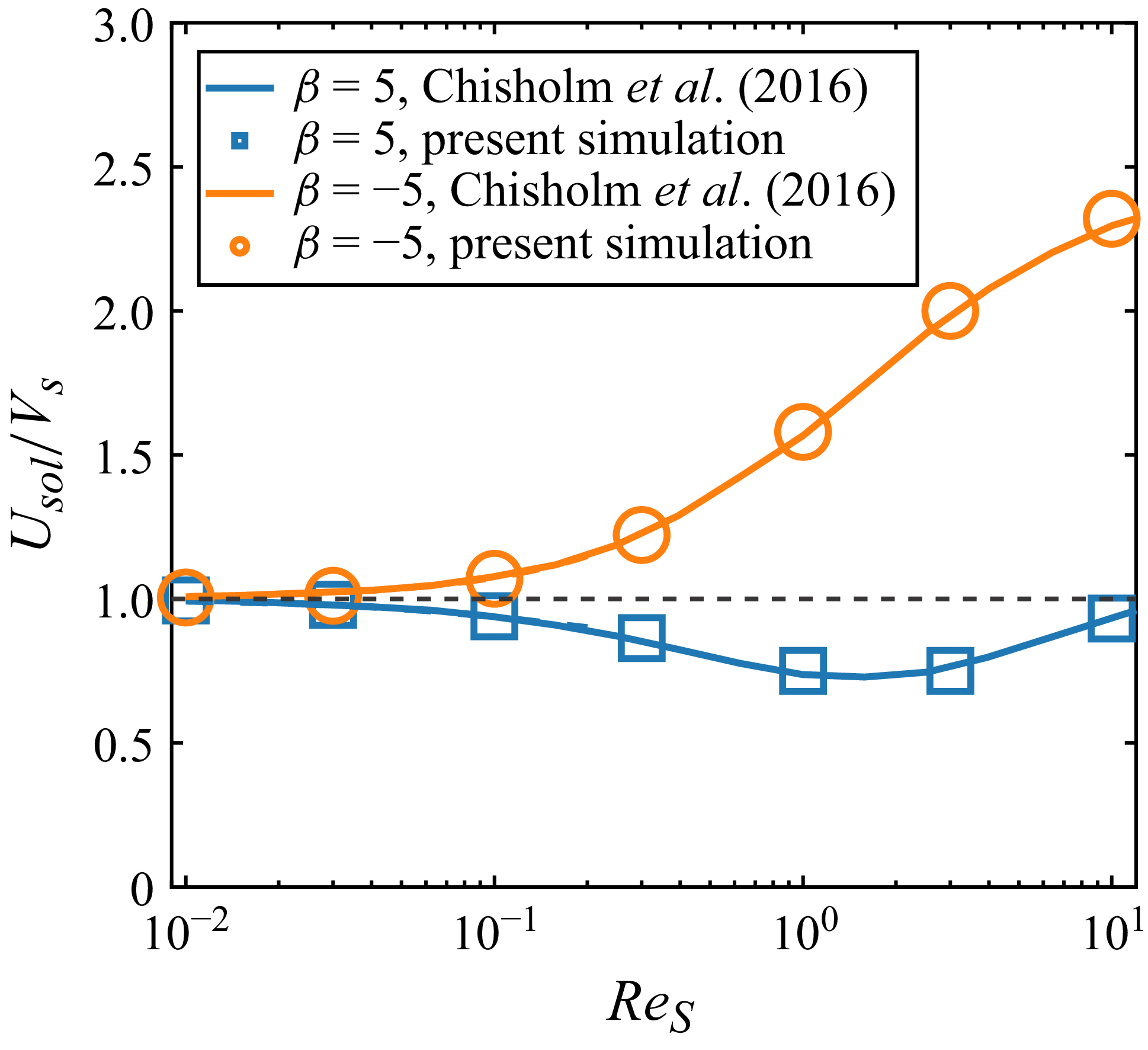
 Usol
 ReS
 Usol
 Vs
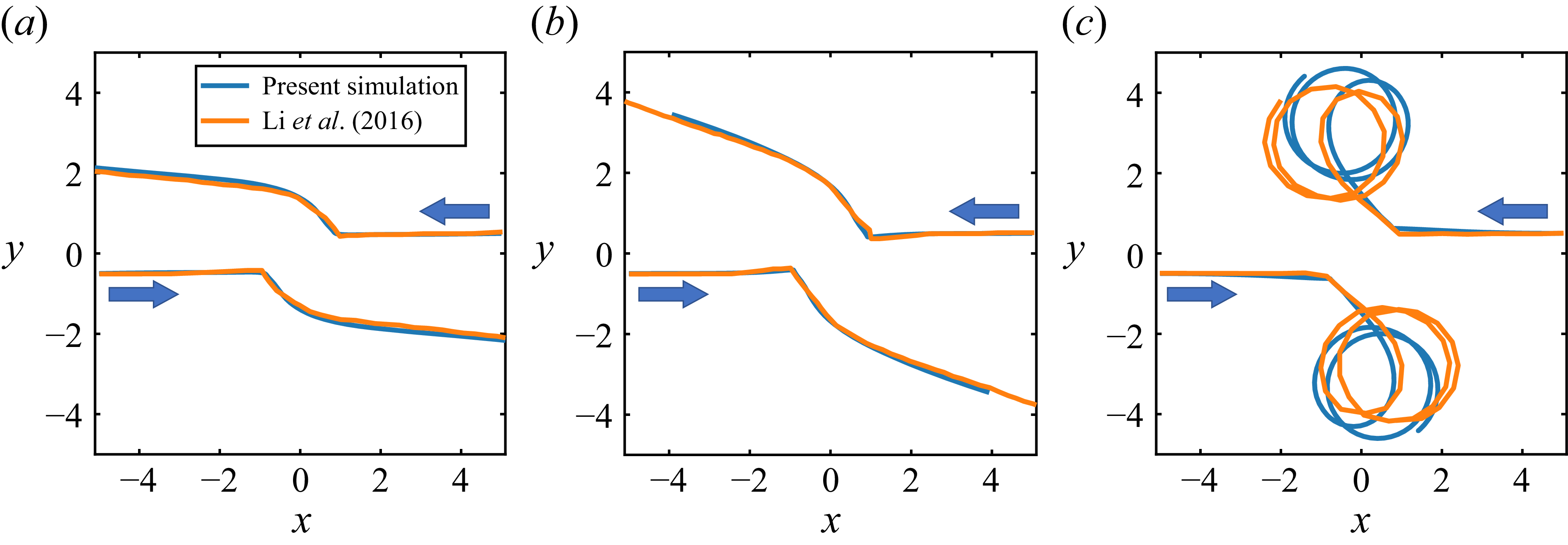
 β=5
 ReS=0.1
 ReS=1
 ReS=10


 ϕ=0.05
 τs=a/Vs
 ReS=0.01

 CU(t)
 β=5
 β=−5
 ϕ=0.05

 β
 ϕ=0.05
 ReS=0.01
 Dt,0

 Dt
 ϕ
 ReS
 β
 Dt/(aVs)=0.24ϕ−1
 β=5

 ϕ
 β=±5
 ReS=10
 ϕ

 β=5
 β=−5
 Ud=−Vg

 β=5
 β=−5
 Dt∥/Dt,0∥
 Dt⊥/Dt,0⊥
 Dt,0∥
 Dt,0⊥
 α=0

 β=5
 β=−5
 ReS=1
 α=0.5

 g(r⊥,xg)
 ϕ=0.025
 α=0
 α=1.0
 ReG=0.01
 ReG=1

 IU′(r⊥,xg)
 β=5
 ReS=1.0
 ϕ=0.025
 α=0.5
 α=0.75
 α=1.0

 β=5
 ReS=1.0
 ϕ=0.025
 x
 y
 α

 β=5
 ϕ=0.025
 ReS=10
 α=1
 ReG=10

 α=1
 β=5
 ReS=0.01
 β=−5
 ReS=0.01
 β=5
 ReS=1.0
 β=−5
 ReS=1.0

 C=Tmax/((4/3)πa3ρfVsVg)
 ReS
 ReG
 β=5
 β=−5
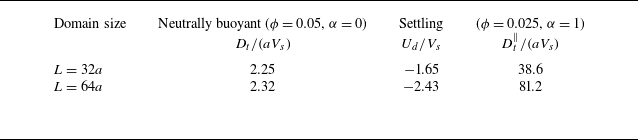
 L
 β=5
 ReS=1

 ϕ=0.05
 ϕ=0.025
 α=1
 ReS=1

 Open access

