The Association of South East Asian Nations (ASEAN) countries has fostered economic growth recently but in the process has encountered a number of serious problems regarding environmental destruction, such as the air and water pollution. In addition, due to rapid population growth and urbanization, there are emerging concerns about decline of the environment in those countries in the near future (Takemoto, Reference Takemoto, Yasunari and Yonemoto1999; Kato, Reference Kato1999; Yamaji and Komiyama, Reference Yamaji, Komiyama and Komiyama2011).
One of the surveys that tries to measure the attitudes of ASEAN citizens on environmental issues is the ASEAN Barometer survey conducted in 2009.Footnote 1 This survey consists of two modules of Health and Environment. Using the latter module (and demographic and nation-level variables), in particular, this paper aims to unfold how ASEAN citizens evaluate environmental problems and what underlies their evaluations.
Overview
Questions about environmental consciousness
What are ASEAN citizens thinking about the environmental problems of that region? To answer this query, the following three questions from the ASEAN Barometer will be used. The first question (Q39) is ‘To what extent do you worry about the following global environmental issues?’ From this question one can measure the extent of ASEAN citizens’ concerns about some global environmental problems. In this paper, it is called Worry about environment. The second question (Q32) is ‘Have you done any of the following environmental activities?’ From this question one can measure the extent of ASEAN citizens’ involvement in some public environmental activities. In this article, it is called Environmental activity in public. The third question (Q34) is ‘How often have you done any of the following actions during the last 12 months?’ From this question one can measure the level at which ASEAN citizens are prepared to commit themselves to environmental activities around them or the family. It is called Environmental activity in private. Out of the latter two questions, Environmental activity in public is the activities relating to the political and social arena, though Environmental activity in private is the activities citizens undertake personally and at home. But these two items are common in the sense of environmentally conscious related activities
There are some sub-questions under the above three questions, and this paper shows what percentage of the respondents gave positive answers on more than half of the sub-questions for each question. So if there are many respondents that gave more positive answers, it shows that there are people who are concerned about environmental problems or are involved in some environmental activities. The next section will analyze the answers to each item by the attributes of ASEAN citizens. The demographic attributes of ASEAN citizens consist of the following eight factors; ‘Gender’, ‘Age’, ‘Educational level’, ‘Marital status’, ‘Household income’, ‘Occupation’, ‘Residence (urban or rural)’, and ‘Religion’.
Worry about environment (Q39)
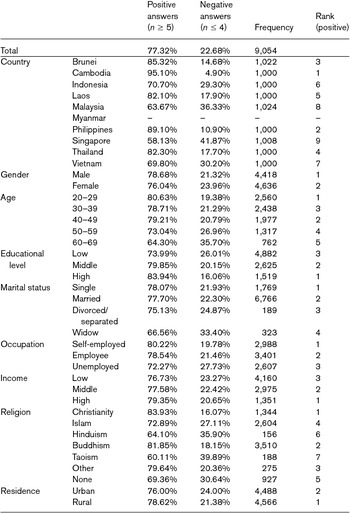
As already mentioned, the question for Worry about environment was ‘To what extent do you worry about the following global environmental issues?’Footnote 2 The ASEAN Barometer survey had eight sub-questions on ‘the global environmental issues’, i.e. depletion of the ozone layer, acid rain, climate change, deforestation, loss of biodiversity, marine pollution, nuclear waste disposal, and usage of chemicals and pesticides. Each indicator was answered using the following four-scale options: ‘very much’, ‘to a certain extent’, ‘not so much’, and ‘not at all’. The first two options are ‘positive answers’, and the other two ‘negative answers’. Four or more positive answers from a respondent equals one, zero otherwise.
Table 1 shows what percentages of the respondents gave four or more positive answers by ASEAN member countries and by individual attributes. As for the results by country, values for Cambodia and the Philippines (95.10% and 89.10%) appear remarkably higher than ones for any other country (that of ASEAN citizens is 77.32%). In contrast, the lowest ratio occurred for Singapore (58.13%). Also with regard to demographic attributes, those that showed the higher ratios were male (78.68%), in their twenties (80.63%), highly educated (83.94%), single (78.07%), employed (78.54%), had a high income (79.35%), Christian (83.93%), and a rural resident (78.62%).
Worry about environment (Q39) by county and individual attribute

Environmental activity in public (Q32)
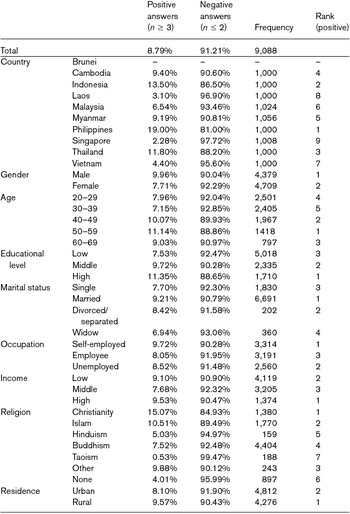
The question for Environmental activity in public was: ‘Have you done any of the following environmental activities? Please answer “Yes” or “No” for each.’Footnote 3 Q32 has five sub-questions. ASEAN citizens were asked whether or not they had ‘attended lectures or seminars about an environmental issue’, ‘taken part in volunteer activities for environment conservation’, ‘signed a petition about an environmental issue’, ‘given money to an environmental group’, and ‘taken part in a protest or demonstration about an environmental issue’. ‘Positive answer’ was given to the answer ‘Yes’, whereas ‘negative answer’ was for ‘No’. Three or more positive answers from a respondent equal one, zero otherwise.
The percentages of respondents that gave three or more positive answers are shown in Table 2. As a rule, these figures are very low. But there are some interesting traits. By country, the result for the Philippines (19.00%) marked high, as it did for the question Worry about environment. And the figure for Cambodia (9.40%) exceeded the ASEAN average (8.79%), though it seems not so high, compared to the results of Q39. On the contrary, though Indonesia (70.70%) scored less than the ASEAN average in Worry about environment, for this question it reached higher rates (13.50%). With regard to demographic attributes, those that showed the higher ratios were male (9.96%), in their fifties (11.14%), highly educated (11.35%), married (9.21%), self-employed (9.72%), had a high income (9.53%), Christian (15.07%), and a rural resident (9.57%). In other words, those who were more concerned about the environmental problems and also more involved in the environmental activities can be regarded as follows: they were male, highly educated, self-employed, had a high income, Christian, and were a rural resident.
Environmental activity in public (Q32) by county and individual attribute

Environmental activity in private (Q34)
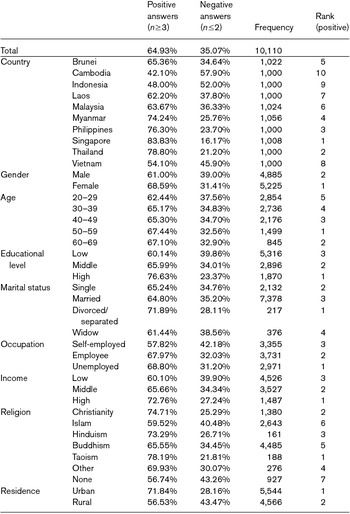
The question for Environmental activity in private was ‘How often have you done any of the following actions during the last 12 months?’ Q34 also has five sub-questions. Respondents were asked whether they had ‘reused or recycled something rather than throw it away’, ‘tried to reduce water consumption’, ‘tried to reduce the amount of energy for cooking, cooling and heating’, ‘used public transportation instead of using personal car’, and ‘bought organic or chemical-free vegetables’. ‘Please choose one answer from “Never”, “Seldom”, “Sometimes”, “Often”, and “Always”.’ In this paper, the first three options are considered as ‘positive answers’ and the final two as negative. Three or more positive answers from a respondent equal one, zero otherwise.
The results are shown in Table 3. The ASEAN-wide rates reached 64.93%. By country, the Philippines attained higher scores (76.30%) in this question again, but the country that marked the highest percentage was Singapore (83.83%), then Thailand came the second highest (78.80%). In contrast, Cambodia and Indonesia produced lower scores (42.10% and 48.00% respectively). By demographic attributes, the higher percentages consist of the following factors; female (68.59%), in their fifties (67.44%), highly educated (76.63%), divorced or separated (71.89%), unemployed (68.80%), had a high income (72.76%), Taoist (78.19%), and an urban resident (71.84%). Among these, the groups that had practiced the above activities most actively were the highly educated, had a high income, were divorced or separated, Taoist, and an urban resident. In addition, being a Christian also seems to impose some impact on immediate eco-activities.
Environmental activity in private (Q34) by county and individual attribute

Comparison of differences by country and demographic attributes
Looking at these percentages country by country, some interesting tendencies can be observed. The Philippines ranked very high in all three items, so it seems to reflect that Filipinos possess high environmental consciousness. Similarly, Thailand was another country that has surpassed the ratio of the whole of ASEAN for all items.Footnote 4 On the other hand, Malaysia and Vietnam have gained ratios below ASEAN. Cambodia marked quite high rates to the question, Worry about environment, and exceeded the rates overall of ASEAN for Environmental activity in public. The country, however, represented an extremely low percentage for Environmental activity in private. Singapore earned low marks for Worry about environment and Environmental activity in public, but showed high scores in Environmental activity in private.
By gender, male percentages were higher for Worry about environment and Environmental activity in public, while females had higher percentages for Environmental activity in private. By age, respondents in their forties had above the ASEAN-wide percentage for all items. For Worry about environment, people in their twenties were the best scoring group, while those who were in their sixties presented the lowest marks. In comparison, for Environmental activity in private the respondents in their twenties got the lowest rank and those in their sixties attained the second highest scores. Analyzed by education and income, a common tendency can be seen from the both attributes, i.e. people from high-education and high-income backgrounds had above the ASEAN-wide percentage, while people from low-education and low-income background had below the ASEAN-wide percentage. By marital status, when comparing merely single and married people, single people tended to worry about environmental problems and adopt personal environmentally friendly practices, while married people were more prone to participate in political environmental activities. By religion, from the results, Christians (both Catholics and non-Catholics) showed strong environmental consciousness, but Muslims (Sunnis and Shiites) did not have much interest in environmental problems. Buddhists (Theravadas and Mahayanas), which have a major presence in ASEAN countries, gained high marks for Worry about environment and Environmental activity in private, but produced only a low ratio for Environmental Activity in Public.
Identification of factors
Hypotheses and method
The previous section outlined the results from the three questions, which lead to a further question: what kinds of factors create the differences in the ASEAN citizens’ environmental consciousness? The ASEAN Barometer survey allows me to use the presence of the ‘positive answers’ of respondents as the dependent variables. The dependent variables in the paper are dichotomous variables as in the discussions so far. It is therefore appropriate to use logistic regression since all of these variables are binary variables.
The variables used in this paper as the independent variables are some demographic ones mentioned before, adding three other variables (‘Marital status’, ‘Occupation’ and ‘English skills’).
In addition, some questions can be used to clarify important problems about the relationship between formal institutions and citizens’ concerns about the environment. Perhaps citizens who cannot deal with environmental issues are more likely to expect international organizations and their own government to take the initiative (Economic Cooperation Division, MITI, 1997, 3). As a result, those who give their confidence to those institutions will be less concerned about environment. But others who do not give their confidence to those institutions will make more commitments to public environmental activity (Gurr, Reference Gurr1970; Kurita, Reference Kurita1993: 138–9).
The following three questions have also been employed: (1) Q51a (Government spending): ‘Please indicate whether you would like to see more or less government spending on the environment, by choosing one answer from “Spend much less”, “Spend less”, “Spend the same as now”, “Spend more”, and “Spend much more”. Please bear in mind that more spending may require a tax increase.’ (2) Q37 (Responsibility): ‘In order to protect the environment, it is necessary for government, business sectors and citizens to work together. Which one of the three actors do you perceive should play the most important role?’Footnote 5 (3) Q53a (Policy initiative): ‘Would you tell me whether you think that policies for the protection of environment should be decided by the ‘State and local governments’, by ‘National governments’, by ‘Regional organizations (such as ASEAN or APEC)’, or by ‘the United Nations’?’ I have created two sets of models: one that includes the above three questions and one that does not have them. Therefore, it means that there are six models for analysis in this paper. Since two questions (Government spending and Policy initiative) were not asked in Myanmar, the objects of the former model are nine countries (the latter, ten countries). Responsibility and policy initiative are nominal variables, so I made dummy variables and set the reference categories (the reference categories are ‘Government’ in Responsibility and ‘State and local governments’ in Policy initiative, respectively).
These models include some country-level variables as independent variables, which may affect the environmental consciousness of ASEAN citizens. In general, citizens living where there is a richer natural environment seem to have higher environmental consciousness. That is because their living environment may become too difficult for inhabitants unless they have a strong interest in nature and are motivated not to let their own environment deteriorate. In this paper, ‘Forest area (% of land area)’Footnote 6 is operationalized as degrees of natural environment. And as the economy advances, people become richer. People are supposed to fulfill any deficiency needs and have leeway to turn their interests toward public issues. As a result, they will come to have more concerns for the environment. In this paper, therefore, ‘Per Capita GDP’Footnote 7 will be used to address a country's economic level.
CO2 also has harmful effects on the environment, because it increases the greenhouse effects. Therefore if the population increases, the impact on the environment increases proportionately. Citizens who live in a region where large amounts of CO2 are emitted or where the population remains high will become sensitized to environmental problems (JICA Research Institute, 2003). In this paper ‘CO2 emission’Footnote 8 and ‘Population density’Footnote 9 are used to represent the above factors.
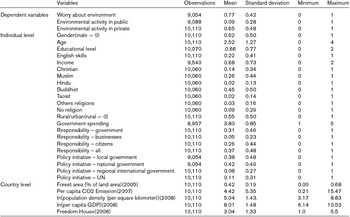
Additionally what type of political regime a country has also matters. People living in a democratic country may be more concerned about the environment, notably because they can have more chances to get information about it. Citizens under a democratic government may also be more actively involved with social protest to solve serious environmental problems, because people have the right to free expression in a democracy (Nomura, Reference Nomura2009). Conversely, citizens under a non-democratic government are more likely to be restricted in public activities, so they become more absorbed in private ecological life. The analysis thus includes the type of political regime (Linz and Stepan, Reference Linz and Stepan1996, 55–65). For this we use the Freedom House Score’.Footnote 10 The ‘Freedom House Score’ has two seven-scale indices, ‘Civil liberties’ and ‘Political rights’, and a country with high scores in is thought to be less liberal. The variables used have been recoded for the analysis in this paper to mean a country with a higher value is considered to be more positive. Basic statistics of all the variables are presented in Table 4. The effect of the differences in domestic respondents is taken into account as are those of the countries, so this examination has adopted a random effects model. Using that model, we can reckon with country-specific effects.
Basic statistics

What factors to determine worry about environment?
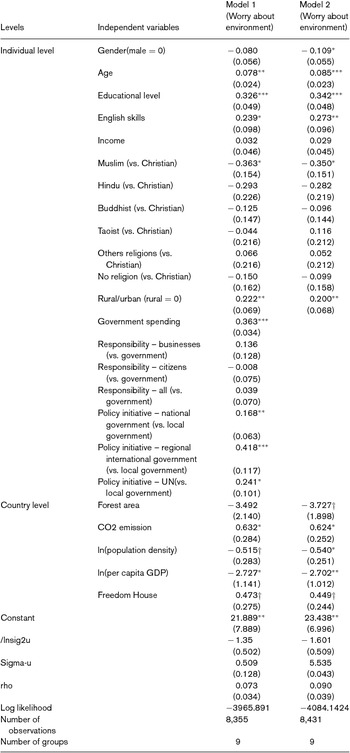
Firstly, this paper tries to examine Models 1 and 2, both of which set the ‘positive answer’ of Worry about environment as the dependent variable. Model 1 includes Government spending, Responsibility and Policy initiative, whereas Model 2 does not. The results are presented in Table 5. As for most demographic variables, similar results were found in both models. In sum ‘younger’ and the ‘highly educated’ were more prone than others to worry about the environmental problems. These results are more or less the same as the results of the descriptive statistics. The interesting difference between the previous result and the current ones is that urban residents are more concerned about environment than the rural ones. Since this quantitative analysis illustrates what kind of results can be expected, all other conditions being equal, it is interesting to know that this regression analysis came out opposite to the earlier results, having several controlled variables. In addition, those who have high-level English skills were more concerned about the environmental issues.
Worry about environment (Q39): logistic regression analysis

Standard errors in parentheses.
†p < 0.10 *p < 0.05 **p < 0.01 ***p < 0.001
Of the three questions that are used only in Model 1, Government spending, ‘National governments’, ‘Regional organizations’, and ‘the United Nations’ out of Policy initiative were positive and significant. Besides whose responsibility that may be, it is understood that people who expect international organizations and their own government to carry the burden to protect the environment are more environmentally conscious. This understanding makes us realize that ASEAN citizens consider environmental problems as ‘borderless’ that ‘international’ organizations should take action beyond states or states’ frameworks. For example, that argument is supported by the fact that in the past fire had occurred by the way of slash-and-burn to clear land for plantations in Indonesia, and the forest fire smoke had caused great damage to ASEAN countries (Kawashima and Sugiyama, Reference Kawashima and Sugiyama1999; Siegert and Hoffmann, Reference Siegert and Hoffmann2000).
As for country-level variables, it can be seen that ‘Population density’, ‘Per capita GDP’, and ‘CO2 emissions’ had significant effects on the three questions, but the former two had negative signs and the rest had positive ones. Generally speaking, people are apt to worry about their environment in countries that have less populated areas, are less developed economically, or emit almost no CO2.
What factors to determine environmental activity in public?
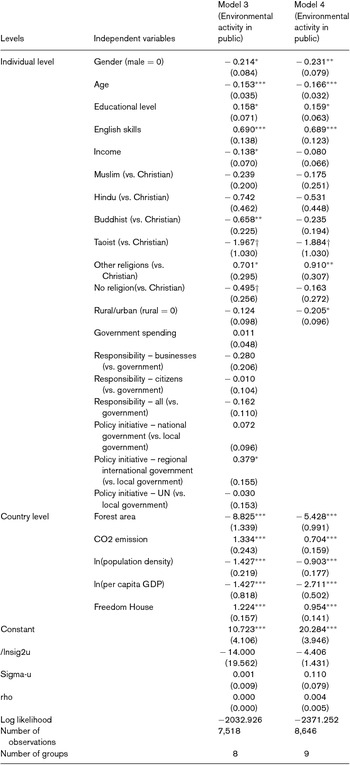
Secondly, I set out Model 3, which included Government spending, Responsibility, and Policy initiative, and Model 4, which excluded the three variables, employing Environmental activity in public as the dependent variables. Table 6 presents the logistic regression results. An overview of the result, generally speaking, reveals that ‘male’, ‘older’, ‘highly educated’, and ‘rural resident’ were more likely than others to take part in some kinds of environmental activities. High-income earners or Christians did not have much significance, but good speakers of English were highly significance.
Environmental activity in public (Q32): logistic regression analysis

Standard errors in parentheses.
†p < 0.10 *p < 0.05 **p < 0.01 ***p < 0.001
As for the three questions that are used in Model 3, only ‘Regional organizations’ of Policy initiative was significant but positive. It may be evidenced that there are people who suspect that the national government is not fulfilling the duty to protect the environment, judging from the fact that people who believe that regional organizations should take initiatives in environmental protection have more tendency to engage in some kind of environmental protection activities.
Concerning country-level variables, all of them, i.e. ‘CO2 Emission’, ‘Freedom House’, ‘Forest area (% of land area)’, ‘Per Capita GDP’, and ‘Population Density’ were statistically significant, and the first two correlated positively with the dependent variable, but the others did negatively. In short, those who have lived in such a country that has little forest, or produces more carbon dioxide, or has fewer people, or has lower per capita income, or is more democratic seem to become more involved in the political and environmental activities.
What factors to determine environmental activity in private?
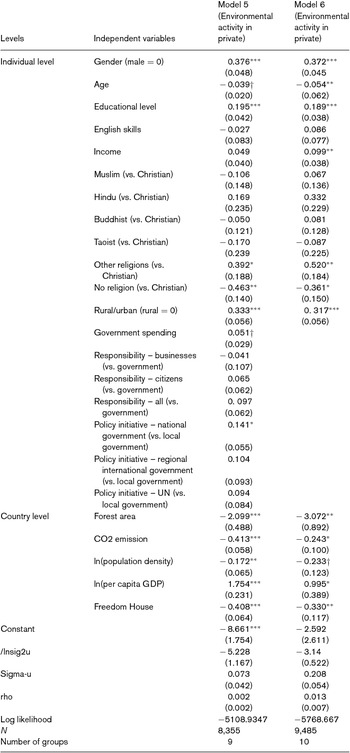
Lastly, this section considers the result from the two models (Models 5 and 6) that have used Environmental activity in private as the dependent variable. Of the two models, only in Model 5 Government spending, Responsibility and Policy initiative are included. Table 7 presents the results. ‘Female’, ‘older’ ‘highly-educated’ and ‘Urban resident’ were more likely than others to engage in some kinds of personal ecological activities undertaken at their homes or in their neighborhoods. These findings accorded with the previous preliminary result.
Environmental activity in private (Q34): logistic regression analysis

Standard errors in parentheses.
†p < 0.10 *p < 0.05 **p < 0.01 ***p < 0.001
Of the three questions used in Model5, only Government spending and ‘National government’ of Policy initiative were positive and statistically significant. Citizens who expected their central government to undertake promotion of environmental policy were inclined to carry out individual ecological activities. Of the country-level variables, ‘Forest area (% of land area)’ ‘CO2 emission’ and ‘Population density’ were negative and statistically significant. In other words, people in a country richly endowed by nature and less economic development seek to lead more eco-friendly lives. Adversely, ‘Per capita GDP’ was positive and statistically significant. It is an interesting result on the point that those who live in a wealthier state are more likely to get involved in private environmental activities. Additionally, the ‘Freedom House Score’ was negative and statistically significant here. This means that people in a democratic country are more reluctant to undertake personal environmental activities in their neighborhoods. This result is consistent with the previous hypothesis.
Conclusion
This paper briefly looked at the environmental consciousness levels of ASEAN citizens. So what can we find from these results?
First, by country, it is remarkable to find that the Filipinos have shown higher environmental consciousness.Footnote 11 According to a report by the Japan External Trade Organization (JETRO), one of the reasons for this finding is that in the Philippines the central government, NGOs, and business sectors have collaborated in order to develop policies and business strategies to raise the environmental awareness of the people. Especially, the central government has pursued a strong attitude toward this issue to provide the environmental legislation and has prepared the environmental infrastructure (JETRO, 2011a). The strong environmental consequences are represented by the fact that the Philippines has the highest percentage (54.60%) of people that chose ‘National governments’ to the question about Policy initiative.
And another question arises about why Cambodians had much concern regarding public problems of environment. Few studies about Cambodia in the past have pointed out that civic environmental awareness has been rooted in Cambodians (JETRO, 2011b, Honda and Kamaya, Reference Honda and Kamaya2010). So this finding from the survey sounds intriguing. According to JETRO (2011b), central government and NGOs in Cambodia have played important roles in offering opportunities for environmental education. Their efforts might become to fruition in 2009, in which ASEAN Barometer survey conducted.
Second, it is worth mentioning that people in a less developed country were more likely to worry about environmental deterioration and show commitment to the environmental movement. At the same time they were more reticent about their immediate ecological activities. Adversely, people in a country that achieved a certain level of economic growth may appear to be more involved in their surrounding activities. Modernization has raised civic environmental awareness, but it might keep citizens unconcerned about the national and international environmental issues. In sum, it seems that there exists a paradox of modernization about environmental problems.
Last, it was found that those who thought that the central government needed to spend more on environmental problems considered the central government should own more responsibility to do something about environmental deterioration. And those who expect regional international organizations to take more measures were more inclined to engage in environmental activities. This indicates that despite the original responsibility of the national government, the more commitments regional international organizations make to protect the environment, the more it may back up citizens’ activities. In the end, it appears that a regional international organization such as ASEAN is expected to deliver an effective response to the serious environmental issues.
About the author
Shinya Sasaoka (Ph.D., Meiji University, 2006) is an Associate Professor of Political Science at Department of International Politics, Faculty of Law, Hiroshima Shudo University, Japan. He taught as part-time lecturer at Meiji University (2006–08, 2009–11) and Aoyama Gakuin University (2008–09). He also worked as research staff at Meiji University (2006–09), University of Niigata Prefecture (2009–10), and Keio University (2010–11). His primary teaching and research interests include comparative politics, Russian politics, and Japanese politics. His main paper is ‘Democracy and Quality of Life in Asian Societies’, with Katsunori Seki, published in Japanese Journal of Political Science, 12(3) (2011): 343–57.